
CERN Just Put ESFD in a Testable Place: Higgs Decay, Off-Shell Z Bosons, and the Field Beneath the Particle
CERN’s ATLAS and CMS experiments have found strong evidence for entanglement in the spin structure of Higgs → ZZ* → 4ℓ decays. The result is real, but the off-shell Z* changes the way the process should be understood: the detectors measure four leptons and reconstruct the intermediate quantum-field state rather than directly watching two ordinary Z particles become entangled. This article converts the 6-3 Electromagnetic Spin-Field Dynamics framework into a Pattern Nexus analysis, separates established collider physics from ESFD hypotheses, corrects the Bell-locality overclaim, and defines the measurement ESFD now needs to calculate: the q²-dependent ZZ* spin-density matrix.
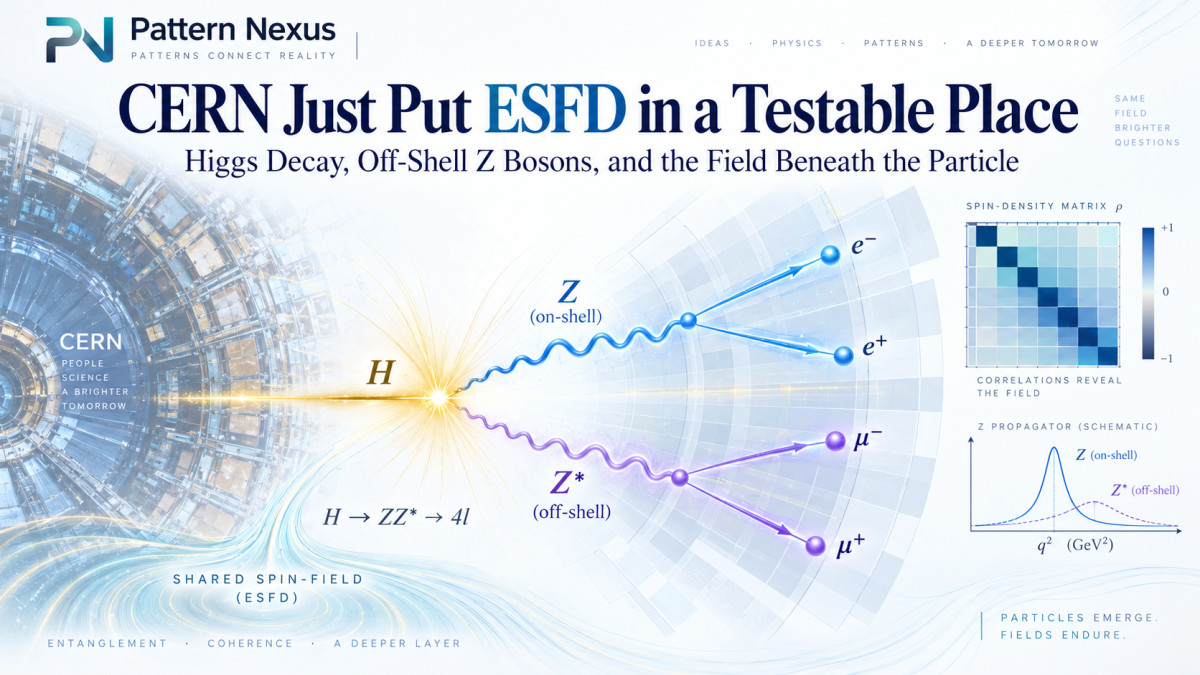
- The CERN result is real. ATLAS and CMS have found strong evidence for quantum entanglement in the spin structure associated with Higgs decays through the H -> Z Z* -> 4 lepton channel.[1][2]
- The detectors do not watch two long-lived Z bosons fly apart. They measure four final leptons and reconstruct the intermediate polarization and spin-density structure from their energies, momenta, invariant masses and angles.[1][3]
- The asterisk matters. A Higgs has a mass near 125 GeV. Two ordinary on-shell Z bosons would require about 182 GeV. One leg is therefore a lower-mass off-shell Z contribution, written Z*.
- No mass is being created from nowhere. Total energy and momentum remain conserved. The off-shell leg simply does not sit on the normal Z mass shell.
- This lands directly inside a much larger private project I have been working on for years. ESFD, or Electromagnetic Spin-Field Dynamics, is my attempt to understand whether spin, electromagnetic structure, field coherence, rotation, saturation and gravity are different expressions of a deeper dynamical system.
- The CERN result does not prove ESFD. Standard quantum field theory predicts the observed Higgs-to-ZZ* correlations. What makes the result important to ESFD is that it gives the framework a new measurable high-energy system in which spin coherence survives through an intermediate state that is not simply two completed on-shell particles.
- That connects to work I had already done before this announcement. My ESFD papers had already explored shared spin-field coherence, quantum behavior emerging from coupled field dynamics, pulsar-magnetar boundaries, neutron-star saturation, strong-field limits and collapse thresholds.
- The next step is not philosophical. ESFD now has to calculate whether it predicts a measurable change in the reconstructed Z/Z* spin-density matrix as the off-shell virtuality changes.
I have been working on ESFD privately for roughly five years. I have never published the full framework. I have written multiple working papers, rebuilt parts of it, thrown parts away, changed definitions, expanded the compact-object side, pushed the quantum side farther, and repeatedly tried to find places where the theory would fail against something measurable.
That matters here because I do not want to take one old draft, pull one paragraph out of it and pretend that paragraph is the theory. It is not. ESFD is a much larger framework built around one recurring idea: spin, electromagnetic structure, field coherence, rotation and saturation may be connected at a deeper level than the way we normally divide physics into separate boxes.
Over time, I found several places where that framework appeared to land near real physical boundaries: the separation between ordinary pulsars and magnetars, the lack of ultra-high-field millisecond magnetars, rapid magnetar spin-down, strong-field saturation, neutron-star stability limits, collapse behavior and quantum-coherence questions. Those are not all equally established and they are not all unique predictions. But they are the reason I kept working on the model.
Then CERN announced strong evidence for entanglement in Higgs decay through Z and Z* states.
That immediately hit one of the stranger parts of the framework.
The part I care about is not simply “CERN found entanglement.” It is that the measurable quantum coherence belongs to an H -> Z Z* -> 4 lepton process in which one Z-like leg is off-shell. That forces us to be much more careful about what we mean by “particle,” “intermediate state,” and “the thing that is actually carrying the correlation.”
CERN measured
Four leptons and the angular/kinematic information needed to reconstruct the Z/Z* polarization structure.
ESFD already contained
A field-first spin/coherence model, saturation thresholds, compact-object boundary work and a shared-field approach to entanglement.
The new opportunity
Use the continuously changing off-shell virtuality q^2 as a new axis on which ESFD and the Standard Model can be compared.
01 · WHAT CERN FOUND
CERN Found Strong Evidence for Entanglement in Higgs Decay
On September 17, 2026, CERN announced that the ATLAS and CMS collaborations had found strong evidence for quantum entanglement between Z-boson spin degrees of freedom produced in Higgs-boson decays.[1]
The ATLAS result is already peer reviewed. In the H -> Z Z* -> 4 lepton channel, ATLAS measured angular observables sensitive to the joint spin-density matrix and reported results consistent with the Standard Model. A complementary likelihood analysis disfavors the relevant separable-state hypothesis at 4.7 standard deviations relative to the entangled Standard Model hypothesis.[2]
CMS approached the problem through a broader spin-correlation analysis of Higgs decays to four leptons. CMS reconstructs polarization information, tests interference among identical-lepton amplitudes and measures parameters that describe how longitudinal and transverse Z polarization amplitudes remain coherent. Under its stated assumptions, CMS establishes an entangled two-qutrit state and excludes fully longitudinal and fully transverse polarization models at more than 6 standard deviations.[4]
Those two significance statements are not the same statistical test. The ATLAS 4.7 sigma result is the cleaner number to quote for its entangled-versus-separable hypothesis test. The CMS greater-than-6-sigma statement refers to excluding the extreme polarization models used in its reconstruction. I am separating those because this result is already interesting enough without blending different tests into one headline.
The important part is that both collaborations are extracting quantum information from one of the cleanest Higgs decay channels we have.
H -> Z Z* -> l+ l- l+ l-
The Higgs starts with spin zero. A massive spin-1 Z has three polarization states. So this is not the usual two-spin textbook problem. Each Z-like subsystem carries three possible spin projections, which is why the collider quantum-information language describes this as a pair of qutrit-like systems.
02 · THE EVIDENCE CHAIN
What CERN Measures Directly and What the Physics Reconstructs
This is where the wording matters.
CERN is not taking a photograph of a Higgs, then a second photograph of two completed Z bosons, then a third photograph of those two Z bosons becoming entangled. Z bosons decay far too quickly for anything like that. What ATLAS and CMS actually record are the stable-enough final products that reach the detector: electrons and muons, their energies, their momenta and their directions.
From those measurements, physicists reconstruct the four-lepton invariant mass, the two dilepton masses and the set of decay angles that retain information about the polarization structure of the intermediate electroweak state.[3][4]
That does not make the intermediate physics imaginary. It means the causal story is inferred through a tested quantum-field framework rather than watched as a frame-by-frame classical movie.
There are therefore three layers that should not be collapsed into one sentence:
- Detector data: four final leptons and their measured kinematics.
- Quantum-field reconstruction: the H -> Z Z* amplitude, polarization structure, interference and spin-density matrix that explain those distributions.
- Ordinary-language shorthand: “the Higgs decayed into two entangled Z bosons.”
The shorthand is useful. The first two layers are where the actual physics lives.
03 · THE ASTERISK
The Off-Shell Z* Is the Part That Changed the Entire Way I Read This
The Higgs mass is about 125 GeV. The Z-boson pole mass is about 91 GeV. If the Higgs were simply producing two ordinary on-shell Z bosons, the minimum rest-mass budget would be roughly:
2 * m_Z ~= 2 * 91 GeV ~= 182 GeV
But:
m_H ~= 125 GeV
So the basic conservation problem is obvious:
182 GeV > 125 GeV
The Higgs does not somehow create the missing mass. One of the two Z-like legs is lower in invariant mass and is therefore written Z*. ATLAS explicitly describes this as one lower-mass Z state in the H -> Z Z* -> 4 lepton process.[3]
For a free particle, the relativistic mass-shell condition is:
E^2 - p^2 c^2 = m^2 c^4
In natural units, c = 1:
q^2 = m^2
For the off-shell Z contribution:
q^2 != m_Z^2
The Z-field propagator is resonantly enhanced when q^2 lies near the Z pole. Schematic form:
1 / (q^2 - m_Z^2 + i * m_Z * Gamma_Z)
Near the pole, the language “a Z boson was produced” is extremely good. Away from the pole, the Z field still participates in the amplitude even though that leg is not a freely propagating 91 GeV Z boson.
This was the part that bothered me enough to keep digging. The second leg is measurably different. Its dilepton invariant mass is different. Yet the complete four-lepton event still contains coherent spin information that can be reconstructed statistically.
That does not violate conservation. It does something more interesting: it exposes the limits of treating every line in a particle diagram like a little physical object moving through a classical sequence.
04 · FIELD BEFORE CARTOON
The Intermediate Field Process Is More Fundamental Than the Little-Particle Movie
Classically, if I write:
A -> B -> C
my brain wants B to be a fully completed thing that existed between A and C. Freeze the movie at the right instant and I should be able to point at B.
Quantum field theory is not always organized that way.
The observable probability comes from a coherent sum of amplitudes:
A_total = A_1 + A_2 + A_3 + ...
P is proportional to |A_total|^2
When those amplitudes are squared, interference terms appear. Those interference terms change measurable distributions. That means multiple intermediate contributions are part of one coherent transition amplitude rather than necessarily being a set of classical histories from which one secretly happened.
This is why the safer description of the CERN result is:
An initial Higgs state evolves through the electroweak field into a correlated four-lepton final state, with one Z propagator near resonance and the other off-shell.
That statement is still ordinary quantum field theory. I am not claiming ESFD invented field theory.
What caught my attention is that ESFD was already built around a similar hierarchy: the underlying field configuration is primary; the stable particle-like manifestations are one way that configuration resolves into measurable states.
That is where the CERN result becomes relevant to my private work.
05 · WHAT ESFD IS
ESFD Is a Larger Framework Than Any One Draft
Electromagnetic Spin-Field Dynamics started as my attempt to answer a question I kept running into across completely different areas of physics: why do spin, rotation, electromagnetic fields, energy density and instability keep appearing together near the places where systems change regime?
Instead of treating those relationships as unrelated, ESFD asks whether they are different expressions of a deeper spin-field dynamical system.
The core object in the formal versions of the framework is a spin density or spin-polarization field coupled to the electromagnetic field. One representation I have used is the antisymmetric Dirac spin tensor:
S_mu_nu(x) = (1/2) * psi_bar(x) * sigma_mu_nu * psi(x)
with:
sigma_mu_nu = (i/2) * [gamma_mu, gamma_nu]
The electromagnetic field remains described by F_mu_nu. The ESFD hypothesis is that the spin structure is not merely a bookkeeping label attached to particles. Under sufficiently coherent or extreme conditions, the coupled spin-field configuration can contribute dynamically to the behavior of the system.
That basic idea was then pushed in several directions: gravity and inertia as emergent field behavior; saturation thresholds; compact-object limits; vacuum polarization; neutron-star and magnetar transitions; collapse; quantum coherence; and later the observer/field layer.
Some of those directions are much stronger than others. The compact-object and threshold work has always been the part I could compare most directly against real data. The cosmology and consciousness extensions are much more speculative. I am not collapsing all of those into one level of confidence.
I have also never released the full body of this work publicly. The documents exist as working papers and internal research versions because I have been treating ESFD as a project to keep testing, not as a finished doctrine.
06 · THE FULL FRAMEWORK
The Pieces of ESFD That Matter Here
The broader framework has several connected layers.
Spin and electromagnetic field coupling
At the base is the idea that intrinsic spin and electromagnetic structure should be treated as a coupled dynamical system. Earlier formal versions write a schematic interaction between the spin tensor and electromagnetic field tensor:
L_interaction ~ kappa * S_mu_nu * F^mu_nu
Later versions expanded this into a larger action containing gravity, Dirac matter, electromagnetism, a spin-field coupling and a saturation potential. I do not need every term in that action to make the CERN connection. The important part is the same across the versions: spin coherence is treated as something physically structured in the field, not merely a label on isolated particles.
Gravity and inertia as emergent behavior
One branch of ESFD explores whether gravitational and inertial behavior can emerge from the stress-energy and back-reaction of coupled spin and electromagnetic fields. In that version of the framework, the same field system that resists acceleration could also contribute to the effective metric or curvature associated with mass-energy.
This is one of the boldest claims in the framework and it still requires a much stronger derivation than the compact-object correlations. But it is important to the architecture of ESFD because the theory is trying to reduce the number of separate “things” nature is doing.
Quantum behavior as field-regime behavior
Another branch asks whether discrete spin states, zero-point behavior, coherence and entanglement are manifestations of how spin-field systems stabilize and interact with the vacuum rather than a completely separate ontological layer.
Saturation
The repeating feature across the astrophysical side is saturation. Systems can only increase field strength, spin alignment, rotational support or coherent feedback so far before energy has to be redirected into radiation, pairs, structural change, mass shedding, reconnection, phase change or collapse.
That saturation idea is the part that led me into the pulsar, magnetar and neutron-star work.
07 · SATURATION
ESFD Kept Producing Boundaries, So I Started Testing the Boundaries
Different ESFD drafts have used different forms of a dimensionless control parameter, which is one reason I do not want to reduce the full framework to one equation from one version.
The broader idea is consistent: define a dimensionless measure that tells us how close a spin-field system is to a critical regime.
In the compact-object proof paper, the simplest strong-field version is written in terms of field strength relative to a critical scale:
chi ~ field strength / critical field strength
For electron-scale magnetic behavior, the familiar strong-field QED scale is near:
B_crit ~= 4.4 x 10^13 gauss
Other ESFD versions introduced a bulk spin/rotation form using magnetic field B, angular frequency Omega and a fitted scale Lambda:
chi = (B * Omega) / Lambda
I do not treat those two formulas as interchangeable. They belong to different stages of the project and different ways of encoding the same physical instinct: there should be a dimensionless measure of how close a system is to nonlinear spin-field saturation.
That distinction matters because the useful part of ESFD is not the symbol chi. The useful part is the search for real regime boundaries.
| Regime | Physical idea | Examples explored in ESFD |
|---|---|---|
| Weak | Ordinary perturbative behavior dominates. | Terrestrial EM, weak-field gravity, ordinary pulsars. |
| Near threshold | Nonlinear feedback, enhanced dissipation or instability appears. | High-B pulsars, magnetars, strong-field vacuum effects. |
| Beyond stable support | The system must shed energy, change phase, restructure or collapse. | Magnetar flare/reconnection states, mass shedding, neutron-star collapse. |
The reason I kept the framework alive is that this language kept lining up, at least qualitatively and sometimes surprisingly closely, with places where nature already changes behavior.
08 · PULSARS AND MAGNETARS
The Compact-Object Work Was Where ESFD Became More Than a Philosophy Exercise
Neutron stars are almost designed to test a spin-field theory. They combine enormous magnetic fields, rapid rotation, dense matter, quantized constituents, relativistic gravity and violent transitions in one object.
Ordinary pulsars can rotate extremely quickly with lower magnetic fields. Magnetars generally occupy a different part of the period-field landscape: much stronger inferred magnetic fields and much slower rotation. The exact populations overlap, and high-B pulsars complicate any clean binary classification, but the broad structure is real.
My ESFD work focused on the fact that nature does not populate this parameter space arbitrarily.
The high-field / high-spin forbidden region
If a neutron star carries magnetar-scale field strength while also rotating at the shortest millisecond-pulsar periods, the electromagnetic spin-down power and field stresses become enormous. In the ESFD picture, that combination drives the system too far into the nonlinear regime to remain there for long.
So the framework expected a practical absence of stable objects occupying the extreme upper-right combination of both field strength and spin frequency.
That is broadly what the observed neutron-star population looks like.
Why magnetars are slower
The framework also interprets magnetar-scale systems as having crossed into a regime where strong magnetic stresses, particle outflows, reconnection and enhanced torque rapidly remove rotational energy. In other words, the field and rotation are not independent knobs. Push the magnetic side hard enough and the system pays for it through spin-down and dissipation.
Why fields do not simply increase forever
At sufficiently strong fields, the vacuum itself becomes nonlinear. Pair processes, photon propagation effects and strong-field QED become increasingly important. In ESFD language, additional energy increasingly goes into new channels rather than indefinitely increasing one coherent field variable.
I did not invent strong-field QED. The ESFD question is whether the same saturation logic that already exists in known physics can be organized into a broader spin-field framework that continues working across scales.
That is the difference.
09 · NEUTRON-STAR LIMITS
The Same Framework Was Extended Into Support, Instability and Collapse
A neutron star is a competition between inward gravity and the mechanisms that can still support matter: degeneracy pressure, nuclear interactions, rotation and field structure.
The ESFD collapse work reframed that competition as a support-versus-saturation problem. As density and compactness rise, the internal degrees of freedom available to resist collapse are progressively exhausted. Rotation can temporarily raise the maximum supported mass, which is already known from ordinary relativistic stellar structure. But rotation also has a mass-shedding limit. Magnetic support also cannot grow without limit.
In the working framework, collapse occurs when the system can no longer find another stable spin/field configuration capable of carrying the required support.
One rough ESFD-style criterion was written schematically as:
chi_collapse ~ U_gravity / (U_spin-field + U_rotation + U_degeneracy)
with instability expected as that ratio approaches or exceeds unity.
That is not a replacement for solving the Tolman-Oppenheimer-Volkoff equations with a real equation of state. It is the conceptual map that motivated the compact-object part of the theory.
The important match was that the natural transition scale in the framework landed in the same physical region where real neutron stars stop being stable and black-hole collapse becomes the expected outcome. The proof paper also explored how rotation shifts that boundary and how post-merger hypermassive neutron stars could move across it as they lose angular momentum.
Again, none of that proves ESFD uniquely. General relativity and nuclear physics already describe these limits. What kept my attention was that the same saturation logic I was using for field/rotation behavior kept reappearing at the known astrophysical boundaries.
10 · THE QUANTUM SIDE
ESFD Was Never Only About Neutron Stars
The compact-object side is easier to visualize because the fields are enormous and the stars give us observable population boundaries. But the deeper reason I kept working on ESFD was quantum behavior.
The framework asks whether some of the rules we describe abstractly in quantum mechanics can be understood as stable configurations, allowed modes and coherent transitions of a deeper spin-field system.
That includes several ideas I have explored in different versions:
- discrete spin states as stable field configurations rather than arbitrary classical orientations;
- vacuum fluctuations as an active part of the physical background rather than empty space;
- coherence as a property of an extended field state;
- entanglement as belonging to the joint field configuration rather than being created by a message sent between two independent particles after measurement;
- the possibility that what we call a “particle” is one stable manifestation of a deeper field configuration rather than the only ontological layer.
This is the piece that matters for CERN.
One of the later spin-field drafts explicitly described entanglement through a shared spin-field envelope. The specific mechanism in that draft still needs work, especially anywhere it makes strong claims about Bell locality. I am not importing every claim from that version into the current framework.
But the core idea survived:
The correlation belongs to the joint physical state before it belongs to two separately completed particle objects.
That is a much cleaner way to state the ESFD connection to this CERN result.
11 · BEFORE THE CERN ANNOUNCEMENT
What Was Already in the Framework Before I Saw This Result
I want to be very specific here because there is a difference between a prior prediction and a story created after the data arrive.
I did not write five years ago that CERN would measure Higgs-to-ZZ* entanglement in September 2026. I did not predict the 4.7 sigma number. I did not predict the exact ATLAS spin-density coefficients. I am not going to pretend I did.
What I had already built into ESFD was broader:
- Field-first structure: the physically important object can be the coherent field configuration rather than only the final particle labels.
- Spin as a primary organizing variable: spin was not treated as a decorative quantum number; it sat near the center of the model.
- Shared coherence: entangled systems were modeled as components of one joint spin-field state.
- Regime dependence: particle-like and classical behavior were expected to be approximations that work better in some regimes than others.
- Extreme systems as tests: I repeatedly looked for conditions where the simple low-energy picture should break and a deeper field description should become more visible.
That is why this CERN result is relevant.
It is not because CERN used the acronym ESFD. It did not.
It is because the experiment has now given us a high-energy quantum system where the thing carrying measurable spin coherence is reconstructed through a field process containing an off-shell leg. That is unusually close to the kind of physical situation I wanted ESFD to be forced to explain.
12 · CERN x ESFD
The Overlap Is Not “Fields Exist.” The Overlap Is Where the Coherence Lives.
| CERN / Standard Model result | ESFD connection | What it means |
|---|---|---|
| Higgs decay produces a coherent Z/Z* spin structure. | ESFD treats spin coherence as a property of a joint field configuration. | Conceptual overlap, not proof. |
| One Z leg is off-shell. | ESFD does not require every intermediate field contribution to be understood as a completed free particle. | This is already compatible with standard QFT; ESFD must add a quantitative difference. |
| The detector measures four leptons. | The final particles can encode information about the prior coherent field state. | This is exactly how collider state reconstruction works. |
| Spin-density information is measurable. | ESFD can be forced to calculate the same observables. | This creates a real test. |
| Current results agree with the Standard Model. | Any ESFD correction in this channel must be small, absent or currently unresolved. | The result constrains ESFD before it confirms anything. |
The important variable is the off-shell virtuality:
q^2 = m_ll,low^2
where m_ll,low is the invariant mass of the lower-mass lepton pair associated with the Z* side.
That value changes across the Higgs event sample.
So now we have a continuous axis that tells us how far the second Z propagator is from the normal mass pole. If ESFD has additional spin-field dynamics that standard electroweak QFT does not, the place to look is not simply “is the system entangled?” The Standard Model already says yes.
The place to look is whether the structure of that entanglement changes with q^2 in a measurably different way.
That is a much better question.
13 · THE NEW TEST
ESFD Now Has to Produce a Curve, Not Another Explanation
The Standard Model gives us a predicted Z/Z* polarization density matrix as a function of the event kinematics. Symbolically:
rho_SM(q^2)
ESFD needs an electroweak-complete version of the spin-field dynamics capable of predicting the same object:
rho_ESFD(q^2; model parameters)
Then the relevant quantity is simply:
Delta rho(q^2) = rho_ESFD(q^2) - rho_SM(q^2)
or, for one of the measured angular coefficients:
Delta C_i(q^2) = C_i_ESFD(q^2) - C_i_SM(q^2)
This is where the theory either becomes useful or becomes constrained.
- Take H -> Z Z* -> 4 lepton events.
- Bin them by the lower dilepton invariant mass.
- Reconstruct the same angular and density-matrix observables ATLAS and CMS already use.
- Calculate the Standard Model curve.
- Calculate the ESFD correction independently.
- Fit one coherent ESFD parameter set across all bins and related electroweak channels.
- See whether the data prefer, reject or cannot distinguish the correction.
The High-Luminosity LHC is important because more Higgs-to-four-lepton events mean much better quantum-state reconstruction.[1]
If the ESFD correction is zero throughout this regime, that tells us something about where the theory can and cannot matter.
If the model predicts a nonzero effect and the data do not show it, that part of the framework is wrong.
If the model predicts a shape before the precision exists to resolve it, and the same shape later appears independently, then we have moved from an interesting framework into genuinely new physics.
That is the standard I want.
14 · WHAT THIS DOES NOT PROVE
The CERN Result Is Important Without Making It Say More Than It Says
CERN did not prove ESFD.
CERN did not prove that virtual or off-shell particles are secretly ordinary particles with changing permanent masses.
CERN did not show energy being created from nowhere.
CERN did not perform a conventional loophole-free Bell experiment with two Z bosons and freely chosen spacelike-separated analyzer settings.
CERN did not show information traveling faster than light.
What CERN did show is strong evidence that the joint spin structure associated with Higgs decay through Z/Z* states is entangled, and it reconstructed that structure from measurable final-state leptons.[1][2][4]
That is enough.
The reason it matters to ESFD is not because the experiment proves my ontology. It matters because the experiment exposes exactly the kind of boundary between “particle language” and “field-level coherence” that ESFD has been trying to model.
Now I have to make the model earn the connection mathematically.
15 · WHERE ESFD GOES NEXT
The CERN Result Changes the Priority List
Before this, the cleanest ESFD tests were mostly astrophysical: neutron-star population boundaries, magnetar polarization, merger remnants, compactness thresholds and strong-field signatures.
Those are still important, but astrophysics always carries messy systematics. We do not control the star. We do not know every detail of the equation of state. We infer magnetic fields. We infer ages. We infer geometry.
The Higgs channel is different.
The Standard Model baseline is exceptionally developed. The detector response is modeled in detail. The same final state can be reconstructed repeatedly. The virtuality changes across events. The spin-density observables already exist.
| ESFD research line | What I would test | Why it matters |
|---|---|---|
| Higgs Z/Z* tomography | q^2-dependent Delta rho or Delta C_i | Cleanest new direct test of the quantum spin-field side. |
| Pulsar/magnetar population | Full catalog test of field/rotation threshold variables | Tests whether the compact-object matches survive outside selected examples. |
| Magnetar polarization | Any residual beyond established QED and magnetospheric models | Strong-field spin/EM regime. |
| Neutron-star merger remnants | Collapse timing versus spin, compactness and field state | Tests support-versus-saturation logic. |
| Precision spin-gravity tests | Spin-polarized versus unpolarized gravitational response | Directly attacks the emergent-gravity branch of ESFD. |
The Higgs result does not replace the rest of ESFD. It gives the quantum side a cleaner target than it had before.
And that may be the most useful thing CERN has handed me here.
16 · PATTERN NEXUS CONCLUSION
The Result Did Not Prove My Theory. It Gave the Theory Somewhere New to Fail.
I have kept ESFD mostly private because I have never been interested in publishing a giant “theory of everything” document just to say I have one.
The interesting part has always been the matches.
I would build a relationship from the framework, then go look at nature. Pulsars and magnetars did not occupy the field/rotation space randomly. Neutron stars had support limits. Rotation shifted those limits but did not remove them. Extreme magnetic fields opened new dissipation channels. Strong-field systems hit boundaries. The same saturation logic kept showing up.
Some of those relationships may ultimately turn out to be ordinary known physics expressed in a different language. Some may disappear when the model is tested on a much larger dataset. That is fine. The entire point of keeping the framework alive is to find out which parts survive.
The CERN result gives me a different kind of test.
A 125 GeV Higgs cannot simply turn into two ordinary 91 GeV Z bosons. One leg is off-shell. The detectors do not directly observe that intermediate Z* as a free particle. They observe four leptons. Yet those final particles carry enough information about the coherent intermediate spin structure for ATLAS and CMS to reconstruct entanglement.
That is exactly the kind of situation where the distinction between a particle description and a deeper field description stops being philosophical and becomes measurable.
ESFD had already put spin coherence and shared field structure near the center of the quantum side of the framework. It had already treated the joint field state as more fundamental than the idea of two totally independent little objects somehow communicating afterward.
So yes, this result correlates with something I had already been working on.
But the useful question is not whether I can tell a story that makes it fit.
The useful question is whether I can calculate something from ESFD that the Standard Model does not already give us.
Now there is an obvious place to try.
Measure the Z/Z* spin-density structure as a function of the off-shell virtuality q^2. Calculate the Standard Model curve. Calculate the ESFD curve. Then let the data decide.
That is what makes this discovery interesting to me.
Not because CERN proved ESFD.
Because CERN may have just given ESFD one of the cleanest places yet to prove itself wrong.
And if it does not fail there, then we keep going.
FAQ
Frequently Asked Questions
Did CERN directly observe two ordinary Z bosons becoming entangled?
No. ATLAS and CMS measure the four-lepton final state and reconstruct the polarization/spin structure associated with the H -> Z Z* process from the measured kinematics and angular distributions.
Why is one Z written Z*?
Because one leg is off-shell. A 125 GeV Higgs cannot produce two ordinary on-shell Z bosons at roughly 91 GeV each. The lower-mass dilepton system therefore corresponds to a Z-field contribution away from the normal mass pole.
Is CERN creating extra mass?
No. Total energy and momentum are conserved. The final four-lepton system fits inside the original event energy budget.
Is the off-shell Z* a different species of particle?
No. It is an off-shell contribution associated with the Z field, not a new stable Z-like particle with a permanently different mass.
What is ESFD?
Electromagnetic Spin-Field Dynamics is Christopher Grenke's private research framework exploring whether intrinsic spin, electromagnetic fields, coherence, rotation, saturation, inertia and gravity can be described as parts of a deeper coupled field system.
Was 6.3 the latest or complete version of ESFD?
No. 6.3 is one working branch of the project, especially useful for the spin-field saturation and entanglement sections. The full ESFD body also includes earlier and parallel proof work on emergent gravity/inertia, compact-object thresholds and quantum behavior, along with later expansions of the field model.
What had ESFD already matched before the CERN announcement?
The working papers explored and qualitatively aligned parts of the framework with known pulsar-magnetar population boundaries, magnetar spin-down/saturation behavior, neutron-star support and collapse limits, and strong-field quantum regimes. These are framework matches, not independent confirmation that ESFD is uniquely correct.
Did ESFD specifically predict CERN would find Higgs Z/Z* entanglement?
No. ESFD had already proposed shared spin-field coherence and a field-first interpretation of entanglement, but it did not predict this exact CERN measurement, date, significance or set of coefficients.
Does CERN prove ESFD?
No. The observed result is consistent with the Standard Model. CERN is important to ESFD because it provides a new measurable system against which the framework can be tested quantitatively.
What is the most useful ESFD test from this result?
Calculate whether ESFD predicts a q^2-dependent change in the Z/Z* spin-density matrix or measured angular coefficients relative to the Standard Model, then compare that prediction with ATLAS/CMS data.
Did CERN perform a Bell test with Z bosons?
No. This is an entanglement-sensitive collider measurement based on reconstructed decay correlations, not a conventional loophole-free Bell experiment with freely selected spacelike-separated analyzer settings.
SOURCES
Research and Primary Sources
CERN, ATLAS and CMS sources support the collider discussion. ESFD sections are drawn from Christopher Grenke's private working papers and research drafts and are identified as the author's proposed framework rather than established external physics.
- CERN, Strong evidence for quantum entanglement between Z bosons found by ATLAS and CMS, September 17, 2026.
- ATLAS Collaboration, Measurements of Z-Boson Pair Entanglement in Decays of Higgs Bosons at the ATLAS Experiment, Physical Review Letters 137, 111804, September 11, 2026.
- ATLAS Experiment, ATLAS explores quantum entanglement using Higgs boson decays, while charting its properties, June 5, 2026.
- CMS Collaboration, CMS-PAS-HIG-25-011: Study of spin correlations in Higgs boson decays to four leptons.
- Christopher Grenke, Proof of the Electromagnetic Spin-Field Dynamics (ESFD) Theory, private working paper, 2026.
- Christopher Grenke, Spin-Field Saturation Dynamics (ESFD): A Unified Framework for Emergent Gravity, Collapse, and Quantum Coherence, private working draft, 2026.
- Christopher Grenke, later ESFD / Pattern Nexus working material on field coherence, observer structure and emergent spacetime, private research material, 2026.
- B. Haisch, A. Rueda and H. E. Puthoff, Inertia as a zero-point-field Lorentz force, Physical Review A 49, 678 (1994).
- C. M. Kim and S. P. Kim, Magnetars as Laboratories for Strong Field QED, arXiv:2112.02460.
The CERN result is established collider evidence for entanglement-sensitive quantum correlations in Higgs-to-four-lepton decays and is currently consistent with the Standard Model. ESFD remains a private proposed framework. The q^2-dependent ESFD collider comparison in this article is a new research direction proposed here, not a CERN claim.
Pattern Nexus separates measured collider results, Standard Model interpretation, the author's prior ESFD framework and the new proposed ESFD test.
This analysis is for research and educational purposes. ESFD is presented as an evolving private research framework, not as experimentally established physics.
What's Your Reaction?
 Like
0
Like
0
 Dislike
0
Dislike
0
 Love
0
Love
0
 Funny
0
Funny
0
 Wow
0
Wow
0
 Sad
0
Sad
0
 Angry
0
Angry
0

Nexus (Christopher)
Founder of Pattern Nexus. I research markets, macro, geopolitics, AI, history, ancient systems, and the patterns most people overlook. I’m also building Market Radar, a trading scanner designed to read pressure, risk, confirmation, and setup quality before ch…
Related research

August CPI Just Activated the Fed’s One-Hike Option—and Deepened the Long-End Trap
August CPI rose 0.4% on the month and 3.4% from a year earlier, while core CPI rose a hotter-than-expected 0.3% even as its annual rate eas…
41 shared topics.
Polar Vortex Watch 2026–27: Early Arctic Organization Is Now Pressing Historical Extremes
What started as an unusual late-August structural signal is becoming something much harder to dismiss. The 10-hPa Arctic winds have moved a…
42 shared topics, same research avenue.
Polar Vortex Watch 2026–27: The Early Organization Signal, Measured
The wind-speed test and the geometry test give different answers. Pattern Nexus compares 48 autumn wind series and 744 historical height fi…
42 shared topics, same research avenue.
No One Who Wants Power Should Have It: The 90-Day State
Elections reward the people best adapted to campaigning, fundraising, party advancement and self-promotion—not necessarily the people best …
41 shared topics.
OpenAI Turns Atlas Shutdown Into an Embedded-Agent Browser Strategy
OpenAI says ChatGPT Atlas is scheduled to stop working on August 9, 2026, and tells users to export bookmarks and save tabs or history beca…
41 shared topics.
Are Auto Sales Predicting a Recession? A 50-Year Regression and the 2026 Signal
Vehicle sales normally weaken before recession becomes obvious elsewhere. Pattern Nexus reconstructs every U.S. recession since 1976, build…
41 shared topics.
The Yen Line Broke: The Intervention That Changed the Global Liquidity Map
yen-line-broke-us-japan-intervention-global-liquidity-map Meta description: Pattern Nexus reconstructs the yen’s plunge to a 40-year low, …
41 shared topics.
The Oil Inventory War Machine: How Long the Global Buffer Can Hold
A full Pattern Nexus reconstruction of U.S. and global oil inventories from the 1970s through the 2026 war shock, including original regres…
41 shared topics.
Comments (0)
Security Check
Please complete the captcha to verify you are human.