

WindRunner: America’s Oversized Cargo Jet That Can Move Fighter Squadrons Without Disassembly
Radia’s WindRunner aircraft is designed to move entire fighter and helicopter detachments intact — bypassing disassembly delays and landing on short or unpaved runways. If successful, it rewrites U.S. force-projection logistics and creates a new strategic chassis for rapid deployment in contested environments.
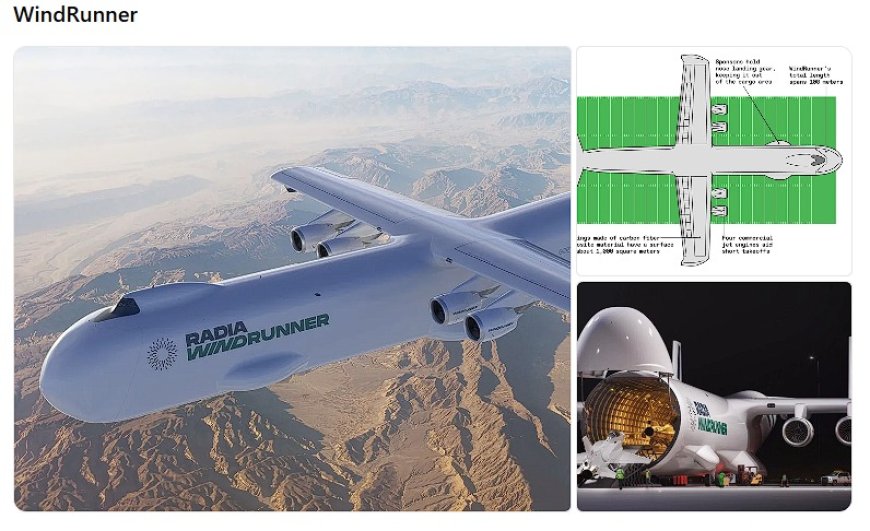
WindRunner: The Ultra-Large Cargo Jet That Could Airlift Entire Fighter Squadrons
Thesis: The next big military advantage isn’t just a new weapon—it’s a new logistics chassis. Radia’s WindRunner is designed around volume over raw tonnage, promising intact movement of fighters, helicopters, and outsized systems to ~6,000-ft austere runways. If realized, that compresses time-to-combat and widens basing options.
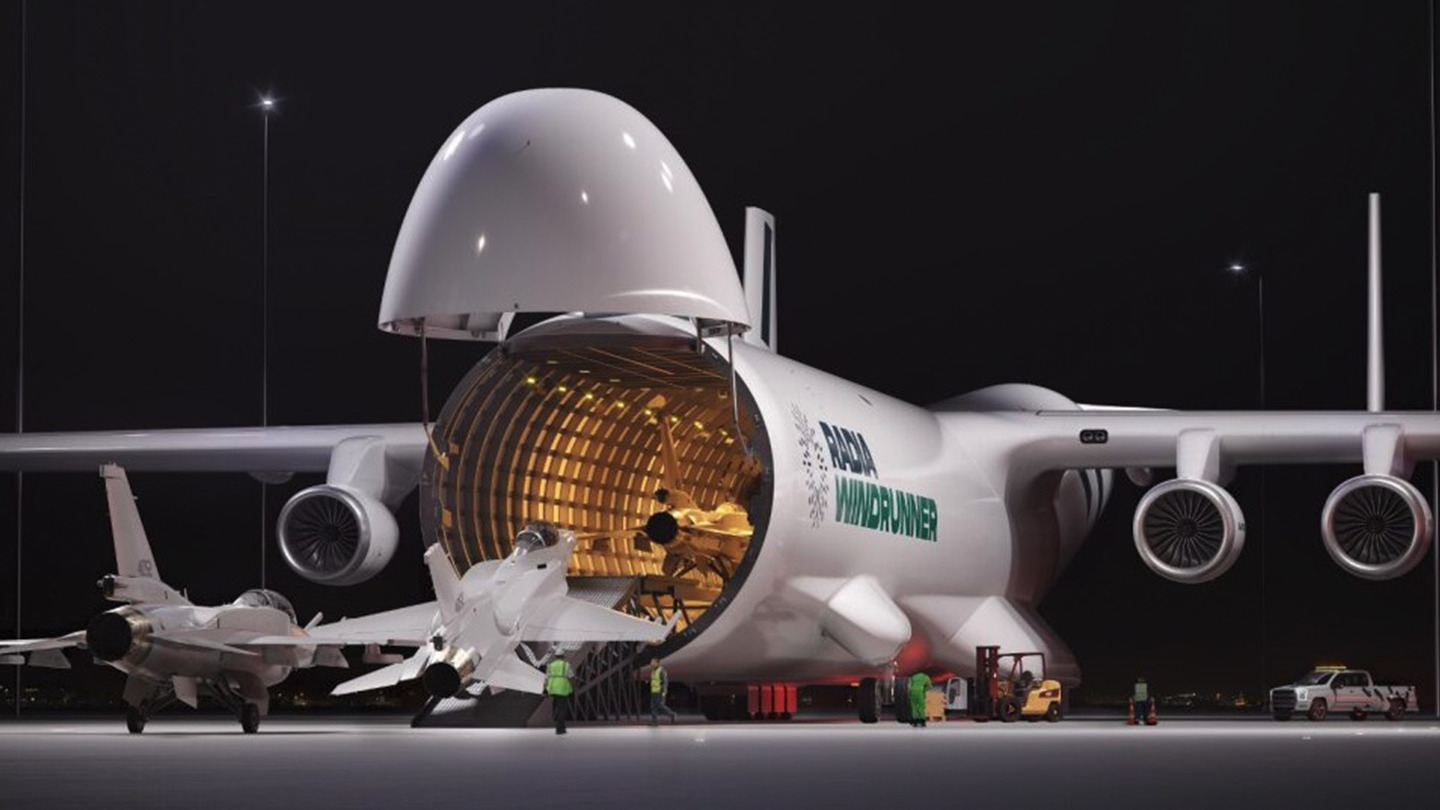
What WindRunner Is
Built by Colorado-based startup Radia, the WindRunner began as a civilian solution to haul 100-meter wind-turbine blades to remote onshore sites. That commercial use-case—transporting extremely large but relatively light components—makes it a natural crossover for defense logistics where volume is often the constraint, not just weight.
Key Specs (as disclosed to date)
| Length | ~109 m / 356 ft |
|---|---|
| Wingspan | ~80 m / 261 ft |
| Max payload (weight) | ~160,000 lb (≈72.6 t) |
| Runway | ~1,800 m / ~6,000 ft (unpaved capable, per company) |
| Range at max load | ~2,000 km / ~1,200 mi |
| Cruise | ~Mach 0.6 |
Source: Radia’s published specs — see official page.

From Wind Farms to War Plans
Reporting indicates the defense pitch includes transporting up to four F-35s or six CH-47s without disassembly, plus claims of operations from semi-prepared strips. That combination—intact loads + austere access—compresses timelines and sidesteps infrastructure chokepoints that slow traditional airlift.
- Business Insider coverage on the intact F-35/Chinook use-case and runway claims.
- The War Zone on USAF engagement and a ~2030 first-flight target.
- Breaking Defense on unpaved ~1,800 m runway operations.
Strategic Upside
- Time-to-combat: Intact airframes mean less wrench-time and faster sortie generation at arrival.
- Basing flexibility: Ability to use shorter, semi-prepared strips expands forward options.
- Volume-first logistics: Ideal for big but lighter systems—sensors, shelterized kits, rotorcraft, drone swarms, mobile hospitals.
Reality Check
- It’s still a concept: No public prototype yet; certification and financing risks are non-trivial.
- Weight vs. volume: Max payload weight trails some legacy heavylift; the play is cubic meters, not brute tonnage.
- Target timeline: First flight around 2030 has been floated; large-aircraft programs slip.
- High-value asset: In contested airspace, a giant lifter needs protected corridors and timing.

Bottom Line
WindRunner is a logistics swing at the real bottleneck: space and access. If Radia executes, U.S. planners get a new lever—deploying capability packages intact into places the current fleet struggles to reach. That’s a quiet—but decisive—force multiplier.
References & Credits
- Radia — WindRunner official page (specs, imagery): radia.com/windrunner
- Business Insider — defense use-case (F-35/CH-47, runway): link
- The War Zone — USAF brief, timeline to ~2030: link
- IEEE Spectrum — wind-blade logistics driver: link
- Breaking Defense — unpaved ~1,800 m runway operations: link
What's Your Reaction?
 Like
0
Like
0
 Dislike
0
Dislike
0
 Love
0
Love
0
 Funny
0
Funny
0
 Wow
0
Wow
0
 Sad
0
Sad
0
 Angry
0
Angry
0

Nexus (Christopher)
Founder of Pattern Nexus. I research markets, macro, geopolitics, AI, history, ancient systems, and the patterns most people overlook. I’m also building Market Radar, a trading scanner designed to read pressure, risk, confirmation, and setup quality before ch…
Related research

The Cycles of Power: From Regime Change to Digital Dominion – How Empires Evolve in the Age of AI
A deep investigation into the repeating patterns of American intervention—from world wars and Cold War coups to blockchain tokenization, AI…
G4 Geomagnetic Storm Threatens the U.S. Power Grid — And Exposes a 20-Year Infrastructure Problem
A rare G4 geomagnetic storm is forecast to hit the U.S., risking grid instability across northern states just as AI demand and aging infras…

The Quartz Chokepoint: Silica, Semiconductors, Solar, and the Quiet Resource That Runs the Modern Machine
A Pattern Nexus systems read on silica and quartz: why “sand” is abundant but ultra-high purity quartz is a strategic chokepoint for chips,…
Small Modular and Micro‑Reactors (SMRs) for AI and Data‑Centre Power: global technologies, companies and deployment outlook
Small modular and micro-reactors are being wired directly into the AI power stack. A full Pattern Nexus deep dive on SMR technologies, time…

The Nuclear Renaissance: 2026’s Drive for a 400 GW Grid and the Control Layers of Energy
In 2026 the United States announced plans to quadruple its nuclear power capacity to 400 GW by 2050, investing billions in domestic enrichm…

Quantum Control, Cryptographic Risk, and the Energy Stack
Quantum computing is no longer a lab curiosity. It is becoming a control-layer technology with implications for security, money, and energy…
Comments (0)
Security Check
Please complete the captcha to verify you are human.