
SOUTHCOM’s Caribbean Buildup: Warships, Marines, and Regime Change Speculation
The U.S. Southern Command (SOUTHCOM) has deployed a powerful task force to the Caribbean in late 2025. This analysis explores its military posture, potential regime change objectives, regional reactions, and geopolitical implications.
Related & Updated Coverage:
• Caribbean Surge: From sea strikes to land options — a breakdown of the U.S. buildup and SOUTHCOM’s shifting mission profile.
• Consolidating Power: Mapping global carrier deployments and how the Caribbean surge fits into a broader force alignment.
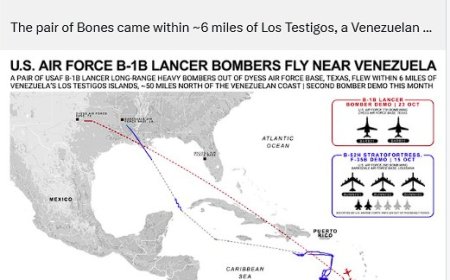
• Second Bomber Demo: A deeper look at recent U.S. bomber activity near Venezuela — the signal, not the show.
• The Regime-Change Question: Examining the ethical and strategic limits of Washington’s latest moves in Venezuela.
SOUTHCOM’s Caribbean Buildup: Warships, Marines, and Regime Change Speculation
In recent months, the United States Southern Command (USSOUTHCOM) has massed a significant military force in the Caribbean, deploying Navy warships, aircraft, and thousands of troops. The official rationale is to combat drug trafficking and target “narcoterrorist” cartels. However, the scale and composition of this deployment – including guided-missile destroyers, an amphibious ready group with Marines, a special operations “mothership,” fighter jets, and even a submarine – suggest ambitions beyond a typical counter-narcotics mission. Regional observers and officials are openly debating whether Washington is signaling a possible regime change operation against an adversary government under the guise of a drug wa. This article provides an in-depth analysis of SOUTHCOM’s role, the recent deployments, their potential objectives, historical precedents, and the geopolitical ripples spreading across Latin America.
What is SOUTHCOM? Role and Area of Responsibility
U.S. Southern Command (SOUTHCOM) is the Pentagon’s unified command overseeing U.S. military activities in Latin America and the Caribbean. Headquartered in Doral, Florida, SOUTHCOM is responsible for contingency planning, operations, and security cooperation across its assigned Area of Responsibility (AOR). This AOR encompasses Central America, South America, and the Caribbean Sea (excluding U.S. territories), totaling 32 nations and several territories. SOUTHCOM’s mission includes deterring aggression, confronting transnational threats like drug trafficking, responding to crises (such as natural disasters), and ensuring the defense of the strategic Panama Canal. In practice, the command engages in joint exercises, training of partner militaries, humanitarian assistance, and, at times, military interventions in the region. Notably, SOUTHCOM led past operations like the 1989 invasion of Panama and the 1994 intervention in Haiti, reflecting its role when U.S. force is applied in the hemisphere. Today, SOUTHCOM operates with a relatively small permanent staff (~1,200 personnel) but can rapidly leverage Army, Navy, Air Force, Marine, Coast Guard, and special operations components for missions in its theater.
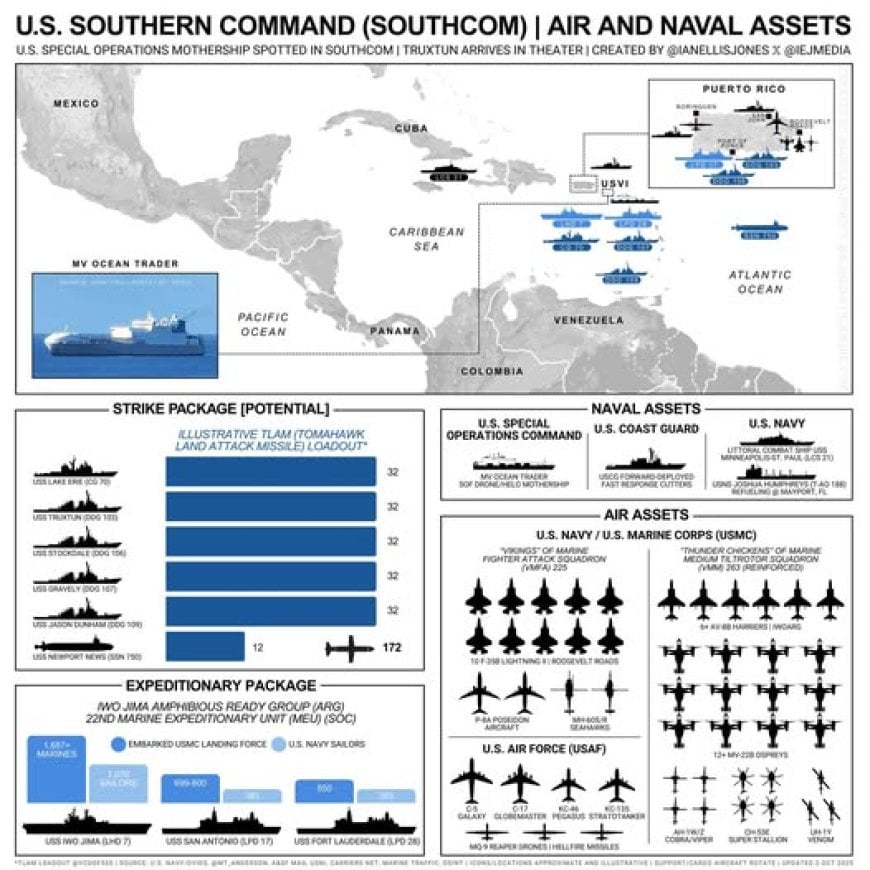
The Latest U.S. Deployments: Warships and Special Forces in the Caribbean}A map of U.S. military assets deployed around the Caribbean as of early October 2025. Warships (blue icons) are positioned near Venezuela and across the region, with aircraft based in Puerto Rico , reflecting the unprecedented scale of this buildup.
Beginning in late August 2025, the U.S. initiated a major buildup of forces in the southern Caribbean, ostensibly as part of a new counter-narcotics campaign. This deployment has grown to include at least ten naval vessels as well as air and ground assets. Key assets deployed as of September–October 2025 include:
- Guided-missile destroyers – e.g. USS Jason Dunham, USS Gravely, USS Stockdale, and USS Truxtun. These Arleigh Burke-class destroyers carry advanced Aegis air defense systems and Tomahawk land-attack cruise missile, giving the U.S. the ability to strike land targets from the sea. Their presence signals a high-end combat capability, far beyond what's needed to chase drug smugglers.
- Guided-missile cruiser – USS Lake Erie (Ticonderoga class). Cruisers like Lake Erie provide robust air defense cover for the group and also carry dozens of Tomahawk missiles. In early October, satellite imagery actually spotted Lake Erie sailing alongside the special ops ship off Trinidad, just ~126 km from Venezuela’s coast, apparently to shield the smaller vessel and assert air superiority near a potentially hostile shore.
- Expeditionary support ship – MV Ocean Trader. This innocuous-looking merchant vessel is a U.S. Special Operations Command “mothership” carrying Navy SEALs or other special forces. Originally a ro-ro cargo ship (formerly MV Cragside), it was converted with a helicopter deck, troop berthing for ~159 commandos, boat launch hatches, and command-and-control facilities. Ocean Trader can stay at sea ~45 days and support covert special operations raids, surveillance, and insertion of forces. Its current deployment in the Caribbean – confirmed by the Navy in late September – strongly indicates a Special Operations role in the ongoing mission.
- Amphibious Ready Group (ARG) – The USS Iwo Jima (LHD-7) amphibious assault ship, accompanied by landing dock ships USS San Antonio (LPD-17) and USS Fort Lauderdale (LPD-28). Embarked on these ships is the 22nd Marine Expeditionary Unit (MEU), some 2,200 Marines including infantry, aviation, and support elements. The Iwo Jima ARG sailed from Norfolk in mid-August with over 4,000 total Navy-Marine personnel, marking the first deployment of a U.S.-based Marine ARG to the Caribbean in years. These Marines are a versatile force—equipped with MV-22 Osprey tilt-rotors, CH-53E heavy lift helicopters, AV-8B Harrier jump-jets (aboard Iwo Jima), and armored vehicles—able to conduct amphibious landings, airfield seizures, humanitarian evacuations, or direct assaults.
- Littoral combat ship – USS Minneapolis–Saint Paul (LCS-21), a smaller warship for coastal patrols and interdiction. Its role likely involves chasing down speedboats or submarines used for drug smuggling, though in a high-end conflict its utility is limited.
- Attack submarine – USS Newport News (SSN-750), a Los Angeles–class nuclear-powered submarine, was also reportedly in the Caribbea. An SSN provides covert intelligence, surveillance, and if needed can launch Tomahawk missiles. Venezuela’s government even complained that a U.S. “nuclear submarine” in the Caribbean violates the region’s nuclear-weapon-free zone (the 1967 Treaty of Tlatelolco).
- Air forces – The U.S. quietly forward-deployed advanced aircraft to support this mission. In response to a “highly provocative” encounter where Venezuelan F-16 fighters buzzed a U.S. destroyer on September 4, the Pentagon rushed ten F-35 Lightning II stealth fighters to Puerto Rico. These Marine Corps F-35Bs give the U.S. air superiority and precision strike capabilities over the Caribbean theater. Surveillance assets like MQ-9 Reaper drones have also been sent to monitor the area. Additionally, Air Force Special Operations units practiced airfield seizure exercises in the Caribbean over the summer—a drill for quickly capturing and using an airport, which could be vital in an intervention scenario.
Collectively, this is an exceptionally heavy force package for a counter-drug operation. It has been noted as the largest U.S. naval presence in the region since 1965, when the U.S. intervened in the Dominican Republic’s civil wa. Five of the Navy warships deployed are equipped with long-range Tomahawk cruise missiles, a capability irrelevant to drug interdiction but very relevant to striking land targets (e.g. radar sites or military bases) in a conflict. The inclusion of an ARG with hundreds of Marines signals that the U.S. is prepared not just to find and destroy drug boats, but to put boots on the ground if necessary. The Pentagon’s unusual decision to have this operation led by the II Marine Expeditionary Force (a North Carolina–based Marines command) rather than by SOUTHCOM’s own staff underscores its expeditionary, combat-oriented nature. In short, Washington has assembled a contingency force in the Caribbean reminiscent of an invasion task force, even as it maintains that the focus is on drug cartels.
Why These Forces? Clues to Operational Goals
The composition of the U.S. forces hints strongly at operational goals that go beyond drug interdiction. A fleet of this size and capability would be suited to a range of military actions up to and including regime change in a hostile nation. Analysts point out that this looks, walks, and talks like a preparation for possible coercive action against Venezuela’s Maduro government, which the U.S. has openly opposed. Consider the assembled tools:
- Special operations – The presence of Ocean Trader and reported sightings of MH-6 Little Bird special ops helicopters near the Venezuelan coast suggest covert operations are underway or on standby. Such assets could insert commando teams to conduct raids, sabotage, or to support local insurgents. It’s notable that President Trump has reportedly authorized the CIA to conduct covert operations inside Venezuela as well:, indicating a parallel clandestine effort to destabilize the regime.
- Amphibious assault capability – An ARG with a Marine Expeditionary Unit provides the ability to rapidly land a sizable combat force. This could be used for a direct intervention (e.g. seizing a port or oil terminal), for establishing a beachhead to deliver humanitarian aid under armed protection, or for evacuating U.S. citizens. The Marines training for “expeditionary advanced base operations” could seize and hold key terrain (like a small island or an airfield) to project power ashore. It’s essentially a regime change insurance policy: if a decision were made to topple a government, this force could insert ground troops quickly.
- Air dominance and strikes – Fighter jets (F-35s, Harriers) and armed drones give the U.S. control of the skies, allowing it to strike ground targets with precision or counter any hostile air force. The deployment’s striking power was underscored by the Financial Times noting that five of eight principal warships carry Tomahawks capable of hitting land targets deep inland. This means U.S. commanders could, if ordered, preemptively destroy air defenses, command centers, or other strategic targets in a country like Venezuela or Cuba. In fact, since early September the U.S. has conducted a series of airstrikes destroying small vessels allegedly carrying drugs – the first U.S. lethal strikes in Latin America since 19890. Trump hinted “there’s more where that came from,” even as legal experts question these actions.
- Logistics and sustainability – Conducting sustained operations at sea requires significant logistics (fuel, supplies, bases). The use of Puerto Rico as a forward staging area for aircraft and the cooperation of partners like the Dominican Republic (which helped recover cocaine from a sunk smuggling boat) indicate a broad support network. The current force could sustain a blockade, no-fly zone, or combat operations in the region for an extended period.
The assembled package, therefore, gives the U.S. multiple military options. On the lower end, it can surge counter-narcotics patrols to interdict cocaine shipments (indeed several go-fast boats and even a narco-submarine have been destroyed in September–October, with around 30 alleged traffickers killed). But on the higher end, it postures the U.S. to launch air and sea strikes, conduct commando raids, or even initiate an amphibious landing if a decision was made to forcibly change a regime or respond to a crisis. U.S. officials insist the mission is about drug cartels, yet they simultaneously acknowledge it puts pressure on Venezuela’s Nicolás Maduro, whom they accuse of harboring “narco-terrorists. Indeed, one former U.S. National Security Council official told reporters, “This really looks…like a regime change preparation.”: The line between a counternarcotics operation and a military intervention is unusually blurry in this case. By design or not, Washington now has a potent force on station that could execute a regime change playbook reminiscent of Panama 1989 if ordered.
Historical Parallels in the Region: From Panama to the Cuban Crisis
The Caribbean and Central America have seen multiple U.S. military interventions in the past century, and the current situation evokes many of these precedents. Understanding a few key historical episodes helps put the present buildup in context:
Panama, 1989 (“Operation Just Cause”) – The U.S. invasion of Panama in December 1989 is a prime example of a U.S. force assembled under one pretext that ultimately achieved a regime change. Citing General Manuel Noriega’s indictment on drug trafficking and threats to U.S. citizens, President George H.W. Bush unleashed over 20,000 troops in a lightning campaign to oust Noriega. Within days, the Panama Defense Forces were crushed, Noriega was in U.S. custody, and a pro-U.S. government was installed. Notably, “war on drugs” rhetoric was used to help justify the invasion (Noriega was accused of facilitating narcotics smuggling). The operation was tactically successful but drew international condemnation – the UN General Assembly called it a “flagrant violation of international law”. The Panama example shows how quickly a dictator was removed by U.S. forces when deemed a threat. Parallels to today: like Noriega, Venezuela’s Maduro and some of his inner circle have been indicted in U.S. courts for drug-related charges. A similar rapid strike to decapitate Venezuela’s leadership has been openly contemplated in Washington in recent years.
Haiti, 1994 (“Operation Uphold Democracy”) – In September 1994, the U.S. led a multinational force to restore Haiti’s democratically elected president, Jean-Bertrand Aristide, who had been ousted by a military coup. Some 20,000 U.S. troops were staged, including the 82nd Airborne for an airdrop and a Marine amphibious force offshore. The invasion was averted at the last minute when diplomacy (led by former President Jimmy Carter) persuaded the Haitian military regime to step aside. U.S. forces landed peacefully and occupied Haiti for months to stabilize and handover to a UN mission. Haiti 1994 is an example of a large Caribbean deployment that achieved its goal through show of force without major combat. The current SOUTHCOM buildup similarly might hope to pressure a regime (e.g. Venezuela) to yield or negotiate once it sees the writing on the wall. However, unlike Haiti’s junta, regimes like Maduro’s Venezuela or Cuba’s government are ideologically hardened and less likely to step down meekly.
Cuba crises (1961–1962) – The Cuban Missile Crisis of October 1962 was perhaps the closest the Caribbean came to full-scale war. The U.S. imposed a naval “quarantine” (blockade) around Cuba to force the removal of Soviet nuclear missiles, leading to a tense superpower showdown. Ultimately it was resolved diplomatically, but the episode ingrained the idea of Latin America as a Cold War battleground. A year earlier, in 1961, the U.S. had sponsored the Bay of Pigs invasion – a covert landing of Cuban exiles to overthrow Fidel Castro, which failed disastrously. The echoes today are striking: once again we have U.S. Navy ships off the coast of Cuba (and Venezuela), talk of covert operatives, and great-power tensions (now involving Russia and China) swirling around a small region. The current U.S. naval concentration is the largest in the Caribbean since 1965, when over 40,000 U.S. troops occupied the Dominican Republic. It’s as if the specter of the Cold War has returned, with Washington openly referring to “communist narco-states” and invoking the Monroe Doctrine tradition that the U.S. will not tolerate extra-hemispheric meddling. The big difference is that today Moscow is far weaker in the region than in 1962, and Beijing, while economically influential, has little military footprint in the Americas. Still, the Cuban experiences show how such military posturing can bring the hemisphere to the brink of war – a sobering precedent for all sides.
Likely Targets: Venezuela, Cuba, Nicaragua in the Crosshairs
Given the nature of the forces and rhetoric, observers speculate that Venezuela is the primary target (or at least focal point) of this U.S. deployment. U.S. officials claim Venezuelan authorities and military figures are complicit in the drug trade (often referencing the so-called “Cartel of the Suns”), and the White House has explicitly linked its campaign to elements within Venezuela. President Maduro’s government, in turn, has denounced the U.S. deployments as a “threat of invasion”, claiming that 4,200 U.S. troops with eight warships are poised near its coast ready to strike. Indeed, Venezuelan defense minister Vladimir Padrino ordered his armed forces to prepare to repel a U.S. attack, and reports emerged in mid-September of Venezuelan military exercises – including moving mobile air defense batteries and coastal defense missiles – to showcase readiness. Caracas has reason to be alarmed: not only has the U.S. labeled Maduro and his circle as narco-terrorists, but Trump disclosed he authorized CIA covert action in Venezuela, and opposition sources have openly cheered the U.S. naval buildup as a step toward forcing Maduro’s exit:. However, many experts believe a full-scale U.S. invasion of Venezuela remains unlikely due to the risks and scale of conflict that would entail. Instead, the force might be aiming to intimidate and isolate Maduro, carry out limited strikes (as already seen with the boat attacks), and possibly encourage Venezuela’s military to reconsider its loyalty. In a sense, regime change could be the ultimate, unstated goal – whether accomplished by external force or by catalyzing internal collapse.
Cuba is another nation perennially in Washington’s sights. Cuba is a founding member of the ALBA alliance with Venezuela and has its own communist government long sanctioned by the U.S. Under the Trump administration, U.S. policy toward Cuba hardened again (reversing the brief 2015–2016 thaw). It’s conceivable that the Cuban leadership sees the U.S. buildup as a warning to them as well. In fact, Cuban President Miguel Díaz-Canel, speaking at an ALBA summit, condemned the U.S. “imperial show of force” in the Caribbean and urged the world to join in opposing this “irrational attack by the Trump Administration”. Cuba’s inclusion (along with Venezuela and Nicaragua) on the invite list of countries the U.S. pointedly excluded from the upcoming Summit of the Americas has further fueled Havana’s perception that Washington is isolating and targeting them. While a direct U.S. invasion of Cuba is highly unlikely today, the island’s leaders are no doubt studying the 2025 scenario closely – it wouldn’t be the first time a U.S. naval buildup presaged action against Cuba, as history shows.
Nicaragua and others: Nicaragua’s Sandinista government led by Daniel Ortega is another ALBA member and vocally anti-U.S. Though Nicaragua is smaller and poorer, it has aligned with Venezuela and Cuba against U.S. “hegemonic” policies. The U.S. has sanctioned Nicaraguan officials heavily in recent years. The current Caribbean deployments are not positioned near Nicaragua (which lies in Central America and has both Caribbean and Pacific coasts), but it’s reasonable to see Nicaragua on the U.S. radar for increased pressure. If nothing else, Washington’s message with this show of force – that authoritarian regimes aligned with extra-hemispheric rivals are not safe – would apply to Managua as well. U.S. officials have lumped Nicaragua’s regime in the same “troika of tyranny” (alongside Cuba and Venezuela), so a future operation could theoretically extend to it, perhaps through proxy forces or regional allies. For now, however, Venezuela remains the focus, as it directly ties into the narcotics trafficking narrative and hosts significant Russian, Chinese, and Iranian influence – making it a geopolitical prize.
Timing, Signaling, and Political Calculations
Why is this military campaign happening now, in late 2025? Several factors likely converged. First, the U.S. domestic political context: the administration in Washington (under President Donald Trump, in this scenario) has made fighting drug cartels a high-profile issue, even designating several cartels and gangs as terrorist organizations in early 2025. With U.S. overdose deaths from drugs (like fentanyl) a hot-button issue, a dramatic military effort to “stop the poison” plays well to domestic audiences. Trump’s officials have explicitly equated Latin American cartels with ISIS or Al-Qaeda, laying the legal and rhetorical groundwork for using military force. By ordering strikes on alleged drug boats and showcasing tough action, the President can claim decisive leadership in the war on drugs.
Secondly, the strategic timing vis-à-vis Venezuela. Venezuela has been in protracted crisis for years, and U.S. sanctions and diplomatic efforts have so far failed to dislodge Maduro. 2024–25 presents a moment when Venezuela is supposed to hold presidential elections; if Maduro moves to secure another term through contested means, the U.S. might seize that moment to escalate pressure. Some analysts think the buildup is timed to preempt any succession or to exploit a possible power transition in Caracas. It’s also worth noting that earlier in 2025, a foreign policy hawk (Marco Rubio) became U.S. Secretary of State – Rubio has long advocated a hard line on Venezuela and Cuba. Indeed, Rubio has been touring Latin America rallying support, and was present when Colombia’s President Gustavo Petro convened CELAC to address the situation. The U.S. show of force may also be intended to signal regional leaders: those who cooperate (like Dominican Republic or Guyana) are appreciated, while those who criticize (like Petro of Colombia or AMLO of Mexico) will not deter Washington’s resolve.
Internationally, the timing sends a message to great power rivals. Russia’s military is bogged down in other theaters (e.g. Ukraine), limiting its ability to support allies in Latin America; China, while expanding influence in the Americas, has no military bases nearby. The U.S. may judge this is a window of opportunity to reassert the Monroe Doctrine without triggering a major power standoff. Still, the signaling cuts both ways: Moscow and Beijing are watching closely. Trump’s bold moves in the Caribbean might be calculated to warn them off from deepening ties with regimes like Maduro’s – essentially drawing a line in the sand in America’s “backyard”. Conversely, it could be a domestic political signal: demonstrating a “strength abroad” narrative as U.S. elections loom (showcasing success in a foreign venture could rally nationalist support).
Finally, timing could be influenced by conditions on the ground: intelligence might have shown a surge in cocaine flows or a particular vulnerability in the Maduro regime’s grip that military pressure could exploit. There were also reports of a humanitarian angle – Venezuela’s economic collapse continues, and migrant flows through the Americas (including to the U.S. southern border) remain high. Nearly 7.9 million Venezuelans have fled their country amid the crisis, straining neighboring countries. U.S. officials might be using the narco-terrorism argument partly to address this instability at its source. In short, the current moment likely appeared ripe in Washington to act decisively, hoping to achieve multiple objectives: curtail drug trafficking, push out a hostile regime, and score a public relations win.
Geopolitical Stakes: Global and Regional Responses
The geopolitical reaction to the U.S. military buildup has been strong, highlighting the high stakes involved. Latin American regional organizations and allies of Venezuela have largely condemned the U.S. actions, while a few governments have quietly supported Washington’s rationale. Key dynamics include:
Regional bloc condemnation (CELAC & CARICOM) – The Community of Latin American and Caribbean States (CELAC), which includes every country in the Americas except the US/Canada, held an emergency meeting in early September at Colombia’s behest. The outcome was a call to keep Latin America a “zone of peace” free from intervention, with CELAC foreign ministers stressing respect for sovereignty and the UN Charter}. The CELAC statement implicitly criticized the U.S. deployment, rejecting “interventionist logic” and urging any concerns be resolved diplomatically:content. Individually, many Latin American leaders have voiced concern. For example, Colombia’s President Gustavo Petro (who holds CELAC’s rotating presidency) not only convened the talks but later accused the U.S. of violating Colombian sovereignty – after one of the destroyed boats turned out to be Colombian and within Colombian waters. Mexico’s government likewise has emphasized non-intervention. The Caribbean Community (CARICOM) has mostly echoed these sentiments, with even close U.S. partners uneasy about military action in the region. Notably, at the CELAC meeting, Trinidad and Tobago was reportedly the only CARICOM member to explicitly back the U.S. stance:}, reflecting how isolated Washington is in regional public opinion.
ALBA alliance support for Venezuela – The leftist governments in the ALBA-TCP alliance (which includes Venezuela, Cuba, Nicaragua, Bolivia, and others) have unsurprisingly rallied to denounce the U.S. military escalation. In late August, ALBA members convened and unanimously condemned the U.S. deployments as illegal and destabilizing. They affirmed their support for Maduro and accused Washington of violating international law and threatening regional stability. Cuba’s Díaz-Canel and others labeled the U.S. actions an act of “imperialism” and called for Latin American unity against U.S. aggression. The ALBA declaration and subsequent statements specifically reject the U.S. narco-terror narrative, seeing it as a pretext to justify military intervention. They also pointed to the irony of the U.S. militarizing a drug war when, in their view, socio-economic cooperation and justice are needed. ALBA countries have sought support in forums like the G77+China and the Non-Aligned Movement to amplify their case. Nicaragua, for instance, demanded an immediate end to what it called U.S. hostile policies. The strong ALBA stance signals that any U.S. move on Venezuela (or Cuba/Nicaragua) would face not just local, but regional ideological resistance.
Major power backing (Russia & China) – Both Moscow and Beijing have aligned with Venezuela diplomatically in this crisis. Russia’s Foreign Minister Sergei Lavrov condemned the U.S. strikes on vessels near Venezuela and warned of “far-reaching consequences for the region” if Washington continues escalating. In an October 5 statement, Russia cautioned that U.S. actions in the Caribbean could destabilize the entire area and explicitly voiced “full support and solidarity” with Venezuela’s leadership. Russian officials even speculated that the U.S. might use the cartel war as a pretext for other interventions (noting concern that the U.S. could link it to action in crisis-torn Haiti). While Russia’s practical ability to aid Maduro is limited (short of arms shipments or advisors, which it has provided in the past), the Kremlin’s messaging is clear: it views the U.S. buildup as a dangerous provocation in its ally’s backyard. China, meanwhile, has been more measured but similarly critical. A Chinese foreign ministry spokesperson stated that China opposes “the use or threat of force” and any external interference in Venezuela’s affairs. China has significant investments in Venezuela’s oil sector and has cultivated a strong partnership with Caracas, so it has urged respect for sovereignty. Both Russia and China raised the issue at the UN Security Council when Venezuela’s ambassador brought a complaint about the U.S. strikes, though direct UNSC action is unlikely due to U.S. veto power. In essence, global power rivalry is quietly in play – the U.S. is testing how far it can push in a region historically under its dominance, and Russia/China are registering objections but so far without direct confrontation.
Local allies and responses – A few regional actors have aligned or cooperated with the U.S. effort. The Dominican Republic has provided logistical help (its Navy helped retrieve a ton of cocaine from one of the sunk boats, in a joint operation hailed as a first of its kind). Guyana, which has a bitter border dispute with Venezuela, openly supported U.S. statements about Venezuela’s cartel connections – Guyana’s government echoed the U.S. line that narco-trafficking from Venezuela is a menace to regional peace. (Guyana likely sees the U.S. presence as a buffer against any Venezuelan aggression in their Essequibo dispute.) Trinidad & Tobago, as noted, showed some support, perhaps fearing Venezuelan crime spillover and valuing U.S. security ties. On the other hand, Brazil and Argentina have expressed concern and pushed for dialogue; Brazil’s President Lula, for instance, offered to mediate and insisted South America be kept free of new conflicts. In Venezuela itself, beyond official circles, even opposition factions are divided – some in the opposition welcome intense U.S. pressure on Maduro, while others worry about the humanitarian fallout of any military clash. And in the streets of Caribbean nations, peace activists and social movements have organized protests. For example, the Assembly of Caribbean Peoples declared an Oct 16 “Day of Collective Action” urging governments to unite against U.S. intervention and reject any exclusion of Venezuela, Cuba, Nicaragua from hemispheric forums. This underlines a crucial point: the memory of past U.S. invasions runs deep in the Americas, and many in the region reflexively oppose any whiff of gunboat diplomacy.
Conclusion: High-Stakes Posture in America’s Backyard
The U.S. Southern Command’s current military posture in the Caribbean is a bold and risky gambit. On the surface, it’s an anti-drug operation – a muscular extension of the “War on Drugs” onto the high seas, using warships and warplanes to go after smugglers. But the subtext cannot be ignored: this is also an unmistakable display of power aimed at Latin America’s anti-U.S. regimes, chiefly Venezuela’s Maduro government. The force composition – from the USS Truxtun and USS Lake Erie bristling with missiles, to the Marine expeditionary unit aboard Iwo Jima, and the secretive commandos on Ocean Trader – provides the U.S. with tools to intervene decisively if it chooses. Whether Washington’s endgame is to actually topple a regime or simply coerce changes in behavior, the message has been delivered with cannon-shot clarity.
The coming weeks will test how this high-stakes deployment plays out. Will it remain a series of contained strikes on “narco-vessels” and a war of nerves, eventually de-escalating? Or does it presage a more direct confrontation – an amphibious landing, a no-fly zone, even a regime implosion triggered by the pressure? The historical echoes of Panama, Haiti, and Cold War Cuba hang over the scenario, both as lessons and warnings. The geopolitical balance is also in the mix: U.S. rivals are probing how far the Monroe Doctrine can go in 2025, and Latin American neighbors are reaffirming that their region is not a chessboard for unilateral moves. For the U.S., SOUTHCOM’s Caribbean show of force is a test of its ability to project power in its near abroad without sliding into an expensive quagmire or diplomatic disaster. For the countries in the crosshairs, it’s a stark reminder of their vulnerability when the superpower to the north decides to flex its muscles.
In the end, this Caribbean buildup underscores the enduring truth of regional power dynamics: the Caribbean Basin remains a critical arena of U.S. influence and interest, where issues of drugs, democracy, and great-power competition intersect. Whatever the immediate outcome, the events of 2025 may well reshape hemispheric relations for years to come – either reinforcing a U.S.-led security order or galvanizing Latin America to more forcefully defend its autonomy. The world is watching the waves and skies of the Caribbean, as a familiar drama of power and principle plays out under very modern circumstances.
Sources
Sources
- Wikipedia: 2025 United States naval deployment in the Caribbean – Overview of the U.S. naval buildup, objectives (counter-narcotics and regime change), and timeline.
- U.S. Southern Command – About SOUTHCOM (official site) – Mission, Area of Responsibility (32 nations in Central/South America & Caribbean), and responsibilities (Panama Canal defense, etc.).
- Task & Purpose (Sept 25, 2025): “The elusive ship built to carry US special operators is in the Caribbean” – Details on the MV Ocean Trader special ops support ship and confirmation of its deployment.
- Task & Purpose (Oct 18, 2025): “United States releasing survivors of latest airstrike in the Caribbean…” – Reports on U.S. strikes on smuggling boats, survivors held on USS Iwo Jima, and regional reactions (e.g. Colombia’s response).
- Maritime Executive (Oct 8, 2025): “U.S. Navy Cruiser Escorts Special Operations Ship Off Venezuela” – Intelligence on Lake Erie and Ocean Trader operating near Venezuela; expert commentary likening the deployment to regime-change prep.
- Reuters (Oct 17, 2025): “Exclusive: In a first, US strike in Caribbean leaves survivors, US official says” – Notes on the overall U.S. buildup (~6,500 troops, destroyers, F-35s, submarine) and Trump authorizing CIA covert ops in Venezuela.
- Reuters (Oct 5, 2025): “Russia condemns U.S. strike on alleged drug vessel near Venezuela” – Russia’s Lavrov warning against U.S. escalation and expressing support for Venezuela’s Maduro.
- EFE (Sept 2, 2025): “CELAC urges ‘land of peace’ amid US naval deployment near Venezuela” – Emergency meeting by Latin American foreign ministers calling for no intervention; Venezuelan response to U.S. forces.
- Dominican Today (Oct 17, 2025): “Caribbean movements unite against U.S. intervention on ‘Day of Collective Action’” – Regional civil society and Assembly of Caribbean Peoples denounce U.S. “imperialist” aims on Venezuela’s oil.
- Venezuelanalysis (Aug 22, 2025): “ALBA-TCP Condemns US Military Buildup Near Venezuela…” – ALBA alliance denounces the U.S. deployment and cites China’s support for Venezuela.
מה התגובה שלך?
 אהבתי
0
אהבתי
0
 לא אוהב
0
לא אוהב
0
 אהבה
0
אהבה
0
 מצחיק
0
מצחיק
0
 וואו
0
וואו
0
 עצוב
0
עצוב
0
 כועס
0
כועס
0

Founder of Pattern Nexus. I research markets, macro, geopolitics, AI, history, ancient systems, and the patterns most people overlook. I’m also building Market Radar, a trading scanner designed to read pressure, risk, confirmation, and setup quality before chasing a move. Pattern Nexus is where I connect the dots between data, history, technology, and the bigger system playing out around us.








תגובות (0)