

Caribbean Surge: From Sea-Strikes to Land Options — What the U.S. Is Building
As U.S. Southern Command ramps up its Caribbean deployment, amphibious ships, Tomahawk destroyers, and special operations units signal a shift from maritime interdiction to potential land-based action. Trump’s comments confirm the transition: the sea is “under control” — now land targets are next .Caribbean Surge,…
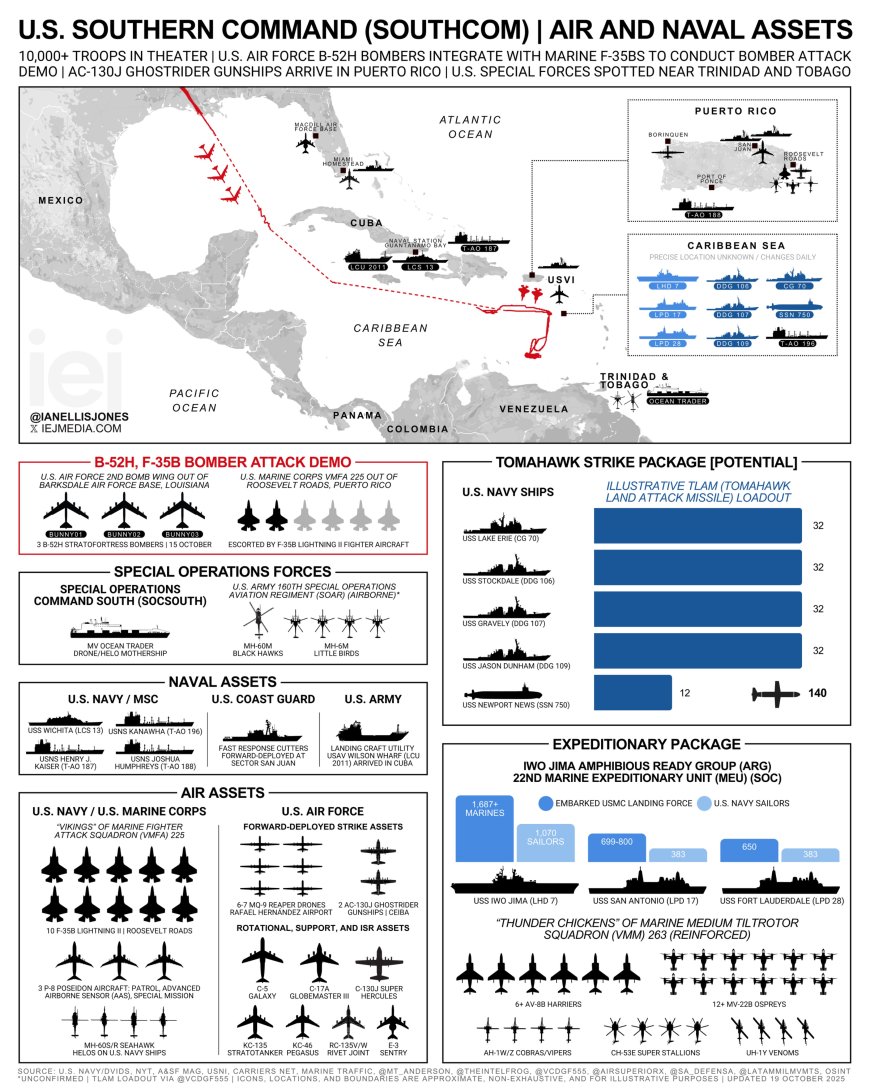
As U.S. Southern Command ramps up its Caribbean deployment, amphibious ships, Tomahawk destroyers, and special operations units signal a shift from maritime interdiction to potential land-based action. Trump’s comments confirm the transition: the sea is “under control” — now land targets are next .Caribbean Surge,…
Jump to a section
Caribbean Surge: From Sea-Strikes to Land Options — What the U.S. Is Building
Published October 23, 2025 | by Pattern Nexus
We’ve already flagged the surge. Now it’s getting more concrete. The U.S. Southern Command (SOUTHCOM) isn’t just positioning assets in the Caribbean — it’s stacking a **full-spectrum power-projection platform**. Amphibious ships, Tomahawk-capable destroyers, forward marine air wings, and a special operations mothership are all accounted for. And just as important: the rhetoric has shifted.
Earlier, the story was “we’re going after the boats.” Now, the story is “land targets are on the table.” And the author of that shift is Donald Trump. In public remarks he declared that because maritime smuggling has been “under control,” the next phase is looking at land-based routes and operations.
The Asset Stack
Here’s what we’re seeing:
- Amphibious Assault Group(s) deployed in the southern Caribbean — ready to insert Marines, helicopters, and Ospreys into littoral zones.
- Destroyers and cruisers armed with land-attack missiles (Tomahawks) offshore Venezuela and nearby islands.
- Air assets — everything from B-52 strategic bombers to F-35s and Marine AV-8Bs — passing through Puerto Rico, Ceiba, and Caribbean staging areas.
- Covert operations via Central Intelligence Agency (CIA) inside Venezuela, as Trump confirmed earlier this month.
In short: Not just “drugs interdiction.” At this scale, it begins to look like **regime-change insurance** in our hemisphere.
Why the Shift from Sea to Land?
The narrative: after a run of high-profile boat strikes in the southern Caribbean (many tied to Venezuelan-origin vessels, allegedly run by the Tren de Aragua cartel), the maritime route is now considered “under pressure.” The White House line: if traffickers can’t use the sea, they’ll try land. Which means U.S. forces may follow.
Trump’s own words: “We are certainly looking at land now because we’ve got the sea under control.”That statement alone flips the mission from interdiction → into **cross-border strike logic**. When you treat drug boats like enemy combatants, and then you move inland, you’re talking about military operations in sovereign terrain.
That’s the moment the build-up shifts from “targeting smuggling” to “changing regimes or at least coercing them.” Experts say the legality is deeply murky; especially since the U.S. long held that it’s not at war with sovereign states in that region — until now.
What This Means on the Ground
Here are the likely implications:
- Increased deployments of U.S. Marine Expeditionary Units (MEUs) into staging areas in Puerto Rico, the U.S. Virgin Islands, northern South America or the southern Caribbean islands.
- Forward positioning of long-range strike assets (ships and aircraft) just off the coast of Venezuela and Colombia. That gives options for land-attack, not just sea-attack.
- Covert operations inside Venezuela — the CIA and special operations forces are likely expanding missions focused on regime insiders, intelligence networks, and possible “decap” planning.
- Heightened risk of cross-border incident. If U.S. forces conduct kinetic raids on land inside Venezuela or Colombia, the threshold for conflict rises dramatically — not just drug war, but war-by-other-means.
- So far the South American governments have protested loudly. Nicolás Maduro will use this for internal rallying and likely mobilize militias. The regional backlash could include diplomatic isolation, bloc building, and even proxy escalation.
Why It Matters to You
This isn’t just “far away stuff.” When the U.S. shifts expeditionary assets into the Caribbean and positions for land-strikes in the hemisphere — this touches on:
- **Energy & commodities**: Venezuela is rich in oil. Regime pressure means ripple effects in markets, sanctions, supply chains.
- **Migration flows**: Military action in Venezuela or nearby could greatly increase refugee outflows toward the U.S. and Caribbean islands.
- **Military-industrial implications**: Tomahawk-capable destroyers, forward-deployed air wings, amphibious assault ships — this costs real money, and signals procurement, contract, and readiness shifts.
- **Geopolitical stability**: A U.S. military posture that crosses the sea/land threshold around Venezuela changes the calculus for Latin America and Caribbean states. Boundaries of sovereignty and intervention are shifting.
Sources:
What's Your Reaction?
 Like
0
Like
0
 Dislike
0
Dislike
0
 Love
0
Love
0
 Funny
0
Funny
0
 Wow
0
Wow
0
 Sad
0
Sad
0
 Angry
0
Angry
0

Nexus (Christopher)
Founder of Pattern Nexus. I research markets, macro, geopolitics, AI, history, ancient systems, and the patterns most people overlook. I’m also building Market Radar, a trading scanner designed to read pressure, risk, confirmation, and setup quality before ch…
Related research
The Venezuela Flashpoint: Why the U.S. Just Locked Down Airspace and Shifted the Caribbean Chessboard
The most in-depth analysis of the 2025 Venezuela escalation: FAA NOTAMs, airspace closure, U.S. naval buildup, covert operations, cartel-st…
5 shared topics, same research avenue.
The Stablecoin Front: Dollar Tokens, Sanctions, and Aircraft Carriers off Venezuela
A deep Pattern Nexus investigation into how Venezuela became the first live theater where U.S. military power, stablecoin adoption, sanctio…
6 shared topics, same research avenue.
Venezuela, SOUTHCOM, and the New Western Hemisphere Power Map (2025 Update) | Pattern Nexus
Updated 2025 force-posture analysis: why the Caribbean just became the most important theater of the 21st century. Carrier groups, JASSM bo…
5 shared topics, same research avenue.
Venezuela on the Brink — From Quiet War to Open Confrontation
Escalation between the U.S. and Venezuela has moved from covert operations to direct confrontation. Strikes, intelligence activities, and r…
6 shared topics.
Imminent Escalation Watch: Venezuela — Markets, Signals, and the Playbook (Pattern Nexus Situation Update)
description" content="Pattern Nexus Situation Update: Carrier posture, bomber signaling, maritime strikes, and GPS interference point to el…
4 shared topics, same research avenue.
Consolidating Power: The Global Carrier Pattern and the Caribbean Surge
U.S. carrier strike groups are on the move — from the Ford in the Mediterranean to the Iwo Jima Amphibious Ready Group now under SOUTHCOM i…
4 shared topics, same research avenue.
Trump Signals Possible Military Strikes on Drug Cartels Beyond U.S. Borders
Trump says he will notify Congress before launching U.S. military strikes on foreign soil targeting drug traffickers — a move signaling a s…
4 shared topics, same research avenue.
Caracas Escalation: Explosions, Airstrikes, and the Fog of Verification
Explosions near Caracas, airstrike claims at Higuerote Airport, armored deployments, and U.S. aerial assets on radar. A Pattern Nexus reco…
3 shared topics, same research avenue.
Comments (0)
Security Check
Please complete the captcha to verify you are human.