

Griffin-1: The Race for a Lunar Foothold
Griffin-1 and Astrolab’s FLIP rover could give NASA and its partners valuable experience at the lunar south pole. The larger competition with China runs through water, power, mobility, communications…
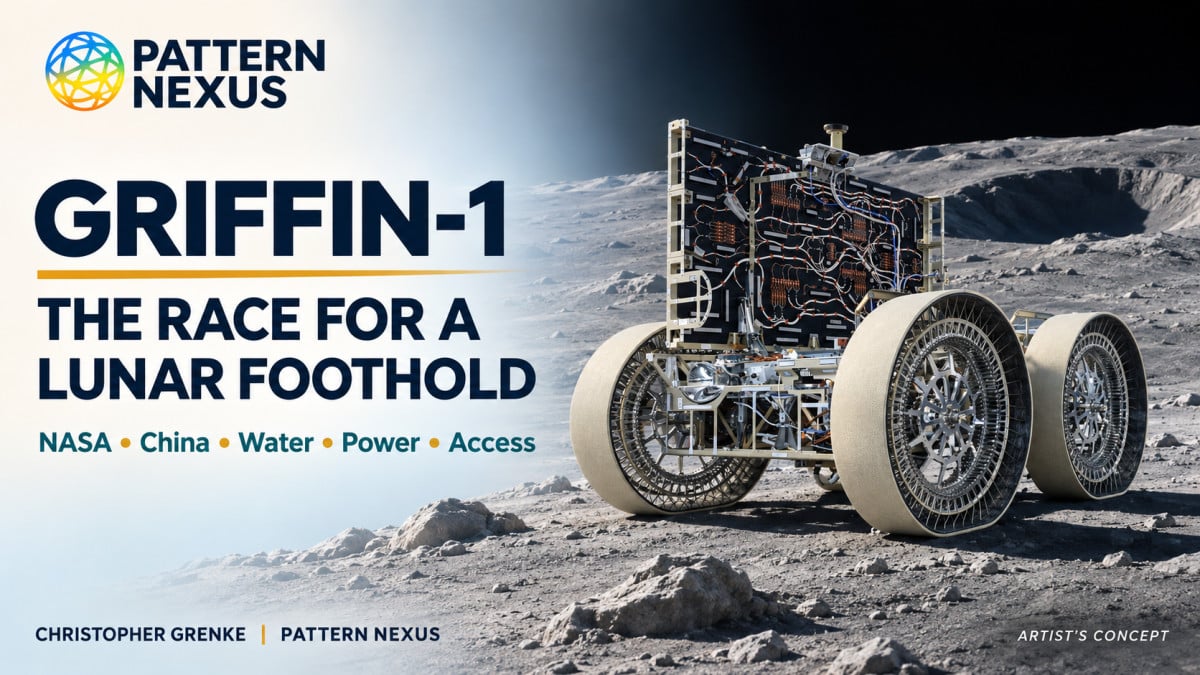
Quick Read
Griffin-1 could help establish a working American and partner foothold near the Moon’s south pole. Its rover, FLIP, carries experiments in mobility, water prospecting, navigation and computing. Useful results would improve the starting point for later missions, while failure would cost hardware, data and time. China’s Chang’e-7 is pursuing its own polar exploration program. The strategic advantage will grow through repeated, reliable operations.
This is a public NASA-backed commercial mission. Its importance comes from how the equipment, location and follow-on plans connect. Landing a rover does not create ownership of a crater. [1][13][17]
Useful ground combines power, access, communications and resource potential.
The mission becomes more valuable when the hardware keeps working.
Experience can shape where later missions go and what they depend on.
01 · GRIFFIN-1 / THE LUNAR FOOTHOLD
A rover can change what comes after it
Griffin-1 is carrying a small part of something much larger: the machinery needed to turn the lunar south pole into a place where the United States and its partners can keep working. A lander reaches the ground. A rover moves away from it. Instruments examine the terrain. Engineers learn which parts of their design survive the actual conditions. That information becomes part of the next mission’s starting point.
I look at this the same way I look at an infrastructure project on Earth. A parcel of land becomes more useful when you understand the ground, can reach it reliably, and can supply it with power and communications. The Moon adds much harsher conditions and an enormous delivery problem, but the dependencies are recognizable. Equipment has to arrive, function and keep supporting the work around it.
That is the connection running through my earlier Moon Base Alpha analysis and the October space-buildout update. The discussion has been moving toward utilities, logistics and continuity. Griffin gives us a specific machine and a specific region to examine within that larger process.
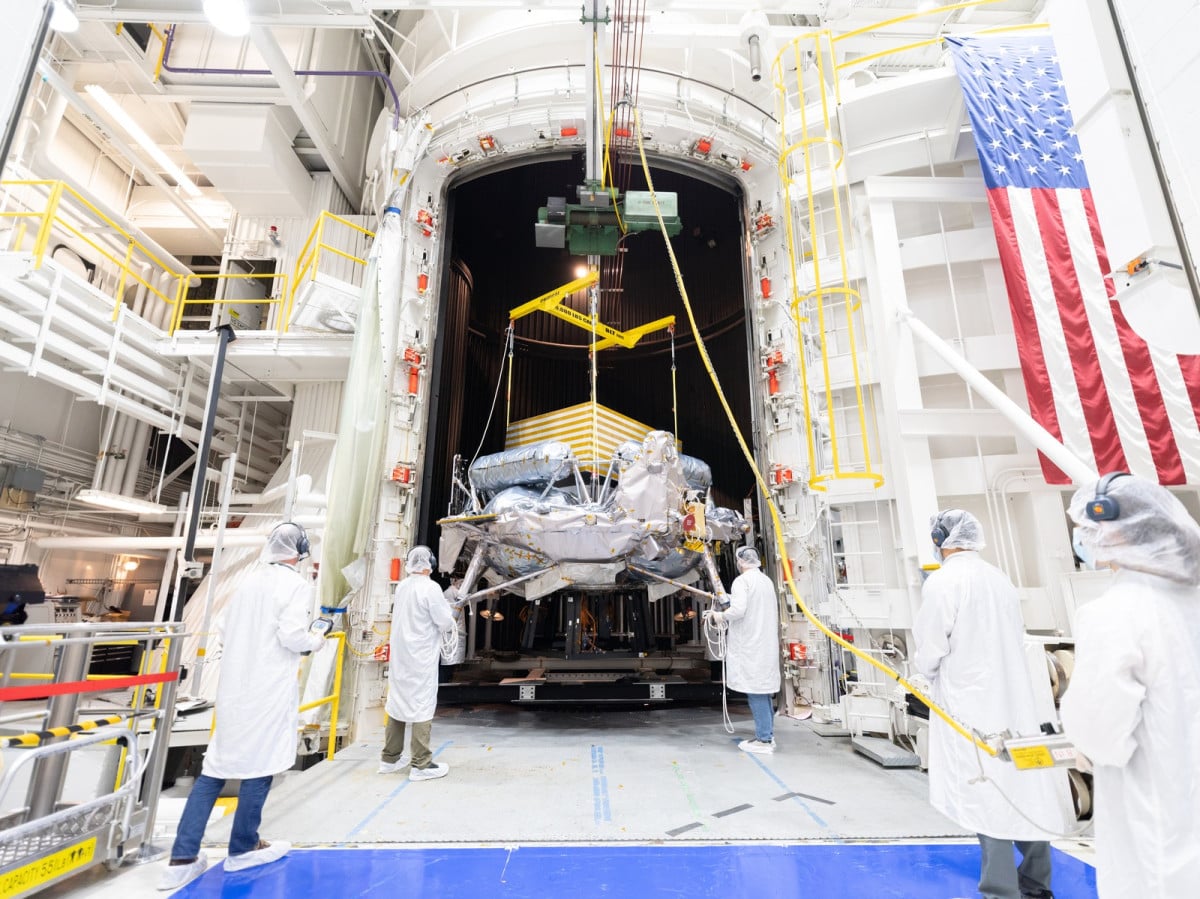
Griffin-1 at JPL during environmental testing. The yellow-striped box on top simulates the rover payload; it is not FLIP. Photograph taken August 31, 2026. Credit: NASA/JPL-Caltech. [2]
The hardware has already passed a substantial round of Earth testing. NASA’s Jet Propulsion Laboratory reports that Griffin completed its environmental test campaign in September, including checks intended to expose it to launch stresses and the temperature extremes of space. It then returned to Pittsburgh for final assembly. Those are meaningful preparation milestones; the lunar landing remains ahead. [2]
Schedule check — November 8, 2026: NASA’s public mission page still lists late 2026. Jeff Foust’s October 26 report describes a NASA presentation whose slide listed no earlier than January 2027. A precise launch or landing date for November 9–15 is not established by the sources reviewed here. The article therefore treats Griffin as an upcoming mission. [1][16]
02 · GRIFFIN-1 / THE LUNAR FOOTHOLD
The rocket, the lander and the rover do different jobs
Three names belong together here. SpaceX’s Falcon Heavy is the launch vehicle. Griffin-1, developed by the former Astrobotic operation now known as Voyager Lunar Systems, is the lander. FLIP, built by Astrolab, is the rover carried to the surface. NASA is buying lunar delivery and flying investigations through its Commercial Lunar Payload Services program, usually shortened to CLPS. [1][2]
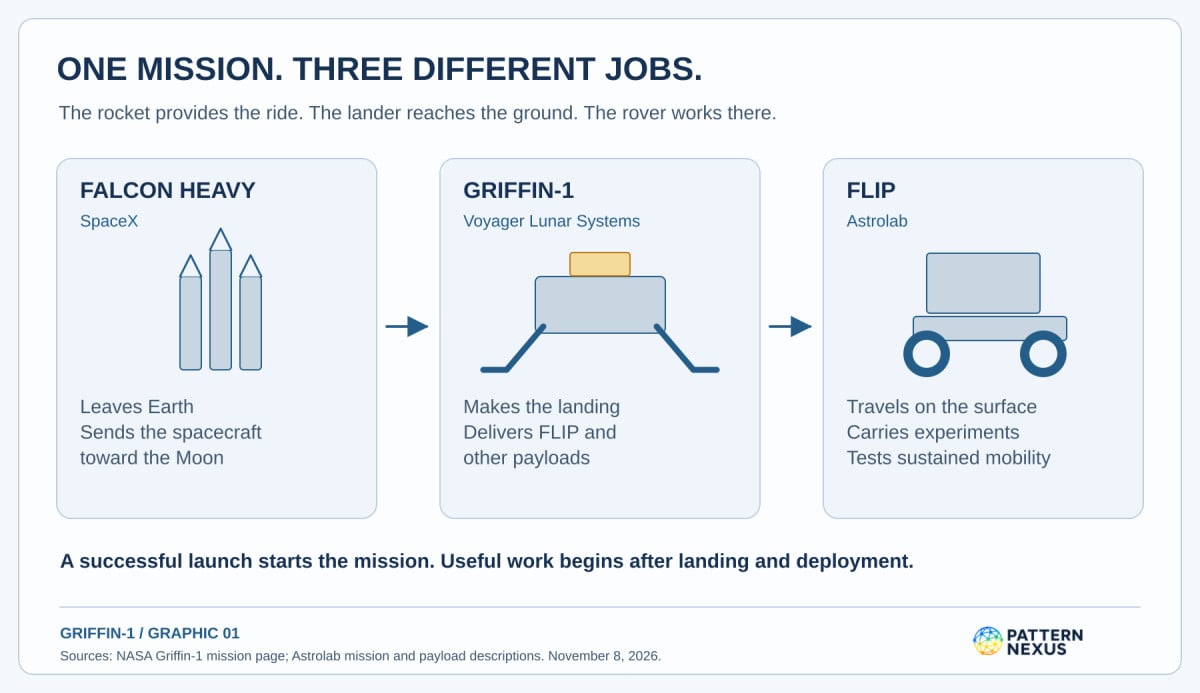
The hardware names describe different jobs within the same delivery. A successful launch still leaves the landing, rover deployment and surface work ahead. Credit: Pattern Nexus; sources: NASA and Astrolab. [1]
FLIP is a four-wheeled vehicle with a mass of about 480 kilograms, roughly 1,060 pounds. Its large wheels and upright panel give it a very different appearance from the small robotic vehicles many people imagine. It is designed as a platform for experiments and as a way to learn how larger lunar rovers should operate. [4][6]
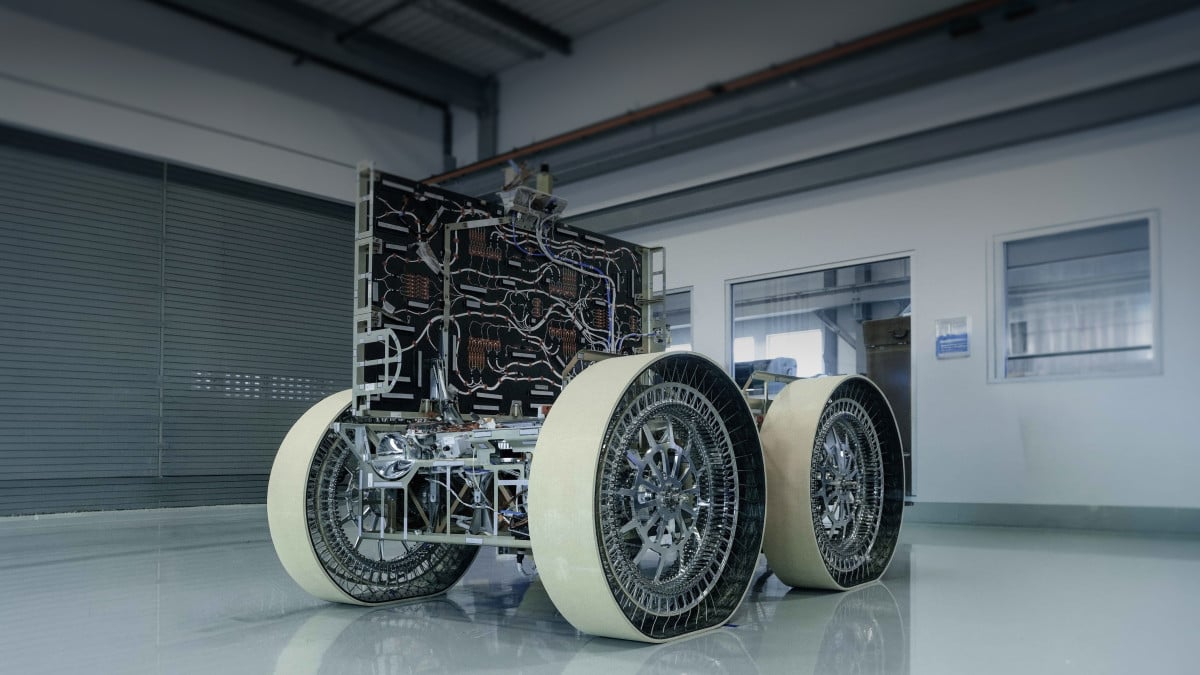
FLIP is the rover. Its flight is intended to test equipment and operating methods that can inform later, larger lunar vehicles. Ground photograph from Astrolab’s FLIP page. Credit: Astrolab. [5]
The mission also carries the history of an earlier plan. Griffin was originally associated with NASA’s VIPER water-searching rover. After VIPER’s 2024 cancellation, the lander remained in the delivery program, and Astrolab developed FLIP for the available ride. FLIP uses components intended to inform the larger FLEX rover. That history explains why older Griffin coverage often shows a different vehicle. [6]
For this mission, the useful question is what FLIP can demonstrate. A component that works in a factory becomes much more persuasive after it works on the Moon. Future operators can use that experience when choosing equipment, preparing routes and deciding what to send next.
03 · GRIFFIN-1 / THE LUNAR FOOTHOLD
The valuable ground is where several advantages overlap
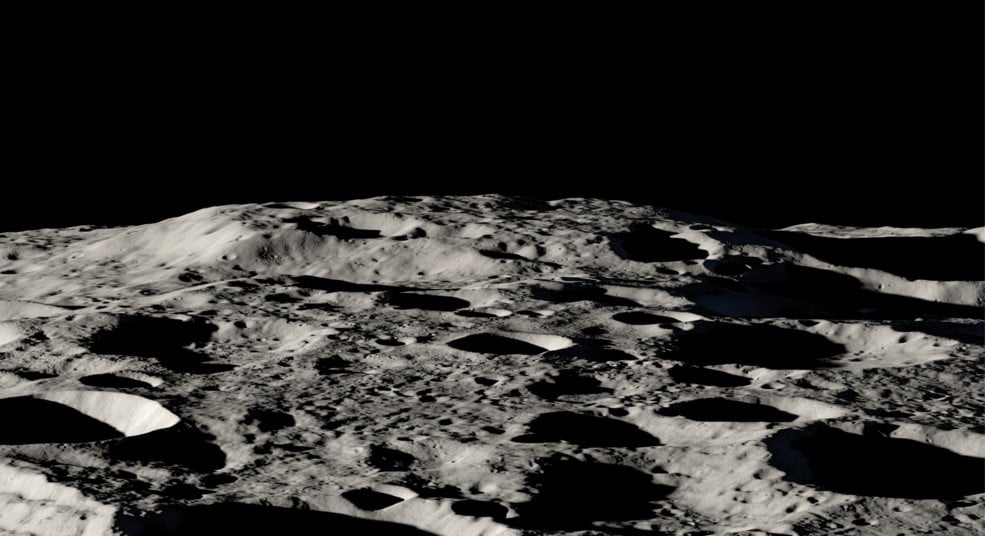
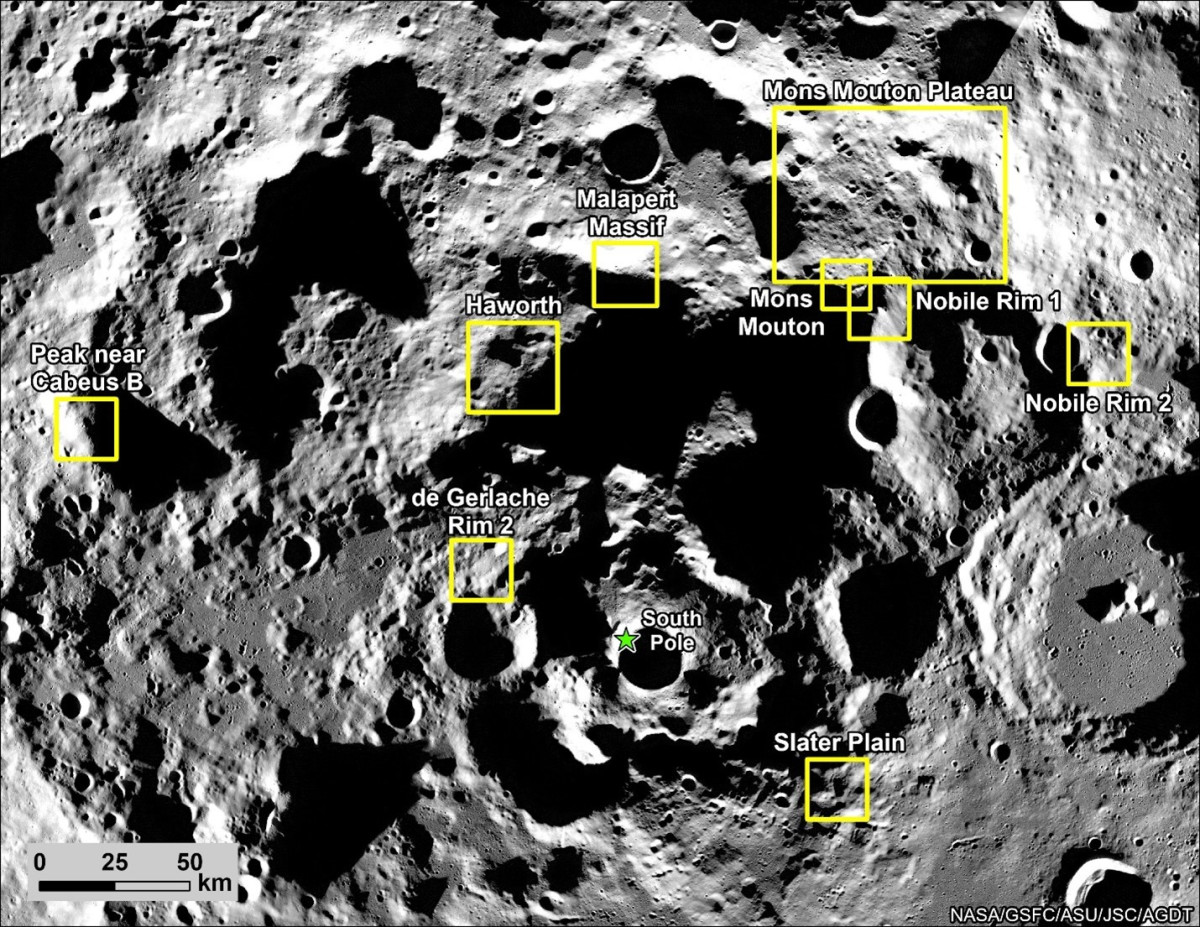
Griffin’s target is near Mons Mouton, beside the Nobile crater region. Mons Mouton is elevated, relatively broad terrain near the lunar south pole. NASA’s geographic description places it adjacent to Nobile’s western rim. These names describe neighboring features, not an instruction to land at the bottom of the crater. [3][7]
Geographic orientation from NASA’s 2024 candidate-region map. The outlined areas are historical crewed-landing candidates, not Griffin’s landing ellipse or a current mission schedule. Credit: NASA/GSFC/ASU/JSC/AGDT. [23]
The south pole puts attractive resources close to difficult operating conditions. Some elevated locations receive extended sunlight, which helps solar equipment. Nearby low areas can remain deeply shadowed and cold enough to preserve ice. Slopes, rocks and long moving shadows complicate the route between places that look close on a map. The quality of one location depends on how several of those conditions fit together. [8]
Voyager describes site selection as a balance among reachable terrain, useful lighting, safe landing conditions and communications. The rover also needs a workable radio connection with the lander. A ridge that looks excellent for sunlight can still create problems if the surrounding terrain blocks the signal or makes driving hazardous. [3]
NASA’s visualization of Mons Mouton. The elevated terrain is adjacent to Nobile’s western rim. This is geographic context, not a published final touchdown coordinate. Credit: NASA/Scientific Visualization Studio. [7]
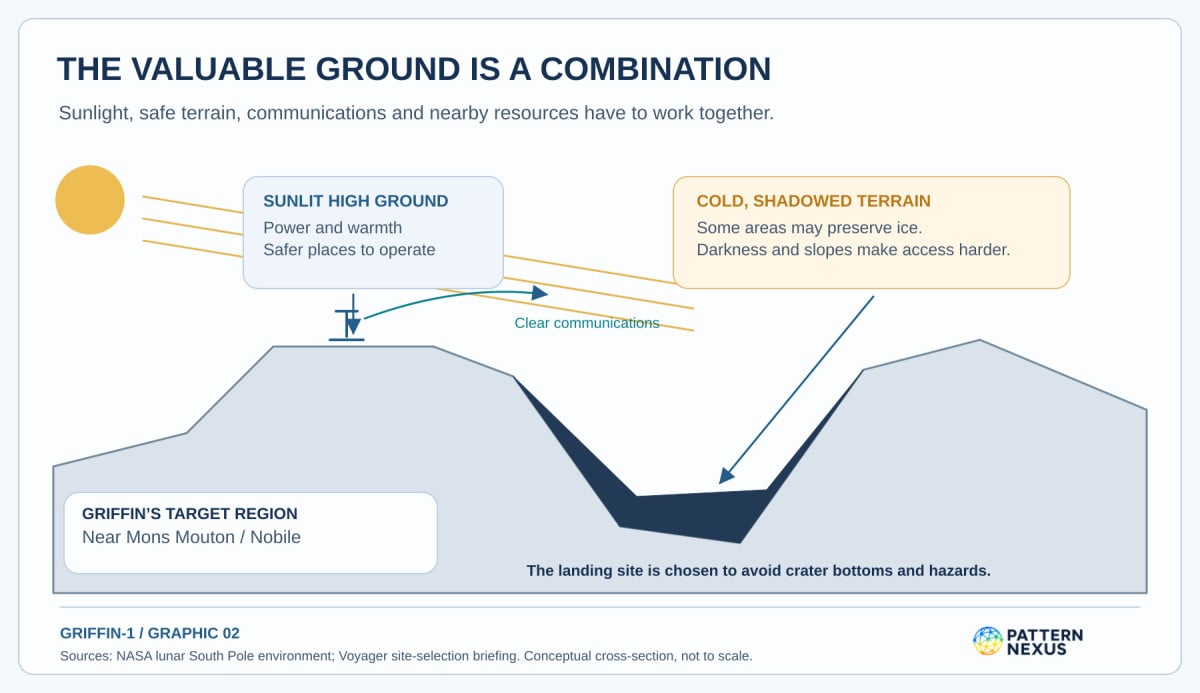
Useful terrain combines several advantages. This conceptual cross-section is not a map or a prediction of FLIP’s route; the mission is not presented as a drive into a dark crater. Credit: Pattern Nexus; sources: NASA and Voyager. [3]
Water adds the larger economic possibility. If recoverable deposits can be found and processed, water could support crews, provide oxygen and supply ingredients for rocket propellant. Every useful resource produced locally could reduce part of the burden of bringing supplies from Earth. The equipment and energy needed to extract, process and store it would still have to be built. [9]
There is no demonstrated mine waiting beside Griffin’s landing site. A useful deposit needs enough material, a workable location and a practical way to recover it. That is exactly why local measurements have value. They help turn a promising region into a place that can be planned around.
04 · GRIFFIN-1 / THE LUNAR FOOTHOLD
FLIP will help investigate what is actually there
One of FLIP’s payloads is the Puli Lunar Water Snooper. ESA’s November 4 project update confirms its flight opportunity on the rover. The instrument measures neutron signals that can be used, with calibration, to estimate hydrogen in the upper ground. Surface measurements can examine local variations that are difficult to resolve from orbit. [10]
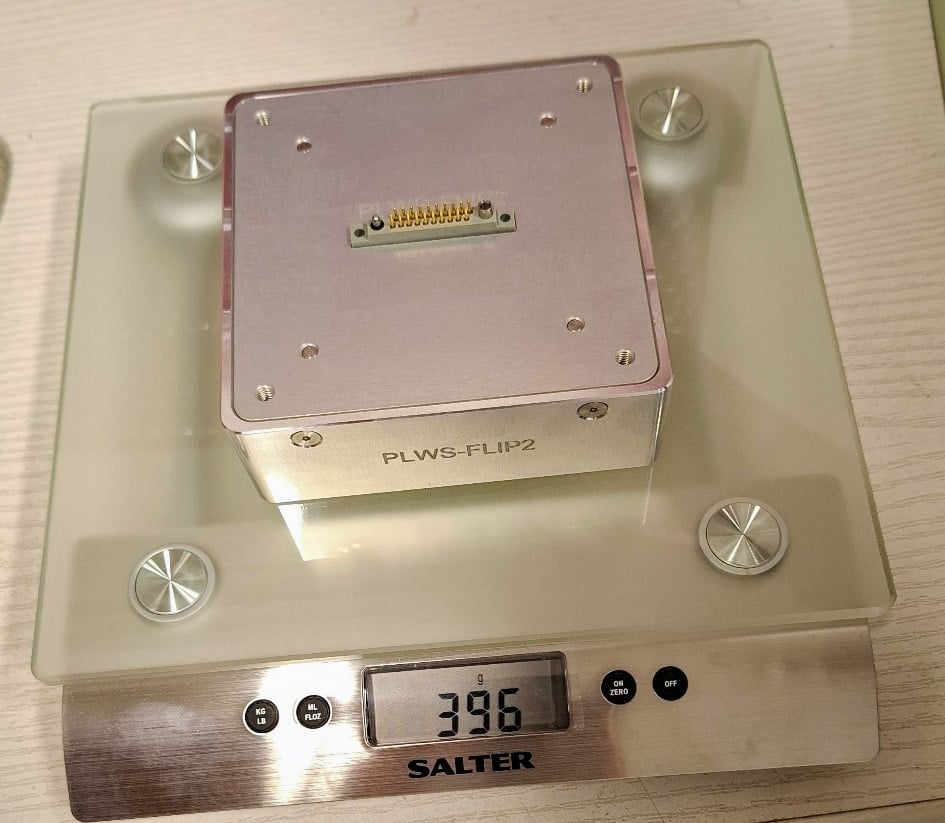
The compact Puli Lunar Water Snooper FLIP2 unit before delivery, shown on a scale. It is intended to measure neutron signals used to investigate hydrogen in the ground. Credit: Puli Space Technologies, via ESA Space Solutions. [10]
That is prospecting evidence. It does not by itself establish a usable ice deposit, its purity or the cost of mining it. Think of it as a way to identify where the next investigation should concentrate. Better measurements can help later teams avoid spending a far larger mission budget on the wrong assumptions. [10]
Other payloads address equally practical problems. NASA’s laser-based mapping experiment is intended to help identify terrain and obstacles. A dust experiment studies how material on equipment affects performance. Imaging and reflector experiments add information about the surface and the rover’s location. These are the kinds of measurements that help later equipment do useful work without losing power, visibility or position. [11]
Put those tasks together and the rover begins to look like an early site investigation. Where can machinery travel? What affects its operation? Which places deserve another look? I would want those answers before sending more expensive equipment, depending on a particular route, or committing people to work there.
05 · GRIFFIN-1 / THE LUNAR FOOTHOLD
The computer and the battery belong in the same story
FLIP also carries HPE’s Spaceborne Computer-4. HPE says the system is intended to test advanced computing on the lunar surface, including image analysis, AI workloads and processing laser-mapping data. These are planned experiments, with the results still to be established after deployment. [12]
The practical aim is to do more useful processing where the data is collected. A future robot that can interpret terrain locally has more options than one that depends on sending every observation home before it can proceed. Demonstrating computing under lunar conditions helps establish what later machines might reliably be allowed to handle for themselves. [12]
But none of that helps if the equipment runs out of usable power or gets too cold to operate. Astrolab lists survival through the lunar night as a mission objective and describes a specialized battery enclosure developed with Venturi. The actual periods of light and darkness at a polar site depend on the surrounding terrain. Continued operation is an engineering result the mission still has to earn. [4][8]
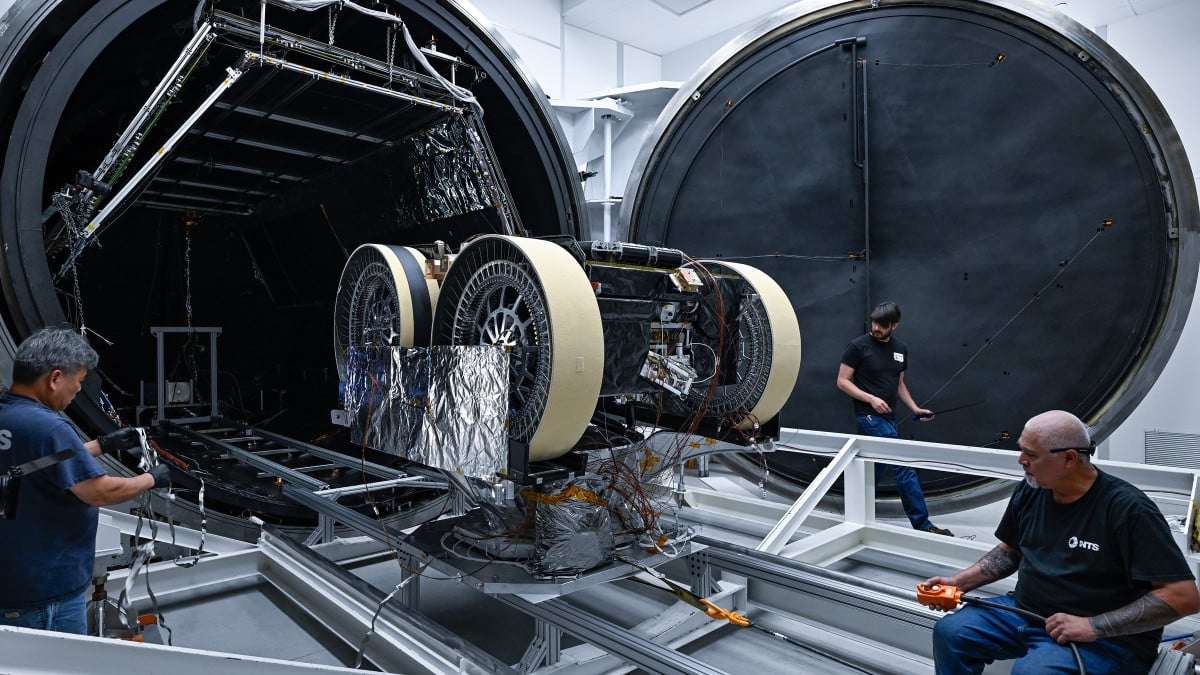
FLIP in a ground-testing facility. Surviving periods without sunlight is a mission objective that must still be demonstrated on the Moon. Credit: Astrolab. [4]
This is where an impressive landing begins to turn into infrastructure. A vehicle that can resume work after darkness offers a different planning horizon. Later missions could build on experience with energy storage, thermal protection and recovery procedures. Even a short mission can return useful information; longer reliable operation gives the next team more to work with.
The connection to AI is physical all the way down. Software depends on a functioning computer. The computer depends on electrical power and temperature control. Mobility depends on wheels, actuators, navigation and a usable route. Each part has to support the others in the same place, at the same time.
06 · GRIFFIN-1 / THE LUNAR FOOTHOLD
China is assembling its own polar exploration system
China’s Chang’e-7 combines an orbiter, lander, rover and hopping vehicle. Together, those elements are intended to investigate the south-pole environment and resources. A hopper can approach shadowed terrain differently from a rover that must drive across the surface. China’s broader program also retains a goal of landing people on the Moon before 2030. [13]
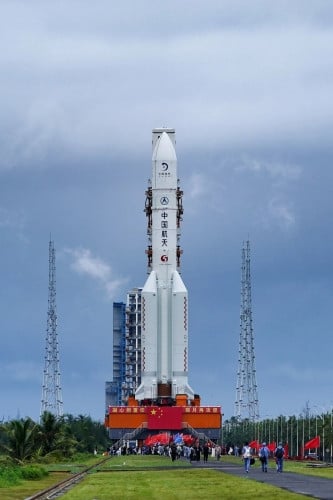
Chang’e-7 and its Long March 5 rocket during rollout on August 19, 2026. China announced four days later that the mission could not launch in the planned 2026 window. Credit: Su Dong / China Manned Space Agency, via CNSA. [15]
The mission reached a visible preparation milestone when its Long March 5 rocket rolled toward the launch area on August 19. On August 23, China’s space authorities announced that conditions were not suitable for carrying out the mission in its planned 2026 window. That official notice did not give a replacement date. [14][15]
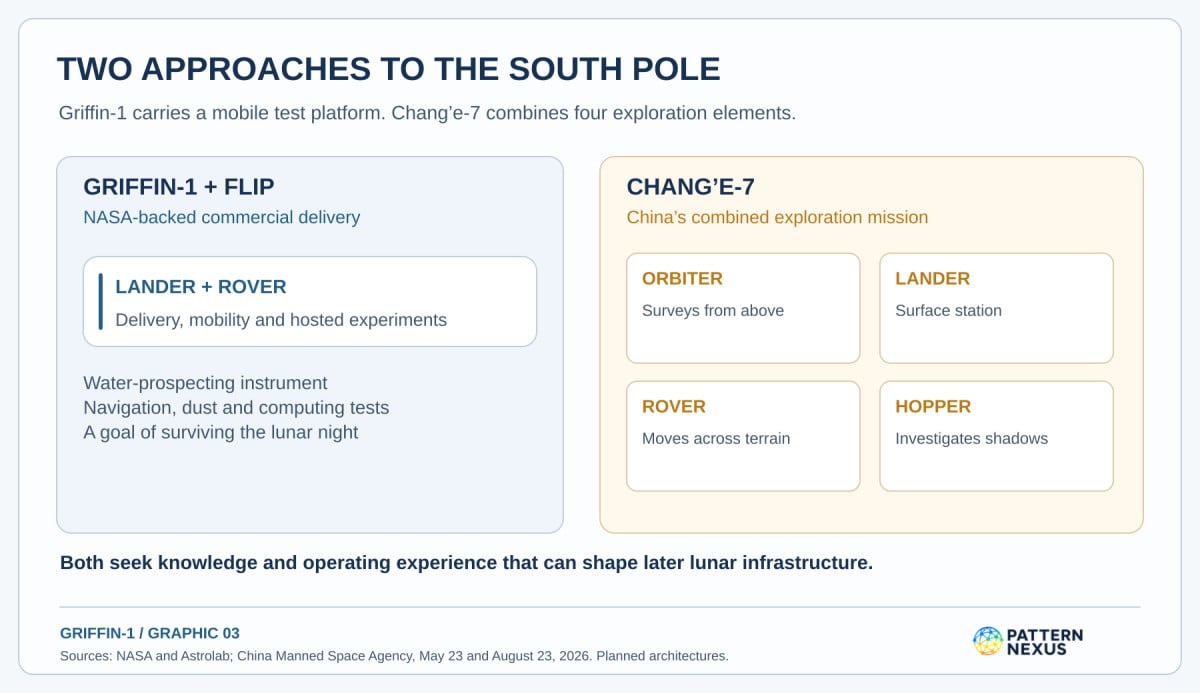
The programs approach the south pole with different combinations of hardware. The diagram shows planned functions, without implying equal capabilities or a confirmed launch order. Credit: Pattern Nexus; sources: NASA, Astrolab and China Manned Space Agency. [13]
NASA’s concern about access is already public. In reporting on Jared Isaacman’s September remarks, Jeff Foust records the NASA administrator’s warning that Chang’e-7 “could have potentially denied access to some of the most interesting spots.” Isaacman was discussing Shackleton. Griffin’s stated target is near Mons Mouton and Nobile. These are different locations within the wider south-pole competition. [3][16]
The argument is still consequential. A country that surveys useful terrain, proves its equipment and establishes working infrastructure can influence where later activity gathers. China and the United States are each trying to develop that ability. A delay gives the other program time, but useful advantage still has to be created with missions that work.
07 · GRIFFIN-1 / THE LUNAR FOOTHOLD
Being there first can change what everyone else does
The Moon is enormous, but the ground that combines useful lighting, manageable slopes, communications access and nearby resource potential is much more limited. Competition can concentrate around those combinations long before there is a large settlement. The value lies in the conditions that make continued work possible.
On Earth, a useful site becomes more valuable when roads, power and services reach it. Other activity begins to organize around what already works. On the Moon, the same tendency could develop around reliable delivery, communications coverage, operating knowledge and access to useful terrain. The earliest dependable systems could shape the choices available to later arrivals.
That does not require a country to own the entire region. A company might prefer to send its instrument on a proven vehicle. A partner might design equipment around an available communications service. Mission planners might choose terrain with better local measurements. Repeated choices like those can direct investment and operating experience toward the same network.
There is also a real coordination problem. Landings, surface travel and other operations can interfere with nearby equipment. Once someone is already working in an area, later arrivals must take that activity into account. The location and nature of the existing operation become facts that other planners have to address.
The legal framework does not turn this into automatic sovereignty. The Outer Space Treaty bars national appropriation of the Moon and provides for free access. The Artemis Accords describe safety zones as temporary arrangements for notification and coordination, sized around the activity and its risks. They expressly retain the principle of free access. A rover does not give either country a deed to a crater. [17][18]
My assessment is that the strongest early advantage will come from useful capability and continuity. A working system can attract partners, reduce some uncertainties and make follow-on investment easier to justify. It could also create disputes over how nearby activities should be coordinated. The scale of that influence will depend on what is actually built and how it is operated.
That is how I read the stakes around Griffin. It can contribute to a stronger American and partner presence, especially if its results feed into subsequent deliveries. The claim that one successful rover secures permanent dominance skips all the work that has to follow it.
08 · GRIFFIN-1 / THE LUNAR FOOTHOLD
What success would establish, and what failure would cost
I would judge Griffin through a sequence of results. The first is a safe landing in a condition that lets the payloads work. The next is FLIP getting off the lander and moving. After that come measurements, functioning communications, useful computing tests and whatever duration of operation the hardware can sustain. The public touchdown image would capture only one part of that sequence.
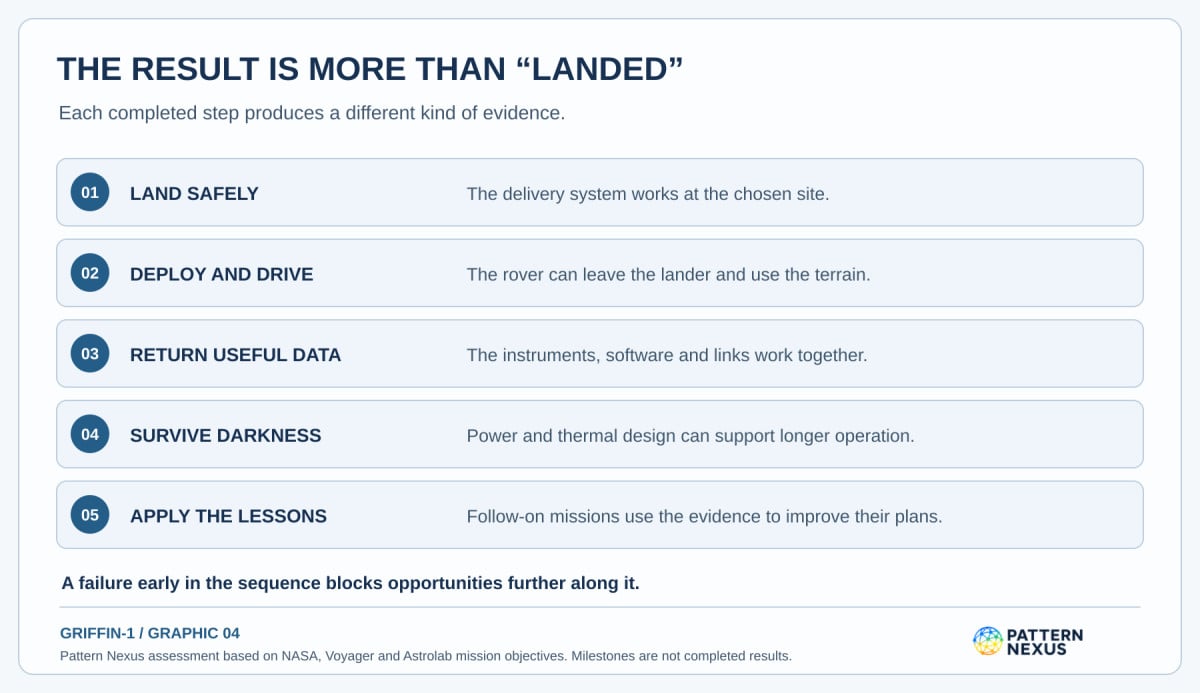
The mission can produce partial success. Each completed stage establishes something useful; the value increases when later missions apply the results. Credit: Pattern Nexus analysis, informed by mission objectives. [4]
A strong result would establish several capabilities together. The lander would demonstrate delivery to demanding terrain. The rover would provide experience with mobility and payload operations there. Instrument teams would receive information they can compare with their expectations. If FLIP also survives darkness and resumes work, that would add evidence for longer surface operations.
The larger payoff would come when those lessons change a later mission: a safer deployment, a better route, an improved battery enclosure, a stronger instrument design or a more informed site decision. That is where one successful operation can reduce uncertainty for the next. It does not remove all risk, but it changes the quality of the starting assumptions.
A failed landing would cost more than the vehicle. It could prevent every payload from getting its intended surface opportunity. The loss would include measurements that never happened, operating experience that was never gained and time needed to investigate the failure. A replacement opportunity would have to fit into another delivery schedule and another budget.
Partial outcomes matter too. Griffin might land but leave the rover unable to deploy. FLIP might drive and return valuable data without surviving its first extended darkness. An instrument might fail while others work. Describing the whole mission with a single win-or-loss label would conceal what the next mission can actually learn from it.
For China, an American setback could widen the opportunity to establish useful polar operations first. Whether it does so depends on China’s own schedule and performance. Both programs still face the same basic requirement: deliver hardware that works on difficult ground. A Griffin failure would be a serious lost opportunity within a wider American campaign; it would not decide the entire future of the Moon.
09 · GRIFFIN-1 / THE LUNAR FOOTHOLD
The next deliveries are already part of the plan
NASA’s November 7 announcement makes the wider campaign more concrete. Eight companies were selected for the next CLPS contracting framework, with a combined ceiling of $10 billion over ten years. That is an upper contract limit, not money already spent or a guarantee that every planned delivery will fly. [19]
The same announcement advanced PROMISE, a separate nuclear-powered rover targeted for launch in late 2028, along with other transportation and surface-infrastructure work. PROMISE is intended for a longer investigation of polar terrain and resources. It is not the rover aboard Griffin. [19]
NASA’s concept for PROMISE, announced November 7 with a target launch in late 2028. This is a separate future rover, not the vehicle riding on Griffin-1. Credit: NASA. [19]
This gives Griffin a place in a developing sequence. Early missions test delivery and operation. Later hardware can investigate more demanding locations and support a broader range of work. Continued funding, successful engineering and a dependable flow of launches will determine how much of that sequence becomes real.
The larger trajectory is consistent with the questions in the September Pattern Nexus space update: who can supply the network, who can keep it functioning, and which partners begin to depend on it? The October update followed those questions into lunar utilities. Griffin lets us examine the first layers at ground level.
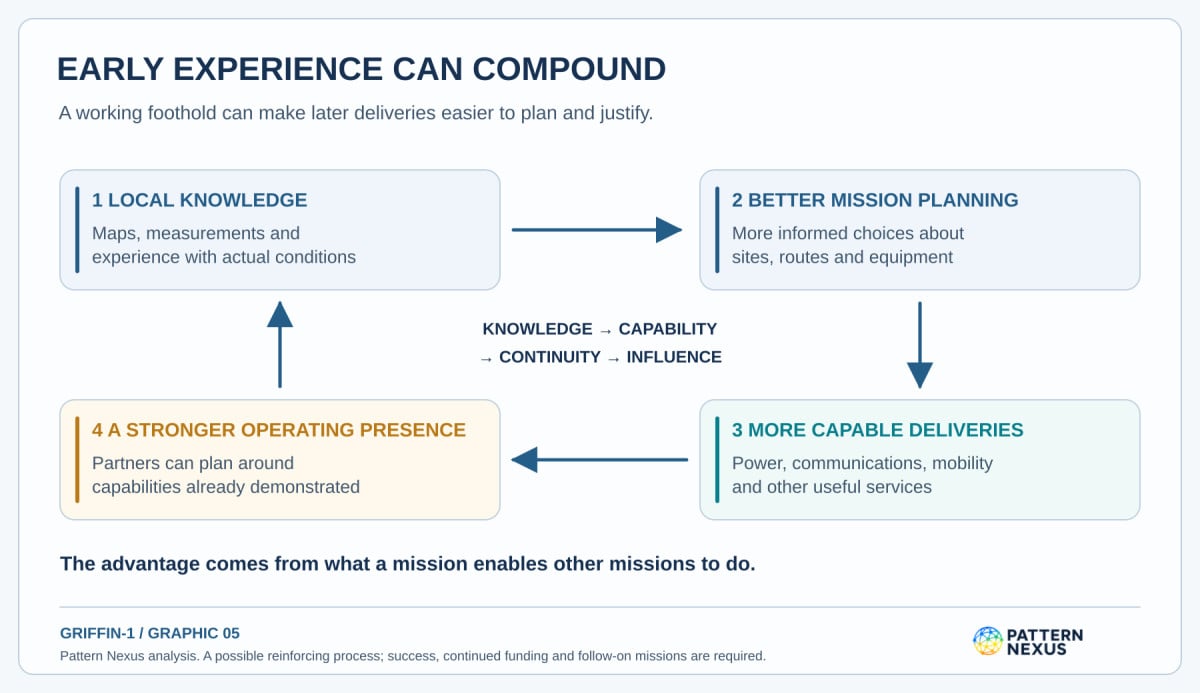
Pattern Nexus analysis: early operating experience can reinforce later capability. The loop depends on successful execution, funding and repeated deliveries. Credit: Pattern Nexus analysis.
A productive foothold grows through accumulated capability. Better knowledge supports better planning. Better planning can support more capable deliveries. Those deliveries make additional work possible, giving the system more reasons to continue. Failure can interrupt that process; repeated success can strengthen it.
For me, that is the consequence to watch. Griffin-1 could help the United States and its partners establish the experience that later lunar operations are built around. China is pursuing its own path toward the same kind of durable presence. The long-term advantage will belong to the programs that can deliver, learn, return and keep working.
10 · GRIFFIN-1 / THE LUNAR FOOTHOLD
Reader questions
Is Griffin-1 an Artemis mission?
It is a NASA-backed commercial lunar delivery supporting the broader Artemis and Moon Base effort. Falcon Heavy launches it, Griffin makes the landing, and Astrolab’s FLIP is the rover. It is separate from a crewed Orion mission. [1][11]
Will FLIP dig up lunar ice?
The confirmed Water Snooper payload investigates hydrogen through neutron measurements. That can inform water prospecting. It does not establish a mining operation or prove that a particular deposit can be recovered economically. [10]
Would a successful landing give the United States control of a crater?
It would establish equipment and operating experience at a location. It would not create legal ownership. Any wider influence would have to develop through continued activity, useful services, partnerships and how nearby operations are coordinated. [17][18]
Sources and related reading
Mission descriptions and dates come from the sources below. The discussion of future strategic advantage is Pattern Nexus analysis.
- NASA — Griffin-1 mission overview. Current mission page, checked November 8, 2026.
- NASA / JPL — Griffin-1 environmental testing and photographs. October 12, 2026.
- Voyager Technologies — How Voyager chose Griffin-1’s lunar landing site. October 22, 2026.
- Astrolab — Mission 1. Current mission page, checked November 8, 2026.
- Astrolab — FLIP rover specifications. Current product page, checked November 8, 2026.
- Walker, Randell and Shar / Astrolab — The FLIP Mission to Mons Mouton: Project Update. Lunar and Planetary Science Conference, 2026.
- NASA — Moon mountain name honors Melba Mouton. February 15, 2023.
- NASA — The lunar South Pole region. Current reference page, checked November 8, 2026.
- NASA Science — Lunar ice deposits are widespread. NASA lunar resource research.
- ESA Space Solutions — Puli Water Snooper. Updated November 4, 2026.
- Astrolab — NASA payloads for FLIP. May 18, 2026.
- HPE — Spaceborne Computer-4 on FLIP. October 20, 2026.
- China Manned Space Agency / State Council — Chang’e-7 mission overview. May 23, 2026.
- China Manned Space Agency — Chang’e-7 cannot fly in the planned 2026 window. August 23, 2026.
- CNSA / China Manned Space Agency — Chang’e-7 and Long March 5 rollout. August 19, 2026.
- Jeff Foust / The Space Review — Dodging bullets and firing blanks. October 26, 2026.
- Outer Space Treaty — Articles I and II. 1967 treaty text, NASA archive.
- NASA — Artemis Accords. Current reference page, checked November 8, 2026.
- NASA — Moon Base transportation, technology and science awards. November 7, 2026.
- Pattern Nexus — Moon Base Alpha: Why the Moon Is Becoming Infrastructure. January 2026.
- Pattern Nexus — The Space Infrastructure Race Has Entered Its Next Phase. September 23, 2026.
- Pattern Nexus — The Space Buildout Is Becoming Real. October 28, 2026.
- NASA — South-pole candidate landing-region map. October 28, 2024.
Research cutoff: November 8, 2026, U.S. Central time. Mission dates are planning statements unless identified as completed events. Diagrams explain relationships and planned functions; they do not show measured results, confirmed flight routes or territorial boundaries. Strategic outcomes are the author’s analysis. Official photographs, manufacturer imagery and artist’s concepts are identified in their captions.
A useful place on the Moon becomes strategically significant when someone can reach it, understand it and keep working there. Griffin-1 is one of the missions that could help establish that capability.
Article overview
Griffin-1 and Astrolab’s FLIP rover could give NASA and its partners valuable experience at the lunar south pole. The larger competition with China runs through water, power, mobility, communications, and the ability to keep working after landing.
Qual è la tua reazione?
 Mi piace
0
 Non mi piace
0
 Amore
0
 Divertente
0
 Wow
0
 Triste
0
 Arrabbiato
0

Nexus (Christopher)
Founder of Pattern Nexus. I research markets, macro, geopolitics, AI, history, ancient systems, and the patterns most people overlook. I’m also building Market Radar, a trading scanner designed to read pressure, risk, confirmation, and setup quality before ch…
Related research
Moon Base Alpha: Why the Moon Is Becoming Infrastructure
Moon Base Alpha isn’t sci-fi anymore. Starship, Artemis, power constraints, and south-pole logistics are converging into real lunar infrast…
5 shared topics, same research avenue.
NASA’s Moon Base, MoonFall, Nuclear Missions, and the Drone Layer of Mars
A Pattern Nexus analysis of NASA’s 2026 surface-first lunar architecture, MoonFall hopper drones, lunar nuclear power, nuclear-electric Mar…
4 shared topics, same research avenue.
The Polar Vortex Reversed on November 10. NASA Has Confirmed It—Now We Track the Cold Delivery
NASA has confirmed an exceptionally early 60°N 10-hPa easterly reversal. This report separates analyzed observations from forecasts and tra…
3 shared topics, same research avenue.
The Space Infrastructure Race Has Entered Its Next Phase: Weapons, Orbital AI, Sovereign Networks, and the Moon
From September 4–23, space infrastructure accelerated on almost every front. Isar Aerospace reached orbit from continental Europe. India po…
3 shared topics, same research avenue.
Polar Vortex Watch 2026–27: The Sun Quieted, the Vortex Hit a Record — Now the Real Test Begins
The early-season Arctic vortex has now crossed from unusual into a verified date-matched record at 10 hPa. At the same time, NOAA reports v…
3 shared topics, same research avenue.
The Space Infrastructure Race Just Escalated: PALLAS-1, Orbital Warfare, and NASA’s Mars Network
Three developments in the first days of September 2026 pushed the space-infrastructure thesis forward again. China’s Galactic Energy succes…
3 shared topics, same research avenue.
Space Is Becoming Infrastructure: The Two Weeks That Exposed the New Orbital Operating System
Roman launched, Falcon 9 hit 100 flights, China landed Zhuque-3, NASA expanded the Deep Space Network and autonomous spacecraft navigation,…
3 shared topics, same research avenue.Did Life on Earth Begin on Mars? Sample 25, Viking, and the Evidence We Left Behind
Perseverance sealed the strongest potential Martian biosignature yet inside Sample 25. Viking's 1976 results are being re-litigated. NASA's…
3 shared topics, same research avenue.
Commenti (0)
Security Check
Please complete the captcha to verify you are human.