
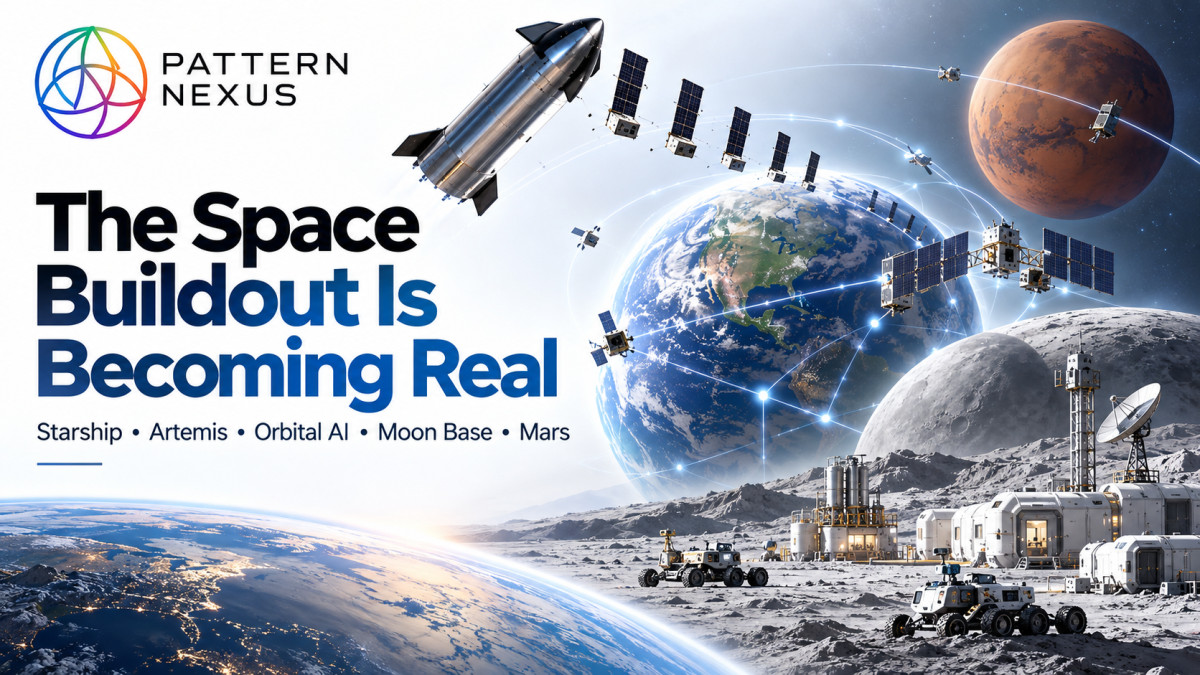
The Space Buildout Is Becoming Real: Starship Reaches Orbit, Artemis Rewrites the Moon Plan, Orbital AI Goes Live, and Mars Infrastructure Expands
Since the September 23 Pattern Nexus space update, several themes that were still forecasts have crossed into hardware and operations. Starship reached Earth orbit for the first time and deployed 26 …
Jump to a section
 Pattern Nexus Research
The Space Buildout Is Becoming Real: Starship Reaches Orbit, Artemis Rewrites the Moon Plan, Orbital AI Goes Live, and Mars Infrastructure Expands
September 24–October 28, 2026: a full Pattern Nexus update on launch, Artemis, Moon Base infrastructure, space resources, nuclear power, orbital AI and data centers, manufacturing, servicing, sovereign satellite networks, military infrastructure, Mars exploration, and the major science missions now moving through the system.
The infrastructure is starting to acquire utilities.
Since the September update, Starship reached orbit and deployed operational Starlink V3 satellites; NASA rewrote Artemis III into a 2027 systems-integration mission and moved the first Artemis surface return to Artemis IV in 2028; NASA funded lunar 5G and continued developing commercial rovers, resource systems, and nuclear power; Google's Project Suncatcher prototype launched and is operating; MMX launched toward Phobos; Varda and Starfall continued building the return lane; and military and sovereign communications networks kept expanding. The common thread is no longer simply that more hardware is going to space. Separate utility layers are beginning to appear around that hardware.
I still separate demonstrated systems from proposed ones. Starship is an orbital carrier, not yet a fully reusable transport system. Project Suncatcher proves a TPU experiment can operate in space, not that orbital hyperscale data centers are profitable. Lunar-resource hardware is advancing, but there is no operating mine. Artemis has a more explicit logistics architecture, but the 2028 landing target still depends on a long chain of unproven integrations.
This article covers September 24 through October 28, 2026. Earlier facts appear only when they are needed to audit an earlier Pattern Nexus thesis or explain the current system. Completed launches and operating hardware are separated from target dates, contract awards, environmental-review envelopes, and proposed architectures.
This follows The Space Infrastructure Race Has Entered Its Next Phase, The Space Infrastructure Race Just Escalated, Space Is Becoming Infrastructure, and Moon Base Alpha. I am using this update to test those earlier claims against what has actually happened.
The space story has changed again, and this time the change is structural
I have been writing some version of the same argument for almost two years now: the next phase of space development was never going to be defined by one rocket, one flag, one Moon landing, or one company. The important transition would come when the separate pieces began connecting into a system. That is what I think we are finally starting to see. Over the last month, transportation, power, communications, mobility, computing, manufacturing, resource processing, return logistics, and military networking all moved at the same time, and several of those pieces crossed from slideware or future planning into hardware that is actually operating.
Starship reaching orbit matters because it was no longer flying only to prove that Starship could survive another test. It carried and deployed operational Starlink V3 satellites. NASA rewriting Artemis III matters because it exposed just how complicated the lunar logistics architecture has become and forced the program to test docking, software, crew procedures, and two competing commercial landers in low Earth orbit before committing astronauts to the Moon. Google putting a Project Suncatcher TPU prototype into orbit matters because orbital AI is no longer just an interesting paper exercise. NASA awarding a lunar 5G contract, advancing commercial rovers, funding resource systems, and expanding nuclear-power work matters because those are the kinds of things a base actually needs after the landing spectacle is over.
The same thing is happening farther out. JAXA's MMX spacecraft is now physically on the way to the Mars system. NASA is separating Mars communications, nuclear-electric transport, aerial reconnaissance, and surface science into different programs that can mature independently. Varda and Starfall are working on the opposite side of the launch problem by making downmass more routine. The Space Development Agency continues filling out a low-latency military transport layer. Europe is deciding which pieces of the post-ISS, lunar, navigation, and communications stack it wants to own. China continues feeding launch demand with sovereign broadband and observation constellations while commercial launch firms iterate underneath that demand.
That is why I would update the Pattern Nexus thesis again. I do not think the useful sentence anymore is simply that space is becoming infrastructure. The better description is that space infrastructure is beginning to acquire utilities. A utility is different from a mission. A mission carries everything it needs and succeeds or fails largely on its own. A utility is a service that other missions can consume: bandwidth, navigation, power, transportation, compute, mobility, servicing, propellant, or return capacity. Once those services exist independently, the economics and the pace of development both change because every new project does not have to reinvent the entire stack from scratch.
What changed from the September framework, and what did not
The last September space package left several major items in a pending state. Starship Flight 14 had not yet proven sustained orbital payload deployment. Artemis still carried the public expectation that Artemis III would be the first crewed lunar landing. Orbital AI was moving from theory toward demonstrations, but there was not yet a Google TPU experiment operating in space. MMX was still sitting on the ground. Commercial satellite servicing looked promising but had not yet been tested against some of the realities that eventually killed NASA's much larger OSAM-1 program and failed to save Swift.
One month later, some of those probability weights have changed significantly. Starship has now proven that it can reach orbit and deploy operational payloads, even though neither stage has demonstrated the rapid full-system reuse that would justify treating it like an airline. Google has confirmed contact with the Project Suncatcher prototype and says it is operating as expected, which moves orbital compute into a real hardware-validation phase without proving the economics of orbital hyperscale. MMX launched successfully and separated into its planned trajectory, so the Phobos sample-return mission moved from schedule risk to cruise risk. NASA's lunar plan moved in the opposite direction: the landing date slipped, but the architecture became more explicit and, in my view, more honest about the integration work required before people are sent to the surface.
There were also useful failures. NASA began shutting down OSAM-1 after years of cost, schedule, and technical problems. The emergency commercial attempt to raise Swift's orbit did not work, and the observatory later ended operations as atmospheric drag continued pulling it down. Those outcomes do not invalidate satellite servicing. They narrow the business case. Servicing spacecraft that were never designed to be serviced is a different problem from servicing future spacecraft built with standardized docking, refueling, power, and data interfaces. That is an important distinction because the commercial servicing market may ultimately grow by designing the next generation correctly rather than rescuing every legacy satellite already in orbit.
This is the reason I keep the PN framework separate from the individual forecasts. The architecture can be directionally right while the exact vehicle, date, or provider changes. What matters is whether the underlying demand for transportation, bandwidth, power, maintenance, and local resources continues growing. Through October, that underlying demand did not weaken. It became more specific.
| September status | October update | PN read |
|---|---|---|
| Starship orbital mission pending | Reached orbit and deployed 26 Starlink V3 satellites. | Orbital carrier capability is real; routine full reuse is not. |
| Artemis III expected as lunar landing | Converted to a 2027 LEO integration mission; Artemis IV targets 2028 landing. | Schedule slipped, but the operational architecture became more credible. |
| Orbital AI entering test phase | Project Suncatcher prototype is operating in orbit. | Edge compute is becoming real; orbital hyperscale remains speculative. |
| Mars layers mostly planned | MMX launched; SR-1 advanced; Mars telecom remains contracted. | Mars infrastructure is decomposing into separate transport, science, comms, and power programs. |
| Servicing market emerging | Otter launched; OSAM-1 shut down; Swift rescue failed. | Commercial servicing survives, but standardized future interfaces matter more than heroic legacy rescues. |
Flight 14 changed the status of Starship, but not in the simplistic way either side wants to frame it
Starship Flight 14 launched on September 28 and became the first Starship mission to enter Earth orbit. That alone was a program milestone, but the more important detail for the infrastructure thesis was the payload. SpaceX deployed 26 Starlink V3 satellites, making this the first Starship mission carrying operational constellation hardware rather than a purely developmental payload.[2][3]
The flight also showed why I am not ready to call Starship a mature transportation system. One of the Ship's engines shut down early after stage separation, the planned multi-orbit mission profile was shortened, and the booster experienced engine losses during descent before its planned ocean splashdown. SpaceX was able to work around those problems well enough to reach orbit, deploy the satellites, and control the Ship's return. That is a strong demonstration of redundancy and operational learning, but neither stage returned for reuse. A vehicle that survives anomalies and completes the primary payload mission is valuable. A vehicle that can do that, land both stages, turn them around, and repeat the process on a predictable schedule is the thing SpaceX is still trying to build.
That nuance matters because Starship's role is expanding faster than the reuse demonstration. Starlink V3 creates immediate internal demand for enormous payload volume. Artemis creates a separate demand for tanker launches, depot operations, crewed lander missions, and eventually cargo. If Starship can only fly occasionally, those architectures stay fragile. If it can fly dozens or eventually hundreds of times with rapid refurbishment, the economics change completely. That is why cadence is now more important to me than another spectacular launch video.
Flight 15 preparation was already underway by late October. Booster 22 completed a 33-engine static fire on October 25, while the associated Ship still has its own test sequence ahead.[7] I would not treat any unofficial launch date as locked. The thresholds worth watching are far more specific: upper-stage recovery, ship reuse, booster reuse on the same hardware family, orbital propellant transfer, turnaround time, launch-site throughput, and whether operational payload deployment can become routine rather than exceptional.
So the October update to the Starship thesis is fairly precise. Starship is now an orbital carrier with a real customer in its own Starlink network. It is still not the fully reusable logistics system on which the most ambitious Moon and Mars architectures depend. That gap between what has been demonstrated and what the downstream plans require is where most of the next two years of the program will be decided.
The scale hidden inside the environmental paperwork is almost as important as the rockets
The launch story is moving beyond individual vehicles and into industrial capacity. The FAA is studying a SpaceX proposal for Starbase that could accommodate a first phase of up to 100 Starship launches per year and a second phase with an environmental-review envelope as high as 456 annual launches, along with corresponding landings.[4] That number is easy to misuse, so it is worth being clear: this is not a forecast that SpaceX will fly 456 times next year, and it is not a launch license for that cadence. It is the scale of activity the company wants regulators to evaluate.
I still think that is enormously revealing. Companies do not ask regulators to study hundreds of annual heavy-lift launches unless the long-term factory, pad, propellant, engine, workforce, shipping, road, range, and customer assumptions are being designed around something much closer to transportation infrastructure than traditional launch operations. The same pattern is appearing in Florida. At SLC-37, the Department of the Air Force has analyzed a substantial Starship launch-and-landing envelope and allowed certain site work to move ahead, while commercial operations still remain subject to FAA licensing.[5]
The important part is that SpaceX is not the only branch of the heavy-lift tree. NASA added Blue Origin's New Glenn 9×4 configuration to the NLS II contract in September, giving the agency another qualified path for large future payloads.[6] Stoke remains worth watching because it is attacking the upper-stage-reuse problem rather than stopping at booster recovery, while Europe's Spectrum and Ariane programs and China's commercial launch sector are all building their own national or regional alternatives.
This is how I would frame the launch market now: Falcon 9 proved that booster reuse can radically change cadence, but the next phase is not merely copying Falcon 9. The next phase is building enough competing launch capacity that one provider's failure does not freeze an entire sector, then pushing reuse higher into the stack until payload return, upper-stage recovery, and rapid turnaround become normal. We are not there yet, but the industrial planning is increasingly being built for that world.
NASA did not simply delay the Moon landing; it exposed the integration problem that had been hiding underneath the schedule
NASA's October 23 Artemis update deserves more attention than a normal schedule change. Artemis III is no longer planned as the first crewed lunar landing. NASA now intends to fly Randy Bresnik, Frank Rubio, Andre Douglas, and ESA astronaut Luca Parmitano on a roughly 14-day low-Earth-orbit mission in 2027, where Orion will perform demonstrations with test articles from both Blue Origin and SpaceX.[8] NASA now identifies Artemis IV in early 2028 as the first Artemis surface mission.[9]
It is fair to call that a delay, because the landing moved. I also think the change makes technical sense. The human landing system is not a simple capsule that gets bolted onto Orion. NASA is trying to integrate Orion with two fundamentally different commercial architectures, different docking geometries, different software, different life-support environments, different control logic, and different operational concepts. Discovering those problems for the first time in lunar orbit would be reckless. Low Earth orbit gives NASA a place to test rendezvous, docking, communications, crew procedures, cabin systems, and integrated flight operations while still having relatively fast abort and return options.
The new plan is also more interesting competitively. SpaceX and Blue Origin are no longer being discussed as if one owns one mission and the other simply waits for the next slot. NASA is pushing both toward a 2028 surface architecture and requiring uncrewed demonstrations before crewed use. That introduces actual redundancy into a program that has often depended on single critical paths. It also means Artemis III starts to look less like a failed landing date and more like an interoperability rehearsal for a broader lunar transportation ecosystem.
The downside is obvious: more systems and more providers also create more interfaces, and interfaces are where complex programs fail. The revised plan reduces lunar-distance risk but does not make the underlying vehicles easier to build. SpaceX still needs to demonstrate orbital propellant transfer and the HLS mission sequence. Blue Origin still has to prove Blue Moon and its transfer architecture. Orion and SLS still have their own production and cadence constraints. The schedule is tighter precisely because the architecture is more complicated than the old public timeline implied.
My read is that Artemis became less cinematic and more infrastructural. That is probably healthy. A sustainable lunar program was always going to depend more on boring integration, logistics, docking, refueling, maintenance, and repeat missions than on whether a particular crew touched the surface in a particular calendar year.
The revised lander plans finally show how much of the Moon problem is really a supply-chain problem
The updated concepts of operations make one thing much clearer: getting people from Earth to the lunar surface is no longer a single-launch problem. SpaceX's HLS architecture depends on repeated Starship tanker flights, cryogenic propellant aggregation in low Earth orbit, a depot or depot-like staging architecture, and then a fully fueled lunar Starship capable of completing the Moon mission. Blue Origin's accelerated approach is different, but it is not simple either. NASA's public material describes an architecture using three expendable transfer stages to move Blue Moon Mark 2 toward the Moon without depending on the same near-term orbital-refueling sequence.[9]
Those approaches are useful because they expose the trade. SpaceX is betting that high launch cadence and in-space cryogenic propellant transfer will create a reusable logistics system that becomes more powerful over time. Blue Origin is willing to throw away transfer stages in the near term to reduce dependence on technologies that still need to be demonstrated at scale. One architecture is more ambitious about reuse and infrastructure; the other may be easier to schedule if the expendable hardware can be produced fast enough.
Either way, the Moon is showing itself to be a logistics problem before it is a colonization problem. Propellant has to be launched, stored, transferred, and managed for long periods. Vehicles have to rendezvous and dock. Crew have to move safely between spacecraft. Abort paths have to exist. Communications have to remain continuous. Surface cargo has to arrive before or with the crew. Rovers, power systems, scientific instruments, and consumables have to be staged where they can actually be used. The glamorous lander is only one node in that chain.
This is why I have kept returning to the idea of the Moon as a logistics node. If a company or nation can make the Earth-to-LEO-to-lunar-orbit-to-surface chain repeatable, it gains something much more valuable than a single landing. It gains the ability to move mass through cislunar space on demand. That capability eventually supports science, construction, resource extraction, communications, military monitoring, and whatever commercial activity proves economically real. The landing itself is the visible event; the supply chain underneath it is the actual strategic asset.
The Moon Base concept is becoming less abstract because the utility list is finally filling in
The most convincing evidence that NASA is thinking beyond isolated landings is not a new habitat rendering. It is the growing list of contracts for the systems that would make repeated surface operations possible. NASA awarded Modulate Space an approximately $38 million fixed-price contract to develop a standards-based lunar 5G system with integrated Wi-Fi 6. The contract includes terrestrial development and lab demonstration through early 2028 and a lunar-surface flight demonstration period planned for late 2028.[11]
That sounds mundane compared with a lander, but a base without a common local network is just a collection of expensive machines talking past one another. Astronauts, autonomous rovers, teleoperated equipment, scientific instruments, construction systems, power stations, resource processors, and landing-zone sensors all need reliable data links. A standards-based network also matters commercially because future hardware can be designed to connect to an existing communications layer rather than carrying a bespoke radio architecture for every mission.
Mobility is developing in parallel. NASA says VIPER is fully built and undergoing final testing, while Astrolab's CLV-1 and Lunar Outpost's Pegasus are being developed as commercial lunar terrain vehicles. NASA selected Blue Origin to deliver the LTVs toward the south-pole region by 2028.[10] Those vehicles are intended to operate in crewed, autonomous, and teleoperated modes, which makes them more like surface logistics platforms than recreational rovers. The ability to move instruments, cargo, samples, and people tens of kilometers away from a lander changes how much useful territory a single landing can support.
NASA also added new PRISM science investigations and issued lunar-surface technology solicitations that cover oxygen extraction, power, radioisotope systems, and manufacturing.[12][13] Put those together and the Moon Base thesis starts to look less like a slogan. Communications, mobility, energy, local materials, science, and manufacturing are all being developed as distinct layers. None of that guarantees a permanent settlement in the 2020s, but it does mean the architecture is increasingly being designed around repeat use rather than one-off sorties.
That is the shift I care about. The first sustainable lunar base may not look like science fiction. It may look like a small industrial site with antennas, battery and reactor hardware, rovers, storage tanks, excavators, landing pads, cables, spare parts, and a network connection. That is not less ambitious. It is what makes the ambitious part possible.
The resource story is advancing, but the difference between prospecting and mining still matters
Space mining is one of the easiest areas to overstate because the eventual numbers can become enormous while the current hardware is still doing basic chemistry and prospecting. There is no commercial lunar mine operating today, and there is no demonstrated industrial chain extracting lunar water, oxygen, helium-3, metals, or construction material at economically meaningful scale. What does exist is a growing set of technologies aimed at answering whether that chain can be built.
NASA's CaRD work has used concentrated solar energy and simulated lunar regolith to demonstrate chemistry that can release oxygen-bearing compounds from lunar-like material.[14] That matters because oxygen is potentially valuable in several ways at once: life support, oxidizer for propellant, and industrial processing. Unlike a speculative commodity that must be shipped back to Earth, oxygen has a local customer if sustained lunar operations exist. Every kilogram produced on the Moon is a kilogram that does not have to be launched from Earth, which means its value is partly the launch cost it avoids.
NASA has also funded Interlune under a $6.9 million lunar-resource contract. The planned hardware is intended to scoop and process regolith, heat or mechanically separate material, and measure released volatile gases, including hydrogen and helium-3.[51][52] I would still describe that as resource characterization and extraction technology, not mining. The next questions are much harder: What concentrations actually exist in the accessible regolith? How much power does the machinery require? How quickly does abrasive dust destroy moving equipment? How much material has to be processed to produce one useful kilogram? Where is the customer, and how much are they willing to pay?
The economics will probably favor local-use resources before export commodities. Water, oxygen, shielding, regolith-based construction feedstock, and perhaps metals used locally have a built-in logistics advantage because they replace something that would otherwise have to be lifted out of Earth's gravity well. Helium-3 is a different proposition because the customer is primarily on Earth and its future value depends on technologies and markets that are themselves uncertain. I would not build the near-term lunar economy around helium-3 even though it remains worth measuring.
Asteroid-resource companies face the same sequencing problem at even greater distances. AstroForge's Autonomy-1 mission is important not because it is about to return tons of asteroid metal, but because it is designed around autonomous operation after separation. Deep-space resource systems cannot depend on constant human command loops forever. Autonomy, navigation, target characterization, sampling, processing, and return all have to become reliable before the word “mining” means what most people imagine. The industrial opportunity may be real, but the honest status in 2026 is still prospecting and technology development.
The Moon-to-Mars architecture keeps running into the same problem: serious infrastructure needs serious power
NASA and the Department of Energy signed a broader memorandum on October 8 covering space nuclear power and propulsion, including research, fuel, testing, launch integration, and eventual operations.[15] I think the importance of this goes beyond any one reactor design. As soon as the mission changes from a short visit to sustained operations, energy stops being a subsystem and becomes one of the central constraints on everything else.
Solar power will remain extremely important on the Moon, but it is not automatically sufficient everywhere. Polar terrain creates complex lighting. Permanently shadowed regions are attractive because they may preserve volatiles, but by definition they are poor solar locations. Lunar night and long periods of low illumination create storage requirements. Excavation, heating regolith, communications, life support, thermal management, manufacturing, and oxygen production can all require substantial continuous power. If the Moon becomes an industrial environment, power demand will rise faster than a few scientific instruments and habitat lights imply.
NASA's Fission Surface Power work describes a roughly 40-kilowatt-class path for lunar use in the early 2030s, while the broader NASA-DOE framework is intended to support a more durable nuclear ecosystem.[16] The exact dates and reactor designs will change, but I think the strategic direction is hard to avoid. A base that can operate through lighting cycles and power resource-processing equipment has a very different operating envelope from a base dependent on local sunlight and batteries.
The same logic extends into propulsion. NASA's Space Reactor-1 Freedom is intended to become the first fission-powered spacecraft to travel beyond Earth orbit and demonstrate nuclear electric propulsion, with work on the power module continuing toward a late-2028 launch target.[17] Its first major payload, SkyFall, is a set of three Mars helicopters designed to map terrain, study climate, and search for subsurface ice with instruments including ground-penetrating radar.[18]
That combination is exactly the kind of systems convergence I have been looking for. Nuclear power supports deep-space transport. The transport carries rotorcraft. The rotorcraft map terrain and subsurface ice. That data informs future landing zones and local resource strategy. Energy, mobility, and resource exploration are no longer separate topics; they are starting to become one architecture.
Mars is getting infrastructure before it gets people, which is probably how it has to happen
JAXA's MMX launch on October 20 was the clearest completed Mars-system development since the last PN update. H3 Flight 10 lifted off from Tanegashima at 4:41:03 a.m. JST, and JAXA confirmed spacecraft separation roughly 71 minutes later into the planned trajectory.[19] MMX is designed to reach the Mars system in 2027, operate around Phobos, deploy the IDEFIX rover, perform two landing operations, collect at least 10 grams of material, observe Deimos, and return the sample to Earth in 2031.[20]
MMX is fundamentally a science mission, but it also develops technologies that matter for a larger Mars infrastructure story: long-duration deep-space navigation, reliable communications, low-gravity proximity operations, autonomous landing, sample acquisition, departure from the Mars system, and Earth return. Those are not the same technologies required for a human settlement, but they are pieces of the operational experience base that makes increasingly complex missions possible.
At the same time, NASA's Mars Telecommunications Network contract with Blue Origin remains one of the most important infrastructure developments of the year. The contract can reach roughly $700 million and calls for a dedicated high-performance Mars communications spacecraft to be delivered by the end of 2028.[21] That is a conceptual shift because Mars communications have historically been tied heavily to individual science orbiters and opportunistic relay. A dedicated network treats bandwidth and navigation as shared services.
SR-1/SkyFall adds power and local aerial reconnaissance to that picture. Existing assets such as Curiosity and Perseverance provide the long-duration surface operations experience. MMX adds sample return from the Mars system. Mars Telecom adds a network layer. SR-1 adds nuclear transport and power demonstration. SkyFall adds high-mobility scouting and subsurface-ice detection. None of those programs require a crewed Mars landing to be useful, and that is exactly why they matter.
I think the realistic path to Mars infrastructure looks like this: build communications, mapping, weather, navigation, high-endurance robotics, power, and cargo transport before asking human crews to depend on those services. By the time people arrive, the ideal system should already know where the ice is, where the safe landing zones are, how to move data, how to move cargo, and how to keep critical hardware powered. Mars becomes much less dangerous when the infrastructure gets there first.
Project Suncatcher moved orbital computing out of the concept-art phase
Google's Project Suncatcher prototype launched October 1 aboard SpaceX's Transporter-18 rideshare mission. Google confirmed contact and said the satellite was operating as expected.[22] The mission is deliberately modest compared with the giant orbital-data-center concepts circulating online. Google is testing whether TPU hardware can tolerate launch stress, radiation, thermal cycling, and the other conditions that a future space-based machine-learning platform would have to survive.
That is exactly the right stage of development. Before anyone talks seriously about gigawatts of orbital compute, the hardware has to prove that it can operate reliably in a radiation environment, reject heat, maintain timing and data integrity, and survive enough years in orbit to justify launch cost. The prototype gives Google real data instead of purely simulated answers.
The broader market is also developing a more immediately practical form of orbital compute: edge processing. India's TakeMe2Space has been working with Nvidia Orin hardware to process sensor data onboard rather than transmitting every raw pixel to Earth.[24] That use case makes sense even if orbital hyperscale never wins economically. Earth-observation satellites generate huge data volumes. If onboard models can identify fires, ships, crop stress, missile launches, cloud-free imagery, or unusual events and transmit only the relevant results, the value comes from lower latency and reduced downlink demand rather than from replacing terrestrial data centers.
Transporter-18 itself shows why these experiments are becoming easier to fly. SpaceX launched 130 payloads on one mission and said its rideshare program had passed 1,800 payloads delivered to orbit.[23] That radically lowers the organizational threshold for a compute company that wants to test a box in space. It no longer needs to buy an entire launch or build a full spacecraft bus from scratch.
So I would split the orbital-compute story into two tracks. Edge compute near the sensor is already becoming operationally useful. Large-scale AI training or hyperscale data centers in orbit remain an open engineering and economic experiment. The first category can grow even if the second never makes sense.
The concepts are getting larger, but the hardest part is still getting rid of the heat
The orbital-data-center narrative accelerated again in October. Cowboy Space unveiled a concept called Big Iron, an 86-meter launch vehicle whose upper stage would effectively become a roughly 15-ton orbital compute node with around one megawatt of processing power. The company has described a long-term vision involving as many as 20,000 nodes and is targeting an initial launch late in the decade.[25] That is an ambitious architecture, not deployed capacity, and I would treat it accordingly.
SpaceX also finalized a roughly $40 billion financing arrangement tied to AI chips and server hardware that are expected to begin delivering in 2027.[26] The deal is evidence that AI infrastructure and the space industrial base are converging financially. It is not proof that those chips will all operate in orbit, and I do not think the article should imply that. Even SpaceX has warned in regulatory filings that space-based AI data centers are unproven and may not become commercially viable.[27]
The attraction is obvious. Orbit offers enormous solar exposure and avoids terrestrial land constraints. Compute can sit closer to satellite-generated data. Large optical networks could eventually connect clusters of orbital processors. But the engineering penalty is just as obvious if you stop thinking of space as “cold.” Space is a vacuum. There is no air or water loop outside the spacecraft carrying waste heat away through convection. A megawatt-class compute node has to reject that energy through radiators, and the radiator area, mass, orientation, degradation, and micrometeoroid risk become central design problems.
Radiation adds another penalty. High-performance processors are not naturally optimized for years of energetic-particle exposure. Shielding adds mass. Redundancy adds hardware. Fault-tolerant software adds complexity. Networking has to support extremely high throughput and synchronization. Maintenance is difficult unless the hardware is modular and serviceable. And all of those systems have to compete economically with terrestrial data centers that can swap failed components, connect directly to fiber, and use mature power and cooling systems.
I still think orbital data centers are worth watching because launch economics and AI power demand are changing quickly enough to reopen questions that would have been absurd a decade ago. But the October evidence does not justify saying that the business model is solved. What has changed is that the first hardware experiments are in orbit and the capital required to test bigger versions is becoming available. The physics has not gotten easier just because the financing got larger.
A real orbital economy needs a freight lane in both directions
Varda's late-September financing is one of the cleaner examples of the space economy beginning to behave like an industrial supply chain. The company raised another $250 million at a reported $1.6 billion valuation after completing multiple capsule reentries and booking a large future mission manifest.[28] Varda's thesis is not simply that microgravity is scientifically interesting. It is that certain pharmaceutical and material processes may create enough value in orbit to justify launching the equipment and bringing the product back.
That last part is the key. Cheap launch only solves the outbound half of an orbital-manufacturing business. If the useful product has to return to Earth, downmass becomes its own infrastructure category. SpaceX's Starfall capsule is attacking that side of the problem from another direction. Bandwagon-5 launched on October 20 carrying Starfall along with dozens of other payloads, and independent coverage identified it as Starfall's second flight.[29][30]
I would expect the return market to become more standardized if orbital manufacturing actually scales. A mature model looks less like a bespoke scientific mission and more like freight. A customer books volume. Hardware and feedstock ride up on a routine launch. Processing occurs in a standardized platform. The finished material is packed into a return capsule. The capsule reenters, is recovered, and the next batch flies. At that point, the value of the spacecraft is not the spectacle of reentry; it is schedule reliability, insurance cost, turnaround time, and how many kilograms can be returned for a predictable price.
This is also where Starship could eventually matter beyond launch price. A fully reusable heavy-lift system with meaningful downmass would allow much larger orbital manufacturing hardware to be serviced, replaced, and returned. But that future still depends on upper-stage recovery and reuse that has not yet been demonstrated. For now, capsules like Varda's and Starfall are the more concrete signal because they are already flying.
October gave us a useful lesson: servicing is real, but the first generation of targets may be the wrong market
NASA's SSPICY mission launched October 1 using Starfish Space's Otter spacecraft. Beginning in 2027, Otter is intended to approach inactive U.S. objects in low Earth orbit and autonomously navigate close enough to inspect them with minimal ground intervention.[31] That is the kind of focused demonstration I expect to become increasingly important because autonomous proximity operations are a prerequisite for inspection, servicing, debris removal, relocation, and eventually refueling.
At almost the same time, NASA began the orderly shutdown of OSAM-1 after years of cost growth, technical difficulty, and schedule problems.[32] The contrast is useful. OSAM-1 was trying to solve a very difficult version of servicing: autonomously refuel and service a spacecraft that was never designed to be touched after launch. That is technically impressive, but it may not be the business model that scales.
Swift reinforced the same point in a much more painful way. NASA and Katalyst Space tried to execute an emergency commercial mission to raise Swift's orbit. The boost did not happen, though NASA says the effort produced useful lessons in rapid commercial servicing and spacecraft operations.[33] Swift later returned to science temporarily, but atmospheric drag continued lowering the orbit, and NASA ended the mission in October after more than two decades of operation.[34]
I do not read those failures as evidence that satellite servicing is a dead end. I read them as evidence that serviceability has to be designed into the next generation. Standard docking fixtures, mechanical capture points, refueling interfaces, data connections, and modular components make a completely different market from trying to improvise around a legacy spacecraft. The aviation industry does not maintain aircraft by inventing a new tool every time a panel needs to come off. Orbital infrastructure will eventually need the same standardization.
Europe is building the end-of-life side of the lifecycle as well. The UK has committed more than £60 million toward an active debris-removal mission intended to capture and remove two defunct satellites using robotic servicing hardware.[35] A mature orbital economy therefore needs a full lifecycle: launch, operate, inspect, repair or refuel when economic, and deliberately remove hardware when it is finished.
Bandwidth, spectrum, navigation, and direct-to-device access are becoming strategic assets
The communications layer continues consolidating into platforms large enough to matter nationally. The FCC approved Amazon Leo's roughly $11.5 billion acquisition of Globalstar on October 27.[36] The strategic value is not just Globalstar's satellites. It includes spectrum rights, ground infrastructure, existing mobile-satellite relationships, and a direct-to-device path that complements Amazon's own LEO constellation buildout.
That is a recurring pattern in space communications. Hardware gets most of the attention, but spectrum and regulatory rights can be equally scarce. Thousands of satellites are useless if the operator cannot transmit legally, avoid interference, connect into terrestrial networks, or obtain enough gateway capacity. This is why the FCC's broader satellite-spectrum work and the consolidation of licensed assets matter as much as another batch of satellites.
Europe is building the same strategic stack through public programs. ESA expanded Galileo Second Generation procurement by four spacecraft, taking the planned G2 fleet to 16. The next generation adds stronger antennas, digital payloads, inter-satellite links, and upgraded atomic-clock architecture, with first launches planned for 2028.[37] IRIS² development continues in parallel, with ESA's Low-LEO activities drawing dozens of companies into studies around secure broadband, maritime and aviation services, data relay, and government applications.[38]
What I think is emerging is a portfolio model. Nations and regions are not going to rely on one satellite network for everything. They will want broadband, navigation and timing, direct-to-device connectivity, government communications, military resilience, Earth observation, and crosslinks spread across different orbital regimes and providers. The strategic question becomes less “who has satellites?” and more “who owns enough of the communications stack that another country cannot switch them off?”
China kept feeding the launch flywheel even while Chang’e-7 remained delayed
China's low-Earth-orbit internet buildout continued through October. A Long March 12 launched the 27th low-orbit internet satellite group on October 10 from the Hainan commercial spaceport, and a Long March 8A launched the 28th group on October 25.[39][40] A separate Long March 4B mission placed six Yaogan remote-sensing satellites into orbit on October 24, with official Chinese material describing uses including scientific experimentation, land-resource surveys, crop-yield estimation, and disaster mitigation.[41]
LandSpace also continued operating its methane-fueled Zhuque family. A Zhuque-2 improved vehicle launched 10 satellites on October 14, marking the tenth flight of the Zhuque-2 series.[42] The important connection to the reusable-launch thesis is demand. Reusable vehicles do not become economically powerful because landing is impressive. They become powerful when enough payloads exist to keep flying the recovered hardware. China's sovereign broadband, remote-sensing, scientific, and commercial constellations create exactly the kind of launch queue needed to support rapid iteration.
This is why I think the Chinese launch story should be analyzed as an ecosystem rather than as a list of rockets. State-backed demand, commercial launch providers, new spaceports, methane propulsion, reusable-booster programs, broadband constellations, and lunar ambitions all reinforce one another. A country does not need one perfect “SpaceX equivalent” if several providers can collectively build the production and launch capacity required by the national constellation program.
The lunar side remains less clear in the near term. Chang'e-7 lost its 2026 launch window. Thailand's NARIT says its MATCH instrument remains ready and describes the mission as delayed into 2027, but I still have not seen a precise replacement date publicly locked by the responsible Chinese authority at this cutoff.[54] I would keep the mission active in the PN map without pretending an approximate partner timeline is the same thing as an official launch date.
The September doctrine story is turning into a communications and data-transport problem
The September PN package focused heavily on orbital maneuver warfare, reconnaissance, target custody, servicing, and the public acknowledgment of on-orbit space-control weapons. The most important October development is less dramatic visually but may be more important operationally: the Space Development Agency launched 21 additional Tranche 1 Transport Layer satellites on October 10, bringing 84 Tranche 1 spacecraft on orbit.[43]
The Transport Layer is designed to move data quickly across a proliferated low-Earth-orbit mesh. That is the part of the kill chain that often gets lost in public discussions about sensors or weapons. A sensor that sees something is only useful if the information can move to the right decision-maker or system quickly enough to matter. A distributed optical network also creates resilience because losing one spacecraft does not necessarily break the entire chain.
SpaceX also launched the classified NROL-97 mission on Falcon Heavy in early October, with the two side boosters returning while the center core was expended.[44] Public mission information does not disclose the classified payload details, and I am not going to fill those gaps with speculation. The broader point is visible without it: national-security missions are increasingly routine customers of reusable commercial launch, while military architectures themselves are moving away from small numbers of exquisite satellites toward larger, distributed fleets.
That is where the military-space and commercial-space stories overlap. The same optical crosslinks, autonomous navigation, high-cadence launch, onboard processing, servicing, and resilient network design needed by commercial infrastructure also make military systems harder to disrupt and easier to reconstitute. The dual-use problem is not an exception to the infrastructure buildout. It is built into the same technology stack.
Europe is moving from “independent launch” toward a much larger question about which orbital layers it intends to own
Europe's space strategy is becoming broader than Ariane 6 or the successful Spectrum flight we covered in September. ESA commissioned industrial studies to examine the feasibility of a future European-led orbital outpost after the ISS era.[45] That does not mean Europe has committed to building its own station. It means ESA wants to understand the cost, industrial base, and technology required to preserve a meaningful human-spaceflight role if the post-ISS market becomes dominated by commercial American stations.
ESA's October Council work pushed the same question farther out, discussing a scalable exploration path through low Earth orbit, the Moon, and toward Mars while balancing greater European autonomy with international partnerships.[46] Put that beside Galileo G2, IRIS², Ariane 6, Spectrum, debris-removal programs, and European lunar contributions, and the pattern is not subtle. Europe is deciding which parts of the stack it considers too strategic to outsource completely.
This matters because sovereignty in space is not binary. A region can have its own launcher but still depend on someone else's navigation, station access, broadband, heavy lift, lunar lander, or military data network. The real autonomy question is layered. Europe may choose to own navigation and secure communications, maintain independent medium and small launch, participate heavily in lunar surface infrastructure, and buy some heavy-lift or human-transport services from partners. That would still represent a very different strategic position from depending on one external provider for everything.
I would expect the European debate to become more explicit as the ISS retirement approaches and as lunar programs move from science participation toward infrastructure contracts. The question is no longer whether Europe belongs in space. It is which utilities Europe wants to control directly.
The industrial buildout is not replacing exploration; it is supporting more exploration at the same time
The Nancy Grace Roman Space Telescope continues to be one of the cleanest success stories in the current PN space series. NASA announced on October 22 that Roman had completed comprehensive observatory and primary-instrument checkout and entered its final science-commissioning phase.[47] The observatory is fully functional, and teams are calibrating image quality and instrument response before science operations begin. That updates the earlier Roman story from “successful launch and unusually efficient trajectory” to “working observatory in final commissioning.”
BepiColombo is approaching an even more critical milestone. ESA's Mercury Transfer Module separated in September, the Mercury Planetary Orbiter's instruments checked out successfully, and a September 24 trajectory-correction burn delivered the required adjustment. Mercury orbit insertion remains scheduled for November 21.[48] That insertion is the event that turns an eight-year interplanetary cruise into the actual Mercury science mission, so I would treat it as one of the largest near-term planetary milestones on the calendar.
ESA's Juice spacecraft also completed its September 28 Earth gravity assist, passing thousands of kilometers above the Indian Ocean and using Earth's gravity to reshape its path toward Jupiter.[49] The maneuver changed the spacecraft's velocity and trajectory substantially without consuming the propellant that a comparable powered maneuver would require. This kind of planetary navigation is the opposite end of the spectrum from rapid reusable launch: once a spacecraft leaves Earth, physics still rewards patience and precise orbital mechanics.
NASA's Lucy mission reached another historic threshold on October 28 by entering the Jupiter Trojan region, becoming the first spacecraft to do so after traveling more than 2.2 billion miles. Its first Trojan encounter, Eurybates, is planned for August 2027.[50] These missions matter to the infrastructure story because infrastructure is not the replacement for exploration. It is the thing that eventually makes multiple exploration frontiers possible at the same time without every new mission requiring a national mobilization.
The operating stack is now detailed enough that the bottlenecks are becoming measurable
When I first started framing space as infrastructure, the model was fairly abstract: cheaper access creates more satellites, more satellites create demand for communications and maintenance, the Moon becomes a logistics node, and eventually resources and manufacturing follow. By October 2026, the map is specific enough to attach real hardware and real bottlenecks to most of those layers.
| Layer | What is real now | What still has to be proved |
|---|---|---|
| Launch access | Falcon cadence, Starship orbital payload deployment, New Glenn qualification path, European and Chinese commercial launch. | Multiple providers sustaining high cadence at competitive prices. |
| Full reuse | Falcon booster reuse is mature; Starship and Stoke target full-system reuse. | Routine upper-stage recovery, refurbishment, and reflight. |
| Propellant logistics | Starship HLS formally depends on LEO tanker/depot operations. | Large-scale cryogenic storage and transfer in orbit. |
| Communications | Starlink, Amazon Leo/Globalstar, IRIS², Chinese internet groups, lunar 5G contract. | Interoperability, spectrum efficiency, resilience, and shared cislunar services. |
| Navigation | Galileo G2, autonomous spacecraft navigation, deep-space tracking. | Persistent cislunar and planetary navigation utilities. |
| Surface mobility | VIPER, CLV-1, Pegasus, SkyFall development. | Long-life operations, maintenance, dust tolerance, and logistics integration. |
| Power | Solar/storage systems, lunar fission programs, SR-1 development. | Safe deployment and continuous high-power operations at useful scale. |
| Compute | Project Suncatcher operating; onboard AI and edge compute expanding. | Thermal management and economics at hyperscale. |
| Resources | Oxygen-extraction chemistry, Interlune prospecting hardware, south-pole science. | Ore grade, excavation durability, throughput, customers, and cost. |
| Manufacturing/downmass | Varda commercial missions and Starfall flights. | Repeatable high-value products and predictable return pricing. |
| Servicing/disposal | Otter in orbit, debris-removal programs, growing autonomous proximity capability. | Standard interfaces and scalable economics. |
| Planetary networks | Mars Telecom contract, MMX cruise, DSN modernization. | Shared Mars/cislunar services at operational scale. |
| Defense | SDA proliferated transport, maneuver doctrine, reconnaissance and national-security launch cadence. | Resilience, target custody, escalation control, and governance. |
The reason this matters is that an economy emerges when missions can buy services instead of carrying every capability with them. A lunar rover that can connect to an existing network, charge from shared power, receive navigation support, and hand samples to a standardized return system is fundamentally different from a rover that has to bring its own communications, power, localization, and disposal solution. The same principle applies in orbit. A satellite designed to use shared launch, crosslinks, servicing, compute, and disposal services can be cheaper and more replaceable than a bespoke spacecraft designed to survive alone for fifteen years.
That is the transition I think we are entering. The bottlenecks are still severe, but they are becoming concrete enough to measure. Flights per month. Kilowatts delivered. Megabits moved. Kilometers driven. Kilograms processed. Kilograms returned. Hardware reused. Those numbers will tell us far more about the real pace of the space economy than the number of dramatic announcements.
The next milestones are finally specific enough to separate progress from promotion
The next few months should make the framework easier to test. BepiColombo's November 21 Mercury orbit insertion is a binary planetary milestone. Starship Flight 15 should tell us whether the propulsion problems seen on Flight 14 are being closed and whether SpaceX can move closer to recovering the upper stage rather than intentionally expending it. The more important Starship milestone beyond that remains large-scale orbital propellant transfer because the lunar HLS architecture cannot exist as designed without it.
Artemis should be judged by hardware integration rather than press-conference dates. I want to see test articles, docking systems, actual software integration, HLS development, Blue Moon transfer-stage progress, and the uncrewed demonstrations required before astronauts are committed to the surface. The 2028 landing date matters, but the hardware path to that date matters more.
On the lunar-resource side, I am looking for concentration data, excavation throughput, power consumption, dust tolerance, and actual kilograms of useful product. Headlines about trillion-dollar lunar resources do not answer whether a machine can process enough regolith per hour to justify the energy and maintenance cost. The 5G and rover demonstrations are more mundane, but they will tell us whether the surface is becoming a connected operating environment.
Project Suncatcher should produce radiation, thermal, and hardware-health data that can either strengthen or weaken the orbital-compute case. Varda and Starfall need to keep flying often enough for downmass to become predictable. MMX needs to remain healthy through cruise toward the Mars system. SR-1 needs to keep its reactor and spacecraft integration on a credible path toward 2028. Amazon Leo and Globalstar now need to prove that combining spectrum, direct-to-device capability, and a new constellation creates an integrated network rather than just a large acquisition.
China remains one of the most important watch areas because its broadband constellation, commercial launch programs, methane vehicles, reusable systems, remote sensing, and lunar program all feed one another. I am specifically watching for a precise Chang'e-7 replacement date and for evidence that recovered or reusable-class commercial boosters are moving from landing demonstrations into actual reflight.
The common thread is throughput. I care less about how many companies say they are building a space economy and more about how much mass they move, how much bandwidth they deliver, how much power they generate, how much material they process, how frequently hardware returns, and how quickly a failed component can be replaced. That is the point where this technological arc becomes measurable instead of rhetorical.
Reader questions
What changed most since the September 23 Pattern Nexus space update?
Several systems moved from scheduled or proposed status into hardware. Starship reached orbit and deployed Starlink V3 satellites, Google's Project Suncatcher prototype launched and is operating, MMX launched toward Phobos, NASA contracted lunar 5G and advanced Moon Base mobility, and the Space Development Agency added another 21 Tranche 1 transport satellites.
Is Artemis III still the first crewed lunar landing mission?
No. NASA redefined Artemis III as a 2027 low-Earth-orbit systems test with Orion and test versions of the Blue Origin and SpaceX lunar landers. NASA now identifies Artemis IV in early 2028 as the first Artemis surface mission.
Has Starship demonstrated full reusability?
No. Flight 14 reached Earth orbit and deployed operational Starlink V3 satellites, but neither stage was recovered for reuse. Routine upper-stage recovery, rapid refurbishment, large-scale orbital propellant transfer, and high flight cadence remain future thresholds.
Are orbital AI data centers commercially proven?
No. Project Suncatcher is operating in orbit and onboard edge computing is becoming more practical, but megawatt-class orbital data centers remain proposed. Thermal rejection, radiation, networking, maintenance, launch economics, debris management, and replacement cost remain unresolved at commercial scale.
Is anyone commercially mining the Moon today?
No. Lunar resource activity is still in prospecting, chemistry, excavation, concentration, and hardware-development stages. NASA and companies such as Interlune are advancing extraction and measurement systems, but there is no operating commercial lunar mine.
What is the central Pattern Nexus conclusion?
The thesis has advanced from “space is becoming infrastructure” to “space infrastructure is acquiring utilities.” Launch, communications, navigation, mobility, power, compute, resource processing, servicing, downmass, and defense are increasingly being built as interconnected operating layers rather than isolated missions.
Primary documents, official mission records, company statements and independent reporting
Source dates refer to the underlying release or current mission status. Planned dates and company forecasts are attributed rather than presented as completed outcomes.
- [1] Pattern Nexus — The Space Infrastructure Race Has Entered Its Next Phase (Sept. 23, 2026).
- [2] Reuters — Starship makes orbital debut, deploying Starlink V3 satellites (Sept. 28, 2026).
- [3] SpaceX — Starship Flight 14 mission (Sept. 28, 2026).
- [4] FAA — Starship-Super Heavy Boca Chica Programmatic Environmental Impact Statement (current Oct. 2026).
- [5] FAA — Starship-Super Heavy at SLC-37, Cape Canaveral (current Oct. 2026).
- [6] NASA — NASA Adds Blue Origin New Glenn 9×4 to Launch Services Contract (Sept. 29, 2026).
- [7] Space.com — Booster 22 completes 33-engine static fire ahead of Starship Flight 15 (Oct. 27, 2026).
- [8] NASA — Artemis III Mission to Test Future Moon Lander Operations (Oct. 23, 2026).
- [9] NASA — NASA, Partners Accelerate Lander Development for 2028 Moon Missions (Oct. 23, 2026).
- [10] NASA — NASA Provides Progress Update on Moon Base Rovers (Oct. 20, 2026).
- [11] NASA — NASA Awards Contract to Develop 5G Communications for Moon (Sept. 30, 2026).
- [12] NASA — NASA Adds New Science Investigations for Moon Base (Sept. 30, 2026).
- [13] NASA — NASA Calls for Proposals to Accelerate Lunar Surface Technologies (Sept. 2026 update).
- [14] NASA — Sunlight Extracts Oxygen From Regolith Using Solar Chemistry (Feb. 13, 2026).
- [15] NASA — NASA, Energy Department Advance New Era of Nuclear-Powered Exploration (Oct. 8, 2026).
- [16] NASA — Fission Surface Power (current Oct. 2026).
- [17] NASA — SR-1 Freedom Advances with Progress on Nuclear Power Module (Oct. 20, 2026).
- [18] NASA — SkyFall Mars Helicopters (current 2026).
- [19] JAXA — MMX launch result aboard H3 Flight 10 (Oct. 20, 2026).
- [20] JAXA MMX — Martian Moons eXploration mission profile and status (current Oct. 2026).
- [21] NASA — NASA Selects Blue Origin as Mars Telecommunications Network Provider (Sept. 1, 2026).
- [22] Google — Project Suncatcher prototype satellite is in orbit (Oct. 1, 2026).
- [23] SpaceX — Transporter-18 mission (Oct. 1, 2026).
- [24] Reuters — TakeMe2Space orbital computing satellite (Sept. 28, 2026).
- [25] Space.com — Cowboy Space unveils Big Iron and proposed orbital AI data-center architecture (Oct. 27, 2026).
- [26] Reuters — SpaceX enters $40 billion AI-chip financing arrangement (Oct. 26, 2026).
- [27] Reuters — SpaceX filing warns orbital AI data centers remain commercially unproven (Apr. 21, 2026).
- [28] Reuters — Varda raises $250 million to scale orbital manufacturing (Sept. 30, 2026).
- [29] SpaceX — Bandwagon-5 mission manifest (Oct. 20, 2026).
- [30] Spaceflight Now — Second Starfall reentry-capsule launch (Oct. 20, 2026).
- [31] NASA — SSPICY / Starfish Otter inspection mission (Oct. 8, 2026).
- [32] NASA — OSAM-1 cancellation and orderly shutdown (Oct. 1, 2026 update).
- [33] NASA — Lessons from Swift commercial boost mission (Sept. 28, 2026).
- [34] NASA — Swift mission ends (Oct. 23, 2026).
- [35] UK Government — UK active debris removal mission (Oct. 15, 2026).
- [36] Reuters — FCC approves Amazon Leo acquisition of Globalstar (Oct. 27, 2026).
- [37] ESA — ESA procures four additional Galileo Second Generation satellites (Oct. 27, 2026).
- [38] ESA — IRIS² Low-LEO consolidation activities (Sept. 17, 2026).
- [39] CNSA — China launches low-orbit internet satellite group 27 (Oct. 10, 2026).
- [40] CNSA — China launches low-orbit internet satellite group 28 (Oct. 25, 2026).
- [41] CNSA — China launches six Yaogan remote-sensing satellites (Oct. 24, 2026).
- [42] CNSA — Zhuque-2 improved vehicle launches 10 satellites (Oct. 14, 2026).
- [43] Space Development Agency — Fourth orbital plane of Tranche 1 transport satellites (Oct. 10, 2026).
- [44] SpaceX — NROL-97 Falcon Heavy mission (Oct. 1–2, 2026).
- [45] ESA — ESA studies future European-led orbital outpost (Sept. 29, 2026).
- [46] ESA — ESA Council advances Europe’s future exploration strategy (Oct. 22, 2026).
- [47] NASA — Roman enters final science commissioning (Oct. 22, 2026).
- [48] ESA — BepiColombo Mercury arrival updates (current Oct. 2026).
- [49] ESA — Juice completes Earth gravity assist (Sept. 28, 2026).
- [50] NASA — Lucy reaches Jupiter Trojan region (Oct. 28, 2026).
- [51] Interlune — Interlune awarded $6.9 million NASA lunar-resource contract (May 4, 2026).
- [52] NASA — NASA Fosters Development of Lunar Resource-Seeking Technologies (May 4, 2026).
- [53] AstroForge — Autonomy-1 mission (current Sept.–Oct. 2026).
- [54] NARIT — CE-7 MATCH remains ready following Chang’e-7 postponement (Aug. 24, 2026).
For most of the last two years, I have been arguing that space was moving from a sequence of missions toward infrastructure. By late October 2026, I think the wording needs to change again. The infrastructure is beginning to acquire utilities. Starship can carry operational payloads to orbit. Artemis is being reorganized around interoperable transportation systems and propellant logistics. NASA is contracting lunar communications, mobility, resource technology, and power. Google is testing AI hardware in orbit. Varda and Starfall are building return logistics. JAXA has a sample-return spacecraft on the way to the Mars system while NASA is separating Mars communications, nuclear transport, and aerial scouting into different programs. Sovereign satellite networks are becoming larger and more integrated, and the military layer is being built on top of the same communications, sensing, autonomy, and launch stack. Most of the hardest thresholds are still ahead, but the bottlenecks are becoming concrete enough to measure. That is the point where a technological arc stops looking like science fiction and starts looking like an industrial buildout.
Article overview
Since the September 23 Pattern Nexus space update, several themes that were still forecasts have crossed into hardware and operations. Starship reached Earth orbit for the first time and deployed 26 Starlink V3 satellites. NASA rewrote Artemis III into a 2027 low-Earth-orbit systems test and shifted the first Artemis surface landing to Artemis IV in 2028, while revealing much more explicit Starship and Blue Moon lunar logistics architectures. NASA also moved Moon Base utilities into contracted development: 5G/Wi-Fi surface communications, lunar terrain vehicles, new science payloads, resource extraction, manufacturing, and nuclear power. Google launched the first Project Suncatcher orbital TPU prototype and confirmed it is operating, while larger orbital-data-center concepts are moving from theory toward hardware tests but remain economically unproven. Japan launched MMX to Phobos, NASA advanced the fission-powered SR-1 Freedom/SkyFall Mars architecture, commercial downmass and satellite servicing continued to mature, sovereign networks expanded, and military proliferated LEO added another 21 transport satellites. The Pattern Nexus update is no longer merely that space is becoming infrastructure. The infrastructure is beginning to acquire utilities: power, bandwidth, mobility, compute, maintenance, return logistics, resource processing, and strategic control.
What's Your Reaction?
 Like
0
 Dislike
0
 Love
0
 Funny
0
 Wow
0
 Sad
0
 Angry
0

Nexus (Christopher)
Founder of Pattern Nexus. I research markets, macro, geopolitics, AI, history, ancient systems, and the patterns most people overlook. I’m also building Market Radar, a trading scanner designed to read pressure, risk, confirmation, and setup quality before ch…
Related research

Humanity's Next Operating System — Audio-Video Edition
The opening episode of The Next Normal maps a century of AI acceleration, programmable liquidity, corporate-state power, human divergence, …
5 shared topics.
Google Turns PJM Nuclear Uprates Into a 3.6-Gigawatt AI-Grid Power Rail
Google and Constellation announced a long-term PJM power package on October 6, 2026, centered on 890 MW of new nuclear capacity from uprate…
5 shared topics.
Google Turns Orbital TPUs Into an AI-Infrastructure Escape Hatch
SpaceX is targeting October 1, 2026, for the Transporter-18 rideshare from Vandenberg, with Project Suncatcher M1 listed in the deployment …
7 shared topics, 1 shared asset.
Google and Nvidia Turn Flexible Load Into an AI-Data-Center Fast Lane
Google, Nvidia and Emerald AI have launched the AI Energy Management Alliance to promote flexible AI data centers that can adjust electrici…
6 shared topics.
What’s Happening to Our World? AI, Agenda 2030, and the Control System Built in Public
I was reading these documents twenty years ago, when most people thought the warnings were insane. Now the architecture is everywhere. This…
4 shared topics, 1 shared asset.
Did Life on Earth Begin on Mars? Sample 25, Viking, and the Evidence We Left Behind
Perseverance sealed the strongest potential Martian biosignature yet inside Sample 25. Viking's 1976 results are being re-litigated. NASA's…
5 shared topics, same research avenue.
The ISS Is Leaking Again: Aging Hardware, Russian Segment Cracks, and the Closing Window Before Commercial Space Stations
The International Space Station air leak is not just a scary headline about astronauts in danger. It is a systems warning. The leak sits in…
7 shared topics.
The Scientist Layer Is Getting Fragile: Amy Eskridge, Missing Researchers, China’s Strategic Death Cluster, and the Knowledge Bottleneck Beneath Modern Power
A growing list of dead and missing scientists, aerospace personnel, nuclear-linked workers, military AI researchers, hypersonic specialists…
5 shared topics, same research avenue.
Comments (0)
Security Check
Please complete the captcha to verify you are human.