The Internet Was Wild: From AOL to AI, How 25 Years Built the Digital Control Layer
In 1999 the internet was something we logged into. Twenty-seven years later, phones, cars, cameras, satellites, databases, artificial intelligence and increasingly autonomous machines are becoming parts of one connected information environment. This is not a claim that one secret group designed the entire system. It is the opposite: governments wanted security, companies wanted data, consumers wanted convenience, intelligence agencies wanted information, police wanted better tools and technology companies wanted scale. Each layer made sense on its own. Connect the layers and something much larger appears.
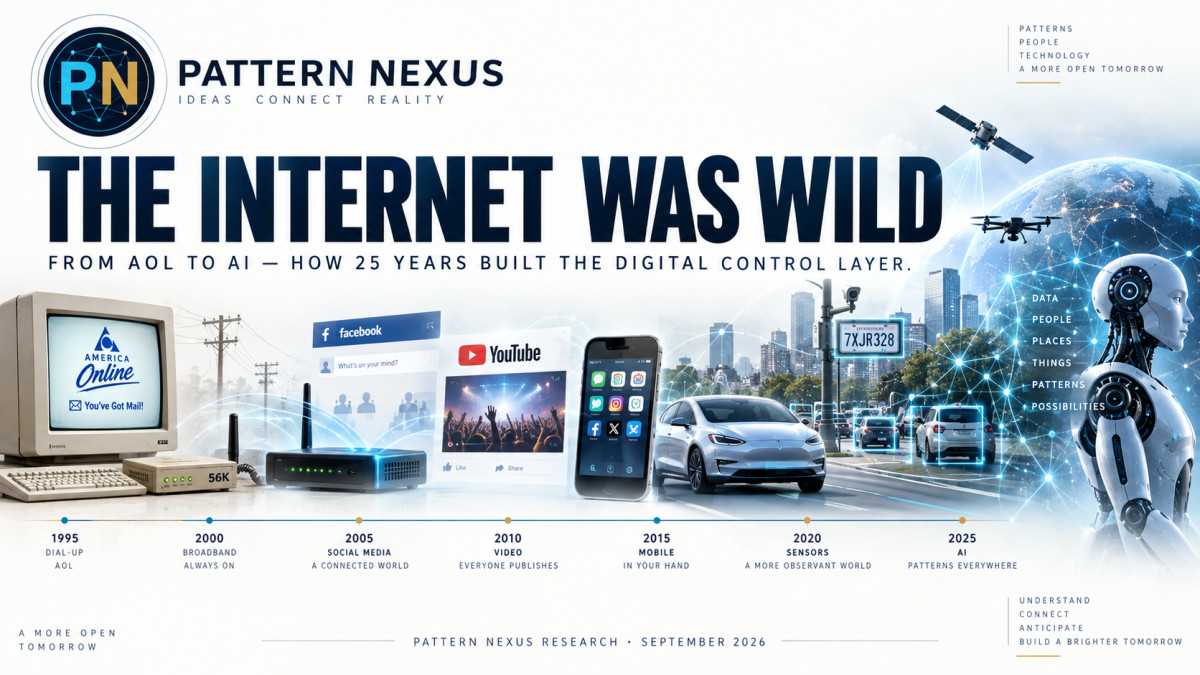
 Pattern Nexus Research
The Internet Was Wild: From AOL to AI, How 25 Years Built the Digital Control Layer
In 1999 the internet was something you logged into. Now the network follows us through phones, cars, cameras, satellites, financial systems and physical infrastructure. AI is becoming the layer capable of connecting and interpreting all of it. The important story is not any one technology. It is what happens when the technologies become one system.
We did not suddenly arrive in the AI surveillance age. We built it layer by layer for more than two decades.
I woke up in 1999 and the internet was still wild. AOL was chiming, dial-up was screaming through phone lines and most of us still thought of the internet as somewhere we went. Then broadband arrived, online gaming moved into the living room, MySpace, Facebook and YouTube arrived, the smartphone put the network in our pocket and in less than a decade normal life became almost unrecognizable compared with the beginning of the period.
At exactly the same time, another system was growing. The post-9/11 security architecture expanded government surveillance authorities. The internet became political infrastructure. The Tea Party and Occupy demonstrated that enormous numbers of people could organize outside traditional information gatekeepers. Then the Snowden disclosures showed the public that intelligence collection had also moved directly into the telecommunications and internet infrastructure. None of these systems stopped developing when the headline disappeared.
Now the digital system is moving into physical space. License-plate readers, facial recognition, police and federal drones, connected vehicles, location data, commercial databases and networked cameras are already real. AI matters because it can increasingly connect information that previously existed in separate systems. Robotics and autonomy matter because they potentially close the final loop between observing the physical world and acting inside it. That is the pattern I am looking at.
This is not a claim that ten people are sitting in a room controlling every event on Earth. That has never been the basis of my model. Systems of control can emerge without one controller. Governments want security. Companies want profit and data. Police want better tools. Intelligence agencies want better intelligence. Advertisers want better targeting. Consumers want convenience. Insurance companies want better risk models. Every actor follows an incentive that can make sense individually. Then you connect all of those systems and discover that collectively you have constructed something far larger than any single actor.
Nine years changed almost everything
I woke up in 1999 and the internet was rising, but it was still wild. AOL was chiming. Most of us were tying up the telephone line to get online. Websites were ugly, search was primitive compared with today, downloading anything substantial could take forever and the internet was still mostly separated from normal physical life. You went to the computer, logged onto the internet and then eventually logged back off. That distinction seems almost absurd now because today we don't really go online. We live inside a networked environment almost continuously.
What happened next was one of the fastest social and technological transformations in human history. Pew's historical data puts U.S. home broadband adoption at roughly 1% of adults in March 2000. By 2008 the measurements were generally in the mid-to-upper 50% range. That change sounds like a statistic until you remember what it actually did. Broadband took the internet from something slow and occasional and turned it into an always-available communications layer. Sony launched the PlayStation 2 network adapter in North America in August 2002 and explicitly described the PS2 as part of a mass-market broadband platform. Gaming was no longer necessarily the people sitting in the same room. Your television and game console were becoming entrances to a worldwide network.
Then the platforms arrived almost on top of each other. MySpace became a mass social network. Facebook launched in 2004. YouTube began in 2005 around the extremely simple idea that anybody with a camera and an internet connection could upload a video and potentially reach the world. Then Apple introduced the iPhone in January 2007 as a phone, media player and full internet communications device in one machine. That last step was more important than it looked. The network escaped the desk.
Think about the speed of that transformation. Go from 1999 to 2008 and the way people communicated, consumed media, played games, dated, shopped, found information, followed politics and interacted socially had already changed. Go another two years and smartphones and social networking were becoming normal parts of life. Take somebody whose frame of reference ended before 2000 and drop them into 2010 and you would have to explain an entirely different information environment. That happened in basically one decade.
And this is only the technology layer. I have not even gotten to the institutional layer yet.
The internet was wild because information escaped the old gatekeepers
People who grew up after the platforms consolidated everything do not completely understand what made the early mass internet different. It was not just that the pages looked different. The information structure was different. There were millions of independent sites, forums, message boards, blogs and small communities. Search engines sent you away from themselves. People built websites because they wanted to write about something, teach something, argue about something or simply put something into the world. It was chaotic and a lot of it was garbage, but the important point is that the distribution layer was suddenly available to almost everybody.
YouTube may be the cleanest example. When it was created in 2005, the company described a service where ordinary users could upload, tag and share personal video across the web, blogs and email. By 2010 co-founder Chad Hurley was describing the original idea as a place where anybody with a camera and an internet connection could share a story with the world. That sounds completely normal now. It was not normal before the internet. Before this transition, reaching a mass audience usually required access to somebody else's printing press, television station, radio network, record label, newspaper, publisher or distribution system.
The internet broke that model. Not completely, and not forever, but enough to matter. One person could publish to millions. One video could outrun a television network. One blog could challenge a newspaper. One person with a camera could document an event before a professional news crew even arrived. Information was no longer moving only vertically from institutions down to populations. It could move horizontally between millions of ordinary people.
That was liberating. It was also disruptive to every institution that historically depended on being an information gatekeeper. This is one of those areas where people make the mistake of needing everything to have only one effect. The internet increased individual freedom and it created one of the largest data-collection infrastructures ever built. Both happened at the same time. That contradiction is not a flaw in the model. It is the model.
While the open internet expanded outward, the security architecture expanded underneath it
Then September 11 happened, and this is where another layer begins developing alongside the consumer internet. The USA PATRIOT Act became law on October 26, 2001, only weeks after the attacks. The law expanded investigative and intelligence authorities across multiple areas. Later laws, FISA authorities and institutional changes added additional layers to the national-security structure. The point here is not to pretend there was no reason for any of this. There had just been a catastrophic terrorist attack. The point is to understand how systems grow: crisis creates a demand for capability, capability becomes infrastructure and infrastructure generally outlasts the specific moment that produced it.
That is why I have never looked at this primarily as Bush versus Obama versus Trump versus Biden or Republican versus Democrat. Administrations change. Institutional capability survives them. One administration creates something, another inherits it, another modifies it, another expands some part and restricts another part. The political fight happens on the surface while the underlying technical and legal architecture can continue developing for decades.
Congress enacted FISA Section 702 in 2008. The authority permits targeted collection of certain foreign intelligence from non-U.S. persons reasonably believed to be outside the United States, and it prohibits targeting U.S. persons under the authority. The legal boundaries matter. So does the technical reality underneath them: modern intelligence collection had become inseparable from modern communications infrastructure. That would become much more obvious to the public a few years later.
The same basic pattern is visible in detention law. The 2012 National Defense Authorization Act generated significant legal and political controversy around Sections 1021 and 1022 and the detention authorities associated with the post-9/11 Authorization for Use of Military Force. There were important statutory limitations and arguments over scope, particularly involving U.S. citizens and lawful residents. Again, I am not flattening those legal details into some slogan. I am looking at the longer movement: the post-9/11 period built a national-security framework that became a permanent part of the operating environment.
That is important because technology does not develop independently of law. The sensors may be technical. The databases may be technical. The communications networks may be commercial. But law determines who can access what, under which authority, for what purpose and under what oversight. The architecture is technological and institutional at the same time.
Then people discovered that the network could organize the street
By the end of the 2000s the internet was no longer just a communications system or entertainment system. It was becoming political infrastructure. Pew found that in the 2008 election cycle, 55% of the entire U.S. adult population had used the internet to participate in the political process or get political news and information. Eighteen percent of internet users had posted political thoughts or comments online, 45% watched campaign-related video and a third forwarded political material to other people. That was already a major structural change. Political communication no longer had to move through the old television-newspaper-party pipeline.
Then you saw movements appear from completely different ideological directions. The Tea Party protests in 2009 generated enormous online discussion and organization. Two years later Occupy Wall Street spread from Zuccotti Park into cities around the country, and images and videos of the demonstrations repeatedly became major subjects on blogs, YouTube and Twitter. Pew was documenting Occupy-related videos and photographs spreading through the internet while the movement was still unfolding.
I am not combining the Tea Party and Occupy because they believed the same things. Obviously they did not. I am putting them next to each other because the network mechanism was similar. Different groups had discovered that they could coordinate people, distribute footage, spread arguments and create a national narrative without first receiving permission from an established institution.
That matters. For most of human history information structures were predominantly vertical. State to citizen. Church to congregation. Newspaper to reader. Television network to viewer. Corporation to consumer. The open internet introduced a massive horizontal layer where millions of people could communicate directly with millions of other people. Once that existed, institutions had to adapt to it. They were never going to simply ignore the most powerful information network ever created.
Then Snowden showed the public how far the other side of the information revolution had developed
This is the point where something that would have sounded like conspiracy talk to a lot of people suddenly became documented government history. Edward Snowden's 2013 disclosures exposed surveillance programs that most ordinary Americans had never heard of. After the disclosures, the government's own Privacy and Civil Liberties Oversight Board produced detailed reports on both the Section 215 telephone-records program and the Section 702 surveillance system.
The Section 215 program involved bulk telephone metadata. Section 702 operated differently and included collection mechanisms commonly known as PRISM and Upstream. The details matter because people constantly turn technical subjects into slogans. PRISM involved compelled assistance from electronic communications service providers. Upstream involved collection with the compelled assistance of providers that operated parts of the telecommunications backbone over which internet and telephone communications traveled. Section 702 is legally directed at non-U.S. persons reasonably believed to be abroad, not at targeting U.S. persons. But communications involving Americans can be acquired incidentally when they communicate with lawful foreign targets, which is one reason the program has generated continuing privacy and civil-liberties debate.
That is the fact pattern. We do not need to exaggerate it. The real architecture is significant enough. By this point, the internet had created an unprecedented system for moving human information across privately operated infrastructure, and intelligence agencies had built legal and technical mechanisms for collecting foreign-intelligence information from that infrastructure at enormous scale.
This is why I keep telling people to stop thinking about these systems one headline at a time. The internet increased our ability to speak. It also increased the amount of observable information. Encryption increased privacy. Cloud storage increased centralization. Social media allowed ordinary people to publish. Social media also built detailed behavioral records. Smartphones gave everybody a powerful computer. Smartphones also put a location-aware networked sensor in everybody's pocket. Every technology can carry both effects at once.
The network gave individuals more power. The network gave institutions more power. Both statements are true.
Now the information network is moving off the screen and into the physical world
This is the part people need to look at now, because we are in another transition. The first internet connected computers. The smartphone connected individuals continuously. The next layer connects the physical environment itself. Cameras are networked. Vehicles are networked. Doorbells are networked. Traffic systems are networked. Satellites provide persistent observation. Drones can move sensors wherever somebody needs them. License-plate readers turn vehicle movement into searchable data. Facial-recognition systems can search enormous image collections. None of those things by itself creates some omniscient system. The capability appears when the data can be connected.
The federal government's own reports show how broad the toolset has become. In 2024 the Government Accountability Office examined CBP, ICE and the Secret Service and found the agencies reported using more than 20 types of detection, observation and monitoring technology in public spaces. That included drones, pole-mounted cameras, automated license-plate readers and facial-recognition technology, along with analytical software, including AI-enabled systems. All three agencies also reported agreements allowing them to query or view information from third-party automated license-plate readers, giving personnel access to what GAO described as a nationwide source of license-plate data.
That one example tells you where the architecture is going. An agency does not necessarily have to own every camera. It does not necessarily have to build every database. It can access systems owned by other agencies or commercial providers. That is a much more important distinction than people realize because a modern information system does not require one giant centralized database containing every piece of information. Distributed systems can query each other.
Then look at the commercial layer. Flock Safety's automated license-plate-reader network has grown into one of the largest systems in the country. Reuters reported in September 2026 that the company operates about 120,000 AI-powered cameras across 49 states. The same report covered a growing political backlash over privacy, misuse and the scale of automated vehicle tracking, including Florida moving to prohibit local police use of the cameras on state highways. There are real law-enforcement arguments for these systems and real privacy arguments against them. My point is not that only one side exists. My point is that the infrastructure exists.
And once infrastructure exists, its future use is not determined only by why it was originally purchased.
Your car is not just becoming a computer. It is becoming another node in the data system
People still think about cars as mechanical machines with computers added to them. That distinction is disappearing. The Federal Trade Commission has warned that modern connected vehicles can collect precise geolocation, telematics, video, biometric information and other sensitive personal data. In January 2026 the FTC finalized an order settling allegations that General Motors and OnStar collected, used and disclosed precise location and driving-behavior information from millions of vehicles without adequately notifying consumers and obtaining affirmative consent.
The type of data involved matters. We are talking about location, speeding, hard braking and other driving behavior. According to the FTC, some of the information had been disclosed to consumer-reporting agencies, creating the possibility that data generated while simply driving a vehicle could influence other decisions such as insurance. GM agreed to restrictions and additional consent and transparency requirements. That enforcement action does not prove every car company is doing the same thing. It proves the underlying capability is already real enough to require federal enforcement.
Now connect the car to everything else. Your vehicle has a location. Your phone has a location. An automated license-plate reader sees a plate at a location and time. A traffic camera sees an intersection. A payment system sees a transaction. Another database knows the registered owner. Another system contains public records. A commercial data broker may contain additional information. The important transition is no longer the creation of more isolated data. We have plenty of data.
The transition is the ability to correlate it.
That is where AI becomes different from the previous era.
COVID showed how quickly an entire modern society can reconfigure when the system believes it is facing an emergency
Then came 2020. I am not going to turn this article into another argument over every COVID policy, vaccine argument, school closure or mandate because that is not what I am examining here. The systems lesson is bigger than any one of those arguments. HHS declared a federal public-health emergency effective January 31, 2020. That emergency framework, repeatedly renewed, remained in place until May 11, 2023. During the broader pandemic period, federal, state and local governments adopted different combinations of emergency rules and public-health measures, while private institutions simultaneously changed how work, education, commerce, travel and access operated.
Look at that event only as a systems experiment for a moment. Hundreds of millions of people altered behavior almost simultaneously. Offices went remote. Schools moved online. Supply chains reorganized. Businesses adopted digital ordering and payment systems at extraordinary speed. Telemedicine expanded. Travel systems changed. Governments and companies created new data processes. Emergency authorities that had existed on paper suddenly mattered in daily life. Then public resistance and legal challenges pushed back against different parts of that architecture, and the system adapted again.
That does not prove some predetermined plan. It demonstrates something more useful for understanding the future: modern digitally networked societies can change operating rules extremely quickly when institutions and populations perceive a sufficiently large threat.
That matters when you are trying to understand future emergencies, future technologies and future security systems. The question is never only what government can technically do today under normal conditions. The more important question is what infrastructure already exists when the next emergency arrives, what legal authorities become available, what the population will accept and what capabilities can be connected quickly.
The precedent for remote lethal force arrived before autonomous AI
This is another part people are going to misunderstand if it is not stated precisely. I am not saying police drones are currently flying around American cities autonomously killing political dissidents. That would be a claim far beyond the evidence. I am saying the technological and legal history already crossed a threshold that would have sounded unbelievable to many people several decades ago.
In 2011 the United States killed Anwar al-Awlaki, an American citizen and senior al-Qaeda figure, in a drone strike in Yemen. The Department of Justice produced a legal framework describing circumstances under which it concluded lethal force against a U.S. citizen abroad who was a senior operational leader of al-Qaeda or an associated force could be lawful. The framework included a high-level determination of an imminent threat of violent attack, infeasibility of capture and compliance with applicable law-of-war principles.
Whatever somebody thinks about the merits of that specific operation, the historical threshold matters. Remote state lethal force against a U.S. citizen under a national-security framework stopped being a hypothetical discussion. It happened abroad in the context of armed conflict and counterterrorism. That context is critical and should not be erased. But neither should the precedent itself.
My forward concern begins after the documented facts, not before them. We already have remote surveillance. We already have remotely piloted lethal systems. We already have automated identification and tracking technology. We already have autonomous navigation. We already have increasingly capable AI. What happens when those technologies converge over the next ten or twenty years is a legitimate systems question. It is not necessary to pretend the final outcome has already occurred in order to see the direction of capability.
AI did not suddenly appear when the public got access to it
This is another thing that gets lost because people confuse public adoption with technological origin. AI did not start with ChatGPT. The intellectual roots extend earlier, and the field formally called artificial intelligence is generally dated to the 1956 Dartmouth Summer Research Project on Artificial Intelligence, where John McCarthy and other researchers helped define the field. By the 1960s ARPA was already funding advanced AI and robotics work. In 1966 ARPA funded the project that became Shakey, the first mobile robot with enough artificial intelligence to navigate through rooms on its own.
That does not mean anybody secretly had GPT-5 in 1966. That would be ridiculous. It means technology develops through stages long before the mass public sees the mature consumer version. Basic research becomes a laboratory system. Laboratory systems become expensive specialized tools. Specialized tools become industrial or government systems. Hardware becomes cheaper. Computing becomes more powerful. Infrastructure spreads. Eventually the capability becomes cheap enough and reliable enough to move into everyone's life.
The internet itself proves this pattern better than almost anything. People my age remember AOL and think of the 1990s as when the internet appeared. It did not. ARPANET became operational in 1969. The network expanded across universities, government laboratories and military sites during the 1970s. TCP/IP became the standard in 1983. ARPANET was eventually retired as the larger internet emerged. By the time ordinary households were hearing the modem scream through the phone line, decades of networking research had already happened.
That distinction is critical when people ask what technology exists today versus what consumers have today. The public sees the end of an enormous research, infrastructure and cost curve. The technology may have been evolving for decades before it becomes something you can buy at Walmart or download onto your phone.
AI is following the same pattern, except the development curve is now accelerating because the network, data centers, semiconductor industry, cloud infrastructure and global software distribution system already exist.
The individual technologies are not the story anymore. The convergence is.
This is where my model separates from the way most people consume news. Most people look at each thing in isolation. They see a new AI model and call it an AI story. They see Flock cameras and call it a police-surveillance story. They see connected cars and call it an automotive story. They see drones and call it a drone story. They see facial recognition and call it a privacy story. They see humanoid robots and call it a robotics story. Then they move on to the next headline.
I don't look at them separately because they are no longer developing separately.
The internet created the communications layer. Cloud computing created the scalable storage and computation layer. Smartphones created a permanent human sensor and identity layer. Social platforms created enormous behavioral datasets. Cameras, license-plate readers, connected cars, smart infrastructure and satellites extend observation into physical space. AI creates an increasingly capable interpretation layer on top of the information. Autonomous software can turn interpretation into digital action. Robotics and drones can turn digital decisions back into physical action.
That creates a very simple systems chain:
That is the actual technological transition I am watching. Millions of cameras have limited value if human beings have to sit there and manually watch every frame. Billions of location records have limited value if humans have to manually compare every record. Satellite images have limited value if analysts need to inspect every square mile themselves. License-plate records become much more powerful when a system can automatically query movement across time and space. AI changes the economics of understanding enormous datasets.
That is why the current AI conversation is so shallow when it focuses almost entirely on whether ChatGPT can write your email or generate a picture. Those are useful consumer applications. They are nowhere near the largest structural implication.
The larger implication is that we have spent decades building enormous networks of information, and we are finally developing machines capable of interpreting those networks at machine speed.
A system of control does not require one person controlling the system
This is the part of Pattern Nexus that gets flattened into something I am not actually saying. People hear the word control and imagine I mean one secret organization designed every part of modern society from the beginning. That is a cartoon version of the argument. The real system is more complicated and in some ways more concerning because nobody has to control the entire thing.
Governments have an incentive to maintain order and national security. Police have an incentive to solve crimes. Intelligence agencies have an incentive to identify threats. Companies have an incentive to learn about customers. Advertisers have an incentive to predict behavior. Banks have an incentive to understand risk. Insurance companies have an incentive to understand behavior associated with claims. Technology companies have an incentive to collect data because data improves products and trains models. Consumers have an incentive to trade some privacy for convenience because convenience has enormous immediate value.
None of those incentives requires evil people. Most of them make perfect sense viewed from inside the institution pursuing them.
Now zoom out.
One company collects the car data. Another system captures the plate. Another company knows the phone location. Another platform knows the social relationships. Another database knows the property record. Another network knows the financial transaction. Another system has satellite imagery. Another system has the camera footage. Historically, those separate datasets were constrained partly by the cost of connecting and analyzing them. AI reduces that constraint.
This is how a control system can emerge from decentralized incentives. Nobody needed to draw the entire thing on a blueprint fifty years ago. Each generation built the next useful component. Each crisis added another authority. Each new technology produced another data stream. Each business found another profitable use. Each agency found another operational use. Then eventually someone steps back far enough to see that the pieces fit together.
This is also why I keep going back thousands of years when I talk about systems. The technology is new. The incentive is ancient. Kings controlled scribes because written information mattered. Empires controlled roads because movement and communication mattered. Churches controlled texts. Guilds controlled skills. States controlled currency. Universities controlled credentials. Newspapers controlled printing and distribution. Television networks controlled mass broadcasting. Information has always been power.
The internet temporarily shattered parts of that old information hierarchy by allowing almost anybody to publish. The next battle was always going to be over how the new information system was organized, filtered, monetized, surveilled and controlled.
The machine changed.
The incentive did not.
Now the mind is getting a body
AI spent most of its history trapped inside computers. That limitation is disappearing. The machines can already see through cameras, hear through microphones, navigate using multiple sensor systems, identify objects, recognize speech, interpret language, generate plans, write software, analyze databases and coordinate digital tasks. Robots are giving those systems wheels, legs, arms and hands. Drones give them flight. Autonomous vehicles give them mobility across road networks. Industrial machines give them strength and precision.
Again, none of that automatically creates some dystopian machine state. Robotics can create enormous abundance. Autonomous systems can do dangerous jobs humans should not have to do. AI can improve medicine, science, engineering, logistics and education. Drones can find missing people. Cameras can solve crimes. Connected cars can detect crashes and summon emergency help. The same technology can have immense public benefit.
But technology is capability. It does not come with one predetermined social use.
The same drone that finds a lost hiker can perform surveillance. The same facial-recognition system that identifies a violent suspect can identify somebody attending a protest. The same location system that navigates you to a hospital can create a detailed movement history. The same connected car that detects a collision can collect behavior that an insurer may want. The same AI that discovers a cancer pattern can discover a behavioral pattern across millions of people.
That is why I am not interested in the argument that technology is either good or bad. That question is almost meaningless. The question is what capabilities exist, who can access them, what incentives govern their use, what legal restrictions surround them and how easily different systems can be connected.
Go back to where I started. In 1999 AOL was chiming and most people could not have imagined what normal life would look like by 2009. The smartphone barely existed as we understand it today. YouTube did not exist. Facebook did not exist. Modern social media did not exist. Household broadband was barely beginning. Online console gaming was not yet mass-market reality.
Then nine years passed.
Do the same exercise now.
Look at where AI, robotics, autonomous vehicles, drones, connected infrastructure, satellite observation, facial recognition and sensor networks are in 2026. Then stop thinking about each one separately and move the clock to 2036.
I am not telling you I know every form the system will take. Nobody does. I am telling you that the direction of capability is visible. The network has already been built. The sensors are spreading. The databases already exist. The AI interpretation layer is advancing at extraordinary speed. The machine is learning how to operate in physical space.
The internet connected the world.
The smartphone connected the individual.
The sensor network is connecting the physical environment.
AI is connecting the information.
Robotics connects the intelligence back to physical action.
That is the progression.
That is the pattern.
And that is why the most important question of the next decade is not whether AI can write better than you, draw better than you or eventually drive better than you.
The question is what happens when a machine can see the system, understand the system and increasingly act inside the system.
Then ask the question I always come back to:
Who controls the infrastructure around it, what incentives control the people and institutions operating it, what information can it access, and what are we eventually going to allow it to do?
Because we have seen this pattern before.
You usually do not understand how much the world changed until you look backward ten years and realize the world you remember no longer exists.
Questions this argument usually produces
Are you saying one group secretly designed the entire system?
No. The argument is largely the opposite. Governments, corporations, consumers, intelligence agencies, police departments, advertisers and technology companies pursue different incentives. The aggregate result can become a powerful control and information architecture even without a single central designer.
Was broadband really that transformative that quickly?
Yes. Pew's historical survey data shows home broadband among U.S. adults moving from roughly 1% in March 2000 to the mid-to-upper 50% range by 2008. That transition turned internet access from an occasional dial-up activity into an increasingly persistent part of daily life.
Did the NSA literally record everything everyone did?
No. That is broader than the documented evidence. The Snowden disclosures and subsequent government reports established major surveillance capabilities including the Section 215 bulk telephone-metadata program and Section 702 collection through PRISM and Upstream. Each operated under specific legal authorities, targeting rules and procedures.
Can U.S. law enforcement already use nationwide license-plate data?
GAO reported that the three DHS law-enforcement agencies it studied had agreements allowing personnel to query or view information from third-party automated license-plate-reader systems, providing access to what GAO called a nationwide source of license-plate data.
Are connected cars really collecting location and driving information?
Yes. The FTC has specifically addressed the sensitivity of connected-vehicle geolocation and telematics data, and its 2026 GM/OnStar order followed allegations involving the collection and disclosure of precise location and driving-behavior data from millions of vehicles.
Are you predicting autonomous drones will be used against Americans?
I am identifying a future capability pathway, not claiming that outcome has already occurred. The documented pieces include drones, remote lethal-force precedent abroad, automated identification, AI analysis, sensor networks and autonomous navigation. Whether and how those systems are combined domestically is a legal, political and technological question that remains open.
When did artificial intelligence actually begin?
The modern field is generally dated to the 1956 Dartmouth Summer Research Project on Artificial Intelligence. Important precursor work existed before that, and government-supported AI and robotics research expanded during the following decades. ARPA funded the Shakey robot project beginning in 1966.
What is the main Pattern Nexus thesis here?
Do not analyze the technologies as isolated products. Broadband, smartphones, cloud computing, social networks, surveillance systems, connected vehicles, cameras, satellites, AI and robotics form layers of an increasingly integrated information system. The important question is what capabilities appear when those layers converge.
Primary records, oversight reports and historical data
- [1] Pew Research Center — Internet and Home Broadband Usage in the United States, historical survey series, 2000–2025.
- [2] Pew Research Center — Home Broadband 2008.
- [3] Sony Computer Entertainment America — PlayStation 2 Network Strategy and Network Adaptor launch materials, 2002.
- [4] YouTube — 2005 company launch and historical material describing the original user-uploaded video model.
- [5] Apple — January 9, 2007 announcement introducing the iPhone as a mobile phone, media player and internet communications device.
- [6] U.S. Government Publishing Office — Public Law 107-56, USA PATRIOT Act of 2001.
- [7] U.S. Intelligence Community — FISA Section 702 overview.
- [8] Pew Research Center — 2008 internet political participation, Tea Party-era internet discussion and Occupy Wall Street coverage.
- [9] Privacy and Civil Liberties Oversight Board — 2014 Section 215 telephone-records report.
- [10] Privacy and Civil Liberties Oversight Board — Section 702 surveillance report covering PRISM and Upstream collection.
- [11] U.S. Government Accountability Office — Law Enforcement: DHS Could Better Address Bias Risk and Enhance Privacy Protections for Technologies Used in Public, GAO-25-107302.
- [12] Reuters — September 3, 2026 reporting on Flock Safety license-plate-reader deployment and state-level surveillance backlash.
- [13] Federal Trade Commission — 2026 final GM and OnStar connected-vehicle data order.
- [14] Federal Trade Commission — Cars & Consumer Data: On Unlawful Collection & Use, 2024.
- [15] U.S. Department of Health and Human Services — COVID-19 Public Health Emergency records, 2020–2023.
- [16] U.S. Department of Justice — White Paper: Lawfulness of a Lethal Operation Directed Against a U.S. Citizen Who Is a Senior Operational Leader of al-Qa'ida or an Associated Force.
- [17] Dartmouth — History of the 1956 Dartmouth Summer Research Project on Artificial Intelligence.
- [18] DARPA — ARPANET history and innovation timeline.
- [19] DARPA — Shakey the Robot, ARPA-supported robotics research beginning in 1966.
คุณมีปฏิกิริยาอย่างไร?
 ชอบ
0
ชอบ
0
 ไม่ชอบ
0
ไม่ชอบ
0
 รัก
0
รัก
0
 ตลก
0
ตลก
0
 ว้าว
0
ว้าว
0
 เศร้า
0
เศร้า
0
 โกรธ
0
โกรธ
0

Founder of Pattern Nexus. I research markets, macro, geopolitics, AI, history, ancient systems, and the patterns most people overlook. I’m also building Market Radar, a trading scanner designed to read pressure, risk, confirmation, and setup quality before chasing a move. Pattern Nexus is where I connect the dots between data, history, technology, and the bigger system playing out around us.

ความคิดเห็น (0)