

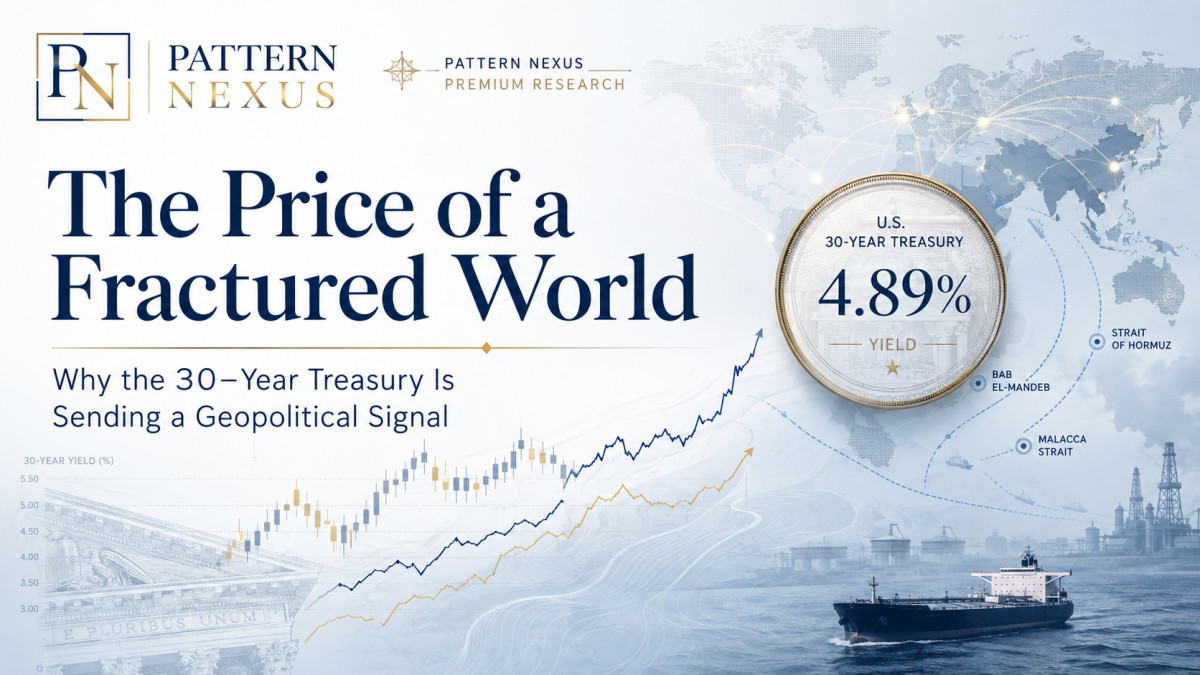
The Price of a Fractured World: Why the 30-Year Treasury Is Sending a Geopolitical Signal
Something about the global system feels uncomfortable, and the last month of data suggests that feeling has a measurable foundation. The U.S. 30-year Treasury has pushed above 5.3%, real long-term yields are above 3%, the Strait of Hormuz remains severely constrained, U.S. missile inventories are being consumed across multiple theaters, Russia and Ukraine are attacking the commercial infrastructure of the Black Sea, China continues pressure around Taiwan and the South China Sea, new regional defense blocs are forming, tariffs are fragmenting trade, and governments and AI companies are simultaneously competing for enormous amounts of capital. This Pattern Nexus investigation asks whether the long end of the Treasury market is becoming one of the cleanest aggregate prices of a more fragmented world—and separates that thesis from the much weaker claim that the Treasury market itself is failing.
```html

The world is not necessarily breaking. It is becoming more expensive to hold together.
- The long end is the signal that started this article. On July 17, the U.S. 10-year Treasury constant-maturity yield was 4.55% and the 30-year was 5.06%. By August 18 they were 4.71% and 5.28%. The 30-year also traded around 5.33% intraday, its highest level since 2007.[1][3]
- This is not just an inflation-expectation move. Treasury's 10-year real yield rose from 2.31% to 2.41% over the same period, while the 30-year real yield increased from 2.87% to 3.03%. A meaningful part of the long-end repricing is therefore occurring in the real required return on capital.[2]
- The Treasury market is not experiencing a buyers' strike. Foreign residents bought a net $207.1 billion of long-term U.S. securities in June, and Treasury auctions continue clearing. The market still wants U.S. securities. Investors are simply demanding more compensation to hold duration.[8][9]
- Hormuz is still a physical economic shock. Before the Iran conflict, roughly 21.6 million barrels per day of crude oil and petroleum liquids moved through the Strait of Hormuz. EIA estimates the second-quarter 2026 average collapsed to roughly 4.9 million barrels per day.[10]
- The alternative route has its own war. Saudi Arabia and other Gulf producers shifted more oil west toward Red Sea export infrastructure, increasing the importance of Bab el-Mandeb at the same time Houthi attacks raised the risk of using that corridor.[10]
- Military inventory has become a measurable industrial constraint. Heavy consumption of Patriot, THAAD, Tomahawk and other precision systems across Iran and Ukraine has been followed by enormous multiyear production agreements designed to rebuild inventories and expand factory output.[18][19][20][21]
- The Middle East is reorganizing, not merely fighting. Saudi Arabia, Turkey and Pakistan signed a mutual-defense agreement on August 7 and are building joint military, procurement, industrial and exercise mechanisms around it.[13][14]
- Ukraine is again becoming a global shipping and food problem. Russia and Ukraine are attacking ports, grain infrastructure, tankers and energy routes in the Black Sea. Washington has already intervened diplomatically when Ukrainian actions threatened oil flows tied to other producers.[22][23][37][38]
- The Pacific has not gone quiet while attention moved to Iran. China conducted new Taiwan Strait live-fire drills, Taiwan expanded blockade and communications-denial exercises, and China and the Philippines continue confronting one another in disputed waters.[25][26][27]
- Trade itself is becoming part of national security. The United States imposed another broad tariff regime, Brazil initiated a reciprocity process, and BRICS central banks are discussing connections between domestic fast-payment networks and CBDCs.[29][30][31]
- The fiscal backdrop was already difficult before adding any of this. CBO projects a roughly $1.9 trillion fiscal 2026 federal deficit and net interest expense above $1 trillion. Treasury expects $739 billion of privately held net marketable borrowing in the July–September quarter and another $628 billion in October–December.[5][6][7]
- Governments are not the only borrowers. AI infrastructure, data centers, utilities, power generation, transmission and semiconductor capacity are simultaneously demanding historic amounts of private capital. That gives the bond market another competitor for long-duration savings.[4]
- My working conclusion: the 30-year Treasury may be functioning as one of the cleanest aggregate prices of a world that requires more redundancy, more defense capacity, more energy infrastructure, more sovereign borrowing and more compensation for uncertainty.
This is not another geopolitical-news roundup and it is not an attempt to turn every military exercise into World War III.
The purpose of this report is to connect the transmission layers that normally get analyzed separately: Treasury duration, real yields, term premium, oil chokepoints, missile inventories, military procurement, sovereign borrowing, global bond competition, tariffs, payment rails, food exports, AI capital spending and the changing structure of alliances.
The central distinction matters. A war headline does not mechanically make Treasury yields rise. A geopolitical shock has to pass through energy, inflation, fiscal spending, industrial demand, risk premium or capital flows before it becomes a bond-market variable. This article maps those steps and also includes the evidence that could prove the thesis wrong.
The problem is not one war. The problem is that the buffers between systems are getting thinner.
There was a time when I could look at war, recession risk and financial stress and expect a familiar sequence.
Fear rises.
Capital moves toward dollars and Treasuries.
Long Treasury prices rise.
Yields fall.
Financial conditions eventually loosen.
That mechanism still exists. Treasuries remain the deepest sovereign safe-asset market in the world.
But the shocks entering the system are different.
A war that blocks oil supply is not simply a risk-off event. It is an inflation event.
A war that consumes advanced interceptors is not merely a military event. It becomes an industrial-policy and fiscal event.
An attack on a Black Sea port is not merely part of the Russia-Ukraine war. It can become a wheat-price, food-security, shipping-insurance and emerging-market event.
A tariff is not merely trade policy. It changes supply chains, prices, corporate investment and strategic alignment.
A regional defense pact is not merely diplomacy. It redirects future procurement, industrial capacity and capital spending.
A higher Japanese government bond yield is not simply a Japanese monetary-policy event. It changes the return available to one of the world's largest pools of savings.
And a federal debt stock approaching $40 trillion does not exist separately from any of this. It has to be financed through the same capital markets that governments, defense companies, utilities, power systems, chip companies and AI infrastructure projects are asking to fund everything else.
The world can continue functioning as those assumptions weaken.
It simply requires more capital to do so.
Do not turn correlation into a story just because the story feels right.
The first thing I wanted to know was whether I was reverse-engineering a macro theory from an uncomfortable feeling.
That is always a risk.
Oil goes up. Bonds sell off. A war is happening. It becomes easy to say the war caused the bonds to sell off and move on.
That is not enough.
The long Treasury yield can change because of expected Federal Reserve policy, expected inflation, expected real growth, Treasury issuance, foreign demand, hedging costs, liquidity, dealer balance-sheet capacity, pension demand, quantitative tightening, term premium, fiscal credibility and technical positioning.
Geopolitics enters that system indirectly.
That is different from saying war automatically sends yields higher.
It plainly does not.
A severe recession, banking crisis, liquidity event or financial accident could still overwhelm these pressures and send investors aggressively into long Treasuries.
The question is why that safe-haven mechanism has not been enough to push the long end materially lower yet.
The events that matter are the ones that transmit into something else.
I went through the last month looking for geopolitical events with a plausible path into energy, food, shipping, military capacity, industrial spending, trade, sovereign finance or global capital flows.
This is not literally every diplomatic meeting, border incident or battlefield event. That would bury the signal.
| Date | Event | Transmission channel |
|---|---|---|
| July 20–22 | China and the Philippines again confront one another in contested South China Sea waters and exchange formal protests. | Maritime trade · U.S. alliance obligations · escalation risk.[27] |
| July 23 | China begins two days of live-fire exercises in the Taiwan Strait. | Taiwan risk · semiconductors · naval and air readiness.[25] |
| July 23 | Brent reaches roughly $105 amid Hormuz and Red Sea disruption. | Energy · inflation · freight.[10] |
| July 24 | United States announces new tariffs affecting dozens of trading partners. | Trade fragmentation · prices · retaliation.[29] |
| July 29 | U.S. Army awards a multiyear Patriot interceptor production agreement worth up to $58.6 billion. | Defense industrial capacity · fiscal spending.[19] |
| July 31 | Black Sea grain and port infrastructure face increasing attack risk. | Food · shipping · emerging-market inflation.[37] |
| August 3–4 | Pentagon expands Patriot/THAAD production while new reporting describes substantial precision-missile drawdowns from the Iran war. | Military scarcity · industrial mobilization.[18][21] |
| August 5 | Ukraine says allied missile-interceptor deliveries have fallen sharply from 2025 levels. | Cross-theater competition for air defense.[24] |
| August 7 | Saudi Arabia, Turkey and Pakistan sign the Mecca Joint Defence Agreement. | Alliance architecture · defense procurement.[13] |
| August 10 | Taiwan's Han Kuang exercises simulate blockade and communications degradation. | Civil resilience · blockade preparation.[26] |
| August 11 | BRICS central banks discuss connecting fast-payment networks and CBDCs. | Financial redundancy · settlement architecture.[31] |
| August 12–14 | Black Sea tanker, grain and commercial-shipping attacks become part of U.S.-Ukraine-Russia negotiations. | Oil · food · shipping insurance.[22][23][38] |
| August 13 | Brazil begins formal retaliation process over U.S. tariffs. | Trade retaliation · supply-chain risk.[30] |
| August 17–18 | U.S. 30-year Treasury yield reaches levels not seen since 2007 while long yields also rise in Japan and Europe. | Global capital cost · duration repricing.[3][4] |
| August 18 | U.S.-Iran negotiations again appear stalled while Hormuz remains severely constrained. | Oil · inflation · shipping.[11][12] |
| August 18 | Israel strikes a Syrian airbase near Turkey and Washington works on a formal deconfliction mechanism. | Israel-Turkey escalation risk · NATO exposure.[15] |
Do not read that as a list of wars.
Read the transmission column.
Oil.
Shipping.
Food.
Missiles.
Industrial capacity.
Trade.
Financial infrastructure.
Capital.
That is the actual pattern.
The 30-year is not just high. It is high inside a system built around cheaper long-term capital.
"Too high" is not a technical bond-market term.
A yield is the market-clearing price.
When I say the 30-year feels too high, what I mean is that a 5.2%–5.3% risk-free long rate creates increasingly uncomfortable mathematics for everything built on top of it.
| Date | 10-Year | 30-Year | 30Y–10Y |
|---|---|---|---|
| July 17 | 4.55% | 5.06% | 51 bps |
| July 31 | 4.75% | 5.27% | 52 bps |
| August 17 | 4.72% | 5.31% | 59 bps |
| August 18 | 4.71% | 5.28% | 57 bps |
Those are Treasury's official constant-maturity rates.[1]
The month produced roughly a 16-basis-point increase in the 10-year and a 22-basis-point increase in the 30-year.
That is not a disorderly bond-market event.
It is a modest long-end steepening occurring at already restrictive absolute yields.
The distinction matters.
This is not the market saying the United States is about to default.
It is the market saying that committing money for decades requires more compensation.
Reuters reported that the New York Fed's estimate of the 10-year term premium had risen to around 80 basis points, near its highest level in about 12 years.[4]
That is exactly where a persistent uncertainty premium should show itself.
Not necessarily in tomorrow's overnight interest rate.
In the price of surrendering capital for a decade or three.
The part that bothers me most is that this is not only an inflation trade.
If nominal Treasury yields were rising entirely because oil pushed expected inflation higher, the interpretation would be much simpler.
The real-yield curve says something else is happening too.
| Date | 10Y Nominal | 10Y Real | 30Y Nominal | 30Y Real |
|---|---|---|---|---|
| July 17 | 4.55% | 2.31% | 5.06% | 2.87% |
| July 31 | 4.75% | 2.47% | 5.27% | 3.03% |
| August 17 | 4.72% | 2.44% | 5.31% | 3.06% |
| August 18 | 4.71% | 2.41% | 5.28% | 3.03% |
Source: U.S. Treasury nominal and real constant-maturity curves.[1][2]
From July 17 to August 18:
- 10-year nominal: +16 basis points.
- 10-year real: +10 basis points.
- 30-year nominal: +22 basis points.
- 30-year real: +16 basis points.
A rough nominal-minus-real comparison puts 10-year inflation compensation near 2.24% on July 17 and about 2.30% on August 18.
The same rough comparison for 30 years moves from about 2.19% to roughly 2.25%.
This is not a perfect breakeven calculation because nominal and TIPS par curves have different technical characteristics.
But the directional message is clear.
That moves the analysis toward fiscal supply, term premium, global competition for savings, future monetary-policy uncertainty and the opportunity cost of holding duration.
Oil is part of the story.
The real yield says it is not all of it.
The Treasury market was already being asked to absorb enormous supply before we added the geopolitical layer.
CBO's 2026 baseline projected a federal deficit of roughly $1.9 trillion for fiscal 2026, equal to around 5.8% of GDP.[5]
Debt held by the public is projected around 101% of GDP in 2026 and roughly 120% by 2036.[5]
CBO also projects net federal interest expense around $1 trillion in 2026, rising materially over the following decade.[6]
Then look at Treasury's near-term financing.
For July through September 2026, Treasury projects $739 billion of privately held net marketable borrowing.
For October through December, another $628 billion.[7]
Those are quarterly borrowing requirements.
The fiscal sensitivity then becomes partly reflexive.
Higher yields increase federal interest expense.
Higher interest expense increases future deficits, all else equal.
Larger deficits require greater issuance.
Greater issuance requires investors to absorb more duration.
If investors demand more compensation to absorb that duration, yields remain higher.
That does not automatically produce a sovereign debt spiral. The United States retains enormous taxation capacity, a reserve currency, a huge productive economy and the world's deepest sovereign bond market.
But the system becomes more sensitive to the price of long-term capital.
Now add military replenishment.
Add energy redundancy.
Add domestic semiconductor capacity.
Add electrical transmission.
Add data centers.
Add AI infrastructure.
All of those things can be productive.
They still require capital.
Do not call this a Treasury buyers' strike. The evidence does not support it.
This is the easiest place to turn a serious problem into a bad argument.
The 30-year reaches 5.3% and people immediately say:
"Nobody wants U.S. debt."
That is not what the current data shows.
Treasury's June international-capital data showed foreign residents making roughly $207.1 billion of net purchases of long-term U.S. securities.
Private foreign investors accounted for most of that flow, while foreign official institutions were also net buyers.[8]
Those statistics cover long-term U.S. securities broadly and country-level custody data has limitations.
But they are difficult to reconcile with a simplistic story that foreigners have abandoned the United States.
Treasury auctions tell a similar story.
Recent 10-year and 30-year auctions cleared at exceptionally high yields—but they cleared.[9]
Investors were willing to fund the government.
They demanded more compensation.
That is not as dramatic as a failed auction.
It can be more economically important because it can persist for years without producing a single obvious crisis headline.
The world's most important oil chokepoint is still not functioning normally.
The Strait of Hormuz is where geopolitics becomes macroeconomics with almost no translation required.
EIA estimates crude and petroleum liquids moving through the strait averaged about 21.6 million barrels per day in the fourth quarter of 2025.
During the second quarter of 2026, the average fell to around 4.9 million barrels per day.[10]
That is not a normal oil-price fluctuation.
It is a physical reorganization of one of the world's largest energy flows.
Saudi Arabia and other Gulf producers can reroute some barrels west.
Saudi crude can move through the East-West pipeline toward Yanbu on the Red Sea.
But that increases dependence on Bab el-Mandeb.
EIA estimates petroleum flows through Bab el-Mandeb increased as Gulf producers rerouted supply away from Hormuz.[10]
Then Houthi pressure makes that corridor more dangerous too.
This is the part people miss when they say the world can simply use another route.
The alternative route has its own war.
Brent reached roughly $105 during the July escalation before easing. On August 18 it closed around $91 as optimism around renewed U.S.-Iran negotiations faded again.[10][11][12]
The important distinction is physical capacity.
If inflation comes from excessive demand, higher rates can reduce demand.
If inflation comes from a blocked shipping lane, higher rates cannot reopen the shipping lane.
The central bank can only weaken enough demand elsewhere to compensate.
That is how an energy war becomes a monetary-policy problem.
The missile shortage is the physical version of the same capital problem.
Pattern Nexus has already looked separately at the U.S. missile-stockpile problem.
The recent production response makes that framework much harder to dismiss.
Reuters reported on August 4 that heavy use during the Iran war had substantially reduced U.S. inventories of several long-range precision systems. Exact inventories remain classified and some outside estimates cannot be independently verified.[18]
The defensive side is just as important.
Patriot and THAAD interceptors have been heavily consumed across multiple theaters, while Ukraine continues asking allies for more air-defense ammunition.[19][24]
The procurement response tells us what policymakers think about the constraint.
| System | Production response | Why it matters |
|---|---|---|
| Patriot | Army multiyear agreement worth up to $58.6 billion through fiscal 2032. | Indicates sustained demand far beyond normal annual replenishment.[19] |
| Patriot / THAAD components | Additional multibillion-dollar agreements to expand interceptor-component capacity. | Factory capacity itself has become a strategic asset.[21] |
| Tomahawk | Seven-year contract worth up to $22.9 billion and plans for sharply higher annual production. | Long-range strike inventory is being converted into industrial mobilization.[20] |
The same factory cannot deliver the same missile to Ukraine, the Gulf and the Pacific at the same time.
That sounds obvious.
For decades, the system behaved as if inventory depth was large enough that the distinction rarely mattered politically.
Now it does.
Ukraine needs Patriots because Russia uses ballistic missiles.
U.S. forces and Gulf partners need Patriots and THAAD because Iran uses ballistic missiles.
A Pacific contingency would require enormous quantities of air defense, long-range strike, anti-ship weapons and naval munitions.
When those stocks are not deep enough, the solution is not financial engineering.
It is factories.
Factories require labor, machines, energetics, rocket motors, electronics, semiconductors, metals, land and capital.
The region is not just fighting. It is reorganizing.
The most structurally important Middle Eastern event of the month may not have been a missile launch.
It may have been the agreement signed in Mecca on August 7.
Saudi Arabia, Turkey and Pakistan signed a joint defense agreement stating that an attack on one member would be treated as an attack on all.[13]
Turkey subsequently described a larger implementation structure involving foreign and defense officials, military commanders, joint exercises, air defense, unmanned systems, electronic warfare, artificial intelligence, logistics, joint development and defense production.[14]
I would not describe this as Saudi Arabia, Turkey or Pakistan abandoning the United States.
That would be much too strong.
All three maintain substantial relationships with Washington.
The stronger interpretation is security redundancy.
Countries that previously leaned heavily on one architecture are building additional layers because the regional environment is too unstable to depend on only one.
Then August 18 showed why that redundancy might matter.
Israel struck a Syrian airbase near the Turkish frontier. According to the U.S. envoy involved in the diplomacy, Turkey was not warned beforehand and Washington is now working toward a formal deconfliction mechanism involving Israel, Turkey and Syria.[15]
The geography now contains:
- Israel;
- Turkey, a NATO member;
- Syria's government;
- Saudi Arabia;
- nuclear-armed Pakistan;
- Iran;
- U.S. forces;
- Russian interests.
Lebanon is simultaneously moving through another U.S.-supported process involving Israeli withdrawal and Hezbollah disarmament.[16]
Gaza remains unstable despite continued mediation by the United States, Egypt, Qatar and Turkey.[17]
The Middle East is therefore not moving cleanly toward either war or peace.
It is becoming a denser network of partial agreements, overlapping deterrence systems, unresolved borders and redundant alliances.
Redundancy increases resilience.
It also increases spending.
Ukraine is becoming a shipping, food and energy war again.
The Russia-Ukraine war has never been only about territory.
The latest phase increasingly attacks the infrastructure that converts territory into economic survival.
Ports.
Tankers.
Grain terminals.
Refineries.
Commercial vessels.
By late July, both sides were increasingly targeting maritime infrastructure in and around the Black Sea.[37]
Ukraine then proposed a mutual halt to attacks on civilian shipping as concerns grew over food exports and maritime access.[22]
Russia rejected the narrower Black Sea ceasefire proposal.[23]
One of the most interesting developments came when Ukraine reportedly paused attacks on tankers using Russia's Novorossiysk port after a U.S. request connected to concerns about destabilizing oil flows and Kazakhstan's CPC export route.[38]
That is nearly a perfect Pattern Nexus example.
A Ukrainian military operation against Russian infrastructure threatens Kazakh oil.
That creates concern in Washington.
Washington is already dealing with an oil shock from Iran.
The American government then changes its diplomatic pressure on Ukraine because two geographically separate wars have become connected by the marginal barrel of oil.
The grain side matters too.
Russia and Ukraine are major global agricultural exporters.
Higher wheat and freight prices transmit quickly into import-dependent countries across Africa, the Middle East and parts of Asia.
Food shocks can then become subsidy costs, currency pressure, fiscal stress and social instability.
A port strike can therefore travel through the global economy without changing the battlefield front line at all.
The dangerous assumption would be that China waits for the other wars to finish.
The Middle East dominates financial attention because oil reprices immediately.
The Pacific did not become quiet.
China began two days of live-fire exercises around the Taiwan Strait on July 23.[25]
Taiwan's August Han Kuang exercises went beyond traditional battlefield drills and deliberately tested communications degradation, civil resilience and scenarios built around blockade pressure.[26]
That tells us something about Taiwan's own risk model.
It is not preparing only for an amphibious invasion.
It is preparing for:
- blockade;
- communications disruption;
- cyber pressure;
- economic isolation;
- gray-zone escalation;
- long-duration civil resilience.
The South China Sea remains active too.
China and the Philippines exchanged diplomatic protests after another confrontation in contested waters.[27]
The Philippines matters because it is a U.S. treaty ally.
A relatively small maritime incident therefore carries a built-in escalation ladder.
Then add North Korea.
Russia-North Korea military cooperation has moved well beyond symbolism. North Korean forces previously assisted Russia around Kursk, while Western and South Korean officials continue focusing on the technology, training or military support Russia may provide in return.
On August 18, Russian Foreign Minister Sergei Lavrov publicly framed cooperation with North Korea as part of building a different international order.[28]
The European war and Northeast Asian security system are therefore no longer cleanly separable.
If North Korea gives Russia manpower or ammunition and receives advanced support in return, the Ukrainian battlefield can alter the future military balance in Northeast Asia.
The nexus is not rhetoric.
It is resource exchange.
Tariffs and payment rails are becoming part of national security.
Military conflict is only one kind of fragmentation.
On July 24, the United States imposed a broad new tariff regime affecting 60 trading partners.[29]
Whether somebody agrees with the policy is not the issue here.
The macro consequence is that trade policy is increasingly being used as strategic policy.
Brazil responded by opening a formal process under its reciprocity framework.[30]
The dispute potentially extends beyond simple matching tariffs and into areas such as intellectual property and other forms of economic leverage.
This is what mature fragmentation looks like.
Trade.
Payments.
Patents.
Standards.
Critical minerals.
Semiconductors.
Ports.
Cloud infrastructure.
Data.
All can become instruments of statecraft.
The BRICS payment discussion belongs in the same category, but it should not be turned into a dollar-collapse story.
Reserve Bank of India Governor Sanjay Malhotra said BRICS members are discussing potential links among fast-payment systems and central-bank digital currencies.[31]
The project remains at the discussion stage.
That is not a replacement global reserve currency.
It is not proof that Treasury demand disappears.
It is evidence that large countries value redundant settlement rails.
If this were only a U.S. fiscal story, I would expect the rest of the bond world to look different.
The United States has a real fiscal problem.
But long-duration pressure is not confined to the United States.
Japan's benchmark government yields have moved into territory not seen in decades, while German and French long rates have also risen substantially.[3][4]
Developed governments are increasingly dealing with similar structural pressures:
- aging populations;
- higher defense spending;
- energy-system investment;
- industrial-policy spending;
- higher interest expense;
- larger sovereign debt stocks.
Europe's defense push is already pressuring national budgets while countries increase military investment.[32]
Japan is particularly important because Japanese institutions are major global investors.
If domestic Japanese government securities offer better returns, the relative advantage of buying U.S. duration shrinks—especially after foreign-exchange hedging.
That does not require Japan to dump Treasuries.
A smaller marginal incentive to buy can matter when Treasury issuance is already enormous.
Then there is AI
The capital market is also funding a private infrastructure boom at the same time sovereign borrowing remains elevated.
Hyperscalers, data-center developers, utilities and energy companies are raising capital for:
- data centers;
- power generation;
- electrical transmission;
- semiconductor fabrication;
- cooling and water systems;
- network infrastructure;
- AI accelerators and associated equipment.
Reuters has highlighted increasing competition between sovereign and corporate issuance for investor capital.[4]
This is an important non-geopolitical variable.
The article becomes weaker if every yield move gets blamed on war.
The capital market is simultaneously being asked to finance:
U.S. deficits.
European defense.
Japanese fiscal spending.
Military rearmament.
Grid construction.
Energy redundancy.
Semiconductor capacity.
AI infrastructure.
Reshoring.
When demand for long-term capital rises faster than the supply of savings willing to lock itself up, the clearing price rises.
That price is the yield.
The rest of the geopolitical system is not quiet either.
Venezuela is being pulled back toward the U.S. energy system
Venezuelan oil exports to the United States have increased, and a U.S. Energy Department official said on August 18 that roughly half of Venezuela's current production was going to the United States.[33]
One month's flow does not establish a permanent political realignment.
It does show how Middle Eastern supply risk increases the strategic value of nearby heavy crude to U.S. refiners.
Washington is reasserting security influence in Latin America
The United States is deepening security cooperation with Colombia while continuing to treat Chinese influence around strategic infrastructure such as the Panama Canal as a national-security issue.[35]
That looks like another form of regional consolidation.
Sudan remains a major unresolved war
The Rapid Support Forces renewed attacks around al-Obeid in August while drone strikes returned to several Sudanese cities.[34]
Sudan will not move the 30-year Treasury tomorrow morning.
But northeast Africa sits beside the Red Sea, Gulf competition, migration routes and strategically important mineral and trade corridors.
The broader direction remains the same: more parts of the world require more security spending simply to preserve basic economic continuity.
Build the transmission mechanism without skipping the steps.
This is the part I wanted before reaching any conclusion.
How exactly does geopolitics become a 30-year Treasury problem?
Energy
Hormuz or Red Sea disruption removes efficient oil supply and raises freight, insurance and fuel costs.
Inflation
Higher input costs reduce the freedom central banks have to ease when growth weakens.
Fiscal
War, missile replenishment, subsidies and industrial policy increase government financing requirements.
Capital
Governments, defense companies, utilities and AI firms compete for the same long-duration investor capital.
Term Premium
Greater uncertainty increases the return investors demand to lock money up for decades.
Foreign Demand
Higher sovereign yields abroad can reduce the relative advantage of owning U.S. duration.
Now run one shock through the system
Step 1: Iran disrupts Hormuz.
Step 2: Gulf producers reroute whatever supply they can toward the Red Sea.
Step 3: Red Sea shipping becomes more important at the same time Houthi activity makes that corridor more dangerous.
Step 4: Freight, insurance and crude costs increase.
Step 5: Inflation remains higher than it otherwise would have been.
Step 6: The Federal Reserve has less freedom to respond to slowing growth with aggressive rate cuts.
Step 7: U.S. forces expend expensive interceptors and precision weapons.
Step 8: Congress and the Pentagon finance factory expansion and replenishment.
Step 9: Ukraine simultaneously needs many of the same classes of weapons.
Step 10: Europe increases defense spending because it cannot assume unlimited U.S. inventory.
Step 11: European governments issue more debt while Japan offers investors better domestic yields.
Step 12: Treasury continues financing a nearly $2 trillion annual deficit.
Step 13: AI companies and utilities simultaneously raise capital for data centers and power infrastructure.
Step 14: Investors demand more compensation for committing money 20 or 30 years into an increasingly uncertain environment.
Step 15: The 30-year yield remains higher than a simple recession-only model would have predicted.
That framework does not require the dollar to collapse.
It does not require China to dump Treasuries.
It does not require hyperinflation.
It does not require World War III.
It does not require sovereign default.
It requires only that the world becomes more capital-intensive and less predictable at the same time.
I see three paths from here, and only one requires something to break.
Scenario One · De-escalation restores the old bond trade
Iran and the United States reach a durable arrangement.
Hormuz traffic normalizes.
Red Sea risk declines.
Oil moves materially lower.
Black Sea commercial shipping stabilizes.
U.S. growth keeps slowing and inflation falls.
The Federal Reserve gains room to ease.
Under that setup, long Treasury yields could finally move substantially lower.
Scenario Two · Nothing breaks, but nothing normalizes
This may be the most uncomfortable scenario because it never creates enough panic to force a major policy reset.
Hormuz improves but remains impaired.
Oil stays expensive but below crisis levels.
Defense spending remains high.
Missile inventories take years to rebuild.
Europe spends more.
Japan keeps normalizing rates.
AI capital spending remains enormous.
Treasury issuance remains heavy.
The 30-year does not need to go to 7%.
It can simply stay near levels that continually pressure mortgages, federal interest expense, leveraged businesses, housing and valuations.
No crisis.
No relief.
Scenario Three · The theaters interact faster than the system can adapt
Hormuz deteriorates.
Red Sea attacks intensify.
Black Sea grain or energy shipping suffers another major shock.
Israel and Turkey move closer to direct confrontation.
A serious Taiwan or South China Sea event occurs.
Military inventories become a binding constraint rather than a planning concern.
Oil returns above $100 while fiscal borrowing rises.
That produces the most difficult bond-market combination:
weakening growth with persistent inflation and larger fiscal needs.
That is not my base case.
It is the tail risk that helps explain why long-duration investors may be demanding more compensation today.
What would make me say this framework is wrong?
A thesis that can explain everything explains nothing.
| Signal | What would weaken the thesis? | Why it matters |
|---|---|---|
| 30-year yield | Falls sustainably despite continued fiscal issuance and geopolitical stress. | Safe-haven and monetary forces would be dominating fragmentation pressure. |
| 30-year real yield | Falls materially below the current 3% area. | Would weaken the capital-scarcity interpretation. |
| Term premium | Declines despite continued conflict and issuance. | Would weaken the uncertainty-duration channel. |
| Hormuz | Traffic and Gulf production rapidly normalize. | Removes the strongest current energy channel. |
| Missile production | Production closes inventory gaps much faster than expected. | Reduces cross-theater scarcity. |
| Treasury demand | Domestic and foreign demand absorbs issuance at substantially lower yields. | Shows global savings remain deeper than the model assumes. |
| AI capital demand | Hyperscaler capex and associated financing fall sharply. | Removes a major non-geopolitical competitor for capital. |
The cleanest test is simple.
If geopolitical fragmentation remains high, fiscal supply remains high and AI capital spending remains high—but real long yields and term premium still collapse—then I am placing too much weight on the capital-scarcity channel.
I would rather watch twelve variables than read twelve thousand geopolitical posts.
| Variable | Current signal | What matters next |
|---|---|---|
| 30Y Treasury | 5.28% official Aug. 18 close | Does the 5.3% area reject or become accepted? |
| 10Y Treasury | 4.71% | Whether 5% becomes a genuine test. |
| 30Y real yield | 3.03% | Does real long-term capital remain above 3%? |
| Term premium | Around an 80-bp estimate cited by Reuters | Does the uncertainty premium continue rising? |
| Brent | Around $91 on Aug. 18 | Return above $100 or normalization toward $80. |
| Hormuz flows | Far below prewar levels | Watch physical vessel and petroleum flow, not political statements. |
| Bab el-Mandeb | More strategically important because of rerouting | Houthi attacks, insurance and freight costs. |
| Patriot / THAAD | Inventories under pressure | Production rate versus combat consumption. |
| Black Sea | Elevated port and shipping attacks | Grain exports and commercial-vessel risk. |
| Taiwan Strait | Repeated exercises | Shift from episodic drills toward sustained blockade behavior. |
| Japan long yields | Multi-decade highs | Whether more Japanese savings remain domestic. |
| Treasury auctions | Demand functioning at high yields | Tails, bid-to-cover, indirect bidders and auction concession. |
I would add one qualitative variable.
How often do supposedly separate systems begin changing one another's decisions?
Ukraine changing tanker operations because Washington is worried about oil during an Iran conflict is one example.
Ukraine and Gulf states competing for the same interceptors is another.
Saudi Arabia adding a new defense layer while remaining tied to Washington is another.
Those cross-system interactions tell me more than the raw number of wars.
The questions that need clean answers.
Is the U.S. Treasury market collapsing?
No. Auctions continue clearing and foreign demand for long-term U.S. securities remains substantial. The evidence is more consistent with investors demanding greater compensation for duration than investors refusing to finance the United States.[8][9]
Why focus on the 30-year instead of the Federal Reserve?
The Federal Reserve directly controls the overnight policy rate. The 30-year reflects decades of expected inflation, real growth, monetary policy, sovereign issuance and uncertainty. It therefore contains information the federal funds rate does not.
How high was the 30-year yield on August 18?
Treasury's official constant-maturity close was 5.28%. During the session it traded near 5.33%, the highest level since 2007.[1][3]
Is this only because investors expect inflation?
No. The 30-year real Treasury yield rose from 2.87% on July 17 to 3.03% on August 18. The nominal increase therefore contains an important real-rate component.[2]
Why does Hormuz matter to bonds?
Energy disruption can raise oil, freight and insurance costs, complicate inflation, reduce the central bank's freedom to ease and simultaneously increase military and fiscal spending.
Is the United States actually running out of missiles?
Exact inventories are classified, so absolute claims should be treated cautiously. What is public is substantial combat consumption and unusually large multiyear production agreements designed to increase Patriot, THAAD and Tomahawk output.[18][19][20][21]
Why does Ukraine matter to Iran or Taiwan?
Theaters increasingly compete for overlapping categories of interceptors, precision weapons, intelligence assets, factories and political attention. Physical inventories make supposedly separate conflicts interact.
Does the Saudi-Turkey-Pakistan pact replace the United States?
No. The stronger interpretation is additional security redundancy. All three countries retain important U.S. relationships while simultaneously building another defense structure.[13][14]
Are BRICS countries replacing the dollar?
No evidence supports that conclusion today. The current discussion involves possible links among payment networks and CBDCs. It is an attempt to create alternative rails, not evidence of a replacement reserve system.[31]
What could drive long Treasury yields lower?
Durable Middle East de-escalation, lower oil, weaker growth, lower inflation, easier Federal Reserve policy, stronger Treasury demand, lower foreign sovereign yields or a broad financial risk event could all push the long end materially lower.
What would make the current situation materially more dangerous?
A simultaneous escalation involving Middle Eastern energy routes, Black Sea trade and an Indo-Pacific security event would place pressure on energy, shipping, military inventory and fiscal requirements at the same time.
I think I finally understand what felt wrong.
I started this without a clean conclusion.
I just knew I did not like what I was seeing.
The 10-year was too high relative to where I expected the economy eventually to take it.
The 30-year bothered me even more.
Then every day there seemed to be another geopolitical story.
Iran.
Hormuz.
Ukraine.
Black Sea shipping.
Taiwan.
China and the Philippines.
Russia and North Korea.
Saudi Arabia, Turkey and Pakistan.
Israel and Syria.
Tariffs.
BRICS payments.
Taken individually, none of them explained the feeling.
That was the mistake.
I was trying to identify which event mattered.
I think the signal is that too many of them matter to the same underlying resources.
Oil routes.
Shipping capacity.
Missile inventories.
Factories.
Electrical generation.
Semiconductors.
Industrial metals.
Government budgets.
And capital.
The world is not necessarily deglobalizing into isolated national islands.
It is duplicating systems so countries are less vulnerable to one another.
Two pipelines where one used to work.
Two payment rails.
Larger strategic inventories.
More defense factories.
More domestic semiconductor capacity.
More power generation.
More naval protection.
More resilient supply chains.
More government borrowing.
Redundancy is safer.
Redundancy is also less capital-efficient.
And maybe that is the piece I have been missing in the 10-year call.
I still think many of the underlying long-term disinflationary forces are real: aging populations, automation, technology, AI productivity and the enormous stock of debt already accumulated throughout the system.
Those forces still make it difficult for me to believe very high long rates can persist forever without creating enough economic damage to pull them back down.
But the path can stay interrupted much longer than expected if the world simultaneously decides it has to rebuild military inventories, energy systems, industrial capacity, supply chains, power grids and data centers.
That is an enormous capital call.
I do not think 5.3% means the Treasury market is breaking.
I do not think BRICS replaces the dollar next year.
I do not think every military drill means war is imminent.
I do not think one weak auction means foreign demand has disappeared.
And I am not calling for inevitable global collapse.
What I think is happening is more subtle.
The buffers that used to keep geopolitical shocks separated from financial markets are thinner.
An oil war reaches inflation faster.
A missile war reaches industrial policy faster.
A shipping war reaches food prices faster.
A defense alliance reaches procurement faster.
A tariff reaches supply-chain investment faster.
A higher Japanese yield reaches the Treasury relative-value calculation faster.
And because the United States already has enormous financing requirements, each marginal pressure arrives at a bond market that was already being asked to absorb a lot.
The uncomfortable feeling has merit, but I would not translate it into "something is about to break."
I would translate it into a measurable loss of slack.
Energy slack is lower.
Military inventory slack is lower.
Fiscal slack is lower.
Shipping slack is lower.
Geopolitical trust is lower.
Cheap long-duration capital is less abundant.
The 30-year Treasury may simply be the place where all of those reduced buffers become visible at once.
That does not tell us exactly what happens next.
It tells us what to watch.
And right now, I am watching the 30-year.
Treasury data, energy flows, defense capacity and geopolitical reporting.
- [1] U.S. Department of the Treasury, Daily Treasury Par Yield Curve Rates, 2026.
- [2] U.S. Department of the Treasury, Daily Treasury Par Real Yield Curve Rates, 2026.
- [3] Reuters, U.S. 30-year yields hit highest level since 2007 as war and oil worries fester, August 18, 2026.
- [4] Reuters, Global bond markets put governments on notice over fiscal and inflation risks, August 18, 2026.
- [5] Congressional Budget Office, The Budget and Economic Outlook: 2026 to 2036.
- [6] Congressional Budget Office, Director's Statement on the Budget and Economic Outlook, 2026.
- [7] U.S. Department of the Treasury, Treasury Announces Marketable Borrowing Estimates, August 2026.
- [8] U.S. Department of the Treasury, Treasury International Capital Data for June 2026, August 17, 2026.
- [9] Reuters, As U.S. debt mounts, investors demand higher returns to lend, August 18, 2026.
- [10] U.S. Energy Information Administration, Short-Term Energy Outlook: Global Oil Markets, August 2026.
- [11] Reuters, Trump says no talks planned with Iran, Tehran says Strait of Hormuz still shut, August 18, 2026.
- [12] Reuters, Oil climbs as fading U.S.-Iran peace hopes raise supply risk, August 18, 2026.
- [13] Reuters, Saudi Arabia, Turkey and Pakistan sign joint defence deal, August 7, 2026.
- [14] Reuters, Turkey lays out plans for defence pact with Pakistan and Saudi Arabia, August 13, 2026.
- [15] Reuters, U.S. working on deconfliction mechanism among Turkey, Israel and Syria, August 18, 2026.
- [16] Reuters, Lebanon and Israel agree shortlist of countries that could verify Hezbollah disarmament, August 7, 2026.
- [17] Reuters, U.S. envoys continue Gaza diplomacy, August 16, 2026.
- [18] Reuters, U.S. long-range precision missile inventory and Iran-war consumption, August 4, 2026.
- [19] Reuters, Patriot missile supply and production pressure, August 7, 2026.
- [20] Reuters, U.S. awards multiyear Tomahawk production contract, August 17, 2026.
- [21] Reuters, U.S. expands Patriot and THAAD component production, August 3, 2026.
- [22] Reuters, Ukraine offers Russia Black Sea truce as food supply fears mount, August 13, 2026.
- [23] Reuters, Russia dismisses Black Sea ceasefire proposal, August 14, 2026.
- [24] Reuters, Ukraine says missile-interceptor deliveries have fallen sharply, August 5, 2026.
- [25] Reuters, China begins live-fire drills in Taiwan Strait, July 23, 2026.
- [26] Reuters, Taiwan simulates degraded communications during annual war games, August 10, 2026.
- [27] Reuters, Philippine and Chinese ministers trade protests over South China Sea, July 22, 2026.
- [28] Reuters, Russia highlights deepening strategic cooperation with North Korea, August 18, 2026.
- [29] Reuters, United States imposes new tariffs affecting 60 trading partners, July 24, 2026.
- [30] Reuters, Brazil opens reciprocity process over U.S. tariffs, August 13, 2026.
- [31] Reuters, BRICS nations discuss linking payment systems and CBDCs, August 11, 2026.
- [32] Reuters, NATO defence push strains European budgets, July 2026.
- [33] Reuters, About half of Venezuela oil output now goes to the United States, August 18, 2026.
- [34] Reuters, RSF renews assault around Sudan's al-Obeid, August 12, 2026.
- [35] Reuters, U.S. discusses deeper security cooperation with Colombia, August 12, 2026.
- [36] Pattern Nexus, Gold Was Right. The 10-Year Was Early. The War Premium Changed the Path., June 2026.
- [37] Reuters, Black Sea attacks threaten grain exports, July 31, 2026.
- [38] Reuters, Ukraine pauses tanker strikes after U.S. request, August 12, 2026.
- [39] Pattern Nexus, Iran Turns America's Missile Stockpile Into a Two-Theater Deterrence Gap, August 2026.
Method and claim discipline
Market observations are point-in-time values and will change after publication. Treasury nominal and real yields come from official U.S. Treasury data.
Military inventory levels are partly classified. Where Reuters or outside analysts estimate specific remaining inventories, those figures should be treated as estimates rather than audited public counts. The stronger evidence is combat consumption plus the subsequent multiyear expansion of production capacity.
Geopolitical events are not assumed to cause Treasury yields directly. The report separates the transmission channels into energy, inflation, fiscal spending, industrial demand, foreign capital competition and term premium.
The central Pattern Nexus conclusion—that geopolitical fragmentation is contributing to a broader repricing of long-duration capital—is an analytical synthesis. It is not a claim made by the Treasury Department, Federal Reserve, EIA, Reuters or any government cited above.
The framework should be downgraded if geopolitical fragmentation remains elevated while long real yields and term premium fall materially despite continued sovereign and private capital demand.
```
What's Your Reaction?
 Like
0
Like
0
 Dislike
0
Dislike
0
 Love
0
Love
0
 Funny
0
Funny
0
 Wow
0
Wow
0
 Sad
0
Sad
0
 Angry
0
Angry
0

Nexus (Christopher)
Founder of Pattern Nexus. I research markets, macro, geopolitics, AI, history, ancient systems, and the patterns most people overlook. I’m also building Market Radar, a trading scanner designed to read pressure, risk, confirmation, and setup quality before ch…
Related research
America’s New Map of Power: Mega-Regions, AI Data Centers, and the Re-Industrialization of the Midwest
8 shared topics.
Market Wrap December 12, 2025: AI Leadership Breaks as Long Yields Stay Bid
A rough session for risk assets as AI-linked leaders sold off, volatility jumped, and the long end refused to rally. With the dollar steady…
7 shared topics, 1 shared asset.
The Short-End Liquidity Loop: How T-Bills Became a Permanent Monetary Conveyor Belt
A step-by-step, plumbing-accurate explanation of the Fed–Treasury–dealer short-end liquidity loop: T-bill issuance, secondary-market bill p…
13 shared topics, same research avenue.
Treasury Buyback Confirms the New Liquidity Regime
Treasury retires $12.5B in debt in a single buyback operation, confirming the shift into a post-QT, Treasury-driven liquidity regime.
11 shared topics.
SEC Approves DTCC’s Tokenization Plan for U.S. Stocks, Bonds, and Treasuries
The SEC has approved DTCC’s groundbreaking plan to tokenize U.S. stocks, bonds, ETFs, and Treasuries, launching a regulated digital-asset f…
5 shared topics, same research avenue.
Trump Signs Sweeping AI Executive Order: Federal Preemption, State Law Crackdown, and the New AI Power Stack
President Trump signs a sweeping AI Executive Order targeting state-level regulation, creating DOJ litigation mechanisms, conditioning fede…
42 shared topics, same research avenue.
Market Wrap – December 11, 2025: Post-Cut Melt-Up, Oracle Shock, and a Stubborn Front End
Daily Pattern Nexus market wrap for December 11, 2025: index melt-up after the Fed’s first asset-purchase move, Oracle’s AI-spend shock, ra…
41 shared topics, 2 shared assets.
Comments (0)
Security Check
Please complete the captcha to verify you are human.