

QT Is Over: The System Just Crossed Its Reserve Floor
The liquidity cycle has flipped. QT exhausted the reserve buffer, pushing the system into structural limits the Fed can’t ignore. This isn’t a debate — it’s a regime shift. From banking reserves to tokenized collateral, here’s what comes next.
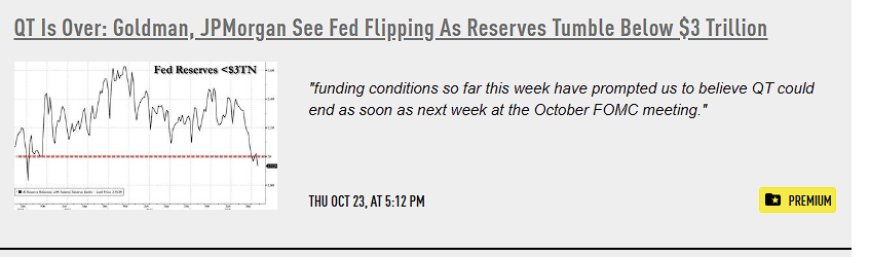
QT Is Over: The System Just Crossed Its Reserve Floor
Published October 23, 2025 | by Pattern Nexus
We just crossed the line I’ve been mapping for months. Not the line pundits argue about on TV. The system line — where quantitative tightening (QT) runs into the hard limits of banking reserves, collateral availability, and market plumbing. When that floor is hit, the game board changes. It’s not a “maybe.” It’s a structural constraint on how far policymakers can drain liquidity before something breaks that they actually care about.
If you’ve been following my work, you know this turn has been telegraphed: falling excess reserves, collapsing usage of easy buffers, stress rippling through funding channels, and a policy backdrop that can’t afford a real accident heading into an election-heavy world and a deglobalized commodity map. The net: QT has exhausted the true buffer. The next phase is stabilization, then quiet re-liquefication — call it “QE in practice,” whatever the branding.
The Reserve Floor Problem (Why QT Can’t Be Infinite)
Central banks like to suggest QT is a dial they can turn smoothly. Reality is jagged. Below a certain system-wide reserve level, funding markets become nonlinear: repo specialists get twitchy, dealers hoard the “right” collateral, and banks start prioritizing optionality over intermediation. You don’t see this in one neat headline; you see it in behavior — bid/offer dynamics, term premia, bill richness, and how fast stress transmits when a surprise hits.
At that floor, every marginal dollar drained from the system starts pulling connective tissue, not fat. That’s when policymakers change posture — sometimes publicly (rate guidance), more often mechanically (operations, pace adjustments, composition). We’re there.
How This Shows Up in Markets
- Rates & Term Structure: Front-end policy can still move, but the bias shifts toward accommodation via plumbing — slower balance sheet run-off, altered reinvestments, or facilities doing quiet heavy lifting.
- Credit Rationing & Risk: Lenders get selective. Spreads stop tightening on good news, widen quickly on bad news. Funding windows feel shorter; issuance timing matters more.
- Collateral Scarcity vs. Cash Scarcity: The dance flips back and forth. When reserves are scarce, “pristine” collateral levitates. That can make duration feel safe… until it doesn’t.
- Gold & Hard Assets: Not a religion — a mirror. When the system hints at re-liquefication, the pricing mirror tilts. Hard assets sniff first.
Policy: What Shifts Next (Label It However You Want)
Policymakers won’t hold a parade and announce “QT is over.” They’ll talk “prudence” and “stability,” then do the work. Expect one or more of the following:
- Slower QT Pace: The most frictionless lever. Let runoff decelerate without admitting defeat.
- Targeted Reinvestment Tweaks: Subtle changes in duration and composition to ease specific pressure points.
- Facility Usage as a Relief Valve: Periodic operations to cushion funding, keeping optics calm.
- Forward-Guidance as Camouflage: Talk “data dependence,” act to protect pipes. Optics matter.
The point isn’t what they say. It’s what the machine does. The machine is already turning.
Beyond Markets: Liquidity as Infrastructure for a Digitized Economy
Liquidity isn’t just about stocks and bonds. It’s the operating system for the next rails: tokenized treasuries, real-time settlement, programmable collateral, and a data-native dollar. A world shifting to 24/7 markets, streaming payments, AI-driven logistics, and machine-to-machine commerce can’t run on brittle, starved liquidity. That’s why each tightening cycle ends the same way: with a reluctant admission that the base layer must be funded if you want the future to actually boot.
What I’m Watching (Signals, Not Noise)
- Balance-Sheet Mechanics: Pace and composition of runoff vs. reinvestment; any “temporary” ops that look suspiciously permanent.
- Front-End Funding: Repo/term dynamics, bill richness, and dealer balance-sheet telltales.
- Collateral Behavior: On-the-run vs. off-the-run spreads; specialness in specific maturities.
- Cross-Asset Confirmations: Gold/hard assets, long duration’s reaction function, credit curve kinks.
- Policy Language vs. Plumbing: Dissonance between the press conference and what the pipes actually do.
Execution Mindset (Not Financial Advice)
This is a regime inflection, not a one-day trade. Positioning should respect higher path-dependency: liquidity windows open/close faster, dispersion increases, and headline shocks matter less than plumbing shifts. Survival is sizing; edge is timing; conviction is earned by reading the pipes, not the pundits.
Key Takeaways
- QT exhausted the real buffer; the system hit (or is skimming) its reserve floor.
- Policy will pivot in practice before it admits it in words.
- Re-liquefication supports the rails of a digitized, tokenized economy.
- Watch plumbing, not press releases.
Related Posts (Pattern Nexus)
- Fed’s October Pivot: Liquidity Cycles, Digital Dollar Frontier
- The Calm Before the Liquidity Storm: QE 2026 in Motion
- Daily Recap (Oct 22, 2025): Markets Brace for a Data-Blind Fed
- The Calm Before the Liquidity Storm
- Fed, MBS & Repo Operations: QE2026 and the Liquidity Cycle
- Era of Easy Money Ends — How Declining Liquidity Is Shaping Markets
What's Your Reaction?
 Like
0
Like
0
 Dislike
0
Dislike
0
 Love
0
Love
0
 Funny
0
Funny
0
 Wow
0
Wow
0
 Sad
0
Sad
0
 Angry
0
Angry
0

Nexus (Christopher)
Founder of Pattern Nexus. I research markets, macro, geopolitics, AI, history, ancient systems, and the patterns most people overlook. I’m also building Market Radar, a trading scanner designed to read pressure, risk, confirmation, and setup quality before ch…
Related research
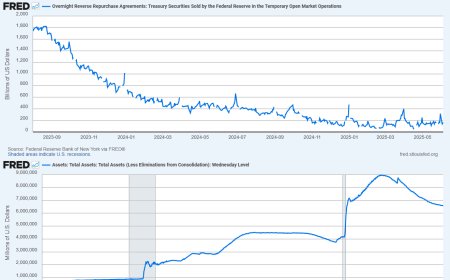
Era of Easy Money Ends – How Declining Liquidity Is Shaping Markets
Central banks are pulling back trillions in liquidity after years of easy money. We examine how this liquidity drain – in the US and global…
Two Economies, One Balance Sheet: The Unstable Barbell of 2026
Reserve support has returned, but real long rates, fiscal supply, and an AI-energy capital wave are splitting the U.S. economy between capi…
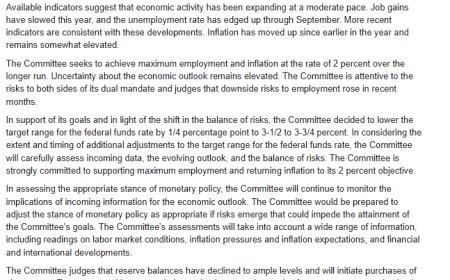
December 10, 2025: QT Ends, QE-Lite Begins
The Fed cut rates by 25 bps, acknowledged rising downside risks to employment, and quietly ended QT by initiating short-term Treasury purch…
The Calm Before the Liquidity Storm
After Powell’s quiet remarks in Philadelphia about ending Quantitative Tightening (QT), subtle tremors are building across the repo and col…
The Quiet Repo Surge: $14.75B SRF Tap + $30B Liquidity Pulse Signals the New Regime
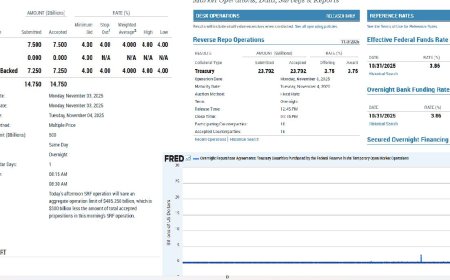
In three trading days, the Fed silently pushed nearly $45B through the repo window — including a $14.75B SRF tap and a ~$30B overnight repo…
🚨 The Fed Just Tapped the MBS Repo Valve — Why That Matters More Than People Think
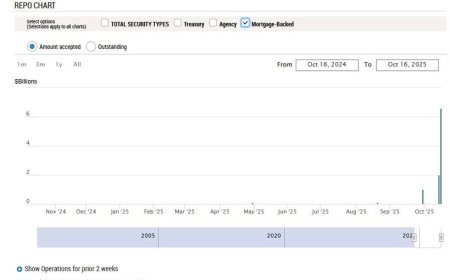
The Federal Reserve quietly conducted nearly $9 billion in mortgage-backed repo operations after months of inactivity — signaling early liq…
Comments (0)
Security Check
Please complete the captcha to verify you are human.