
Red-Lit Airspace: What the U.S. NOTAM Over Venezuela Really Signals
U.S. Issues Full NOTAM Over Venezuela — What’s Really Moving Beneath the Surface
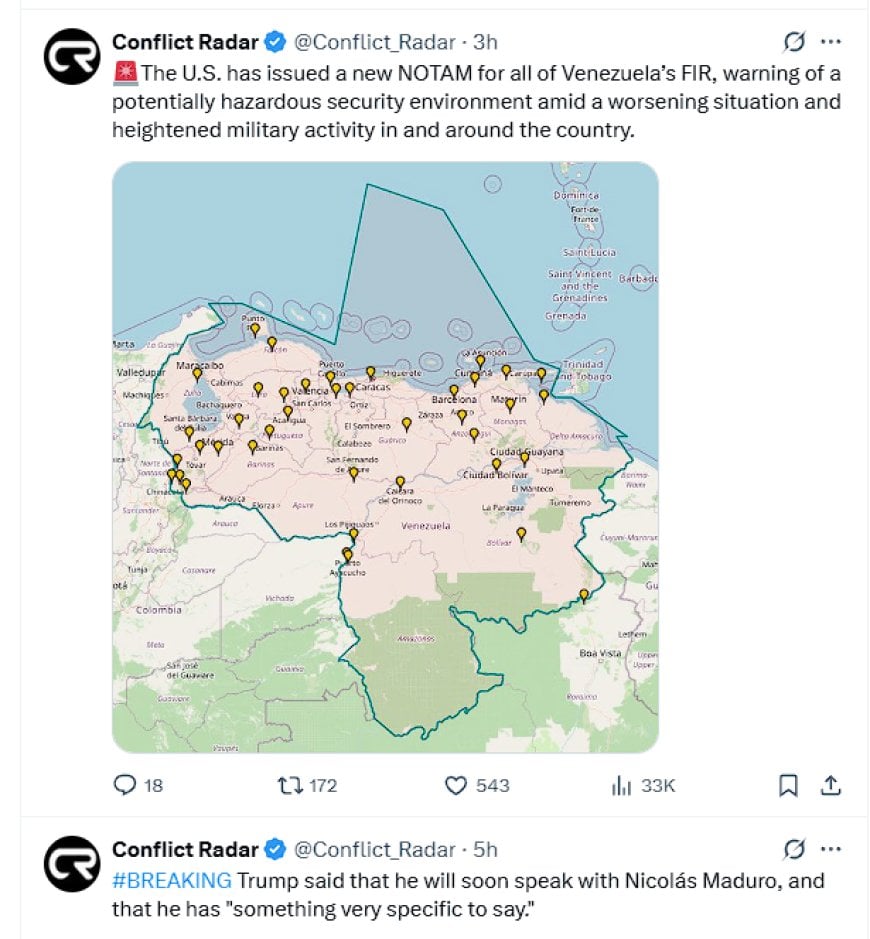
Red-Lit Airspace: What the U.S. NOTAM Over Venezuela Really Signals
A full-country air warning, a carrier group off the coast, and a U.S. president saying he has “something very specific” to tell Nicolás Maduro. This isn’t noise — it’s a live stress test of the Western Hemisphere’s security architecture.
Navigation
- The Signal: A Full-FIR NOTAM Over Venezuela
- Operation Southern Spear and the Military Buildup
- Trump, Maduro, and the Terror-Designation Squeeze
- Essequibo, Brazil, and the Wider Map
- What This Actually Means for Airspace Risk
- Scenario Map: What Could Happen Next
- Pattern Nexus Watchlist: Next 7–14 Days
- Sources
The Signal: A Full-FIR NOTAM Over Venezuela
This is not a routine aviation update. A full NOTAM for all of Venezuela’s Flight Information Region (FIR) is the kind of move you usually see when intelligence agencies expect real, time-bounded risk.
On November 21, 2025, the United States issued a new Notice to Air Missions (NOTAM) covering the entirety of Venezuela’s controlled airspace, warning of a “potentially hazardous security environment” amid a “worsening security situation and heightened military activity in or around the country.” The advisory stresses that threats could affect aircraft at all altitudes — during overflight, approach, departure, and even while parked on the ground at Venezuelan airports.
In practical terms, this is Washington telling every commercial operator: we believe the risk profile around Venezuela just jumped a level, and we are putting that judgment in writing. It also gives insurers, airlines, and logistics planners political cover to reroute traffic without having to spell out their underlying threat models.
Aviation analysts have been flagging the southern Caribbean as a rising-risk corridor all year as U.S. military movements increased and Caracas responded with sharper rhetoric and mobilizations. The new NOTAM essentially codifies that shift into official guidance.
Key context: NOTAMs don’t mean “war tomorrow.” They mean the U.S. believes the probability distribution of bad outcomes for aircraft is now high enough that silence would be negligent.
Operation Southern Spear and the Military Buildup
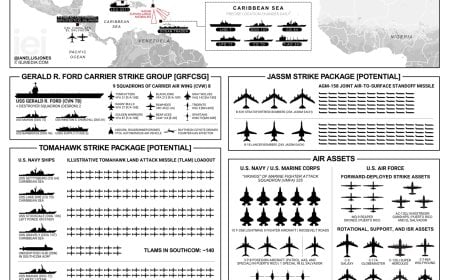
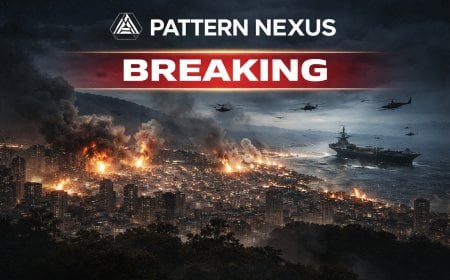
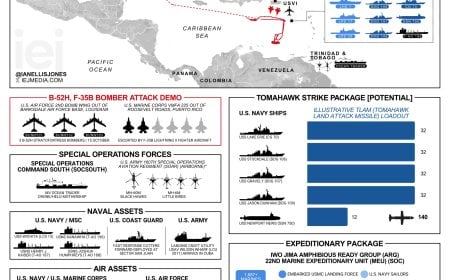
The NOTAM doesn’t appear in a vacuum. It lands on top of the largest U.S. military presence in the Caribbean in roughly three decades. Under the umbrella of Operation Southern Spear, Washington has deployed the USS Gerald R. Ford carrier strike group, advanced fighters, surveillance platforms and maritime assets into the region, officially to target narcotrafficking networks and “narcoterrorism” with links to Venezuela.
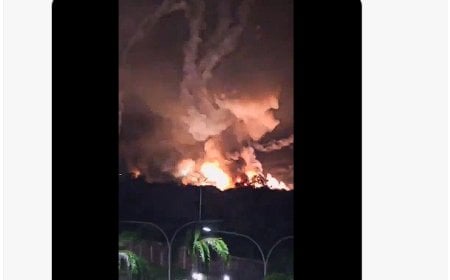
Since early September, U.S. forces have conducted a series of kinetic strikes on suspected drug-smuggling vessels in Caribbean and Pacific waters, with open-source tallies putting the death toll from these engagements in the dozens. These are real, lethal operations — not just freedom-of-navigation cruises — and they move the regional environment out of “peacetime routine” and into what Pattern Nexus would call a low-intensity conflict envelope.
For Caracas, the picture looks even more threatening: a hostile great power parking its most advanced carrier off its maritime approaches while flying bombers and reconnaissance aircraft nearby, combined with economic sanctions and legal warfare in U.S. courts. That perception matters, because it shapes how Venezuelan planners read every radar return and every blip on ADS-B.
From Washington’s lens: this is framed as a counter-narcotics and counter-terror campaign with optionality to deter or strike the Maduro regime.
From Caracas’ lens: it looks like the shaping phase of a regime-pressure or regime-change operation, even if Washington insists otherwise.
Trump, Maduro, and the Terror-Designation Squeeze
Layered on top of the military signaling is a deliberate information and legal campaign. In mid-November, the Trump administration moved to designate the alleged Venezuelan network known as the Cartel de los Soles as a Foreign Terrorist Organization, claiming President Nicolás Maduro effectively leads a narco-terror apparatus. That designation matters because it expands the legal toolkit for sanctions, interdictions, and even the use of force.
On the same timeline, Trump has repeatedly floated that he is open to direct talks with Maduro — while explicitly refusing to rule out the deployment of U.S. troops in or around Venezuela. In multiple interviews he has said he will “speak with Maduro soon” and that he has “something very specific to say” to the Venezuelan leader, without disclosing the content.
This is a dual-track pressure architecture:
- Escalatory track: terrorist designation, military build-up, kinetic strikes on “narco” targets, and open discussion of troop options.
- Diplomatic track: public hints at a phone call, talk of “being willing to negotiate,” and references to possible business opportunities in Venezuela’s oil sector.
For markets and regional governments, this combination is inherently unstable. It creates a negotiation space where de-escalation is possible, but it also keeps the door open to sudden kinetic moves framed as counter-terror or counter-narcotics operations. The NOTAM fits right into that logic — a risk-management layer on top of a deliberately ambiguous strategy.
Essequibo, Brazil, and the Wider Map
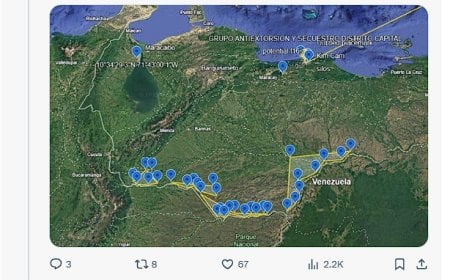
Behind the U.S.–Venezuela confrontation sits a separate, but connected, fault line: Venezuela’s long-standing claim over Guyana’s Essequibo region and the discovery of massive offshore oil reserves nearby. Over the past two years, Caracas has used referendums, military exercises, and new maps to reinforce its claim. Georgetown, backed by Washington and other partners, has treated this as a direct threat to its territorial integrity.
Brazil, for its part, has quietly shifted into a hedged posture. In early November, Brasília reinforced air and ground assets in the northern state of Roraima, which borders both Venezuela and Guyana, explicitly framing it as a precaution against volatility around the Essequibo dispute. Brazil’s message is simple: we don’t want a war on our border, and we’re prepared to secure our own territory if things spiral.
The result is a layered security geometry in the southern Caribbean:
- U.S. power projection from the sea and air, framed around narcotics and terrorism.
- Venezuela’s regional ambitions and regime survival logic, including the Essequibo claim.
- Guyana’s sudden elevation from marginal state to oil and security pivot.
- Brazil’s stabilizer role, trying to avoid being dragged into a confrontation between its neighbors and a superpower.
When you redraw the map in terms of flows instead of borders, Essequibo is where resource flows, security guarantees, and great-power signaling all intersect. That’s why a “simple” NOTAM over Venezuelan airspace is not just about aviation — it’s about the structure of regional order.
What This Actually Means for Airspace Risk
For airlines, cargo operators, and insurers, the new NOTAM translates into a concrete set of questions:
- Do we reroute over-water to avoid Venezuelan airspace entirely, even at higher fuel cost?
- Do we maintain overflights but raise crew advisories and review diversion plans?
- Do we continue operating to Venezuelan airports, and if so, under what risk thresholds and insurance terms?
Independent aviation risk trackers already list Venezuela as a higher-risk FIR, especially for non-essential overflight. The combination of heightened military activity, potential misidentification between civilian and military aircraft, and the possibility of strikes on targets near major transport corridors makes the risk asymmetric: the upside of flying the shortest route is mostly economic; the downside, in the worst case, is catastrophic.
Operationally, the NOTAM doesn’t close the sky. It changes the baseline assumption from “normal but politically tense” to “tension plus elevated miscalculation and kinetic risk.” That’s a meaningful shift.
The maritime picture mirrors this. As U.S. and Venezuelan forces shadow each other in contested waters, the risk of accidental or intentional engagements against vessels — especially those misread as carrying contraband or supporting an adversary — rises alongside airspace risk.
Scenario Map: What Could Happen Next
Pattern Nexus doesn’t forecast single outcomes here — it maps structures. Given the current configuration, several near-term pathways stand out:
Coercive Diplomacy With a Narrow Off-Ramp
The Trump administration uses the carrier presence, terror designation, and NOTAM as leverage to force Maduro into concessions: on drug trafficking, political prisoners, or the Essequibo dispute. The promised “very specific” message becomes a hard ultimatum delivered by phone. Escalation risk remains but is managed through back-channel talks involving regional states.
Limited Kinetic Expansion, Still Below “War”
U.S. forces widen their target set against assets they characterize as narco-terror or cartel-linked, possibly creeping closer to Venezuelan territorial waters or infrastructure. Venezuela retaliates asymmetrically with cyber operations, proxy actions, or harassment at sea and in the air. The NOTAM proves prescient as the air and maritime domain get noisier and less predictable.
Negotiated Freeze Around Essequibo and Security Guarantees
Brazil, CARICOM states, and perhaps the OAS or UN help broker a temporary freeze: no new Venezuelan moves on Essequibo, no U.S. strikes near core Venezuelan infrastructure, and a framework for monitored de-escalation. The NOTAM stays in place as a conservative risk posture, but the underlying probability of worst-case events declines.
Miscalculation and Accidental Escalation
The darkest pathway isn’t a deliberate invasion — it’s a misread radar track, a civilian aircraft mistaken for a surveillance platform, or a clash at sea that kills the wrong personnel at the wrong time. In that world, leaders on both sides may feel compelled to “respond,” even if neither actually wanted a wider conflict. The current density of forces and the intensity of rhetoric make that tail risk non-trivial.
The structural takeaway: the U.S. just moved the Venezuela situation deeper into a zone where aviation, maritime security, energy flows, and domestic politics are entangled. The NOTAM is the visible paperwork attached to that shift.
Pattern Nexus Watchlist: Next 7–14 Days
- Additional NOTAMs or route-specific restrictions over the southern Caribbean, Guyana, or neighboring FIRs.
- New U.S. designations or indictments tied to Venezuelan officials, security services, or entities linked to the alleged narco-terror network.
- Brazilian posture changes in Roraima and other northern states — more air patrols, new exercises, or explicit statements on Essequibo.
- OAS, CARICOM, or UN statements that move from “concern” language to explicit warnings about use of force.
- Venezuelan military doctrine updates or mobilization orders that hint at contingency planning against U.S. strikes, not just Guyana.
- Energy-market reaction if traders start pricing a risk premium on disruptions to Caribbean shipping lanes or Venezuelan production capacity.
- Details on the Trump–Maduro call, if and when it happens, especially any references to timelines, red lines, or “last chances.”
Wherever this goes, the core Pattern Nexus lens is simple: follow the structures, not the soundbites. The NOTAM is one of those structures — a formal, documented shift in how one superpower rates the risk of operating in and around Venezuela. Everything else now evolves inside that new frame.
Sources
External hyperlinks are listed here only, with no in-text external linking, per Pattern Nexus style.
- AP / FAA coverage of the new U.S. NOTAM warning over Venezuela’s airspace and “worsening security situation.” AP News – FAA Venezuela NOTAM
- Latin Times aviation reporting on the NOTAM language and operational risk changes. Latin Times – Airspace Restriction Report
- Additional Latin Times reporting on U.S. base upgrades and operational posture in the Caribbean. Latin Times – Naval Base Upgrade Report
আপনার প্রতিক্রিয়া কি?
 পছন্দ করুন
0
পছন্দ করুন
0
 অপছন্দ
0
অপছন্দ
0
 ভালোবাসা
0
ভালোবাসা
0
 মজার
0
মজার
0
 বাহ!
0
বাহ!
0
 দুঃখজনক
0
দুঃখজনক
0
 গোস্বামী
0
গোস্বামী
0

Founder of Pattern Nexus. I research markets, macro, geopolitics, AI, history, ancient systems, and the patterns most people overlook. I’m also building Market Radar, a trading scanner designed to read pressure, risk, confirmation, and setup quality before chasing a move. Pattern Nexus is where I connect the dots between data, history, technology, and the bigger system playing out around us.










মন্তব্যসমূহ (0)