
Venezuela, SOUTHCOM, and the New Western Hemisphere Power Map (2025 Update) | Pattern Nexus
Updated 2025 force-posture analysis: why the Caribbean just became the most important theater of the 21st century. Carrier groups, JASSM bombers, Tomahawks, MEUs, ISR corridors — and what it signals for Venezuela, Guyana, and the next decade of hemispheric strategy.
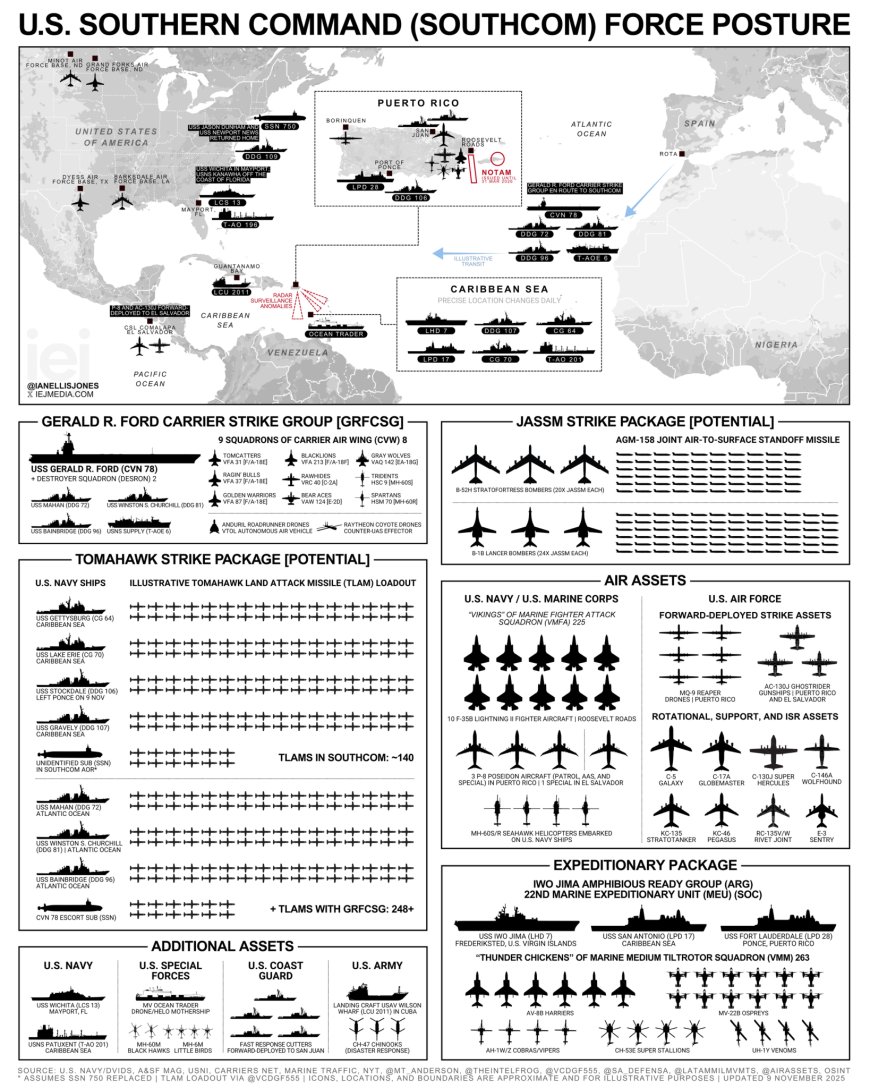
Venezuela, SOUTHCOM, and the New Western Hemisphere Power Map (November 2025 Update)
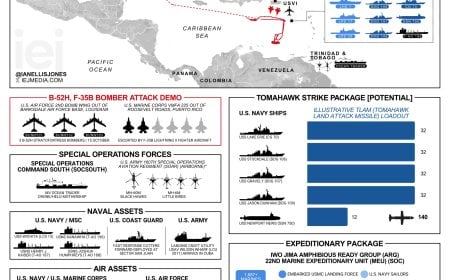
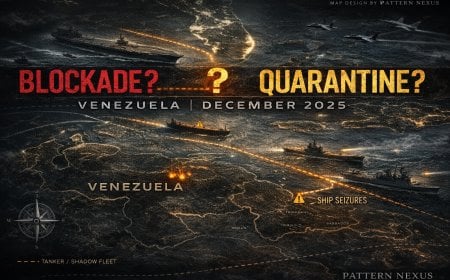
The Caribbean just became the most strategically important theater of the 21st century. Carrier groups, JASSM bombers, Tomahawk saturation, MEUs, ISR corridors, and proxy interdiction — a posture configured not for messaging but for decision-time.
1) The U.S. Response Is Not Symbolic — It’s Structural
Past Caribbean flare-ups saw single-unit surges. The 2025 package is a layered denial grid designed for rapid decision cycles with overlapping windows for air denial, maritime choke control, standoff strikes, and amphibious forcible entry.
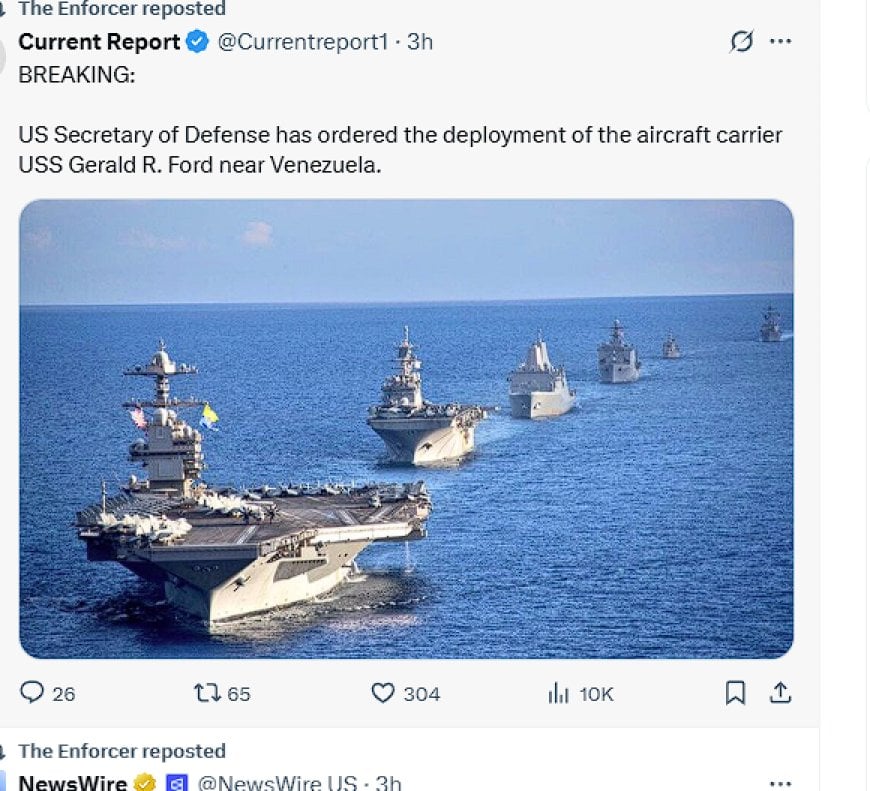
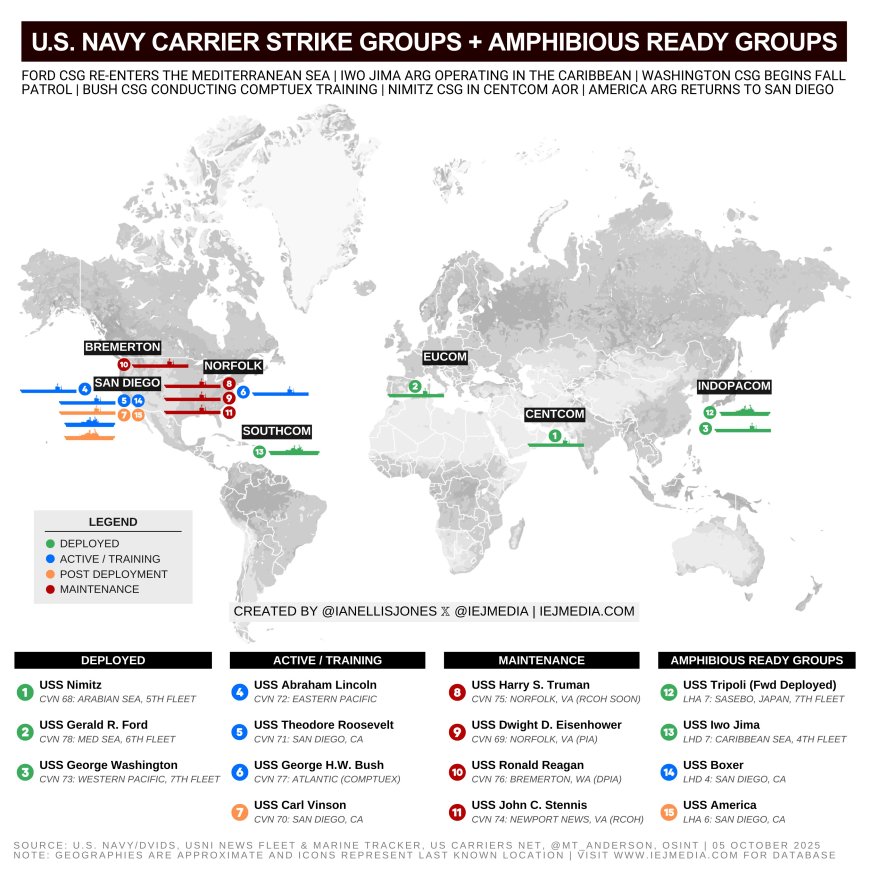
You don’t assemble this to “message.” You assemble it so options exist now if the threshold is crossed. For context on the carrier signaling pattern, see Consolidating Power — The Global Carrier Pattern & the Caribbean Surge and the earlier signal read in USS Gerald R. Ford Deployment — The Signal, Not the Show.
↑ Back to top2) Why Venezuela Matters Now (Not a Decade Ago)
2025 ≠ 2015. Three structural shifts changed the game: hemispheric consolidation, deeper external patronage, and Guyana’s transformation into a high-value petro hub. I’ve laid the long-cycle scaffolding in Systemic Realignment and Tokenized Reserve Era.
- Hemispheric consolidation: The U.S. is hardening a Western Hemisphere security monopoly — energy, food, minerals, maritime lanes, and AI-industrial logistics. See overview in The Pattern Nexus — Master Brief.
- External patrons: For the proxy toolkit and maritime control logic, cross-reference The Blockade Age.
- Guyana’s oil: For the “mini-Kuwait” framing within the broader oil/FX cycle, see Commodities, Gold & FX.
3) What This Posture Actually Means
Hot takes call this “deterrence.” It’s more precise: pre-decisional force staging. Washington assumes Caracas may cross a line and wants immediate strike/interdiction options. For the earlier build-up chronology, see SOUTHCOM’s Caribbean Buildup and Caribbean Surge — From Sea Strikes to Land Options.
↑ Back to top4) Scenarios
Scenario 1 — Boundary Crisis Stabilization (Most Likely)
ISR escalation, maritime control modules, SOF interdictions, and diplomatic isolation cap the crisis without major kinetic action. My first “imminent watch” on this path: Imminent Escalation Watch: Venezuela.
Scenario 2 — Limited Incursion into Guyana (High Risk)
If Venezuela crosses the border: air denial, Tomahawk/JASSM precision strikes, rapid infrastructure security by Marines, and strict maritime exclusion. Early rehearsal signals discussed in Second Bomber Demo Near Venezuela — The Signal, Not the Show.
Scenario 3 — Covert Patron Involvement (Medium Risk)
Iran/Russia/PRC proxies trigger counter-proxy ops: cyber against remote links, hard maritime boarding, and SOF actions against forward nodes. Framework: War & Conflict Escalation (Section).
Scenario 4 — Regime Destabilization (Low Probability, High Impact)
If strikes degrade regime apparatus, the U.S. may be dragged into humanitarian corridors and interim stabilization — the least-preferred outcome due to long dwell. See the trade-offs mapped in The Regime-Change Question.
↑ Back to top5) Updated 2025 Predictions
- Semi-permanent Caribbean air & maritime corridor: predictable CSG rotations (90–120 days), persistent ISR lanes, more assets into Puerto Rico.
- Naval modernization locally: USCG cutter surge, unmanned systems, sub presence near the Venezuela Basin, and drone-swarm maritime ISR.
- Hybrid escalation, not open war: cyber intrusions, maritime militia, drone overflights, shadow shipping, and disinfo — cheap, deniable, effective.
- Guyana = mini-Kuwait: de facto U.S. protection architecture around offshore production and export corridors.
- China stays the long game: finance, logistics, covert ISR support — but avoids direct exposure.
- Flashpoint at sea: patrol-vessel confrontation → skirmish → rapid escalation is the highest-likelihood spark.

Explore the live, interactive version:
Open Full-Screen Map Preset: Guyana Watch • layers & sliders enabled6) The Bigger Picture: The Caribbean Is the New South China Sea
Resource-rich, lane-dense, contested by gray-zone actors, and wrapped in proxy competition — the Caribbean inherits the South China Sea’s logic but sits on America’s doorstep. The rule being written: the Western Hemisphere will not be contested. For the macro-liquidity spine under this doctrine, see Reverse Repo Trap and the follow-through in The Calm Before the Liquidity Storm (QE-2026).
↑ Back to top7) Final Take
Venezuela is the spark, not the story. The story is a 50-year boundary for the Americas: no Russian/Iranian/PRC proxies building coercive leverage in the hemisphere’s energy and logistics core. This posture is the opening move of a long-term realignment — consistent with the operating rules I’ve laid out across Systemic Realignment, AI Industrial Flywheel, and The Dollar Isn’t Collapsing — It’s Evolving.
Related Reading (Pattern Nexus)
- Imminent Escalation Watch — Venezuela
- Second Bomber Demo Near Venezuela — The Signal, Not the Show
- SOUTHCOM’s Caribbean Buildup
- Caribbean Surge — From Sea Strikes to Land Options
- The Regime-Change Question
- Signal in the System — USS Gerald R. Ford
- Global Carrier Pattern & Caribbean Surge
- The Pattern Nexus — Master Brief
- The Blockade Age
Hashtags: #Geopolitics, #Southcom, #VenezuelaCrisis, #USMilitary, #CaribbeanSea, #NationalSecurity, #GlobalPowerShift, #MilitaryAnalysis, #PatternNexus
What's Your Reaction?
 Like
0
Like
0
 Dislike
0
Dislike
0
 Love
0
Love
0
 Funny
0
Funny
0
 Wow
0
Wow
0
 Sad
0
Sad
0
 Angry
0
Angry
0

Founder of Pattern Nexus. I research markets, macro, geopolitics, AI, history, ancient systems, and the patterns most people overlook. I’m also building Market Radar, a trading scanner designed to read pressure, risk, confirmation, and setup quality before chasing a move. Pattern Nexus is where I connect the dots between data, history, technology, and the bigger system playing out around us.









Comments (0)