
The Pattern Nexus Master Brief: CBDCs, BRICS, Energy Corridors, and the Next Security Era
A Pattern Nexus master brief on the new security era: CBDCs, tokenized treasuries, BRICS trade, carrier posture, GPS warfare, and why money, energy, and narrative now move as one system.

Global Multipolarity, Digital Sovereignty, and the New Security Era
This master overview synthesizes key themes explored at Pattern Nexus. In a single narrative it links monetary architecture, trade politics, military posture and alliance dynamics. It draws from dozens of articles to show how money, security, energy and narrative now operate as one system. Here you’ll find the larger pattern behind central‑bank digital currencies (CBDCs), the breakdown of the post‑Cold War order, the misread signals in U.S. geopolitics, the convergence of hard and soft power, and why the China–Russia axis remains shallow despite appearances. The goal is not to retell each piece but to weave them into a coherent framework for understanding the world in late 2025.
The Race for Monetary Control: CBDCs and Digital Sovereignty
Money has always been more than a medium of exchange; it is a lever of sovereignty and geopolitical leverage. As digital platforms swallow commerce and communications, governments are scrambling to re‑assert control over the rails of money before private tech giants lock them out. Pattern Nexus explains how the global race for central‑bank digital currencies (CBDCs) moved from fringe concept to policy priority. By 2025 more than 130 countries, representing roughly 98 % of global GDP, are developing, piloting or researching CBDCs. The fear driving this rush is that Big Tech might control transaction rails or dollar‑backed stablecoins might replace sovereign currency rails. China’s e‑CNY pilot, Europe’s planned digital euro and America’s regulated stablecoin framework illustrate divergent approaches. The BIS‑led mBridge project—linking China, Hong Kong, Thailand and the UAE—has already processed real cross‑border transactions without SWIFT. What’s at stake is not just domestic digital cash but who writes the rules for programmable money: trade settlement without dollar intermediaries, instant currency conversion and capital‑control features such as expiring funds or location‑restricted spending. Governments ask themselves not whether they need CBDCs but whether they will control the rails or cede them to private platforms.
A crucial tension is emerging between two monetary futures: public‑domain sovereign digital money versus private tokenized money. The United States is leaning toward regulated private rails, China is all‑in on state‑controlled CBDCs, and Europe is crafting a hybrid. Pattern Nexus likens this moment to a digital Bretton Woods—an impending bifurcation where the network that clears value matters as much as the currency itself. The next decade’s flashpoints include the digital euro’s rollout and privacy guarantees, U.S. legislation for stablecoins and tokenized treasuries, scaling of mBridge into production, BRICS digital currency cooperation and the rise of offline CBDC payment technology for crisis readiness. None of this is about convenience; it’s about control, power and programmable sovereignty.
From Unipolar Dominance to Multipolar Liquidity
The unipolar world that defined the late twentieth century was built on American currency, sea power and rule‑writing. Every oil barrel, debt issuance and trade transaction was priced in dollars because the U.S. printed the currency and controlled the oceans. But systems built on control eventually face entropy. The post‑Cold War order is breaking apart through its own mechanisms. Pattern Nexus calls the replacement multipolar liquidity—a decentralized structure of trade, energy and finance built not around ideology but around access to flows. The future empire isn’t about armies; it’s about networks: pipelines, data cables, rare‑earth supply chains and settlement systems. We are watching the global operating system reprogram itself in real time.
The BRICS+ alliance (Brazil, Russia, India, China, South Africa and new entrants like Saudi Arabia and Iran) constitutes the most coordinated challenge to dollar hegemony in modern history. Collectively the bloc accounts for more than 40 % of global oil output and 30 % of global GDP (PPP), and members are routing trade settlements outside U.S. systems. Their strategy isn’t to destroy the dollar but to outgrow it. Russia and China conduct most of their energy trade in yuan; India buys Russian oil in rupees and dirhams. The BRICS New Development Bank and its planned payment system aim to bypass SWIFT and the IMF. Energy is becoming a currency: China dominates solar and rare‑earth supply chains, Russia and Iran control vast gas networks, and Gulf states hedge between U.S. protection and eastern financial opportunity. Infrastructure is the new battleground—China’s Belt and Road and Middle Eastern corridors build physical trade arteries while BIS projects like mBridge lay digital settlement layers. The coming world will not have a king currency but overlapping zones of trust—regional ecosystems clearing trade digitally through programmable rails.
Domestic Theater vs. Global Projection: Misreading U.S. Power
One reason Americans often misinterpret geopolitical moves is that domestic political theater disguises the continuity of U.S. statecraft. At home, politics plays out through a left–right culture‑war lens. Abroad, the United States projects a single strategic actor with enduring institutions, capabilities and interests that outlast any administration. The Pattern Nexus essay “Domestic Theater vs. Global Projection” illustrates this with the viral clip of Representative Ilhan Omar defending President Trump during a meeting with European politicians. Online, the moment shocked partisans; in diplomacy, it made sense because overseas representatives are expected to protect national legitimacy and signal unity. Foreign governments don’t negotiate separately with Democrats one day and Republicans the next; they engage the U.S. state—the treaty network, military posture, dollar system, export controls, intelligence alliances and diplomatic leverage.
Research across decades shows that U.S. foreign policy displays broad continuity despite headline drama and partisan fights. Even recent scholarship finds that a bipartisan backbone remains resilient on major external questions. Examples include cross‑party sponsorship of the American Privacy Restoration Act, a bill to repeal the USA PATRIOT Act. At home, the incentive is to maximize attention and mobilize identity tribes; internationally, the incentive is to preserve deterrence, alliances and market confidence. Understanding this split is critical: when citizens confuse partisan theater with the nation’s strategic identity, they become vulnerable to narrative manipulation and misread foreign moves. The world keeps negotiating with a single actor called the United States; to see the board accurately, track institutions and structural bills, separate domestic and international incentives, watch bipartisan coalitions and price credibility rather than pundit arguments.
Monetary and Kinetic Convergence: Carriers and Code
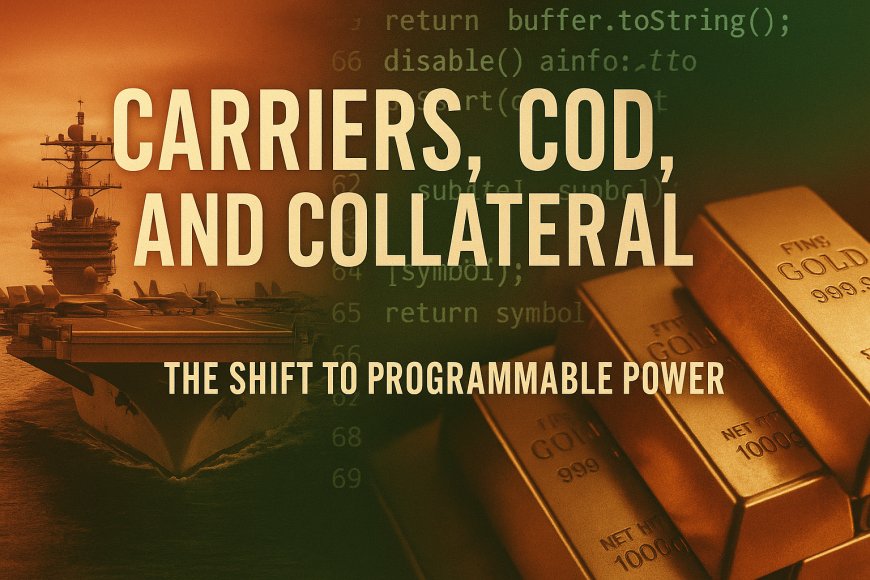
Pattern Nexus notes that economic, digital and military systems are increasingly synchronized. The U.S. Navy’s deployment of the USS Gerald R. Ford (CVN‑78) to the Southern Command theater in October 2025, ostensibly for drug interdiction, is described in “Signal in the System” as more than a military maneuver. It represents a visible node in the deeper systemic realignment that Pattern Nexus has been tracking. Decentralization of U.S. power has peaked and consolidation has begun. The Caribbean—once a logistical backwater—has become the epicenter of multi‑domain leverage. Ports, airfields and undersea communication routes in the region are now as strategically critical as any oil field or stock exchange. SOUTHCOM has been quietly expanding interoperability between naval, amphibious and intelligence assets. The Ford’s movement completes this triad, providing the kinetic backbone behind a hemispheric network designed for rapid projection rather than long‑term occupation.
The article explains that the key to control in the new era isn’t territory but corridors. Whoever dominates the pathways of trade, energy and data flow dictates the shape of global leverage. The Ford’s arrival in the Caribbean signals U.S. determination to secure the western hemisphere’s connective tissue ahead of an economic inflection point. When liquidity contracts, governments reassert physical control over the arteries that sustain their economies. This deployment synchronizes with experiments in tokenized treasuries and blockchain‑based settlement rails. It shows how monetary, informational and military systems are being recalibrated together; the movement itself is the message. It signals that the next phase of global restructuring will not remain confined to balance sheets or currency regimes; it will extend into physical space as carriers, satellites and data centers converge to enforce system integrity.
Trade Diplomacy Meets Nuclear Signaling
The interplay between trade negotiations and military posture came to a head in late October 2025. In Busan, South Korea, President Trump met with President Xi Jinping for their first face‑to‑face talks since 2019. According to Reuters, the two leaders agreed to trim U.S. tariffs on Chinese imports to 47 % from 57 % in exchange for Beijing cracking down on the fentanyl trade, resuming U.S. soybean purchases and pausing rare‑earth export curbs for a year. The deal also included a U.S. pledge to delay a measure that would bar thousands of Chinese firms from receiving U.S. technology. China agreed to buy 12 million metric tons of U.S. soybeans through January and 25 million tons annually for the next three years, and to resume energy purchases. While markets cheered a reprieve from escalating trade war rhetoric, analysts noted that the tariff cut in exchange for a promised fentanyl crackdown is transactional relief rather than a structural reset; tensions could resume whenever either side feels shortchanged.
Hours before the Busan meeting, Trump shocked the world by announcing on social media that he had instructed the Pentagon to “start testing our nuclear weapons.” As reported by Reuters and examined in the Pattern Nexus article “Trump Orders Immediate Resumption of U.S. Nuclear Weapons Testing”, the directive broke a three‑decade moratorium on U.S. nuclear explosive testing. Trump framed it as necessary to ensure the United States does not fall behind Russia and China, declaring that “Russia is second, and China is a distant third, but will be even within five years.” The timing, on the eve of talks with Xi, suggested the announcement was a deliberate bargaining chip. Pattern Nexus points out that even signaling a restart is provocative and risks triggering an arms race, though practical constraints mean full‑yield tests would take years to prepare. The directive fused trade diplomacy with nuclear posture, creating a narrative coup: the White House used the prospect of explosive tests to telegraph resolve toward both China and Russia while framing renewed testing as parity rather than escalation. Key questions going forward include whether the administration pursues full‑yield or sub‑critical experiments, how allies and rivals respond, and whether arms‑control talks survive.
Forced Cooperation: China–Russia Distrust and the Limits of Alliances
Amid talk of a Sino‑Russian “no‑limits” partnership, Pattern Nexus argues that any China–Russia axis is more compulsion than camaraderie. External research supports this scepticism. An Indo‑Pacific Defense Forum analysis notes that historical friction undermines claims of a limitless partnership. China historically eyed Russia’s Far East (Vladivostok) and is expanding into Central Asia, areas Moscow sees as its sphere of influence. In the Arctic, China seeks access to new shipping lanes and resources but only on Russia’s terms, reflecting deep strategic mistrust. The article suggests employing Sun Tzu’s principle of “using the foreigner to manage the foreigner”: rather than confronting a united bloc, the United States and its allies should exploit these friction points.
National Defense Magazine similarly reports that despite joint exercises and high‑profile meetings, China and Russia are defined by both cooperation and friction. China gains little militarily and primarily plays up friendship to avoid isolation while Russia seeks access to Chinese capital. Analysts caution against taking “no‑limits” at face value; both capitals distrust each other yet cooperate where interests align. The evolving relationship is transactional, not underpinned by trust or an alliance treaty. War on the Rocks adds that speculation about an enduring rapprochement between India and China misreads structural frictions: unresolved border disputes, competing regional ambitions and mutual distrust mean any normalization is fragile. India’s tacit cooperation with China within BRICS or the SCO does not erase deeper tensions. These sources underscore Pattern Nexus’ view that the China–Russia pairing is a forced cooperation borne out of shared opposition to U.S. pressure and mutual economic convenience rather than genuine alignment. The two powers will not go to war for one another, and their rivalry in Central Asia, the Arctic and the Indo‑Pacific provides opportunities for others to wedge them apart.
This scepticism has gained new relevance since Trump’s nuclear‑testing directive. Chinese officials publicly urged Washington to respect its commitment to a moratorium, and Xi did not voice support for resuming tests during the Busan summit. The silence speaks volumes: Beijing values access to global markets and fears arms‑race dynamics that could drag it into a costly spiral. Russia responded cautiously to Trump’s announcement, wary of escalating an arms race it cannot afford. These reactions hint that neither Moscow nor Beijing is willing to follow the United States down the path of resuming nuclear detonations. The alignment is transactional, and diverging strategic calculations will continue to shape Sino‑Russian behaviour.
Security Dilemma and the Rimland–Heartland Balancing Act
The convergence of monetary innovation and military posturing sets the stage for a new security dilemma between what analysts call the Eurasian rimland and heartland. The rimland comprises U.S.‑backed blocs—NATO in Europe, Pakistan and the “Asian Containment Crescent” formed by Japan, Taiwan and the Philippines. The heartland is the emerging Russia–India–China (RIC) format at the core of BRICS and the SCO. Pattern Nexus highlights that arms races may become the Pentagon’s preferred tool for slowing down RIC‑accelerated multipolar processes. NATO’s buildup, Pakistan’s partial re‑armament and the militarization of the Asian crescent could pressure Russia, India and China to divert resources into defence rather than infrastructure. Deployments like the USS Gerald R. Ford are part of this strategy, as are intermediate‑range missile deployments and the “Golden Dome” ballistic‑missile defense network. The risk is that these moves could backfire by deepening Sino‑Russian military‑technical coordination, though the underlying mistrust between them may limit how far such cooperation goes.
For India, participation in BRICS and the SCO does not equate to choosing sides; it is hedging across multiple blocs. Recent signs of thaw between New Delhi and Beijing—such as eased visa restrictions, resumed dialogues and proposals to allow Chinese stakes in Indian firms—may be tactical. Analysts caution that unresolved border disputes and structural frictions make any rapprochement fragile. New arms races could prompt India to recalibrate again, perhaps drawing closer to Russia for military supplies or to the United States for technology. The security dilemma is not binary but layered; states will hedge, align and realign as digital money, energy corridors and alliance structures evolve.
Gold, Treasuries and Tokenized Assets: The Digital Return to Real Money
Behind the headlines about CBDCs lies a parallel development: the digitization of safe collateral. Pattern Nexus’ article “Gold, CBDCs, and the Digital Return to Real Money” argues that the world’s monetary architecture is converging around CBDCs, tokenized treasury bills, gold‑backed stablecoins and programmable settlement railroads. Collateral is the power source, and control of the ledger is the game. The Bank for International Settlements’ 2024 survey shows that 91 % of central banks are exploring digital currencies, with wholesale projects often more advanced than retail ones. The Atlantic Council’s CBDC tracker reports that 137 countries and currency unions—representing 98 % of global GDP—are researching a CBDC, with 72 in advanced stages. India’s e‑rupee pilot has become the world’s second largest, while the United States has paused retail CBDC development but continues to explore wholesale cross‑border rails through projects like Project Agorá.
Alongside state projects, private markets are building a composable system of tokenized treasuries and stablecoins. BlackRock’s BUIDL tokenized money market fund holds a short‑term portfolio of cash and U.S. treasuries and has amassed billions in assets. Franklin Templeton’s OnChain U.S. Government Money Fund tokenizes T‑bills and repurchase agreements without bank credit risk. Stablecoins like USDC and USDT remain dominant but are increasingly backed by short‑term treasuries rather than bank deposits, turning payment tokens into de‑facto money‑market shares. Gold is quietly resurging: central banks have purchased over 1,000 metric tons of gold per year since 2022. The World Gold Council reports that 95 % of reserve managers expect official holdings to increase. This buying spree is a response to sanctions—such as the freezing of Russia’s reserves in 2022—that exposed the risks of relying solely on dollars. Tokenized gold products like PAXG and XAUt allow ownership of vaulted bullion to move at network speed. In crises, states may activate CBDCs for emergency stimulus while investors pile into tokenized treasuries and gold tokens. A digital gold standard need not be declared; it is emerging de facto as the ballast behind programmable liabilities. The big picture is that money, collateral and settlement rails are converging into a hybrid system where gold anchors credibility, treasuries anchor yield and CBDCs/stablecoins provide the interface for everyday transactions and policy enforcement.
Conclusion: Systems Thinking for a Complex Era
The convergence of monetary innovation, trade diplomacy, military posture and narrative control signals that the world has entered a new systems era. CBDCs and tokenized assets are transforming money into programmable code; infrastructure and energy corridors are rewiring the map of power; geopolitical theater hides continuity even as it fuels misperceptions; and carriers and missiles are repositioned in tandem with liquidity cycles. Alliances are transient and transactional, not value‑driven. The China–Russia partnership is a marriage of convenience, not trust. Trade deals and nuclear testing announcements are timed for leverage. Gold is quietly reasserting itself through digital wrappers. At every level, flows—of money, energy, data and military hardware—define the next strategic logic.
For readers of Pattern Nexus, the lesson is to look beyond headlines. See the pattern rather than the show. Track the rails of value, the corridors of power and the incentives that align across domains. The world is fracturing into overlapping zones of liquidity and security, but the underlying system remains coherent—an operating system rewiring itself in response to the pressures of technology, demographics and geopolitics. Understanding that system is the key to navigating the turbulence of the coming decades.
Related Pattern Nexus Analysis
- Digital Sovereignty & the Global Race for CBDCs
- Gold, CBDCs & the Digital Return to Real Money
- Signal in the System: USS Gerald R. Ford & U.S. Power Consolidation
- SOUTHCOM’s Caribbean Buildup: Warships, Marines & Regime-Change Speculation
- Caribbean Surge: From Sea Strikes to Land Options
- Second Bomber Demo Near Venezuela: The Signal, Not the Show
- The Regime-Change Question: Has Washington Crossed the Line in Venezuela?
- Domestic Theater vs Global Projection: Why Americans Misread Geopolitics
- Gold vs the 10-Year Yield: The Next Inflation Wave
- QT Is Over: The System Crossed Its Reserve Floor
- The Pivot Is Here: Rate Cuts, QT Ending & the QE-2026 Setup
- Fed Cuts Again, Tees Up the End of QT — Exactly as I Called It
- The Fracturing World Order: From Unipolar Dominance to Multipolarity
- Why the Dollar Isn’t Weaker: From Store-of-Value to System Utility
- Venezuela on the Brink: Quiet War → Open Confrontation
What's Your Reaction?
 Like
0
Like
0
 Dislike
0
Dislike
0
 Love
0
Love
0
 Funny
0
Funny
0
 Wow
0
Wow
0
 Sad
0
Sad
0
 Angry
0
Angry
0















Comments (0)