
UAE, Swap Lines, and the T-Bill Funnel: The New Oil Order Is Being Built Through Liquidity Rails
A Pattern Nexus analysis on the UAE leaving OPEC/OPEC+, U.S. dollar swap-line discussions, the T-bill funnel, and how oil, LNG, reserves, security, and Treasury demand are becoming one U.S.-anchored system chain.

UAE, Swap Lines, and the T-Bill Funnel: The New Oil Order Is Being Built Through Liquidity Rails
The UAE exit from OPEC/OPEC+ is not just an oil headline. It is a signal that energy, dollar liquidity, reserves, Gulf security, U.S. oil and LNG exports, and Treasury demand are starting to merge into one U.S.-anchored system chain.
The important part of the UAE story is not only that it is leaving OPEC/OPEC+. It is that the exit sits next to another, much deeper development: Washington is discussing dollar swap-line arrangements with Gulf and Asian partners, and the UAE has been cited as a possible beneficiary. That matters because standing Federal Reserve dollar swap lines are not normal geopolitical favors. They are part of the highest layer of dollar liquidity architecture, currently maintained with only a small group of major central banks. If Gulf producers are being pulled closer to that layer while U.S. oil and LNG exports are expanding, then the system is not simply trying to replace OPEC with more barrels. It is trying to replace cartel logic with liquidity rails.
Oil is not just a commodity. It is a control rail for industrial activity, shipping, inflation, and sovereign leverage.
Dollar access is not just finance. It is the permission layer that lets reserves, banks, and trade continue during stress.
T-bills become the funnel because short-dated Treasuries are the safest and most liquid dollar collateral in the system.
The new energy map is producer-by-producer alignment, not one cartel center controlling the global throttle.
The UAE Exit Is the Headline, but It Is Not the Whole Story
The UAE leaving OPEC/OPEC+ is the kind of headline most people will reduce to a simple production story. They will ask whether the UAE can pump more oil, whether Saudi Arabia loses influence, whether OPEC discipline weakens, and whether prices move lower after the immediate geopolitical shock fades. Those are valid questions, but they are not the deepest part of the story.
The deeper story is that the UAE is stepping away from a producer cartel at the same time the United States is expanding the logic of a different system. That system does not work only through quotas. It works through dollar access, reserves, Treasury collateral, security alignment, oil exports, LNG exports, sanctions pressure, and shipping routes. This is why the OPEC exit and the swap-line discussion belong in the same frame. They are not separate events. They are two different layers of the same system shift.
OPEC worked because producers accepted limits in exchange for pricing power. The cartel model gave members a way to coordinate scarcity, stabilize revenues, and project influence through the production throttle. But the cost of that model is obvious: a producer with capacity ambitions has to subordinate part of its national energy strategy to the group. If the UAE no longer sees that bargain as worth the restraint, then the center is losing gravity.
That does not mean OPEC disappears tomorrow. It does not mean oil instantly collapses. It does not mean the Gulf suddenly stops mattering. The point is more structural than that. When a major producer decides the exit is more valuable than the quota system, it tells you the old coordination layer is becoming less dominant.
PN translation: the UAE exit is not just a barrel story. It is a node leaving one control system while another control system is being built around dollar liquidity, security, energy exports, and Treasury collateral.
The Swap-Line Discussion Is the Real Signal
The part that matters most is the dollar swap-line discussion. Treasury Secretary Scott Bessent has said the United States is discussing dollar swap lines with Gulf and Asian partners, and reporting has cited the UAE as a potential beneficiary. That is not a casual detail. A dollar swap line is not just a financial convenience. It is access to the emergency plumbing of the dollar system.
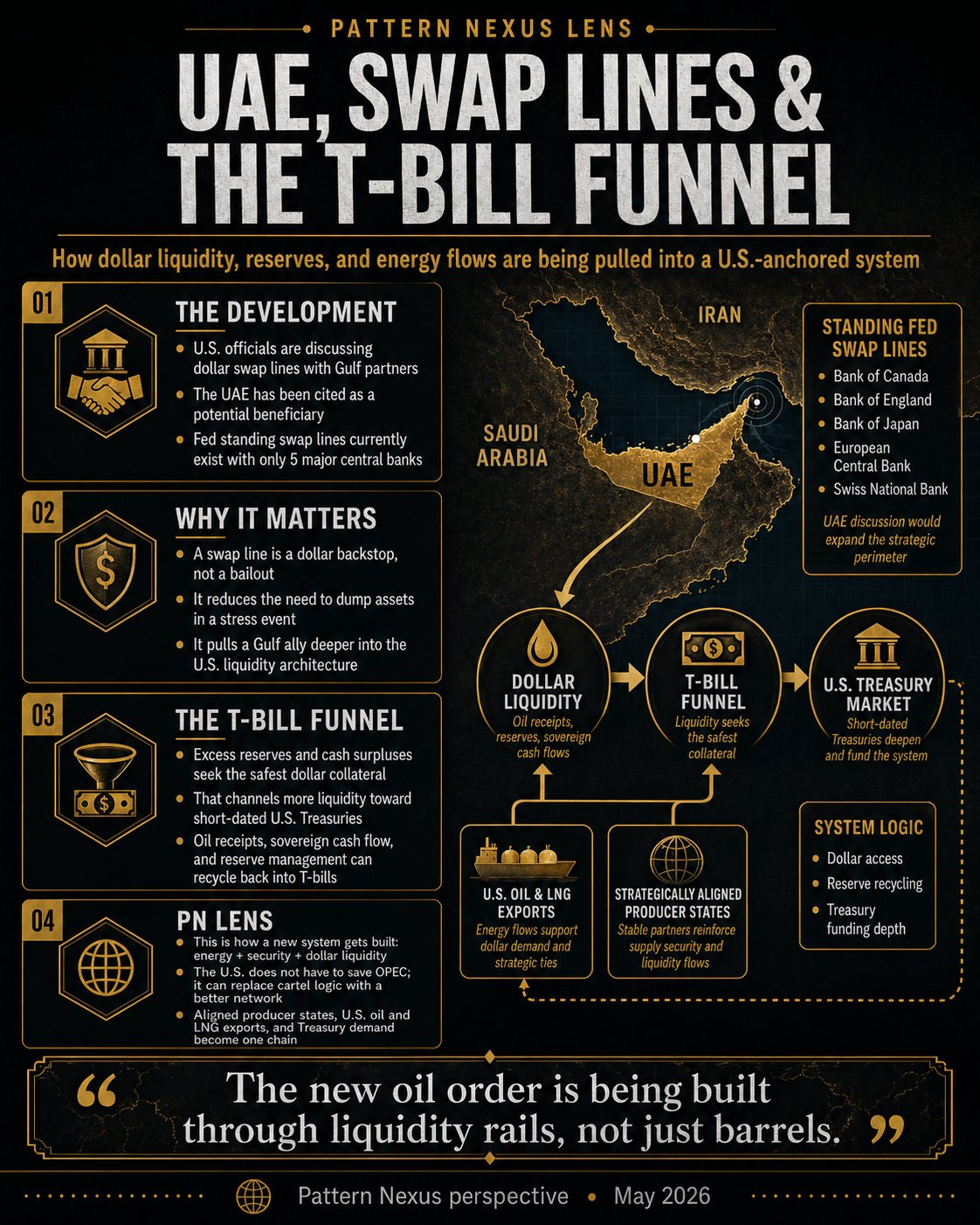
The Federal Reserve’s standing swap-line network is extremely selective. The standing U.S. dollar liquidity swap arrangements currently sit with the Bank of Canada, Bank of England, Bank of Japan, European Central Bank, and Swiss National Bank. That is the core club. These are not random countries. They are core nodes of the dollar-centered financial order.
So if the UAE is being discussed in relation to something adjacent to that architecture, the meaning is not simply “the UAE needs dollars.” The UAE has deep reserves, massive sovereign wealth, and major energy cash flow. The more important meaning is that the United States may be trying to give a strategically aligned Gulf producer a higher-grade dollar backstop so it does not have to operate as a semi-independent oil node under stress. It would be a liquidity bridge into the U.S.-anchored network.
That is the shift. In the old oil order, Gulf producers sold energy into the world, recycled reserves, held Treasuries, and remained inside a Saudi-led quota system with the U.S. security umbrella sitting above it. In the new version, the U.S. does not just provide security from the outside. It starts turning aligned producer states into integrated liquidity partners.
What a Swap Line Actually Does
A swap line is not a bailout in the normal political sense. It is a dollar backstop. The basic idea is that a foreign central bank can obtain U.S. dollars from the Federal Reserve, provide its own currency in exchange, and then lend those dollars into its domestic financial system if funding stress appears. The purpose is not to make the other country rich. The purpose is to stop dollar funding stress from turning into forced selling, disorderly liquidation, or a broader credit break.
That is why this matters for a Gulf producer. A country like the UAE is plugged into energy revenues, dollar settlement, banks, sovereign funds, ports, logistics, real estate, trade finance, and global capital flows. If Hormuz risk, war risk, shipping insurance, or oil-route instability starts tightening dollar liquidity, the country does not necessarily want to liquidate reserves at the worst moment or rely on less desirable settlement channels. A dollar backstop gives it optionality.
Optionality is the key word. It does not mean the UAE is weak. In some ways, it means the opposite. Strong countries want access to the cleanest rails before stress becomes visible. They do not wait until the market forces them to sell. They negotiate access before the break.
This is where most people miss the story. They hear “swap line” and think crisis loan. Pattern Nexus reads it differently. A swap line is a permission rail. It tells you who gets clean dollar access during stress and who has to scramble through the open market.
How Excess Reserves and Cash Flow Recycle into U.S. Treasury Demand
The next layer is the T-bill funnel. This is where the energy story becomes a Treasury story.
Oil and gas exports create dollar flows. Gulf reserves create dollar balances. Sovereign wealth funds and central banks have to park liquidity somewhere. In a world of stress, duration risk, political risk, counterparty risk, and sanction risk, the safest short-term instrument is still the U.S. Treasury bill. Bills are short-dated Treasury securities, typically ranging from four weeks to fifty-two weeks, and they function as one of the cleanest forms of dollar collateral in the global system.
That is why the funnel matters. If the U.S. can build a system where aligned producer states receive dollar access, sell energy through dollar channels, hold reserves in dollar instruments, and recycle excess cash into short-dated Treasuries, then the energy system and Treasury funding system start reinforcing each other. Oil receipts do not just sit as cash. They become reserve management. Reserve management becomes bill demand. Bill demand deepens the front end of the Treasury market. The front end becomes the collateral layer that supports the dollar system.
This is not the old cartoon version of the petrodollar where oil is simply priced in dollars and everyone buys Treasuries because there is no other choice. This is more adaptive. The new version is built around liquidity preference, collateral safety, sanctions architecture, LNG corridors, oil export capacity, strategic security arrangements, and the desire of allies to avoid being caught outside the dollar backstop during a crisis.
That is why a possible UAE swap-line arrangement matters so much. If the UAE is leaving the cartel layer while getting closer to the dollar-liquidity layer, then the system is not just losing OPEC discipline. It is gaining a new recycling channel.
Why This Fits the U.S. Oil Strategy
The U.S. oil strategy is not only “drill more.” That is the public-facing layer because it is easy to understand politically. The real strategy is to change the architecture that determines which barrels matter, which routes matter, which currencies settle the flow, which countries receive liquidity protection, and which forms of collateral absorb the surplus.
This is where U.S. oil and LNG exports become part of the same chain. The United States is not just a consumer trying to escape OPEC anymore. It is a major producer, a major LNG exporter, a major financial center, the issuer of the reserve currency, the issuer of the deepest collateral pool, and the security power behind many of the routes and alliances that keep energy moving. That is a different position than the one people still have in their heads from the 1970s oil-shock model.
When the U.S. exports more oil and LNG into a stressed world, it is not just selling molecules. It is selling continuity. It is telling allies: if the Gulf is unstable, if Russia is unreliable, if Hormuz is constrained, if insurance costs explode, if OPEC loses cohesion, then the U.S.-anchored system is where the fallback supply, fallback liquidity, and fallback collateral live.
This is why the swap line, the T-bill funnel, and the UAE exit belong together. The U.S. does not have to save OPEC. It can build around it. It can replace the cartel model with a network model. That network does not depend on one producer group controlling scarcity. It depends on aligned producers, dollar rails, Treasury collateral, sanctions power, shipping corridors, and energy exports feeding back into the same system.
Why This Is Bigger Than OPEC
The mistake would be to treat this as a narrow OPEC breakup story. It is bigger than that. OPEC is one layer of the oil order, but it is not the whole order. The full order includes shipping, insurance, ports, refineries, currency settlement, central bank reserves, Treasury collateral, sovereign wealth allocation, military protection, sanctions, and the political legitimacy of price stability.
That is the Pattern Nexus lens. The world is not divided into clean topics. Energy is not separate from money. Money is not separate from war. War is not separate from shipping. Shipping is not separate from insurance. Insurance is not separate from credit. Credit is not separate from Treasury collateral. Treasury collateral is not separate from the dollar system. The layers interact whether analysts want them to or not.
So when the UAE leaves OPEC/OPEC+ while the U.S. is discussing dollar swap lines with Gulf partners, the point is not that one press release explains the future. The point is that the direction of travel is visible. Producer states that once fit neatly inside the cartel model are now being pulled toward a U.S.-anchored liquidity and security architecture. That architecture can absorb energy flows, support Treasury demand, and give aligned countries a reason to stay inside the dollar system even when geopolitical stress rises.
That is what a control system looks like when it updates itself. It does not always announce the new map. It changes the rails first. Then the institutions catch up. Then the public realizes the operating reality already moved.
Drawn System Map: From UAE Energy Flows to the T-Bill Funnel
This is the simplified operating map. The UAE exit weakens the old cartel layer, but the more important development is the possible movement toward a U.S.-anchored liquidity chain: dollar access, reserve recycling, energy exports, Treasury bills, and strategic producer alignment.
Drawn PN map: the UAE exits the old cartel layer while the U.S.-anchored chain tries to connect producer alignment, dollar access, reserve recycling, T-bills, and Treasury market depth.
Pattern Nexus Lens
The old oil order was built around cartel coordination, Gulf security, dollar settlement, and Treasury recycling. The new oil order is being built around something more direct: aligned energy producers tied into U.S. dollar liquidity rails and U.S. collateral markets.
That is the real point. The U.S. does not need to destroy OPEC in one dramatic move. It only needs to make OPEC less useful to the countries inside it. A Gulf producer does not have to be controlled through a quota table if it can be integrated through a better network: security, export demand, dollar access, reserve management, and Treasury collateral.
This is why the UAE story matters. The exit from OPEC/OPEC+ is the visible break. The swap-line discussion is the hidden rail. The T-bill funnel is the collateral sink. U.S. oil and LNG exports are the energy spine. Together, they point toward a system where producer states are not just selling barrels into a market. They are being connected into a dollar-backed operating chain.
The new oil order is being built through liquidity rails, not just barrels.
The Public Will Debate Oil. The System Is Moving Through Rails.
Most of the public argument will stay stuck on oil prices. People will ask whether UAE production brings prices down, whether Saudi Arabia retaliates, whether OPEC survives, and whether the market overreacted. That is the surface debate.
The deeper question is whether the U.S. is building a replacement architecture underneath the old cartel order. That architecture would not look like one giant treaty. It would look like U.S. oil exports, LNG capacity, Treasury collateral demand, swap-line discussions, Gulf security alignment, sanctions pressure, and aligned producer states slowly moving into the same system chain.
That is how modern control systems change. Not always through a clean collapse. Not always through one dramatic announcement. Often it happens through routing, collateral, access, and incentive structure. The old layer keeps existing while the new layer becomes more useful. Then one day the old center still has the name, but the operating gravity has already moved somewhere else.
Sources
- Reuters — U.S. discussing dollar swap lines with Gulf and Asian partners
- Federal Reserve Bank of New York — Central Bank Swap Arrangements
- Federal Reserve — Central Bank Liquidity Swaps
- Reuters — UAE to leave OPEC and OPEC+ oil producer groups
- TreasuryDirect — Treasury Bills
- U.S. Energy Information Administration — U.S. LNG exports forecast to grow
- Reuters — U.S. crude oil exports rose to record high, EIA says
Note: This article frames the UAE swap-line issue as a reported discussion/proposal unless and until a formal permanent facility is officially announced. The analysis focuses on the system logic if that discussion becomes part of a broader U.S.-anchored Gulf liquidity architecture.
Frequently Asked Questions
Jaká je vaše reakce?
 Líbí se
0
Líbí se
0
 Nesouhlasím
0
Nesouhlasím
0
 Láska
0
Láska
0
 Vtipné
0
Vtipné
0
 Wow
0
Wow
0
 Sm sad
0
Sm sad
0
 Rozčílený
0
Rozčílený
0

Founder of Pattern Nexus. I research markets, macro, geopolitics, AI, history, ancient systems, and the patterns most people overlook. I’m also building Market Radar, a trading scanner designed to read pressure, risk, confirmation, and setup quality before chasing a move. Pattern Nexus is where I connect the dots between data, history, technology, and the bigger system playing out around us.

Komentáře (0)