
The Knowledge Layer Is Starting to Look Fragile
A Pattern Nexus research-level analysis of missing scientists, dead researchers, sensitive research nodes, aerospace and nuclear-adjacent disappearances, and the 6/6/2026 Green Jar cipher as symptoms of a fragile knowledge layer.
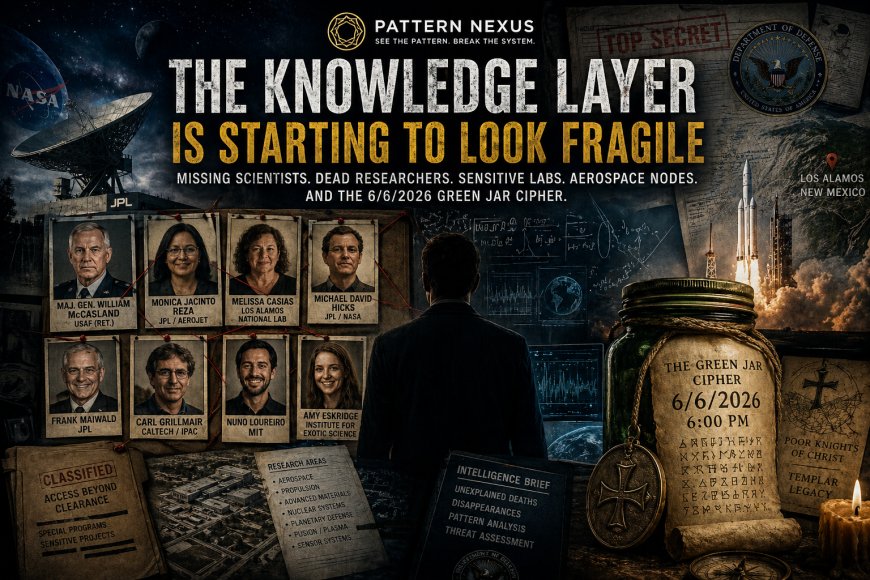
The Knowledge Layer Is Starting to Look Fragile
Missing scientists, dead researchers, sensitive labs, aerospace nodes, nuclear-adjacent personnel, and the 6/6/2026 Green Jar cipher all point toward the same deeper problem: the public no longer trusts the official interface layer of reality.
The first mistake people make with this story is trying to force it into one of two categories. Either every case is connected by one giant hidden operation, or none of it matters because no single proven connection has been established. That is the same lazy binary the system uses over and over again. It either demands courtroom-level proof before anyone is allowed to notice a pattern, or it treats every unproven connection as if the underlying structure is meaningless.
Pattern Nexus does not work that way. A pattern does not have to prove a single plot to reveal a system. Sometimes the point is not that every event was coordinated. Sometimes the point is that the events keep clustering around the same strategic domains, and those domains tell you where the next version of power is being built.
The deaths and disappearances now circulating around retired Air Force Maj. Gen. William “Neil” McCasland, Monica Jacinto Reza, Melissa Casias, Michael David Hicks, Frank Maiwald, Carl Grillmair, Nuno Loureiro, Amy Eskridge, Joshua LeBlanc, and others should not be treated as one clean, proven case file. They are not all the same type of event. But once the cases are sorted by domain instead of forced into one plot, a more serious question appears: why do so many of the names being pulled into the narrative sit near aerospace, nuclear systems, propulsion, advanced materials, JPL, Los Alamos, fusion, planetary defense, military research, national labs, and the hidden knowledge infrastructure underneath the next world order?
- The Story Moved Out of the Internet Layer
- McCasland and the Special Programs Layer
- Monica Reza and the Materials Layer
- Los Alamos and the Support-Staff Problem
- JPL, Caltech, and the Sensor Layer
- Fusion, Plasma, and the Energy Door
- Amy Eskridge and the Missing Sciences Boundary
- The 6/6/2026 Green Jar Cipher
- Why This All Feels Fake Now
- The Knowledge Layer
- Pattern Nexus Lens
- Sources
The Story Moved Out of the Internet Layer
The story became harder to ignore when it moved out of the internet layer and into the institutional layer. On April 20, 2026, the House Committee on Oversight and Government Reform announced that Chairman James Comer and Rep. Eric Burlison were seeking information from the Department of Energy, Department of War, FBI, and NASA about “scientists and other personnel connected to U.S. nuclear secrets or rocket technology” who had died or mysteriously vanished in recent years. The committee itself used careful language, describing the matter as “unconfirmed public reporting,” but it also stated that if the reports were accurate, the deaths and disappearances could represent a threat to national security and to people with access to sensitive scientific information.
That is the first important distinction. Congress was not saying the pattern was proven. Congress was saying the pattern was serious enough to ask federal agencies what they knew. That alone changes the category of the story. It does not validate every theory attached to it, and it does not turn every name into a victim of the same operation. But it does move the issue beyond anonymous speculation.
CBS later reported that the FBI was leading an effort to look for possible connections among ten missing or deceased scientists and staff connected to sensitive nuclear or space-technology laboratories. According to CBS, the FBI said it was working with the Department of Energy, Department of War, and state and local partners. But CBS also reported that people close to the separate investigations said they saw no links between the cases. That contradiction is the real story. The federal government was looking for connections, while investigators close to individual cases were saying they did not currently see a linked pattern. That does not end the conversation. It defines it.
The mainstream countercase is also real and has to be included if this is going to be credible. AP reported that no evidence had been found definitively linking the cases or establishing coordinated foul play. AP also noted that some of the cases already had identified suspects, some involved roles that were exaggerated online, and some had family members or investigators pushing back against the idea of a spy-thriller plot. That matters. It is not honest to ignore it.
But the mainstream countercase has its own weakness. It treats the absence of a proven master plot as if the pattern has no analytical value. That is not how systems work. Correlation does not prove causation, but repeated domain clustering still tells you something about where public anxiety, institutional secrecy, and strategic vulnerability are intersecting.
McCasland and the Special Programs Layer
McCasland is the center of gravity because his background is not ordinary. His official Air Force biography says he commanded the Air Force Research Laboratory at Wright-Patterson Air Force Base and was responsible for managing a $2.2 billion Air Force science and technology program, plus another $2.2 billion in customer-funded research and development, along with a global workforce of about 10,800 people. The same biography places him across space research, acquisition, operations, the National Reconnaissance Office, the Phillips Research Site at Kirtland, the Space and Missile Systems Center, the Office of Space Acquisition, and Special Programs in the Office of the Under Secretary of Defense for Acquisition, Technology and Logistics.
This is not a random retired officer. This is a man whose career sat near the classified aerospace, satellite, weapons-research, special-access, and military-technology layer of the American state. That does not automatically turn his disappearance into a hostile act, but it does mean the disappearance cannot be understood only through the usual missing-person frame.
According to the Bernalillo County Sheriff’s Office, McCasland was last known to be at or near his home in the Quail Run Court NE area of Albuquerque on the morning of February 27, 2026. His wife left the home around 11:10 a.m. and returned around 12:04 p.m.; McCasland was gone. His phone, prescription glasses, and wearable devices were found at the residence. Investigators believed his hiking boots, wallet, and a .38 caliber revolver with a leather holster were missing. The same sheriff’s release said a gray U.S. Air Force sweatshirt was later found about 1.25 miles east of the residence, though it had not been confirmed as his, and no blood was detected during initial processing. The sheriff’s office also stated there was currently no evidence indicating foul play, while also saying the case remained active.
That is the exact kind of case where people are going to ask questions. They are not wrong to ask them. A retired general tied to AFRL, Kirtland, Wright-Patterson, space acquisition, special programs, and high-level aerospace research disappears after leaving behind key personal items, and the public is supposed to treat that as if it is no different from any ordinary missing-person case. Maybe it is ordinary at the human level. Maybe the explanation is personal, medical, voluntary, accidental, or tragic. But at the institutional level, it is not ordinary. The institutional footprint is too large. The domains around him are too sensitive.
Monica Reza and the Materials Layer
Monica Jacinto Reza creates the second major axis of the story, and her case matters because it moves the pattern from the command-and-program layer into the materials layer. Reza disappeared while hiking in the Angeles National Forest near the Mount Waterman area on June 22, 2025. Public reports described her as an at-risk missing person last seen around the Angeles Crest Highway area, with multiple agencies involved in the search.
On its own, that is a missing-hiker case. But Reza was not just any missing hiker. FOX LA described her as an aerospace engineer and materials processor who worked for both NASA’s Jet Propulsion Laboratory and Aerojet Rocketdyne, and said she was known for developing and patenting a specialized type of metal used in rocket manufacturing. The same report stated that investigators had noted her professional overlap with other figures in the field, including McCasland.
The material angle is where this becomes important. The Air Force reported in 2016 that a sub-scale preburner test campaign had accomplished several firsts for key rocket-engine technologies, including the first use of Mondaloy 200 superalloy in a rocket-engine environment. The Air Force said Mondaloy 200 was co-developed by Aerojet Rocketdyne and the AFRL Materials Directorate and was important because of its combination of high strength and burn resistance in harsh oxygen-rich staged combustion environments.
That detail is not fringe. It is strategic propulsion infrastructure. The same Air Force article explained that the United States had a limited technology base in high-performance oxygen-rich staged combustion and that Russian RD-180 engines had powered the Atlas V, making domestic technology development strategically relevant.
This is where the public conversation usually becomes stupid. People say “rocket metal” like it is just a colorful detail. It is not. Materials are the physical foundation of empire. A state can have the theory, the design, the simulation, the launch requirement, the military need, and the strategic pressure, but if it does not have the material that survives the environment, it cannot build the system at scale.
Oxygen-rich staged combustion is not a polite environment. It is chemically aggressive, thermally extreme, mechanically violent, and strategically valuable because it offers performance advantages. In that kind of system, metallurgy is not a secondary detail. Metallurgy is the bottleneck.
That is why Reza matters in the Pattern Nexus frame. She sits at the level where abstract aerospace ambition becomes physical possibility. McCasland’s career footprint points toward programs, acquisition, special access, and command-level aerospace infrastructure. Reza’s professional footprint points toward the material substrate of advanced propulsion. Those are different kinds of knowledge, but they are not unrelated kinds of power. One is the program layer. One is the material layer. If there is a real pattern here, it may not be a single conspiracy. It may be that the people being pulled into the same public narrative sit near the same capability chain.
Los Alamos and the Support-Staff Problem
The Los Alamos portion of the story needs more discipline than the internet usually gives it. Melissa Casias worked at Los Alamos National Laboratory, but CBS reported that her niece said she was an administrative assistant and did not have high-level clearance. AP also highlighted that some online claims had treated Casias as a scientist even though her known role was administrative. That correction matters. It is not acceptable to inflate someone’s role just because it makes the pattern look more dramatic.
But there is another side to that. Support staff near sensitive systems are still part of the access environment. That does not mean Casias had nuclear secrets. It means the technical secret is not always the only sensitive thing inside an institution. Administrative staff can see schedules, personnel rhythms, internal processes, contact chains, facility patterns, travel routines, meeting structures, badge systems, ordinary vulnerabilities, and the human map of the institution.
Modern security failures often happen through the routine layer, not the glamorous layer. The public tends to imagine secrets as formulas and classified files. Real systems also run on calendars, doors, accounts, people, vendors, forms, maintenance, and habits. So Casias should not be mislabeled as a scientist, but she should not be dismissed as irrelevant simply because she was administrative. In a secure environment, administration is part of the institutional nervous system.
That is what makes the New Mexico cluster so sensitive. New Mexico is not random geography. Los Alamos, Sandia, Kirtland, Albuquerque, AFRL, national-lab infrastructure, nuclear-weapons-adjacent contractor ecosystems, and defense research all sit inside the same regional knowledge map. The public version of the story may exaggerate some roles, but the geography itself is not random. This is one of the places where the American weapons-science state touches the ground.
JPL, Caltech, and the Sensor Layer
The JPL and Caltech cluster is similar. It is messy, but it still has analytical weight if handled correctly. Michael David Hicks worked at JPL as a NASA postdoc and research scientist from 1998 to 2022. The American Astronomical Society’s Division for Planetary Sciences says his specialty was the physical properties of comets and asteroids, and that he served on the science teams of DART, NEAT, Dawn, and Deep Space 1. That places him in the space-observation and planetary-defense environment, not just generic astronomy.
Frank Maiwald, according to his obituary, spent many years at JPL, managed development of the SBG-VSWIR instrument, oversaw delivery of instruments for the AMR-C program, served as a technical group supervisor, and contributed to projects including AMR/SWOT, COWVR, AMR/Jason 3, and HIFI. In plain English, that places him in the space-instrumentation and measurement layer. This matters because modern power increasingly depends on seeing, measuring, mapping, detecting, modeling, and predicting. A sensor is not just a scientific tool. A sensor is a state capability when it is embedded inside a strategic architecture.
Carl Grillmair adds another space-observation node, but his case also shows why this story cannot be written carelessly. Caltech says Grillmair was an astronomer at IPAC, with scientific interests spanning exoplanets, stellar streams, NEOWISE, asteroid and comet detection, NEO Surveyor, and lunar impact monitoring. That makes him relevant to the space-observation layer. But public reporting also stated that a suspect was charged in connection with his killing, with charges including murder and carjacking. That does not make Grillmair’s death an unsolved disappearance. It makes it a criminal case with an identified suspect, even if motive questions remain.
The JPL/Caltech thread is therefore not strong because every case is the same. It is strong because the institutions sit in the sensor layer of civilization. Hicks points toward asteroids, DART, NEAT, and physical properties of near-space objects. Maiwald points toward instruments and Earth/space measurement systems. Grillmair points toward exoplanets, stellar streams, NEOWISE, NEO Surveyor, and observational infrastructure. These are not just academic labels. Whoever sees first, tracks first, maps first, and models first has an advantage.
Fusion, Plasma, and the Energy Door
Nuno Loureiro represents the fusion and plasma layer, and his case also demands caution. MIT reported that Loureiro, a professor of nuclear science and engineering and physics and director of MIT’s Plasma Science and Fusion Center, died at age 47 from gunshot wounds. MIT described him as a theoretical physicist and fusion scientist whose work advanced understanding of plasma behavior, turbulence, magnetic-field dynamics, confinement, transport, and fusion-device design.
That makes him symbolically and strategically important because fusion is one of the locked doors of civilization. It is not just “clean energy.” It is a potential rearrangement of the energy hierarchy. It touches power generation, national security, industrial capacity, grid architecture, materials science, plasma physics, superconducting systems, and the long-term question of whether energy scarcity remains a political control mechanism.
But again, the existence of a strategic domain does not automatically rewrite the facts of a death. AP reported that Loureiro’s killing was tied to Claudio Manuel Neves Valente, who also carried out the Brown University shooting and later died by suicide; AP also reported that the motive had not been established but that the two men knew each other decades earlier in Portugal.
So Loureiro should not be used as a cheap mystery prop. He should be used as evidence of something more subtle: the knowledge layer is human. Fusion is discussed as if it is an inevitable institutional project, but the work is carried by fragile people. The same is true for materials science, aerospace acquisition, planetary defense, instrumentation, and classified programs. We talk about systems like they are permanent. They are not. They are made of people who can disappear, die, burn out, break down, be attacked, get sick, hike alone, drive into bad situations, or become the center of events no institution can fully control.
The fragility is not only geopolitical. It is biological.
Amy Eskridge and the Missing Sciences Boundary
Amy Eskridge belongs in a different category. She is not the same kind of case as McCasland, Reza, Hicks, or Loureiro. Her obituary says she died on June 11, 2022, at age 34, and describes her as chairwoman and president of The Institute for Exotic Science in Huntsville, Alabama, which she co-founded. It also describes her as someone who questioned conventional wisdom “from the universe to the nanoparticles of the atom.”
Eskridge matters because she bridges the aerospace world and the missing-sciences world. Huntsville is not random geography. It is Rocket City. It sits inside the American propulsion, missile, and space-industrial imagination. The Institute for Exotic Science, anti-gravity commentary around her legacy, and the broader claims attached to her case move the conversation toward exotic propulsion, field physics, gravity modification, and the boundary between serious aerospace research and forbidden speculation.
This does not mean the most dramatic claims about her are proven. It means her case is part of the symbolic field around the story. She represents the part of the knowledge layer where official science, defense mythology, alternative physics, and public distrust all overlap.
The 6/6/2026 Green Jar Cipher
That brings the analysis to the 6/6/2026 Green Jar cipher, which should not be treated as evidence for the missing-scientist cases. It belongs in the paper for a different reason. The Green Jar story is a myth-history signal object. It is not a verified institutional artifact. It is not peer-reviewed proof. It is not evidence of a plot against scientists. But it tells us something about the same public condition that makes the missing-scientist narrative spread.
The Green Jar claim appears publicly through Scott Wolter’s appearance on The Why Files: Operation Podcast / Basement #006, where the episode framing connects the Kensington Runestone, Templar treasure, a sealed jar allegedly dug up from the Adirondack wilderness, the Founding Fathers, the Talpiot Tomb, and a scroll presented as historically explosive. A transcript of the episode describes the “green jar” as part of a story challenging conventional history and religion. The same transcript includes claims about codes, sacred numbers, the Kensington Runestone, the Templars, and a scroll allegedly translated from Aramaic for the Poor Knights of Christ.
The skeptical countercase is important. Jason Colavito, who writes critically about pseudohistory, described Wolter’s claim as involving an old prune-juice jar from the 1940s, a nineteenth-century scroll wrapped in a 1950s-era napkin, an Italian headnote, and six pages of cipher text allegedly representing an English translation of an Aramaic autobiography of Jesus. Colavito characterized the claim as a hoax and reported that Wolter interpreted the cipher as pointing to June 6, 2026, at 6 p.m.
That is where discipline is needed. The paper should not say the Green Jar cipher is real. It should say the Green Jar cipher is important as a cultural artifact. It sits at the intersection of hidden history, sacred numbers, Templar mythology, religious revision, encoded texts, alternative archaeology, and a future date. In other words, it is not evidence in the normal sense. It is a symptom. It shows that large numbers of people no longer trust the official interface layer of reality.
They do not trust official science communication. They do not trust official history. They do not trust institutional silence. They do not trust the media’s reflexive dismissal of anomalies. So they start looking in old jars, ciphers, buried maps, secret orders, missing researchers, declassified files, podcasts, and patterns that may or may not hold together.
The bridge between the missing scientists and the Green Jar cipher is not factual causation. It is epistemic collapse. Both stories ask the same underlying question: who controls knowledge? The missing-scientist story asks who protects the people who hold strategic technical knowledge. The Green Jar story asks who controls the authentication of historical and religious knowledge. One lives in the national-security layer. The other lives in the myth-history layer. But both challenge the same interface. They challenge the assumption that official institutions are giving the public the full map.
Why This All Feels Fake Now
That is why everything feels fake now. It is not because reality stopped existing. It is because the interface layer has replaced the territory for most people. Markets are real, but prices are routed through liquidity, passive flows, dark pools, options mechanics, buybacks, Fed expectations, and narrative triggers. Politics is real, but the policy range is constrained by donors, agencies, courts, debt, military commitments, intelligence relationships, regulatory capture, and continuity architecture.
Science is real, but the public-facing version is filtered through grants, journals, reputation risk, national security, corporate funding, classification, and institutional incentives. History is real, but the public version is shaped by archives, gatekeepers, religious institutions, museums, universities, and the politics of what a civilization is willing to admit about itself.
When trust collapses, every unexplained event becomes a clue. That can lead people into nonsense. It can also lead them toward patterns that institutions would rather keep unexamined. The hard part is separating signal from noise without letting the official system define all signal as noise by default. That is the real intellectual problem here. The public is not wrong to distrust the interface. The public is also not automatically right about every hidden pattern it imagines. The Pattern Nexus position has to live in that uncomfortable middle space.
The Knowledge Layer
The strongest version of this paper is not “they are all being killed because they know too much.” That is too simple, and it is too easy to dismiss. The stronger argument is that modern civilization has become dependent on a distributed knowledge layer that the public barely understands. That layer includes rocket materials, oxygen-rich staged combustion, advanced sensors, asteroid tracking, planetary defense, nuclear laboratories, plasma confinement, fusion modeling, special-access aerospace programs, administrative access systems, and exotic research cultures sitting on the edge of respectable science.
The people attached to that layer are not celebrities. They are not household names. But they may sit closer to the future than most politicians, journalists, or influencers ever will.
That is the part people miss. Power is not just who wins elections. Power is not just who prints money. Power is not just who owns media. Power is what can be built, powered, launched, detected, hidden, modeled, classified, manufactured, and scaled. The real control layer is capability. A country that cannot produce the material cannot build the engine. A country that cannot build the engine cannot control launch. A country that cannot control launch cannot control the next orbital architecture. A country that cannot see incoming objects cannot defend against them. A country that cannot master plasma cannot open the fusion door. A country that cannot protect its knowledge workers cannot protect its own future.
That is why the story matters even if the FBI ultimately finds no connection. If McCasland’s disappearance has a personal explanation, the strategic question remains. If Reza’s disappearance was a hiking tragedy, the material-domain question remains. If Casias had no access to classified information, the access-layer question remains. If Grillmair and Loureiro belong inside separate criminal cases, the sensor and fusion-layer questions remain. If the Green Jar cipher is a hoax, the hidden-knowledge hunger remains.
The point is not that every dramatic claim survives scrutiny. The point is that the scrutiny itself reveals a fragile, opaque, and increasingly distrusted knowledge system.
Pattern Nexus Lens
The wrong question is whether every person in this cluster is connected by one proven conspiracy. That is the question the system wants because it is easy to defeat. The better question is why so many names now orbit the same sensitive domains: aerospace, nuclear systems, propulsion, plasma, JPL, Los Alamos, advanced materials, national labs, classified-adjacent research, and forbidden science.
The wrong question is whether the 6/6/2026 Green Jar cipher is real. The better question is why people are so desperate for hidden documents, secret codes, buried artifacts, and future dates in the first place.
The wrong question is whether every fringe theory is correct. The better question is why the official model of reality feels too small.
That is the Pattern Nexus point. The interface layer keeps telling people to trust the headline, trust the agency statement, trust the expert panel, trust the market price, trust the official history, trust the institutional explanation. But the interface keeps failing. So people start looking underneath it. Sometimes they find patterns. Sometimes they find noise. Sometimes they find fraud. Sometimes they find something the system forgot to bury deep enough.
FAQ
Is this article saying all of these cases are connected?
No. The argument is not that every case is connected by one proven operation. The argument is that the cases being pulled into the public narrative repeatedly cluster around strategic domains such as aerospace, nuclear systems, advanced materials, fusion, national labs, sensors, and classified-adjacent research.
Is the McCasland disappearance confirmed to involve foul play?
Public law-enforcement statements have said there was no confirmed evidence of foul play at the time of the cited release, while also describing the case as active. The Pattern Nexus point is not that foul play is proven. It is that McCasland’s career footprint makes the disappearance strategically abnormal.
Was Monica Reza just a missing hiker?
She disappeared while hiking, but her professional background as a JPL and Aerojet Rocketdyne-linked aerospace materials figure is why the case became part of the broader discussion. The domain is not hiking. The domain is advanced materials and propulsion.
Is the Green Jar cipher real?
The Green Jar cipher should not be treated as verified historical evidence. It belongs in this analysis as a cultural and symbolic object because it shows the same collapse of trust in official knowledge systems. The important issue is not proving the jar. The important issue is why people are now searching for hidden knowledge through ciphers, old artifacts, secret orders, and future dates.
What is the main Pattern Nexus takeaway?
The next world order is not controlled only by presidents, banks, media, or markets. It is controlled by capability: what can be built, powered, launched, detected, hidden, modeled, classified, manufactured, and scaled. The people attached to that capability layer matter more than most people understand.
Sources
- House Committee on Oversight and Government Reform, “Comer, Burlison Seek Information on Missing Nuclear and Rocket Scientists.” Read source
- CBS News, reporting on FBI review of deaths and disappearances involving scientists and staff connected to sensitive labs. Read source
- AP News, reporting on claims, corrections, and lack of confirmed linkage among cases. Read source
- U.S. Air Force biography, Maj. Gen. William N. McCasland. Read source
- Bernalillo County Sheriff’s Office press release on William McCasland disappearance. Read source
- People, reporting on Monica Reza disappearance in Angeles National Forest. Read source
- FOX LA, reporting on Monica Reza’s aerospace/materials background and missing-person case. Read source
- U.S. Air Force, “AF demonstrates key rocket engine technologies for next generation launch systems,” including Mondaloy 200. Read source
- American Astronomical Society Division for Planetary Sciences, Michael David Hicks memorial. Read source
- Legacy obituary for Frank Maiwald. Read source
- Caltech, “Caltech Mourns the Passing of Carl Grillmair.” Read source
- MIT News, Nuno Loureiro obituary and research summary. Read source
- Amy Eskridge obituary, AL.com. Read source
- The Why Files / Scott Wolter transcript discussing the Green Jar and related claims. Read source
- Jason Colavito, skeptical analysis of Scott Wolter’s Green Jar / Yeshua Scroll claim and 6/6/2026 interpretation. Read source
Source note: This article separates documented reporting, public institutional statements, disputed claims, and symbolic analysis. The Green Jar / 6/6/2026 section is treated as a cultural signal object, not as verified historical evidence.
Jaká je vaše reakce?
 Líbí se
0
Líbí se
0
 Nesouhlasím
0
Nesouhlasím
0
 Láska
0
Láska
0
 Vtipné
0
Vtipné
0
 Wow
0
Wow
0
 Sm sad
0
Sm sad
0
 Rozčílený
0
Rozčílený
0

Founder of Pattern Nexus. I research markets, macro, geopolitics, AI, history, ancient systems, and the patterns most people overlook. I’m also building Market Radar, a trading scanner designed to read pressure, risk, confirmation, and setup quality before chasing a move. Pattern Nexus is where I connect the dots between data, history, technology, and the bigger system playing out around us.















Komentáře (0)