
Israel Strikes Iran: Escalation Ladder
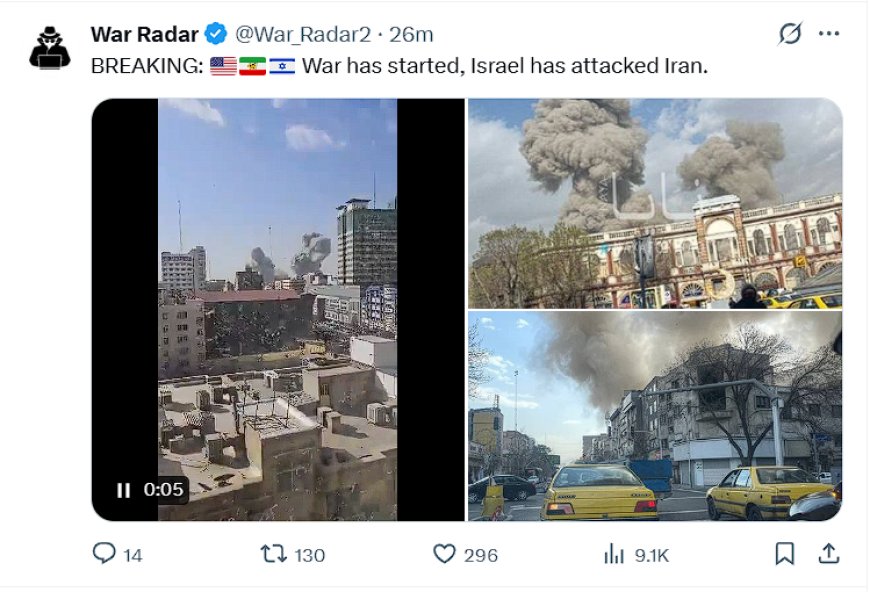
Israel says it launched a “pre-emptive” strike on Iran as explosions hit Tehran. Here’s the escalation ladder, the oil chokepoint risk, and the market plumbing
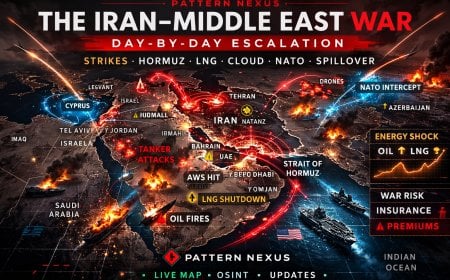
- Dubai: Authorities confirm an incident/fire on Palm Jumeirah with 4 injured moved to medical facilities (cause not definitively stated; debris vs direct hit still debated in reporting).
- UAE: Reporting cites 1 fatality in Abu Dhabi tied to falling debris during intercept activity.
- Bahrain / US basing: Bahrain’s National Communication Centre says the Fifth Fleet service centre was subjected to a missile attack; Washington Post reports verified footage showing a drone strike at a US naval support site in Bahrain producing a major explosion and smoke near a radome area.
- Qatar: MoD statement carried by local outlets says missiles were intercepted before reaching Qatari territory; subsequent reporting describes additional “waves” being handled under the same pre-approved defense plan.
- Jordan: Armed Forces report large-scale air-defense activity, including 49 drones/missiles intercepted in one statement (with 13 ballistic missiles cited), with debris/material damage across multiple areas and no casualties reported.
- Kuwait: Official reporting indicates Ali Al Salem Air Base came under attack, interceptions occurred, and debris-related injuries were reported (details vary by outlet, but the base event itself is repeatedly confirmed in regional reporting).
- Iran internal visibility: NetBlocks reports Iran’s internet connectivity dropping to roughly 4%, which is consistent with why footage is fragmented and why “live” clips are hard to validate at scale.
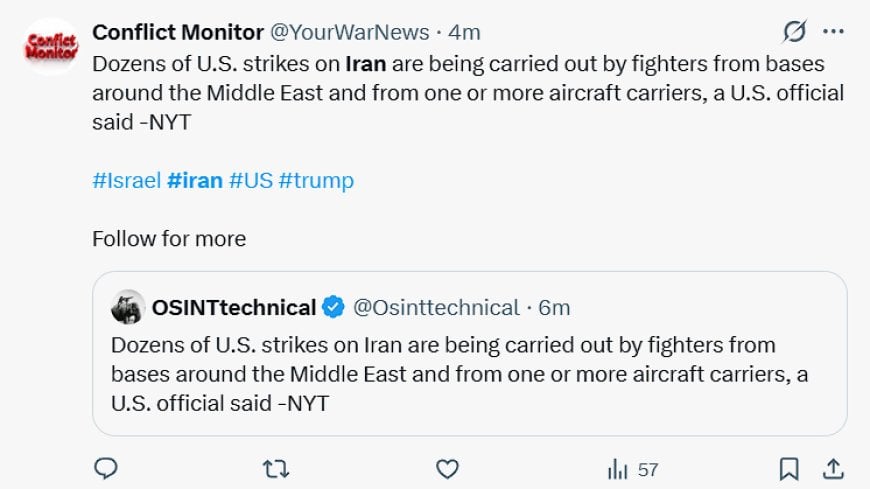
- US posture: President Trump publicly stated “major combat operations” are underway against Iran and framed it as pressure toward leadership change; Reuters reports the operation is expected to span several days.
- Maritime escalation: Reuters reports EU naval mission officials say IRGC VHF broadcasts told ships “no ship is allowed” to pass the Strait of Hormuz; energy/shipping sources report shipments slowing/suspending and governments issuing “avoid / highest security” advisories.
- Inside Iran leadership targets: Reuters reports (via three sources) that Iran’s Defence Minister Amir Nasirzadeh and IRGC commander Mohammed Pakpour are believed killed in strikes (Tehran has not publicly confirmed in the same reporting window).
- “Dubai direct hit” vs debris: multiple outlets lean “debris during intercept” but nobody has released a definitive technical attribution yet.
- “Al Udeid radar destroyed” claims: viral posts exist, but Qatar’s official messaging emphasizes interceptions before impact, so treat destruction claims as unverified until a credible on-record confirmation appears.
- “Widespread fires across Saudi/Bahrain”: explosions/air-defense activity are reported, but “everything’s on fire” is not supported by the official lines available right now.
- Wave cadence: whether Iran continues multi-salvo launches across Gulf basing (Qatar/Bahrain/Kuwait/UAE/Jordan air-defense load is the constraint).
- Hormuz reality: whether the “no ships” VHF messaging becomes physical enforcement (boarding, mining, missile/drone harassment) and whether insurers effectively shut traffic.
- Leadership decapitation confirmation: whether Tehran confirms/denies reported senior deaths and whether retaliation shifts to higher-value targets.
- Duration signal: US framing already suggests “days,” so plan your coverage as an ongoing campaign, not a one-night exchange.
Spillover is now explicitly regional (Gulf + Levant): Multiple major outlets are reporting alert posture across the region, including sirens/alerts in Jordan and Gulf states as the exchange widens beyond a simple Israel↔Iran lane.
Bahrain / U.S. footprint: Reporting now includes Bahrain activating sirens tied to Iranian threats/attacks against U.S. facilities in-country, with public reporting that the U.S. 5th Fleet center/HQ area was targeted (and smoke/explosions reported in/near Manama/Juffair).
Qatar air-defense claim: Live coverage is also carrying Qatar Defense Ministry messaging that an incoming missile was intercepted (this is an important confirmation point because it implies at least one inbound was tracked and engaged over/near Qatari airspace).
Comms clamp is tightening inside Iran: Beyond the broader connectivity drop, live reporting now includes mobile phone services being cut — which is exactly how regimes reduce real-time ground truth during kinetic escalation.
“Sustained campaign” language is now official on the Israeli side: IDF-linked reporting is carrying the line that the operation will continue as long as necessary (this is the clearest “days/weeks, not hours” signal in the public record right now).
Shipping lane risk is re-opening: Reporting also indicates Houthis are preparing to resume attacks on Israel and Red Sea shipping routes in support of Iran — which broadens the theater to logistics/energy insurance immediately.
Trump escalates the framing (combat + casualties): Reuters reports Trump said the U.S. has begun “major combat operations” in Iran, describing the objective as eliminating “imminent threats,” and explicitly warned that “Americans may be lost” and casualties are possible.
Regime-change language is now in the public layer: AP reports Trump urged Iranian citizens to overthrow their government in his messaging around the strikes. Separately (pre-strike), Reuters reported Trump saying regime change “seems like… the best thing that could happen.”
Iran information-control signal: AP reporting includes Iran shutting down communications as the attacks unfolded (that’s a major tell for internal control + response coordination).
Campaign-duration probability rises (why “days/weeks” is plausible): Earlier Reuters reporting said the U.S. military was preparing for potentially weeks-long operations and expected Iranian retaliation leading to back-and-forth strikes over time. That doesn’t guarantee “weeks,” but it’s the clearest on-record setup for a sustained sequence rather than a single-night event.
Trump statement: AP is reporting Trump said the U.S. has begun “major combat operations in Iran,” with early reporting describing targets tied to Iranian military infrastructure and state/security symbols. Initial strike reporting includes activity near the offices/compound area tied to Iran’s Supreme Leader (presence not confirmed).
Iran response posture: Iran has threatened retaliation and has previously warned it could hit U.S. bases in the region if attacked. Reuters reporting indicates Iran’s Supreme Leader was moved to a secure location as the strikes unfolded.
Official line (admin framing): Some senior U.S. officials have been messaging that the goal is not “regime change” and is instead focused on nuclear / threat reduction.
Trump political layer: In the run-up, Trump has publicly floated regime-change language as a possible outcome if Iran refuses to deal (that’s been part of the rhetoric backdrop even when other officials emphasize narrower objectives).
Operational reality: Reuters has previously reported U.S. planning options can include targeting individuals and even pursuing regime change if ordered. That doesn’t prove the current strike set is a decapitation campaign, but it explains why “IRGC leadership hit” rumors explode instantly whenever Tehran gets lit up.
Yes, it can. Not because anyone has officially promised “weeks,” but because the setup fits a sustained operation profile: months of coordination planning (per Israel’s public posture and Reuters reporting), heavy U.S. regional force posture, wide target ambiguity (air defenses, missiles, C2, intelligence, nuclear-linked nodes), and an escalation ladder that rarely ends in one night when both sides signal “more to come.”
Translation: Expect follow-on waves unless there’s a fast diplomatic off-ramp or a deliberate “one-and-done” declaration backed by visible de-escalation moves (carrier repositioning, air tasking drop, airspace normalization, or explicit pause statements).
What we know right now
Israel says it launched a “pre-emptive” / “preventative” attack against Iran and moved to emergency posture at home (airspace restrictions, closures, shelter guidance). Multiple outlets report explosions in Tehran and visible smoke over parts of the city. Some reports place impacts near sensitive government/security areas, but exact target confirmation takes time.
This is the key point: the first 6–18 hours are about establishing the fact-pattern and the retaliation channel. The market will not wait for perfect clarity. It will price the distribution of outcomes and force everyone else to catch up.
What “U.S. involvement” could actually mean
The phrase “U.S. involved” gets abused because it can describe multiple layers of participation. Reporting indicates coordination with Washington, and some reporting suggests direct participation, but the public picture can remain messy early.
(2) Air and missile defense posture to intercept retaliation
(3) Refueling / logistics / electronic warfare support
(4) Direct kinetic strikes (U.S. aircraft or missiles hitting targets)
(5) Sustained joint campaign with follow-on waves
Watch what the U.S. officially owns. If Washington frames it as “defensive support,” it’s signaling a desire to contain escalation. If it frames it as “strikes” with stated objectives, you’ve moved up the ladder and the retaliation math changes.
The escalation ladder: Iran’s response menu
Iran’s response will likely be designed around two constraints: domestic legitimacy (must respond) and regime survival (cannot invite total collapse). That usually produces “calibrated” retaliation first—then optional escalation if deterrence fails.
- Direct missile/drone retaliation toward Israel to demonstrate capability and resolve
- Proxy pressure across the region to widen the battlefield without owning the full cost
- Maritime and energy pressure to impose a global economic tax and force diplomacy
- Cyber and infrastructure disruption where attribution stays grey
- Targeting U.S. assets only if Iran decides Washington is a co-belligerent
Market transmission: oil → rates → credit
Geopolitics hits markets through a very specific chain. You don’t need a full-scale war for financial conditions to tighten. You just need uncertainty in energy, shipping, and insurance—and a volatility shock that feeds back into funding.
Rates vol ↑ → credit spreads ↑ → risk assets de-rate
Strong USD / funding stress → EM and levered credit feel it first
Shipping/insurance disruption → real-economy drag with a lag
Translation: if this drags on, you should expect tighter financial conditions even if central banks “do nothing.” The market becomes the tightening mechanism.
The watchlist: signals that change the outcome
Ignore the noise. Track the signals that move probabilities:
1) Retaliation channel (direct vs proxy vs maritime) and its scale
2) U.S. posture (defensive framing vs declared strikes/objectives)
3) Energy/shipping layer (insurance rates, rerouting, port disruptions)
4) Second-wave targeting (one-and-done vs sustained campaign)
5) Diplomacy timeline (backchannels, UN posture, regional mediators)
6) Domestic stability cues inside Iran (information controls, leadership movements, internal security posture)
Pattern Nexus Lens
FAQ
Sources
- Reuters — “Israel says it launched pre-emptive attack against Iran” (Feb 28, 2026)
- Reuters — “Israel’s operation against Iran was coordinated with U.S., Israeli official says” (Feb 28, 2026)
- Associated Press — “Apparent strike in Tehran happened near offices of Supreme Leader…” (Feb 28, 2026)
- Financial Times — “Israel launches attack on Iran” (Feb 28, 2026)
- The Guardian — “Israel launches attack on Iran as explosions heard in Tehran” (Feb 28, 2026)
- CBS/AP — “Israel launches ‘preemptive strike’ on Iran…” (Feb 28, 2026)
- ABC News (Australia) — reporting on Israel confirming strikes and Tehran blasts (Feb 28, 2026)
Jaká je vaše reakce?
 Líbí se
0
Líbí se
0
 Nesouhlasím
0
Nesouhlasím
0
 Láska
0
Láska
0
 Vtipné
0
Vtipné
0
 Wow
0
Wow
0
 Sm sad
0
Sm sad
0
 Rozčílený
0
Rozčílený
0

Founder of Pattern Nexus. I research markets, macro, geopolitics, AI, history, ancient systems, and the patterns most people overlook. I’m also building Market Radar, a trading scanner designed to read pressure, risk, confirmation, and setup quality before chasing a move. Pattern Nexus is where I connect the dots between data, history, technology, and the bigger system playing out around us.















Komentáře (0)