
K2-18 b: The Planet That Shows How Close We Are to the Edge of Knowing
K2-18 b is not proof of alien life, but it may be one of the most important exoplanets ever studied because it shows how the search for life is shifting from imagination to contested atmospheric chemistry. JWST has detected methane and carbon dioxide in its atmosphere, while disputed DMS and DMDS claims show how difficult it will be to separate biology, chemistry, instrument noise, media hype, and human hope.
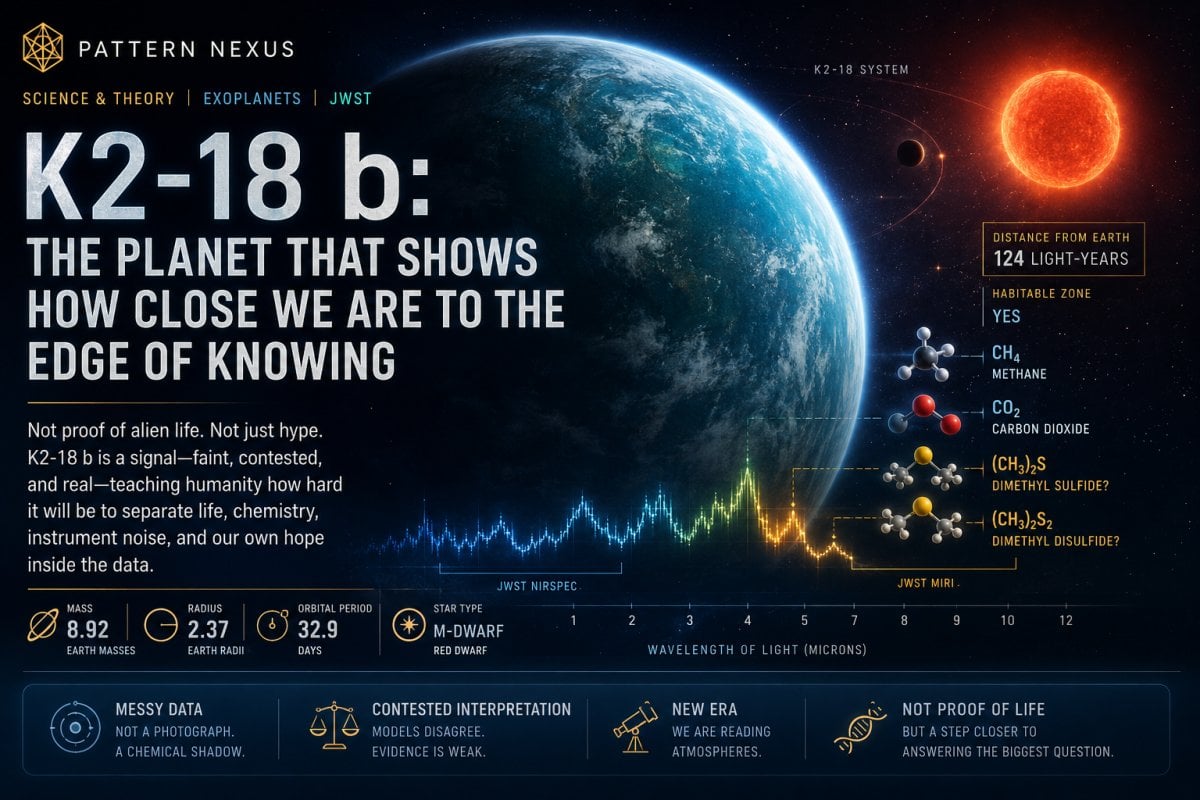

 Pattern Nexus
K2-18 b: The Planet That Shows How Close We Are to the Edge of Knowing
K2-18 b is not proof of alien life. That is not the point. The point is that humanity is now reading the atmosphere of a world more than 100 light-years away and fighting over whether a faint chemical shadow is biology, chemistry, instrument noise, or our own hope echoing back through the data.
Quick Read
K2-18 b is one of the most important exoplanets being studied right now, not because it proves life exists somewhere else, but because it shows how the search for life is changing. We are no longer just imagining planets around other stars. We are reading their atmospheres through light.
This world is larger than Earth, smaller than Neptune, and orbiting inside the habitable zone of a red dwarf star. NASA lists K2-18 b as roughly 8.92 Earth masses, 2.37 Earth radii, with an orbital period of about 32.9 days and an orbital distance of about 0.1429 AU. That places it in the strange category of planets our solar system does not give us a local example of, which is exactly why the debate around it is so messy.
JWST has detected methane and carbon dioxide in its atmosphere, and later claims suggested possible dimethyl sulfide or dimethyl disulfide, molecules that on Earth are strongly associated with biological activity. But that does not mean aliens were found. It means the signal is important enough to test harder.
The Wrong Question Is “Did We Find Aliens?”
The public keeps trying to force K2-18 b into a simple box because the human brain wants the answer to be clean. Life or no life. Ocean or no ocean. Proof or fraud. Discovery or exaggeration.
That is not what this is.
K2-18 b is not a little Earth sitting out there waiting for us, and it is not some confirmed alien ocean world filled with plankton under a blue sky. But it is also not meaningless hype, because the data coming back from this planet is exactly the kind of messy, layered, frustrating signal you should expect when humanity first starts touching the edge of life detection outside the solar system.
This planet matters because it forces us to stop thinking about alien life like a movie scene and start thinking about it like a system problem. Photons move through an atmosphere. Molecules absorb certain wavelengths. Telescopes convert that into spectral data. Researchers build models around that data. Other researchers attack the assumptions. The media turns probability into certainty. Then the public converts uncertainty into belief almost instantly.
That is the real Pattern Nexus lens here. K2-18 b is not just an exoplanet story. It is a signal interpretation story. It is a human meaning story. It is a control-layer story between what the universe is actually saying, what instruments can actually hear, what scientists can responsibly claim, and what society emotionally wants to be true.
What K2-18 b Actually Is
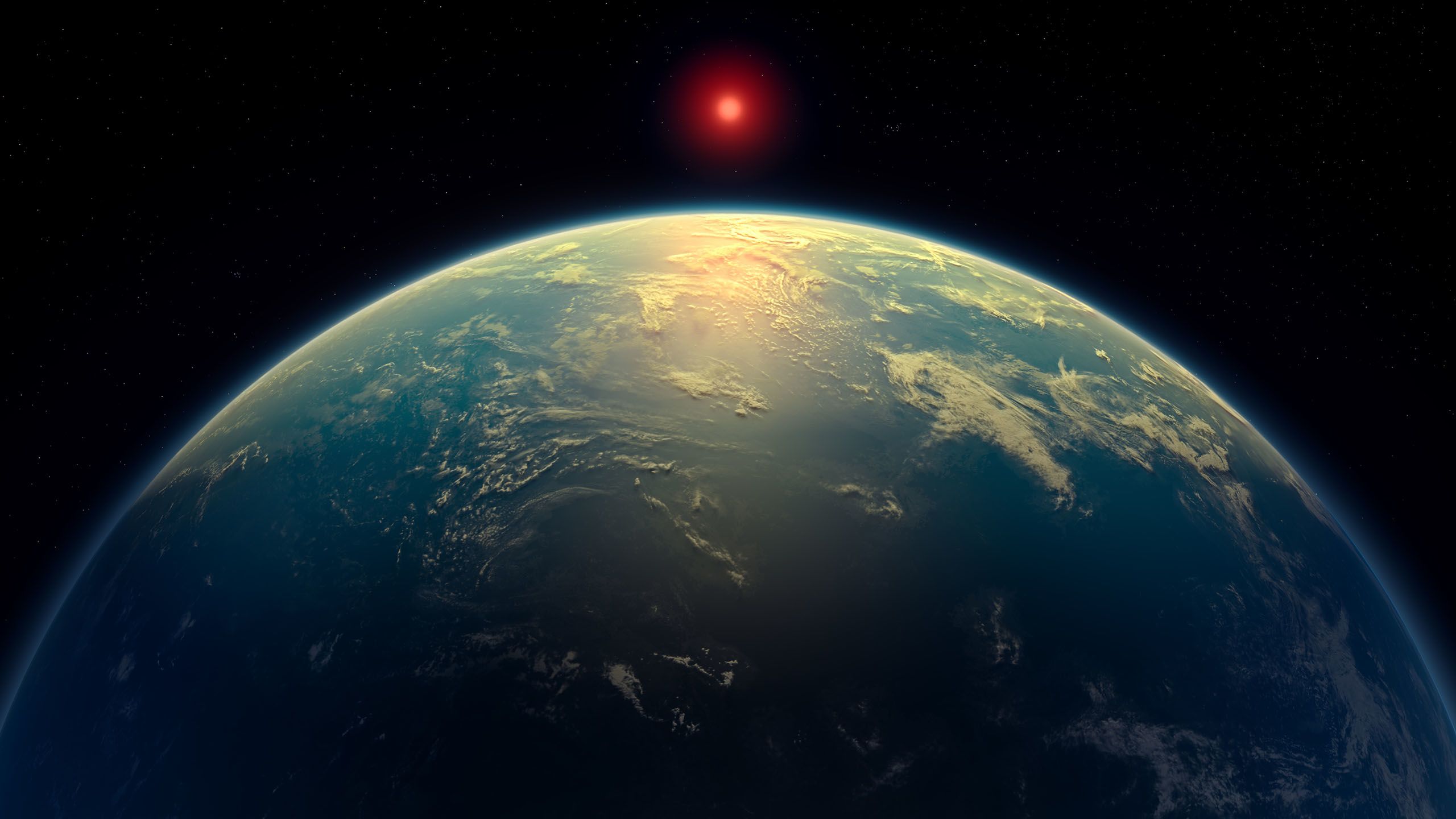
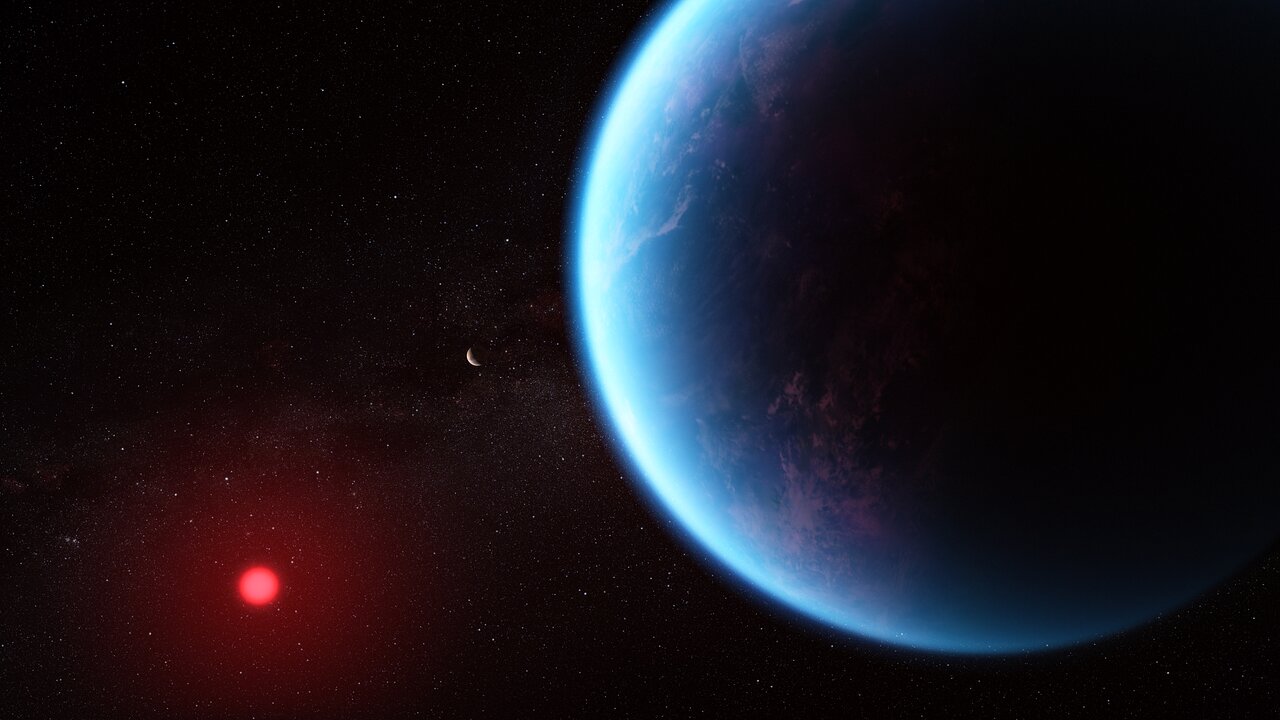
K2-18 b orbits an M-type red dwarf star in the constellation Leo, and the reason it became so important is that it sits in the habitable zone while also being large enough for its atmosphere to leave a readable imprint during transits.
A transit is when the planet passes in front of its star from our point of view. During that moment, a tiny amount of starlight filters through the planet’s atmosphere before reaching us. Different molecules absorb different wavelengths of light, so the atmosphere leaves a chemical fingerprint behind.
That sounds simple until you understand how insane the measurement actually is.
We are not looking at oceans. We are not seeing continents. We are not watching clouds move across the planet the way we see weather on Earth. We are watching a star slightly dim as a planet crosses it, then trying to separate the normal starlight from the tiny amount of light that passed through the planet’s atmosphere, then looking for chemical fingerprints inside that difference.
That is why this entire debate has to be handled carefully. The signal is not a photograph of life. It is a tiny chemical shadow interpreted through models.
NASA describes K2-18 b as a planet type with no direct analog in our solar system because worlds between Earth and Neptune are common in the galaxy but absent locally. That matters because we are trying to understand a category of planet nature apparently makes often, but our own neighborhood never gave us up close.
That alone changes the whole conversation. We keep using Earth as the template because Earth is the only confirmed inhabited planet we know, but the universe may not care about our template. K2-18 b may belong to a class of planets where habitability, atmosphere, chemistry, pressure, oceans, and internal structure operate under rules that are not Earthlike but also not automatically dead.
Planet Type
Sub-Neptune / super-Earth size range, with no clean analog in our solar system.
Why It Matters
Its atmosphere is large enough for JWST to read through transit spectroscopy.
Main Claim
Methane and carbon dioxide are strong. The possible DMS / DMDS biosignature claim remains disputed.
Real Lesson
The first life debate may arrive as contested chemistry, not cinematic proof.
The Hycean World Idea
The reason K2-18 b became so interesting is because some researchers have argued it could be a Hycean world, meaning a planet with a hydrogen-rich atmosphere above a possible liquid-water ocean.
That idea matters because a hydrogen atmosphere is easier to detect than a thin Earthlike atmosphere. If some larger planets can hold hydrogen envelopes while still keeping ocean temperatures in a life-compatible range, then the number of potentially habitable worlds may be much larger than the old rocky-Earth model suggested.
This is where people get carried away, though. A Hycean interpretation does not mean confirmed ocean. It does not mean confirmed habitability. It does not mean life.
It means the data can be interpreted in a way that allows for a hydrogen-rich atmosphere and potentially water underneath, but that interpretation has to compete against other models where K2-18 b is more like a mini-Neptune with a thick atmosphere, high-pressure layers, haze, clouds, deep volatile envelopes, or exotic chemistry that has nothing to do with biology.
This is why K2-18 b is so important and so dangerous at the same time. It opens the door to a wider definition of habitability, but it also exposes how easy it is to mistake a possible structure for a confirmed world.

What JWST Really Found
The strongest part of the K2-18 b story is not the possible life molecule. It is the fact that JWST detected carbon-bearing molecules in the atmosphere of a temperate exoplanet in the habitable zone.
In 2023, NASA reported that JWST observations revealed methane and carbon dioxide in K2-18 b’s atmosphere, while also noting that the planet’s size and class made its true nature uncertain because sub-Neptunes are poorly understood and do not exist in our own solar system.
That is already a huge scientific step.
The boring version is “JWST saw methane and carbon dioxide.” The bigger version is that humanity is now building instruments capable of reading the atmospheric chemistry of planets around other stars, and that means the search for life is leaving the realm of pure speculation and entering the realm of ugly, contested, statistical evidence.
That is the shift people are missing. The discovery is not one planet. The discovery is the method becoming real.
The DMS and DMDS Claim
The reason the story exploded was because researchers reported possible signs of dimethyl sulfide and/or dimethyl disulfide, usually shortened to DMS and DMDS, in the atmosphere of K2-18 b.
On Earth, DMS is strongly associated with biological activity, especially marine microbial life, which is why the claim immediately carried emotional weight far beyond the actual certainty of the data.
Cambridge described the 2025 result as one of the strongest hints yet of possible biological activity beyond the solar system, but even that framing came with caution because unknown chemical processes could still be responsible. The reported detection was around the three-sigma level, not the much stronger five-sigma threshold normally expected before a discovery of this importance would be treated as settled.
That distinction matters. Three-sigma is not “we found life.” Three-sigma is “this is interesting enough to go after harder.”
The public hears “possible biosignature” and translates it into “aliens,” but science does not work that way. Even if DMS or DMDS is actually present, the next question becomes whether that molecule can be produced without life under the conditions of a hydrogen-rich sub-Neptune atmosphere.
On Earth, DMS may point toward biology because Earth has a known biosphere and known ocean chemistry. K2-18 b is not Earth. Molecules do not carry the same meaning in every planetary environment.
A molecule is not a confession. It is a clue.

Why The Skeptics Are Not Just Being Boring
The skeptical side of this debate is not just a bunch of scientists refusing to be excited. They are asking the correct question: are we actually seeing the molecule, or are we seeing instrument behavior, noise, reduction choices, stellar contamination, haze effects, or another molecule that can mimic the same spectral shape?
A 2025 paper titled K2-18b Does Not Meet The Standards of Evidence For Life argued that the mid-infrared MIRI data are highly vulnerable to unresolved instrumental systematics, that different wavelength binning choices can produce different atmospheric interpretations, and that there is not yet statistically significant evidence for biosignatures in the planet’s atmosphere.
That is not a minor objection. That is the core problem.
If changing the way you process the data changes the story from “possible life molecule” to “no reliable biosignature,” then the claim is not strong enough yet. A true civilization-level discovery has to survive hostile analysis, not just friendly interpretation.
That does not kill the possibility. It puts the possibility back where it belongs: inside uncertainty.

The Haze Problem Changes Everything
One of the most important parts of this debate is that K2-18 b may be explainable without requiring extra exotic life-associated molecules at all.
Some models point toward a hazy, high-metallicity sub-Neptune atmosphere shaped by disequilibrium chemistry, photochemical hazes, and cloud formation. That matters because haze is not background decoration.
Haze is a visibility control layer.
It determines what parts of the atmosphere JWST can see, which molecular features get muted, which ones get exaggerated, and whether the absence of one gas actually means something physical or just means that gas is hidden below the layer the telescope can probe.
This is where K2-18 b becomes very Pattern Nexus, because the whole story is about layers controlling interpretation.
The public thinks the question is whether there is an ocean. The scientists are asking which atmospheric layer the telescope is actually sampling. The public thinks the question is whether DMS means life. The scientists are asking whether haze, clouds, and disequilibrium chemistry can produce or hide similar signals. The public thinks the question is whether JWST is powerful enough. The deeper issue is whether the signal pathway from planet to telescope to model to media to human belief can survive all the distortions along the way.
Water-Rich Does Not Automatically Mean Habitable
One of the hardest parts of this story is separating “water-rich” from “habitable.”
A planet can have water and still be dead. A planet can have an ocean and still have crushing pressure, hostile chemistry, no stable energy gradient for life, or an atmosphere so thick that the habitable region is not accessible in the way people imagine.
K2-18 b’s mass and radius are much larger than Earth’s, and that alone creates the central problem. A planet at that size may have a deep atmosphere and high-pressure interior structure very different from a rocky planet with a surface ocean.
This is why I do not like the way most headlines frame it. They say “possible ocean world” because that gets clicks, but the deeper reality is that K2-18 b may be a layered object where ocean, atmosphere, pressure, haze, chemistry, and internal heat all interact in ways we do not fully understand.
If there is a liquid-water layer, it may be buried under hydrogen. If there is water, it may not be surface-accessible. If there is an ocean, the pressure at depth may be nothing like Earth’s oceans. If there is chemistry that looks biological, it may be produced by non-biological pathways we have not mapped well because we do not have a local K2-18 b to test.
That is the problem with studying a planet type our solar system does not contain. We are not just missing data. We are missing a reference object.
The Red Dwarf Problem
K2-18 b also orbits a red dwarf, and that matters because red dwarf habitable zones are close to the star.
That makes planets easier to detect because they transit more often and block more relative starlight, but it also means the planet lives inside a more intense stellar environment than the simple phrase “habitable zone” suggests.
A planet can be in the habitable zone mathematically while still being exposed to stellar flares, ultraviolet radiation, atmospheric stripping, photochemical forcing, tidal locking, and climate patterns that make habitability very different from Earth.
This does not automatically rule out life, but it does mean you cannot treat the star like a harmless light bulb. The star is part of the chemistry. The star is part of the climate. The star is part of the false-positive problem.
That is another reason K2-18 b should not be reduced to “DMS equals life,” because the radiation environment of the host star may help shape sulfur chemistry, haze production, atmospheric escape, and the long-term stability of any biosphere that might exist there.
Why This Feels Bigger Than The Evidence
This is the part that matters most to me because the K2-18 b debate is not only about a planet. It is about how human beings respond when weak evidence touches a deep existential wound.
People want this to be true because the idea that life exists somewhere else changes the emotional structure of reality.
It makes the universe feel less empty. It makes Earth feel less isolated. It makes consciousness feel less like an accident. It makes all of human history feel like one local chapter inside a much larger story.
That is why the media cannot handle a three-sigma molecule responsibly, because the molecule is not just a molecule once it enters public consciousness. It becomes a symbol. It becomes hope. It becomes mythology. It becomes another battlefield between believers, skeptics, institutions, content farms, scientists, and people who are tired of being told to wait for certainty while the biggest questions in existence sit right in front of them.
This is where I think the real story is.
K2-18 b shows us that the first serious hints of life beyond Earth may not arrive as a clean signal that everyone agrees on, but as a disputed atmospheric feature that lives for years in the space between chemistry and biology.
That is frustrating, but it is probably realistic. The universe may not hand us proof in the form we want. It may hand us probability.
Pattern Nexus Lens
K2-18 b is a layered system, and every layer has a gatekeeper.
The planet has a physical layer: mass, radius, orbit, atmosphere, pressure, temperature, stellar radiation, possible ocean, possible high-pressure interior.
The atmosphere has a chemical layer: methane, carbon dioxide, possible sulfur compounds, hazes, clouds, missing ammonia, disequilibrium chemistry, photochemistry, and whatever unknown pathways exist on a planet we have never visited.
The telescope has an instrument layer: JWST, NIRSpec, NIRISS, MIRI, wavelength coverage, noise, binning choices, calibration, red noise, pipeline differences, and limits that most headline readers never see.
The science has an interpretation layer: retrieval models, priors, assumptions, competing explanations, statistical thresholds, peer criticism, and the brutal requirement that a claim this large has to survive repeated independent attack.
The media has a narrative layer: “possible life,” “strongest hint yet,” “not so fast,” “alien planet,” “scientists divided,” and all the emotional compression that turns slow science into instant belief.
Then there is the human layer, which may be the most powerful one of all, because people are not only asking whether there is DMS in an atmosphere. They are asking whether the universe is alive.
That is why K2-18 b matters even if the biosignature claim eventually fails. It is showing us the shape of the future.
The first real life-detection debate may not be a moment. It may be a process. It may be years of spectra, models, counter-models, failed replications, stronger observations, new instruments, new chemical experiments, and a slow tightening of probability until the question becomes too strong to ignore.
My Read
My read is simple: K2-18 b is not proof of life, but it is one of the clearest signs that the search for life has entered a new stage.
We are no longer just pointing telescopes at stars and guessing whether planets exist. We are reading atmospheres. We are fighting over molecules. We are arguing over whether a sulfur compound is biological, abiotic, instrumental, or something we do not understand yet.
That is progress. Messy progress, but progress.
The wrong people will turn this into fake certainty, and the overly cautious people will try to flatten it into nothing, but both reactions miss the point because K2-18 b is important precisely because it sits in the middle.
It is not proof. It is not nothing. It is a boundary object.
It is a planet sitting at the edge of what our instruments can currently extract from the universe, and that makes it valuable even if the alien-life angle collapses.
If the DMS claim survives future testing, then K2-18 b may become one of the most important discoveries in human history. If the DMS claim fails, K2-18 b still becomes one of the planets that taught us how not to fool ourselves when the first real biosignature candidates arrive.
Either way, this planet has already done something important.
It showed us that the search for life is not going to feel clean, comfortable, or cinematic. It is going to feel like this: a faint signal, a disputed model, a molecule that might mean biology, a planet we cannot touch, a telescope reading shadows, and a species trying to decide whether the universe just whispered back or whether we heard our own hope inside the noise.
Sources
- NASA Exoplanet Catalog: K2-18 b
- NASA: Webb Discovers Methane, Carbon Dioxide in Atmosphere of K2-18 b
- University of Cambridge: Methane and Carbon Dioxide Found in K2-18 b’s Atmosphere
- University of Cambridge: Strongest Hints of Biological Activity Outside the Solar System
- Nature: Signs of Life on a Distant Planet? Not So Fast, Say These Astronomers
- arXiv: K2-18b Does Not Meet The Standards of Evidence For Life
Image Credits
Pattern Nexus is not just tracking the headline. It is tracking the layers underneath it: the planet, the atmosphere, the instrument, the model, the institution, the media frame, and the human need to turn uncertainty into meaning.
Frequently Asked Questions
Hvad er din reaktion?
 Synes godt om
0
Synes godt om
0
 Dislike
0
Dislike
0
 Kærlighed
0
Kærlighed
0
 Sjov
0
Sjov
0
 Wow
0
Wow
0
 Trist
0
Trist
0
 Vred
0
Vred
0

Founder of Pattern Nexus. I research markets, macro, geopolitics, AI, history, ancient systems, and the patterns most people overlook. I’m also building Market Radar, a trading scanner designed to read pressure, risk, confirmation, and setup quality before chasing a move. Pattern Nexus is where I connect the dots between data, history, technology, and the bigger system playing out around us.









Kommentarer (0)