
Blockade Age: Why U.S.–China “Trade Deals” Are Just Tempo Management in a Maritime Power War
The U.S.–China relationship isn’t thawing — it’s entering the Blockade Age. Rare-earth deals, naval posture, island-chain strategy, and Arctic corridors signal permanent parallel supply chains, maritime chokepoints, and regional security blocs shaping the next decade. Taiwan becomes a fortified node. China remains boxed by geography. The U.S. builds a perimeter of sensors, subs, and allies.
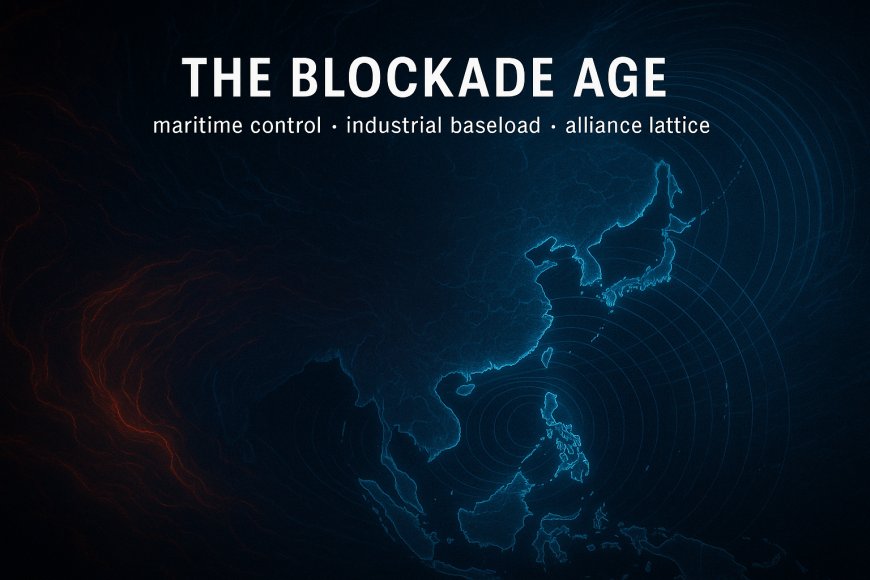
Blockades, Blocs, and the New Maritime Map: Why “Trade Deals” Are Just Tempo Management
Forget “deal or no deal.” We’ve entered the architecture phase of a geopolitical realignment where regional security guarantees, industrial baseload, and maritime chokepoints decide who thrives. The U.S. is building a lattice of alliances and sensors. China is boxed in by island chains and chokepoints. Russia is opening north. Everything else is noise.
Call the current moment whatever you want—“trade war,” “decoupling,” “de-risking.” Under the headline layer, both blocs are re-wiring supply lines, licensing regimes, and defense posture. The U.S. is converting allies into a distributed sensor-shooter web across the island chains; China is leaning on mineral controls and industrial leverage to slow it down; Russia is exploiting warming Arctic corridors. The scoreboard isn’t tariff points—it’s access, assurance, and arcs of fire.
If you only track tariffs, you’ll miss the shipyard being welded behind the stage. If you track the plumbing, the picture snaps into place.
Why now
Beijing has spent the last two years hardening leverage over critical inputs—gallium, germanium, graphite, rare earths, and magnet tech—via export controls and licensing. Those curbs reduced or complicated shipments through 2024–2025, raising prices and forcing hurried diversification by the U.S. and allies (Reuters, Reuters, Reuters, Reuters, The Guardian). That’s not about month-to-month brinkmanship; it’s the industrial prelude to permanent parallel supply chains.
The U.S. response is similarly structural: AUKUS Pillar 1/2 (submarines + advanced capabilities), the Japan–ROK–U.S. Camp David framework, expanded U.S.–Philippines basing and missiles near the Bashi Channel, and first-ever drawdown-style security assistance to Taiwan—all scaffolding for a long contest (CRS on AUKUS Pillar 2, Camp David Fact Sheet, Reuters: Bashi Channel, CFR: U.S. support to Taiwan, CRS: Taiwan defense issues (2025)).
The maritime geometry: chains, chokepoints, nets
Geography is not kind to Beijing’s grand strategy. Yes, China has a long coastline and world-class ports—but blue-water access is constrained by the first and second island chains, the Strait of Malacca, and allied ISR nets. The “Malacca Dilemma” remains the classic vulnerability: most of China’s seaborne energy and high-value trade funnels through narrow, surveilled chokepoints that can be threatened in crisis (Georgetown JIA, Atlas Institute, ISM).
Meanwhile the U.S. (and partners) have layered fixed and mobile undersea surveillance—the Cold-War-era SOSUS evolving into today’s IUSS/SURTASS architecture—plus space, airborne, and unmanned sensors that make PLAN movements predictable (US Navy IUSS, USNI). Add the geography of the Bashi Channel—a narrow gate between Luzon and Taiwan—and it’s obvious why recent U.S.–Philippines posture matters: deny blue-water breakout in a crisis (Reuters, Reuters: EDCA sites).
Bottom line: island chains + chokepoints + sensors = persistent leverage over PLA Navy maneuver. That’s why “tariff détente” headlines don’t change the structural picture.
Alliances as a weapon system
The U.S. isn’t “containing China” alone; it’s fusing capabilities. AUKUS (SSNs + Pillar 2 tech), the Japan missile buy and defense surge, the Camp David trilateral with ROK, and the U.S.–Philippines basing/missile placements form a distributed anti-access web across the first and second chains—plus sovereign production of munitions, sensors, and chips in the wider bloc (AP: Japan Tomahawks, CRS: AUKUS Pillar 2, Camp David Fact Sheet, Reuters: US–PH Task Force).
On the economic flank, the rare-earth squeeze sharpened allied urgency. Expect “Operation Warp Speed”-style parallel chains for extraction, separation, and magnet manufacturing in the U.S., Japan, ROK, Australia, and Southeast Asia—even if China remains dominant near-term (Reuters explainer, Reuters: licensing reprieve, Reuters: magnet exports).
Russia’s Arctic window vs. China’s chokepoints
As the Arctic opens, Russia’s Northern Sea Route keeps inching from niche to viable seasonal artery. Murmansk and Arctic infrastructure expansion persist despite sanctions; Moscow is openly courting Global South investors and targeting Asia-bound flows (Reuters, Bellona, Marine Policy (2024)).
China, by contrast, must still punch through the first island chain or thread Malacca/Lombok/Sunda under watch. Geography isn’t destiny—but it’s a brutal handicap without reliable access corridors (CSIS SCS remarks, RAND, SCMP explainer).
Taiwan: from “porcupine” to regional security node
Taiwan’s value is not just silicon (though TSMC is a global keystone); it’s location inside the first chain and the ability to anchor allied ISR and fires across the Luzon–Ryukyu arc. Washington’s shift to permit drawdown-style aid and the steady flow of FMS packages, plus expanding trilateral coordination, signal a long runway toward a hardened, networked Taiwan that functions as a security node in an informal Indo-Pacific lattice—call it “mini-NATO physics,” not a treaty copy-paste (CRS 2025: Taiwan defense, CFR summary, CSIS: Silicon Island, AP: TSMC Arizona context, FT: diversification costs).
My call: within a decade, Taipei is the de facto lead node of an Asia-Pacific security web—an Israel-analog in function (resilient, tech-dense, alliance-fed), not in legal form. That’s where the arc is bending.
What happens next (1–3–10 years)
12–18 months
- More Chinese licensing frictions around REE magnets/graphite; episodic “reprieves” without structural rollback (Reuters).
- U.S.–Philippines missile presence normalized near Bashi; routine tri-/quad-lateral exercises tighten interdiction playbooks (AP).
- Japan accelerates long-range strike integration (Tomahawk + domestic Type-12 upgrades) (AP).
3–5 years
- AUKUS Pillar 2 yields interoperable kill-chains (undersea, EW, AI/ISR) across the second chain (CRS).
- Non-China REE/magnet capacity grows but remains costlier and thinner than Beijing’s base (Reuters).
- Arctic shipping modestly expands; Russia deepens NSR infrastructure and financing ties (Reuters).
~10 years
More from Pattern Nexus
Sources (selection)
- Rare-earths & critical minerals: Reuters: gallium/germanium curbs, Reuters: graphite permits, Reuters: REE controls explainer, Reuters: licensing reprieve, Guardian: tightened controls.
- Island chains, chokepoints, Bashi Channel: Georgetown JIA: Malacca Dilemma, Atlas Institute, Reuters investigation: Bashi Channel, RAND, SCMP explainer.
- Alliances & posture: Camp David fact sheet, AP: Japan Tomahawks, CRS: AUKUS Pillar 2, Reuters: US–PH task force.
- Taiwan & semiconductors: CRS: Taiwan defense issues (2025), CFR: U.S. support, CSIS: Silicon Island, AP: TSMC Arizona context, FT: diversification costs.
- Undersea surveillance (context): US Navy IUSS, USNI.
- Arctic trendlines: Reuters: Arctic investment, Bellona monthly highlights, Marine Policy (2024): NSR predictions.
What's Your Reaction?
 Like
0
Like
0
 Dislike
0
Dislike
0
 Love
0
Love
0
 Funny
0
Funny
0
 Wow
0
Wow
0
 Sad
0
Sad
0
 Angry
0
Angry
0

Founder of Pattern Nexus. I research markets, macro, geopolitics, AI, history, ancient systems, and the patterns most people overlook. I’m also building Market Radar, a trading scanner designed to read pressure, risk, confirmation, and setup quality before chasing a move. Pattern Nexus is where I connect the dots between data, history, technology, and the bigger system playing out around us.















Comments (0)