
The Leverage Stack: Collateral, Credit, and Control (2008–2030)
A Pattern Nexus system map of leverage from households to the Fed. How collateral, funding, maturity, and liquidity couple together across consumers, business, corporations, housing, markets, government, and the shadow system—why leverage is power, and why liquidity is the constraint (2008–2030).
Published: December 2025
By: Pattern Nexus
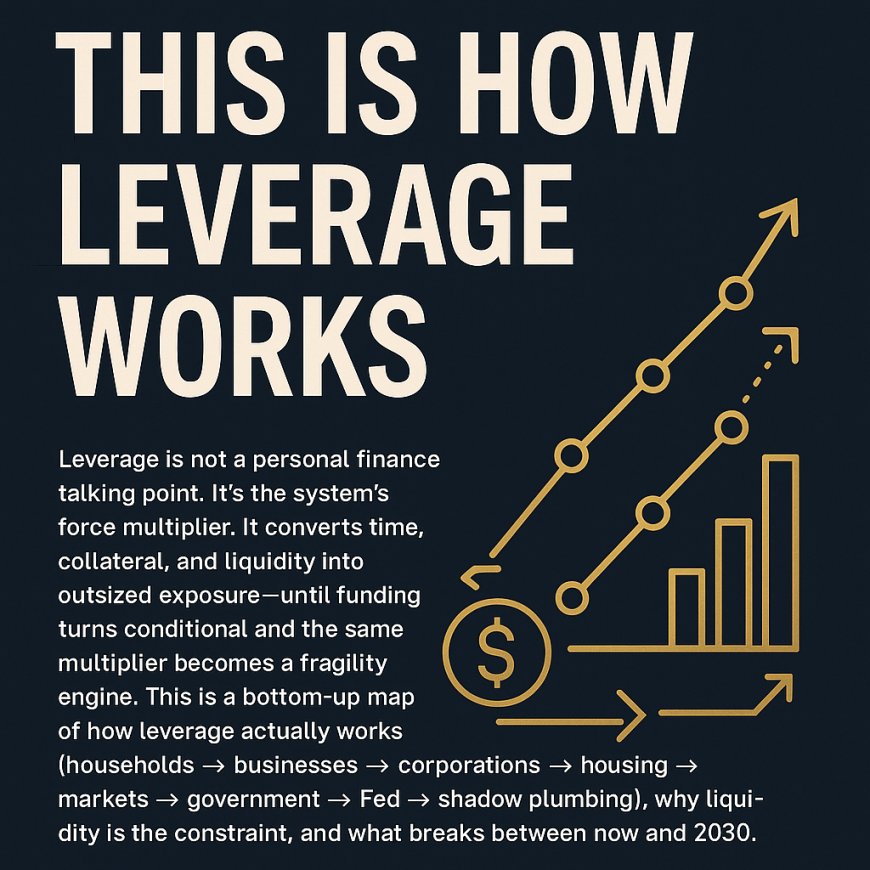
Leverage is not a personal finance talking point. It’s the system’s force multiplier. It converts time, collateral, and liquidity into outsized exposure—until funding turns conditional and the same multiplier becomes a fragility engine. This is a bottom-up map of how leverage actually works (households → businesses → corporations → housing → markets → government → Fed → shadow plumbing), why liquidity is the constraint, and what breaks between now and 2030.
Executive Summary
Leverage is the most misframed concept in finance because most people talk about it as a moral category. “Good debt” versus “bad debt.” “Responsible borrowing” versus “reckless borrowing.” That framing is comfort food. It’s also operationally useless.
Leverage is not a personality trait. It is a structural property of systems that allow future claims to be pulled forward into the present. It is exposure divided by true loss-absorbing capacity, carried through time using funding and collateral. If you want the non-sanitized version: leverage is power. It’s the ability to control more assets, more outcomes, and more optionality than your base capital should allow.
Core Thesis (PN): Leverage is a control-system tool and the hidden unit of power in modern markets. Whoever controls the price of leverage, the availability of leverage, and what counts as acceptable collateral controls outcomes. Liquidity decides whether leverage compounds growth or detonates fragility.
This is why debates that ignore collateral and funding are noise. You can have “low leverage” on paper and still be one liquidity event away from failure if your funding is short, conditional, or mismatch-prone. Conversely, you can look “highly levered” and survive if your funding is long, cheap, stable, and non-callable, and if your collateral remains accepted.
The last 15+ years have been a real-time demonstration. Post-2008 policy didn’t just “lower rates.” It expanded leverage capacity by backstopping collateral, suppressing volatility, and creating a regime where rollover risk felt optional. That regime is not permanent. From 2022 onward, the system has been relearning that leverage is always a hostage to liquidity conditions—even when the spreadsheet says you’re “fine.”
One Sentence Summary: Leverage is survivable when liquidity is abundant and collateral is unquestioned. Leverage is lethal when funding turns conditional, haircuts rise, and volatility forces liquidation.
This article builds leverage bottom-up and then stitches the layers together into a single coupled machine. Households. Small business. Corporations. Housing. Markets. Government. The Fed. Shadow plumbing. Same physics, different wrappers.
What you should watch in real time
- Funding stress: when lines get pulled, spreads widen, auction tails grow, repo rates gap, and “terms” replace “price.”
- Collateral politics: what is accepted, at what haircut, and who gets the backstop when it isn’t.
- Refinancing walls: maturity cliffs that turn solvency into a timing game.
- Volatility regime shifts: the silent trigger that forces deleveraging even without defaults.
Pattern Nexus Rule: The market doesn’t delever because it wants to. It delevers because it has to.
December 2025 context (the current picture): This matters because we are in a regime shift right now. The Fed ended net balance-sheet runoff effective December 1, 2025 and pivoted into “reserve management” buying of shorter-dated Treasuries (primarily bills) to maintain ample reserves, while cutting rates to a lower range. They are not calling it QE. They are calling it rate-control plumbing. Mechanically, it is liquidity support that expands balance sheet capacity at the margin, and it changes the survivability of leverage structures across the system—especially the ones that depend on short-term funding and tight haircuts.
PN Translation: QT being “over” does not mean the tightening impulse is gone. It means the Fed hit a reserve/market-function boundary and switched tools. The lever moved from “runoff” to “terms and pace.” Leverage capacity is being defended—but it’s being defended selectively, under a narrative firewall.
The Leverage Primitive
Start with a strict definition. Leverage, at its core, is:
Strict Definition: Leverage = Total Exposure ÷ True Loss-Absorbing Capital.
“Exposure” is not just the face value of debt. Exposure is the size of the position you control and the speed at which you can be forced to close it. That includes off-balance-sheet commitments, derivatives, guarantees, margin, embedded optionality, and any structure that can create a rapid liquidity call.
“True loss-absorbing capital” is not what the marketing deck says. It’s what remains after the first real hit: cashflow resilience, equity buffers that are actually liquid, margin headroom, and the operational ability to survive a drawdown without being forced into the market at the worst price.
This is where most people get trapped. They think “equity” is always capital. It isn’t. Equity is only capital if it can be mobilized under stress. If your “equity” is trapped in an illiquid asset during a liquidity event, it may as well be a story.
Liquidity Reality: In good times, equity is an accounting concept. In stress, equity is a liquidation outcome.
In the Pattern Nexus definition, leverage is broader than debt. It includes any mechanism that converts small inputs into outsized control across time:
- Balance sheet leverage: assets funded with liabilities.
- Cashflow leverage: fixed obligations against variable income.
- Maturity leverage: long assets funded by short liabilities (rollover risk).
- Collateral leverage: positions carried because collateral is accepted at favorable haircuts.
- Optionality leverage: derivatives and embedded convexity that scale exposure nonlinearly.
- Policy leverage: backstops and guarantees that socialize downside and privatize upside.
- Narrative leverage: “belief” that lowers risk premia, suppresses volatility, and increases capacity until it flips.
Leverage is not automatically “reckless.” It is a multiplier. The question is what the multiplier is attached to: productive cashflows and stable funding, or speculative exposure and conditional funding.
Non-Negotiable Rule: Leverage is never independent. It is always paired with a funding regime and a collateral regime.
That rule is what most commentary gets wrong. They analyze leverage like it lives inside a company, a household, or a bank. It doesn’t. Leverage lives in the relationship between borrower and lender, between asset and funding, between collateral and haircut, between volatility and margin requirement.
If you want to understand why systems blow up “out of nowhere,” you look for the mismatch: stable-looking positions funded in unstable ways, or assets assumed to be money-like that suddenly are not.
The “leverage stack” (a simple system map)
Think of leverage as a vertical stack. Each layer looks stable until the layer beneath it changes. When the base shifts, the top collapses.
- Layer 1: Cashflows (income, revenue, rent, taxes)
- Layer 2: Collateral (what can be pledged, and how it is priced under stress)
- Layer 3: Funding access (who will lend, in size, under what terms)
- Layer 4: Maturity structure (how often you must roll, and what happens if you can’t)
- Layer 5: Optionality (derivatives, guarantees, backstops, embedded convexity)
- Layer 6: Volatility regime (the hidden governor that forces deleveraging)
Pattern Nexus Shortcut: If you want to know how fragile something is, don’t ask “how much debt.” Ask “how quickly can they be forced to sell.”
The Control Variables
Leverage capacity is governed by four variables. Treat these as the system’s levers. They determine what can exist, what can be carried, and what must be liquidated.
- Cost of funding: the interest rate, the spread, and the effective carry after hedging.
- Availability of funding: whether funding exists at all, in size, and under what conditions.
- Collateral acceptability: what counts as “good” collateral, at what haircut, and with what rehypothecation rules.
- Maturity and rollover risk: how often you must refinance and what happens if the window closes.
Why liquidity is king: Liquidity is what allows leverage to persist across time without being forced into liquidation. When liquidity becomes conditional, leverage becomes a countdown timer.
Notice what’s missing: a moral judgment. The system doesn’t care if you’re a “good borrower.” It cares whether your position can be carried under the current funding and collateral regime. That’s it.
This is why leverage cycles feel like “everything was fine until it wasn’t.” Because the trigger is usually not the borrower. It’s the regime. It’s haircuts. It’s funding availability. It’s volatility. It’s a risk desk pulling lines. It’s a collateral schedule changing. It’s a refinancing window slamming shut.
What “conditional funding” actually means
Conditional funding is the quiet killer. It’s when the lender retains the right to change terms, reduce exposure, increase collateral, or refuse renewal. Most real-world leverage is conditional. Even “committed” lines have covenants. Even “stable” funding relies on market functioning.
Translation: If you must refinance, you are always negotiating with the future. The future is not obligated to like you.
Haircuts as the hidden dial
Haircuts are leverage in disguise. If an asset is accepted at a 2% haircut, you can lever it heavily. If it’s accepted at a 20% haircut, leverage capacity collapses. If it’s not accepted at all, your “asset” is no longer collateral. It’s just a thing you own.
System Trigger: Most crises are haircut events first, and default events later.
December 2025 alignment note: If you want a clean way to connect this article to the current regime shift without turning it into a press-release recap, you anchor it here: the Fed stopped runoff when “reserve balances declined to ample levels” and explicitly chose a bill-heavy purchase approach to maintain ample reserves. That is the central bank telling you, indirectly, that the system’s leverage capacity is bounded by reserve conditions and money-market function, not by academic arguments about “long-run balance sheet size.”
PN Framing: The leverage dial is not the fed funds rate alone. It’s the whole bundle: funding cost, reserve conditions, collateral acceptability, and the willingness to backstop the pipes when the pipes start to squeal.
Common Myths That Kill People
Myth: “Leverage is just debt.”
Reality: Leverage is exposure carried through time using funding and collateral. Debt is only one wrapper.
Myth: “If my payment is fixed, I’m safe.”
Reality: Your payment can be fixed while everything else around you becomes variable: income, insurance, taxes, maintenance, tenants, vacancy, spreads, liquidity, refinancing windows.
Myth: “I’m not levered because I don’t borrow.”
Reality: Many people are levered via fixed obligations, illiquidity, and time claims. You can be “debt-free” and still be one shock away from forced liquidation because you have no liquidity buffer.
Myth: “The Fed controls everything.”
Reality: The Fed heavily influences the price and acceptability of leverage, but it does not control the entire collateral and funding ecosystem, especially in the shadow system. Regime shifts still happen.
Myth: “If I’m solvent, I’m safe.”
Reality: Solvency is slow. Liquidity is fast. You can be solvent and still be forced into liquidation by a funding event.
Those myths aren’t just wrong. They’re operationally dangerous. They cause people to build structures that work only in one regime, then act shocked when the regime changes.
Next, we go bottom-up. Not theory. Mechanisms. What leverage actually looks like in households, then in small business, then corporate, then housing, then markets. And we repeat the discipline every time: identify the funding, identify the collateral, identify the maturity, identify the failure mode.
Consumer Leverage
Consumer leverage is where most people first touch the system, and it’s also where most people misunderstand it. The dominant myth is that leverage begins with borrowing. In reality, consumer leverage begins with income predictability. Wages are the primary collateral proxy in modern consumer credit markets. Everything else is layered on top of that assumption.
Credit scores are not measures of wealth, intelligence, or virtue. They’re probability models. The system is not asking whether you are “good with money.” It’s asking whether your income stream is likely to persist long enough to service fixed claims.
Core Mechanism: Consumer leverage is the conversion of future labor into present consumption, carried through time via fixed obligations.
Consumer leverage is a cashflow equation, not a balance sheet
The consumer’s stress point isn’t “assets minus liabilities.” It’s whether cashflow can cover fixed claims after real life happens. Real life is the hidden variable: inflation, healthcare, car repairs, regional job instability, childcare costs, family emergencies. The consumer doesn’t have a treasury desk. They have a paycheck and a calendar.
Revolving credit, installment loans, auto loans, student loans, and mortgages are variations of the same structure. They differ in duration, collateralization, and priority, but they share the same dependency: uninterrupted cashflow. Consumer leverage doesn’t fail because people “become irresponsible.” It fails because liquidity disappears at the margin.
Non-callable payments create a false sense of safety
Most consumer obligations are non-callable in the sense that lenders don’t demand immediate repayment in normal times. That feels “safe.” But it’s a trick: the payment stays fixed while the environment becomes variable. Your debt payment might not change, but your total cash burn does.
Consumer Fragility: A fixed payment does not mean fixed total cost. It means your obligations are rigid while your life is not.
Hidden leverage: time, obligations, and illiquidity
A huge percentage of “consumer leverage” never shows up as a formal liability: subscription stacks, commuting time, variable-rate essentials, childcare schedules, healthcare deductibles, and the loss of redundancy. Dual-income households optimized for peak efficiency often have zero slack. That is leverage. It’s leverage against stability.
Hidden Leverage: Fixed lifestyle obligations behave like debt during stress, even though they are not booked as liabilities.
Where consumer leverage actually breaks
- Income shock: layoffs, hours cut, commission volatility, seasonal instability.
- Inflation shock: essentials rise faster than wages, squeezing the margin.
- Credit shock: revolving rates spike, minimum payments rise, limits get reduced.
- Liquidity shock: no emergency buffer, forced reliance on expensive credit.
And here’s the part most narratives ignore: consumer leverage is downstream of almost everything. Corporations cut costs. Small businesses fail. Housing transactions slow. Consumer cashflows are the first transmission channel. The household becomes the shock absorber for leverage decisions made elsewhere.
System Truth: Households don’t “cause” most downturns. They absorb them.
Small Business Leverage
Small business leverage is structurally different from consumer leverage, but no less fragile. Where consumers borrow against income, small businesses borrow against operating continuity. Inventory, receivables, payables, and short-term credit lines form the core of the small business leverage stack.
Working capital is the small business leverage engine
A small business lives in a timing gap. That gap is leverage. Expenses are immediate. Revenues are uncertain and delayed. Working capital bridges the gap, but only as long as lenders remain confident in turnover and demand.
Small Business Core Mechanism: Borrow short to fund operations that pay back later. If “later” slips, leverage becomes a trap.
Personal guarantees are not “skin in the game”
This is where the system gets predatory while pretending it’s prudent. Banks extend leverage to small businesses by collapsing the distinction between the business and the owner. Personal guarantees substitute for capital. That shifts institutional risk onto individuals. It is efficient for lenders and catastrophic for entrepreneurs during regime shifts.
Critical Detail: Personal guarantees are capital substitution mechanisms that transfer institutional downside into personal ruin.
Why small businesses fail first
Small businesses fail first in tightening cycles because their leverage is short-duration, their funding is discretionary, and their liquidity buffers are thin. Lines of credit get pulled. Terms are revised. Inventory financing dries up. Vendor terms shorten. None of this requires insolvency—only a regime shift in risk appetite.
Small business leverage is “terms risk” more than “rate risk”
People fixate on interest rates. For small businesses, the more lethal variable is terms. Collateral requirements, covenants, borrowing bases, and lender discretion can change overnight. When the system de-risks, small businesses are not repriced—they are removed.
Pattern Nexus Translation: In stress, you don’t lose because your rate went up. You lose because your funding disappeared.
Current regime tie-in: When the Fed shifts from runoff to reserve-management purchases, it is explicitly acknowledging that money market conditions and reserve “ampleness” are binding constraints. That matters for small business because small business credit is the first place discretionary risk committees tighten when they sense pipe noise. You can call it “consumer stress,” “bank conservatism,” or “regional tightening.” It’s all the same mechanism: leverage capacity is being rationed at the edge.
Corporate Leverage
Corporate leverage operates on a different plane. Large firms do not merely borrow; they manage leverage as a strategic variable. Balance sheet leverage, earnings leverage, and financial leverage interact continuously with market access.
The key distinction is this: corporations do not fail because they are levered. They fail because they lose refinancing optionality.
Corporate Reality: Solvency is less important than market access. A firm that can refinance can survive almost anything.
Leverage as optimization in easy regimes
In low-rate regimes, issuing debt to retire equity increases return on equity and concentrates exposure. Buybacks become a leverage tool. This is not “evil” or “genius.” It’s simply what the incentive structure produces when funding is cheap and volatility is suppressed.
The corporate failure mode: the refi wall
Corporate leverage is often fine until the maturity schedule clusters. A refinancing wall turns a stable-looking company into a timing bet. When spreads widen and issuance windows close, a firm can go from “healthy” to “dead” without a single change in its business model.
Refi Wall Logic: When the market says “no,” your historical metrics don’t matter. You are negotiating with the present, not your past.
Covenants are leverage governance
Covenants are not paperwork. They are the governance layer of leverage. Covenant-lite structures flourish in abundant liquidity regimes because lenders compete to lend. When capital becomes scarce, covenants return and leverage becomes conditional again. The regime determines the contract, not the other way around.
Operating leverage: the silent multiplier
Many corporate failures blamed on “debt” are actually operating leverage failures. High fixed costs turn revenue dips into cashflow collapses. Then debt becomes the accelerant. People argue about leverage while missing the underlying cashflow structure that makes leverage survivable or lethal.
PN Rule: Financial leverage is dangerous. Operating leverage is often deadlier because it hides inside the business model.
Current picture: In a world where the Fed is already doing bill-heavy reserve management purchases and positioning it as “implementation,” corporate leverage becomes a two-track game. The top tier (systemically relevant balance sheets with market access) can still refinance. The marginal tier gets repriced through spreads, covenants, and term scarcity. That’s why the same macro environment can feel “easy” to one cohort and lethal to another.
Housing Leverage
Housing is the most socially normalized form of leverage in the economy. Mortgages are long-duration, highly levered positions embedded in everyday life and shielded by cultural narratives about stability and safety.
In mechanical terms, a mortgage is a leveraged bet on duration and income continuity. The asset is illiquid. The liability is rigid. The only reason this works is because payment schedules are long and funding costs are fixed.
Key Insight: Housing is not a consumption good. It is a rate instrument with shelter as a side effect.
What people call “housing risk” is usually liquidity risk
Home equity is often treated as a buffer, but it is only a buffer if liquidity exists. In downturns, equity is theoretical. Taxes, insurance, and maintenance are real. When cashflow fails, forced sales crystallize losses regardless of “paper equity.”
Investor housing leverage: DSCR is a regime bet
DSCR loans replace wage underwriting with cashflow underwriting, tying housing leverage directly to rental demand, vacancy, and operating costs. That’s where real-world property ownership becomes a leverage education very quickly: insurance premiums can jump, taxes can re-assess, maintenance can surge, and capex arrives whether you “planned” for it or not. The property doesn’t care about your narrative. It cares about cashflow.
DSCR Reality: You’re not betting on a house. You’re betting on a cashflow stream staying above a threshold while costs stay contained.
Housing is a duration trade embedded in society
When rates fall, housing leverage capacity rises. Buyers can service larger principals for the same payment. When rates rise, leverage capacity collapses. Transactions freeze. Price discovery stalls. This is why housing markets don’t “clear” smoothly like stocks. They seize.
How housing couples into the system
- Bank asset quality: mortgages and HELOCs sit inside the banking system.
- MBS duration: refinancing waves and prepayment behavior reshape duration distribution.
- Consumption: housing transactions drive spending via moving, renovation, and credit expansion.
- Local liquidity: housing is regional. Leverage stress hits unevenly, which is why narratives fail.
Pattern Nexus Warning: Housing leverage doesn’t break on day one. It breaks when liquidity dries up and the “I can always refi” assumption dies.
December 2025 tie-in: If the Fed is buying bills to keep reserves ample while still presenting the posture as “not QE,” the housing takeaway is not “rates will collapse and save everyone.” The takeaway is that the Fed is managing the floor of system liquidity while the market still prices the long end. Housing can stay frozen even while the Fed does plumbing support, because the transaction channel is a rate channel and a confidence channel, not a reserves channel.
Market Leverage (Margin, Options, Vol)
Market leverage is where leverage becomes reflexive and self-reinforcing. Unlike consumer or housing leverage, which is slow-moving and payment-based, market leverage reprices continuously. It is governed not by monthly obligations but by margin requirements, volatility targets, and collateral haircuts that update in real time.
This is why market leverage produces violent moves that appear disconnected from fundamentals. The trigger is rarely valuation. The trigger is risk constraint activation.
Market Reality: Prices move because positions must be resized, not because opinions changed.
Margin: the simplest forced-sale machine
Margin leverage is the most visible form. Borrowed funds amplify exposure, but they also impose maintenance requirements. When prices move against the position, additional capital must be posted. If it cannot be, liquidation occurs automatically. This creates a mechanical feedback loop: falling prices force selling, which causes further price declines.
Options: leverage with a nonlinear trigger
Options introduce convexity. Small moves can create large P&L swings. Dealers hedge dynamically. When positioning is skewed, hedging flows can amplify trends. The system becomes a self-reinforcing machine: flows create moves, moves create flows.
Gamma Effect: When dealers are short gamma, they buy into strength and sell into weakness, amplifying volatility and trend persistence.
Volatility targeting: the hidden deleveraging accelerant
Risk parity, vol-control, CTA and systematic strategies scale exposure inversely with volatility. When vol is low, exposure rises quietly. When vol spikes, exposure is cut aggressively. This creates a regime where leverage accumulates invisibly during calm periods and is released suddenly during stress.
PN Translation: Calm markets are not safe markets. Calm markets are where leverage hides.
Why “liquid markets” become the shock absorber
Deleveraging concentrates in the most liquid instruments: index futures, ETFs, large caps, benchmarks. That’s why the things that are “best” to trade are often the first to get hit when stress appears elsewhere. Liquidity becomes the exit route, so liquidity gets used, and the price moves.
Rates as the global leverage thermostat
Short rates affect carry trades, margin costs, discount rates, and hedging costs. As funding rates rise, leverage capacity shrinks even without any explicit “selling.” Monetary tightening transmits through leverage math.
Current picture: When the Fed is cutting rates and simultaneously initiating bill purchases framed as “reserve management,” the market message is not “everything is easy again.” The message is: the Fed wants rate control and system function, but it is trying to avoid re-inflating long-duration speculation through explicit QE branding. That tension is why leverage in markets remains volatile. The pipes are being supported, but the casino is not being publicly endorsed.
Government Leverage
Government leverage is misunderstood because it doesn’t resemble household leverage. Sovereigns do not face margin calls, and they cannot be forced into liquidation. But they are constrained by rollover dependency, inflation tolerance, and political legitimacy.
Sovereign Constraint: The market’s willingness to fund deficits at acceptable terms, and society’s willingness to absorb the inflation and distributional consequences.
Auctions are the sovereign’s margin call
People treat auctions like administrative events. They’re not. Auctions are the test of sovereign leverage capacity. If demand weakens, term premia rises, yields rise, and interest expense becomes a political problem. The sovereign’s “margin call” is not a broker email. It’s the yield curve.
Fiscal policy is leverage applied to society
Government leverage is ultimately leverage on national production, future taxation, and monetary stability. Deficits pull future claims forward. They can stabilize downturns, but persistent deficits in tightening regimes crowd out private leverage capacity and raise the economy’s hurdle rate.
Political stickiness is the hidden rigidity
Governments cannot adjust obligations quickly. Entitlements, defense, and debt service are politically sticky. That rigidity makes sovereign leverage highly sensitive to rate regimes and demographic dynamics. The constraint is not “can they print,” it’s “what happens when they do.”
Pattern Nexus Point: Monetary sovereignty doesn’t eliminate constraints. It changes the constraint from solvency to inflation, legitimacy, and distribution.
Current picture: The Fed’s December 2025 posture is a tell: maintaining ample reserves is now officially treated as necessary for smooth rate control and market function. In plain language, government leverage capacity and market plumbing are coupled. The fiscal side can act “large,” but the system still has to clear auctions, fund collateral chains, and preserve money-market function. When those signals wobble, the Fed changes tools.
Federal Reserve Leverage
The Federal Reserve does not “use leverage” like a household or corporation. It does something more powerful: it shapes the leverage capacity of the entire system. Through policy rates, balance sheet operations, and collateral frameworks, the Fed influences funding costs, liquidity availability, and what counts as acceptable collateral.
Fed Function: Price-setter for short-term funding, distributor of duration, and operator of liquidity backstops that create synthetic leverage capacity.
QE/QT as duration distribution
QE removes duration from private balance sheets and replaces it with reserves. QT reverses this by allowing securities to roll off, reintroducing duration into the market. This matters because duration is leverage-sensitive: it changes volatility, term premia, and the capital required to carry positions.
The December 2025 pivot: “runoff ended” and bills became the tool
Here’s the alignment point that matters for our current liquidity environment framing. On October 29, 2025 the Fed signaled it would cease runoff starting December 1, 2025. Beginning December 1, the Desk rolls over maturing Treasuries at auction and reinvests principal payments from agency securities into Treasury bills. Then on December 10, 2025, the FOMC directed the Desk to increase SOMA holdings through purchases of Treasury bills (and if needed, other Treasuries with remaining maturities of 3 years or less) to maintain an ample level of reserves.
PN Translation: QT didn’t “end” because inflation magically died. QT ended because the reserve/money-market boundary showed up. The Fed hit a plumbing constraint and swapped instruments.
Reserve Management Purchases (RMP): why “QE light” is the honest description
The Fed is not calling this QE. It is framing it as ongoing reserve management needed for implementation of the policy rate corridor as non-reserve liabilities grow and reserve indicators shift. That narrative is intentional. “QE” is politically radioactive because it implies macro stimulus and wealth effects. “Reserve management” implies technical maintenance.
Mechanically, purchases add reserves and expand balance sheet capacity. That changes funding conditions at the margin, reduces the probability of acute money-market dislocation, and stabilizes the short-end plumbing that carries leveraged positions. In other words, it is “QE light” in function, even when the stated intent is “implementation.”
Critical Detail: If reserves are “ample,” leverage can be carried with fewer funding accidents. If reserves are merely “adequate,” the system starts paying the volatility tax in repo, haircuts, and term scarcity.
Facilities as conditional leverage insurance
The discount window, standing repo facility, and emergency facilities are not just “liquidity tools.” They are optionality instruments. They create a backstop that allows institutions to carry positions they might otherwise reduce. But the backstop is conditional: terms can change, stigma can exist, eligibility can be narrow, political tolerance can weaken.
PN Warning: The backstop is real, but it is not a promise to you. It is a tool for system stability. You may or may not be the system.
Why “the Fed controls everything” is a trap
The Fed is powerful, but it does not directly control the full collateral and funding ecosystem, especially in the shadow system. It can influence conditions, it can intervene in crises, but it cannot permanently erase the physics of leverage. It can shift timing and redistribute impact. That’s not the same as eliminating the cycle.
Pattern Nexus Rule: Central banks can delay deleveraging. They cannot repeal it.
What to watch now (post-QT, reserve-management era)
- RMP pace and composition: whether purchases remain concentrated in bills and how quickly “elevated” purchases are tapered.
- Money-market signals: repo conditions, usage of standing facilities, and any renewed “reserve scarcity” language.
- Collateral schedules: where haircuts rise despite the Fed’s attempt to keep the floor stable.
- Long-end term premia: the Fed can stabilize the short end and the pipes while the market still punishes duration.
PN Summary: The Fed is defending the pipes, not guaranteeing your trade. The short end is being stabilized. The long end is still a referendum on term premia, fiscal supply, and credibility.
Shadow Leverage and Collateral Chains
The shadow system is where leverage is least visible and most dangerous. Repo markets, securities lending, private credit, structured products, and collateral transformation create leverage capacity outside traditional banking constraints. This is where the system quietly manufactures carry and balance sheet capacity until something breaks.
Repo: the carrying engine
Repo is collateralized borrowing. It allows institutions to fund securities positions using pledged collateral. In stable regimes, repo is cheap, abundant, and assumed. In stress, repo becomes the front line: haircuts widen, rates gap, and funding is rationed.
Shadow Rule: Haircuts are the real leverage dial. Raise haircuts, and leverage evaporates without any change in “debt.”
Rehypothecation: leverage on leverage
Rehypothecation chains reuse the same collateral across multiple positions. This increases efficiency in good times and fragility in stress. When collateral quality is questioned, the chain snaps. Suddenly everyone wants “their” collateral at the same time.
Private credit: leverage migration, not leverage elimination
Private credit grew because banks became more constrained and because investors demanded yield. It is not “new money.” It is leverage capacity migrating into less transparent structures with longer lockups and different failure modes. Private credit looks stable until exits are needed, valuations must be marked, or refinancing becomes harder.
PN Translation: Illiquidity can hide leverage, but it can’t remove it. It just delays the reckoning.
Structured products: leverage wrapped in ratings
The system repeatedly learns the same lesson: you can repackage leverage and call it safe, but the underlying cashflows and correlations do not care about labels. When correlations converge in stress, “diversified” leverage becomes concentrated leverage.
December 2025 alignment: why the Fed pivot is a shadow-system tell
If you want to understand why “reserve management purchases” matter, don’t overthink it. The Fed does not pivot its balance sheet strategy because academics wrote a paper. It pivots because money-market function started flagging. That is the shadow system communicating through rates, facility usage, and reserve indicators. When the shadow funding layer tightens, you do not get a polite repricing. You get a discontinuity: haircuts, terms, and access. That’s why the Fed is defending the short-end plumbing now.
Shadow-System Reality: You can be right on fundamentals and still get liquidated on funding.
How It All Couples Together
Leverage does not exist in isolated silos. It is one machine with multiple access points. Each layer feeds into the next, and the transition is usually not philosophical. It is mechanical.
A coupled-chain walkthrough (the real system sequence)
Start with a tightening regime or a shock. Consumer spending slows. Small business revenues compress. Defaults don’t have to spike at first. What spikes first is caution. Lenders tighten terms. Lines get reduced. Working capital shrinks. Small businesses fail. Layoffs rise. Consumer stress intensifies.
Meanwhile, markets reprice duration and risk premia. Volatility rises. Systematic strategies cut exposure. Asset prices fall. Collateral values decline. Haircuts widen. Funding becomes conditional. More forced sales occur. The process feeds on itself.
Governments face higher interest expense and political pressure. Auctions matter more. Fiscal room narrows. Central banks face a dilemma: stabilize markets and risk inflation credibility, or hold tight and risk a deeper liquidation. The response shifts the regime again.
System Insight: Most “unexpected” crises are simply the coupling becoming visible.
Where the villains actually live
- Funding mismatch: long assets funded by short liabilities.
- Collateral fragility: the moment an asset stops being money-like.
- Volatility regime shifts: the hidden governor that forces deleveraging.
- Margin and haircuts: the mechanical triggers of forced liquidation.
- Rollover risk: refinancing dependence disguised as stability.
- Covenant tightening: leverage becoming conditional again.
- Political limits: legitimacy, distribution, and inflation tolerance.
- Narrative shocks: belief reversals that reprice risk premia instantly.
- Reflexivity: flows change prices, prices change constraints, constraints change flows.
Pattern Nexus Summary: The villain is not “debt.” The villain is the regime shift that turns leverage from carryable to uncarryable.
2008–2030: Regime Evolution
2008–2012: backstops, recapitalization, and the rebirth of leverage
The post-2008 world wasn’t just “low rates.” It was a structural redesign of leverage capacity. The system learned that collapse was politically unacceptable. Backstops became a feature, not a one-off. That changed behavior. It changed risk premia. It changed what leverage could exist.
2013–2019: volatility compression and the quiet expansion
As volatility compressed, leverage expanded across markets and balance sheets. This period created the template: suppress funding costs, suppress volatility, and leverage will appear “safe.” That safety was conditional on the regime staying intact.
2020–2021: emergency leverage capacity goes full scale
The response to 2020 was an explicit signal: in a true shock, liquidity support would be large and fast. That reinforced the leverage reflex. If the downside is backstopped, leverage becomes the rational behavior for those closest to liquidity. The distributional impact is the point everyone argues about later, after the trade is done.
2022–2026: the system relearns the cost of carry
Higher rates reintroduced the cost of leverage. Carry trades became less forgiving. Refinancing became real again. Duration stopped being “free.” Risk premia mattered. This is where refi walls form, because debt issued in the zero-rate world has to roll in a different world.
Refi Wall Thesis: The next phase is not “a crash because debt exists.” It’s a grind because debt must roll under worse terms while cashflows and politics fight over who eats the adjustment.
2025: QT hits the reserve boundary and the toolkit changes
This is the bridge between our “QT is over” thesis and the leverage framework. In late 2025 the Fed explicitly ended runoff starting December 1, 2025 and moved toward a bills-heavy balance sheet path, then initiated reserve management purchases starting mid-December. It framed this as maintaining ample reserves and ensuring the fed funds rate stays in range. In a PN lens, that is the system admitting where the constraint lives: in reserve conditions, money market function, and collateral-funding stability—not in ideology.
PN Emphasis: QT ended the moment it threatened the pipes. That doesn’t make the system “easy.” It makes the system managed.
2026–2030: leverage migration, collateral politics, and selective liquidity
Leverage doesn’t disappear. It migrates. Private credit grows because banks remain constrained and investors need yield. Governments absorb more duration because fiscal deficits persist and because sovereign debt remains the baseline collateral of the system. Liquidity becomes more selective: it goes to systemically important nodes first, not to everyone equally.
The most likely “break” between now and 2030 is not one dramatic event. It’s a sequence: pockets of funding stress, localized collateral problems, periodic volatility spikes, repeated interventions, and a political fight over inflation and distribution. In other words, the system becomes more obviously managed, and leverage becomes more explicitly political.
2030 Outlook (PN): The system can run with high leverage if liquidity is credible, collateral is trusted, and volatility is contained. The risk is that credibility, trust, and containment become harder to maintain simultaneously.
Key forward-looking mechanics (what “breaks” actually means): Between now and 2030, the stress will concentrate where maturity meets politics: refinancing walls in corporate and CRE, insurance/tax shock in housing cashflows, shadow funding sensitivity to haircuts, and a sovereign duration problem that keeps long-end term premia unstable even as the short end is managed. The Fed can defend the floor, but it cannot make every levered structure solvent at every price without changing the currency regime. That is the boundary line.
Pattern Nexus Lens
Leverage is not a side topic. It is the transmission mechanism of liquidity and the control channel of modern finance. If you want to understand markets, stop arguing about “valuation” and start mapping leverage capacity. Where can leverage exist? Under what collateral rules? At what funding cost? With what maturity structure? Under what volatility regime?
This is the real map: liquidity sets leverage capacity, leverage amplifies outcomes, outcomes change politics, politics reshapes liquidity, and the loop continues.
Pattern Nexus Rule: The system doesn’t break because leverage exists. It breaks when leverage outruns the regime’s ability to fund and collateralize it.
If you control the leverage regime, you control outcomes. That control doesn’t always look like explicit commands. It looks like rules, haircuts, eligibility, backstops, funding terms, and the quiet architecture of what is considered “safe.” That’s why leverage is power. It’s not just a trade. It’s a position in the control system.
December 2025 summary in one line: QT ended because reserves stopped being abundant, and “reserve management purchases” began because the Fed decided ample reserves are a prerequisite for stability. That is a leverage statement, not just a balance sheet statement.
FAQ
Is “leverage” the same thing as “debt”?
No. Debt is one container. Leverage is the underlying physics: how much exposure you control relative to real loss-absorbing capacity, and how dependent you are on funding and collateral acceptance to carry that exposure through time. You can have little debt and still have high leverage through illiquidity, fixed obligations, maturity mismatch, or derivative convexity.
What is the single biggest mistake people make when thinking about leverage?
They treat leverage like a static ratio. The system treats leverage like a dynamic contract. The contract changes when volatility changes, when funding changes, when collateral changes, and when the lender’s risk appetite changes. That’s why people blow up “out of nowhere.” It wasn’t nowhere. It was a regime shift.
What does “liquidity is the constraint” mean in plain English?
It means leverage survives only if you can meet obligations and margin calls without being forced to sell at the worst time. Liquidity is your ability to pay, roll, refinance, post collateral, and absorb shocks. When liquidity becomes conditional, leverage becomes a timer.
What’s the practical difference between “cost of funding” and “availability of funding”?
Cost is the rate you pay when the door is open. Availability is whether the door is open at all, and whether it stays open under stress. People obsess over rates and ignore availability. Most real-world failures are availability failures first, price failures second.
Why do haircuts matter more than most people think?
Because haircuts are the leverage dial. A small change in haircut can collapse leverage capacity instantly without any change in the borrower’s “debt.” It’s the collateral regime changing. When haircuts widen, you either post more capital or you sell. If you can’t post, you liquidate.
What does “QT is over” actually mean as of December 2025?
It means net balance-sheet runoff stopped starting December 1, 2025 and the Fed shifted to rolling Treasuries and reinvesting agency principal into Treasury bills, then initiated bill-heavy purchases to maintain ample reserves. In PN terms: the Fed hit a reserve/money-market boundary and switched from shrinking the portfolio to managing reserves through purchases.
Is “reserve management purchases” just QE under a different name?
Mechanically, it expands the balance sheet and adds reserves. Narratively, it is positioned as “implementation” rather than “stimulus.” In PN language: it’s QE-light in function, fenced by messaging and maturity targeting. It stabilizes the pipes more than it explicitly reflates long-duration risk.
Does the Fed buying bills mean the long end is now controlled?
No. Stabilizing the short end and the plumbing can coexist with a long-end term premium problem. The Fed can influence expectations and liquidity conditions, but the long end is also a referendum on fiscal supply, inflation credibility, and duration demand. That’s why you can get “pipe support” without a clean bull market in duration.
Why can markets crash even if there aren’t many defaults yet?
Because market leverage reprices on risk constraints, margin requirements, and volatility. Defaults are slow. Liquidity is fast. You can have a systemwide deleveraging from higher vol and tighter haircuts long before default data catches up.
Why do “safe” assets sometimes sell off in a crisis?
Because they are used as funding collateral and as liquidity sources. When forced selling happens, participants sell what they can sell, not what they want to sell. The most liquid instruments become the shock absorbers.
Is housing “safe leverage” because mortgages are long-term and fixed?
Fixed-rate mortgages reduce payment volatility, but housing is still a leveraged duration position with an illiquid asset behind it. Costs around the mortgage are not fixed (taxes, insurance, maintenance). And if liquidity fails, equity becomes a liquidation outcome, not a buffer.
Why does private credit matter in the leverage story?
Because it’s leverage capacity migrating into less transparent structures. Illiquidity can reduce run risk in the short term, but it can also hide leverage buildup until refinancing or exits are required. The risk doesn’t disappear. It changes shape.
What is the “refi wall” and why does it matter into 2030?
The refi wall is clustered maturities that force borrowers to roll debt under new terms. It’s not a moral story. It’s timing. If the issuance window is open, refinancing is survivable. If it’s shut or expensive, otherwise “healthy” balance sheets become fragile. This is a core transmission channel from rates to real economy stress.
So what’s the real villain mechanism—greed, debt, or the Fed?
None of those alone. The villain mechanism is conditionality: leverage structures built as if funding is permanent, collateral is unquestioned, and volatility is contained. The system punishes that assumption when the regime shifts. The Fed can postpone or redistribute punishment, but it can’t erase the physics without changing the currency regime.
FHQ
If leverage is unavoidable and liquidity is cyclical, what is the real systemic hazard: “too much leverage,” or a structure that repeatedly convinces participants that the current liquidity regime is permanent and therefore safe to lever against indefinitely?
Follow-up (harder): If the answer is “belief,” then is the true control mechanism policy, or narrative—and who gets to write it?
FHQ Expansion (Pattern Nexus version)
Here’s the real test question behind every cycle: if the system requires leverage to function, and the system also punishes leverage when liquidity conditions tighten, then what is actually being managed—risk, or behavior?
- Question 1: When the Fed ends runoff and begins reserve management purchases, is it “supporting the economy,” or is it preventing a shadow-funding discontinuity that would force an involuntary deleveraging across everything?
- Question 2: If “QE” is politically toxic but the pipes require balance sheet growth to stay stable, does the system become permanently dependent on euphemisms and technical framing to keep leverage capacity intact?
- Question 3: If the short end can be stabilized while the long end remains a referendum on term premia and fiscal credibility, does leverage become structurally more fragile because the cost of carry becomes harder to predict over multi-year horizons?
- Question 4: If liquidity becomes selective (system nodes first, margins last), is that still a “market,” or is it an allocation regime with market-like features?
- Question 5: If the winners are consistently those closest to funding access and collateral eligibility, is the economy actually organized around productivity—or around proximity to the leverage valve?
Final FHQ (the one that actually bites): If the system’s stability depends on maintaining “ample reserves” and backstopping the pipes, then is the true risk excessive leverage—or the political impossibility of allowing leverage to unwind at market-clearing prices?
Because once you accept that premise, you’re forced into the real conclusion: the cycle is not just economic. It’s governance. It’s who absorbs the adjustment, who gets the backstop, and which losses are allowed to become real.
Sources
Federal Reserve: Policy Normalization (Balance Sheet Plans)
Federal Reserve: FOMC Statement (December 10, 2025)
Federal Reserve: Implementation Note / Domestic Policy Directive (December 10, 2025)
New York Fed: Statement Regarding Treasury Reserve Management Purchases (December 10, 2025)
New York Fed: FAQs on Reserve Management Purchases and Reinvestment Purchases
FRED (St. Louis Fed Data)
Bank for International Settlements (BIS)
U.S. Treasury Auction Results
NY Fed: Repo Reference Rates
IMF Publications (Debt, Financial Stability, Liquidity)
Hvad er din reaktion?
 Synes godt om
0
Synes godt om
0
 Dislike
0
Dislike
0
 Kærlighed
0
Kærlighed
0
 Sjov
0
Sjov
0
 Wow
0
Wow
0
 Trist
0
Trist
0
 Vred
0
Vred
0

Founder of Pattern Nexus. I research markets, macro, geopolitics, AI, history, ancient systems, and the patterns most people overlook. I’m also building Market Radar, a trading scanner designed to read pressure, risk, confirmation, and setup quality before chasing a move. Pattern Nexus is where I connect the dots between data, history, technology, and the bigger system playing out around us.













Kommentarer (0)