
Space Was Becoming Infrastructure. Now It Has a Weapons Layer: The U.S. Confirms On-Orbit Space-Control Weapons
For the first time, the United States has publicly acknowledged that it operates "on-orbit space control weapons." The hardware remains classified, but the surrounding architecture is not: Space Force doctrine already defines orbital warfare, electromagnetic warfare, cyber operations, reversible denial, degradation and destruction as parts of space control; ground-based counterspace systems are already operational; and China, Russia and other states are developing the same wider capability stack. This Pattern Nexus report separates what is confirmed from what remains unknown, explains the Outer Space Treaty, maps the counterspace technology families, and ties the disclosure directly into earlier Pattern Nexus work on space infrastructure, "Launch. Control. Network.", cislunar logistics, and Control Stack 2.0. The central thesis: space becoming infrastructure was phase one; infrastructure becoming an explicitly armed control layer is phase two.
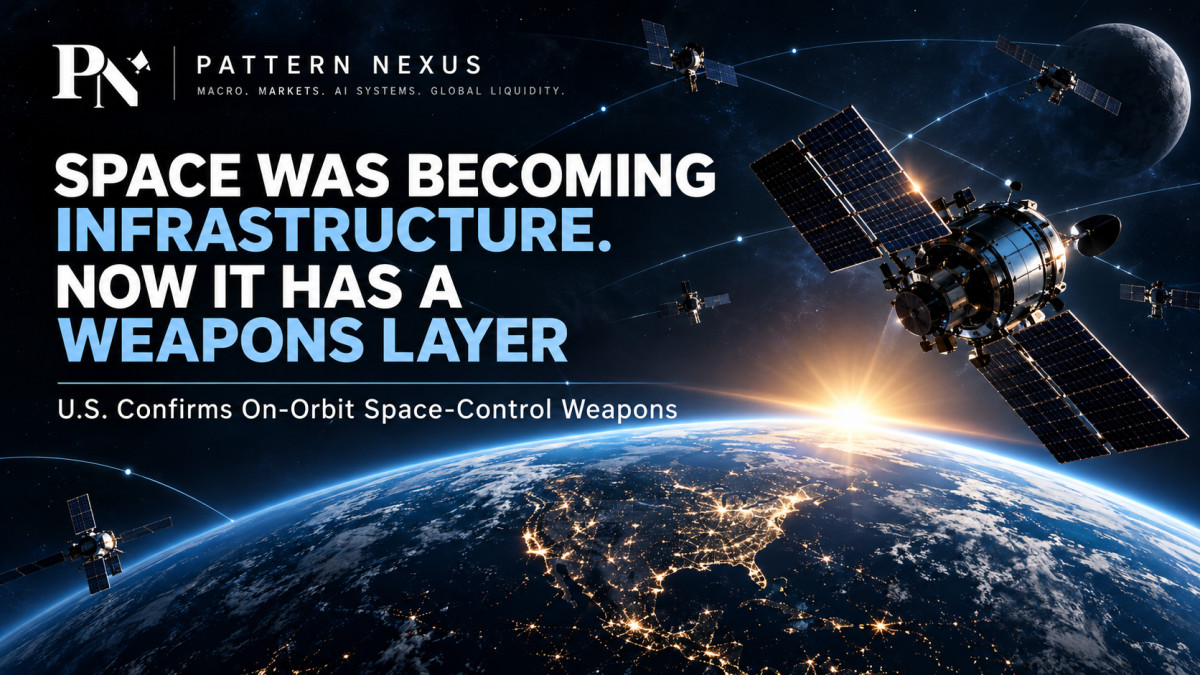
- The U.S. did not suddenly begin using space for military purposes this week. What changed is that the Department of the Air Force publicly acknowledged, for the first time, that the United States has on-orbit space-control weapons already deployed and operated in space.[1][2]
- The weapon type remains classified. Air Force Secretary Troy Meink and Space Force Chief Gen. Douglas Schiess both confirmed the capability but declined to say whether the systems are kinetic, non-kinetic, electromagnetic, directed-energy, robotic, or something else.[2][3]
- This is not the first U.S. counterspace capability. The Space Force has openly fielded ground-based electromagnetic-warfare systems such as Meadowlands and Bounty Hunter, while the Remote Modular Terminal program was designed to scale counterspace electronic warfare across operating locations.[7][8][9]
- The doctrine came before the disclosure. Space Force doctrine already defines space control as offensive and defensive counterspace operations across orbital, electromagnetic, and cyber mission areas, with effects ranging from reversible interference to degradation and destruction.[4][5][6]
- The legal headline is narrower than most people think. Article IV of the 1967 Outer Space Treaty prohibits nuclear weapons and other weapons of mass destruction in Earth orbit. It does not impose a blanket ban on every conventional weapon in Earth orbit, although other international-law obligations still apply.[11][12]
- This is part of a global counterspace buildout. Secure World Foundation's 2026 open-source assessment tracks counterspace programs in 13 countries across co-orbital, direct-ascent, electronic-warfare, directed-energy, and cyber categories.[10]
- The real Pattern Nexus issue is infrastructure control. I have spent months writing that space is moving from missions into permanent infrastructure. Once communications, navigation, timing, reconnaissance, logistics, servicing, and economic activity become dependent on that infrastructure, the ability to protect, deny, interrupt, or control it becomes strategic power.
- This directly extends two earlier Pattern Nexus space pieces. Space Is Becoming Infrastructure mapped the orbital operating system. Days later, The Space Infrastructure Race Just Escalated compressed the new stack into three words: Launch. Control. Network. This announcement is the control layer becoming explicit.
I have been saying for a while now that the mistake is treating space as a collection of spectacular missions. That model is already too old. Space is becoming infrastructure. Infrastructure becomes dependency. Dependency creates chokepoints. Chokepoints create control surfaces. And once rival powers depend on the same domain for communications, navigation, targeting, timing, intelligence, logistics, and economic continuity, those control surfaces become part of warfare whether anyone likes the terminology or not.
That is why this announcement matters more than the headline alone. The headline says the United States has weapons in space. The deeper change is that the U.S. government is now willing to say publicly that it has them, Space Force doctrine already explains how they fit into a wider space-control architecture, ground-based counterspace systems are already operational, maneuverable satellites and servicing technology are blurring the boundary between infrastructure and weapon systems, and other major powers are moving through the same technological transition.
Core distinction: the important "first" is the public acknowledgement of deployed on-orbit U.S. space-control weapons. It is not the first military use of space, the first counterspace program, or the first U.S. capability designed to interfere with an adversary's satellite system.
Militarization is old.
Military satellites, reconnaissance, communications, missile warning, navigation, and targeting support have existed for decades.
The disclosure is new.
The U.S. has now publicly acknowledged that space-control weapons are physically on orbit and being operated there.[1][2]
The weapon is still unknown.
The public record does not identify the platform, number of systems, orbit, target set, effect mechanism, or deployment date.
The systems question matters more than the mystery hardware.
A weapon matters because of the network around it: sensing, tracking, maneuver, command, communications, launch cadence, replenishment, fuel, software, and rules of engagement.
01 · THE DISCLOSURE
The United States Did Not Announce a Future Program. It Acknowledged a Capability Already on Orbit.
On September 14, 2026, Secretary of the Air Force Troy Meink used a phrase that the Department of the Air Force had previously avoided saying this plainly in public: the United States has "on-orbit space control weapons" capable of defending the Joint Force against hostile action.[1]
The next day, the disclosure became harder to dismiss as a loose phrase. Space Force Chief Gen. Douglas Schiess said Guardians operate on-orbit weapons that can defend U.S. forces against space-enabled attacks. He also said the service would make disciplined and responsible choices as it scales that arsenal.[2]
That second statement matters. This is not just a secretary using aggressive language during a conference speech. The service chief publicly described Guardians as operating the systems. U.S. Space Command officials then argued that acknowledging the capabilities supports deterrence.[2]
At the same time, the government drew a hard line around the actual hardware. Meink would not say whether the systems are kinetic or non-kinetic. Schiess would not identify them either. Officials did not disclose how many exist, what orbital regime they occupy, when they launched, what they are designed to target, how they create an effect, or whether they have ever been used operationally against another spacecraft.[2][3]
That is the first analytical boundary I would put around this story. The existence of an on-orbit weapon category is now public. The identity of the weapon is not.
That sounds obvious, but it is important because the internet immediately fills classified gaps with imagination. Lasers. Grappling satellites. Kamikaze interceptors. Signal jammers. Robotic arms. Cyber payloads. Directed-energy platforms. Every one of those belongs somewhere in the broader technical discussion of counterspace warfare. None has been publicly confirmed as the system Meink and Schiess were talking about.
Evidence boundary: I am treating the existence of deployed U.S. on-orbit space-control weapons as confirmed. I am not treating any specific weapon design, orbit, quantity, or effect mechanism as confirmed unless the government identifies it.
That distinction is where this article starts, because the real story is large enough without inventing the classified part.
02 · WHAT "FIRST" MEANS
The First Is the Admission, Not the Beginning of Military Competition in Space
The headline that brought me into this was essentially: the U.S. says for the first time that it now has weapons in space. That is directionally right, but the phrase can create the wrong mental picture if it is read too literally.
Space has been militarized for most of the space age. Satellites have supported reconnaissance, communications, missile warning, navigation, weather, nuclear command and control, targeting, intelligence collection, and battlefield coordination for decades. The United States, Russia, China, India, and other states have also tested or developed ways to interfere with satellites from the ground, through missiles, electronic warfare, cyber operations, lasers, and maneuverable spacecraft.[10]
The United States has openly discussed counterspace for years. It has fielded ground-based systems capable of disrupting satellite communications. It has trained for space-control missions. It has published doctrine describing offensive and defensive counterspace operations. It has created organizational structures specifically for orbital warfare, electromagnetic warfare, cyberspace warfare, and space domain awareness.[4][5][7]
So this did not begin on September 14.
What changed is the public line.
The government crossed from: we need counterspace capabilities; we train for space warfare; we operate systems that can create effects against space architectures into: we have weapons in orbit now.
That is a strategic communication decision as much as a hardware revelation.
In other words, the important variable is not only capability. It is declared capability.
Declared capability changes deterrence calculations because an adversary no longer has to infer whether the United States has crossed a threshold. But declared capability without technical details also creates ambiguity. A competitor knows the capability exists but not exactly what it can do, where it is, how many systems exist, or what would trigger its use.
That ambiguity can be useful for deterrence. It can also be destabilizing, which I will come back to later.
The orbital arms race did not start when the United States admitted it had weapons in orbit. The admission is evidence that the race has matured far enough that secrecy itself is being recalibrated.
That is a very different statement from "space was peaceful yesterday and weaponized today."
03 · DOCTRINE BEFORE HARDWARE
The Space Force Told Us the Operating Logic in 2025
This announcement looks abrupt if you only follow headlines. It looks much less abrupt if you follow the doctrine.
In 2025, the Space Force published a warfighting framework that moved well beyond the old language of simply protecting satellites. The document says space superiority requires the ability to operate without prohibitive interference while denying the same advantage to an adversary. It describes space control as offensive and defensive counterspace operations conducted across orbital, link, and terrestrial segments.[4]
That framework matters because it defines the military problem as a control problem.
The service is not only asking: Can my satellite survive?
It is asking:
- Can I continue to move, communicate, sense, and target through space?
- Can I prevent an adversary from using space to locate and attack my forces?
- Can I temporarily deny a hostile capability without permanently destroying it?
- Can I destroy or degrade a hostile capability if temporary denial is insufficient?
- Can I do this across the spacecraft, communications link, cyber layer, and ground infrastructure rather than treating the satellite as an isolated object?
Space Force Doctrine Document 1 formalized three space-control mission areas: orbital warfare, electromagnetic warfare, and cyberspace warfare.[5]
Former Chief of Space Operations Gen. Chance Saltzman described the effects spectrum even more plainly: interference, degradation, and destruction through kinetic and non-kinetic means, with both offensive and defensive counterspace operations.[6]
That is important because "weapon" in space does not automatically mean an object whose only job is to physically smash another satellite.
A modern weapon can create an effect.
The effect can be reversible.
It can be temporary.
It can be localized.
It can be electromagnetic.
It can be cyber-enabled.
It can involve maneuver.
And at the far end of the escalation ladder, it can be destructive.
The doctrine explicitly leaves all of those doors open.
Pattern Nexus translation: the Space Force is building a control architecture, not simply a collection of anti-satellite weapons. The target is the adversary's ability to use the orbital system at the time and place where that use matters.
This is exactly why the announcement connects so cleanly to my broader work. Control systems do not require permanent destruction at every node. The most scalable control systems prefer selective, reversible, targeted denial when that is enough to produce the desired outcome.
That same logic appears in finance, sanctions, communications networks, compute controls, and now explicitly in space doctrine.
04 · EVIDENCE MAP
What We Know, What We Can Infer, and What Is Still Classified
Because the hardware is classified, this story has to be separated into levels of confidence.
| Question | Current answer | Confidence |
|---|---|---|
| Does the U.S. have on-orbit space-control weapons? | Yes. The Department of the Air Force and the Space Force chief have publicly acknowledged them.[1][2] | Confirmed |
| Are they being operated by Guardians? | Gen. Douglas Schiess said enlisted Guardians operate on-orbit weapons.[2] | Confirmed |
| Are they kinetic? | Officials declined to say. | Unknown |
| Are they non-kinetic? | Officials declined to say. | Unknown |
| Are they designed to destroy satellites? | Possible within Space Force doctrine, but not established for the disclosed systems. | Unknown |
| Can they create reversible effects? | Reversible effects are part of Space Force doctrine, but the disclosed system's mechanism is not public.[4][6] | Possible, not confirmed |
| How many are deployed? | Not disclosed. | Unknown |
| Which orbital regime are they in? | Not disclosed. | Unknown |
| When were they launched? | Not disclosed. | Unknown |
| Are they the same as Golden Dome space-based interceptors? | No public evidence establishes that. Golden Dome interceptors are a separately discussed missile-defense program.[1][13] | Do not conflate |
| Has the U.S. physically attacked another nation's satellite in orbit? | Reuters reported that no nation is known to have taken that consequential step in conflict.[2] | No known case |
This table is not filler. It is the central discipline required to analyze classified systems without turning analysis into fan fiction.
The strongest part of the story is what the government chose to reveal. The weakest part is every confident claim about the hardware itself.
That leaves us with a useful question: if we cannot identify the weapon, what can we still learn?
A lot, because we know the doctrine, the surrounding force architecture, the ground-based systems, the global counterspace technology set, the exercises, the commercial technologies converging with military requirements, and the infrastructure those weapons are meant to defend or deny.
05 · CAPABILITY FAMILIES
"Space Weapon" Is Not One Technology
One reason the public conversation gets distorted is that "weapon in space" produces one visual: a gun, missile, or laser pointed at another satellite.
That is too narrow.
Secure World Foundation organizes counterspace technology into five broad categories: co-orbital, direct-ascent, electronic warfare, directed energy, and cyber.[10]
Those categories do not tell us which system the United States has deployed. They tell us what the modern counterspace technology space looks like.
| Capability family | How it can create an effect | Why it matters | Does the U.S. disclosure identify this? |
|---|---|---|---|
| Co-orbital / proximity systems | Maneuver near another spacecraft; inspect, shadow, interfere, grapple, reposition, or potentially attack. | Blurs servicing, inspection, bodyguard, and weapon roles. | No |
| Electronic warfare | Jam or interfere with uplinks, downlinks, navigation, communications, or other radio-frequency functions. | Can create reversible denial without debris. | No |
| Directed energy | Use lasers or other energy to dazzle, disrupt, damage, or deny sensors and components. | Potentially fast and difficult to attribute depending on effect and geometry. | No |
| Kinetic / intercept systems | Physically collide with or damage a target. | Potentially decisive but creates major escalation and debris concerns. | No |
| Cyber / link attack | Compromise command, control, data, software, or network paths. | Targets the architecture without necessarily touching the spacecraft physically. | No |
There is a systems reason reversible effects are so important.
Debris does not respect ownership.
If you physically destroy a spacecraft in a heavily used orbital regime, the fragments can threaten your own satellites, allied satellites, commercial systems, and future launches. Secure World Foundation's 2026 report counts 6,904 cataloged debris pieces created by anti-satellite testing by the United States, Russia, China, and India, with 2,773 of those pieces still in orbit at the time of the report.[10]
That does not mean kinetic weapons disappear. It means a rational military has a strong incentive to build an escalation ladder with options below catastrophic physical destruction.
Temporary denial can sometimes achieve the military objective with less collateral damage to the orbital environment.
This is the same pattern I keep seeing in other control systems: if a system can deny access selectively, it does not need to destroy the entire network.
That is why the phrase space control is more informative than the public shorthand space weapon.
06 · THE EXISTING COUNTERSPACE LAYER
The U.S. Already Had Weapons That Affect Space. The New Disclosure Moves the Weapon Into Orbit.
Before this week's announcement, the Space Force was already openly fielding systems designed to create effects against satellite communications and other space-enabled functions.
Meadowlands is a good example. The Space Force operationally accepted the system in June 2026. It is a compact, mobile, ground-based radio-frequency system built to disrupt satellite communications.[7]
Bounty Hunter is another ground-based electromagnetic-warfare system. The Space Force described it in April as part of a shift from passive monitoring toward active space defense.[8]
The Remote Modular Terminal was designed around a different scaling problem: make counterspace electronic warfare smaller, cheaper, remotely operated, and fieldable in larger numbers. Space Training and Readiness Command explicitly described the system as a way to scale counterspace electronic-warfare capability globally.[9]
That gives us an important before-and-after.
Before: the United States openly acknowledged weapons on Earth that could affect space systems. Now: it openly acknowledges weapons in space that can create space-control effects.
That is a change in geography, force design, and strategic messaging.
Ground-based electronic warfare has advantages. It is maintainable. It can be moved. It can be protected by terrestrial forces. It can be upgraded without a launch. It can sometimes create effects without generating orbital debris.
On-orbit systems have a different geometry. Depending on design, they can operate from within the domain, maneuver relative to other spacecraft, create effects that are difficult for a terrestrial system to reproduce, and potentially respond where line-of-sight or range constraints make ground systems less effective.
But orbit also creates constraints: fuel, thermal limits, power, communications, orbital mechanics, replenishment, attribution, vulnerability, and the inability to casually repair hardware after launch.
This is why I do not think the future is one magic space weapon.
It is a layered architecture.
Ground electronic warfare.
Cyber.
Space domain awareness.
On-orbit maneuver.
Resilient constellations.
Rapid launch.
Servicing.
Refueling.
Missile warning.
Commercial augmentation.
And now openly acknowledged on-orbit weapons.
The system matters more than any one platform.
07 · THE GLOBAL COUNTERSPACE RACE
The United States Is Not Building This Layer in Isolation
Another mistake would be to read the U.S. disclosure as a single-country story.
Secure World Foundation's 2026 Global Counterspace Capabilities report tracks programs in 13 countries. It describes continued growth in co-orbital systems, direct-ascent anti-satellite technology, electronic warfare, directed energy, and cyber capabilities. It also notes increased interest in "bodyguard" satellites and spaceplanes, and examines China's likely on-orbit refueling experiment during much of the second half of 2025.[10]
Reuters reported this week that the United States, China, and Russia have spent years developing satellite networks and maneuverable spacecraft with capabilities that could potentially interfere with or attack other spacecraft. It also noted China's 2022 demonstration of commanding a satellite to grapple another spacecraft and move it in orbit.[2]
This is where the technical convergence gets uncomfortable.
The same technologies needed to build a sustainable commercial space economy are useful in a military competition.
Autonomous rendezvous is good for servicing.
It is also good for approaching another nation's satellite.
Robotic capture is good for debris removal.
It is also relevant to physically controlling an uncooperative spacecraft.
Refueling is good for extending satellite life.
It is also good for extending the maneuver endurance of a military spacecraft.
High-thrust propulsion is good for responsive logistics.
It is also good for repositioning quickly.
Space situational awareness is good for collision avoidance.
It is also the targeting and custody layer for space control.
This is exactly what I wrote about on September 3 in The Space Infrastructure Race Just Escalated. I had compressed the architecture into three layers:
Launch. Control. Network.
Launch determines who can put mass into the domain and replenish losses.
Control determines who can maneuver, survive, service, inspect, defend, deny, and create effects once there.
Network determines who can communicate, navigate, coordinate, relay, sense, and keep the system functioning at scale.
The U.S. announcement does not replace that model.
It sharpens it.
The control layer now openly includes deployed orbital weapons.
China responded to the U.S. disclosure by reiterating that it supports peaceful use of space and opposes an arms race or weaponization. Russia's Foreign Ministry argued that U.S. orbital weapons threaten long-term space stability and warned about consequences for terrestrial economic activity that depends on orbit.[2][14]
Those reactions should be recorded as the positions of those governments, not treated as neutral descriptions of their own counterspace activity. China and Russia are themselves central actors in the counterspace competition documented by independent open-source assessments.[10]
That is the paradox of arms-control politics in almost every domain: each side describes its own capability as deterrence, defense, stability, or necessity and describes the other's as escalation.
The underlying technology keeps advancing either way.
08 · THE DETERRENCE PARADOX
Why Reveal the Weapon but Hide What It Is?
Meink's wording was deliberate. He later made clear that the government wanted the existence of the capability known while keeping the technical details classified.[3]
That is classic deterrence logic.
If an adversary believes you have no ability to respond, it may calculate that attacking your space infrastructure is relatively cheap.
If it knows you have a response but does not know exactly what that response looks like, it has to add uncertainty to its planning.
Uncertainty can increase caution.
But uncertainty can also increase worst-case planning.
This is the paradox.
A secret weapon has limited deterrent value if the adversary does not believe it exists.
A fully disclosed weapon gives the adversary information needed to evade, counter, target, or reproduce it.
So the state tries to occupy the middle:
Reveal enough to alter the adversary's calculation. Hide enough to preserve operational advantage.
Reuters quoted analysts warning that incomplete information can also push competitors to assume the worst and invest in counterspace capabilities of their own.[2]
That is a real risk.
Imagine you are planning around a classified orbital system. You know it exists. You do not know its range. You do not know its target set. You do not know whether it can create a reversible effect or destroy hardware. You do not know how many are deployed. You do not know whether a spacecraft that looks like a benign inspector or servicing platform is actually part of the weapons architecture.
You now have an incentive to harden more systems, proliferate more satellites, increase maneuver capability, deploy bodyguards, improve tracking, build your own denial tools, and potentially act earlier in a crisis because you fear losing the ability to act later.
That is how deterrence and arms racing can coexist.
The same disclosure that is intended to reduce the probability of an attack can accelerate the architecture that makes future orbital conflict more technically possible.
This is not unique to space. It is the same security dilemma that appears in missiles, submarines, cyber capabilities, and nuclear forces. Space adds a new complication because civilian, commercial, intelligence, and military systems increasingly share the same orbital environment.
09 · SPACE LAW
The Outer Space Treaty Does Not Ban Every Weapon in Earth Orbit
There is already a lot of bad legal shorthand around this story.
The 1967 Outer Space Treaty is foundational, but Article IV is narrower than a blanket "no weapons in space" rule.
Article IV prohibits states from placing nuclear weapons or other weapons of mass destruction in Earth orbit, installing them on celestial bodies, or stationing them in outer space by other means.[11]
The same article imposes a stricter rule on the Moon and other celestial bodies: they are to be used exclusively for peaceful purposes, and military bases, fortifications, weapons testing, and military maneuvers are forbidden there.[11]
A United Nations space-law publication describes this as an incomplete, two-tiered demilitarization: celestial bodies are subject to stronger demilitarization rules, while outer space itself is specifically barred from hosting weapons of mass destruction rather than every possible conventional military system.[12]
That does not mean "anything goes."
Article III requires activities to comply with international law and the U.N. Charter. Article IX includes due-regard obligations and consultation provisions for activities that could cause potentially harmful interference. The law of armed conflict and other bodies of international law remain relevant depending on the operation.[11]
But the simple claim that the existence of a conventional U.S. weapon in Earth orbit automatically violates Article IV is not supported by the treaty text.
This gap between technology and treaty architecture is going to matter more as the line between spacecraft and weapons becomes harder to define.
What is a refueling craft that can dock with an uncooperative target?
What is a debris-removal spacecraft with a robotic arm?
What is a bodyguard satellite that can maneuver between a protected asset and an approaching spacecraft?
What is an inspection satellite that can also interfere with the vehicle it is inspecting?
The law was written when the basic problem was preventing nuclear weapons from being stationed overhead.
The emerging problem is a domain filled with autonomous, maneuverable, software-defined, dual-use machines.
That is a much harder governance problem.
10 · THE PATTERN NEXUS SPACE THESIS
I Wrote That Space Was Becoming Infrastructure. This Is What Comes After Infrastructure.
On August 31, I published Space Is Becoming Infrastructure: The Two Weeks That Exposed the New Orbital Operating System.
The core argument was simple: stop looking at each rocket, satellite, telescope, relay, navigation experiment, servicing mission, lunar lander, and communications upgrade as a separate story.
The real story is continuity.
A frontier becomes infrastructure when activity does not depend on one heroic mission. It becomes infrastructure when launch, communications, navigation, maintenance, servicing, replacement, and coordination continue while individual pieces fail.
That article mapped the orbital operating system.
Then, on September 3, I wrote The Space Infrastructure Race Just Escalated: PALLAS-1, Orbital Warfare, and NASA's Mars Network.
That article went one step further.
Reusable launch was expanding access.
Autonomous maneuvering, proximity operations, servicing, refueling, and military competition were expanding control.
NASA was beginning to extend dedicated communications infrastructure toward Mars.
I reduced the architecture to:
Launch. Control. Network. That is the operating stack.
Now, less than two weeks later, the United States has publicly confirmed the existence of on-orbit weapons inside that control layer.
This is why I keep telling people I do not necessarily try to time individual headlines. I look at structure.
If the structure says space is becoming infrastructure, then several things follow mechanically.
Infrastructure attracts capital.
Infrastructure attracts regulation.
Infrastructure creates standards.
Infrastructure creates dependency.
Infrastructure creates maintenance requirements.
Infrastructure creates insurance markets.
Infrastructure creates chokepoints.
Infrastructure creates strategic value.
And strategic infrastructure eventually gets defended, contested, and weaponized.
That sequence is not unique to space.
Ports did it.
Sea lanes did it.
Railroads did it.
Telecommunications did it.
Energy grids did it.
Payment rails did it.
Compute is doing it now.
Orbit is doing it now.
The pattern: the more essential a network becomes, the less plausible it is that great powers will leave control of that network outside military planning.
That does not mean every satellite becomes a weapon.
It means the orbital operating system becomes part of national power.
11 · CONTROL STACK 2.0
Space Has Moved From Corridor Layer to Enforceable Corridor Layer
This also ties directly into a much broader Pattern Nexus framework: The Modern Control System: Eurodollars, Sanctions, Tokenization, and the Enforcement Stack.
In that work I expanded the control stack beyond old physical chokepoints.
The modern stack is not one institution. It is layers:
Physical lanes → financial rails → collateral → compliance → power → compute → autonomy → space corridor layer.
The point is not that all of those layers are centrally controlled by one actor. The point is that each layer contains dependencies, permissions, standards, bottlenecks, and denial mechanisms.
Space was already the top layer because modern systems depend on it for timing, communications, navigation, intelligence, observation, and synchronization.
This week's disclosure adds something important:
The space corridor is not only a passive support layer.
It has an acknowledged enforcement layer.
That can sound abstract until you follow the dependency chain.
| Orbital function | Terrestrial dependency | Failure transmission |
|---|---|---|
| Positioning, navigation, timing | Military navigation, aviation, shipping, telecom timing, network synchronization, infrastructure timing | Loss of precision, degraded coordination, timing instability, operational friction |
| Satellite communications | Military C2, remote connectivity, maritime and aviation links, emergency communications | Command delays, degraded reach, rerouting, bandwidth scarcity |
| Earth observation / ISR | Military targeting, weather, disaster response, agriculture, mapping, infrastructure monitoring | Reduced visibility, slower decisions, degraded targeting and forecasting |
| Missile warning / tracking | Strategic warning, air and missile defense, command decisions | Compressed decision time and higher uncertainty during crisis |
| Commercial constellations | Broadband, communications, data transport, commercial services | Economic interruption and spillover from military conflict into civilian networks |
| Space-domain awareness | Collision avoidance, military custody, attribution, maneuver planning | Higher collision risk and reduced ability to distinguish accident from attack |
This is why Richard Palmer at U.S. Space Command made a statement this week that is more important than it looks: the Joint Force requires space, allied forces require space, and economies require space.[2]
That is the entire systems problem in one sentence.
Once the economy requires the orbital layer, conflict in that layer is no longer "space news."
It is infrastructure risk.
And infrastructure risk transmits.
A disrupted satellite does not stay in orbit conceptually. Its loss can show up as a communications outage, a navigation problem, a targeting delay, an insurance repricing, a military escalation, a supply-chain delay, or a financial-system timing problem on Earth.
This is why Russia's Foreign Ministry, while criticizing the U.S. move, focused partly on terrestrial socio-economic consequences. That part of the concern is structurally valid even if the geopolitical accusation around it is contested.[14]
Orbit is becoming too economically integrated to remain strategically separate from Earth.
12 · THE DUAL-USE PROBLEM
The Same Technologies Building the Space Economy Are Building the Orbital Battlefield
This may be the most important long-term issue in the whole article.
The commercial space economy needs autonomous spacecraft.
It needs rendezvous.
It needs proximity operations.
It needs robotic servicing.
It needs refueling.
It needs high-thrust maneuver.
It needs persistent tracking.
It needs autonomous navigation.
It needs resilient communications.
It needs rapid launch and replacement.
A military space-control architecture needs many of the same things.
That means the line between infrastructure and weapon is going to become increasingly contextual.
A robotic arm is not inherently a weapon.
A propulsion system is not inherently a weapon.
A docking mechanism is not inherently a weapon.
A proximity satellite is not inherently a weapon.
But capability plus intent plus operating geometry can change what the same machine means.
Secure World Foundation noted growing interest in bodyguard satellites and spaceplanes and examined China's likely on-orbit refueling activity. Reuters highlighted grappling, jamming, lasers, and maneuverable spacecraft as part of the widening technology set around orbital competition.[2][10]
This is a classic dual-use convergence.
The technology that makes the system more maintainable also makes it more maneuverable.
The technology that makes it more maneuverable also makes it more tactically useful.
The technology that lets you rescue a satellite can also let you approach one.
The technology that lets you move debris can also let you move hardware that belongs to someone else.
The technology that lets you refuel a spacecraft can extend the endurance of a defensive escort or an offensive interceptor.
That means future space security cannot be understood only by counting things labeled "weapons."
You have to map capabilities, geometry, custody, maneuver, autonomy, and logistics.
That is why I keep treating servicing and warfare as parts of the same infrastructure story. They are not morally or legally the same activity. They are technically adjacent capabilities living inside the same operating stack.
And as autonomy improves, reaction times shrink.
Spacecraft move at orbital velocities. Communications delays matter. Conjunctions and intercept geometries evolve quickly. The Space Force's own warfighting framework notes that high speeds, long distances, congestion, and automation reduce the amount of time available for human decision-making.[4]
That pushes more decision support toward software.
Which means the orbital arms race is also an AI and autonomy race.
That links this space story directly back into the AI-industrial flywheel I write about constantly: compute, power, sensors, autonomy, communications, and physical machines are converging into one stack.
13 · GOLDEN DOME
Do Not Automatically Assume the Disclosed Weapons Are Golden Dome Interceptors
The timing makes this easy to blur together.
In the same broader modernization discussion, Meink highlighted the Space-Based Interceptor program associated with Golden Dome and said it had moved from initial contract work toward flight-ready hardware rapidly.[1][3]
But that does not establish that the already deployed on-orbit space-control weapons are Golden Dome interceptors.
Those are different public statements about different capability categories.
Golden Dome's space-based interceptors are being developed around missile-defense missions. The newly disclosed weapons were described more broadly as space-control weapons capable of defending the Joint Force against hostile adversary action.[1][3]
Could architectures eventually overlap?
Possibly. Space systems rarely live in neat bureaucratic boxes once sensing, tracking, communications, and intercept functions are networked together.
But we should not erase the distinction before the government does.
Do not conflate: an acknowledged on-orbit space-control weapon, a future or developmental space-based missile interceptor, a maneuverable inspection satellite, and a ground-based jammer are all different things unless evidence connects them.
The more useful connection is architectural.
Golden Dome adds sensing, tracking, data fusion, and potential interceptors.
Space control adds protection and denial.
Proliferated constellations add resilience.
Commercial launch adds replenishment.
Ground electronic warfare adds reversible effects.
Space-domain awareness adds custody.
Put those together and you have a much more complete military space stack than a single "space weapon" headline suggests.
14 · FROM EARTH ORBIT TO CISLUNAR SPACE
This Is Not Evidence of Weapons at the Moon. It Is Evidence the Control Logic Arrives Before the Frontier Fully Matures.
I want to be precise here because this is where people can run too far ahead of the evidence.
The U.S. announcement does not tell us that the United States has weapons stationed near the Moon.
It does not tell us that cislunar space has been weaponized in the same way.
What it does show is the order in which strategic systems mature.
First comes access.
Then communications.
Then navigation.
Then persistence.
Then logistics.
Then servicing.
Then economic and military dependency.
Then protection and control become unavoidable planning problems.
That is why this connects to Moon Base Alpha: Why the Moon Is Becoming Infrastructure and Artemis II Launches: Reopening the Deep-Space Stack.
In those pieces, I was not arguing that somebody plants a flag and suddenly "owns" the Moon.
I was mapping the infrastructure that determines who can operate repeatedly:
Transportation.
Power.
Communications.
Landing corridors.
Fuel.
Navigation.
Surface mobility.
Orbital nodes.
Maintenance.
Rules and standards.
The same systems logic applies as activity moves outward.
If cislunar space becomes economically and militarily important, the ability to see, move, communicate, refuel, service, and protect assets there becomes strategic.
That does not require a conspiracy. It is how infrastructure behaves.
The Navy did not become strategically important because the ocean was inherently military. It became strategically important because trade, movement, resources, and national power depended on access to the ocean.
Orbit is going through the same transition faster because it begins as a technological domain already deeply connected to military systems.
Cislunar space is behind Earth orbit in maturity.
But the logic is visible early.
That is the part worth watching.
15 · WATCHLIST
What I Am Watching Next
The announcement itself is important. The next information will tell us what kind of transition this actually is.
| Signal | What to watch | Why it matters |
|---|---|---|
| Official terminology | Whether leaders keep using "weapons," shift back to "capabilities," or begin naming specific mission sets. | Language changes often precede greater doctrinal transparency. |
| Orbital warfare units | New squadrons, deltas, training events, or operator pipelines tied explicitly to on-orbit fires, maneuver, or protection. | Shows whether the capability is small and exquisite or becoming a normal force element. |
| Exercise scale | Growth beyond Apollo Maneuvers into larger multi-orbit, allied, and commercial exercises. | Training reveals the architecture even when the weapon remains classified. |
| Servicing and refueling | More autonomous docking, refueling, bodyguard, inspection, and proximity missions by the U.S., China, and others. | These determine endurance and maneuver capacity. |
| Rapid launch and replenishment | Launch cadence, tactically responsive launch, proliferated constellations, and replacement timelines. | A force that can rapidly replace losses is harder to disable. |
| Ground counterspace expansion | Meadowlands, Bounty Hunter, RMT, cyber units, and new electromagnetic-warfare deployments. | The on-orbit layer makes more sense when mapped with the terrestrial effect layer. |
| Rules and arms-control proposals | U.N. resolutions, test moratoria, transparency proposals, and definitions of harmful interference. | Technology is moving faster than the legal architecture. |
| Commercial risk pricing | Insurance, satellite hardening, redundancy, cyber requirements, and contract language around conflict. | This is where military risk begins transmitting into the civilian space economy. |
| Debris-avoidance doctrine | Preference for reversible effects, non-debris systems, and temporary denial. | Shows whether strategic competition can remain below destructive thresholds. |
| Cislunar domain awareness | Tracking networks, navigation systems, communications relays, and logistics nodes beyond GEO. | This is the early infrastructure layer for the next operating region. |
The single biggest thing I am watching is not whether somebody leaks the name of the weapon.
I am watching whether this becomes normal.
Does "on-orbit weapon" remain a rare phrase used once for deterrence?
Or does it become part of routine Space Force force-design language?
If it becomes routine, then the disclosure is not only about a classified system that already existed.
It marks a public doctrinal transition.
16 · PATTERN NEXUS LENS
The Frontier Did Not Become Dangerous Overnight. It Became Important Enough That the Control Layer Could No Longer Stay Implicit.
This is the part I think most people will miss.
The weapon itself is classified, so the public conversation will obsess over guessing what it looks like.
I think that is the least interesting part we can actually know right now.
The larger pattern is visible.
Space moved from exploration to infrastructure.
Launch cadence is rising.
Constellations are proliferating.
Communications networks are becoming more permanent.
Autonomous navigation is improving.
Servicing and refueling are becoming real operating capabilities.
Military forces are reorganizing around orbital warfare and electromagnetic warfare.
Commercial and military systems increasingly share the same launch providers, data pipes, sensing technologies, and orbital environment.
And now the United States has openly said it has weapons in orbit.
Those are not separate stories.
They are the maturation of one system.
The Pattern Nexus framework has always been more useful to me when I stop asking, "What does this one headline mean?" and start asking, "What system had to exist for this headline to become possible?"
For on-orbit weapons, the answer is an enormous stack:
Cheap enough launch.
Reliable enough propulsion.
Good enough sensors.
Precise enough tracking.
Resilient enough communications.
Advanced enough autonomy.
Enough satellite dependency to make denial strategically valuable.
Enough rival capability to justify the mission.
Enough doctrine to organize the force.
Enough political willingness to admit the category publicly.
That stack is the story.
This is also why I would not frame the event as "America just weaponized space." That overstates what changed and understates what already existed.
A better framing is:
The United States just publicly acknowledged that the orbital infrastructure competition has an armed control layer.
That is a more consequential statement because it tells us where the system is heading.
In the modern control architecture I have been mapping across money, energy, compute, AI, sanctions, logistics, and space, power increasingly comes from controlling the systems other systems depend on.
Sea lanes matter because energy and trade move through them.
Payment rails matter because commerce clears through them.
Power matters because compute depends on it.
Compute matters because AI and autonomy depend on it.
Orbit matters because communications, navigation, timing, sensing, targeting, and autonomous machines depend on it.
The weapon is downstream of the dependency.
That is the pattern.
Final Pattern Nexus takeaway: space becoming infrastructure was phase one. Space infrastructure becoming a contested control system is phase two. The United States has now publicly confirmed that the second phase is not theoretical.
FAQ
Frequently Asked Questions
Did the United States really confirm that it has weapons in space?
Yes. On September 14, 2026, Air Force Secretary Troy Meink said the United States has on-orbit space-control weapons. On September 15, Space Force Chief Gen. Douglas Schiess said Guardians operate on-orbit weapons that can defend the Joint Force against space-enabled attacks.[1][2]
Do we know what the weapons are?
No. Officials declined to identify the systems or say whether they are kinetic or non-kinetic. Their number, orbit, deployment date, target set, and technical effect mechanism remain undisclosed.[2][3]
Is this the first U.S. counterspace weapon?
No. The U.S. has had acknowledged counterspace capabilities for years, including ground-based electromagnetic-warfare systems designed to disrupt satellite communications. The new element is the explicit public acknowledgement of deployed weapons physically on orbit.[7][8][9]
Does "space-control weapon" automatically mean a satellite killer?
No. Space Force doctrine includes a spectrum of effects from reversible interference and denial to degradation and destruction. The disclosed system could belong to several capability families, but the public evidence does not identify which one.[4][5][6]
Does the Outer Space Treaty ban these weapons?
Article IV bans nuclear weapons and other weapons of mass destruction in Earth orbit and imposes stricter demilitarization rules on the Moon and other celestial bodies. It does not contain a categorical ban on every conventional weapon in Earth orbit. Other international-law obligations still apply.[11][12]
Are China and Russia also developing counterspace capabilities?
Yes. Independent open-source assessments document counterspace research, testing, and fielding across multiple countries, including China and Russia. Capabilities include maneuverable co-orbital systems, electronic warfare, direct-ascent systems, directed energy, and cyber tools.[10]
Have satellites already been physically attacked in an actual war?
Reuters reported that no nation is known to have physically attacked another nation's satellite in orbit during conflict. Non-destructive counterspace effects such as jamming and cyber interference have been used in active conflicts.[2][10]
Are the newly disclosed weapons part of Golden Dome?
There is no public evidence establishing that. Golden Dome includes a separately discussed Space-Based Interceptor effort for missile defense. The already deployed on-orbit space-control weapons were not publicly identified as that program.[1][3][13]
Why does this matter economically?
Because modern economies depend on space-based communications, navigation, timing, Earth observation, weather, and data services. Conflict in orbit can therefore transmit into terrestrial communications, transportation, military operations, insurance, supply chains, and other infrastructure rather than remaining isolated "in space."
What is the Pattern Nexus conclusion?
The important transition is from space as a destination to space as infrastructure, and from infrastructure to a contested control layer. The United States' public acknowledgement of on-orbit weapons is one more step in that structural transition.
SOURCES
Research and Data Sources
Primary government material is used wherever possible. Independent reporting and the Secure World Foundation open-source counterspace assessment are used for context, reactions, and international capability comparisons.
- [1] U.S. Department of the Air Force, Meink offers blueprint for modernizing Air, Space Forces 'affordably', September 14, 2026.
- [2] Reuters, US admission of orbital weapons seen as landmark moment in race with China, Russia, September 15, 2026.
- [3] Air & Space Forces Magazine, Meink Reveals Space Force Has 'On-Orbit Space Control Weapons', September 14, 2026.
- [4] U.S. Space Force, Space Warfighting: A Framework for Planners, 2025.
- [5] U.S. Space Force, Space Force Doctrine Document 1, April 2025.
- [6] U.S. Space Force, CSO Notice to Guardians #34: Space Control, March 7, 2025.
- [7] U.S. Space Force Combat Forces Command, U.S. Space Force grows electromagnetic warfare capability with Meadowlands operational acceptance, June 26, 2026.
- [8] U.S. Space Force Combat Forces Command, From Monitoring to Maneuvering: Bounty Hunter and the USSF Shift to Active Space Defense, April 3, 2026.
- [9] Space Training and Readiness Command, STARCOM tests Remote Modular Terminal system, April 18, 2024.
- [10] Secure World Foundation, 2026 Global Counterspace Capabilities Report, April 8, 2026.
- [11] United Nations Office for Outer Space Affairs, Treaty on Principles Governing the Activities of States in the Exploration and Use of Outer Space, including the Moon and Other Celestial Bodies.
- [12] United Nations Office for Outer Space Affairs, United Nations Treaties and Principles on Outer Space: Space Law background and peaceful-use discussion.
- [13] U.S. Space Systems Command, Space Combat Power mission areas and Space Based Interceptors.
- [14] Reuters, Russia says U.S. acknowledgement of orbital arms ignores space conflict consequences, September 15, 2026.
- [15] USA TODAY, US says for 1st time it now has weapons in space. What we know (so far), September 15, 2026.
- [16] Pattern Nexus, Space Is Becoming Infrastructure: The Two Weeks That Exposed the New Orbital Operating System, August 31, 2026.
- [17] Pattern Nexus, The Space Infrastructure Race Just Escalated: PALLAS-1, Orbital Warfare, and NASA's Mars Network, September 3, 2026.
- [18] Pattern Nexus, The Modern Control System: Eurodollars, Sanctions, Tokenization, and the Enforcement Stack, February 1, 2026.
Pattern Nexus analyzes systems upstream of the public narrative: infrastructure, chokepoints, liquidity, energy, compute, autonomy, logistics, and control structures.
This analysis is for research and educational purposes. It is not legal, military, security, or investment advice.
Hvad er din reaktion?
 Synes godt om
0
Synes godt om
0
 Dislike
0
Dislike
0
 Kærlighed
0
Kærlighed
0
 Sjov
0
Sjov
0
 Wow
0
Wow
0
 Trist
0
Trist
0
 Vred
0
Vred
0

Founder of Pattern Nexus. I research markets, macro, geopolitics, AI, history, ancient systems, and the patterns most people overlook. I’m also building Market Radar, a trading scanner designed to read pressure, risk, confirmation, and setup quality before chasing a move. Pattern Nexus is where I connect the dots between data, history, technology, and the bigger system playing out around us.




Kommentarer (0)