
The Modern Control System: Eurodollars, Sanctions, Tokenization, and the Enforcement Stack
Part Three centers the modern era: offshore dollars, eurodollars, sanctions as rail-denial, and the current pivot into stablecoins and institutional tokenization. It backfills Vietnam, 1971, and the petrodollar era only as the runway into today’s permissioned settlement system and the global “exit-building” response.
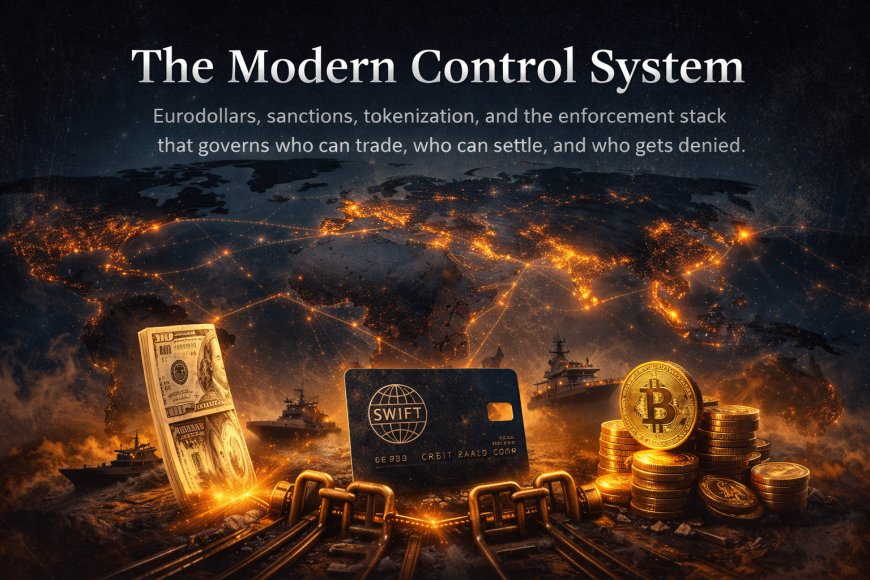
![[HERO_IMAGE_ALT: dark world map with shipping chokepoints glowing and faint settlement-rail lines overlayed]](https://patternnexus.com/uploads/images/202602/image_870x_69803c0a841d4.jpg)

Part 1 : WWII Was a Resource War Built on Credit: Oil, Steel, Sanctions, and the Narrative Layer
Part 2 : From Pearl Harbor to Petrodollar: Surrender Calculus, Cold War Plumbing, and the Energy Enforcement Era
If you want causality, follow routing. Who can move energy, who can clear payments, who can insure shipping, who can access collateral.
When rails become weapons, everyone learns the same lesson: build exits before you need them.
The modern battlefield isn’t always tanks. It’s permission. Membership. Settlement finality. Collateral acceptability.
Domestic stability is an input. If the machine is debt- and asset-based, transfers aren’t charity, they’re balance-sheet shock absorbers.
AI doesn’t “change markets.” AI changes the substrate. The control system upgrades when the substrate upgrades.
Robotics is the conversion layer: electrons → motion → production. Control power and you control the new labor base.
Space is not “science.” Space is corridor control: comms, GPS, ISR, launch licensing, and denial capability.
Tokenization isn’t “crypto.” Tokenization is programmable settlement governance. Governance is where enforcement lives.
The System You Live Inside
I’m starting where most history writing refuses to start: the present. Not because the past doesn’t matter, but because the past only matters here as the runway that produced the system you’re living under right now. If you don’t understand the present system, you won’t correctly interpret the past. You’ll keep reading wars and sanctions as moral theater instead of control surfaces.
The modern order is not held together by a slogan. It’s held together by routing and permissions. The world runs on continuous operations that people don’t notice until they fail: energy has to move; goods have to move; shipping has to be insured; payments have to clear; trade has to be financed; refinancing has to remain possible; collateral has to remain acceptable. When these functions are smooth, people call it “markets.” When these functions are denied, people call it “crisis.” The system doesn’t need to occupy you to break you. It can force dysfunction mechanically by denying the functions that make a modern economy operate at scale.
The first mistake is thinking “money” is the system
Most people talk about money like it’s the root cause. It isn’t. Money is a permission token that routes real resources. The system is physical substrate + financial substrate + governance substrate. If you can control the routing of energy, you can control production. If you can control production, you can control labor. If you can control labor and settlement at once, you can steer whole populations without looking like you’re steering anything.
This is why the Pattern Nexus framework treats macro, geopolitics, AI, and space as one machine. The machine is not “banks” and it’s not “politicians.” It’s an enforcement architecture: lanes, rails, collateral, compliance, and increasingly compute. The tools change. The objective does not.
This is why I keep using the word control system. A control system doesn’t need your consent to constrain you. It only needs to control inputs, routing, and feedback loops. If it can limit your access to settlement, it can limit your access to trade. If it can limit trade, it can limit energy. If it can limit energy, it can limit productive capacity. If it can limit productive capacity, it can destabilize politics from the inside. That’s not a conspiracy. That’s systems math.
Dollar dominance isn’t “prestige,” it’s architecture
The reason this works in the modern era is because the world is dollar-native in a way most people don’t understand. The dollar is not just “America’s currency.” The dollar is the default unit for pricing, invoicing, debt, and collateral. It lives offshore, inside global banking and global credit chains, and it persists even when the U.S. isn’t involved in the transaction. That offshore dollar ocean is what people gesture at when they say “eurodollars,” but most people still interpret the term like it’s a niche historical artifact. It isn’t. It’s the baseline architecture of modern trade finance.
Eurodollars are simple once you stop romanticizing money as a government object. Banks create dollar liabilities outside the U.S. because the world wants a common unit. Companies borrow in dollars because commodities are priced in dollars and hedging is deepest in dollars. Governments manage reserves in dollars because the collateral pool is deepest in dollars. The world doesn’t have to ship paper notes to dollarize itself. It dollarizes itself when balance sheets become USD-native.
That offshore dollar reality creates two outcomes simultaneously. It hard-locks workflows because switching out of USD is not “a preference,” it’s a rewrite of balance sheets, trade invoicing, hedge books, debt maturity schedules, and collateral relationships. It also creates an enforcement surface because the system can influence whether your dollars can clear, whether your counterparties can touch you, whether insurers will cover you, whether banks will intermediate you, and whether your collateral will be treated as eligible by institutions that matter.
This is where most people get stuck, because they still believe monetary dominance is “confidence” or “prestige.” Those are narrative words. The record words are liquidity, collateral, legal enforceability, and network adoption. The dollar wins because it is the unit you can use at scale without asking permission from twenty different systems at once, and because it plugs into the deepest collateral reservoir on Earth: Treasuries and Treasury-like collateral chains backing repo, margin, and funding structures globally. This is why dollar dominance is durable, and why it becomes weaponizable when permission tightens.
The offshore dollar organism and the liquidity heartbeat
Dollar dominance isn’t just the unit, it’s the balance sheet ecosystem that grows around the unit. Once the world builds a dollar-native credit system, it behaves like a living organism. It expands when risk appetite is high, spreads are tight, and collateral flows freely. It contracts when risk appetite breaks, spreads widen, and collateral becomes scarce. In expansion, the offshore system manufactures liquidity that feels like prosperity. In contraction, the offshore system manufactures scarcity that feels like crisis. That cycle is why the Pattern Nexus liquidity framework belongs inside a geopolitics piece. You’re not watching isolated policy actions. You’re watching the expansion and contraction of a global dollar organism.
That organism does not care about narratives. It cares about collateral haircuts, refinancing windows, capital constraints, and balance-sheet risk limits. When the cost of funding rises and collateral becomes scarce, the organism contracts. When it contracts, stress concentrates in the weakest nodes first. And when stress concentrates, enforcement posture tends to harden, because the system is defending itself while managing external rivals. Liquidity and geopolitics are coupled variables in the same machine.
And that’s where stabilization becomes real. The system is constantly choosing between two bad options: let contraction run and risk cascading defaults, unemployment, and legitimacy fracture, or intervene and risk inflation, moral hazard, and longer-run instability. When people say “why don’t they just stop printing,” they’re pretending the system can tolerate debt deflation without political consequences. It can’t. That’s why the system prints. Not because it’s evil. Because it’s trapped in its own feedback loop.
| USD credit to non-banks outside the U.S. | $14 trillion at end-Q3 2025; ~55% in international debt securities (bonds), remainder bank loans |
| USD credit to EMDE non-banks | Just over $4 trillion at end-Q3 2025; debt securities share also ~55% |
| Global cross-border bank claims (all currencies) | $45 trillion outstanding; +$832B expansion in Q3 2025 (exchange-rate & break adjusted) |
| SWIFT FIN traffic | ~53.3 million FIN messages per day average (2024); record daily peaks have exceeded 59.5M (2024) and later set higher records in 2025 |
| Sanctions perimeter scale | OFAC SDN List: over 17,000 names connected with sanctions targets (not “countries,” but persons, firms, vessels, networks) |
When USD credit outside the U.S. is measured in the tens of trillions, you are not dealing with “America’s currency.” You’re dealing with a global balance-sheet organism. And when settlement flows run through standardized messaging and compliance gates at massive daily scale, “access” becomes a first-class governance variable. That combination is what makes rail denial work: dependency + centralization = leverage.
Control systems don’t stop at finance
Once you see the world this way, dollarization is no longer a moral topic. It’s an infrastructure topic. Countries don’t dollarize because they love America. They dollarize because the dollar is the easiest way to import energy, price trade, refinance debt, and access collateral without getting squeezed by spreads and illiquidity. In weak monetary regimes, dollarization often happens bottom-up because citizens and businesses choose a unit that holds value better and clears better. In stronger regimes, it happens top-down through debt markets, trade invoicing, and reserve management. Either way, it’s a control surface because it creates dependency on a unit and on the rails that move that unit.
This is where stabilization comes in. The modern system stabilizes itself by exporting dollars and importing real goods. It supplies global dollar liquidity because the world demands it. When the world is stressed and scrambles for dollars, it doesn’t only scramble for the currency. It scrambles for collateral, funding, and clearing. That offshore market is where dollar liquidity is created, transformed, and recycled outside the U.S. domestic base. It’s what makes the system global. It’s also what makes the system vulnerable to permission tightening.
If you want the bridge from history in one sentence, it’s this: the postwar order initially anchored confidence through Bretton Woods. When the gold promise broke, the system stabilized itself through connectivity—deep markets, deep collateral, global offshore dollar creation—and a security umbrella that keeps trade lanes open. That is the runway. The aircraft is the permissioned settlement world you live inside right now.
Vietnam, 1971, petrodollars: runway, not religion
Vietnam sits on that runway as a cost-structure and legitimacy lesson. The system learned that prolonged open-ended legitimacy war is expensive, politically destabilizing, and corrosive. It didn’t stop enforcing global order after that. It changed how it enforces it. It leaned harder into finance, covert pressure, proxies, and later into sanctions and permissioned settlement. The objective remains the same. The tools get cleaner.
If the world is USD-native and the rails are permissioned, then economic life becomes membership-based. You can be “allowed” to operate at scale, or you can be restricted into dysfunction without anyone invading you.
That’s why this article tilts modern. The modern era isn’t “after history.” The modern era is the same machine upgraded into software and compliance. The control system didn’t disappear. It became cleaner, more scalable, and more deniable. It moved from blockades to sanctions; from seizures to compliance fear; from occupation to capital denial and settlement denial. It still has physical force as an escalation option. It simply prefers the tools that scale.
Physical lanes move the barrel. Financial rails move the payment. Collateral rules decide who gets funded. Compliance decides who gets to participate. Control enough layers at once, and the system can discipline behavior without firing a shot.
The hidden modern input: compute
Here’s the modern extension that matters now: compute is becoming a strategic input the way oil became a strategic input. The difference is that compute is modular, scalable, and directly tied to power and chips. If you can gate chips, you can gate compute. If you can gate compute, you can gate AI. If you can gate AI, you can gate the next productivity layer and the next military layer. That means the control system’s substrate is expanding: it’s no longer just lanes and rails, it’s power islands, chip supply chains, and AI model infrastructure.
Most people still talk like AI is “software.” That’s incomplete. AI is an industrial stack: electricity, cooling, grid interconnect, gas turbines, transformers, copper, chips, fabs, and data pipelines. Once AI becomes a labor multiplier, whoever controls the AI-industrial stack controls a new form of economic gravity. And that gravity will shape how settlement rails evolve, because systems upgrade rails to fund and govern the substrate that matters most.
The system you live inside is not “markets.” It’s a multi-layer control architecture. The money layer only makes sense once you map the substrate it’s funding: energy, compute, logistics, and governance.
How Enforcement Actually Works
The enforcement story most people carry is childish: one country is “bad,” America notices, America responds, the world changes. That’s narrative. The record is enforcement. Enforcement means the system exerts pressure through the control surfaces it actually owns.
When you say “any country that doesn’t operate inside our system gets hit,” the blunt version is emotionally satisfying, but not precise enough to be useful. The accurate version is colder: the system applies a pressure stack. It chooses tools based on scalability, deniability, and cost. It escalates when needed. The goal is not always occupation. The goal is not always regime change. The goal is flow control and precedent control, because precedent is how systems drift and eventually break.
The enforcement ladder
Think of enforcement as a ladder with rungs. The system prefers the lowest rung that achieves compliance because low rungs are cheap, deniable, and reversible. When a low rung fails, the system climbs.
Narrative pressure → compliance fear → de-risking by banks → loss of correspondent access → loss of insurance/servicing → capital market exclusion → secondary sanctions on partners → chokepoint interdiction → kinetic escalation.
Notice what sits in the middle: the network self-polices. Modern enforcement works best when you don’t have to enforce it directly. You publish the rule, you create uncertainty, and every institution inside the perimeter chooses “not worth the risk.” That’s scalable enforcement.
Here’s the key shift: enforcement moved from physical denial to rail denial because rail denial scales. When rails are weaponized, you don’t need to physically stop the ship. You can stop the ship’s insurance. You can stop the ship’s servicing. You can stop the payment. You can stop the bank that intermediates the payment. You can stop the counterparties that might touch the bank. You can create a fear signal so pervasive that the whole network self-polices without you firing a shot. The sanction is not the weapon. The compliance fear is the weapon.
SWIFT is a symbol in public discourse, but SWIFT isn’t the entire rail. The rail is the stack: correspondent banking, dollar clearing, settlement finality, compliance screening, insurer risk tolerance, and capital market access. When SWIFT service gets cut to sanctioned entities, it is a public tell that the messaging layer can be used as a chokepoint. It trains the rest of the world in real time: this system is permissioned, and permission can be revoked.
That is the defining feature of the modern control system. It doesn’t have to defeat you militarily. It can make you nonfunctional economically by denying your ability to clear and insure. And it can force your partners to choose between you and their own access to the dominant system. That’s why secondary sanctions matter: they extend enforcement outward into third parties. They turn geopolitics into network graph management.
| EU directive | EU sanctions directed that specialized financial messaging services could not be provided to sanctioned Iranian entities |
| SWIFT action | SWIFT terminated services for designated Iranian banks (including the Central Bank of Iran) following EU Council decision |
| U.S. framing | U.S. Treasury publicly welcomed the EU/SWIFT action as part of financial pressure architecture |
Cutting a node off from standardized financial messaging is not “symbolic.” It forces operational friction across every downstream dependency: correspondent relationships, trade finance documentation, settlement assurance, and counterparty willingness. The network doesn’t just comply because it agrees with the policy; it complies because non-compliance becomes existential risk for institutions that need access to the dominant system.
| OFAC SDN List scope | Over 17,000 names connected with sanctions targets |
| Sanctions throughput | 2025 saw large volumes of new designations and export-control actions, highlighting that sanctions are not static—they are an active governance tool |
Rail denial works because the world is already locked into the dominant unit and its operational stack. Once the system demonstrates it can revoke membership, every actor learns the same survival instinct: build exits before you need them.
Physical lanes never went away, they became the baseline
The physical layer never disappeared. It became the baseline assumption. A trade system can’t exist without lane stability, and energy can’t exist without chokepoints staying open. Maritime security posture is part of stabilization because chokepoints transmit into inflation, growth, and policy reaction. You can’t talk about monetary dominance while pretending lane dominance is unrelated. It’s the same system expressed in different layers.
In Part Two we treated WWII as a resource clock and a routing contest. Part Three treats the modern era as the same logic upgraded. Old era blockade: deny fuel and steel. Modern era sanctions: deny clearing and insurance. Same physics. Different infrastructure. If you cut an industrial system off from non-optional inputs, you start a clock. Clocks compress options into gambles. Gambles create escalation. Escalation creates enforcement. Enforcement creates the next layer of control. That feedback loop is what you’re watching in modern geopolitics.
Modern enforcement is slow on purpose
The system rarely wants a clean public war unless it has to. It prefers a ramp: pressure, isolation, internal destabilization, elite fracture, then either compliance or replacement. That’s why sanctions regimes and banking restrictions sit for years. They’re not only punishment. They’re conditioning. They train counterparties to stop touching the node. They train insurers to avoid the node. They train banks to de-risk. By the time kinetic events happen, the node is already economically weakened and politically isolated. The public sees the last move. The record shows the prior decade.
Node theory: energy nodes, corridor nodes, settlement nodes
The point is not to claim one invoice currency caused each war. The point is that energy nodes, corridor nodes, and settlement nodes attract enforcement because they are levers of the operating system. The story changes depending on what is sellable. The mechanism is more consistent than the story.
Iraq is a motive stack: reserves, geography, alliance architecture, and precedent control at an energy node. Iran is rail-denial logic on full display: access restriction as engineered stress. Syria is corridor warfare: ports, alliance lattice, land corridor geometry, and reconstruction leverage. North Korea is codified input denial. Venezuela is the modern template where payment rails and authorization rules become explicit governance over who can sell, who can buy, and how proceeds may route.
The goal is not always to conquer territory. The goal is to control the node’s ability to move flows and clear settlement. Govern flows and you govern outcomes.
AI-era enforcement begins as “export controls,” ends as “compute denial”
The same enforcement logic is moving into the AI-industrial domain. Today the public language is “security,” “advanced technology,” “dual-use.” The mechanism is familiar: deny a non-optional input, start a clock, compress options, force expensive rerouting. The non-optional inputs of the AI era are chips, power, and integration capacity. If the system can gate those, it can gate future productivity and future military capability.
That means enforcement is moving up the stack. We started with lanes and rails. We moved into compliance and collateral. Now we’re moving into compute and robotics. This is not optional. Systems govern the substrate that determines who can build the next generation industrial base.
If you want to understand why it repeats, stop thinking in terms of “wars.” Think in terms of control surfaces: lanes, insurance, clearing, collateral eligibility, capital market access, compliance permission, and now compute (chips, power islands, model infrastructure). These are modern blockades with better deniability.
Exit-Building and the Next Operating System
The moment rails become weapons, exit-building becomes a survival instinct. This is where most people misunderstand the modern era because they interpret stablecoins, tokenization, and CBDCs as “technology trends.” They are routing strategy. They are the response of states, institutions, and individuals to a world where settlement permission can be revoked.
Stablecoins are a routing layer, not a religion
Stablecoins matter because they are non-bank dollar rails. They allow dollar settlement to occur outside traditional correspondent pathways. That creates a paradox most pundits can’t hold at once: stablecoins can extend dollar usage globally while shifting control points away from some legacy choke surfaces. They can strengthen dollarization in weak regimes while threatening deposit bases and weakening specific banking-era control levers. This is not culture war. This is sovereignty and banking structure.
In this framework, stablecoins are the eurodollar instinct expressed through new infrastructure. Eurodollars were offshore bank-created dollars because the world needed dollar liquidity outside the U.S. domestic system. Stablecoins are dollar claims that move globally with different routing characteristics and different chokepoints. They still depend on issuers, on-ramps, off-ramps, custody, and regulation. They are not outside the system. They are part of the system, and they create new pressure points inside the system.
| USDT circulating supply | ~$186–$187B range reported across major market coverage in January 2026 |
| USDC circulating supply | ~$75B reported in January 2026 coverage, with strong multi-year growth |
| Total stablecoin supply | Widely reported as “over $270B,” with multiple trackers placing the market at roughly $300B+ by early 2026 |
Dominant dollar stablecoins are typically backed by reserve portfolios heavily weighted to short-duration, Treasury-like instruments and cash equivalents. Functionally, the stablecoin layer becomes a parallel distribution engine for dollar collateral demand: users hold tokens, issuers hold reserve collateral, and redemption mechanics convert “internet dollars” back into banking dollars.
| Deposit displacement risk | Major bank research coverage has warned of large potential deposit outflows from banks to stablecoins over the next few years |
| Payments incumbents adapting | Card networks and banks have openly piloted or explored stablecoin settlement pathways to avoid being bypassed by the new rail |
Stablecoins are not “crypto volatility.” They are a dollar transport protocol competing with correspondent banking for certain use cases. They extend dollarization while shifting choke points. That dual-use nature guarantees perimeter regulation and institutional counter-moves.
The Pattern Nexus stablecoin doctrine
The doctrine is not “stablecoins are good” or “stablecoins are bad.” The doctrine is that stablecoins are a new distribution layer for the dollar system. They can function as an extension of dollar dominance and as an escape hatch around specific choke points. That dual-use nature is why the response will be strategic: perimeter control, issuer pressure, on-ramp governance, and institutional replication (banks issuing their own tokens, central banks testing tokenized wholesale settlement).
In plain terms, stablecoins behave like an auxiliary engine: they keep the unit dominant while changing route geometry. They introduce a new kind of run risk and a new kind of policy bypass risk because a large stablecoin complex becomes a shadow version of banking—deposits, reserves, short-duration collateral, redemption—operating at internet speed. Systems do not leave that unmanaged once it crosses strategic scale. They bring it inside the perimeter or squeeze the on-ramps until it behaves like a regulated rail.
Tokenization is the system upgrading itself, not being “disrupted”
Tokenization is not a novelty. It’s the legacy system upgrading itself into programmable settlement without surrendering governance. The direction is clear: tokenized deposits, tokenized central bank money (wholesale), and tokenized collateral on a unified platform where settlement finality and compliance are native features.
Collateral is the nerve system of this transition. In the modern world, what is acceptable collateral determines what is liquid. What is liquid determines what can operate at scale. If tokenized assets become eligible collateral inside core institutions, tokenization stops being a pilot and becomes monetary infrastructure.
Agorá is a BIS Innovation Hub project exploring whether tokenized bank deposits (private money) and tokenized central bank money (wholesale) can operate together on a “network of networks” architecture designed to reduce frictions in cross-border payments while keeping regulation, AML/CFT, and settlement finality inside the design.
| Phase status | Moved from design to prototype building, then into intensified testing phases with broad commercial-bank participation |
| Declared objective | Prototype to evaluate potential infrastructure (not a retail CBDC rollout) |
| Milestone | A lessons-learned report has been targeted for the first half of 2026 per BIS project notes |
Atomic settlement means payment and asset transfer can complete together as one final action, reducing settlement risk and cutting multi-hop reconciliation across correspondent chains. In practice, the promise is speed and cost. The strategic value is governance: the more settlement becomes programmable, the more membership, compliance, and conditionality can become native platform rules.
This is the system’s counter-move to public rails: adopt the efficiency, keep the perimeter. Tokenization is the upgrade path that preserves governance while modernizing settlement.
Parallel rails don’t need to “replace” the dollar to matter
The wrong question is “will it replace the dollar.” Replacement is not required. Optionality is the challenge. If enough corridors can settle outside dominant rails, rail denial becomes less absolute. Enforcement leverage decays at the margin. That marginal decay is how systems shift: not in one day, but through cumulative routing changes that compound over time.
This is why platforms like mBridge matter. They are proof that states will build and test cross-border settlement infrastructure that does not depend on the same legacy pathways. The throughput is the signal. Not the speech. Transactions are the only thing that matters in a control system.
| Cumulative mBridge volume | Over $55B processed (reported as a surge from small 2022-era baselines) |
| Transaction count | 4,000+ cross-border transactions reported across participating central bank tests |
| Dominant currency share | Digital yuan reported as ~95% of platform volume in those snapshots |
This does not need to “kill the dollar” to matter. It only needs to create corridor optionality for actors who fear rail denial. The strategic signal is that major state actors are willing to invest in parallel settlement infrastructure that can be used for trade settlement in specific corridors, especially where sanctions risk is perceived as structural.
Exit-building is not ideology. It’s routing resilience. When the system proves it can revoke membership, parallel rails become a rational insurance policy.
The point is governance, and governance is becoming programmable
Offshore dollars are the ocean that makes the world USD-native. Sanctions are the permission layer that weaponizes that ocean. Stablecoins are a new channel inside that ocean that changes routing and shifts choke points. Tokenization is the system upgrading itself into programmable settlement so it can preserve governance while adopting the efficiencies of digital rails. State platforms are the parallel project for actors who expect the dominant rails to be hostile in a future conflict cycle.
This is why “tokenization of the world” is not a tech prophecy in the Pattern Nexus framework. It is a governance shift. Tokenization converts assets and settlement into programmable objects inside managed platforms. Once assets are programmable, policy becomes programmable. Compliance becomes programmable. Membership becomes programmable. Denial becomes programmable. That is the modern control system moving closer to software.
Here is the part most people avoid: the system prefers enforcement tools that are scalable, deniable, and reversible. Tokenized settlement platforms make enforcement more granular and more reversible. A platform can restrict one participant without collapsing the whole network. It can impose conditionality without declaring war. That is why the system is moving in this direction. Efficiency is real. Controllability is the deeper prize.
Reinsert liquidity: why this accelerates after stress
This ties directly into the Pattern Nexus “1997 to today” macro framework. Liquidity expansions inflate asset values and expand leverage, which expands the system’s footprint and the number of actors dependent on the core unit and core collateral. Liquidity contractions expose fragility and increase enforcement posture because stress makes the system more defensive. When stress rises, sanctions become more likely, exit-building accelerates, and tokenization moves from “innovation” to strategic infrastructure.
The story isn’t past-based. The past is runway. The aircraft is what you’re watching right now: dollarization through offshore credit, enforcement through permissioned settlement, stabilization through collateral reservoirs, tokenization as institutional upgrade, stablecoins as parallel distribution, platform settlement as the next OS contest. This is the modern control system.
Why the System Pays People Who Don’t Produce
This question forces you to stop thinking in morals and start thinking in mechanics. On the surface it looks insane: entire communities where meaningful shares of people aren’t producing, yet wages get subsidized, rent gets covered, healthcare gets paid, food gets provided, and the machine keeps moving. The instinct is to call it corruption, weakness, stupidity, or collapse. That’s narrative. The record is simpler.
The system pays for nonproduction because social stability is an input. It’s not a feel-good concept. It’s a requirement. A modern debt and asset-based economy cannot tolerate uncontrolled demand destruction without breaking its own balance sheets. If consumption collapses, revenues collapse. If revenues collapse, debt service fails. If debt service fails, defaults cascade. If defaults cascade, banks tighten. If banks tighten, unemployment rises. If unemployment rises, political stability fractures. At that point you don’t get “a correction.” You get a legitimacy event.
So yes, it looks like government is “paying wages for nothing.” In system terms, those transfers are the cost of preventing an uncontained feedback loop. They are automatic stabilizers, political stabilizers, and asset-price stabilizers rolled into one. The modern order doesn’t only govern through police and laws. It governs through continuous operation. It needs the machine to keep running even when productivity is uneven, hollowed out, or shifting under automation.
Balance-sheet economics: when demand becomes collateral
In a financialized economy, the real economy and the balance-sheet economy are welded together. Asset prices are not investor toys. They are collateral, retirement, bank solvency, corporate refinancing, and household confidence. When the system allows demand to collapse, it’s not only allowing stores to close. It’s allowing collateral values to drop into a debt structure priced for stability. That’s how a recession becomes a cascade. Transfers are not only about helping people. Transfers are about preventing the cascade.
MMT is not politics, it’s the operating model
In the Pattern Nexus frame, “printing” is not a scandal. It’s the operating model. A sovereign issuer can always make nominal payments in its own unit. The question is what happens when it pays: does it bid up scarce real goods, trigger inflation, destabilize the currency, or fracture legitimacy anyway because purchasing power collapses even if checks clear.
Now add the global unit twist: the U.S. is not just a domestic issuer. It is the issuer of the global unit. Offshore dollars and eurodollars create external demand for the unit and the collateral financing the machine. That offshore dollar ocean lets the system run hotter for longer than a closed economy could.
Stablecoins add a modern pressure valve: they export dollar usage into places banking doesn’t reach cleanly, often on rails that are faster and more global than traditional correspondent pathways. That reinforces dollarization globally while changing domestic banking dynamics, because transactional demand can migrate into a parallel rail beside banks instead of inside them.
The controlled-shock model
The system isn’t only paying people to survive politically. It’s paying to protect the operating system. If households fall behind, delinquencies rise. If delinquencies rise, banks tighten. If banks tighten, refinancing shuts. If refinancing shuts, corporate defaults rise. If corporate defaults rise, employment breaks. If employment breaks, municipal budgets break. If municipal budgets break, disorder rises. The system can take the shock in a controlled way through transfers and liquidity, or take it uncontrolled through cascades. It usually chooses controlled shock.
The system isn’t paying people because it loves them. It’s paying people because demand collapse, debt collapse, and legitimacy collapse are the same failure mode once the economy becomes balance-sheet driven.
Robotics is the next destabilizer and the next stabilizer
Automation is accelerating, and robotics is automation embodied. AI replaces cognitive tasks first. Robotics replaces embodied tasks next. When robotic labor scales, employment structure changes faster than politics can adapt.
That creates a fork: allow labor markets to fracture and risk legitimacy failure, or increase transfers, subsidies, and stability financing to keep households solvent through transition. This is why “why pay nonproducers” is not a morality debate. It’s a forward-looking stability debate. The system is pre-buying calm.
Robotics can increase real output, but real output is still constrained by power, materials, and supply chains. That means the bottleneck becomes industrial throughput, not dollars. You can print dollars. You cannot print transformers on demand. You cannot print grid interconnect capacity on demand. You cannot print fab capacity on demand. The system will route capital to bottlenecks, and the settlement upgrade exists to make that routing faster, more governable, and more conditional.
How long can this continue? Not a calendar—constraints. The system can continue as long as it maintains nominal support without an inflation and legitimacy blowout, keeps essentials from becoming politically fatal, and keeps the collateral machine absorbing issuance without confidence rupture. Nominal capacity is huge. Real resource capacity is not. Political tolerance is not. Collateral credibility is not.
When support can’t continue in the same form, it doesn’t instantly stop. The form changes: inflation as hidden haircut, tightened eligibility, deeper socialization of sectors under “stability,” or financial repression where savers subsidize the machine through negative real returns.
Tokenization ties into this pivot because programmable settlement implies programmable distribution: targeting, eligibility, conditionality, rapid tightening and loosening. This does not require dystopia to be true. It only requires that controllability is attractive to a system that must keep paying without losing legitimacy.
Prepare for form change, not movie collapse. Reduce fixed obligations. Build liquidity that buys time. Avoid being forced to sell assets in a stress window. Build income optionality. Keep your personal balance sheet resilient to inflation, rate shocks, and job shocks.
Pattern Nexus takeaway: communities that don’t produce are not a mystery. They are a predictable outcome of a mature debt, asset, and automation cycle where the system must keep demand alive while the productive base shifts. The modern control system’s answer is support plus permission. Support stabilizes the inside. Permission controls the outside. Tokenization makes permission more granular and programmable. Stablecoins extend the unit and stress-test old choke points. Watching those variables is how you see the pivot before it becomes a headline.
AI, Robotics, and the New Industrial Substrate
Up to this point we’ve described the modern control system in terms of finance, compliance, and geopolitics. Now zoom in on the substrate shift that forces the next upgrade: AI and robotics are industrialization events, not app events. That means they change the base layer of the system the same way electrification and oil did. And when the base layer changes, the control system changes with it.
AI is the new general-purpose amplifier
AI compresses cognition: planning time, design time, analysis time, coordination time. That’s productivity leverage. But it only matters at scale if you can feed it compute, data, and power. In the Pattern Nexus framework, compute is to the next era what oil was to the last: a scalable input that multiplies capability. When decision speed and automation become strategic, the system stops treating AI like a private novelty and starts treating it like critical infrastructure.
Robotics is the bridge from AI to real output
Robotics is intelligence turned into physical work. That’s why this is not sci-fi. It’s a labor rewire and a force multiplier. Drones were the preview. Autonomous systems will be the scale. The modern industrial base will be defined by who can manufacture, deploy, and coordinate autonomous systems at volume. That extends control surfaces into supply chains: motors, actuators, batteries, power electronics, sensors, and industrial tooling. Systems will govern those flows the same way they govern oil corridors and settlement corridors because robotics becomes national capacity.
Power is the bottleneck and the battlefield
AI and robotics are power-hungry. If you can’t secure time-to-power, you can’t secure time-to-compute. If you can’t secure time-to-compute, your AI layer caps out. If AI caps out, robotics caps out. If robotics caps out, industrial advantage caps out. That’s why grid capacity, generation capacity, and supply chain throughput become strategic variables—not just economic ones.
| 2024 global data centers | ~415 TWh (about 1.5% of global electricity consumption) |
| 2030 projection | ~945 TWh (more than double), with AI as a major driver; AI-optimized data centers projected to more than quadruple demand by 2030 |
| U.S. electricity consumption | Projected records in 2025 and 2026, with data centers cited among key drivers alongside broader electrification trends |
When the bottleneck is power, governance follows the bottleneck. Permitting, interconnect queues, transformers, fuel optionality, and on-site generation become strategic. Finance then reorganizes to fund the bottleneck quickly. That is why settlement upgrades matter here: programmable rails are the financial form that matches an industrial buildout at speed.
Compute denial is the new rail denial
Rail denial works because dollars are non-optional in the current system. Compute denial becomes decisive when AI becomes non-optional in the next system. The mechanics rhyme: restrict access to the core input, force rerouting, increase cost, slow growth, widen gaps, push targets toward dependency or parallel stacks. That’s why export controls and chip restrictions are sanctions logic moving up the stack. Once the system establishes it can deny compute, every major actor learns the same lesson settlement taught them: build exits before you need them.
Tokenization meets AI: programmable funding for programmable infrastructure
Tokenization becomes more important, not less, in an AI-robotics era. Why? Because the system wants three things at once: rapid deployment of capital into bottleneck infrastructure, compliance and governance over that deployment, and risk management over collateral and settlement. Tokenized rails are the natural upgrade for that environment. Tokenize money and settlement speeds up. Tokenize collateral and financing becomes modular. Attach rules to both and funding becomes programmable. That is exactly what a system wants when it is building out a new industrial substrate under geopolitical stress.
In the AI era, settlement upgrades aren’t fintech. They are industrial strategy. Rails are being rebuilt to fund and govern the next substrate: power, compute, and automation.
Space as a Corridor Layer and Chokepoint
Most people talk about space like it’s a NASA montage. In the Pattern Nexus framework, space is corridor control. It’s the next layer of lanes and rails because modern civilization already depends on orbital infrastructure for communications, navigation, timing, surveillance, and increasingly broadband redundancy.
Space is already part of the control stack
GPS isn’t a convenience. It’s timing and navigation infrastructure. Satellite comms isn’t a luxury. It’s redundancy and coverage. Earth observation isn’t just pictures. It’s intelligence, compliance verification, targeting, and economic mapping. If you can degrade or deny these capabilities, you can degrade a nation’s ability to operate at scale. Space is not separate from enforcement. It’s an extension of it.
Licensing and insurance are the “space SWIFT” levers
In maritime enforcement, insurance and servicing are denial levers. In settlement enforcement, correspondent access and compliance are denial levers. In space, licensing, launch services, spectrum coordination, tracking, and insurance become denial levers. You don’t have to shoot satellites down to apply pressure. You can throttle participation in the ecosystem that launches, maintains, insures, and legally operates them.
Cislunar becomes the next corridor map
As activity expands beyond LEO, corridor logic expands. Cislunar logistics has choke behaviors: launch cadence, propellant access, transfer windows, custody, and servicing capability. This is not an imminent-mining prophecy. It’s a governance statement: if a domain becomes economically relevant, it becomes a control domain.
| Tracked objects | ~40,000 objects tracked by surveillance networks |
| Active payloads | ~11,000 active payloads (active satellites) reported in ESA’s space environment snapshot |
As orbital density rises, resilience becomes political. Collision avoidance, debris mitigation, tracking custody, and spectrum coordination become governance. Whoever can provide resilient comms, positioning, and observation under stress holds corridor leverage at the space layer.
Space is a corridor. Corridors become chokepoints. Chokepoints become enforcement surfaces when rivalry rises. The same logic that governs ports and payment rails will govern orbit: membership, standards, permission, and denial.
Tokenization and space: settlement for future claims
As space becomes real industry, finance follows. Large-scale infrastructure in hostile domains requires enforceable claims, standardized collateral, and settlement mechanisms recognized by institutions. Tokenization is a practical tool for this: it makes complex claims transferable, auditable, and governable. The enforcement question remains the same: who recognizes the claims, who clears settlement, and who can be denied membership.
Space and AI converge: the orbital data layer
Space is also a data layer. Earth observation feeds models. Communications feed coordination. Navigation feeds autonomy. As autonomy expands, demand for resilient comms and timing expands. That ties space directly to robotics. The machine is upgrading, and the control system upgrades with it.
The Pattern Nexus “Control Stack 2.0” Model
Everything above compresses into one expanded stack. The original control stack (lanes, rails, collateral, compliance) is still true. The modern upgrade is that the stack now includes power, compute, autonomy, and space as first-class control surfaces.
Physical lanes (energy + goods) → financial rails (clearing + settlement) → collateral rules (eligibility + liquidity) → compliance perimeter (membership + denial) → power substrate (time-to-power) → compute substrate (chips + data centers) → autonomy substrate (robotics + drones) → space corridor layer (comms + timing + surveillance).
Why this matters: the system can enforce at more layers
The more layers a system can influence, the less it needs brute force. That’s the direction of travel: scalable, deniable, reversible control. Tokenized rails make settlement programmable. AI makes analysis and targeting scalable. Robotics makes physical enforcement scalable. Space makes observation and coordination global. The machine becomes more precise. It can pressure one node without collapsing the whole network. That is mature control-system behavior.
Where “Bank-of-America-style messaging” actually fits
Market messaging is a soft layer, but it’s still part of the machine. Large institutions have incentives. They speak in ways that align with positioning and business models. That’s structural, not mystical. In a control system, narrative helps prepare the harder layers. It conditions expectations. It signals risk appetite. It creates cover for policy or liquidity decisions. It doesn’t replace enforcement. It lubricates the gears.
So when you see an “extreme bullish reading,” interpret it in multiple frames at once: sentiment gauge, liquidity tell, positioning signal, and behavioral steering for a public that reacts to headlines more than plumbing. In the Pattern Nexus framework, the question is not “are they lying.” The question is “what does this message support in the larger machine.” Sometimes it supports risk expansion. Sometimes it supports exit-building urgency. Sometimes it supports perimeter tightening. Often it supports all three in different audiences simultaneously.
| SWIFT throughput | Traffic growth, record-message days, and the shift toward faster, more trackable payment flows are indicators of where the system is hardening and modernizing |
| Sanctions cadence | Rate of designations, secondary-sanctions rhetoric, and export-control expansions show whether the perimeter is tightening |
| USD credit outside the U.S. | Growth/slowdown in BIS dollar credit is the heartbeat of the offshore organism; stress shows up as tightening funding conditions and reduced risk capacity |
| Tokenization milestones | Institutional pilots moving from “design” to “test” is the tell that programmable settlement is becoming strategic, not experimental |
| Data center power trajectory | IEA projections toward ~945 TWh by 2030 are a proxy for how fast AI is becoming a grid-level variable |
| Robotics scale | Industrial robot installations exceeding ~500k per year (recent IFR reporting) show autonomy is not theoretical; it’s industrial adoption |
| Orbital density | ESA’s active-payload and tracked-object counts show space is becoming a congested corridor where resilience becomes governance |
The old model watched speeches. The new model watches flows: funding, settlement, collateral, power, and throughput. When those variables shift together, the system is pivoting, whether the headlines admit it or not.
If you can hold this model, you can stop getting emotionally whiplashed by headlines. You can see why exits are being built. You can see why tokenization is not optional. You can see why AI and robotics are not “tech.” They’re control surfaces. And you can see why the next decade looks like a settlement upgrade and an industrial upgrade happening at the same time.
Pattern Nexus Lens
Part One showed the prototype: deny inputs, start a clock, compress options into gambles, and watch how states behave when survival is defined by logistics. Part Two carried that prototype through surrender calculus and occupation outcome selection, then into the postwar operating system shift. Part Three is the modern layer: the control system upgraded into offshore dollars, eurodollars, sanctions as rail denial, and tokenization as programmable settlement governance.
The core Pattern Nexus claim is not that history is fake. The claim is that history is taught as narrative and lived as plumbing. The plumbing today is offshore dollars and collateral. The enforcement tool today is permission and compliance. The instability trigger today is rail weaponization. The response today is exit-building. The upgrade path today is tokenization and platform governance. The domestic mirror is stability financing: transfers, support, and policy pivots designed to prevent balance-sheet cascades from becoming legitimacy events.
The missing modern addendum is the substrate shift: AI makes intelligence scalable, robotics makes labor scalable, space makes observation and coordination scalable. Power becomes the bottleneck, compute becomes the contested resource. Once those become true, the control system governs those layers the same way it governed lanes and rails. That’s why the next order is not just new money. It’s new infrastructure with new permissioning.
When you see it this way, you stop arguing about which speech caused what. You start watching what gets denied, what reroutes, what becomes acceptable collateral, what becomes restricted, and which platforms gain throughput. You can watch the next order forming in the same place you watch markets form: in flows.
The modern order is enforced through routing and permissions. The next order forms through exit-building, collateral policy, platform governance, and control of power and compute. Watch flows, not speeches.
FAQ
Is this saying every war is “about oil”?
No. Energy is a high-gravity input in a post-gold system, but monocause explanations fail. The Pattern Nexus method uses motive stacks: node value, corridor topology, settlement behavior, regime alignment, and great-power positioning. Energy is one layer that amplifies stakes because it is non-optional and transmits into inflation and policy.
Do eurodollars weaken the United States or strengthen it?
Both can be true. Offshore dollars strengthen the system by embedding the dollar into global balance sheets, collateral chains, and trade finance. Offshore dollars also create fragility because stress produces dollar shortages and funding squeezes outside the U.S. domestic base. In a control-system lens, offshore dollars are both the engine and the vulnerability surface.
Do stablecoins weaken or strengthen the dollar?
Both can be true simultaneously. Dollar stablecoins can extend dollar usage globally while shifting routing away from some legacy choke points. That dual nature is why stablecoins are treated as monetary infrastructure and why the response tends to be perimeter control and institutional upgrade rather than ignoring them.
Why does tokenized collateral matter?
Because collateral eligibility is monetary infrastructure. If tokenized assets become accepted collateral in core institutions, tokenization becomes part of the settlement and liquidity engine. In this framework, tokenization is programmable settlement governance.
How do AI and robotics fit into a finance-and-sanctions article?
Because they are becoming the next industrial substrate. When a substrate becomes strategic, enforcement moves into that substrate. Chips, compute, power, and autonomy become denial points the same way rails and insurance became denial points. The control system upgrades where the bottlenecks are.
Is space really part of the “control stack”?
Yes. Modern operations depend on orbital infrastructure for navigation, timing, communications, and surveillance. Space becomes a corridor layer. Corridor layers become governance layers. Governance layers become enforcement layers when rivalry rises.
What should I watch to see this in real time?
Watch corridors and chokepoints, sanctions and secondary sanctions, insurance and shipping services, SWIFT and correspondent access, stablecoin rails and on/off-ramp policy, tokenized collateral acceptance, platform throughput, time-to-power buildouts, chip supply constraints, compute policy, autonomy deployment scale, and orbital resilience indicators.
Sources
Primary references supporting offshore dollar/eurodollar scale (BIS GLI), international bank claims (BIS IBS), sanctions mechanics and perimeter scale (U.S. Treasury/OFAC, SWIFT), tokenized settlement experiments (BIS Project Agorá, Reuters coverage), parallel rail throughput (Reuters mBridge), stablecoin system scale and banking impact (Reuters, major market coverage), AI-energy bottleneck modeling (IEA, EIA), robotics scale (IFR), and orbital congestion snapshots (ESA).
- BIS: Global liquidity indicators at end-September 2025 (USD credit outside U.S. $14T; composition)
- BIS: International banking statistics at end-September 2025 (cross-border claims $45T)
- U.S. Treasury (archived): Statement on EU/SWIFT action affecting sanctioned Iranian banks (March 15, 2012)
- SWIFT: Press release on disconnecting sanctioned Iranian banks (March 15, 2012)
- OFAC: SDN list scale (over 17,000 names connected with sanctions targets)
- SWIFT: CEO annual letter (FIN messages and performance metrics)
- SWIFT: 2025 highlights (record message-day disclosures)
- BIS Innovation Hub: Project Agorá (timeline, scope, objectives)
- Reuters: Central banks and commercial banks advance Project Agorá testing (Jan 14, 2026)
- Reuters: mBridge throughput surge and corridor alternative narrative (Jan 16, 2026)
- Reuters: Stablecoins and bank deposit displacement risk (Jan 27, 2026)
- Reuters: Visa stablecoin settlement and incumbent adaptation (Jan 14, 2026)
- Market coverage: USDC/USDT supply figures and growth (Jan 6, 2026)
- IEA: Data center electricity demand projected to ~945 TWh by 2030 (AI-driven)
- Reuters: EIA forecasts U.S. record power use (data centers among drivers)
- International Federation of Robotics (IFR): World Robotics 2025 (542,000 industrial robots installed in 2024)
- ESA: Space Environment Report 2025 (tracked objects and active payloads)
- CNAS: Sanctions by the Numbers (2025 year-in-review statistics)
What's Your Reaction?
 Like
0
Like
0
 Dislike
0
Dislike
0
 Love
0
Love
0
 Funny
0
Funny
0
 Wow
0
Wow
0
 Sad
0
Sad
0
 Angry
0
Angry
0

Founder of Pattern Nexus. I research markets, macro, geopolitics, AI, history, ancient systems, and the patterns most people overlook. I’m also building Market Radar, a trading scanner designed to read pressure, risk, confirmation, and setup quality before chasing a move. Pattern Nexus is where I connect the dots between data, history, technology, and the bigger system playing out around us.

















Comments (0)