
G4 Geomagnetic Storm Threatens the U.S. Power Grid — And Exposes a 20-Year Infrastructure Problem
A rare G4 geomagnetic storm is forecast to hit the U.S., risking grid instability across northern states just as AI demand and aging infrastructure push the system to its limits.
G4 Geomagnetic Storm Threatens U.S. Power Grid — Why 2025 Is the Most Fragile Year in Two Decades
A rare, high-intensity solar storm is on track to hit North America — just as the U.S. energy grid faces historic demand from AI data centers, electrification, and under-maintained infrastructure.
Overview
Referenced Reporting & Data
Media Coverage
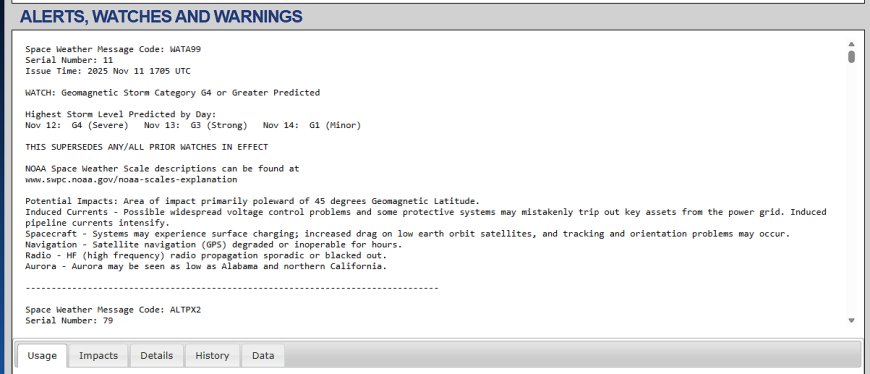
The NOAA Space Weather Prediction Center (SWPC) has issued a rare **G4 geomagnetic storm warning** — one of the strongest classifications outside the catastrophic G5 tier. For many parts of the northern United States, this level of solar disturbance is enough to cause **voltage instability, transformer saturation, grid protection misfires**, and in worst cases, **regional blackouts**.
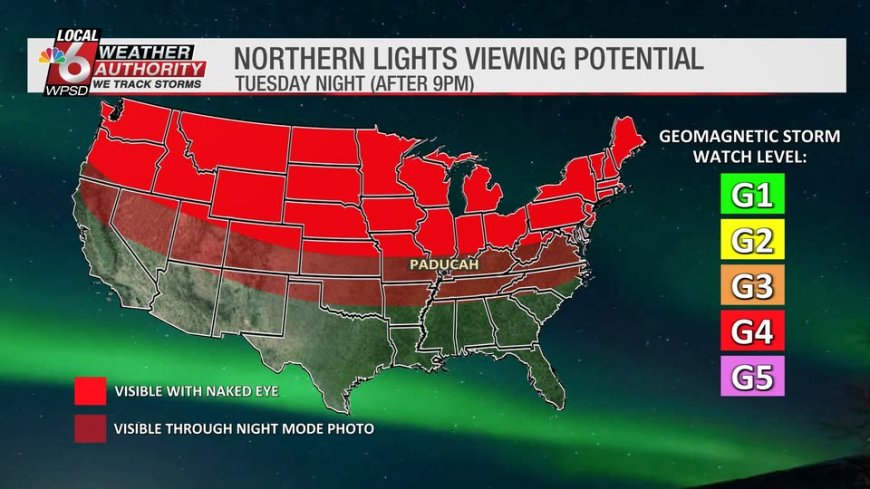
States at risk include: Oregon, Idaho, Montana, South Dakota, Minnesota, Wisconsin, Michigan, New York, Vermont, New Hampshire, and Maine — essentially every region north of the 45th parallel.
This is the first storm of this magnitude many Americans will have witnessed in their lifetimes. And it arrives in a year where the U.S. grid is already under historic strain from demand growth not seen since the early 2000s.
Why It Matters
Grid fragility is a national blind spot. You only notice it when it fails. The U.S. is simultaneously:
- Retiring aging baseload plants faster than replacements come online
- Electrifying transport, heating, and industrial processes
- Planning **hundreds of gigawatts** of AI data centers
- Facing megaproject timelines of **5–10 years** for new transmission
- Operating transformers that are often **30–50 years old**
A geomagnetic storm doesn’t have to be apocalyptic to cause meaningful damage — it just has to hit an overstressed system.
The July 2025 DOE grid outlook already warned that **several U.S. regions could face elevated outage risk through the end of the decade** due to infrastructure deficits and volatile demand curves. A G4 storm is precisely the kind of “unexpected accelerant” that exposes structural weaknesses.
The U.S. Grid Was Already Cracking Before the Solar Storm
2024–2025 marks the first time in 20 years that U.S. electricity demand grew faster than grid capacity. A few core drivers:
1. The AI-Industrial Buildout
AI data centers use 50–100x the power of a traditional cloud facility. PJM, MISO, ERCOT, and SPP have all issued warnings about multi-gigawatt deficits tied to AI clusters.
2. Climate Volatility
Record heatwaves, winter blasts, and unpredictable seasonal swings create unprecedented load peaks.
3. Transformer Shortages
Large transformers have 2–4 year lead times. Some utilities are cannibalizing older units for parts.
4. Continued Transmission Bottlenecks
Even approved lines take a decade to build. Meanwhile, load centers keep growing.
Into this already-fragile setup, we now add a G4 geomagnetic storm.
Real-Time Space Weather Signatures
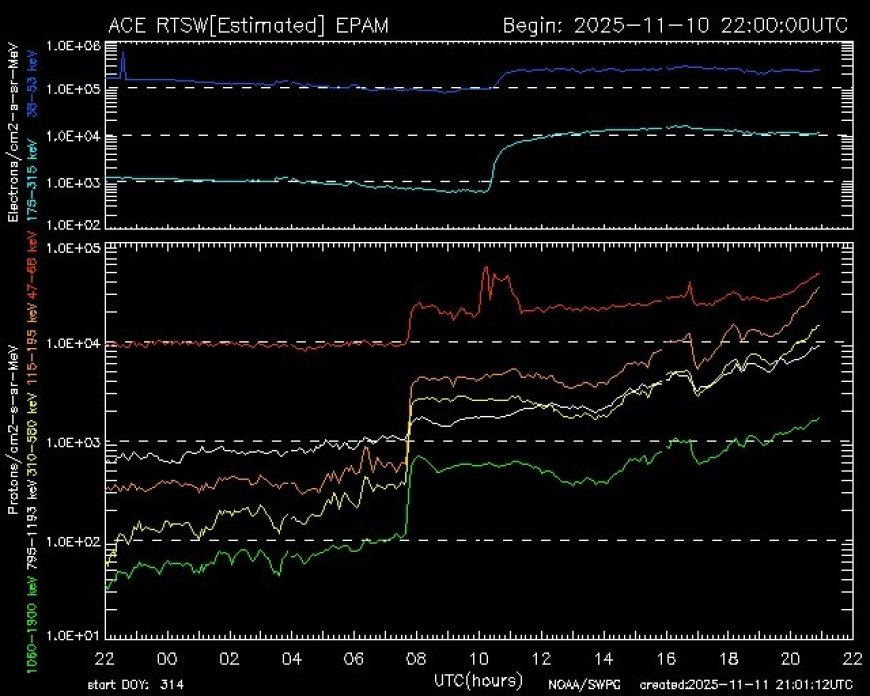
These are the most recent NOAA SWPC & ACE EPAM indicators showing particle flux spikes, CME arrival signatures, and expected aurora visibility across the United States. These charts confirm the storm’s rapid intensification heading into the G4 range.
What NOAA Is Warning About
NOAA’s G4 alert is direct:
“Possible widespread voltage control problems and some protective systems may mistakenly trip out key assets from the power grid.”
This is not theoretical. It's how grid failures cascade:
- Geomagnetically induced currents (GICs) saturate transformers.
- Voltage fluctuates outside normal bands.
- Automated protection relays disengage assets to prevent damage.
- Load suddenly shifts to remaining lines.
- Those lines fail from overload.
- A regional blackout becomes a multi-state blackout.
Satellite systems may be “degraded or inoperable for hours,” and auroras could reach as far south as Alabama.
What a Geomagnetic Storm Actually Is
Geomagnetic storms occur when high-velocity solar wind and magnetic fields slam into Earth’s magnetosphere. The major driver: coronal mass ejections (CMEs) — massive clouds of charged particles hurled from the Sun.
When they collide with Earth:
- Radio systems degrade
- GPS accuracy drops
- LEO satellites experience drag, orbital drift, and potential control-loss
- GICs flow through long-distance power lines
The most famous historical example: the **1989 Quebec blackout**, triggered by a G4–G5 storm that collapsed the grid in under 90 seconds.
Expected Impacts This Week
📡 Communications
GPS degradation, HF radio blackouts, location errors in precision agriculture, logistics, trucking, aviation.
⚡ Grid Instability
Northern U.S. states should expect voltage fluctuations and protective trip events.
🛰 Satellite Risk
LEO satellites may lose altitude and require burns to maintain orbit.
🌌 Aurora Visibility
Aurora borealis may appear as far south as **Alabama, Georgia, and Oklahoma** depending on storm strength and darkness conditions.
The Systemic Layer Nobody Talks About
This storm intersects exactly where U.S. systemic vulnerability already is:
- AI + electrification demand curve rising exponentially
- Transformer lifecycle issues that utilities can’t afford to fix quickly
- Long-haul transmission lines acting as antennas for geomagnetic currents
- Reactive power deficits in northern grids
- Multi-decade underinvestment in grid modernization
This is why 2025 is unique: we have demand curves with the wrong slope and infrastructure with the wrong age profile — colliding with a solar maximum cycle.
What Happens Next
The SWPC will release hourly magnetometer readings and updated storm intensity predictions. Utilities in affected regions will:
- Increase spinning reserve
- Put critical transformers in bypass mode
- Limit long-line power flows
- Coordinate voltage management across ISOs
For now, people should expect visible auroras, possible GPS issues, and minor grid anomalies — but the real risk is that this coincides with a historically overloaded energy system.
This is the first storm of this magnitude in a generation.
Sources
واکنش شما چیست؟
 پسندیدن
0
پسندیدن
0
 نپسندیدن
0
نپسندیدن
0
 عشق
0
عشق
0
 خنده دار
0
خنده دار
0
 وای
0
وای
0
 ناراحت
0
ناراحت
0
 عصبانی
0
عصبانی
0

Founder of Pattern Nexus. I research markets, macro, geopolitics, AI, history, ancient systems, and the patterns most people overlook. I’m also building Market Radar, a trading scanner designed to read pressure, risk, confirmation, and setup quality before chasing a move. Pattern Nexus is where I connect the dots between data, history, technology, and the bigger system playing out around us.







نظرات (0)