
The Maduro Raid and the Rise of Non-Kinetic War
The Caracas raid that captured Maduro triggered a second battle: a fast-spreading claim that the U.S. used a “mystery” sonic or directed-energy device to incapacitate defenders. Confirmed or not, the narrative signals where warfare and state power are heading.
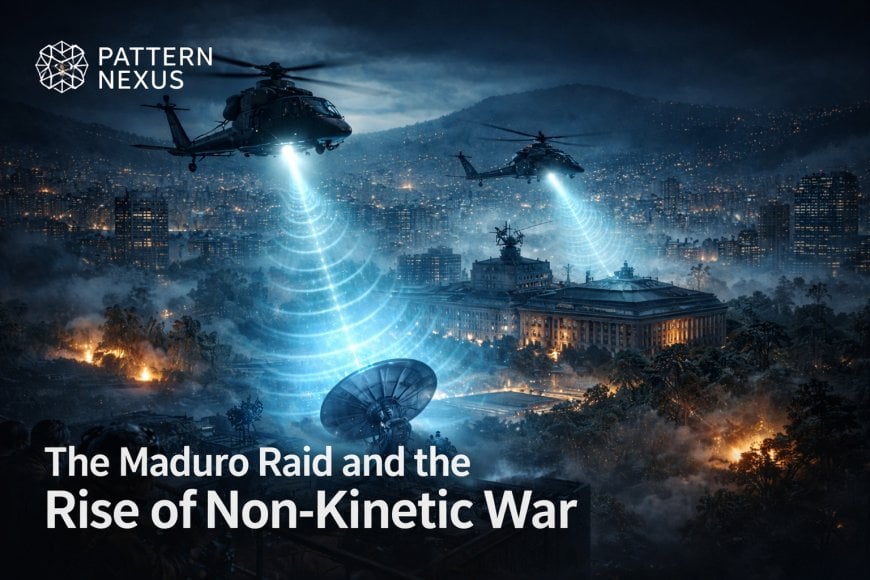
![[HERO_IMAGE_ALT: Dark aerial over Caracas with rotor wash and city haze; no text]](https://patternnexus.com/uploads/images/202601/image_870x_6962f2d50b14e.jpg)

The rumor phase just crossed into presidential rhetoric. In an interview with NewsNation’s Katie Pavlich, Trump openly bragged that U.S. special forces used a “secret sonic weapon” in the Maduro raid and claimed that “nobody else” has it. He offered no technical detail, no employment description, and no follow-on clarification from the Pentagon—but the headline is now simple: the President of the United States is taking public credit for an exotic, one-of-a-kind incapacitation device.
Analytically, this does not give us engineering specs or independent corroboration. It does, however, escalate the narrative from “viral witness account amplified by surrogates” to “Commander-in-Chief personally framing the raid around a secret capability.” That changes how allies, rivals, and defense establishments read the event. Even if the device label is imprecise or partly performative, the presidential boast hardens the belief that a classified human-effects tool may have been in play.
From a control-systems perspective, this is exactly what the original article argued: the belief is part of the weapon. When the political leader at the top of the chain leans into the legend on television, the “mystery weapon” moves from rumor-space into doctrine-space. Planners now have to assume that Washington is willing to advertise invisible tools as part of its deterrence portfolio—even if the underlying physics and platforms remain opaque.
Since first publish, the “mystery sonic weapon” story moved from a viral anecdote into mainstream syndication. The key development is not “confirmation” of a device. The key development is that the provenance chain is now clearly mapped, official channels still won’t validate it, and the injuries described have credible non-exotic explanations inside a raid that already featured heavy explosions, breaching, and mass fires.
When I first published this, a lot of you were upset telling me Maduro was turned over, it was an inside job, the radars were off, or any number of other angles. I don’t disagree with those possibilities. But understand what’s happening in the comments: most of that is low-value noise in terms of analysis because it doesn’t actually engage with the point of the post. It’s not “wrong,” it’s just not the layer I’m mapping here.
And the bigger pattern matters: I start posting these things, and then the media “discovers” it a week later. That isn’t a coincidence. That’s just how the world works now. We are in an information war in the literal sense, not the conspiracy-theory sense. Information has become an operational domain. It shapes behavior, fear, planning, and escalation before a single additional shot is fired.
That’s why I said in the original article it doesn’t even fully matter whether the device was real, misattributed, exaggerated, or fabricated. What matters is whether China, Russia, and every other serious adversary believes it might be real. Even if it’s only a 10% belief, that changes battle planning. It changes force posture. It changes risk tolerance. If they believe their systems and defenders can be made temporarily ineffective, the entire decision tree shifts.
So I’m reaffirming it here at the top a second time: this article is about the signal. The belief is the weapon. The narrative is part of the battlefield outcome.
- The claim traces to a Jan 9 TikTok posted by “Varela News” (@franklinvarela09) presenting an alleged interview with a Venezuelan security force member; it then spread via an English transcription posted to X by Mike Netter. The War Zone (Trevithick) maps the chain.
- White House Press Secretary Karoline Leavitt re-shared Netter’s post (“stop what you are doing and read this”), which massively amplified the story, but does not constitute confirmation of the underlying account. TWZ summary.
- When pressed for specifics, a Pentagon spokesperson told TWZ they had nothing to add beyond the Chairman’s Jan 3 briefing; SOUTHCOM declined comment. TWZ reporting.
- Casualty reporting continues to point to a kinetically violent operation: Venezuelan officials have floated death totals up to 100. Reuters (Jan 8).
- Earlier AP live updates put the official death count at least in the dozens (and rising) in the immediate aftermath, reinforcing that this was not a “silent” extraction. AP live updates (Jan 6).
- The legal architecture also surfaced: a newly released OLC memo argues the operation did not rise to “war in the constitutional sense,” and separately indicates DOJ did not resolve whether the action violated international law. AP on the OLC memo • The Guardian on the international-law question.
- TWZ notes the described injuries (nosebleeds, “vomiting blood,” collapse, inability to stand) can be consistent with internal blast injuries from explosion shockwaves, of which there were many during the operation. TWZ “Other Explanations”.
- Flashbangs and other distraction devices (including newer variants) could also contribute to confusion, disorientation, and memory distortion in the sequence of events. TWZ “Other Explanations”.
- TWZ explicitly flags the probability that some or all of the “super weapon” story could be face-saving, deterrence messaging, or active disinformation—useful to multiple actors regardless of truth value. TWZ analysis.
The information environment is now part of the battlefield outcome. A single “enemy witness” account, when laundered through official amplification and mass syndication, becomes a regional capability belief. Planning changes. Morale changes. Escalation math changes. That’s true whether the device was real, misattributed, exaggerated, or fabricated.
New reads added to our source stack: TWZ fact/fiction teardown • Reuters legal breakdown • Reuters casualty claim • AP OLC memo coverage • Guardian memo coverage.
Two wars can happen at once: a kinetic operation in the streets and a cognitive operation in the timelines. The second one can outlive the first and reshape deterrence.
Risk: when a claim is emotionally satisfying (“they flipped a switch and everyone dropped”), it spreads faster than verifiable reporting. That doesn’t make it true, but it does make it strategically useful.
Non-kinetic does not mean non-violent. It means the violence is moved into invisible domains: spectrum control, perception control, and human-effects control.
What Happened in Caracas
In mainstream reporting, the Caracas raid is described as a high-tempo special operations operation executed with overwhelming joint support. The headline result is simple: Nicolás Maduro was captured in a predawn operation and moved into U.S. custody. The operational details matter because they set the baseline for what is known versus what is being claimed.
Multiple outlets describe extensive preparation, integrated aviation, and a contested extraction. Reports cite special operations forces conducting the seizure while aircraft and drones provided cover, suppression, and ISR. Public accounts include aircraft taking fire and U.S. forces using suppressive fires during extraction.
Casualty reporting also points to a kinetic fight. Major outlets describe dozens of deaths among Venezuelan and Cuban security forces and civilians, and several U.S. injuries. This is not the profile of a “silent” or purely non-kinetic operation, even if non-kinetic tools (jamming, cyber, deception) were part of the package.
The confirmed story is a joint raid with special operations forces plus ISR, aviation, and electronic warfare. The disputed story is an additional “human-effects” device that incapacitated defenders. The two can coexist, but they should not be conflated.
The Mystery Weapon Narrative
The “secret weapon” claim is not anchored in mainstream post-operation briefings. It is instead driven by a circulated witness account and secondary amplification through tabloids, social media reposts, and commentary ecosystems. The story describes a sudden incapacitation event: defenders collapsing, disoriented, bleeding, and unable to respond effectively.
What makes this narrative durable is that it matches the direction of travel in modern warfare. People already accept that drones can hunt, that jammers can blind, and that cyber can freeze systems. The psychological leap from “they turned off radar” to “they turned off people” is smaller than it looks, especially when directed-energy and non-lethal programs have existed in the open record for decades.
The most important analytical move is to treat the claim as a signal, not as a concluded fact. Signals can be true, false, or partially true. The strategic impact comes from what the region now believes about U.S. capability and willingness.
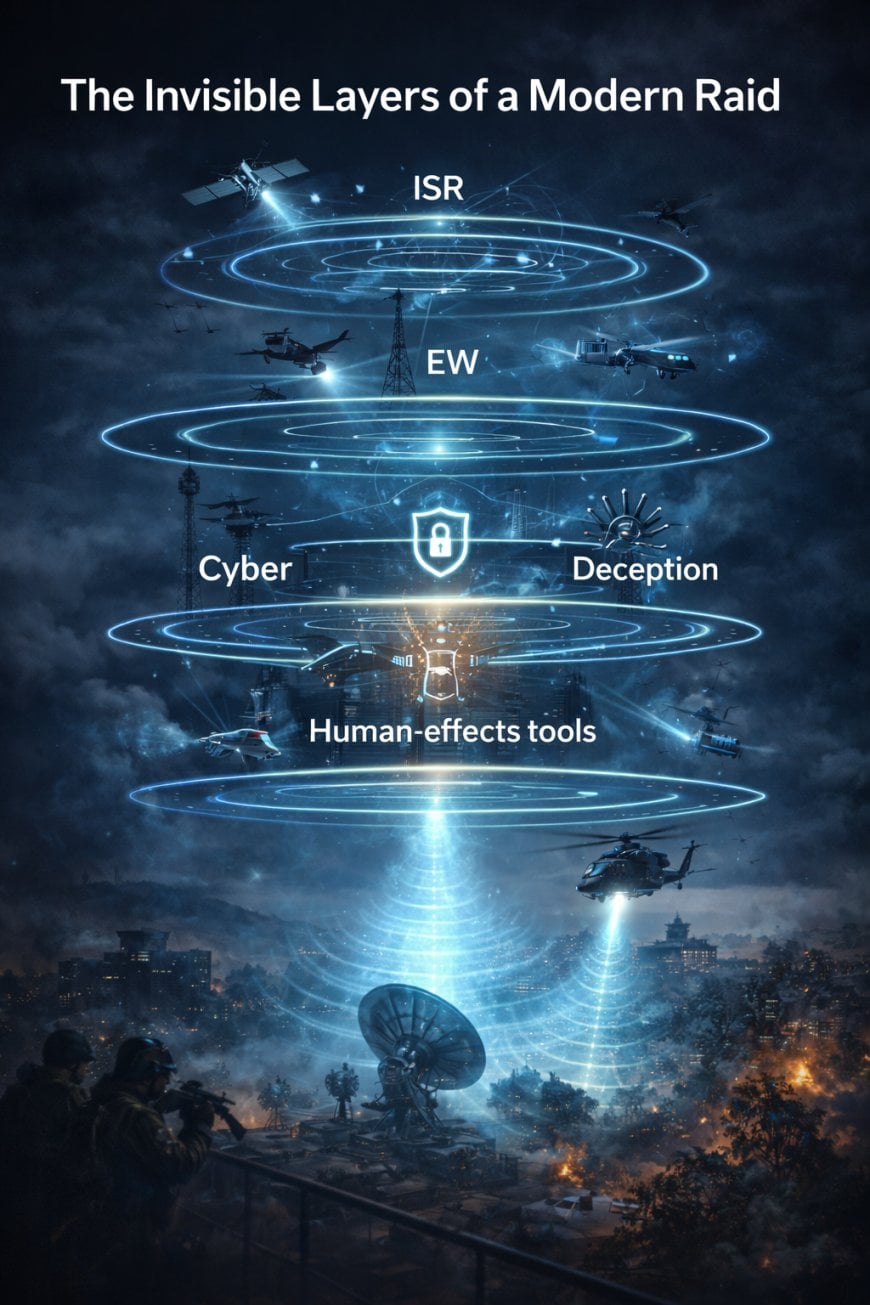
visual: “The Invisible Layers of a Modern Raid” showing ISR, EW, cyber, deception, and potential human-effects tools layered over conventional force.
There are several plausible explanations that do not require exotic “brainwave interruption” technology, and several that remain technically plausible but unverified. The key is to keep categories separate: electronics disruption, sensory disruption, and physiological disruption.
- Electromagnetic dominance: radar and comms disruption can create the perception of “instant paralysis,” especially if defenders cannot coordinate or cue fires.
- Acoustic/sensory denial: high-intensity directional audio can cause pain, disorientation, nausea, and flight behavior in a localized sector.
- Overpressure and breaching effects: concussive events can create confusion, vomiting, bleeding, and collapse in the immediate aftermath.
- Directed-energy “intermediate force” concepts: non-lethal programs exist in the open record; a classified or platform-integrated variant is not a physics leap, but it is still unproven here.
- Information shaping: a dramatic “mystery weapon” story can be useful to multiple actors, including the U.S., rivals, and domestic factions, regardless of its factual status.
The Non-Kinetic Stack That Already Exists
Even without confirming any specific device in Caracas, the broader technology ecosystem is real. The open record shows multiple families of “intermediate force” and directed-energy systems, plus a rapidly maturing high-power microwave industry focused on disabling electronics at scale. This matters because it explains why the rumor is believable.
The public record already includes non-lethal directed-energy systems for personnel deterrence, directional acoustic devices used by militaries and police, and high-power microwave platforms that can disable electronics in wide beams. Whether any of that was used in the Maduro raid is separate from whether the capability class exists.
1) Directional acoustic devices (LRAD class). These are real, fielded tools used for long-range communication and escalation-of-force signaling. In deterrent modes, they can create intense pain and disorientation at close range, and they are explicitly discussed as alternatives intended to change behavior without firearms.
2) “Intermediate force” directed energy (Active Denial Technology). The U.S. has publicly described systems that project a focused beam designed to deter, stop, and turn back individuals with minimal risk of injury. The purpose is to fill the gap between presence and lethal force. The key point is not the specific mechanism; it is the doctrine: engineered, controllable human-effects as a tool of force management.
3) Microwave auditory concepts (MEDUSA lineage). The open record includes prototypes exploring pulsed microwave effects that can create the perception of sound inside the human head. Public descriptions emphasize deterrence and temporary incapacitation. Whether these became operational is unclear, but the concept itself exists.
4) High-power microwave (HPM) weapons for electronics and drones. The last few years produced rapid validation: wide-beam microwave systems can disable many targets in one engagement. Demonstrations and procurement programs focus on drone swarms, not people, but the infrastructure (power, beam control, integration, employment concepts) is the foundation of a broader directed-energy era.
5) Cognitive warfare as a declared domain. NATO and defense institutions now treat cognition, perception, and decision integrity as contested terrain. This is not “science fiction mind control” in official language; it is the institutional admission that the center of gravity is shifting from destroying platforms to shaping decisions at scale.
Pattern Nexus Lens
The Maduro raid is not just a Venezuela story. It is a control-systems story. Modern power is increasingly expressed through layered dominance: sensing, jamming, cueing, targeting, narrative shaping, and selective force application. The most valuable capabilities are the ones that look like “nothing happened” from the outside while the target’s ability to coordinate collapses from the inside.
That is why the “mystery weapon” narrative matters even if it remains unproven. A rumor about neurological incapacitation is itself a cognitive weapon. It forces adversaries to plan against an invisible class of threat, inflates perceived U.S. capability, and pushes regional actors into risk-avoidant behavior. Deterrence is not only hardware; deterrence is expectation management.
The deeper pattern is the migration from blunt violence to engineered compliance. First it was air superiority. Then it was ISR dominance. Then it was precision. Then it was drones. Then it was spectrum control. The next rung is human-effects control: disabling the ability to resist without needing a high body count and without needing to destroy infrastructure.
Whether the “sonic device” claim is true is almost secondary to the trajectory: warfare is converging with control systems, and the most decisive tools are increasingly invisible, deniable, and scalable across both machines and minds.
FAQ
Was a sonic or directed-energy “brain disruption” weapon officially confirmed in the Maduro raid?
No public confirmation has been provided in mainstream reporting or official briefings. The claim is primarily driven by a circulated witness account and tabloid amplification, while major outlets describe a kinetically contested raid with significant casualties and multiple U.S. injuries.
Do non-lethal directed-energy and acoustic incapacitation systems exist in real life?
Yes. Public records describe directional acoustic devices used for communication and deterrence, and the U.S. has publicly described directed-energy “intermediate force” systems intended to deter and turn back individuals with minimal risk of injury. Separately, high-power microwave systems have been demonstrated disabling drone swarms and electronics at scale.
Why does the rumor matter if it may not be true?
Because belief shapes behavior. If regional actors conclude that U.S. forces can disable defenders invisibly, it changes deterrence, planning, morale, and escalation thresholds. In the control-systems era, narrative can function as a force multiplier.
Sources
Reporting on the Maduro raid and its aftermath, plus public documentation and credible coverage of non-lethal and directed-energy systems, high-power microwave developments, and cognitive-domain doctrine.
- Washington Post: Inside the Maduro raid (Jan 3, 2026)
- Associated Press live updates: U.S. injuries and raid aftermath (Jan 6, 2026)
- Associated Press: Cuba says 32 Cuban officers killed (Jan 2026)
- The Guardian: U.S. urges citizens to leave Venezuela (Jan 10, 2026)
- Modern War Institute (West Point): Eight Military Takeaways from the Maduro Raid
- New York Post: “Mystery/sonic weapon” witness account (Jan 10, 2026)
- DoD JIFCO: Active Denial Technology fact sheet
- DoD JIFCO: Non-lethal weapon requirements (definition and intent)
- NATO ACT: Cognitive Warfare (exploratory concept)
- Epirus: Leonidas HPM demonstration results (Sep 10, 2025)
- Financial Times: UK tests microwave weapon to disable drone swarms
- Wired: MEDUSA microwave “silent audio” concept (Aug 16, 2007)
واکنش شما چیست؟
 پسندیدن
0
پسندیدن
0
 نپسندیدن
0
نپسندیدن
0
 عشق
0
عشق
0
 خنده دار
0
خنده دار
0
 وای
0
وای
0
 ناراحت
0
ناراحت
0
 عصبانی
0
عصبانی
0

Founder of Pattern Nexus. I research markets, macro, geopolitics, AI, history, ancient systems, and the patterns most people overlook. I’m also building Market Radar, a trading scanner designed to read pressure, risk, confirmation, and setup quality before chasing a move. Pattern Nexus is where I connect the dots between data, history, technology, and the bigger system playing out around us.


















نظرات (0)