

Stocks Rally, Gold Surges and Global Signals Diverge: A Comprehensive Look at October 20 2025
A surge on Wall Street pushed major stock indexes close to record territory while tech giants grabbed headlines. Apple shares jumped on strong iPhone 17 demand, gold prices continued their record run amid talk of a “debasement trade,” and global markets diverged as India rallied and China posted slower growth. This…
A surge on Wall Street pushed major stock indexes close to record territory while tech giants grabbed headlines. Apple shares jumped on strong iPhone 17 demand, gold prices continued their record run amid talk of a “debasement trade,” and global markets diverged as India rallied and China posted slower growth. This…
Jump to a section
Market Rally Driven by Easing Tensions and Rate-Cut Hopes
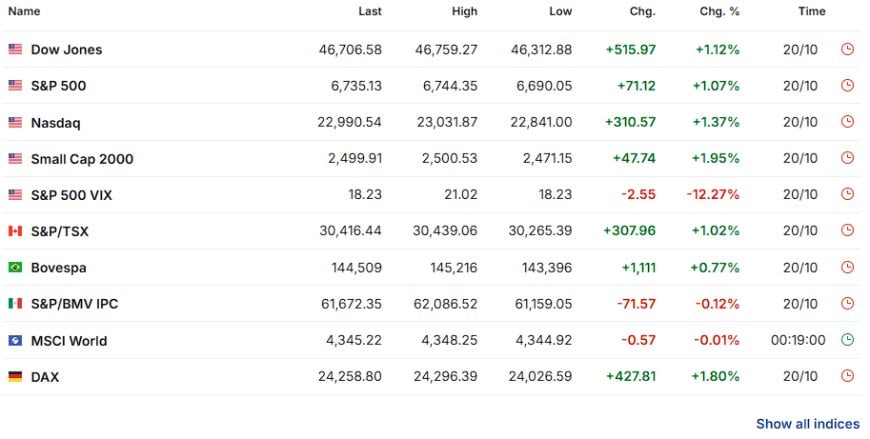
After a volatile stretch, U.S. stocks began the new week with a sharp rally that pushed major indexes within a whisper of their all-time highs. The S&P 500 rose around 1.1%, while the Dow Jones Industrial Average jumped more than 500 points and the Nasdaq Composite climbed about 1.4%, buoyed by optimism that trade hostilities between Washington and Beijing would cool (MarketScreener). The rally was broad-based, with bank stocks recovering from last week’s worries and helping to shore up sentiment (MarketScreener). Investors also looked ahead to upcoming earnings releases from heavyweights such as Coca-Cola, Tesla, and Procter & Gamble (MarketScreener), and rate-cut expectations strengthened as Treasury yields eased.
The market surge reflected a wider global uplift. European and Asian indexes also climbed, supported by hopes of a thaw in U.S.–China trade frictions and favorable monetary policy outlooks (MarketScreener). Japan’s Nikkei 225 jumped 3.4% as the ruling Liberal Democrats struck a coalition deal that could install former internal affairs minister Sanae Takaichi as Japan’s first female prime minister — a development investors see leading to more stimulative fiscal and monetary policies (Reuters). Meanwhile, Hong Kong’s Hang Seng index rose 2.4%, and Shanghai’s composite gained 0.6%, though the Chinese economy’s growth remained under scrutiny.
Apple’s Run and Tech-Sector Crosscurrents
Apple Inc. was the standout performer on Wall Street. Apple shares gained roughly 4.2% to $262.90, propelling the company’s market capitalization to about $3.9 trillion and putting it within striking distance of becoming the world’s third company to reach a $4 trillion valuation. Research firm Counterpoint reported that the newly released iPhone 17 lineup outsold its predecessor by 14% in the first 10 days of availability in China and the United States (Reuters). Analysts at Evercore ISI added Apple to their Tactical Outperform list, noting that robust online orders in China and stable U.S. pricing could drive earnings beats later this quarter (Reuters). Art Hogan of B Riley Wealth described demand trends for the latest iPhones as “on the front foot” and a relief after concerns earlier in the year over tariffs and Chinese competition (Reuters).
Not all tech news was positive, however. Early Monday an outage in Amazon Web Services (AWS)’ U.S.-East-1 data center disrupted millions of users worldwide. Sites ranging from Snapchat and Reddit to payment platforms and video-meeting services went dark as a network health monitor malfunctioned (Reuters). Amazon quickly rerouted traffic and restored service, but the incident underscored the economy’s dependence on a handful of cloud providers and raised questions about infrastructure resilience. Despite the disruption, Amazon’s stock still rose about 1.5% (MarketScreener), highlighting investors’ focus on the company’s underlying strength. The episode prompted renewed calls for diversification in cloud architecture and more rigorous stress testing.
Gold’s Surge and the “Debasement Trade” Debate
While equities rallied, gold prices continued their record-breaking run, briefly breaching $4,300 per ounce amid expectations that central banks will soon cut rates and a renewed appetite for safe-haven assets (Reuters). Gold has gained more than 60% in 2025 (Reuters), driven by geopolitical tensions, de-dollarization efforts, and strong central-bank buying.
This extraordinary rise has revived talk of a “debasement trade” — a strategy premised on the belief that the U.S. dollar is losing purchasing power and that hard assets like gold and cryptocurrencies offer protection. However, Reuters analysis suggests that the narrative is more hype than substance: the dollar remains relatively robust against other major currencies even as rate-cut bets proliferate, and bond yields have fallen but not collapsed. The surge in gold appears to reflect a hedging strategy against policy missteps and geopolitical risk rather than an outright rejection of fiat currency. With the Federal Reserve expected to begin easing in 2026, investors are positioning for a new monetary phase — but the data do not yet support claims of imminent dollar debasement.
Diverging Global Signals: India’s Festive Cheer vs. China’s Slowdown
Outside the United States, the picture was mixed. Indian equities extended a winning streak, with the BSE Sensex climbing 411 points (0.49%) to 84,363.37 and the NSE Nifty 50 rising 133 points (0.52%) to 25,843.15 (Moneycontrol). The gains coincided with the Diwali festival and marked the final session of the Hindu calendar year Samvat 2081. Heavyweights such as Reliance Industries and HDFC Bank led the advance after posting strong quarterly results, and the Nifty Bank index surged past 58,000 (Moneycontrol). Analysts attributed the rally to earnings optimism and structural reforms that are expected to keep India’s GDP growth around 6.8% in FY 2026 (Moneycontrol).
Meanwhile, China’s latest economic data disappointed. Official figures showed that China’s GDP grew 4.8% year-on-year in the July-to-September quarter, down from 5.2% in the previous quarter and the slowest pace in a year (Reuters). The slowdown was widely attributed to a prolonged property slump and ongoing trade tensions, which weighed on domestic demand (Reuters). Reuters noted that fixed-asset investment fell 0.5% year-to-date, and property investment dropped 13.9%, highlighting persistent weakness in the real-estate sector (Reuters). Analysts quoted by Reuters said Beijing may meet its full-year growth target of around 5%, but they warned that more targeted fiscal stimulus would be needed to reignite momentum (Reuters). The data underscored a growing divergence between India’s upbeat trajectory and China’s more subdued outlook.
Macro Backdrop: Growth Forecasts and the AI Investment Boom
In the broader macro-economic landscape, the International Monetary Fund (IMF)’s October World Economic Outlook projected that global growth will slow to 3.2% in 2025 and 3.1% in 2026, down from an estimated 3.3% in 2024 (IMF). Advanced economies are expected to expand by around 1.5%, while emerging markets should grow just above 4% (IMF). Inflation is forecast to decline but remain above central-bank targets in the United States and other advanced economies (IMF).
One factor complicating the outlook is the artificial-intelligence investment boom. IMF chief economist Pierre-Olivier Gourinchas warned that the surge of capital into AI could mirror the 1990s dot-com bubble: valuations are soaring and consumption is getting a lift, but returns have yet to materialize (Reuters). Gourinchas noted that unlike the 1990s, today’s AI boom is not built on heavy leverage, which reduces the risk of a systemic financial crisis (Reuters). Nevertheless, he cautioned that a market correction could still trigger broader repricing of assets and spur volatility (Reuters). The IMF expects the AI investment wave to cushion the U.S. economy in the near term but warns that inflation could remain sticky as demand outstrips productivity gains (Reuters).
Why This All Matters
Even after Monday’s rally, the financial landscape remains defined by contradictions: investors are cheering robust corporate earnings and enjoying the best gains of the year, yet cracks are visible under the surface. U.S. stocks are pricing in a benign outcome for trade negotiations and monetary policy; the debate about currency debasement is alive, but the data show a more measured reality; and global growth is uneven, with India charging ahead while China struggles to escape a property-led slowdown. On top of these themes sits the AI investment frenzy — a potential catalyst for innovation or a bubble waiting to deflate. Navigating this environment will require balancing enthusiasm with vigilance and recognizing that markets can be both euphoric and fragile at the same time.
📚 Sources
- Reuters – “Gold extends record run past $4,200 on rate-cut hopes, safe-haven fervor”
- Reuters – “Debasing the ‘debasement’ trade” (analysis)
- Reuters – “China Q3 GDP growth slows to 4.8% y/y, in line with forecast”
- Reuters – “Apple nears $4 trillion valuation as shares surge on strong iPhone 17 demand”
- Reuters – “AI investment boom may lead to bust, but not likely systemic crisis, IMF chief economist says”
- Moneycontrol – “Market ends Samvat 2081 on a strong note: Nifty tops 25,800, Sensex up 411 points”
- MarketScreener / Associated Press – “Wall Street rallies and gets near its all-time high”
- Reuters – “AWS cloud service back to normal after outage disrupts businesses worldwide”
- IMF – World Economic Outlook, October 2025
מה התגובה שלך?
 אהבתי
0
אהבתי
0
 לא אוהב
0
לא אוהב
0
 אהבה
0
אהבה
0
 מצחיק
0
מצחיק
0
 וואו
0
וואו
0
 עצוב
0
עצוב
0
 כועס
0
כועס
0

Nexus (Christopher)
Founder of Pattern Nexus. I research markets, macro, geopolitics, AI, history, ancient systems, and the patterns most people overlook. I’m also building Market Radar, a trading scanner designed to read pressure, risk, confirmation, and setup quality before ch…
Related research

Pattern Nexus Macro Archive: 328 Timestamped Articles, October 2025–July 2026
A guided public index of 328 timestamped Pattern Nexus articles covering Federal Reserve liquidity, interest rates, the dollar, gold and si…
5 shared topics, 2 shared assets.
Market Wrap: Dollar Break, Hard-Asset Bid, Equities Hold — Jan 26, 2026
A January 26, 2026 market wrap: DXY slid into the 96 handle as gold stayed in price-discovery above $5,000 and silver stayed parabolic. Equ…
4 shared topics, 3 shared assets, same research avenue.
Market Wrap – January 16, 2025: CPI Relief Cools, Yields Slide, Oil Loses the Security Premium
U.S. stocks dipped after Wednesday’s CPI-fueled surge as investors parsed earnings and fresh data. Treasury yields eased after Waller comme…
7 shared topics, 3 shared assets, same research avenue.
Market Wrap – December 18, 2025: Equities Higher, Bonds Bid, Metals Volatile, Crypto Lags
U.S. markets closed higher on December 18, 2025, led by tech and AI names, while bonds were bid, gold and silver saw sharp intraday swings,…
5 shared topics, 2 shared assets, same research avenue.
Market Wrap – December 11, 2025: Post-Cut Melt-Up, Oracle Shock, and a Stubborn Front End
Daily Pattern Nexus market wrap for December 11, 2025: index melt-up after the Fed’s first asset-purchase move, Oracle’s AI-spend shock, ra…
4 shared topics, 2 shared assets, same research avenue.
Market Wrap-Up 12/3/2025: Risk Rally, Yield Drift, and the Crypto Rebound
Markets rallied on December 3, 2025 as yields softened and risk sentiment returned. Equities rose, crypto surged, commodities stayed mixed,…
6 shared topics, 1 shared asset, same research avenue.
Pattern Nexus Weekly Wrap-Up: Markets Reprice the December Fed Pivot as Global Tensions Escalate (Week of Nov 15–21, 2025)
Markets aggressively repriced a December Fed rate cut as U.S. equities surged, bond yields fell, and global tensions escalated across Ukrai…
2 shared topics, 2 shared assets.
Market Wrap-Up — November 13, 2025: Red Tape, Strong Dollar, and a Fed That Markets Still Expect to Blink
U.S. markets had their worst day in a month as the Dow fell nearly 800 points, AI stocks sold off, and Fed cut odds briefly slipped to a co…
5 shared topics, 3 shared assets, same research avenue.
תגובות (0)
Security Check
Please complete the captcha to verify you are human.