
The Patent Illusion: Why the U.S. Still Leads the AI Race (and Why That Tsinghua Chart Is Misleading)
This article breaks down why Tsinghua University’s surge in AI patents doesn’t mean China is winning the AI race. Patent charts measure universities—not compute, chips, cloud infrastructure, power, or frontier model leadership. Using real data, we explain why the U.S. still dominates the AI-industrial stack in 2025 and what pressure points actually matter.
The Patent Illusion: Why the U.S. Still Leads the AI Race (and Why That Tsinghua Chart Is Misleading)
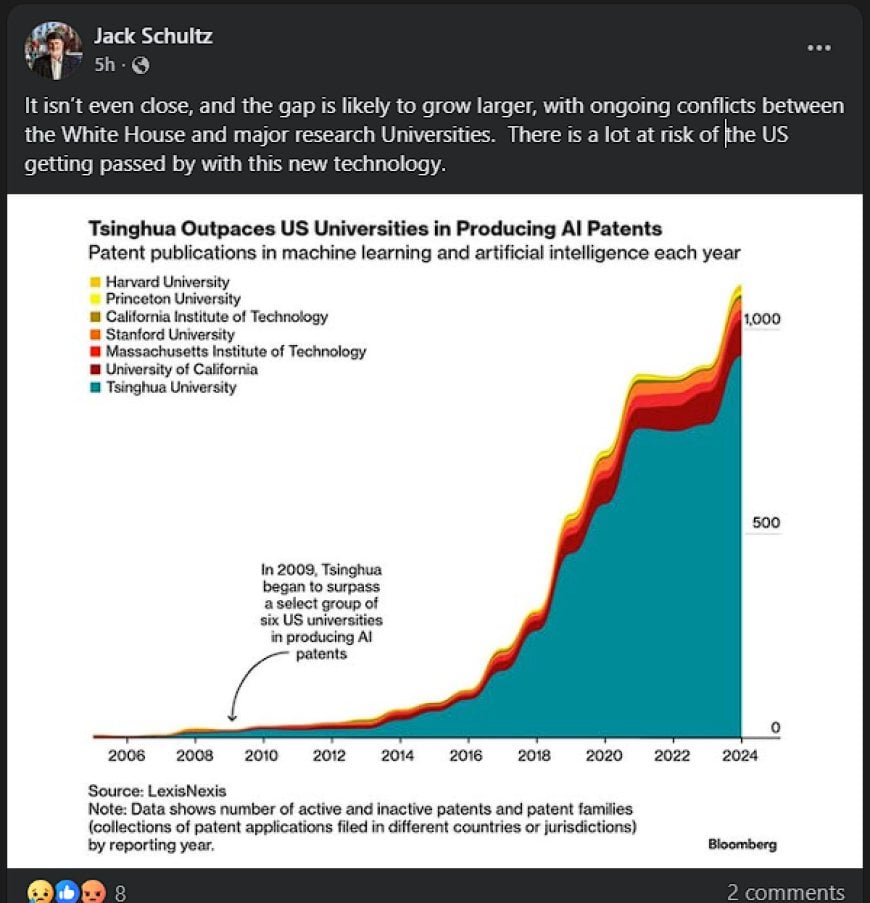
A viral chart claims China’s Tsinghua University has “beaten” top U.S. universities in AI patents. That sounds scary—until you remember that frontier AI in 2025 isn’t won by university paperwork. It’s won by compute, chips, cloud, capital, and talent… and the U.S. still dominates those layers.
The Viral Tsinghua Patent Chart
You’ve probably seen the screenshot by now: a bright stacked-area chart from Bloomberg showing “Tsinghua Outpaces US Universities in Producing AI Patents”. A big teal block labeled Tsinghua surges past the slivers of Harvard, MIT, Stanford, and friends. The implied message is simple: China won, the U.S. is falling behind.
Bubble Take: The chart is technically correct on a narrow metric… and strategically useless if you’re trying to understand who actually leads AI in the real world.
The fine print matters. The Bloomberg piece is based on LexisNexis patent data for universities, and specifically for patent publications in machine learning and AI over roughly the last 15–20 years. Tsinghua’s volume spikes dramatically after 2009 and dwarfs the combined filing counts of six big-name U.S. universities.
If your worldview begins and ends with “number of patents filed by universities,” then yes, that looks like a Chinese victory lap. But we don’t live in a world where university patent counts decide who controls AI.
What the Chart Actually Measures (and Why It’s the Wrong Battlefield)
Let’s be explicit about what this chart is counting:
- Only university institutions (no private companies, no government labs, no startups).
- Only patent publications (not trade secrets, not model weights, not training pipelines).
- Only in the domain of machine learning / AI-related patents.
Now compare that to what actually moves the needle in 2025:
- Frontier foundation models and the teams that train them.
- The supply of advanced GPUs and AI accelerators.
- Cloud infrastructure and AI supercomputer capacity.
- Capital flows into AI companies and chips.
- Skilled researchers, engineers, and the ecosystems they cluster in.
Highlight: Universities used to be the engine of frontier research. In the current AI wave, they’re more like feeders and satellites orbiting a much larger industrial core built by private companies and cloud providers.
A chart that only looks at campus patent paperwork is like judging who owns the skies by counting paper glider designs while ignoring who actually builds jumbo jets, runs airports, and manufactures jet engines.
Where the Real AI Race Is Being Fought
To understand who is actually ahead, you have to climb up the entire AI stack: models → chips → compute → cloud → power → capital → talent. On almost every one of those layers, the U.S. still holds the commanding position.
Frontier Models
Stanford’s 2025 AI Index and multiple independent surveys show that U.S.-based labs still produce the majority of frontier-scale models and key breakthroughs. U.S. entities produced on the order of 40 “notable” large models vs roughly 15 from China and a handful from Europe in the latest year of data, with the U.S. still leading on average benchmark performance, even as Chinese models close some of the gap.
The names at the frontier are familiar: OpenAI, Anthropic, Google DeepMind, Meta, Microsoft, and to a lesser extent xAI and Amazon. They are overwhelmingly U.S.-based or U.S.-controlled firms. China has serious players—DeepSeek, Alibaba’s Qwen, Moonshot, Baidu’s Wenxin, Kimi—and some of their newer models benchmark extremely well, particularly on coding and reasoning, but they are still generally following U.S. architectural and training innovations rather than setting the curve.
Key Point: Frontier model leadership still tilts U.S., with China emerging as a solid #2— but the scoreboard is in private labs and supercomputer clusters, not in university patent offices.
Money and Private-Sector AI Investment
Recent market analyses put U.S. AI investment above $60 billion per year vs roughly $40–45 billion for China, with the U.S. hosting more AI “unicorns” and significantly deeper private funding per firm. U.S. AI research also tends to have higher average citation impact, indicating more influential work per paper even as China leads in publication counts.
The brutal truth: whoever can afford to burn the most GPU-hours at scale gets to push the frontier fastest. On that metric, U.S. capital markets and mega-cap tech firms still massively outgun everyone else.
Chips and Compute Capacity
Advanced AI chips are the choke point of the whole system. And here, the U.S. has stacked the board. NVIDIA, a U.S. company, controls somewhere between 70–95% of the high-end AI accelerator market, depending on how you measure it, and around 90%+ of the data-center GPU segment. AI accelerators may be less than 1% of global wafer volume, but they already command around 20% of semiconductor industry revenue—they’re the valuable part of the stack.
Export controls and licensing schemes have kept the highest-performing NVIDIA chips—A100, H100, and now Blackwell-class parts—either outright banned or tightly throttled for sales into China. Earlier “watered-down” chips (A800, H800, later H20) were specifically engineered to comply with U.S. national-security limits… and then those cut-down parts got swept into tighter rules as well.
State-of-AI and policy modeling work suggest that, under strict export limits, the U.S. could maintain on the order of a 30× advantage in available frontier compute over China; looser licensing, smuggling, and back-channel sales shrink that margin, but the baseline still reflects a U.S.-tilted capacity stack.
Compute Reality Check: Even if Huawei hits its public target of a couple hundred thousand advanced domestic AI chips in 2025, that’s still a fraction of the H100-equivalent capacity sitting in U.S.-aligned hyperscale data centers.
Cloud and AI Supercomputers
Cloud infrastructure is where chips turn into usable compute. Globally, three U.S. firms—AWS, Microsoft Azure, and Google Cloud—control well over 60% of the entire cloud infrastructure market, with no non-U.S. competitor above low-single-digit percentages. Those same three are pouring tens of billions into AI-optimized clusters, networking, and storage.
Recent estimates of global AI supercomputer capacity suggest that around three-quarters of the world’s H100-class compute lives in U.S.-aligned systems, with China holding a smaller but rapidly growing slice. The ratio varies depending on how you count on-prem clusters and off-book state systems, but the direction is clear: the densest, most capable AI compute sits in American-operated or American-controlled clouds.
Talent Flows
There’s also the human layer. Multiple studies have shown that a large share of top Chinese AI PhDs eventually take jobs in the U.S. or at U.S.-aligned institutions, driven by higher pay, deeper research ecosystems, and more access to compute. The result: China trains a lot of talent, and the U.S. vacuum-cleans part of it back out via migration and hiring.
This isn’t a moral judgment; it’s just the incentive math of global labor markets. AI talent goes where the chips and money are.
Where China Really Is Strong (and Why It’s Different from the Chart)
None of this means China is weak at AI. It means the viral patent chart is measuring the wrong strength.
China genuinely leads in:
- AI-related publications and patents by raw count.
- Fast-improving open-weight and domestic models (DeepSeek, Qwen, Kimi) that are closing the gap on many benchmarks.
- Industrial adoption across e-commerce, payments, logistics, and social platforms like Alibaba, Tencent, ByteDance, and Meituan.
Chinese models are now reaching benchmark performance within a few months of top U.S. systems in many areas, especially when you discount proprietary safety, tooling, and ecosystem polish. The open-weight ecosystem coming out of China is arguably ahead of where U.S. open source is—largely because U.S. frontier labs have moved into closed, monetized models while China treats open weights as a strategic export.
Important Nuance: China isn’t “behind” in everything. It’s a genuine peer in model quality and deployment in some areas, but that’s a very different claim from “one university filed more patents than Harvard.”
The story is not “America is safe forever.” The real story is “China is catching up fast—but on a battlefield shaped by U.S. chips, U.S. clouds, and U.S.-centric compute capacity.”
AI as an Industrial Stack: Compute, Cloud, Power
The Pattern Nexus view is simple: AI leadership is becoming an industrial policy problem, not an academic one.
Think of AI as a stack:
- Layer 1 – Chips: High-end GPUs, memory (HBM), networking silicon.
- Layer 2 – Compute: Supercomputers, data-center racks, orchestration, scheduling.
- Layer 3 – Cloud: Global infrastructure, regions, redundancy, APIs, security.
- Layer 4 – Power: Electricity, cooling, transmission lines, nuclear and gas plants.
- Layer 5 – Capital & Policy: Liquidity, credit, subsidies, export rules.
- Layer 6 – Models & Apps: The LLMs, agents, and tools normal people actually see.
The U.S. doesn’t have to win on every input. It just has to maintain control over enough of the stack that everyone else’s AI ambitions run through American hardware, clouds, and capital markets.
AI-Power Nexus: As AI chips drive a new semiconductor supercycle—and as data centers start to look like power plants with GPUs attached— the “race” stops being about who writes more papers and becomes about who can build and finance the most compute-dense, power-hungry infrastructure.
That’s why export controls on high-end GPUs, HBM memory, and advanced lithography are such a big deal: they gate how fast China can scale the bottom of the stack. It’s also why the U.S. is suddenly obsessed with nuclear restarts, grid upgrades, and DOE loan guarantees for data-center-heavy industrial projects. The AI race is quietly mutating into a power race and a liquidity race.
What Could Actually Change the Balance
If you want to think seriously about risks to U.S. AI leadership, don’t stare at university patent charts. Watch these pressure points instead:
- Export controls and chip flows: How porous are the rules? How many “China-safe” chips really ship, and at what performance level?
- Power bottlenecks: Does the U.S. actually build enough grid, transmission, and nuclear capacity to feed its AI clusters?
- Open-source models: Do U.S. labs starve open ecosystems while Chinese firms flood the world with aggressively capable open weights?
- Talent migration: Does the U.S. stay attractive to top researchers, or do visa friction and political risk push talent elsewhere?
- Macro shocks: Does a financial or political crisis choke off the capital that’s funding this AI-industrial build-out?
Those are the levers that could tilt the board. None of them show up in that Tsinghua patent chart.
Pattern Nexus Lens: How Not to Get Played by Charts Like This
When you see a graphic screaming “China has already won,” run it through a simple three-step filter:
- What is actually being measured? Universities? Patents? Papers? Patents per capita? None of these directly equal real-world power.
- What’s missing from the frame? Chips, compute, capital, cloud share, power infrastructure, migration flows.
- Who benefits from the framing? Politicians pushing threat narratives, think tanks selling fear, or companies lobbying for subsidies.
Core Idea: AI leadership isn’t a single number. It’s a stacked system of hardware, energy, software, and money. Any chart that ignores most of that stack is at best incomplete—and at worst propaganda with nice colors.
Tsinghua absolutely matters in AI research. China absolutely matters as a rising AI power. But if you’re going to panic about the future of American AI, at least panic about the right things: compute, power, and the industrial flywheel—not a bar chart of university patents.
Sources & Further Reading
Selected references and data points used in this article:
- Bloomberg – “China’s AI University Beats Out Harvard, MIT in Race for AI Patents”
- Stanford HAI – 2025 AI Index Report
- State of AI Report 2025 – Key Takeaways
- SecondTalent – “USA vs China in AI & LLM: Statistics & Market Analysis [2025]”
- IoT Analytics – “Leading Generative AI Companies and GPU Market Share”
- Markets & Markets – “NVIDIA’s Dominance in the AI Chip Market”
- UST – “AI Chips Driving the Next Semiconductor Supercycle”
- CloudZero – “Top Cloud Service Providers in 2025”
- Cargoson – “Global Cloud Infrastructure Market Share: AWS vs Azure vs Google (2025)”
- CIO Dive – “Cloud’s Big 3 Continue to Rule Infrastructure Services”
- U.S. Congressional Research Service – “U.S. Export Controls and China: Advanced Semiconductors”
- AI Business – “NVIDIA Developing China-Specific AI Chips to Comply with Export Rules”
- GamersNexus – “Timeline: GPU Export Controls and NVIDIA Bans”
- Chosun Biz (EN) – “White House Reaffirms Ban on NVIDIA Blackwell Chip Exports to China”
- Institute for Progress – “Should the US Sell Blackwell Chips to China? The B30A Decision”
- Reuters – “US Says China’s Huawei Can’t Make More Than 200,000 AI Chips in 2025”
- Wired – “The US Needs an Open Source AI Intervention to Beat China”
- Bloomberg – “The AI Showdown: How the US and China Stack Up”
- WUAB – “Who’s Winning in AI—China or America?”
आपकी प्रतिक्रिया क्या है?
 पसंद करें
0
पसंद करें
0
 नापसंद
0
नापसंद
0
 प्यार
0
प्यार
0
 मज़ेदार
0
मज़ेदार
0
 वाह
0
वाह
0
 दुखद
0
दुखद
0
 गुस्सा
0
गुस्सा
0

Founder of Pattern Nexus. I research markets, macro, geopolitics, AI, history, ancient systems, and the patterns most people overlook. I’m also building Market Radar, a trading scanner designed to read pressure, risk, confirmation, and setup quality before chasing a move. Pattern Nexus is where I connect the dots between data, history, technology, and the bigger system playing out around us.













टिप्पणियाँ (0)