
The World Is Not Normal Anymore
A broad system-level look at the Middle East war, markets, money, Bitcoin, AI, control systems, and why the world order now appears to be shifting in ways that are bigger than most people realize.
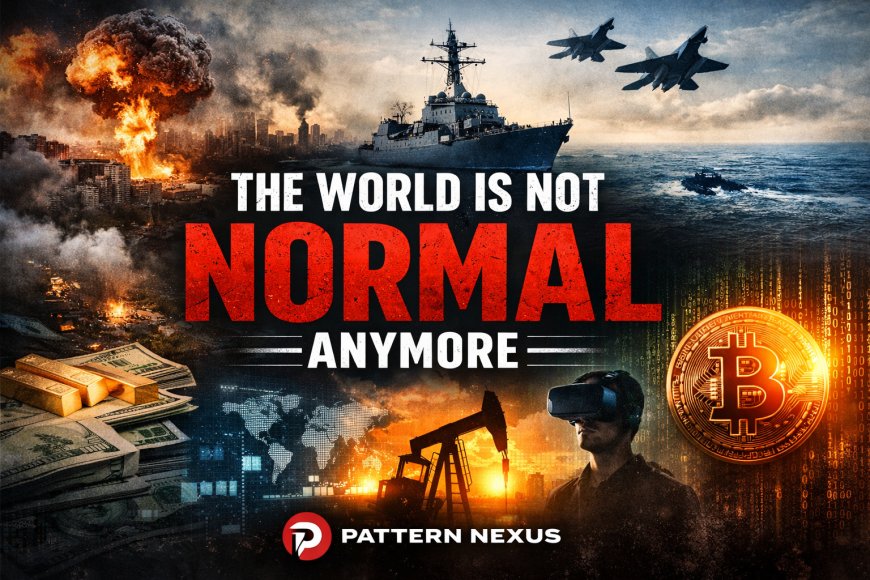
Today’s article is going to be a little different. Instead of focusing on one specific topic, I’m going to talk more broadly about current events, markets, and the overall mood of the world. I also want to address some of the comments many of you have made across different posts over the past week or so.
Let’s start by walking through the current situation.
On February 28th, what began unfolding in the Middle East became something much larger than a simple U.S.–Israel conflict with Iran. Calling it that doesn’t really capture the scope of what’s happening. This is effectively a broader regional war. You could call it the Third Gulf War, the Third Middle East War, or something else entirely, but the reality is that it is already larger in scale and complexity than the previous conflicts in the region.
In terms of casualties, it may not yet rival earlier wars. But in terms of infrastructure destruction and disruptions to production, it is already significant. When I talk about “real” economic activity, I’m referring to the things that actually produce tangible outputs. At the most basic level, there are really only three foundational industries that create physical resources: fishing, agriculture, and mining or mineral extraction. Everything else is built on top of those.
Space may eventually become the fourth industry once off-planet resource extraction becomes viable, but today those three remain the base layer of the global economy.
I believe I mentioned this in some of the earlier Pattern Nexus articles. I’ve written about so many different topics at this point that it can be difficult to keep track of where each idea first appeared. Many of the comments people make on my posts are actually valid observations. The issue is that they’re often focusing on a subsystem of a much larger system.
Some arguments are about subsystems. Others are subsystems of subsystems within systems that ultimately govern the broader structure.
If you’ve never watched The Matrix, I’d actually recommend thinking about it from a different angle than the typical interpretation. Most people think the film is about escaping reality, or about red pill versus blue pill philosophy. But in reality, the deeper theme of the movie is about control systems.
It’s about layers of control: the narrative layer, the structural layer, and the system architecture underneath everything. In the movie, the ultimate authority—the thing people might metaphorically call “God”—is actually the machine system itself. Neo doesn’t overthrow the system in the way people imagine. Instead, he ultimately merges with it.
The deeper philosophical question the movie raises is whether Neo ever truly had a choice at all. Was the rebellion itself simply another designed layer of control? If opposition becomes predictable, then it becomes manageable.
Uncontrolled opposition is dangerous. Controlled opposition is not.
With that framing in mind, let’s talk about the world as it exists right now.
Over the past six months, we’ve spent a lot of time discussing liquidity in the global financial system. My argument from the beginning has been that the world is facing a massive liquidity shortfall. I predicted that central banks would ultimately need to print large amounts of money again to stabilize the system.
But there was a problem.
In order to justify massive monetary expansion, there usually needs to be a crisis.
Without a crisis, large-scale money printing becomes politically and economically difficult to justify. My estimate has been that something in the range of $100 trillion in global liquidity creation may ultimately be required across central banks to stabilize asset prices, debt markets, and global financial structures, including China’s system.
For a long time, however, the financial data didn’t support the idea that a crisis was imminent. The Federal Reserve began cutting rates. Markets remained relatively stable. There are certainly areas of stress—commercial real estate, private credit, and certain debt markets—but those issues alone were not large enough to trigger a systemic reset.
So the situation became unusual.
Many subsystems of the global economy are flashing warning signals, while the main system still appears operational.
This exact dynamic has occurred before major financial corrections in history. Before the Global Financial Crisis. Before Black Monday. Before the dot-com collapse. Stress accumulates in subsystems while the core system appears stable.
Eventually something breaks.
Some people will blame AI spending or capital expenditure cycles if a crisis occurs. But in my view, that would miss the bigger picture. What we are witnessing now is a destabilization of the global order itself.
And that destabilization appears to be intentional.
To understand why, we need to go further back in history.
In 2001, the attacks on September 11 reshaped global geopolitics overnight. The United States responded rapidly, launching military operations across multiple regions of the Middle East. We all know the official narrative around those events and the wars that followed.
But if you zoom out and look at the economic structure beneath those events, another pattern becomes visible.
For decades, countries attempting to sell oil outside the U.S. dollar system have faced severe consequences.
Saddam Hussein attempted to shift Iraqi oil sales away from the dollar. Muammar Gaddafi proposed a gold-backed African currency for energy trade. Those governments no longer exist.
Whether people want to debate the motivations or not, the pattern is historically observable.
Energy markets and currency systems are deeply intertwined with geopolitical power.
Iran has long existed as one of the remaining major energy producers operating outside the full dollar system. Meanwhile, Russia has been running what’s commonly referred to as a shadow fleet to move oil outside Western sanctions.
Interestingly, despite public narratives suggesting total hostility between the United States and Russia, there are moments where their strategic interests appear to align.
The United States understands that confronting China directly without Russia neutralized, or at least not fully aligned with China, would be extremely difficult.
If Russia and China were completely unified strategically, the balance of power would look very different.
You can find numerous strategic papers from U.S. intelligence agencies dating back decades discussing exactly this scenario.
Meanwhile, the European Union sits in a strange position.
The euro competes with the dollar, but the European financial system also relies heavily on the dollar framework. For the euro system to maintain cohesion, Europe also benefits from having a clear geopolitical adversary. Russia plays that role.
The ongoing war in Ukraine has strengthened NATO cohesion, increased European military spending, and driven significant purchases of American defense systems.
That dynamic benefits multiple actors.
Now let’s talk about oil.
Iran produces a type of lighter crude oil. Venezuela produces extremely heavy crude. Interestingly, these two types of oil can be chemically blended, allowing the mixture to be transported more easily through pipelines and shipping infrastructure.
Iranian and Venezuelan oil has been flowing to China through shadow networks for years, often at discounted prices due to sanctions.
That gives China a structural energy advantage.
If the United States disrupts those flows, China’s economy immediately faces pressure.
At the same time, higher oil prices benefit the world’s largest producers: the United States and Russia.
Most other economies are harmed by rising energy costs.
In 2008, rising oil prices were damaging to the U.S. economy. But the United States is now the largest oil producer in the world. That changes the equation.
Today, energy shocks hurt Europe and Asia far more than they hurt the United States.
The most immediate economic consequence of the current conflict will likely be inflation through energy prices. If inflation spikes enough, it could trigger a recession.
Ironically, that recession may be exactly what policymakers need.
A recession provides the political justification for massive liquidity injections, precisely the kind of monetary expansion required to stabilize the global debt structure.
We already saw a prototype of this system in 2020.
Direct fiscal stimulus. Massive central bank liquidity. Rapid recovery in asset prices.
If something similar occurs again, it could fill the enormous liquidity gap that exists in the current global financial system.
And this is where China becomes a critical factor.
China relies heavily on imported energy. A huge portion of its industrial system still depends on seaborne oil and gas flows, and one of the most sensitive chokepoints on earth remains the Strait of Hormuz. If instability in the Middle East threatens those flows in a sustained way, China eventually faces a strategic decision that goes far beyond diplomacy.
This is where people need to stop thinking in headlines and start thinking in systems.
If you are China, and the United States and its partners are steadily degrading Iran, destabilizing regional oil infrastructure, pressuring shipping lanes, and creating a structure where your discounted sanctioned barrels from Iran and Venezuela become harder to move, then the issue is no longer just oil price. The issue becomes survivability of your industrial machine.
China can survive a temporary spike in oil prices.
China cannot comfortably survive a world in which the United States can selectively threaten the energy arteries that power Chinese manufacturing, exports, shipping, and internal stability whenever it chooses.
That is a completely different level of strategic risk.
Historically, countries facing energy strangulation often resort to military action. Japan’s decision to attack Pearl Harbor did not emerge in a vacuum. It followed a resource squeeze and an understanding that its long-term strategic room was collapsing.
That does not mean China will respond the same way. But it does mean that energy dependency changes the psychology of great powers.
If China concludes that the current order is moving toward a position where the U.S. can indirectly throttle Chinese oil access, then Beijing will have only a handful of choices.
One option is to absorb the pressure and try to outlast it economically. That is the weakest option, because it leaves China dependent on an adversary-controlled maritime order.
Another option is to accelerate continental alternatives—Russia, pipelines, overland Eurasian routes, strategic reserves, domestic substitution, rationing, and deeper alignment with sanctioned producers. China is already doing parts of this, but it is not enough to fully replace maritime energy flows.
The third option is the dangerous one: direct naval assertion.
That would mean expanding operational presence to protect shipping, escort tankers, participate in corridor security, and eventually challenge U.S.-aligned maritime control in ways that China has so far been cautious about doing in the Gulf itself.
If China sends its navy into the Persian Gulf or meaningfully participates in securing Hormuz-linked flows, we have entered a new era. At that point this is no longer a regional war with global market implications. It becomes the opening stage of a direct contest over control of the arteries of industrial civilization.
And once that begins, every country on earth is forced to choose how close to the American system, the Chinese system, or the gray zone in between they intend to stand.
People underestimate what Hormuz actually represents. They think of it as “an oil route.” It is not just an oil route. It is one of the key valves on the machine. If enough supply is disrupted there, or even perceived to be at risk there, it transmits into insurance markets, shipping rates, refinery margins, currency pressures, fiscal balances, food prices, military planning, and consumer inflation across continents.
This is why I keep saying that people are too focused on individual events and not focused enough on system architecture.
A missile hit is not just a missile hit.
A tanker strike is not just a tanker strike.
A refinery disruption is not just a refinery disruption.
Those are triggers that move through layers of finance, logistics, politics, and military response all at once.
China’s demographic situation also complicates its long-term strategy. Its population is aging rapidly, and its working-age base is shrinking. Many analysts believe China’s best window to surpass the United States economically was somewhere between 2015 and the mid-2020s.
If that window closes without decisive geopolitical changes, then China’s relative power may peak before it achieves the dominance it expected.
Meanwhile, U.S. restrictions around semiconductors, AI systems, advanced compute, and industrial technology are not temporary irritants. They are part of a long-duration throttling strategy.
Combine energy vulnerability, demographic decline, industrial dependence, and technological containment, and you get a picture of a country that may eventually feel like time is no longer on its side.
That is what makes the current moment dangerous.
Not because war automatically becomes world war tomorrow.
But because the structural conditions for a broader confrontation are steadily coming into place.
All of these factors together create an extremely unstable global environment.
Countries around the world are adjusting their defense postures. Alliances are shifting. Negotiations that seemed impossible a year ago are suddenly happening.
We’re seeing South American countries deepen partnerships with the United States on crime and trade. Negotiations with Venezuela are reopening. Regional alliances are shifting across multiple continents.
The world is changing faster than many people realize.
Many people still assume these events are temporary, that everything will calm down in a few months.
But the scale of these structural shifts suggests something larger may be underway.
For years I’ve argued that by around 2032, the global system would be forced to undergo a major transformation.
What we are seeing now may be the beginning of that process.
This is probably the right place to explain something that a lot of people misunderstand about how I look at the world.
Pattern Nexus is not built around taking one headline and screaming about it louder than everyone else. It is built around trying to understand how systems interact with other systems. The narrative system. The monetary system. The energy system. The military system. The logistics system. The political legitimacy system. The technological system.
Most people talk about one layer at a time.
I am usually trying to explain how the layers sit on top of one another.
That is the Pattern Nexus lens.
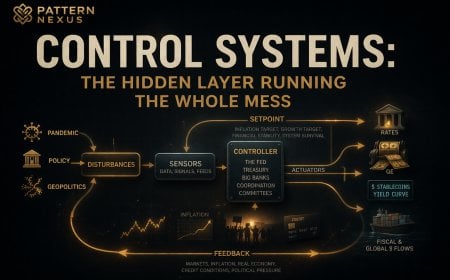
When I say “control systems,” I’m not talking about some lazy catchphrase. I mean that the world is governed through interlocking structures that shape behavior, constrain choices, and produce predictable responses. Money is a control system. Debt is a control system. Narratives are a control system. Supply chains are a control system. Access to energy is a control system. Access to markets is a control system. Sanctions are a control system. Military positioning is a control system.
Most people imagine power as something obvious and theatrical. A president gives a speech. A bomb drops. A law gets signed. A stock crashes. Those are visible outputs.
But visible outputs are usually downstream of hidden architecture.
The real question is always: what system made that event more likely?
Why did that decision become available at that specific time?
What pressures forced it?
What incentives rewarded it?
What narrative structure was laid down in advance so that people would interpret it the right way afterward?
That is how you have to think if you want to actually understand the world.
This is also why I often say that valid objections from readers are usually not wrong. They’re just incomplete.
Someone will say, “It’s about oil.”
Yes, it is.
Someone else will say, “It’s about central banking.”
Yes, it is.
Someone else will say, “It’s about military empire.”
Yes, it is.
Someone else will say, “It’s about AI, debt, demographics, trade corridors, or domestic politics.”
Yes. It is all of those things.
The problem is not that any one of those observations is false. The problem is that most people stop at the first layer they recognize.
What I am usually trying to do is show how those things connect into a larger machine.
That machine does not require every person inside it to understand the whole thing. In fact, most people operating inside powerful systems only understand the piece directly in front of them. That is how large systems function. Fragmentation of understanding is often part of the design.
You do not need everyone to know the full map.
You only need them to perform their role within it.
That is why the world often looks chaotic on the surface while still producing very coherent outcomes over long periods of time.
That is also why I come back so often to the distinction between narrative and structure.
Narrative tells you why something happened.
Structure tells you how it was made possible.
And control sits underneath both.
I also want to add something from the comments, because this came up heavily on one of my Bitcoin posts from about two or three weeks ago. That post got a lot of engagement. A lot of opinions. A lot of people calling Bitcoin digital beanie babies. And that’s fine. Everyone has an opinion about Bitcoin. Everyone has an opinion about what is real money and what is fake money and what has value and what does not.
My view is simpler than that.
An asset is an asset.
It does not matter what it is.
A rock can be an asset.
I literally have an article about rocks being money. On one island, giant carved stones effectively functioned as money, or at minimum as a socially accepted store of value and status-linked accounting system. Very few people read that piece because the idea sounds foreign to them. But the point is not whether people personally like the example. The point is that anything can become money if enough people within a system agree that it functions as money.
Gold can be money.
Silver can be money.
Bitcoin can be money.
Cattle can be money.
Land can be money.
Dirt can be money.
Air can be money if access to it is constrained and tradable.
Anything can be monetized.
People get trapped in this illusion that there is some sacred dividing line between “real money” and “fake money,” but most of that is just social conditioning layered over systems of power and historical habit.
Money is not magical.
Money is a claim.
That’s it.
It is a claim on resources, a claim on labor, a claim on production, a claim on energy, a claim on time, and ultimately a claim on your share of what the world extracts from the earth and turns into usable goods and services.
That is all money really is.
Money is your claim on those foundational resources as they are extracted, processed, moved, and distributed through the global system.
And in a deeper sense, money is also your claim on experience.
The more money you have, the more world you get to see.
The less money you have, the less world you get to see.
That is not poetry. That is the practical reality of how access works.
Money decides where you can go, what you can touch, what kind of life you can build, how much pain you can avoid, and how many options you have when systems turn against you.
So when I say money is a control system, I mean it literally.
Money is not “real” in the way people think it is real. It is real in its effects. But as a concept, it is an organizing mechanism. It exists to ration access. It exists to direct behavior. It exists to keep order through controlled scarcity, controlled permission, and controlled distribution.
If everyone had access to everything at once, the current system would collapse.
That is the uncomfortable truth.
At the same time, if no one had to compete, strive, build, risk, or create, we also probably would not have a lot of the complexity and technology that exists today. That is a different debate, a broader debate, and I do not want to spend this article diving all the way into that economic theory. But it matters enough to mention, because this is where so many people get confused.
They think criticizing money as a control system means denying that incentives matter.
That is not what I am saying.
I am saying the system is built to distribute incentive, pain, reward, access, and dependency in a very specific way.
That brings me to another comment I saw: that the United States and the fiat system can create as much private money as they want and continue rolling the tax base over and over again.
Yes.
That is largely true.
There is no hard limitation inside the current system in the way many people imagine. The limitation is not purely mathematical. The limitation is political legitimacy, inflation tolerance, productive capacity, energy availability, and the ability to keep confidence intact while the system grows.
As long as the system keeps expanding, debt can keep increasing.
And as debt increases, the amount of money in the system increases.
And as the amount of money in the system increases, the velocity channels change, asset prices rise, balance sheets inflate, and those who own assets become richer.
Then they borrow against those assets, spend more into the economy, buy more productive capacity, acquire more claims on future output, and reinforce the cycle.
That is why I keep telling people that the cage-state economy is not some distant sci-fi scenario.
It is already being built.
A lot of people tell me, “It’s all going to collapse.”
And my answer is usually no, not in the simple way you mean.
They have already shown you what the future looks like.
The future looks a lot more like Ready Player One than some Mad Max total reset.
If you have never seen that movie, go watch it.
For a huge portion of society, the future is not going to look like freedom, abundance, and ownership in the old sense.
It is going to look like layered dependency.
It is going to look like managed existence.
It is going to look like people living in compressed physical conditions while escaping into digital worlds, entertainment layers, augmented identity, virtual status, and synthetic meaning structures because tangible upward mobility keeps getting harder.
It is going to look like direct fiscal support, food support, digital distraction, and permissioned existence packaged as convenience.
Middle-class people living in increasingly constrained real-world conditions while spending more and more of their lives in digital overlays is not some crazy distant theory. It is already visible in partial form.
We are already there.
It just has not swallowed the whole system yet.
It has only consumed parts of the social order so far.
Not everyone has bought into dependence.
Not everyone has been forced into dependency.
But over time, many more people will be, because life will get harder, opportunity will narrow, and AI will displace large categories of labor faster than society can adapt.
This is another place where I disagree with the overly optimistic AI narrative.
People say AI will create endless opportunity for humanity.
Maybe in an abstract civilizational sense, yes.
Maybe at the level of productive capacity, yes.
Maybe for elites, owners, highly adaptable operators, and people positioned near the infrastructure layer, yes.
But for the average person trying to earn money, maintain bargaining power, and build a stable middle-class life inside the system, that does not automatically follow.
That assumption is often just a past-world framework projected onto a future that no longer operates by the same rules.
If you want my broader view on that, read my AI Wars, Our Human Wars article. I laid a lot of this out there.
I even wrote about the future conflict between Earth and Mars and how that will eventually emerge. People laugh at that kind of thing because they think it sounds too far away or too cinematic. But these kinds of developments are often more predictable than people realize, because systems create incentives, incentives create feedback loops, and feedback loops create inevitabilities.
That is the world we live inside.
That is what The Matrix was really trying to teach you.
Not that reality is fake in some cheap philosophical sense, but that systems generate paths, constrain choices, and produce repeated outcomes so reliably that people mistake the loop for freedom.
Over the last few days, and especially over this weekend, we’ve had Iran, Israel, and the United States increasingly bombing oil-related infrastructure, strategic targets, and commercial structures tied to the broader functioning of the region. Iran is also striking civilian-linked infrastructure, desalination capacity, commercial systems, and shipping-related targets.
This is going to continue.
More countries are making defense posture statements.
More countries are adjusting military positioning.
More actors are being forced to clarify where they stand.
The world right now feels like it is sitting on a seesaw where one side is dropping fast and nobody has yet landed on the other side hard enough to stabilize the balance.
And if nobody does, then the drop ends in impact.
That impact does not create clean outcomes.
It creates unknown outcomes.
It creates branching paths.
It creates second-order and third-order effects that nobody fully controls once the motion is large enough.
That is part of what makes this so dangerous.
People keep treating this like a list of separate incidents.
It is not.
It is an acceleration event.
And underneath all of it is an enormous amount of waste and destruction that the modern world tends to ignore until the bill arrives.
Think about the amount of ordnance being used.
Think about the missiles, drones, interceptors, bombs, logistics, replacement parts, aircraft wear, naval deployment costs, damaged industrial sites, damaged water systems, damaged refineries, damaged ports, damaged shipping, damaged confidence, damaged insurance structures, and damaged civilian commercial systems.
All of that has to be replaced.
All of that has to be rebuilt.
All of that has to be financed.
All of that eventually feeds back into inflation, debt issuance, industrial demand, military procurement, fiscal strain, commodity repricing, and the next layer of political justification.
There are so many aspects to what is happening right now that I could write a separate article about almost every single topic I’ve touched on in this one.
I could write one just on Bitcoin and the concept of money.
I could write one just on AI and dependency.
I could write one just on Hormuz and shipping insurance.
I could write one just on Iran, Venezuela, and China’s oil structure.
I could write one just on the coming form of digitally managed economic life.
I could write one just on the military-industrial replacement cycle that follows modern wars.
But what I’m trying to do here is give you a systems view.
Not a perfect systems view, not a fully exhaustive one, but a systems view from enough altitude that you can start seeing how these pieces fit together.
Before I close, I want to address some of the comments I’ve seen lately, because a lot of you are circling around the same core point from different directions.
Some of you are saying this war is moving too fast and spreading too widely to be viewed as just another isolated regional conflict. I agree.
Some of you are saying markets still seem too calm relative to what is actually taking place on the ground. I agree with that too.
Some of you are saying the public still does not grasp how much of the world economy sits on top of fragile shipping routes, fragile currency arrangements, and fragile political legitimacy. I agree with that as well.
Some of you have said that it feels like all of this was building for a long time and now several systems are starting to break pressure at once. That is very close to how I see it.
Others have raised the point that the system often appears to manufacture the justification it later needs to do what it was already going to do. Again, I think that is a valid observation. Whether people want to phrase it that way or not, history is full of examples where structural incentives existed first and moral or political narratives were organized afterward.
Some of you think I’m too bearish. Some think I’m too cynical. Some think I’m overfitting patterns. That’s fine. I understand why people would think that.
But I would say this very clearly: I am not claiming every event is scripted in some cartoonish sense. I am saying that systems under stress tend to move in ways that favor the preservation of power, the preservation of monetary hierarchy, and the preservation of strategic control.
That should not even be controversial.
That is how empires behave.
That is how institutions behave.
That is how financial systems behave.
That is how power behaves.
And when multiple systems are under strain at once, the responses become more aggressive, more visible, and more dangerous.
A lot of people also keep assuming that because things have not fully broken yet, they will not break.
That is one of the most common errors people make in all cycles.
They assume the system is stable because it is still standing.
But systems often remain standing right up until the moment they reprice violently.
That is true in markets.
That is true in banking.
That is true in geopolitics.
That is true in empires.
The reason I write the way I do is because I am trying to trace the structure before the repricing is obvious to everyone.
That does not mean I will be right about every timing point.
It does mean I am looking at the world through a framework that tries to connect finance, war, energy, logistics, and political behavior into one model instead of pretending they are all separate conversations.
They are not separate conversations.
They are one conversation.
So where does that leave us?
It leaves us in a world where the old order is being tested, the monetary system is strained, energy flows are weaponized, shipping routes are no longer neutral, and major powers are being forced to make decisions sooner than they wanted to.
It leaves us in a world where a recession may not simply be an accident, but a policy-usable event.
It leaves us in a world where inflation may not be just a domestic issue, but a geopolitical transmission mechanism.
It leaves us in a world where the Middle East is not just the Middle East. It is the hinge between energy, currency, shipping, and military dominance.
It leaves us in a world where money is increasingly revealed for what it actually is: not a sacred object, but a system of claims, permissions, incentives, exclusions, and access.
It leaves us in a world where digital assets, fiat expansion, AI displacement, military conflict, and social dependency are not separate topics. They are interlocking features of the same evolving structure.
And it leaves us in a world where China may eventually have to decide whether it is willing to defend its economic lifelines in a real, visible, military way, or accept a future defined inside a system still dominated by the United States.
That is why I do not think this is just another short-term flare-up.
This feels bigger because it is bigger.
Not only in the number of explosions, not only in the number of countries involved, not only in the amount of destruction, but in what it represents.
It represents a world order under revision.
It represents a monetary order under stress.
It represents a control structure being tightened in some places, challenged in others, and exposed more openly than most people are used to seeing.
A lot of what was considered impossible in 2025 is now on the table in 2026.
That alone should tell you something fundamental has changed.
And once that starts happening, you should stop asking whether the world is returning to normal and start asking what the next normal is going to look like.
あなたの反応は?
 いいね
0
いいね
0
 嫌い
0
嫌い
0
 愛
0
愛
0
 面白い
0
面白い
0
 ワオ
0
ワオ
0
 悲しい
0
悲しい
0
 怒っている
0
怒っている
0

Founder of Pattern Nexus. I research markets, macro, geopolitics, AI, history, ancient systems, and the patterns most people overlook. I’m also building Market Radar, a trading scanner designed to read pressure, risk, confirmation, and setup quality before chasing a move. Pattern Nexus is where I connect the dots between data, history, technology, and the bigger system playing out around us.






コメント (0)