
AI Feedback Loops: How Self‑Reinforcing Systems Quietly Shift Power
AI Feedback Loops Are Rewriting Power – Systems & Patterns (2025) From predictive policing to trading algorithms and social platforms, AI-driven feedback loops are shaping behavior and concentrating control. What happens when the system trains itself—and we can’t see how?
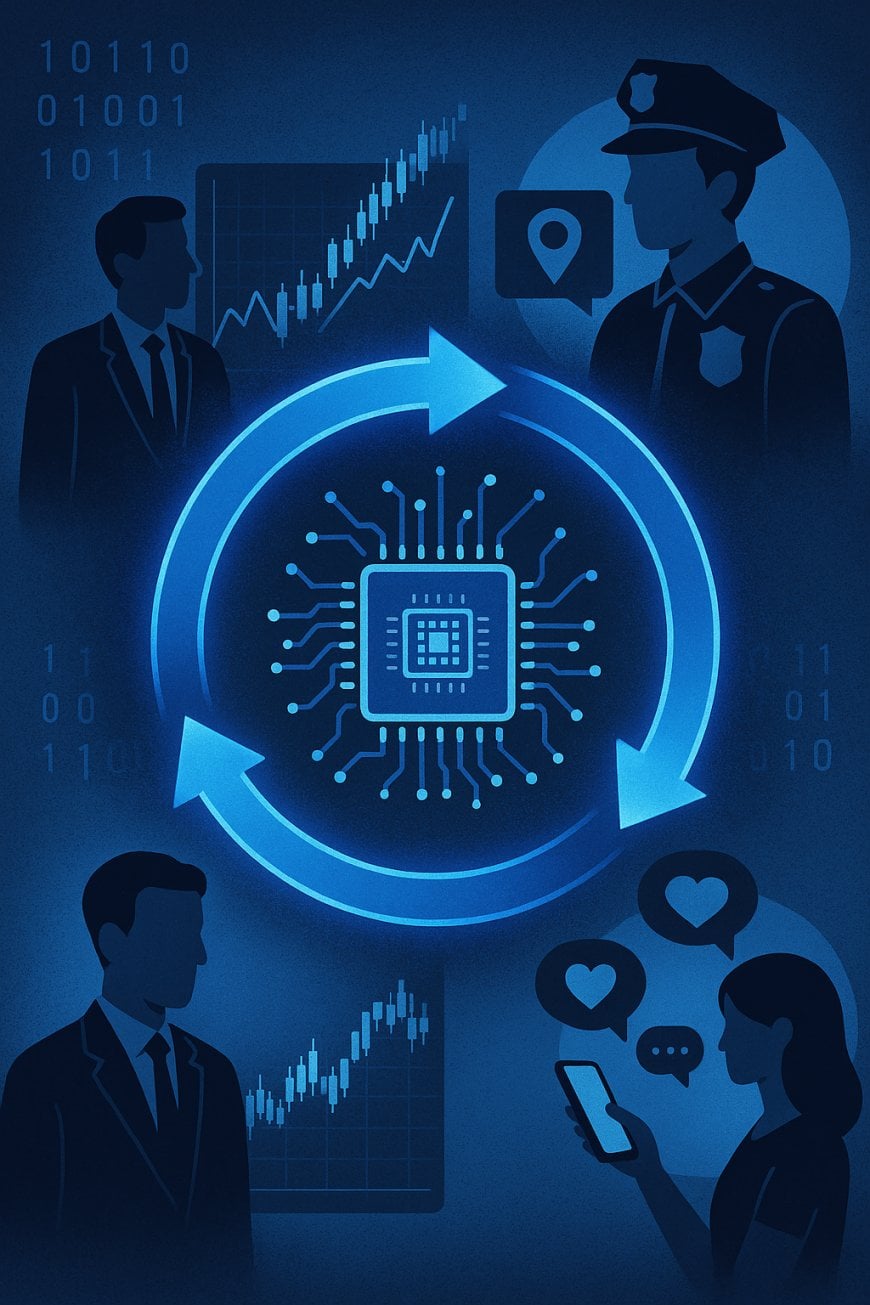
AI Feedback Loops and the Quiet Reshaping of Power
Advanced algorithms and artificial intelligence are increasingly mediating our world in subtle but profound ways. They learn from our behavior and, in turn, shape our behavior – creating feedback loops that reinforce certain patterns. From policing tactics and financial trades to the news we see on social media, these AI-driven systems are quietly shifting who holds power and control. What makes them especially potent is their ability to adapt and self-reinforce: once set in motion, they can amplify biases or trends without any human telling them to do so. This article examines how such self-reinforcing tech systems operate in domains like law enforcement, finance, social platforms, and governance, and why their opaque, automated nature poses new challenges for society.
Predictive Policing: When Data Becomes Destiny
One striking example of an AI feedback loop is predictive policing – the use of algorithms to forecast crime and guide law enforcement. In theory, it promises data-driven deployment of police to where crime is likely. In practice, it can create a pernicious cycle. Consider Chicago’s now-infamous “Strategic Subjects List,” which algorithmically ranked people by their supposed likelihood of being involved in gun violence. In 2017, a Chicago resident with no criminal record was shocked to find himself on this list after being the victim of a shooting. Because the system flagged him (based on criteria like having past contact with police, even as an innocent victim), he became a target for intensified police attention and surveillance. This reveals a disturbing pattern: the algorithm drew on historical police data – data imbued with existing biases about which neighborhoods and individuals were policed – and then recommended more policing for those same people and places. Every new police encounter fed back into the software as further proof of “suspicious” activity, which in turn justified even more aggressive patrols in those communities. The result was a feedback loop of escalating surveillance. Instead of objectively predicting crime, the tool was amplifying the police department’s prior focus, effectively automating a self-fulfilling prophecy. Such systems can unfairly entrench racial and socioeconomic biases under the guise of algorithmic objectivity.
The power dynamics here are subtle but real. The communities labeled “high risk” by a computer may find themselves caught in a cycle that is hard to break, as the very label invites heavier policing. Meanwhile, the police officers on the ground might start to trust the algorithm’s outputs implicitly – a phenomenon known as automation bias. There have been multiple cases in the United States where this bias led to grave mistakes. For instance, facial recognition software (another algorithmic policing tool) has misidentified innocent people as criminal suspects. In at least eight instances, individuals – predominantly Black men – were wrongfully arrested because police treated an AI-generated match as ironclad evidence. In one report, officers described the software’s pick as a “100% match” to the suspect, immediately accepting it as truth and proceeding with an arrest. Only later, after innocent people spent time in jail, did it become clear the algorithm was wrong. Basic checks that a human detective might normally do (like verifying where the person was at the time of the crime or comparing distinguishing features) were bypassed because the computer’s word carried so much weight. This illustrates how easily human oversight can be sidelined when an algorithm enters the chain of decision-making. The risk is that police and officials begin to defer to machines over their own judgment, shifting power to the algorithm’s unseen logic. And when that logic is hidden – often these policing algorithms are proprietary, developed by private companies that don’t reveal their inner workings – it becomes nearly impossible for those affected to challenge or even understand why they have been flagged. The result is a loss of transparency and accountability in a core function of governance.
Algorithmic Markets: Trading at the Speed of AI
Finance is another arena where AI-driven feedback loops have quietly reconfigured power. Today, the majority of stock trades are executed not by humans yelling on a trading floor, but by algorithms co-located in data centers. Estimates suggest roughly 60–70% of trades in equities markets are now handled by automated trading systems. These algorithms operate on millisecond timescales and respond to market data far faster than any human can blink. While this brings efficiency and liquidity, it also introduces new kinds of volatility and systemic risk that stem from feedback effects among algorithms. A dramatic example was the “Flash Crash” of May 6, 2010, when nearly $1 trillion in market value vanished within minutes, only to largely rebound half an hour later. Investigations found that the crash was not caused by any major news or human panic, but by algorithms triggering each other in a rapid chain reaction. One automated trading program’s large sell order hit the markets, which was interpreted by other high-frequency trading algorithms as a sign to sell as well. Those sales drove prices down, which in turn activated even more algorithms programmed to withdraw liquidity or short the market at certain thresholds. In effect, one feedback loop set off the next and then the next, in a cascading failure of coordination. With so many bots following similar strategies, the market became an echo chamber of algorithms amplifying each other’s moves. Prices plummeted in a self-reinforcing spiral until circuit-breakers halted the trading.
The Flash Crash was a wake-up call to how much power these unseen algorithms wield over financial stability. What’s more, it highlighted an uncomfortable truth: as markets become dominated by automated agents, small errors or quirks in one system can be magnified through feedback loops into systemic events. In this case, no malicious intent was needed – the algorithms were simply following their code – yet collectively they nearly crashed the stock market. This concentration of control in algorithms also shifts power toward those who design and deploy them. Elite trading firms with the fastest, smartest algorithms can effectively outrun and outmaneuver traditional investors, potentially profiting from swings that their own machines help create. Regulators have been grappling with how to oversee this new reality. Proposals include stronger transparency requirements (for example, having algorithms certified or stress-tested for weird scenarios) and circuit breakers to dampen runaway feedback effects. However, direct regulation is challenging because these trading models are complex and proprietary, and financial firms fiercely guard them as trade secrets. Here again we see opacity: the code that moves billions of dollars around in microseconds is typically invisible to everyone except its creators. Society at large must trust that a few technologists have gotten things right – and as the Flash Crash showed, even a minor oversight can spiral out of control. The potential long-term risk is an unstable market ecosystem prone to sudden shocks that erode public confidence, all orchestrated by autonomous systems humming quietly in the background.
Social Platforms and Behavioral Nudging
If predictive policing and trading algorithms illustrate inadvertent feedback loops, social media platforms demonstrate how algorithms can be deliberately designed to nudge human behavior – and the far-reaching consequences that can follow. Modern social platforms like Facebook, YouTube, TikTok, and Twitter rely on recommendation engines and feeds tailored by AI to maximize user engagement. Every click, like, or share you make becomes input for the algorithm to decide what to show you next, in an endless cycle tuned to keep you scrolling. This creates a powerful feedback loop between human attention and machine curation. Content that triggers a strong reaction (whether it’s outrage, joy, or shock) tends to get more engagement, so the algorithm learns to serve up more of it. Over time, users can become cocooned in what are often called “echo chambers” – seeing mostly posts that align with their existing interests or emotions, because those are the posts that got them to interact before. The process is subtle; users might not realize their feeds are quietly being optimized to push their buttons. But at scale, this algorithmic nudging can shape public opinion and even societal norms.
One infamous case that exposed the power of these systems was the Cambridge Analytica scandal. In 2016, a political consulting firm harvested data on tens of millions of Facebook users and used it to micro-target political advertisements and messages. Facebook’s own algorithms, which determine what content each user sees, became the delivery mechanism for this targeted persuasion. By exploiting the platform’s ability to segment and influence audiences – for instance, sending specific emotional ads to people deemed neurotic or agreeable based on their data – the campaign sought to sway voter behavior. In effect, voters were being nudged in a highly personalized way, outside of their awareness. When this came to light, it raised broader awareness that the constant flood of tailored ads and posts on social media isn’t just about selling shoes or getting clicks – it can be harnessed to manipulate opinions, shopping habits, and votes. Unlike traditional propaganda or marketing, algorithmic nudging operates one-on-one at mass scale, quietly exploiting each user’s tendencies.
Even everyday platform dynamics show the feedback loop at work. Consider how quickly misinformation or extreme content can go viral. If a sensational claim sparks curiosity and people start engaging with it, the platform’s recommendation engine notices the spike and promptly shows that content to more users. Reddit once saw this with a privacy violation incident: stolen private photos of a celebrity were posted, and as throngs of users clicked and upvoted them, Reddit’s automated ranking system kept pushing the images to the top, which drew in even more viewers. In that feedback cycle, engagement begot visibility, which begot more engagement – to the benefit of the platform’s traffic metrics, but at a huge cost to the victim’s privacy and dignity. More routinely, YouTube’s autoplay and “Up Next” algorithms have been criticized for steering viewers toward increasingly extreme videos to keep their attention – for example, drawing someone watching a mild political video into more radical content after a few hours of algorithm-guided suggestions. All of this translates to influence. The power to set these digital “reward systems” for content effectively allows platform owners to influence what information spreads and which voices get amplified or marginalized. It’s a form of soft power exerted by algorithms: not outright censorship or control in the traditional sense, but by tweaking what the audience sees, platforms can subtly shape users’ perceptions of reality. And because the algorithms optimize for engagement above all else (which often correlates with outrage or titillation), they can end up favoring emotionally charged material, contributing to polarization and misinformation spread.
Governing by Algorithm: Efficiency at the Expense of Fairness?
AI-driven systems are not confined to the private sector; they are increasingly embedded in governance and public services. Around the world, governments and agencies have begun using algorithms to help make decisions on matters such as welfare eligibility, unemployment fraud detection, school placements, and even judicial sentencing recommendations. The promise is that algorithms can process data more efficiently and “objectively” than human bureaucrats, potentially eliminating human error or prejudice. But early real-world examples have exposed a darker side: these automated systems can inherit and conceal deep biases, and their opacity can make them dangerous tools of control without accountability. A telling case emerged in the city of Rotterdam in the Netherlands, where an algorithm was deployed to identify welfare benefits fraud. An investigative analysis in 2023 revealed that this system was discriminating based on ethnicity and gender – for instance, single mothers of certain ethnic backgrounds were far more likely to be flagged as “high risk” by the model. This happened even though sensitive attributes like race weren’t explicitly fed into the algorithm; instead, proxies (such as someone’s native language or postal code) served as covert signals, reflecting historical biases. Because the model operated within a bureaucracy with little transparency, those being investigated had no idea a computer’s hidden calculation had singled them out, nor could they easily contest it. It was only through journalists and researchers gaining access to the code (via freedom of information laws) that this bias came to light. One can only imagine how many similar algorithms in government are running unchecked “under the cover of bureaucratic darkness,” silently amplifying inequalities in who gets investigated or who is deemed worthy of support.
This phenomenon has been described as part of the broader issue of algorithmic governance. Decisions that used to be made (imperfectly) by humans – often with avenues for explanation, appeal, or public debate – are now sometimes made by inscrutable models. For example, in the criminal justice system, many jurisdictions use risk assessment algorithms to help judges decide whether a defendant should be granted bail or what their sentence should be. One well-known tool in the U.S., COMPAS, was found to have significant racial bias: it was more likely to falsely label Black defendants as high risk for reoffending compared to white defendants. Such bias in a human judge would be cause for scandal; in an algorithm, it remained largely hidden until investigative journalists and academics studied the outcomes. The use of these tools hands a certain kind of power to software vendors and data scientists who create them – often private companies – while judges, officials, and the public may not understand how decisions are being made. It challenges the legitimacy of governance: if people feel decisions are coming from a “black box” that cannot be questioned, trust in institutions erodes. Moreover, algorithmic systems can scale bureaucratic decisions in a way that, if flawed, harms thousands before the issue is caught. Imagine an unemployment benefits algorithm that mistakenly flags thousands of honest applicants as fraudsters due to a flawed rule; unless someone audits or intervenes, livelihoods could be ruined en masse by an unthinking loop of code. This combination of scale, opacity, and authority makes algorithmic governance a double-edged sword – efficient, perhaps, but potentially unjust and hard to challenge.
Opaque Systems, Automation Bias, and Self-Reinforcement
Across all these domains – policing, finance, social media, public services – certain recurring themes emerge. One is opacity. Many AI-driven systems are effectively “black boxes.” Whether it’s a deep learning model whose complex neural weights even its creators can’t fully interpret, or simply a proprietary algorithm whose details are kept secret, the inner logic of these systems is often hidden. This opacity means that people affected by algorithmic decisions frequently have no insight into why a decision was made. If your loan application is denied or your post is taken down or you keep getting harassed by police checks, and an algorithm is behind it, you are unlikely to be given a satisfying explanation. The lack of transparency tilts power toward those running the algorithms and away from those subjected to them. It also makes it difficult for society to have a debate about fairness – after all, how do we scrutinize or improve a system we aren’t allowed to see? For instance, predictive policing vendors have at times resisted releasing their code or data, citing intellectual property. But that secrecy means crucial public decisions (like who is deemed a threat) are made beyond public oversight. In finance and online platforms, trade secrecy and proprietary advantage similarly keep algorithms under wraps. The result is a growing gap in information and power: a small group of engineers and corporations know how the “rules” work, and everyone else must accept the outcomes.
Another key issue is the human tendency to place too much trust in automation – we touched on this as automation bias. It bears emphasizing that when people assume “the computer is always right,” errors can propagate and worsen. Automation bias doesn’t just afflict police; it affects anyone using AI for decision support. A doctor might rely on an AI diagnostic tool and miss an obvious clinical sign that the machine got wrong, or an investor might stick with a model’s output even when market conditions have changed in ways the model wasn’t trained to handle. The danger is that human judgment, which is supposed to be the fail-safe, gets dulled. The 737 Max airplane crashes in 2018–2019, for example, were partly attributed to pilots not fully understanding or reacting properly to an automated system (the MCAS) that was doing something wrong. While not an AI per se, it’s an illustration of how excessive trust in automation can have fatal consequences. In societal contexts, automation bias can lead to institutionalizing mistakes – like wrongful arrests or unfair denials of benefits – at scale. Once a biased algorithm is in use, people might defend its decisions simply because “it’s data-driven” or appears objective, when in fact it could be systematically wrong.
Perhaps the most insidious aspect of all is how self-reinforcing these algorithmic systems can be. Because many of them learn from feedback, there is a risk of a vicious circle. Imagine an algorithm that determines who is a “high-risk” employee at a company and thus gets extra monitoring. If that algorithm over-scrutinizes certain workers, those workers might end up with more infractions on record (since they’re being watched more closely), which then confirms the algorithm’s initial bias and leads it to target even more people like them. Or consider social media again: if an algorithm disproportionately shows certain types of content (say, sensationalist news) because that drove engagement early on, it will train on user responses to that content and double down, potentially crowding out more moderate voices. Over time, these loops can significantly shift the landscape. In her book Weapons of Math Destruction, data scientist Cathy O’Neil warned that such systems tend to “punish the poor and the oppressed in our society, while making the rich richer,” precisely because they pick up on historical data that reflects existing inequalities and then reinforce those patterns going forward. For instance, if poor neighborhoods have less access to credit and thus fewer loans, a banking algorithm might conclude those areas are bad credit risks and approve even fewer loans there, further stifling economic opportunity. The bias becomes institutionalized and amplified with each iteration of the algorithm’s use. Long-term, these self-perpetuating loops can harden social stratifications and create a kind of automated inertia that is hard to reverse. In a very real sense, they can lock us into the past.
Navigating the Future: Toward Transparency and Oversight
Recognizing these patterns is the first step toward regaining balance. The systems and feedback loops described here are complex, but not invincible. A growing chorus of experts, activists, and even industry insiders are calling for algorithmic accountability. This means implementing measures like algorithmic audits and impact assessments – essentially stress-tests and reviews of algorithms for bias, fairness, and validity, similar to a financial audit – especially for systems used in high-stakes public roles. Some jurisdictions have begun to require that if an algorithm is used in, say, hiring or policing, it should be vetted for discrimination and its outcomes monitored. There are also pushes for transparency by design: for example, requiring companies to disclose the factors their algorithms consider, or open-sourcing certain government algorithms so independent researchers can examine them. While proprietary business interests often resist this, the counterargument is that when algorithms wield power over people’s lives, the public’s right to know should sometimes outweigh trade secrets.
On the human side, training and awareness can mitigate automation bias. Police departments and organizations that adopt AI tools need to instill a culture of healthy skepticism: treat the algorithm as one input, not the final word. In practice, this could mean always having a human in the loop to verify and contextualize important algorithmic decisions. For example, if a system flags someone as high risk, a human analyst should review the underlying factors and check for alternate explanations before any action is taken. In aviation, pilots are now trained more rigorously on how to handle and override automated systems; similarly, professionals in law, finance, medicine, and other fields using AI need training on the limits of these tools and how to spot when they’re going awry. It’s also crucial to preserve avenues for appeal and redress: if an automated system makes a decision about you (denies your loan, marks you as a security risk, etc.), there should be a clear process to question and correct that decision. This often requires policy intervention, as individual companies may not volunteer such mechanisms.
Finally, society needs a broader conversation about the acceptable uses of self-learning systems and where to draw lines. Not every process should be handed over to an algorithm just because it can be. As we’ve seen, when complex social problems – like crime, or creditworthiness, or political discourse – are handed off to machines, the results can be efficient but also dehumanizing and dangerously reinforcing of the status quo. Technology is moving fast, but our governance and ethical frameworks can catch up if we demand it. By shining light on these quiet shifts in power, we can develop new norms and regulations that harness the benefits of AI-driven systems (speed, scale, consistency) while curbing their risks. The goal is to ensure these feedback loops serve society broadly, rather than simply entrenching the power of whoever sets them in motion. In the end, algorithms should be tools to augment human decision-making, not replace it or create automated fiefdoms. Keeping humans in charge – and values like fairness and transparency at the core – will be key to navigating a future where AI is deeply interwoven into the patterns of our lives.
- Social Science Research Council – Impact Assessment of Human-Algorithm Feedback Loops (2022)
- London School of Economics – AI and the Stock Market: Are Algorithmic Trades Creating New Risks? (2025)
- Harvard Business Review – Algorithmic Nudges Don’t Have to Be Unethical (2021)
- Jones Walker Law Blog – AI Police Surveillance Bias: The “Minority Report” Impacting Constitutional Rights (2025)
- WIRED – Inside a Misfiring Government Data Machine (2023)
- Xu Ru Zhang – Long-Term Impacts of Fair Machine Learning (2023)
Apa Reaksi Anda?
 Suka
0
Suka
0
 Tidak Suka
0
Tidak Suka
0
 Cinta
0
Cinta
0
 Lucu
0
Lucu
0
 Wow
0
Wow
0
 Sedih
0
Sedih
0
 Marah
0
Marah
0

Founder of Pattern Nexus. I research markets, macro, geopolitics, AI, history, ancient systems, and the patterns most people overlook. I’m also building Market Radar, a trading scanner designed to read pressure, risk, confirmation, and setup quality before chasing a move. Pattern Nexus is where I connect the dots between data, history, technology, and the bigger system playing out around us.

















Komen-komen (0)