
December 10, 2025: QT Ends, QE-Lite Begins
The Fed cut rates by 25 bps, acknowledged rising downside risks to employment, and quietly ended QT by initiating short-term Treasury purchases to maintain reserves, marking the start of a new liquidity regime.
December 10, 2025
Quick overview
Pattern Nexus:
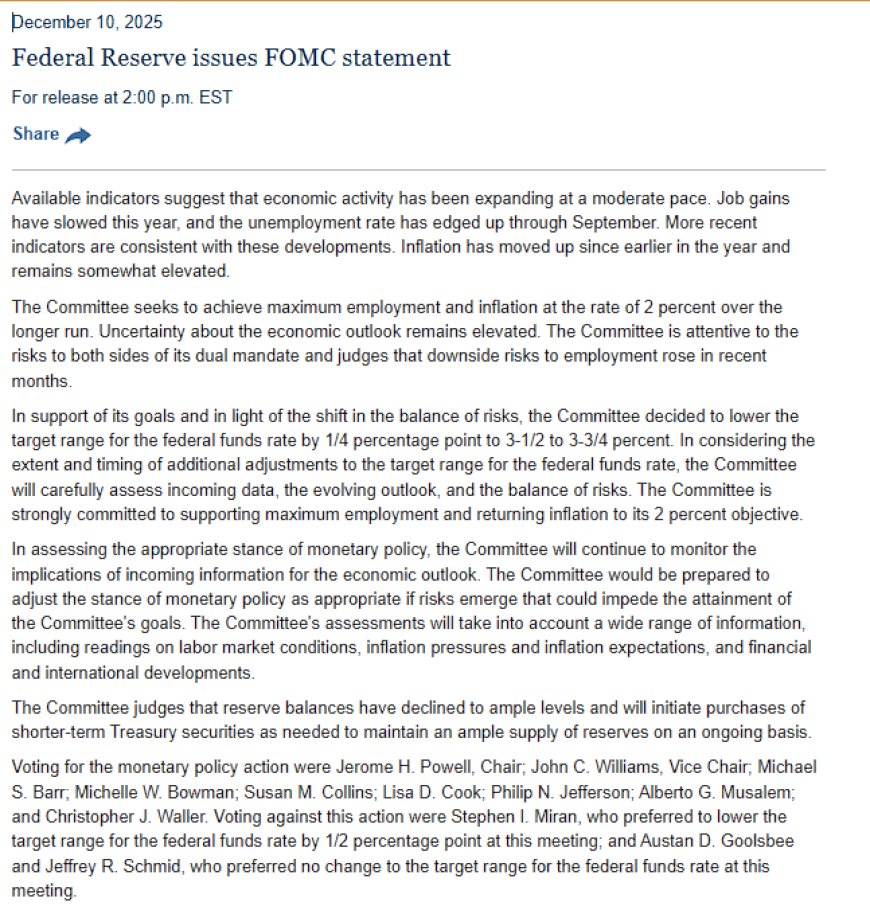
- Rate decision: The Fed cut the federal funds rate by 1/4 percentage point to a target range of 3.50–3.75%.
- Growth and labor: Economic activity is “expanding at a moderate pace,” but “job gains have slowed” and the unemployment rate has “edged up.” The Committee explicitly notes that downside risks to employment have risen.
- Inflation: Inflation has “moved up since earlier in the year” and “remains somewhat elevated,” yet the Fed cut anyway. Labor risks now dominate the reaction function.
- Balance sheet: The Fed judges reserve balances have declined to ample levels and will initiate purchases of shorter-term Treasuries as needed to maintain ample reserves. In Fed-speak, “ample” is the minimum safe reserve floor, not a surplus. This is the functional end of QT and the start of QE-lite.
- Committee split: One voter wanted a 50 bps cut; two wanted no cut at all. This is a transition meeting at the turn of the regime.
- Big picture: The liquidity floor has been hit. The plumbing is now in charge of policy. The path to QE-2026 is open.
What the Fed actually decided and said
The Federal Open Market Committee (FOMC) voted to lower the target range for the federal funds rate by 1/4 percentage point to 3-1/2 to 3-3/4 percent. This is framed as a response to a shift in the balance of risks toward the employment side of the mandate, with inflation still above target but no longer treated as the binding constraint.
On the state of the economy, the statement opens with:
- “Available indicators suggest that economic activity has been expanding at a moderate pace. Job gains have slowed this year, and the unemployment rate has edged up through September. More recent indicators are consistent with these developments.”
- “Inflation has moved up since earlier in the year and remains somewhat elevated.”
On the dual mandate and risk balance, the Committee writes:
- “The Committee seeks to achieve maximum employment and inflation at the rate of 2 percent over the longer run.”
- “Uncertainty about the economic outlook remains elevated. The Committee is attentive to the risks to both sides of its dual mandate and judges that downside risks to employment rose in recent months.”
The policy move is described explicitly:
- “In support of its goals and in light of the shift in the balance of risks, the Committee decided to lower the target range for the federal funds rate by 1/4 percentage point to 3-1/2 to 3-3/4 percent.”
- “In considering the extent and timing of additional adjustments to the target range for the federal funds rate, the Committee will carefully assess incoming data, the evolving outlook, and the balance of risks.”
- “The Committee is strongly committed to supporting maximum employment and returning inflation to its 2 percent objective.”
And on the ongoing assessment framework:
- “In assessing the appropriate stance of monetary policy, the Committee will continue to monitor the implications of incoming information for the economic outlook. The Committee would be prepared to adjust the stance of monetary policy as appropriate if risks emerge that could impede the attainment of the Committee’s goals.”
- “The Committee’s assessments will take into account a wide range of information, including readings on labor market conditions, inflation pressures and inflation expectations, and financial and international developments.”
That language is standard Fed risk-management boilerplate, but in the context of an explicit 25 bps cut and rising labor-market risks, it now carries a clear dovish skew.
What changed vs the last FOMC meeting
Fed statements are written by lawyers with a red pen. The meaning is in the edits. Even without the prior statement in front of you, the direction of change is unambiguous: labor risk up, inflation worry down, liquidity constraints acknowledged.
Last meeting (high-level snapshot)
- Rates: Target range was 3.75–4.00%, which was exactly 25 bps above today’s new range, with the Committee emphasizing a restrictive stance to contain inflation.
- Labor language: The Fed leaned on the idea of a still-strong labor market with solid job gains and a low unemployment rate.
- Inflation language: Inflation was described as elevated, but the emphasis was on the need to keep policy “sufficiently restrictive” until inflation moved convincingly back toward 2%.
- Risk balance: Risks were closer to being framed as balanced or skewed toward inflation rather than employment.
- Balance sheet: QT was ongoing, framed as a passive runoff with no explicit mention that reserves were near any lower bound.
This meeting (December 10, 2025)
- Rates: Target range is now 3.50–3.75%, a 25 bps cut, with the move justified by a “shift in the balance of risks.”
- Labor language: The Committee now states that “job gains have slowed” and that the unemployment rate has “edged up,” and explicitly judges that downside risks to employment have risen.
- Inflation language: Inflation is said to have “moved up since earlier in the year” and to remain “somewhat elevated,” yet this did not prevent a cut. That is a major directional shift.
- Risk balance: The statement highlights that uncertainty about the outlook is elevated and that the downside risks to employment have risen, making the employment side the binding constraint.
- Balance sheet: Most importantly, the Committee now judges that reserve balances have declined to ample levels and will initiate purchases of shorter-term Treasuries as needed to keep reserves ample. That is new and marks the functional end of QT.
The single most important edit is the new balance-sheet paragraph. The Fed is telling you, in dense central-bank code, that: “We hit the reserve floor. QT is over. We will now buy Treasuries whenever needed to prevent funding stress.”
Liquidity, QT, and the quiet launch of QE-lite
Buried beneath the rate cut is the line that matters most for markets and for the Pattern Nexus Liquidity Composite:
“The Committee judges that reserve balances have declined to ample levels and will initiate purchases of shorter-term Treasury securities as needed to maintain an ample supply of reserves on an ongoing basis.”
In plain English, this means:
- The Fed believes reserves are now at or near the minimum “ample” level required for the system to function without stress. In other words, “ample” here describes the floor, not a comfortable surplus.
- QT, in its effective sense, has reached its lower bound. Pushing further would risk funding instability.
- To prevent that, the Fed is willing to buy short-term Treasuries on demand to keep reserves from falling further. These are reserve-management purchases, but from a liquidity perspective, they are QE-lite.
- These purchases will almost certainly concentrate in Treasury bills, echoing the 2019 “this is not QE” bill-buying program that nonetheless marked a clear turn in the liquidity cycle.
- This is the same basic playbook as 2019: “this is not QE” operations that, in practice, mark the turn in the liquidity cycle.
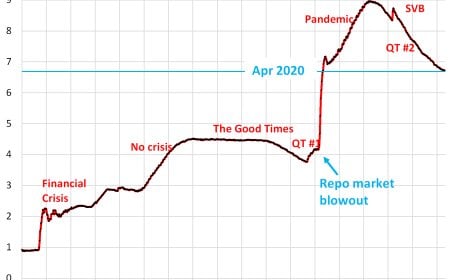
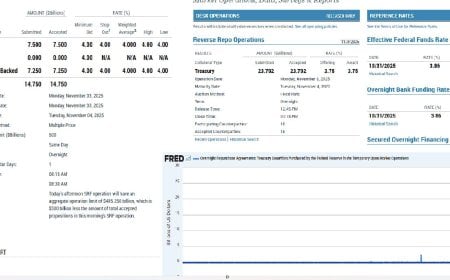
Within the Pattern Nexus framework, this is the moment the plumbing calls the shots. ON RRP has already collapsed toward zero, reserve cushions have thinned, and the system is telling the Fed: “You are out of room on QT.” The statement formalizes that constraint.
Powell will almost certainly frame these purchases as technical operations to support “ample reserves” rather than a change in monetary stance, just as the Fed did in 2019. Markets will look through the branding and trade the balance-sheet direction.
Initial market reaction
The rate cut plus the reserve language is a profoundly dovish combination. Even before the press conference, markets began to reprice the entire forward path of rates and liquidity.
Bonds and rates
- 2-year Treasury: The 2-year, which anchors expectations for the next several Fed moves, is the key tell. A sharp move lower in yields would confirm that traders see this as the start of an easing cycle, not a one-off insurance cut.
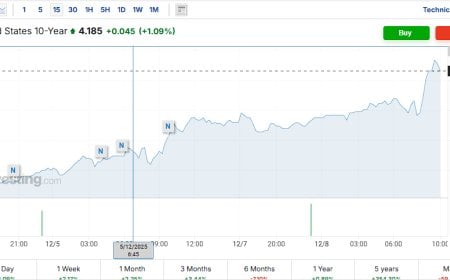
- 10-year Treasury: The 10-year reflects growth, inflation, and term premium. If the 10-year falls alongside the 2-year, the market is leaning into slower growth and earlier easing. If it holds or rises, inflation risk is still alive. With term premium already elevated in 2025, bill-focused QE-lite will not directly crush it, but it will shape expectations for a broader QE program.
- Curve shape: A steepening curve (2s down more than 10s) would be classic early-easing behavior. A flattening or inversion deepening would signal more concern about growth shock and policy error.

Equities and volatility
- Index reaction: A 25 bps cut plus QE-lite language is typically bullish for risk assets, but the details matter. If the market reads the employment language as the Fed chasing a deteriorating cycle, you can get a knee-jerk rally followed by a reality check.
- Sectors: Rate-sensitive sectors (small caps, financials, homebuilders) are the clearest tell for how much the market believes in the easing path. High-duration tech will react to the discount-rate channel and to the implied boost to the AI-industrial buildout.
- Volatility: The balance between a dovish policy pivot and elevated macro uncertainty will show up in the spread between index volatility and single-name skew.

Dollar, gold, and crypto
- Dollar: A softer dollar would confirm that global markets are reading this as a dovish turn and a future drag on real U.S. yields.
- Gold and silver: Elevated inflation plus rate cuts plus reserve additions is a classic hard-asset cocktail. This is textbook bullish for gold, silver, and the broader commodity complex as the market looks ahead to QE-2026.
- Crypto: Crypto continues to behave like a high-beta liquidity gauge. A strong positive reaction would show that traders see this as the official start of the next liquidity wave, not just a technical adjustment.

What this decision sets up for 2026
The real story is not today’s 25 bps. It is the combination of three facts:
- The Fed now openly acknowledges rising downside risks to employment.
- Inflation has moved up and is still “somewhat elevated,” yet they cut anyway.
- QT is effectively over, and reserve-supportive Treasury purchases are now on the table.
Put together, this tells you how 2026 is likely to unfold:
- Rate path: Markets will quickly price a sequence of additional cuts over the next 12–18 months as the Fed leans into labor-market protection and financial-stability risk management.
- Liquidity inflection window: With reserves at the floor and “as-needed” Treasury purchases active, the path to a full QE-2026 program is no longer hypothetical. Any combination of growth shock, credit stress, or market dysfunction will accelerate that timeline. Once the Fed is forced to defend reserves, balance-sheet direction becomes a mechanical response, not a discretionary choice.
- Asset implications: Risk assets that are most levered to liquidity and duration (growth tech, AI, long-duration equities, long-dated credit) stand to benefit first. Hard assets and real assets respond next as the market discounts the long-term consequences of renewed balance-sheet expansion.
- Real economy: For the bottom half of the K-shaped economy, the risk is that asset prices respond faster than wages. The top leg gets rescued by liquidity; the bottom leg still lives in a world of compressed real incomes and rising structural costs.
Pattern Nexus Lens: When the plumbing calls the policy
From the Pattern Nexus perspective, today’s FOMC is not just another meeting. It is the formal recognition of a constraint the liquidity data has been screaming about for months: you cannot run QT indefinitely in a system with structurally thinner reserves and higher structural demand for collateral.
This decision plugs directly into three core Pattern Nexus themes:
- Liquidity Composite and the QT floor The Pattern Nexus Liquidity Composite has been tracking the collision between shrinking Fed reserves, a drained ON RRP facility, and rising demand for safe collateral. Today’s sentence about reserves having “declined to ample levels” is the Fed’s way of admitting that the floor has been reached. Once you hit that floor, QT is over, whether they say the words “QT is over” or not.
- K-shaped economy and policy asymmetry A 25 bps cut plus QE-lite is rocket fuel for the upper leg of the K: portfolios, hard assets, and AI-linked equities. But the statement’s focus on rising downside risks to employment is a quiet acknowledgment that the bottom leg is already under stress. The regime that rescues capital first and wages last is still intact.
- AI-industrial flywheel and QE-2026 The AI-industrial buildout (data centers, grid upgrades, copper, housing, and related infrastructure) is capital-intensive and liquidity-hungry. Ending QT and opening the door to a QE-style reserve backstop is the monetary precondition for the next leg of that buildout. QE-2026 is not guaranteed, but after today’s statement, it is firmly on the path of least resistance.
Strip away the jargon and this meeting comes down to one sentence: the system hit the reserve floor, so the Fed has to turn the liquidity tide. Everything else—the 25 bps cut, the committee split, the employment language—is the human narrative wrapped around that mechanical constraint.
Powell press conference: what he really said
Powell’s press conference wrapped a familiar narrative frame around a completely different macro reality. On the surface, he leaned on tariffs, risk management, and neutral rates. Underneath, he acknowledged higher productivity, AI-linked capex, rising labor-market risk, and the need to restart T-bill purchases to defend reserves. The gap between the story and the plumbing is the whole point.
1. Inflation: “it’s just tariffs” (until it isn’t)
- Headline view: Powell emphasized that PCE and core PCE are both running at 2.8% over the past 12 months, and that these readings are “higher than earlier in the year” because goods inflation has picked up due to tariffs, while services disinflation continues.
- Tariff story: He framed tariffs as a one-time upward shift in the price level, not an ongoing inflation engine, and stressed that the Fed’s job is to make sure this “one-time” shock does not turn into persistent inflation.
- Risk tilt: Despite calling near-term risks to inflation “tilted to the upside,” he repeatedly argued that most of the overshoot is tariff-driven and likely to peak in the first quarter of next year, assuming no new tariffs.
- Pattern Nexus read: Powell is trying to ring-fence inflation as exogenous tariff noise so that rate cuts plus QE-lite can be justified as labor and liquidity protection. The risk he downplays is that markets will price the balance sheet, not the tariff story.
2. Rates, cuts, and “neutral”
- Powell reiterated that with today’s move, the Fed has cut 75 bps over the last three meetings and 175 bps since last September, bringing the funds rate into a “broad range of plausible estimates of neutral.”
- He framed further decisions as meeting-by-meeting, data-dependent, and balanced between employment and inflation risks, with no “pre-set course.”
- The SEP median projection keeps the funds rate around 3.4% at end-2026 and 3.1% at end-2027, unchanged from September, a signaling device that policy is now in the “wait and see” zone.
- Pattern Nexus read: The “neutral” language is cover for a simple reality: the Fed cannot keep tightening when job creation is flirting with zero and reserves are at the floor. Neutral is where you hide when the plumbing forces your hand.
3. Reserves, T-bills, and the quiet end of QT
- Powell explicitly acknowledged that money-market rates had tightened relative to administered rates and that other indicators showed reserve-market strain.
- He stated that the Committee “judged that reserve balances have declined to ample levels” and decided to initiate purchases of shorter-term Treasury securities, mainly T-bills, to maintain an ample supply of reserves over time.
- He stressed that these purchases are for “implementation” only and “separate from the stance of policy,” but then laid out concrete numbers: $40 billion in the first month, remaining elevated for a few months to ease near-term money-market pressures, then stepping down as conditions allow.
- He tied the size and timing to seasonal and secular factors: the need to build reserves ahead of tax day (April 15) and ongoing growth in currency and reserve demand, which he estimated requires $20–25 billion per month of balance-sheet expansion even in normal times.
- Pattern Nexus read: This is the operational admission that QT has hit the reserve floor. The Fed is back to bill buying to defend reserves and keep the funds rate anchored by administered rates rather than day-to-day interventions. Branding it “implementation only” does not change the balance-sheet vector: this is QE-lite.
4. AI, productivity, and a misframed shock
- Powell conceded that productivity has been “higher, definitely higher” for five or six years and that this rise pre-dates generative AI as a dominant driver.
- He acknowledged that AI and data-center spending are supporting business investment and contributing to a higher growth baseline, but argued it is “a little quick” to credit generative AI directly.
- At the same time, he admitted that AI can make users more productive and may force others to “find other jobs,” creating labor-market disruptions the Fed doesn’t have tools to deal with.
- He accepted the logic that persistently higher productivity would, all else equal, push up the neutral rate and allow higher trend growth without higher unemployment, while cautioning that “all things aren’t equal.”
- Pattern Nexus read: Powell is still describing a 1990s-style productivity boom in a world undergoing an AI-industrial regime change. He sees the higher productivity data and AI capex, but frames them as incremental. The liquidity plumbing and reserve strain suggest a much larger regime shift: the marginal cost of intelligence is collapsing, and the system is scrambling for collateral and reserves to fund the buildout.
5. Labor market, negative job growth, and “balanced” risk
- Powell repeatedly emphasized that labor-market risk is now to the downside: job gains have slowed sharply, and internal Fed estimates suggest official payroll data are overstating job growth by ~60,000 per month, implying that true job creation may already be negative.
- He noted that labor supply has also fallen, which masks the weakness in unemployment statistics, and argued that policy should avoid “pushing down on job creation” in that environment.
- He framed recent cuts as a shift from a stance focused almost entirely on inflation to a more “balanced” approach across the dual mandate, given that both inflation and employment are now at risk.
- Pattern Nexus read: This is the Fed admitting that the Phillips-curve playbook is failing in real time. Inflation is still above target, but the labor market is softening faster than the models anticipated. Cuts plus QE-lite are the only politically acceptable way to acknowledge that without saying “we tightened too far.”
6. K-shaped economy, housing, and structural constraints
- On the K-shaped economy, Powell openly admitted that lower and moderate-income households are tightening their belts, trading down on goods and reducing consumption, while higher-income households benefit from high asset and housing values.
- He acknowledged that most consumption is driven by those with more means and that the sustainability of this pattern is an open question.
- On housing, he was blunt: a 25 bps cut won’t fix affordability. Structural shortages, locked-in low-rate mortgages, and years of underbuilding mean housing will remain constrained well beyond the current rate cycle.
- Pattern Nexus read: Powell recognizes the K-shaped distribution of pain but insists the only tools the Fed has are rates and liquidity. That leaves the upper leg of the K heavily leveraged to QE-lite and future QE-2026, while the lower leg remains trapped in a high price-level world with structurally weak real incomes.
7. Communication, division, and legacy
- Powell acknowledged that this decision was unusually divided, with multiple “soft dissents” beyond the three formal ones, reflecting genuine disagreement over how to weight inflation vs employment risks.
- He stressed that all participants agree inflation is too high and the labor market has softened; the split is in how they weight the risks and what they see as the bigger danger.
- On his legacy, he downplayed the question and focused on wanting to hand off an economy with inflation back near 2% and a strong labor market.
- Pattern Nexus read: The internal division reflects the regime shift: some members are still fighting the last war (inflation), others are staring at a weakening labor market and a hard liquidity floor. Powell is trying to stand in the middle and call that “neutral,” while the balance sheet and the AI-industrial buildout pull the system into a new phase.
Put together, the presser confirms what the statement already implied: in Powell’s narrative, tariffs explain the inflation overshoot, “neutral” explains the rate level, and AI is a distant productivity story. In the plumbing, T-bill purchases, reserve scarcity, ON RRP exhaustion, and an AI-driven capex boom are forcing the Fed to quietly end QT and reopen the liquidity spigot. That is the real signal from December 10, 2025.
Sources
- Federal Reserve, FOMC Statement – December 10, 2025.
- Federal Reserve, Implementation Note – December 10, 2025.
- Federal Reserve, historical communications and balance sheet data.
- Market data: U.S. Treasury yields, equity indices, volatility, gold, silver, and major crypto assets around the decision.
Apa Reaksi Anda?
 Suka
0
Suka
0
 Tidak Suka
0
Tidak Suka
0
 Cinta
0
Cinta
0
 Lucu
0
Lucu
0
 Wow
0
Wow
0
 Sedih
0
Sedih
0
 Marah
0
Marah
0

Founder of Pattern Nexus. I research markets, macro, geopolitics, AI, history, ancient systems, and the patterns most people overlook. I’m also building Market Radar, a trading scanner designed to read pressure, risk, confirmation, and setup quality before chasing a move. Pattern Nexus is where I connect the dots between data, history, technology, and the bigger system playing out around us.











Komen-komen (0)