
The Myth of Collapse: Why the Future Doesn’t End Like the Past
Every “Final Crisis” narrative tries to force pre-digital history onto a post-digital civilization. Debt, fiat, gold, and markets aren’t dying—they’re re-architecting into programmable, tokenized, and socially aware systems. This isn’t apocalypse; it’s evolution under pressure.
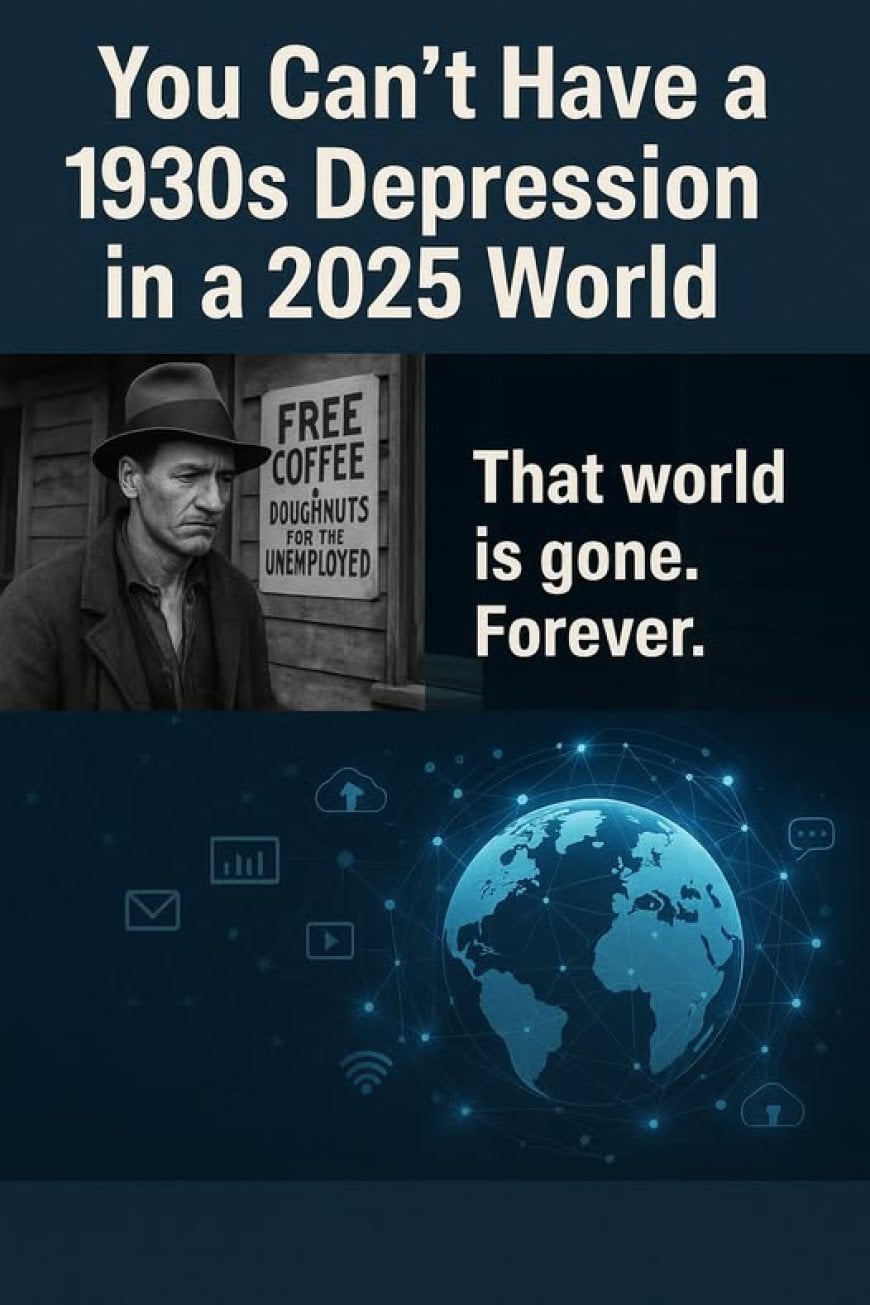
The Myth of Collapse: Why the Future Doesn’t End Like the Past
By Christopher Grenke | Pattern Nexus
Every few years, the same refrain echoes through the halls of macro commentary: the end is near, the debt super-cycle has peaked, fiat currency is dying, and only hard assets will survive. The narrative is hypnotic because it offers both doom and order—a familiar symmetry that comforts those who fear chaos. It tells us that the system will fail exactly as it did before, because history always rhymes.
This week, that rhythm returned in a new piece on ZeroHedge, summarizing John Mauldin’s review of Ray Dalio’s How Countries Go Broke. The essay frames the world’s current predicament as the terminal stage of Dalio’s “Big Debt Cycle,” warning of an inevitable reckoning—a “Final Crisis” in which overleveraged governments print themselves into oblivion, faith in fiat erodes, and civilization staggers backward toward a gold-based anchor.
It’s a compelling thesis because it feels inevitable. Debt cycles are real; history does follow patterns. But the assumption that those patterns will replicate with the same outcome is where this logic collapses. Dalio’s framework—brilliant in its structural clarity—operates under Newtonian economics: predictable reactions to predictable forces. Yet modern systems have shifted into a quantum state, where observation itself changes behavior and the act of prediction alters the trajectory of events.
That’s the core flaw: they’re applying analog logic to a digital civilization. The causal mechanics of collapse haven’t disappeared—they’ve been absorbed by speed, computation, and connectivity. The system has learned to see itself. It doesn’t collapse the same way twice because the feedback loops that trigger collapse are now visible in real time. The observers are inside the machine, constantly rewriting its outcomes.
In this environment, Dalio’s “Final Crisis” becomes something else entirely. It’s not a death—it’s a metabolic process, an adaptive phase transition in which the old structure breaks symmetry to reestablish equilibrium at a higher level of complexity. Civilization doesn’t die; it evolves. And that evolution is now accelerating beyond the temporal boundaries of historical precedent.
I. Information Velocity and the Death of Isolation
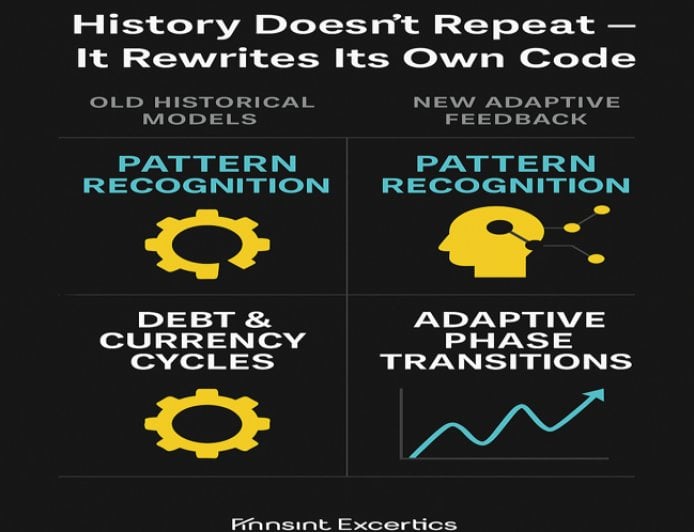
The first variable every collapse theorist underestimates is velocity—the speed at which information, capital, and sentiment now move. Speed is not just acceleration; it’s a form of structural awareness. When information travels faster than policy can respond, the feedback system becomes reflexive—capable of sensing and correcting its own imbalances before they metastasize into systemic failure.
In 1930, economic information moved at the pace of telegraphs and newspapers. Market signals were asynchronous, siloed by geography and privilege. The public experienced collapse only after it was already fact. Today, information latency has effectively approached zero. A rumor, algorithmic model, or meme can alter global liquidity conditions within minutes. The market’s nervous system is now planetary, and collective cognition acts as both observer and participant.
This velocity transforms the geometry of collapse. In a slow-information world, crises compound through ignorance—people don’t know until it’s too late. In a fast-information world, crises compound through overreaction, then self-correct through transparency. Every panic generates a counterforce: data, scrutiny, memetic adaptation. The crowd learns faster than it falls.
What Dalio describes as cascading failure—private debt collapse leading to public overextension—is still valid in principle, but not in execution. Modern crises rarely follow linear contagion. They fragment into thousands of micro-pulses: algorithmic trades, social media cascades, liquidity repricings. Each micro-collapse is absorbed, analyzed, and rebalanced by networks of humans and machines in real time. What looks chaotic is, in fact, a form of distributed equilibrium seeking.
In complexity theory, this is called self-organized criticality—the constant edge between order and chaos where adaptive systems thrive. Financial markets, once linear instruments of policy, have become living ecosystems governed by feedback dynamics. They no longer merely reflect economic activity; they are the economy’s neural field, generating, transmitting, and absorbing energy across billions of nodes. Each crisis is a spark in that network—a recalibration of informational entropy, not the collapse of structure itself.
Ray Dalio’s Big Debt Cycle assumes isolation between cause and effect, policy and population. But the internet, social media, and algorithmic liquidity engines have erased that separation. Information doesn’t move through society anymore; it is society. Every citizen is a node, every algorithm a synapse. The system is no longer a set of institutions—it’s a sentient mesh of feedback loops. In such an environment, collapse cannot behave like a power outage. It behaves like a surge—brief, violent, but followed by rebalancing.
Even monetary authorities operate inside this feedback field. Central banks no longer simply set rates; they signal them into an anticipatory network of algorithmic interpretation. Policy has become narrative—forward guidance as memetic management. Liquidity is no longer issued; it is perceived. The bond market reads the central bank’s tone, body language, and historical context through machine learning. The crowd front-runs the future, and in doing so, it reshapes it.
That’s why the 2020s cannot experience a 1930s-style Depression. The transmission medium itself has evolved. The observer effect now defines the economy. Collapse in this world is feedback—not fate. The network has learned to reroute energy faster than entropy can destroy it.
We are not witnessing the end of the system; we are witnessing the end of isolation. And when isolation dies, so does the classical model of collapse.
II. Monetary Physics: Liquidity as Energy Flow
Every monetary system, no matter how abstract its instruments become, still obeys the deeper laws of thermodynamics. Liquidity is energy. It moves through economies as heat does through matter—always seeking equilibrium, never truly created or destroyed, only transformed. When central banks expand balance sheets, they are not “printing money” in the moral sense so often imagined by collapse theorists. They are releasing latent potential energy into a cooling system to prevent crystallization—a liquidity injection designed to keep motion possible inside an over-structured environment.
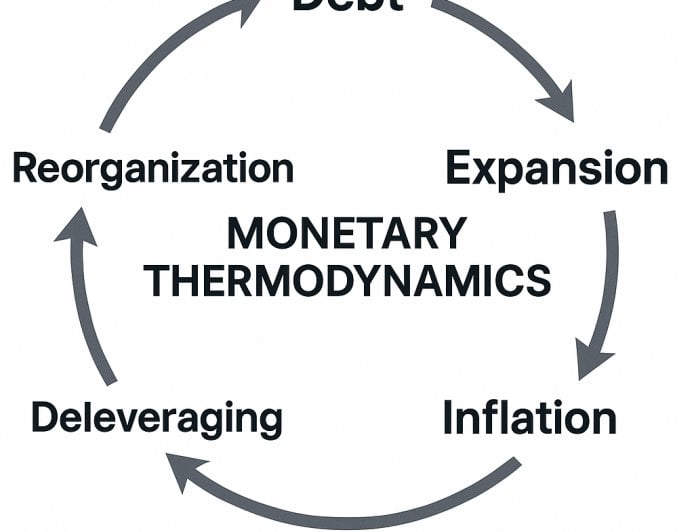
Think of the global financial field as a vast heat engine. Debt creation functions as combustion: it burns expectations of future productivity to generate present expansion. Deleveraging, defaults, and austerity are the exhaust cycle—entropy vented outward to restore balance. What Dalio describes as a terminal stage of the debt super-cycle is really a phase-change between states of monetary matter. The apparent disorder of inflationary excess and asset repricing is the energy required for that transition. It looks chaotic only because we’re standing inside the reaction chamber.
Since 2008, the Federal Reserve’s balance sheet has acted as the planet’s thermal regulator. Quantitative easing expanded the system’s internal volume—lowering density, increasing the space for credit to exist. Quantitative tightening reverses that expansion, raising density until new structures crystallize. This is not moral decay; it is monetary thermodynamics in motion. Energy moves from high-pressure zones (liquidity surpluses) toward low-pressure zones (credit scarcity) until equilibrium is restored. When policymakers misjudge that gradient, the system compensates automatically through market repricing—an adaptive form of entropy correction.
In that sense, fiat currency behaves like plasma: it is simultaneously particle and wave, substance and signal. It transmits confidence while embodying motion. As algorithms accelerate price discovery, liquidity now flows at relativistic speeds—too fast for traditional models of control. The new regulators are not committees; they are feedback networks—high-frequency traders, arbitrage bots, risk engines—each performing micro-adjustments that dissipate volatility across billions of transactions per second. The result is a system that self-cools in real time.
Dalio’s archetype ends with monetary collapse once faith is lost. But in a networked world, faith is measurable energy. Confidence indices, volatility metrics, and sentiment data feed directly into algorithmic liquidity mechanisms. When belief drops, liquidity routes around the damage. The market does not wait for a central banker’s assurance; it generates its own thermal equilibrium through price compression, arbitrage, and digital collateralization. What looks like chaos is the feedback hum of a planetary-scale heat engine learning to balance itself.
This is why debt cannot “end.” It oscillates. Expansion and contraction are the heartbeat of civilization’s metabolism—the inhale and exhale of human ambition translated into numbers. A debt cycle is not a sickness to be cured; it is an energy pulse within the greater field of progress. When that pulse quickens beyond tolerance, we experience crisis. When it slows, we call it stagnation. Either way, the system’s goal remains the same: sustain motion, preserve temperature, and prevent absolute zero.
III. Technological Integration and the Digital Monetary Architecture
When liquidity becomes light—moving at the speed of code rather than the speed of cash—the container that holds it must evolve. The twentieth century’s institutions were designed for solid money: heavy, slow, and scarce. The twenty-first century requires a vessel for photons—value that travels at near-instantaneous velocity. That vessel is the digital monetary architecture now being assembled in plain sight.
From Bretton Woods’ collapse in 1971 to the rise of blockchain and central-bank digital currencies, each epoch of money has followed the same pattern: decentralize, re-stabilize, integrate. Gold anchored credibility when communication was slow. Fiat replaced it when speed demanded flexibility. Now, programmable liquidity is emerging to reconcile the two—a synthetic equilibrium between trust and precision. The BIS mBridge project and the tokenisation of real-world assets mark the early blueprints for that new chassis.
In programmable finance, each monetary unit can carry context—its origin, its permissions, its compliance rules, even its carbon cost. This turns money from a passive medium into an active protocol. It enforces scarcity algorithmically, not politically. That alone dissolves half the moral panic surrounding fiat systems. When value creation and value verification merge into one programmable act, debasement loses its teeth. Inflation becomes a parameter, not a mystery.
Critics imagine that such systems herald dystopia—total surveillance, digital control, loss of privacy. Those dangers are real, but they are implementation risks, not existential flaws. The same architecture that can centralize power can also distribute it. Tokenized reserves, smart contracts, and decentralized audit layers create transparency that exceeds anything the analog era could achieve. The question is not whether digital money replaces paper, but who writes the code that defines its conscience.
Gold still has a role—but only as a digital checksum inside this architecture. Its scarcity, verified by mathematics, becomes collateral for synthetic liquidity pools. We are not returning to a gold standard; we are evolving into a gold reference grid—an invisible constant woven into programmable value systems. The stability that gold once provided physically is now provided informationally. A gram of gold no longer buys bread; it anchors the algorithm that prices the bread.
In this emerging order, money becomes metadata. Every transaction carries its own audit trail. Every reserve asset exists simultaneously as code and commodity. The economy turns transparent from within, because the ledger and the market are no longer separate. When Dalio warns that faith in money will evaporate, he imagines opacity. But in a transparent system, faith is replaced by verification. Belief becomes computation. Trust becomes math.
This is not collapse; it is compression—the condensation of the entire monetary universe into information space. Where gold once represented the physical boundary of confidence, code now defines its digital horizon. The system doesn’t need to revert to metal; it needs to perfect its mirrors. Every byte of programmable value is a reflection of human intention stored as light.
And that brings us to the next layer of transformation: if money has become information, and information has become self-aware, then the final constraint on stability is not fiscal or physical—it is psychological. The next crisis will not be about liquidity or debt; it will be about belief velocity—how quickly collective cognition can shift the energy field of value itself.
The Cognitive Economy & Behavioral Liquidity
Markets have become mirrors for the collective nervous system. What once looked like speculation is now a kind of global biofeedback loop: trillions of micro-choices translating emotion into motion. The ticker tape is an EEG of civilization—volatility spikes are stress signals, long consolidations are meditation. The more aware the species becomes of itself, the more the market behaves like a living organism regulating its own chemistry. Price isn’t a number anymore; it’s a pulse.
Attention has become the new base currency. What the gold standard once was for scarcity, cognition now is for liquidity. Every click, share, and glance becomes a micro-transaction in a global cognitive market—an exchange rate between awareness and capital. When Dalio talks about debt and confidence cycles, he’s describing a dynamic that’s now neurological. Markets don’t just measure trust in institutions anymore; they measure collective attention. Confidence is a bandwidth phenomenon.
The GameStop/Reddit event was the first visible rupture of this new layer of finance—a spontaneous proof that belief can become a market force. A swarm of retail traders turned memetic energy into price action, using humor and rebellion as leverage. It wasn’t “irrational exuberance”; it was a distributed demonstration of reflexive intelligence. Dogecoin followed the same pattern—half joke, half social experiment—yet still managed to convert shared emotion into billions of dollars in market value.
This isn’t a breakdown of rational markets; it’s their evolution into reflexive cognition. George Soros once argued that perception and reality interact through feedback; the modern digital economy has taken that concept to its logical extreme. Markets now respond to perception of perception. Information velocity has surpassed fundamentals. Belief, not balance sheets, determines liquidity. The more a narrative is shared, the more real it becomes—until price itself is the story.
This reflexivity doesn’t make the system unstable—it makes it alive. Markets have become extensions of human psychology, continuously adapting to shifts in attention. The global financial system is now a behavioral ecosystem where sentiment is a variable as critical as supply or demand. We no longer trade assets; we trade awareness of assets. Volatility is the collective heartbeat of a connected species, pulsing faster as the feedback loop tightens.
Every data point now carries a psychological shadow. Every candle on a chart is both math and mood. Macroeconomics without behavioral modeling is obsolete; money velocity has fused with mood velocity. To forecast the next cycle, you must measure not just how capital moves—but how consciousness does.
In the cognitive economy, liquidity is no longer just financial. It’s emotional, informational, and memetic. The markets are not a machine—they are a mirror. And as the reflection sharpens, humanity is learning to see not just how value moves, but how it feels.
Systemic Synchronization and the Nexus Event
When people say “everything feels connected,” they’re not exaggerating. They’re describing a genuine physical phenomenon — the compression of feedback loops across the systems that define civilization. Finance, politics, climate, technology, media — all of them used to operate on different timescales. Now, they’ve collapsed into the same time-domain. What once took decades to ripple through society now propagates globally in hours.
This is the Pattern Nexus moment: the point where every subsystem of civilization — monetary, technological, ecological, and psychological — reaches resonant frequency. Each oscillation reinforces the others until the entire system begins to reorganize itself at a higher order. It’s not apocalypse. It’s resonance.
In physics, resonance occurs when multiple oscillators share a frequency and begin to exchange energy efficiently. That’s what’s happening now. Monetary policy shocks, political polarization, climate stress, and algorithmic information feedback aren’t isolated crises; they’re harmonic couplings inside a single wave function. Financial volatility amplifies political reaction. Political instability feeds social dissonance. Social dissonance drives capital flows. Climate shocks pressure policy. Everything is phase-locked. What feels like chaos is synchronization.
Synchronization is both danger and design. When a system becomes too tightly coupled, resonance can turn destructive — like a bridge collapsing when soldiers march in rhythm. But that same resonance, when stabilized, creates higher forms of organization. Atoms become molecules. Molecules become life. Neurons become thought. Societies become consciousness. Collapse, in this sense, is a feedback correction — a necessary rebalancing that forces coherence between systems that have grown out of sync.
What Ray Dalio calls the “final crisis” is, in reality, the moment the system aligns its internal clocks. It’s not the end of the cycle; it’s the integration point — the universe of systems rebooting itself under new parameters. The kernel panic before the restart. And when it comes back online, it won’t be analog or gold-backed — it’ll be self-aware: a hybrid structure of human creativity and algorithmic homeostasis. Civilization isn’t ending. It’s debugging its own code.
The End of the End (Expanded)
Collapse myths always imagine the ground disappearing beneath us, but history tells the opposite story — the ground keeps rising to meet us. Every failure becomes a foundation. The Roman road still lies beneath the European highway. The Great Depression laid the groundwork for the industrial middle class. The 1971 dollar-gold split created the digital dollar that powers global commerce today. The pattern is recursive: breakdown, adaptation, reintegration. The only thing that ends is ignorance of the process.
Every discipline — thermodynamics, cognition, network theory — points to continuity as the law of evolution. Entropy doesn’t mean destruction; it means transformation. Systems consume disorder to create higher-order equilibrium. Civilization operates the same way. What we interpret as collapse is the transfer of energy from one architecture to the next.
The fall of Rome didn’t end civilization; it decentralized it. The 1930s didn’t destroy capitalism; they recalibrated it. The 1971 monetary shift didn’t end money; it digitized it. Each so-called ending produced more complexity, not less. Each crisis was a compression before expansion — a tightening of potential that forced invention. Progress, when viewed through thermodynamics, is entropy repurposed as learning.
Humanity doesn’t fall off cliffs; it crosses thresholds. Collapse isn’t the death of the system — it’s the system changing substrate. The form mutates, but the function persists. Every “end” in history has simply been civilization finding a new medium for its intelligence.
The Pattern Nexus Perspective (Closing Manifesto)
The collapse isn’t coming — the integration is. The old world isn’t dying; it’s being recompiled.
Fiat money will not die; it will evolve into programmable liquidity.
Gold will not return as currency; it will become tokenized collateral inside digital financial architecture.
Debt will not destroy the system; it will decentralize into an energy pulse — a rhythm of expansion and recalibration.
And humanity, despite its noise and chaos, will move forward — because that’s what we do.
Progress is not linear or clean. It’s messy, recursive, and often painful. But it’s inevitable. We don’t collapse; we reorganize. We don’t go extinct; we upgrade. We don’t end; we evolve.
So when they say the party’s over — they’re wrong. The playlist just changed. The rhythm is different now. And if you listen closely, you can already hear the sound of the next era beginning to play.
Notes & Citations
- BIS (2024). Tokenisation of Real-World Assets.
- BIS Innovation Hub (2024). Project mBridge MVP.
- Federal Reserve History (1971). Nixon Ends Convertibility of USD to Gold.
- Nature Human Behaviour (2025). The Social Dynamics of Retail Trading During the GameStop Event.
- Dalio, R. (2024). How Countries Go Broke. Economic Principles.
Apa Reaksi Anda?
 Suka
0
Suka
0
 Tidak Suka
0
Tidak Suka
0
 Cinta
0
Cinta
0
 Lucu
0
Lucu
0
 Wow
0
Wow
0
 Sedih
0
Sedih
0
 Marah
0
Marah
0

Founder of Pattern Nexus. I research markets, macro, geopolitics, AI, history, ancient systems, and the patterns most people overlook. I’m also building Market Radar, a trading scanner designed to read pressure, risk, confirmation, and setup quality before chasing a move. Pattern Nexus is where I connect the dots between data, history, technology, and the bigger system playing out around us.














Komen-komen (0)