
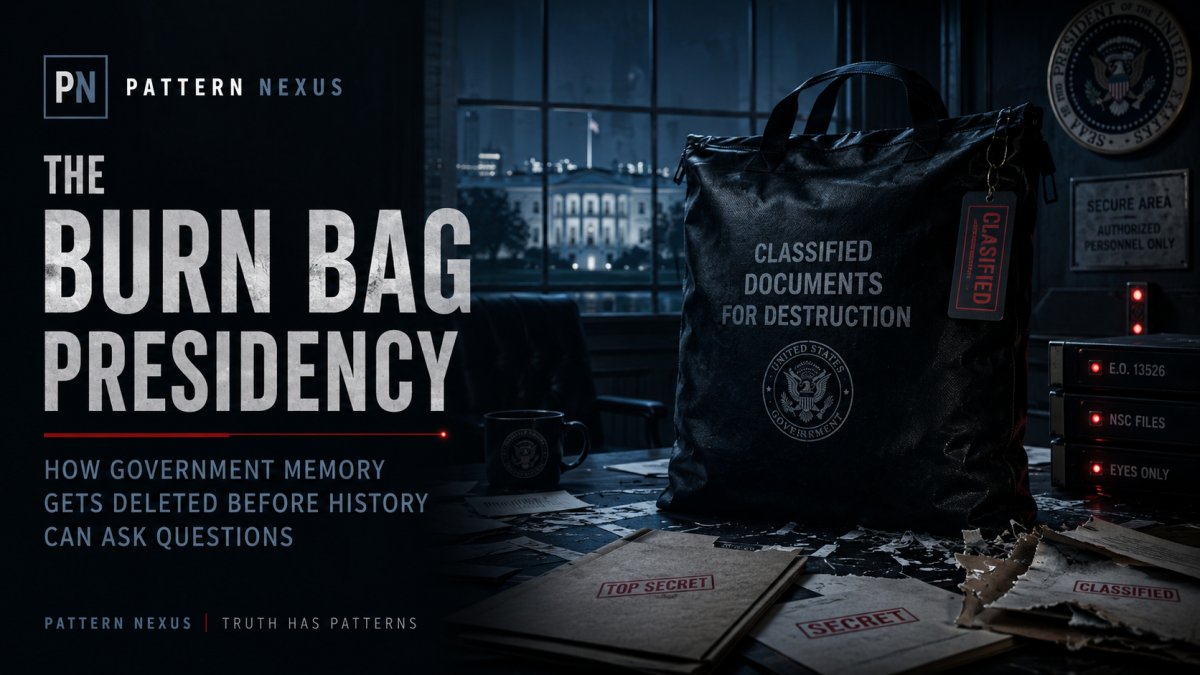
The Burn Bag Presidency: How Government Memory Gets Deleted Before History Can Ask Questions
A burn bag is not just a classified waste container. In the real world, it can become part of a larger system for destroying institutional memory, suppressing records, and controlling what future presidents, Congress, courts, historians, and the public are allowed to know.
Systems & Patterns
The Burn Bag Presidency: How Government Memory Gets Deleted Before History Can Ask Questions
A burn bag is not just a classified waste container. In the real world, it can become part of a larger memory-control system that decides what future presidents, Congress, courts, historians, and the public are allowed to know.
Primer Video: Argo, Tehran, and the Destruction Layer Under Pressure
Before getting into burn bags, presidential records, limited hangouts, Kissinger, and the psychology of statecraft, this scene is worth watching as a primer. It shows the system under pressure: an embassy falling, staff rushing to destroy files, and classified records becoming more dangerous than paper.
This is the point of the article in visual form. When the record survives, the narrative can be reconstructed. When the destruction layer works, the future gets silence. When it fails, the future gets evidence.
Video primer: Argo embassy attack / file-destruction scene. This is a dramatized film clip, not documentary footage, but it captures the correct system logic: destroy the record before someone else can reconstruct it. Watch on YouTube.
Quick Read
The official story says a burn bag is just a secure way to destroy classified waste. That is true, but it is not the full story. In the real world, burn bags sit inside a much larger system of institutional memory control. When documents, drafts, notes, tapes, messages, or records disappear before they are indexed, archived, backed up, or transferred, the future does not just lose paperwork. It loses the ability to reconstruct what happened.
That is the deeper issue. A future president can only inherit the records that survived. Congress can only subpoena the materials that still exist. Historians can only study the evidence that made it into the archive. Courts can only review what was preserved. Once the destruction layer activates upstream, the fight is no longer over access. The fight becomes whether the record ever existed at all.
But destruction is only one side of the system. The other side is controlled disclosure. That is where the concept of the limited hangout matters. A limited hangout is when power gives up a controlled piece of the truth to contain the larger truth. A modified limited hangout is even more refined: not just admitting a little, but structuring the admission so the damaging part stays buried.
The 1979 U.S. Embassy seizure in Tehran proved the same system in reverse. Embassy staff tried to burn and shred sensitive records before the building fell. The destruction layer failed. Many shredded documents were later reconstructed by hand and published. That is why the burn bag matters. When the destruction layer works, the future gets silence. When it fails, the future gets evidence.
The Official Function
Destroy classified or sensitive waste so it cannot be read, recovered, or exposed through normal disposal.
The Real Function
Create a controlled destruction channel where certain information can leave the future before the future knows it existed.
The Limited Hangout
When full concealment fails, power can release a controlled fragment of truth to redirect attention away from the more damaging layer.
The Control Layer
Power does not only control decisions. It controls which decisions leave evidence behind and which disclosures are allowed to define the story.
The Historical Risk
Once records disappear upstream, future presidents, Congress, courts, journalists, and historians inherit a curated version of reality.
The Official Story Is Too Small
There is the official explanation of a presidential burn bag.
Then there is the real one.
The official version says a burn bag is a secure destruction method for classified waste. Sensitive papers, drafts, working notes, duplicate copies, old classified printouts, or other controlled material get placed into a marked container. Then they are collected and destroyed through an approved secure process.
- That is the clean explanation.
- That is the institutional explanation.
- That is the explanation designed for people who still believe systems are only used for the purpose written on the policy sheet.
- But the real-world function is much bigger than that.
- A burn bag is not just a trash bag.
- It is a memory gate.
- It is the point where a piece of government reality can be moved from something that happened into something no future person can prove happened.
And once you understand that, you stop looking at burn bags as office procedure and start seeing them as part of the larger permission stack of government secrecy.
Because the real power is not just making information secret.
The real power is making information unavailable to the future.
The Burn Bag as a Memory Gate
The official process is easy to explain. Classified waste is separated from normal office waste and placed in burn bags. Federal security procedures for White House-adjacent classified waste describe working papers, notes, drafts of classified correspondence, carbon paper, typewriter ribbons, and other material requiring destruction as burn-bag material. Those bags are then collected and destroyed through a secure process.1
That part is not complicated.
The complicated part is what happens when the category of waste becomes elastic.
Because that is where the control system lives.
- Not in the bag.
- In the classification.
- In the label.
- In the decision that something is a draft, not a record.
- In the decision that something is working material, not historical evidence.
In the decision that something does not need to survive because the people who would later need it do not even know it existed.
- That is how institutional memory gets managed.
- Not always by a giant conspiracy.
- Not always by one villain in a dark room.
- Sometimes it is just a process.
A document gets printed for a meeting. A warning gets circulated to a small group. A legal theory gets discussed but never formally routed. A dissenting view gets captured in a draft but never finalized. A sensitive operational detail gets handled on paper because paper is easier to destroy than a traceable digital system.
A future administration comes in later and asks, “What did we know?”
The system answers, “Nothing in the file.”
That is the trick.
A future president cannot ask for a document that no one admits existed.
- Congress cannot subpoena a file that was never indexed.
- Historians cannot FOIA a record that never made it into the archive.
- Courts cannot review evidence that was reduced to ash before the accountability cycle began.
- This is why the burn bag matters.
- Not because every abuse uses a literal burn bag.
- That would be too simple.
- The burn bag is one node in a larger destruction architecture.
The same function can be performed by shredders, destroyed tapes, missing emails, private messaging systems, auto-deleting apps, off-book meetings, classified compartments, personal-record claims, non-capture of social media, withheld notebooks, destroyed drafts, or legal opinions that redefine what has to be preserved in the first place.
- Different tools.
- Same pattern.
Control the record, and you control the future’s ability to understand the past.
Modified Limited Hangout: Tell One Truth to Bury the Rest
This is where the concept of a limited hangout becomes paramount.
Because burn bags are only one side of the memory-control system.
Burn bags deal with the physical record.
Limited hangouts deal with the public narrative.
A limited hangout is the controlled release of partial truth when total concealment is no longer stable. It is what happens when the cover story starts cracking, but power still wants to decide which truth gets seen, which truth gets buried, and which truth becomes the official boundary of the scandal.
The historical phrase became famous through Watergate. In the March 22, 1973 Nixon White House tape transcript, H.R. Haldeman says, “It’s a limited hang out,” and John Ehrlichman immediately refines it: “It’s a modified limited hang out.” Nixon then asks whether the issue is the thing hanging out “publicly or privately,” and John Dean explains the purpose: getting Nixon “up above and away from it.”18
That is the entire concept in one room.
- Not truth.
- Not confession.
- Not accountability.
- Controlled exposure.
Let enough hang out to make it look like the system is being transparent, but not enough to expose the real chain of command, the real motive, the deeper network, the full record, or the people who still need protection.
- WHYY summarized the Watergate version cleanly as conceding a little while stonewalling the rest.19
- That is exactly why this belongs in the burn bag article.
- A burn bag destroys the evidence.
- A limited hangout manages the evidence that survives.
A modified limited hangout is what happens when the system realizes the public is going to see something, so the system decides what that something will be.
That is not transparency.
That is narrative containment.
- It is the same control pattern, just at a different layer.
- If the damaging record can be destroyed, burn it.
- If the damaging record cannot be destroyed, classify it.
- If the damaging record cannot stay classified, redact it.
- If the damaging record cannot be fully redacted, release the least damaging portion.
- If the least damaging portion still looks bad, surround it with a story.
- If the story still fails, blame a lower-level operator.
- If the operator talks, call it old news.
- If the public gets angry, open a controlled investigation.
If the investigation gets close, argue privilege, national security, legal process, executive autonomy, classification, privacy, or institutional stability.
That is the ladder.
That is why people never get the full truth.
The truth is not usually blocked by one locked door.
- It is moved through layers.
- Physical destruction.
- Classification.
- Compartmentalization.
- Legal theory.
- Narrative framing.
- Controlled admission.
- Institutional delay.
- Public exhaustion.
By the time people finally see one piece, they mistake that piece for the whole.
That is the modified limited hangout.
It gives the public a fragment and lets the fragment become the boundary of imagination.
The public thinks, “Now we know.”
The system thinks, “Now they stopped asking.”
Dark Triad, Kissinger, and Machiavellian Statecraft
This is why explaining the burn bag presidency is hard.
It is not one premise.
It is a stack of premises.
- To understand the burn bag, you have to understand classified records.
- To understand classified records, you have to understand institutional memory.
- To understand institutional memory, you have to understand continuity of government.
- To understand continuity of government, you have to understand compartmentalization.
- To understand compartmentalization, you have to understand limited hangouts.
- To understand limited hangouts, you have to understand Machiavellian statecraft.
And to understand Machiavellian statecraft at scale, you have to understand the psychology of power.
That is where the Dark Triad matters.
In psychology, the Dark Triad refers to three overlapping personality traits: narcissism, Machiavellianism, and psychopathy. The term was popularized by Delroy Paulhus and Kevin Williams in their 2002 paper, The Dark Triad of Personality: Narcissism, Machiavellianism, and Psychopathy.20
The point here is not to randomly diagnose every powerful person.
That would be lazy.
The point is to understand the behavioral architecture.
Narcissism explains the need for image, legacy, admiration, domination, and personal myth.
Psychopathy explains emotional detachment, cold risk tolerance, lack of remorse, and the ability to treat human consequences as abstractions.
Machiavellianism explains the strategic manipulation layer: deception, calculated disclosure, use of people as instruments, patience, misdirection, and the willingness to separate morality from outcome.
That third layer is the one that matters most here.
Machiavellianism is not just “being evil.”
That is the cartoon version.
At the state level, Machiavellianism is the logic of power maintenance. It is the belief that survival, advantage, and control can justify deception, selective truth, coercion, sacrifice, and moral compartmentalization.
That is why Henry Kissinger belongs in this conversation.
Not because this article needs to turn into a separate biography of Kissinger.
Because Kissinger is one of the clearest modern American symbols of realpolitik: the cold assessment of national interest, state preservation, secrecy, controlled diplomacy, backchannel power, and morally ambiguous strategy.
The U.S. State Department notes that Kissinger became the first person to serve as both Secretary of State and National Security Adviser, placing him at the center of foreign policy and national security decision-making under Nixon and Ford.21
The Kissinger Center at Johns Hopkins describes Kissinger as conventionally associated with realism, meaning foreign policy assessed through national self-interest. The same source notes that Stanley Hoffmann described Kissinger as a Machiavellian figure who believed preservation of the state required ruthlessness and deceit against foreign and internal adversaries.22
Again, this is not about doing armchair clinical psychology on Kissinger.
It is about recognizing the operating logic.
Kissinger is useful because he represents the worldview where power is not judged by how clean it looks in public. It is judged by whether it preserves position, influence, access, stability, leverage, and state advantage.
That worldview is the natural habitat of the modified limited hangout.
- You do not confess because confession is morally right.
- You disclose because disclosure is strategically useful.
- You do not preserve every record because history deserves the truth.
- You preserve what protects continuity.
- You destroy what creates liability.
- You classify what cannot be destroyed.
- You compartmentalize what cannot be broadly trusted.
- You admit what cannot be denied.
- You bury what cannot be admitted.
That is the Machiavellian layer.
Classical Machiavellian thought is not built around ideal morality. It is built around power, survival, timing, appearances, and the hard mechanics of rule. Stanford’s entry on Machiavelli describes politics in battlefield terms, where the ruler must understand which strategies fit the circumstances.23
Now translate that into modern government.
- The battlefield is not only military.
- It is informational.
- It is archival.
- It is legal.
- It is psychological.
- It is historical.
- The record becomes terrain.
- The archive becomes terrain.
- Public belief becomes terrain.
Congressional oversight becomes terrain.
Future presidential knowledge becomes terrain.
That is why the burn bag and the limited hangout are connected.
One controls what survives.
The other controls what the surviving fragment means.
And this is why a single concept is so hard to explain to people.
Most people want one event, one villain, one document, one scandal, one quote, one smoking gun.
But the real system is layered.
- Dark Triad psychology explains the personality-level capacity for manipulation and emotional detachment.
- Classical Machiavellianism explains the strategic logic.
- Kissinger-style realpolitik explains the statecraft version.
- Limited hangout explains the disclosure tactic.
- Burn bags explain the destruction mechanism.
- Classification explains the access barrier.
- Compartmentalization explains why even insiders may only know one slice.
- Presidential records law explains the formal preservation layer.
- And the archive explains why future people may never know what they were never allowed to inherit.
- That is the whole structure.
- It is not just secrecy.
It is managed reality.
The Future President Problem
People think presidential records are mainly about historians, libraries, memoirs, and public access.
That is the shallow view.
Presidential records are also part of continuity of government.
A new president does not walk into office with perfect knowledge. They inherit a filtered reality. They inherit briefing books, agency files, legal memos, intelligence products, classified histories, operational records, diplomatic cables, military assessments, internal warnings, and the institutional memory of the people who stayed behind.
That inherited memory shapes what the next president believes is possible.
- It shapes who they trust.
- It shapes what risks they understand.
- It shapes what operations they continue.
- It shapes what scandals they never discover.
- It shapes what legal theories remain buried.
- It shapes what foreign commitments are treated as real.
- It shapes what intelligence failures get repeated.
So when records disappear, the damage is not only public accountability.
The damage is presidential continuity itself.
An outgoing administration, agency faction, classified program, or internal network can shape the next administration by shaping the archive it inherits.
Not by telling the next president a lie.
By making sure the next president never sees the part that would contradict the story.
That is a much more powerful form of control.
Because the lie is not spoken.
The evidence is just absent.
The Archive Only Begins If the Record Survives
The Presidential Records Act says presidential records belong to the United States, not the individual president. NARA explains that the law defines public ownership of presidential records and places responsibility for custody and management of incumbent presidential records with the president.2
That sounds strong.
But the weakness is right there in the process.
NARA also states that incumbent presidents have exclusive responsibility for the custody and management of presidential records while in office, and that NARA has no formal role in how incumbent presidents manage those records unless disposal is proposed.3
- That is the hole.
- That is the real-world gap.
- The archive is downstream.
- The destruction decision is upstream.
The official recordkeeping system depends on the people inside the executive branch correctly identifying, preserving, and transferring the material before the archive ever gets full control.
So the real question is not, “What does the law say?”
The real question is, “What survives long enough for the law to touch it?”
That is the entire game.
If a record is preserved, indexed, transferred, logged, backed up, and eventually archived, then there are legal fights over access.
If a record is destroyed before that chain hardens, the fight changes.
- Now the fight is not over access.
- The fight is over existence.
- That is a much harder fight.
- Because now the person asking questions has to prove something existed before they can prove it was unlawfully destroyed.
That is why burn bags matter.
They can move information out of reality before reality gets a receipt.
The Iranian Revolution Proved Why the Destruction Layer Exists
The Iranian Revolution gives this entire issue historical weight because it shows the destruction layer under live pressure.
On November 4, 1979, militant students stormed the U.S. Embassy in Tehran. As the embassy was being overrun, American personnel tried to destroy sensitive records before they could be seized. They burned. They shredded. They tried to collapse the paper trail before the building fell.
But the process failed.
The National Security Archive describes embassy staff doing their best to destroy sensitive records, burning and shredding until their captors broke through and stopped them.11
That failure mattered because the students did not just seize hostages.
They seized memory.

The captured documents included cables, reports, correspondence, classified government material, operational fragments, and internal records from inside the embassy. Some of the shredded documents were later painstakingly reconstructed by hand and published as part of the book-length collections known as Documents from the U.S. Espionage Den.12
That is the part most people miss.
The embassy takeover was not only a hostage crisis.
It was an archive breach.
It was a case where the destruction system did not complete its job before the opposing force reached the records. And because it failed, the hidden layer became visible.

That is why burn bags, shredders, safes, burn rooms, classified waste procedures, and emergency document destruction protocols exist.
- Not because paper is dangerous by itself.
- Because paper connects people, decisions, motives, intelligence networks, assets, operations, assumptions, and lies.
- Once the record survives, the narrative can be reconstructed.
- Once the record is captured, the people who created it no longer fully control what it means.
- That is why this story belongs inside the burn bag article.
- It shows the entire system in reverse.
- When the destruction layer works, the future gets silence.
- When it fails, the future gets evidence.
- Iran proved that.
There is also a cultural reference most people have seen without realizing what they were actually watching.
In Argo, the U.S. embassy takeover is shown with staff rushing to destroy classified material before the compound falls. Files are burned, shredded, cleared out, and treated as something more dangerous than paper. That scene works because it captures the actual institutional fear underneath the process: once the record is captured, the narrative no longer belongs only to the people who created it.
Video reference: Argo embassy attack / file-destruction scene. This is a dramatized film clip, not documentary footage. Source: YouTube, “Embassy Attack - Argo.” Watch on YouTube.
The movie dramatizes it, but the historical core is real.
During the 1979 U.S. Embassy seizure in Tehran, American personnel tried to destroy sensitive records as the building was being overrun. They burned and shredded documents until the captors broke through and stopped the process.11
Many shredded documents were later reconstructed by hand and published in collections known as Documents from the U.S. Espionage Den. Some accounts describe skilled carpet weavers doing the reconstruction. Other accounts describe student volunteers, including high school students, working over time to piece the shredded material back together.14
The phrase “thousands of school kids” should be treated carefully. That version exists in the wider public memory of the story, but the harder-to-attack verified baseline is cleaner: the reconstruction happened, it was done by hand, and accounts differ over whether the core labor was skilled carpet weavers, student volunteers, or a mix of both.
- Either way, the verified point is enough.
- The shredded documents were reconstructed.
- The destruction process failed.
- The hidden record became visible.
Journeyman Footage also lists a 1979 archival footage clip titled “Iran, 1979, hostage crisis, US embassy, shredded documents, repairing shredded documents.” That appears to be licensed footage rather than a free public embed, but it is worth citing because it points directly to the visual historical record of the reconstruction process.16
So the point is not that every detail in Argo is historically perfect.
It is not.
- The point is that the movie shows the correct system logic.
- Destroy the record before the building falls.
- Destroy the record before the enemy gets it.
- Destroy the record before someone can reconstruct the hidden layer.
- In Tehran, that process failed.
And because it failed, the hidden record became visible.
That is the inverse of the burn bag presidency.
In Tehran, the destruction layer failed before an outside force reached the records.
Inside Washington, the danger is reversed: the destruction layer can succeed before Congress, courts, historians, journalists, future presidents, or the public ever get close enough to know what disappeared.
- Same mechanism.
- Different audience.
- Different consequence.
Whoever gets the record gets the power to reconstruct reality.
How the Suppression Layer Works
The real-world suppression layer does not need to destroy everything.
That is amateur thinking.
It only needs to destroy the connective tissue.
- The memo that explains intent.
- The dissent that warned against the operation.
- The legal draft that showed everyone knew the official explanation was weak.
- The handwritten note that connected two people.
- The meeting summary that showed the decision came from higher up.
- The briefing paper that proved the president was warned.
- The classified cable that contradicted the public story.
- The early draft that said the quiet part before lawyers cleaned it up.
- The calendar entry that places the right people in the room.
- The routing slip that shows who saw what.
The difference between a scandal and a non-scandal is often not the main event.
It is the connective tissue.
Burn the connective tissue, and the system can still admit something happened while denying the chain of responsibility.
- That is how power protects itself.
- Not always by denying the event.
- By deleting the pathway.
- The public hears, “There is no evidence.”
But sometimes no evidence means no evidence survived.
Those are not the same thing.
Iran-Contra and the Shredded Nervous System
Iran-Contra is one of the clearest examples of how destruction of records can be used to protect power during a live scandal.
This was not theoretical.
The Walsh report states that Fawn Hall, Oliver North’s secretary on the National Security Council staff, participated with North and other NSC staff members in obstructing official investigations and altering, destroying, and removing official Iran-Contra-related documents from the White House.4
- That is not a conspiracy theory.
- That is the official investigation.
The same report describes Hall helping North during the document destruction process as investigators began closing in.4
- That is the pattern in plain sight.
- A secret policy operation existed.
- Oversight pressure arrived.
- The paper trail became dangerous.
The documents were altered, destroyed, removed, or hidden.
And once that happens, later investigators are no longer reconstructing reality from the original nervous system of the event.
They are reconstructing it from fragments.
- Testimony.
- Surviving notes.
- Partial copies.
- Memory.
- Contradictions.
The pieces someone failed to destroy.
That matters because the destroyed material is often the material that would have shown intent, hierarchy, authorization, and knowledge.
The what happened may survive.
The who knew what and when often gets targeted.
That is how the state protects its inner wiring.
CIA Torture Tapes and Destroyed Reality Capture
The CIA torture tape destruction is another major example of the same pattern.
This was not about a burn bag specifically.
It was about the destruction function.
The National Security Archive describes the CIA’s destruction of videotapes related to interrogations and waterboarding as a major element in the larger torture-record controversy.5
The tapes were not just media files.
They were reality capture.
They could show what words on paper could soften.
They could show physical condition, conduct, tone, duration, resistance, coercion, and the difference between a sanitized legal memo and what actually happened in the room.
Destroying the tapes did not erase the entire torture program.
But it controlled what future investigators, judges, lawmakers, presidents, and the public could independently verify.
That is the key.
The system did not need to erase the entire program.
- It needed to erase the most vivid, undeniable evidence of the program.
- Text can be argued with.
- Video is harder.
- So the video disappeared.
- Again, this is not just about legality.
- It is about historical physics.
Some evidence carries more weight than other evidence.
Destroy the high-density evidence, and the entire accountability environment changes.
The truth may remain partially knowable, but it becomes easier to manage, easier to dispute, easier to bury, easier to reframe, and easier to exhaust the public with complexity.
Trump Records and the Fragile Archive
The Trump records fights exposed another side of the same system: presidential records are only as strong as the preservation culture inside the White House.
In 2022, the House Oversight Committee said it was investigating former President Trump’s removal of classified documents and presidential records, attempts to destroy records by tearing them into pieces, and other missing presidential records. The committee cited NARA information that White House staff had taped together some torn-up records, while other torn-up records transferred to NARA had not been reconstructed.6
That is not just a paperwork dispute.
That is the fragility of the archive.
If staff have to tape presidential records back together, that means the historical record survived only because someone downstream tried to repair what someone upstream damaged.
That is a ridiculous way to preserve the memory of a nuclear-armed state.
The same Oversight release also described concerns around failures to capture and preserve social media records, including deleted posts and direct or private messages on platforms.6
That matters because the modern presidency is no longer just memos and folders.
It is posts.
- Messages.
- Private channels.
- Screenshots.
- Deleted drafts.
- Platform logs.
- Phones.
- Group chats.
If those systems are not captured, the historical record develops holes that are not obvious from the outside.
The future archive may look complete because boxes exist.
But the missing layer is not always visible.
That is the danger.
A record system can look full while being strategically hollow.
USAID Burn Bags and Agency-Level Memory Destruction
This is not only a White House issue.
In March 2025, The Guardian reported that USAID officials had been instructed to destroy classified documents at headquarters using shredders and burn bags, based on an internal email reviewed by the outlet. The email reportedly told staff to clear classified safes and personnel documents, shred as many documents as possible first, and use burn bags when shredders were unavailable.7
Politico also reported on the directive, describing instructions to destroy materials from classified safes and personnel files during the agency’s upheaval.8
The timing was the real issue.
- This was happening during massive turmoil around the agency’s restructuring and attempted dismantling.
- That is the pattern again.
- Large institutional disruption.
- Classified records.
- Destruction process.
- Unclear preservation boundary.
- Future oversight risk.
This is how memory gets lost during transition events.
Not necessarily through one dramatic act.
- Through administrative chaos.
- Through cleanout.
- Through safe clearing.
- Through classified waste disposal.
- Through personnel document handling.
Through a bureaucracy moving fast enough that later accountability has to dig through smoke.
That is why the burn bag is important as a symbol.
It represents the point where the system says, “This no longer needs to exist.”
- But who decides that?
- During what kind of power struggle?
- With what oversight?
- And whose future access gets erased?
Those are the real questions.
The 2026 Presidential Records Fight
The deeper danger is not only physical destruction.
The deeper danger is legal normalization.
On April 1, 2026, the Department of Justice Office of Legal Counsel issued an opinion concluding that the Presidential Records Act is unconstitutional. The opinion argued that the law exceeds Congress’s powers and intrudes on the independence and autonomy of the Executive Branch.9
That is a massive structural shift if acted upon.
Because now the question is not merely whether someone improperly destroyed a document.
The question becomes whether the executive branch can reinterpret the entire preservation obligation as unconstitutional interference.
Reuters reported that the American Historical Association and American Oversight sued President Trump to enforce compliance with the Presidential Records Act after the DOJ opinion. The lawsuit asked a federal court to declare the law valid and prevent agencies from relying on the DOJ memo.10
This is the part that fits the Pattern Nexus framework perfectly.
- First, power tests the process.
- Then it challenges the rule.
- Then it reframes the rule as illegitimate.
- Then it creates discretionary replacement standards.
Then future enforcement becomes dependent on litigation, timing, political control, institutional courage, and whether the records still exist by the time anyone wins.
That is how a memory system gets hollowed out.
Not by openly saying, “We want to delete history.”
- By saying Congress does not have authority over this.
- By saying these are internal executive materials.
- By saying this is a separation-of-powers issue.
- By saying this is personal.
- By saying this was not a record.
- By saying this was working material.
- By saying this was classified waste.
- By saying this was lawfully destroyed.
Every empire has a paper shredder.
Modern ones have legal memos attached to it.
The Real Burn Bag Is the System
Here is the part people are not ready to deal with.
A future president is not automatically told the truth.
A future president is briefed by institutions.
Those institutions have histories, factions, incentives, liabilities, secrets, reputations, contractors, foreign relationships, internal loyalties, and decades of buried mistakes.
So when one administration leaves and another enters, the new president is not receiving divine access to everything that ever happened.
They receive what the system can produce.
And what the system can produce depends on what the system preserved.
That means missing records can shape presidential reality.
- If a covert action record is destroyed, the next president may inherit the consequence without the origin.
- If a legal warning is destroyed, the next president may repeat the same legal mistake.
- If an intelligence dissent is buried, the next president may believe there was consensus.
- If a foreign assurance is undocumented, the next president may not understand why another country behaves a certain way.
- If an internal corruption trail disappears, the next president may continue trusting the same people.
- If a bad operation is sanitized, the next president may approve its successor.
That is how institutional power survives elections.
- The person changes.
- The memory filter remains.
- That is the actual control layer.
- Everyone thinks democracy resets power every four years.
It does not.
It changes the face at the top of a machine whose memory is controlled by records, classifications, clearances, archives, agencies, lawyers, and people who know where the bodies are buried.
- If the record is curated, the president is curated.
- If the archive is hollow, the future is managed.
The physical burn bag is almost too crude.
It is the visible metaphor for a much larger process.
The real burn bag is not always a bag.
The real burn bag is any process that converts state action into permanent non-knowledge.
- A shredder is a burn bag.
- A deleted tape is a burn bag.
- An unlogged meeting is a burn bag.
- An auto-deleting message is a burn bag.
- A private email system can become a burn bag.
- A missing social media archive can become a burn bag.
- A working-paper designation can become a burn bag.
- A compartmented program with no meaningful oversight can become a burn bag.
- A legal memo declaring preservation laws unconstitutional can become a burn bag.
- A modified limited hangout can become a narrative burn bag.
- The mechanism changes.
- The function does not.
- Destroy the record.
- Break the chain.
- Preserve plausible deniability.
- Release a fragment.
- Control the interpretation.
- Leave future investigators with fragments.
- Leave future presidents with curated briefings.
- Leave the public with arguments instead of evidence.
- That is the burn bag presidency.
Pattern Nexus Lens
This is not just about paperwork.
It is about power.
Power is not only the ability to make decisions.
Power is the ability to decide what future people are allowed to know about those decisions.
And when power cannot fully hide what happened, it can still decide how much truth gets released, what frame surrounds it, who gets blamed, what gets classified, what gets destroyed, and what the public is allowed to believe the scandal was really about.
- That is the modified limited hangout.
- That is the narrative version of the burn bag.
- That is why records matter.
- That is why archives matter.
- That is why burn bags matter.
- That is why destroyed tapes matter.
- That is why shredded documents matter.
- That is why missing messages matter.
- That is why limited hangouts matter.
That is why no evidence is not always the same as nothing happened.
A functioning republic needs memory.
- Not mythology.
- Not press releases.
- Not sanitized memoirs.
- Not controlled disclosures designed to end curiosity.
Not classified fragments released thirty years later after everyone involved is dead.
Memory.
- Raw enough to expose failure.
- Durable enough to survive transitions.
- Accessible enough to allow oversight.
- Protected enough to preserve real national security.
But not so controlled that national security becomes the phrase used to destroy the record of the people abusing national security.
That is the line.
And that line is constantly attacked.
- Because whoever controls the record controls the investigation.
- Whoever controls the investigation controls the story.
- Whoever controls the story controls what the next generation believes happened.
That is why the burn bag is not just a bag.
It is a symbol of the state’s oldest instinct:
Keep the power.
Lose the evidence.
And when losing the evidence is no longer possible, release only enough truth to bury the rest.
Sources
- eCFR — 32 CFR Part 2800, Security Procedures
- National Archives — Presidential Records Act of 1978
- National Archives — Presidential Records Act Overview
- Walsh Iran-Contra Report — Chapter 5, Fawn Hall
- National Security Archive — Destruction of CIA Torture Videotapes
- House Oversight Committee — Trump Records Destruction and Removal Investigation
- The Guardian — USAID Employees Told to Destroy Classified Documents
- Politico — USAID Official Tells Remaining Staffers to Shred and Burn Documents
- DOJ Office of Legal Counsel — Constitutionality of the Presidential Records Act, April 1, 2026
- Reuters — Historians and Watchdog Group Sue to Preserve White House Records
- National Security Archive — 1979 Iran Hostage Crisis Recalled
- Internet Archive — Documents from the U.S. Espionage Den Collection
- Wikimedia Commons — Shredded and Reassembled CIA Cable from the Former U.S. Embassy in Tehran
- Boston Magazine — The CIA Fact Checked Parts of Argo
- YouTube — Embassy Attack Scene from Argo
- Journeyman Footage — Iran, 1979, U.S. Embassy Shredded Documents / Repairing Shredded Documents
- Wikimedia Commons — Shredded Documents of U.S. Embassy
- Nixon Library — March 22, 1973 White House Tape Transcript, Watergate Trial Exhibit 16
- WHYY — Nixon v. Frost: The Modified Limited Hang-Out Route
- Paulhus & Williams — The Dark Triad of Personality: Narcissism, Machiavellianism, and Psychopathy
- U.S. State Department Office of the Historian — Henry A. Kissinger
- Johns Hopkins SAIS Kissinger Center — Henry Kissinger and the Study of Global Affairs
- Stanford Encyclopedia of Philosophy — Niccolò Machiavelli
- Project Gutenberg — The Prince by Niccolò Machiavelli
- YouTube — Argo Embassy Attack / File-Destruction Scene
Pattern Nexus is not about isolated events. It is about the systems underneath them. Burn bags are not just disposal tools. They are part of the deeper fight over institutional memory, continuity, secrecy, limited disclosure, narrative containment, and who gets to know what the state already did.
Frequently Asked Questions
Apa Reaksi Anda?
 Suka
0
Suka
0
 Tidak Suka
0
Tidak Suka
0
 Cinta
0
Cinta
0
 Lucu
0
Lucu
0
 Wow
0
Wow
0
 Sedih
0
Sedih
0
 Marah
0
Marah
0

Founder of Pattern Nexus. I research markets, macro, geopolitics, AI, history, ancient systems, and the patterns most people overlook. I’m also building Market Radar, a trading scanner designed to read pressure, risk, confirmation, and setup quality before chasing a move. Pattern Nexus is where I connect the dots between data, history, technology, and the bigger system playing out around us.

















Komen-komen (0)