
The New Dollar Hierarchy: Stablecoins, CBDCs & Tokenized Money
The digital dollar already won. Stablecoins now form a shadow Federal Reserve System — and CBDCs are arriving too late.
The New Dollar Hierarchy: Stablecoins, CBDCs, and the Quiet Absorption of Global Liquidity
The stablecoin market quietly tells the story nobody in D.C. or Wall Street wants to admit: the digital dollar is already here, already dominant, and already shaping the future of global finance—long before any official CBDC arrives.
The Digital Dollar Isn’t Coming — It Already Won
People keep talking about a U.S. CBDC like it’s some far-off future project. But the data doesn’t lie: the dollar has already gone fully digital, and it didn’t need Congress, the Treasury, or the Federal Reserve to bless it.
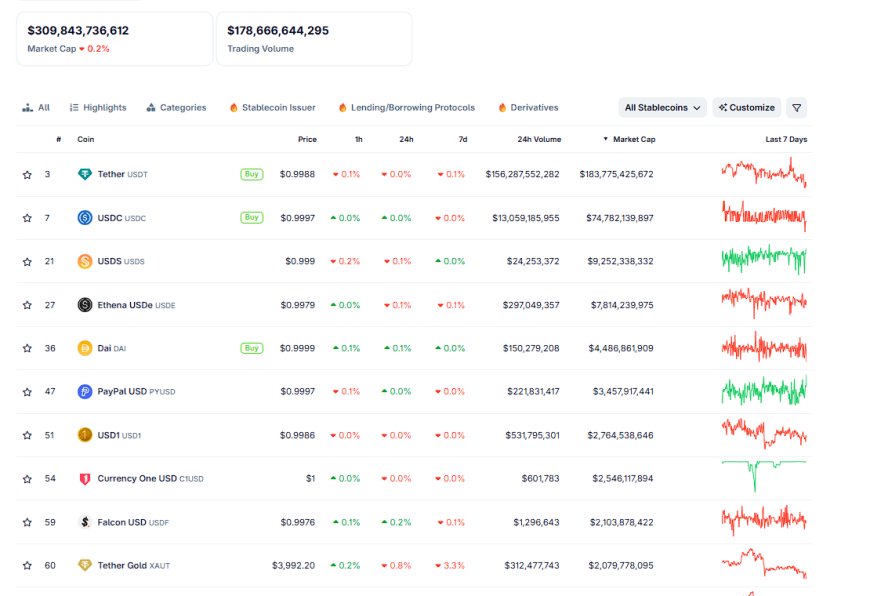
Just look at the numbers from our screenshot:
The top stablecoins — USDT, USDC, USDS, PYUSD, DAI, Currency One USD, and Falcon USD — are all priced at or near $0.998–$1.00. The global market cap for stablecoins now sits above $300 billion.
This means one thing:
The digital dollar already circulates globally at massive scale — but outside traditional banking rails.
This is exactly what we discussed in our article on The Tokenized Reserve Era and our piece on why a “digital dollar” can appear more stable than the physical one.
The Stablecoin Scorecard: Tether, USDC, and the New Dollar Rail
our screenshot shows the actual battlefield for global liquidity:
- Tether (USDT) — $183.7B market cap
- USDC — $74.7B
- USDS — $9.2B (rising fast due to institutional rails)
- DAI — $4.4B
- PYUSD — $3.45B
- Currency One USD — $2.5B
- Falcon USD — $2.1B
That’s seven digital dollars, all backed by some combination of U.S. Treasuries, repo, cash, or tokenized short-term debt.
In other words:
The stablecoin market is already a shadow digital Federal Reserve System — just without the Federal Reserve.
And this reality leads directly into the next section.
CBDCs: The Governments Are Late, and That’s the Point
All year we’ve been covering the global push for CBDCs, from the EU’s “digital euro” pilot to China’s e-CNY, to the BIS gradual rollout of universal CBDC APIs.
But here’s what the market data tells us:
CBDCs are becoming irrelevant before they even launch.
Why?
- The private market is faster. Stablecoins already do what CBDCs claim they’ll do — instantly, globally, and at scale.
- The Treasury prefers stablecoins. They soak up demand for short-term bills and repo without forcing the Fed to act.
- CBDCs require political consensus. Stablecoins require code and collateral.
- Digital dollars already dominate emerging markets. Argentina, Turkey, Nigeria, Vietnam — people use USDT, not bank dollars.
Governments won’t replace stablecoins. They will regulate, consolidate, and integrate them.
The Tokenized Reserve Era: The Dollar’s New Operating System
In our Tokenized Reserve Era essay, we laid out the core thesis:
The U.S. will maintain global monetary dominance by moving Treasuries, repo, and short-term dollar liabilities onto tokenized rails.
Stablecoins are simply the first phase of that operating system:
- Phase 1 (2015–2024): private stablecoins rise
- Phase 2 (2024–2027): tokenized Treasuries become mainstream collateral
- Phase 3 (2027–2030): Treasury-backed digital dollars replace most stablecoins
The End of the Free Crypto Era: Consolidation, Regulation, Absorption
we said it perfectly yesterday:
“History might call this the ‘free crypto era’ — the way we talk about the free banking era.”
The analogy is perfect:
- Many issuers
- All competing for trust
- All issuing their own dollars
- All promising redemption
And just like the free banking era ended with the National Bank Act and the Federal Reserve…
The free stablecoin era will end with the U.S. government consolidating private issuers into a unified digital dollar rail.
What Comes Next: The Global Liquidity Map Rewrites Itself
Here’s the projection consistent with everything we’ve been writing across Pattern Nexus:
- Stablecoin rails become semi-official Treasury distribution channels.
- USDT and USDC either integrate or get absorbed into regulated tokenized T-bill wrappers.
- CBDCs exist, but mostly for interbank settlement — not retail use.
- 2026 QE cycle (QE-2026) supercharges digital collateralization.
- The world starts pricing risk relative to digital liquidity, not physical currency.
The stablecoin table we screenshotted is not “crypto data.” It is the early ledger of the new monetary system.
Beneath the Surface: Why Stablecoins Became the Foundation of the New Global Dollar System
To understand why stablecoins won before CBDCs existed, you have to understand the plumbing. Dollar dominance has never been about “America is strong.” It has always been about:
- the depth of U.S. capital markets
- the global demand for safe collateral
- the ability to clear dollar liabilities anywhere, instantly
Stablecoins solved the one bottleneck the global banking system failed to solve:
They made dollar settlement borderless.
This is the same argument we explored in:
All global AI, energy, commodity, and debt flows ultimately resolve in dollars. Stablecoins simply optimized what banks and SWIFT never could.
Why Tether (USDT) Became the Unofficial Central Bank of the Global South
USDT’s market cap isn’t a crypto number. It’s a geopolitical one.
Most of USDT’s usage isn’t in America, Europe, or Japan. It’s in:
- Turkey
- Argentina
- Egypt
- Nigeria
- Brazil
- Vietnam
These countries don’t trust their banks. They don’t trust their currencies. And they definitely don’t trust their governments.
So they trust Tether — a Cayman-based private company — because it gives them:
- instant dollars
- a hedge against inflation
- global transferability
- no banking middlemen
Tether became the “Federal Reserve of emerging markets” because the Federal Reserve wasn’t willing to be.
In global macro terms, this is the same dynamic we discussed in the Dollar’s Last Stand article — except instead of sovereign FX reserves, it’s retail and merchant-level adoption.
CBDCs as Geopolitical Instruments — and Why the U.S. Doesn’t Actually Want a Retail CBDC
Every time people talk about a U.S. CBDC, they imagine a “federal wallet” where the government tracks every purchase. This is a cartoon version of the conversation.
The U.S. doesn’t need a retail CBDC. It already has:
- Visa
- Mastercard
- PayPal
- USDC
- JPM Coin / Onyx
- USDS and PYUSD
The U.S. wins when the world uses dollars — not when Americans use a Fed wallet.
Meanwhile, China built the e-CNY to control capital flows. The EU built the digital euro to avoid dependence on U.S. payment rails. Africa and Latin America want CBDCs to stabilize currency volatility.
But the U.S. understands something everyone else missed:
You don’t need a CBDC when our private sector already built a global digital dollar empire for you.
This is the same asymmetric strategy we outlined in:
Why QE-2026 Will Supercharge Digital Dollar Infrastructure
The next liquidity cycle — the one we’ve been calling QE-2026 — won’t look like QE in 2008, 2012, or 2020.
This time, liquidity won’t primarily flow into:
- mortgage securities
- bank reserves
- corporate debt
It will flow into:
- tokenized T-bills
- digital collateral rails
- AI–industrial infrastructure
- stablecoin reserves backed by short-term debt
Why?
Because the AI-Industrial Flywheel forces the government to fund:
- massive grid expansion
- SMRs and nuclear restarts
- chips, fabs, and data centers
- AI superclusters and GPU megafarms
This echoes the themes from:
The next global liquidity injection isn’t for banks. It’s for infrastructure — digital, physical, and monetary.
How the Digital Dollar Intersects With the Housing Crisis
This is the part most people miss: Stablecoins and tokenized Treasuries don’t just reshape global liquidity — they reshape U.S. housing.
Why?
- They raise demand for T-bills, pushing the short end lower.
- They steepen the yield curve after the inversion ends.
- They create new pathways for global capital to reach Treasuries instead of real estate.
- They pull liquidity away from property speculation.
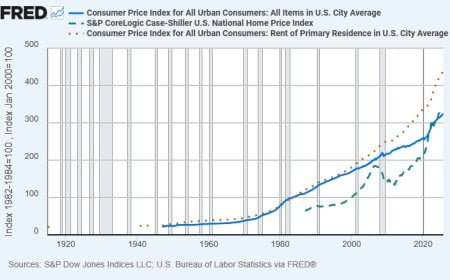
This dynamic was central to our piece: The Quiet Housing Crisis of 2025
As stablecoins become dollar distribution rails, they subtly affect:
- landlord liquidity
- tenant stability
- foreclosure timelines
- the “plateauing” of national housing prices
This is one of our core Pattern Nexus themes:
Housing doesn’t crash — it gets replaced by stronger, more liquid collateral instruments.
The Unavoidable Endgame: A Unified Digital U.S. Monetary Stack
Once you combine:
- stablecoins (private dollars)
- tokenized T-bills (digital collateral)
- CBDC infrastructure (wholesale settlement)
- AI-driven liquidity demand
- global sovereign risk cycles
You get the unavoidable endgame:
A unified, multi-layer digital dollar system where the line between private and public money disappears.
This system will feature:
- a Treasury-controlled collateral backbone
- Fed-managed wholesale settlement rails
- private-sector digital dollars for retail settlement
- global adoption through stablecoins
- AI-industrial financing pipelines driving demand
And when historians look back on this moment, the irony will be obvious:
“We didn’t adopt a CBDC. The market built one around us, and the government simply took control of the parts that mattered.”
Final Thought: You Are Watching Monetary History Happen in Real Time
This is the kind of transition that only happens once every 80–100 years.
We are living through:
- the end of the free crypto era
- the birth of digital collateral civilization
- the rise of global AI-driven dollar demand
- the absorption of private money into state money
- the emergence of a fully tokenized reserve system
Why Governments Will Never Allow Decentralized Money Long-Term
There is a blind spot in the crypto community — a deeply naïve assumption that governments will tolerate private, decentralized money competing with sovereign monetary systems. They won’t. They never have. They never will.
Money isn’t an asset class. It’s a tool of governance, sovereignty, war financing, and strategic power projection. It is the operating system of the state.
If a government loses control of its currency, it loses control of its society.
This is why decentralized money will always hit a hard ceiling:
- Taxation requires centralized rails. No government can collect taxes from an untraceable network.
- Capital controls require chokepoints. Crypto dissolves capital borders, and states can’t allow that.
- War financing requires printing power. No decentralized system can fund trillion-dollar military operations.
- Regulatory capture requires issuers, not protocols. You can pressure Tether or Circle — you can’t pressure a blockchain.
The U.S. won’t ban crypto. It will do something far more effective:
It will co-opt it.
Stablecoins will become digital dollar banks. Tokenized Treasuries will become the ultimate collateral rail. CBDC pipes will run underneath everything. And decentralized assets will be pushed to the fringe — tolerated, but irrelevant at scale.
This is exactly what happened in the Coming Reset article: every time private money rises, the state eventually absorbs it.
How China, Dubai, and Singapore Are Positioning Around Stablecoins
Stablecoins aren’t just a financial instrument — they’re a geopolitical battlefield. Every major power bloc has a radically different strategy, because each one has a different level of control over global capital flows.
China — Contain the Dollar, Globalize the e-CNY
China’s goal isn’t to replace the dollar. They know that’s impossible. Their goal is to prevent their domestic economy from being swallowed by the dollar.
They focus on:
- capital controls
- onshore-only stablecoin pilots
- tight exchange regulation
- pushing e-CNY for trade partners (Belt & Road)
China’s mission is containment: stop USDT from dollarizing the entire Chinese capital system.
Dubai — The Global Free Port of Digital Dollars
Dubai sees the opposite opportunity.
Dubai wants to become:
- a global clearinghouse for stablecoins
- the central hub for tokenized Treasuries outside the U.S.
- the primary on/off-ramp for emerging market dollar flows
Dubai’s strategy is simple:
Become the Cayman Islands of the digital dollar world — but regulated, fast, and plugged into global finance.
Singapore — Build the Institutional Standard
Singapore focuses on:
- regulatory clarity
- institutional custody
- tokenized T-bill integration
- bank-issued stablecoins
Singapore isn’t trying to disrupt the dollar. They’re trying to make sure they sit at the center of the new digital dollar value chain.
This triangulates the world:
- China — reject and contain
- Dubai — embrace and free-market-optimize
- Singapore — formalize and institutionalize
Together, these strategies prove one thing:
The digital dollar is not just a currency system — it’s a geopolitical alignment test.
Why This Ends With Treasury-Controlled Digital Dollars
Every path ultimately converges on a single endgame:
The U.S. Treasury becomes the central issuer of digital dollars — not the Fed.
This isn’t a theory. This is what the structure of the system demands.
Why the Treasury, Not the Fed?
Because:
- Treasuries are the collateral.
- Treasuries back stablecoins.
- Treasuries back repo.
- Treasuries back bank liquidity.
- Treasuries back offshore Eurodollars.
- Treasuries will back tokenized dollars.
The Fed prints reserves, not money. The Treasury issues the actual asset the world wants.
In a tokenized future, this distinction matters.
The Stablecoin → Treasury Integration
When stablecoins become wrappers around short-term bills, Treasury is already the de facto central bank of the digital dollar system.
All the government needs to do is:
- standardize collateral requirements
- require regulated reserves
- enforce redemption windows
- lock issuers into government APIs
At that moment:
“The digital dollar becomes a Treasury product — stablecoins become distribution channels — and the Federal Reserve becomes the wholesale settlement rail.”
This is exactly how the National Bank Act reshaped free banking — except now, the consolidation is digital.
Epilogue: The Coming Reset — The Quiet Rewrite of Global Money
We are not heading into the collapse of the dollar. We are heading into the upgrade of the dollar.
And like every historical monetary transition:
- it starts quietly
- it begins outside the government
- it accelerates during crises
- it ends with consolidation into a new regime
This was true in:
- Weimar → Rentenmark
- Bretton Woods I → II
- Free Banking → National Bank Act → Federal Reserve
And now it’s true again.
The Coming Reset isn’t about the end of the dollar — it’s about the end of the old operating system the dollar ran on.
The new system is:
- tokenized
- programmable
- collateralized by Treasuries
- settled through private and public digital rails
- accelerated by AI-energy industrialization
- globalized through stablecoins
“We are the last generation to live in the analog-dollar world. The next one will grow up in a fully digital monetary ecosystem built on energy, compute, and collateral.”
The stablecoin chart we posted wasn’t a curiosity — it was a snapshot of a civilizational pivot point.
This is the quiet reset. This is the new Bretton Woods. This is the birth of the Digital Reserve Era.
- The Tokenized Reserve Era
- Is the Digital Dollar Worth More Than the Physical Dollar?
- The Quiet Housing Crisis of 2025
- Market Wrap – November 17, 2025
- The AI–Industrial Flywheel
- The AI–Power Nexus
- The Dollar’s Last Stand
- When Money Stops Making Sense: Free Banking, Weimar, and the Coming Reset
- Why the Fed Can’t Let the Dollar Die
Apa Reaksi Anda?
 Suka
0
Suka
0
 Tidak Suka
0
Tidak Suka
0
 Cinta
0
Cinta
0
 Lucu
0
Lucu
0
 Wow
0
Wow
0
 Sedih
0
Sedih
0
 Marah
0
Marah
0

Founder of Pattern Nexus. I research markets, macro, geopolitics, AI, history, ancient systems, and the patterns most people overlook. I’m also building Market Radar, a trading scanner designed to read pressure, risk, confirmation, and setup quality before chasing a move. Pattern Nexus is where I connect the dots between data, history, technology, and the bigger system playing out around us.

















Komen-komen (0)