
Elon Musk at $600 Billion and the Birth of the First Megacorp
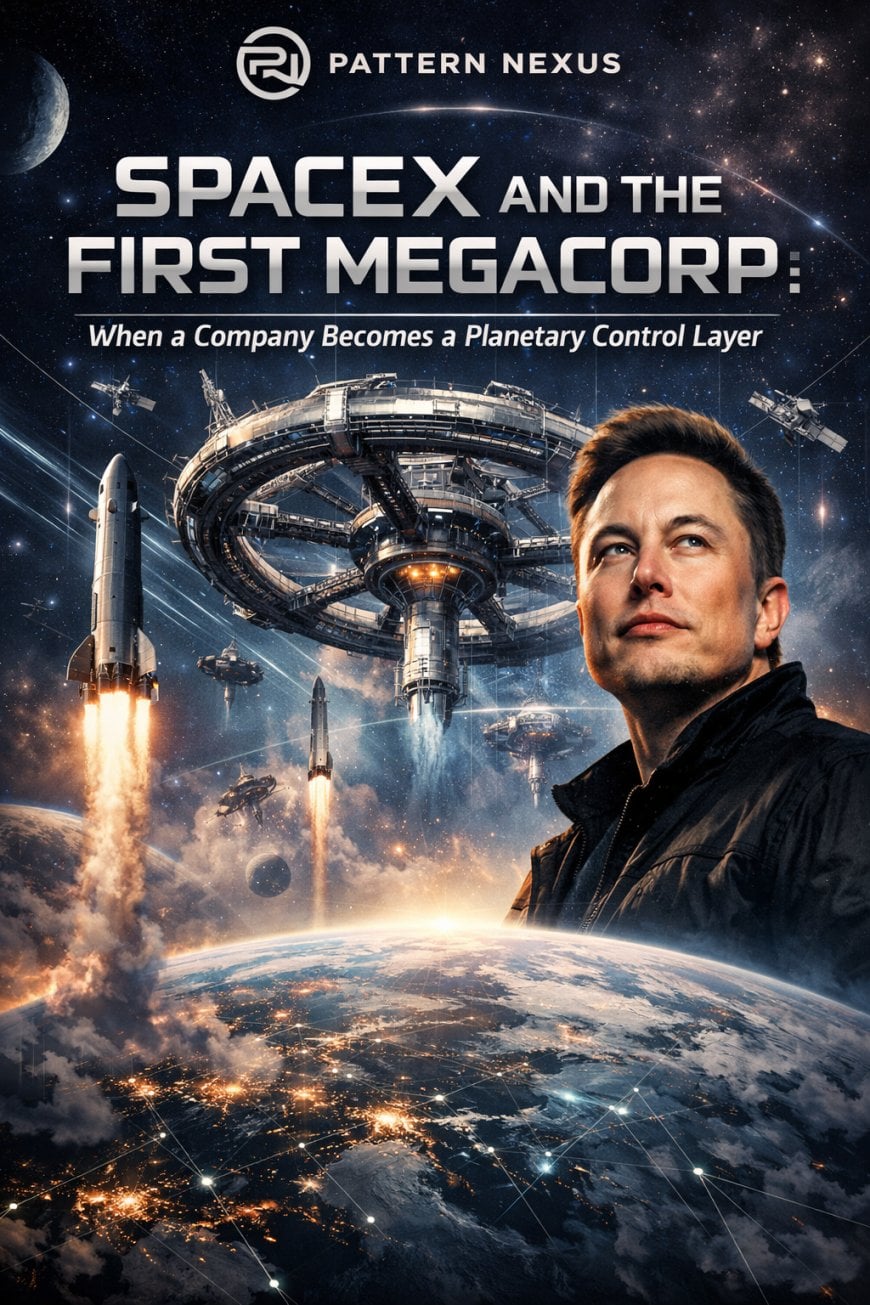
Elon Musk becoming the first human worth over $600 billion is not just a wealth milestone. It is the surface signal of something deeper: the emergence of SpaceX as the first true megacorp and the arrival of post-sovereign corporate power.
Published: April 5, 2026
By: Pattern Nexus
The SpaceX IPO is not just another giant listing. It is the public-market onboarding of a private infrastructure node that already controls launch, already controls a global orbital communications mesh, and is now trying to bring AI, public ownership, and benchmark demand into the same machine.
April 2026 update: the rumor phase is over
For months the SpaceX IPO sat in that familiar soft zone where private-market repricing, billionaire mythology, and media speculation all get treated like the same thing. That phase is over. SpaceX confidentially filed for a U.S. IPO. That does not mean the stock starts trading tomorrow. It does not mean the final valuation is locked. It does not mean the public has seen the full disclosure package. But it does mean the story has crossed from “people are talking about it” into “the regulatory and underwriting machinery is now moving.”
That matters because people keep confusing a confidential filing with a rumor that got upgraded. It is not that. A confidential filing is the point where the company enters the SEC review corridor privately. The difference is simple: before filing, the market is arguing about whether the machine will run. After filing, the real question becomes how the machine is being built. What is the structure. What is the float. How big is the raise. Who gets the allocations. What governance does Musk keep. Which exchange gets the deal. What financial presentation do investors actually see once the public filing lands.
PN bubble: The filing is not the IPO event. The filing is the point where a private control layer begins the formal process of being turned into a public-market asset.
The numbers being discussed are obviously part of why the market cares. The offering has been reported around a $1.75 trillion frame and then above $2 trillion, with as much as $75 billion potentially raised. If anything close to that holds, this is not just the biggest IPO on the calendar. It becomes the biggest IPO in history by a margin that resets the scale people use for the category.
But the size is still not the deepest story. The deeper story is that public markets are no longer being asked to look at SpaceX as an aerospace manufacturer. They are being asked to look at it as launch access, orbital deployment, Starlink continuity infrastructure, defense relevance, and AI-linked future optionality all wrapped into one listing.
How the IPO process actually works from here
The first thing people need to understand is that confidential does not mean invisible forever. The SEC allows companies to submit draft registration statements privately, but the company still has to publicly file the registration statement and the draft submissions at least 15 days before any roadshow or, if there is no roadshow, at least 15 days before the requested effective date. So the quiet stage is real, but it is not indefinite. The public filing still has to happen before the stock can trade.
That means the current phase is the controlled setup phase. The banks and the company work through SEC comments, refine the prospectus, settle how the story is going to be sold, pressure-test demand, and decide how much information they want the market to see and when. Reuters also reported that the usual filing-to-trade timeline can run about three to six months depending on regulatory review and market conditions. So the filing matters because it starts the sequence, not because it finishes it.
From here, the market should be watching for a few specific things. First is the eventual public filing itself, because that is where the real financial presentation, risk factors, use of proceeds language, governance structure, and final framing become visible. Second is exchange choice. Third is whether the company confirms the reported size range or walks it back. Fourth is the final capital structure. Fifth is how the deal is allocated across institutional, sovereign, high-net-worth, and retail channels.
In other words, we are now in the stage where the IPO becomes a design problem. The story is no longer just “will SpaceX go public.” The story is “what exact public object is SpaceX trying to create.”
The deal architecture: size, banks, anchor demand, retail, governance
The underwriting machine tells you a lot about how serious this is. Reuters reported that SpaceX has assembled at least 21 banks under the internal codename “Project Apex,” with Morgan Stanley, Goldman Sachs, JPMorgan, Bank of America, and Citi serving as lead bookrunners. That is not the setup for a normal growth-company listing. That is the kind of structure you build when the deal is so large that distribution itself becomes an engineering problem. You need separate channels for institutions, high-net-worth investors, retail, and regional buyers. You need banks assigned by relationship. You need after-market support. You need a coalition, not just a sale.
Then there is anchor demand. Reuters reported that SpaceX has held talks with Saudi Arabia’s Public Investment Fund about a possible $5 billion anchor investment. That matters in two ways. First, anchor demand helps stabilize a deal of this size before it ever reaches public trading. Second, it signals that the company is not relying only on broad retail excitement or standard institutional appetite. It is trying to secure heavyweight validation early.
Retail is the other big tell. Reuters reported that SpaceX has considered allocating up to 30% of the offering to retail investors, with E*Trade in talks to help route the smaller-ticket share sale. That is wildly different from the traditional institutions-first model that dominates large IPOs. If it holds, it turns the offering into something closer to a public spectacle with ownership attached. That matters because retail holders do more than buy. They amplify narrative, identity, momentum, and cultural stickiness around the ticker.
Governance is the other part people should be staring at. Reuters reported that SpaceX has considered a dual-class structure, and Reuters also quoted analysis that such a structure would allow Musk to tap public capital while retaining firm control even after the dilution that comes with a giant listing. That is a key distinction. If that structure holds, public investors are not really buying control in proportion to their capital. They are buying exposure to the economics of the machine while the command layer stays concentrated.
Then there is the benchmark and listing layer. Reuters reported that SpaceX has leaned toward Nasdaq while seeking early Nasdaq-100 inclusion, and Reuters separately reported that Nasdaq’s new fast-entry rule will allow qualifying mega-cap IPOs to be evaluated on the seventh trading day and potentially admitted by the fifteenth. That matters because the demand story here is not just day-one discretionary buying. It is also about whether the market’s own plumbing gets rewritten to absorb giant late-stage private firms faster than before.
PN bubble: This is not just a giant share sale. It is a deliberately engineered ownership event built across sovereign, institutional, retail, and benchmark demand at the same time.
What public markets are actually being asked to buy
This is where the listing stops being a normal IPO story and becomes a valuation-theory story. Public markets are not really being asked to buy a rocket company. They are being asked to buy a stack.
The stack starts with launch access. SpaceX dominates launch cadence and has a reusable cost structure the legacy players have still not matched cleanly. That is the access layer. Then comes deployment and orbital logistics. Then comes Starlink, which Reuters reported has more than 9,500 satellites in orbit, more than 9 million users worldwide, and accounts for roughly 50% to 80% of SpaceX revenue. Reuters also reported that SpaceX generated about $8 billion in EBITDA on roughly $15 billion to $16 billion of revenue in 2025. That is the business layer that makes public-market scale plausible. The rocket story creates spectacle. Starlink creates the recurring cash-flow base that lets the valuation survive contact with markets.
Then the stack goes wider. The xAI merger matters here, but only as part of the IPO frame, not as the whole article. Reuters reported that SpaceX merged with xAI at a combined valuation of roughly $1.25 trillion, with SpaceX at $1 trillion and xAI at $250 billion. That matters because it means the market is no longer being asked to value only launch and communications. It is being asked to price a company that is increasingly selling AI adjacency and future compute ambition as part of the same story.
Reuters also reported that SpaceX will host an analyst day on April 21 and offer analysts a visit to the xAI “Macrohard” data center in Memphis on April 23. That sequence tells you exactly how the deal is being framed. They are not just saying “look at the rocket company.” They are bundling launch, Starlink, AI linkage, and future infrastructure ambition into the sales pitch itself.
That does not mean the AI layer should be treated like settled economics. Reuters also reported that Musk says the IPO would help bankroll up to 1 million data-center satellites in orbit, while specialists warned the economics and engineering of space-based data centers remain highly questionable. That is the right way to think about it. It is part of the valuation story because it creates optionality and narrative upside. It is not yet the hard earnings engine. Right now, Starlink is the engine. The AI-orbital layer is the future claim being stapled onto it.
PN bubble: The market is not pricing rockets. It is pricing access to orbit, control of an orbital service layer, and the option value of whatever gets built on top of that layer next.
What this IPO means beyond just “largest ever”
The obvious meaning is scale. If the company gets anywhere near the currently reported figures, this becomes the largest IPO in history. That alone would make it important.
But the deeper meaning is legitimization. Once a company like this becomes public, pensions can own it, passive funds can own it, institutions can own it, retail tribes can own it, and benchmark products can potentially be forced to absorb it. That changes the political and financial shape of the company. A strange private strategic node gets converted into a normalized public holding. The system stops talking about dependence and starts talking about portfolio exposure.
That is why the IPO matters more than just the money it raises. The raise matters, obviously. But the real transformation is that a private infrastructure surface becomes domesticated inside public-market language. Ticker symbols, analyst notes, benchmark inclusion, price targets, and ETF ownership all help normalize what would otherwise still look like an abnormal concentration of strategic capability.
That is also why this deal matters for the IPO market itself. Reuters reported that some see SpaceX as a make-or-break test for mega-IPOs, while others warn it may be so singular that it ends up vacuuming in demand rather than broadly reopening the market. That is exactly the right distinction. SpaceX may succeed because it is SpaceX, not because the market is suddenly healthy for every giant private firm. But even in that case, it still changes expectations for what a late-stage private megacap can do when it finally comes public.
What can still change or break
The first thing that can still change is the structure itself. Final valuation can move. Final proceeds can move. The exchange can still matter. The float can shift. The retail sleeve can shrink or expand. Anchor commitments can firm up or disappear. The dual-class structure can still be adjusted. Until the public filing lands, parts of the architecture remain fluid.
The second thing is demand. Right now the size is part of the attraction. It is also part of the risk. A deal this large needs more than hype. It needs actual absorption capacity across multiple buyer types.
The third thing is execution risk beyond the listing. NASA’s watchdog said SpaceX’s Starship development has accumulated at least two years of delays for the Artemis role and identified cryogenic propellant transfer as one of the most significant technical hurdles before a lunar landing can happen. That matters because public investors may be willing to pay up for Starlink and continuity infrastructure, but frontier hardware delays still matter if they begin to erode the future-story premium.
The fourth thing is overreach in the optionality layer. Orbital AI data centers are an example. They help tell a very large story. They do not yet constitute a proven business line. If too much of the valuation starts leaning on the most speculative layers, the company creates room for disappointment later.
Pattern Nexus Lens
The cleanest read is that the IPO is not creating the power. It is formalizing public ownership around power that already exists.
SpaceX is already not behaving like a normal company. It controls launch access at scale. It controls a giant live communications layer in orbit. It is increasingly relevant to state continuity functions. It is stapling AI ambition onto that stack at exactly the moment public markets are being invited in. So the listing is not just a finance event. It is the normalization phase for a private infrastructure node that the system is already routing through.
PN bubble: The headline will be “largest IPO in history.” The deeper story is “public ownership is being wrapped around a private control plane.”
Update sources
- Reuters (Apr 1, 2026): SpaceX files confidentially for IPO
- Reuters (Apr 1, 2026): From filing to first trade, inside the U.S. IPO process
- SEC: Draft registration statement processing procedures
- Reuters (Apr 1, 2026): SpaceX lines up 21 banks for Project Apex
- Reuters (Apr 2, 2026): SpaceX targets more than $2 trillion valuation
- Reuters (Apr 2, 2026): Saudi PIF anchor-investor talks
- Reuters (Mar 30, 2026): E*Trade and retail allocation talks
- Reuters (Mar 26, 2026): Retail-heavy IPO structure reporting
- Reuters (Feb 13, 2026): Dual-class share structure reporting
- Reuters (Mar 10, 2026): SpaceX leans Nasdaq and seeks early index entry
- Reuters (Mar 30, 2026): Nasdaq fast-entry rule changes
- Reuters (Apr 1, 2026): SpaceX business and finances, Starlink scale, revenue and EBITDA
- Reuters (Feb 2, 2026): SpaceX-xAI merger and combined valuation
- Reuters (Apr 1, 2026): Analyst day and Macrohard visit
- Reuters (Apr 1, 2026): Orbital data-center ambitions and skepticism
- Reuters (Mar 10, 2026): Starship delays and NASA timeline risk
- NASA OIG (Mar 10, 2026): Artemis lander program delays and risks
The original December framework preserved below
The headline hook: $600 billion
Elon Musk crossing $600 billion in estimated net worth is a milestone that feels cartoonish because it breaks historical intuition. People can debate inequality, personality, politics, and fairness for weeks and never touch the actual mechanism that produced the number. That’s how the headline cycle works: it keeps you in the theater.
But the $600B milestone is not merely “one man got richer.” It is a visible proxy for an invisible transition: certain corporations are starting to become infrastructure layers that states cannot quickly replicate. When that happens, valuations stop behaving like valuations.
PN bubble: The public sees “Musk got rich.” The system sees “a new control layer is forming.” The number is the symptom.
If you want the cleanest interpretation in one sentence, here it is: Musk didn’t become historically wealthy because he found a better product. He became historically wealthy because the world began pricing SpaceX as strategic continuity.
Wealth is a symptom, not the driver
Most people misunderstand paper wealth at this scale. Musk is not “sitting on $600B in cash.” This is ownership concentration inside a set of interlocking systems that sit on top of the modern economy: communications, logistics, energy, manufacturing, and now the orbital layer.
Extreme wealth is not created in a vacuum. It is created when the system decides a particular node is too important to destabilize and starts routing dependency through it. That is what “valuation” becomes in the megacorp era: a proxy for indispensability.
PN bubble: Once an entity becomes a continuity provider, the market starts treating it like a sovereign asset, even if nobody uses that language publicly.
This is why the moral arguments alone never solve anything. You can hate Musk or love Musk and still miss the point. The point is that the system is re-architecting itself around corporate control planes.
How Musk got there: the SpaceX re-rate
The key mechanical driver behind the $600B+ milestone is the repricing of SpaceX via private secondary sales and tender activity, alongside rising expectations for a potential IPO window. This is the “quiet phase” where private markets reset the reference price before the public narrative fully catches up.
If you’re trying to understand why the number jumped so fast, this is the answer: SpaceX moved from being valued like an elite aerospace firm to being valued like a platform the world cannot replace on short notice.
Tesla still matters. xAI still matters. But SpaceX is the hinge because it touches a category of power that historically belonged to states. That is why the SpaceX stake becomes the gravitational center of the entire Musk wealth story.
The market is not pricing rockets, it’s pricing control
The default framing is “rocket company valuation doubled.” That framing is wrong, or at least incomplete. The market is pricing a stack of capabilities that function as control surfaces:
- Orbital access at scale: cadence, reliability, and cost curves that determine who can build in space and how fast.
- Orbital logistics: the ability to deploy, replenish, and reconfigure infrastructure above the planet under time pressure.
- LEO communications dominance: a private mesh that bypasses terrestrial telecom chokepoints and degrades censorship geometry.
- Dual-use embedment: civil and defense reliance compounding together, making disentanglement politically expensive.
- Optionality: once you control “up,” you gain leverage over observation, routing, resilience, and the next layer of space industrialization.
This is the simplest way to state the repricing: SpaceX is not being valued like an industrial manufacturer. It is being valued like a control plane.
PN bubble: When an entity becomes the control plane, its products become dependencies, and dependency is what markets ultimately price.
SpaceX as post-nation infrastructure
Every era has its core infrastructure monopoly. In the old order, monopolies were negotiated inside borders: rail, oil, telecom, banking. In the emerging order, the core monopoly is continuity across borders.
Starlink is the cleanest proof because it alters enforcement geometry. A terrestrial network can be regulated, seized, physically degraded, or shut down through domestic legal mechanisms. A large, distributed LEO constellation does not make governments powerless, but it forces a different kind of bargaining. Control migrates from “permit and regulate” toward “coordinate, align, or escalate.”
That’s how post-nation infrastructure begins: not as a declaration, but as practical adoption in reliability gaps, disaster zones, and conflict environments. Once embedded, it becomes normal. Once normal, it becomes difficult to dislodge without collateral damage to the very state trying to dislodge it.
PN bubble: The first megacorp doesn’t announce itself. It becomes the thing everyone quietly uses when the old system fails.
The IC framework: the corporate organism
In the Pattern Nexus framework, the Integrated Corporation (IC) is not “a big company.” It is a corporate organism that compounds power across domains by closing loops: capital loops, data loops, logistics loops, and political alignment loops.
The IC operates through fragmentation. It does not require perfect global governance or a single coherent regulatory framework. It simply requires that enough key actors choose the IC as their continuity provider. At that point, the IC doesn’t need to overthrow the state. It becomes the state’s outsourced continuity engine.
- Physical access: launch and deployment capacity as a gate to the orbital layer.
- Communications layer: Starlink as an always-on routing mesh that can persist through disruption.
- Data gravity: telemetry, routing decisions, usage patterns, and operational learning curves that reinforce moat effects.
- Security embedment: defense reliance transforms commercial leverage into geopolitical leverage.
- Expansion surface: the orbital domain creates room for new asset classes: observation platforms, orbital compute, persistent infrastructure.
PN bubble: The IC is not “too big to fail.” It is “too embedded to unwind.” That is a different category of power.
If you want to understand why Musk’s wealth becomes a headline magnet, it’s because founder equity is the easiest way for the public to visualize IC emergence. The public can’t see continuity routing. The public can see a number next to a name.
The megacorp compact governments can’t say out loud
Governments cannot publicly admit dependence on a private control plane without triggering backlash. So they normalize it quietly, then build policy around the dependency once it exists. This is not conspiracy. This is how systems behave under time constraints.
The compact looks like this:
- States tolerate corporate sovereignty surfaces because they need the capability now, not after a decade of procurement fights.
- The corporation tolerates oversight rituals because it needs legitimacy, spectrum rights, launch permissions, and defense partnerships.
- Both sides avoid clean confrontation because separation is disruptive and escalation is expensive.
This is why the megacorp era is not “anti-government.” It is governments admitting—through behavior—that they cannot build the future fast enough, so they rent it.
PN bubble: The megacorp era is a speed problem. Whoever can iterate hardware and infrastructure fastest becomes the system’s default option.
The IPO is legitimization, not liquidity
If SpaceX pushes toward a public offering at trillion-scale valuation, understand what that does structurally. An IPO is not just a financing event. It is a legitimacy event.
- Legitimizes ownership: pensions and institutions become stakeholders in orbital infrastructure.
- Hardens the moat: once systemically owned, “breaking it up” becomes politically self-harming.
- Normalizes the category: public markets domesticate megacorp power by treating it like a ticker symbol.
There is a second-order effect most people miss: public ownership creates narrative cover. Private sovereignty becomes “public investment.” That is how megacorp reality becomes socially acceptable.
Ties to the Pattern Nexus worldview
Here is the connective tissue to the broader Pattern Nexus model. I have been arguing that modern power is migrating away from visible politics and into systems: liquidity plumbing, payment rails, compliance layers, energy constraints, logistics, and data routing. The public fights over personalities. The control layer quietly moves.
SpaceX is the space-domain version of the same phenomenon. Just like liquidity loops route around old constraints and silently determine outcomes, orbital infrastructure and continuity networks will route around old sovereignty assumptions and silently determine outcomes. This is why SpaceX is not “a rocket company” in the way Boeing is a plane company. SpaceX is a control system that just happens to use rockets as its actuator.
This is also where the “AI-industrial flywheel” logic returns. AI demands power, compute, and resilient networking. The future IC does not survive on software alone. It survives on the physical layer: energy, logistics, routing, and continuity. The corporate organism that owns enough of those layers does not just win market share. It starts negotiating the future.
PN bubble: The public thinks “Musk.” Pattern Nexus thinks “control planes.” The $600B headline is a flare that the transition is underway.
What breaks the thesis
A serious framework must state failure modes. The claim is not “SpaceX will rule the world.” The claim is “SpaceX is the first mass-scale prototype of post-sovereign infrastructure and the IC category.” Prototypes can fail or fracture.
- Geopolitical segmentation: blocs hard-split orbital comms and launch ecosystems, reducing unified control-plane leverage.
- Spectrum and export hard walls: restrictions that cap global footprint or force regional carve-outs.
- Adversary duplication: rival constellations and launch stacks reach comparable resilience and cadence.
- Operational shock: collision cascades, catastrophic failures, or prolonged outage events reprice risk and adoption.
- Capital regime shift: tight liquidity slows expansion and delays the next layer (orbital platforms, compute, industrialization).
PN bubble: The megacorp doesn’t need invincibility. It needs default adoption before replacement coordination becomes feasible.
Scenarios: 2026–2035
Scenario A: Controlled public onboarding
SpaceX moves toward a public listing, institutions buy, and the “innovation” narrative becomes the wrapper. Dependence deepens quietly. Regulation stays peripheral. The system locks around the continuity provider.
Scenario B: Fragmented skies
Rival blocs segment orbital infrastructure into aligned constellations and launch ecosystems. SpaceX remains dominant in its sphere, but the planetary-control-layer thesis becomes a multi-polar control-layer thesis. Same pattern, different topology.
Scenario C: Orbital industrial turn
Launch becomes less important than what launch enables: persistent platforms, observation-as-infrastructure, orbital compute, and space-based logistics. If SpaceX becomes the gatekeeper to that layer, valuation shifts from “growth” toward “infrastructure rent logic.”
Scenario D: Backlash window and formalized alignment
A political shock forces the question: should private entities hold this much infrastructure power? The most likely resolution is not a clean breakup. It is a new compact: deeper state alignment, quasi-nationalization features, or a security framework that formalizes dependence.
Pattern Nexus Lens
Elon Musk crossing $600 billion is not the story. It is the receipt. It is the visible artifact created when the system decides that a private entity has become too critical to treat like an ordinary firm.
SpaceX is the first mass-scale proof that the future IC is real: a corporate organism that owns logistics, owns routing, owns continuity, and negotiates with states from a position of embedded indispensability. The public will argue about Musk’s personality for years. The system will keep moving underneath them.
PN bubble: The public debates wealth. The control layer consolidates. SpaceX is the first brand to cross the line into “planetary infrastructure.”
FAQ
Is Musk really “worth” $600+ billion?
It is an estimate based on ownership stakes and private-market reference prices. The practical point is not whether the number is exact. The practical point is that the system is now comfortable assigning that order of magnitude to a single owner of strategic infrastructure.
Does this mean nation-states are obsolete?
No. It means sovereignty becomes layered. States remain essential, but continuity functions begin migrating into private infrastructure providers. That changes bargaining power, enforcement geometry, and policy outcomes.
What should I watch to see if the megacorp thesis is correct?
Watch where continuity routes during stress: militaries, emergency services, critical industry, and communications fallback. The entity that becomes the default continuity provider becomes the backbone of the system.
Is SpaceX unique, or just first?
First. The IC category will expand. SpaceX is simply the earliest large-scale proof that the megacorp era is not science fiction anymore.
Original framework sources
- Forbes (Dec 15, 2025): Musk crosses $600B; SpaceX tender/valuation details
- Reuters (Dec 13, 2025): SpaceX secondary sale and $800B valuation context
- Reuters (Dec 5, 2025): investor communications and valuation comparisons
- Reuters (Dec 6, 2025): Musk response to valuation reporting and narrative friction
- Reuters (Dec 11, 2025): investor expectations for a future IPO and demand dynamics
- Bloomberg (Dec 9, 2025): IPO timing and valuation-target reporting
- WSJ (Dec 5, 2025): share sale discussions and valuation framing
- Fortune (Dec 16, 2025): framing the potential IPO as a historic scale event
Wat is jouw reactie?
 Vind ik leuk
0
Vind ik leuk
0
 Niet leuk
0
Niet leuk
0
 Liefde
0
Liefde
0
 Grappig
0
Grappig
0
 Wauw
0
Wauw
0
 Verdrietig
0
Verdrietig
0
 Boos
0
Boos
0

Founder of Pattern Nexus. I research markets, macro, geopolitics, AI, history, ancient systems, and the patterns most people overlook. I’m also building Market Radar, a trading scanner designed to read pressure, risk, confirmation, and setup quality before chasing a move. Pattern Nexus is where I connect the dots between data, history, technology, and the bigger system playing out around us.

















Opmerkingen (0)