
Mass Layoffs: The Big Cuts of Sep–Oct 2025
From UPS and Amazon to Nestlé, Intel, Target, and Paramount—here are the biggest layoff waves announced over the last 60 days and why they happened.

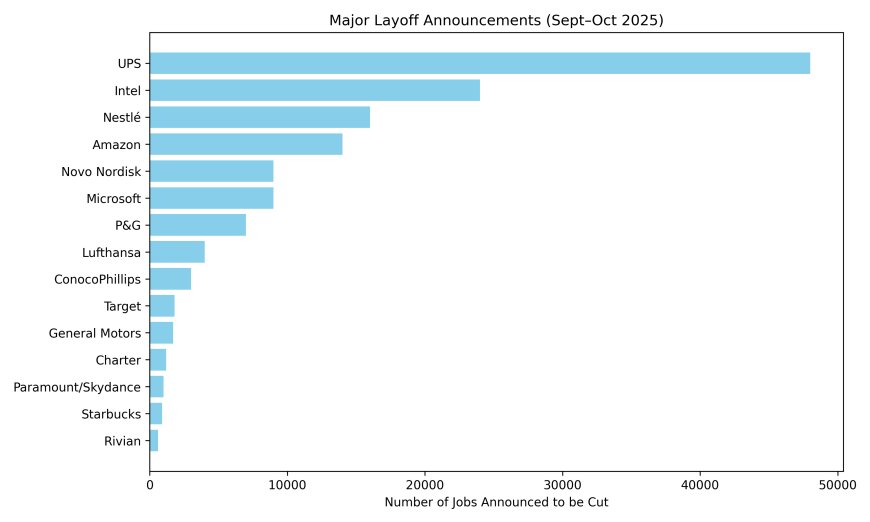
Major Layoff Announcements (Sept 1–Oct 30, 2025)
Zoom out. The headlines say “layoffs,” but what you’re really seeing is a system rewiring itself. When capital gets expensive and margins compress, executives don’t just trim— they re-architect. The past 60 days were the tell: logistics, tech, consumer brands, media, autos, energy—different logos, same playbook. Fewer layers. Fewer bodies. More code, more robots, tighter supply chains.
This isn’t a one-off cycle; it’s the next leg of the transformation I’ve been mapping here for months. The Fed’s whipsaw from QE to QT to a soft pivot didn’t “fix” anything— it exposed where the drag lives. Companies are now doing what the rate curve forced them to do: delever headcount, consolidate footprint, and reallocate spend into AI, automation, and real-time logistics. In other words, the human-heavy operating model is being marked to market.
If you’ve followed my work, you know I don’t read these moves as “weakness.” I read them as positioning. UPS doesn’t slash tens of thousands because packages are going away; they do it because networks are getting smarter, denser, and faster. Amazon, Intel, Microsoft—same story, different angle. Strip bureaucracy, fund the engines (data centers, models, tooling), and let fewer, sharper teams move the flywheel.
And yes—this touches the real economy. EV demand wobble? You right-size lines. Media margins collapsing? You merge, cut, and refocus on what actually converts. CPG under inflation pressure? You simplify SKUs, automate back office, and harden cash flow. The narrative is layoffs; the signal is system optimization.
What follows isn’t doom. It’s the map. Who cut, why they cut, where those dollars will be redeployed—and how this cascade sets the stage for 2026. Read it with a builder’s mindset: the winners aren’t the cheapest operators, they’re the ones who upgrade the machine fastest.
The last two months have seen an acceleration of large workforce reductions as companies across sectors trimmed headcounts to control costs, streamline operations, and invest in automation. In many cases executives pointed to the rising cost of capital and the need to invest in artificial intelligence as reasons to reduce layers of management or close under-performing facilities. The table below summarizes the biggest layoffs announced between September 1 and October 30, 2025.
Summary of major layoffs
| Company (Sector) | Announcement date | Estimated jobs cut (approx.) | Sources | Key reasons (as reported) |
|---|---|---|---|---|
| United Parcel Service (UPS) — logistics | Oct 28, 2025 | ≈48,000 positions (34,000 operational and 14,000 management roles) | fox10tv.com designrush (1) designrush (2) | CEO Carol Tomé said UPS is consolidating operations, closing 93 facilities, introducing more robotics, and reducing reliance on Amazon to save roughly $3.5 billion. |
| Intel — semiconductor/tech | Jul 24, 2025 (effects continued into Sept–Oct) | ≈24,000 employees (~15–20% of workforce) | employeesfirstlaborlaw.com employeesfirstlaborlaw.com | CEO Lip-Bu Tan said Intel will reduce headcount to about 75,000 “core” workers by year-end to cut costs and focus on AI/data-center chips; reductions include WARN filings in California. |
| Nestlé — consumer goods | Oct 16, 2025 | ≈16,000 jobs (12,000 corporate and 4,000 manufacturing roles) | fooddive.com fooddive.com | CEO Mark Schneider announced a two-year plan to simplify the organization, be “ruthless” in assessing talent, and save CHF 3 billion (≈US$3.8 billion). |
| Amazon — retail/technology | Oct 28, 2025 | ≈14,000 corporate jobs initially (sources suggest up to 30,000 overall) | newsweek.com reuters.com reuters.com | CEO Andy Jassy said Amazon will organize more “leanly” with fewer layers, using AI to streamline operations; cuts span HR, operations, devices, and AWS divisions. |
| Novo Nordisk — pharmaceuticals | Sept 10, 2025 | ≈9,000 jobs (~11.5% of workforce) | reuters.com reuters.com | To reignite growth and compete in obesity drugs, the firm is cutting headcount and expects annual savings of ~8 billion DKK; about half of the reductions are in Denmark. |
| Microsoft — technology | Jul 2, 2025 (layoffs continue) | ≈9,000 positions (nearly 4% of workforce) | reuters.com reuters.com | Following an earlier round (~6,000 workers), Microsoft cut another ~9,000 jobs to fund heavy investments in AI and streamline operations. |
| Procter & Gamble (P&G) — consumer goods | Jun 2025 (announced; reductions underway in Sept–Oct) | Up to 7,000 jobs (~6% of global workforce) | kfvs12.com kfvs12.com | P&G is restructuring operations and expects cuts over two years to improve productivity and save costs. |
| Lufthansa Group — aviation | Oct 25, 2025 | ≈4,000 administrative jobs | reuters.com reuters.com | As part of a digitization and automation program aimed at boosting profitability, Lufthansa plans to cut administrative staff by 2030, mostly in Germany. |
| ConocoPhillips — energy | Oct 29, 2025 | 20–25% of workforce (≈2,600–3,250 employees) | reuters.com reuters.com | CEO Ryan Lance cited cost pressures and the need to streamline operations; most reductions to occur before year-end. |
| Target — retail | Oct 25, 2025 | ≈1,800 corporate roles | fox10tv.com newsweek.com | Target said it would eliminate about 1,800 jobs (~8% of corporate workforce) and close ~800 unfilled roles to cut costs amid high borrowing costs and pullback in consumer spending. |
| Paramount / Skydance — media | Oct 29, 2025 | ≈1,000 immediate layoffs (part of ~2,000 total planned) | theguardian.com theguardian.com | Post-merger streamlining under CEO David Ellison to remove redundant roles; U.S. newsrooms (e.g., CBS News) faced deep cuts. |
| General Motors (GM) — automotive | Oct 29, 2025 | ≈1,700 workers across EV plants | kfvs12.com kfvs12.com | GM is cutting ~1,200 jobs at Detroit Factory Zero EV plant, 300 at a Georgia IT center, and 200 engineering roles in Detroit as EV demand slows. |
| Charter Communications — telecom | Oct 22, 2025 | ≈1,200 jobs | newsweek.com newsweek.com | Reports said the cable giant is eliminating ~1,200 management positions to streamline operations after its Bright House merger. |
| Starbucks — hospitality | Sept 25, 2025 | ≈900 non-retail jobs | newsweek.com newsweek.com | $1 billion restructuring plan to close under-performing stores and cut about 900 corporate roles across North America. |
| Rivian Automotive — electric vehicles | Oct 23, 2025 | >600 employees (>4.5% of workforce) | upi.com upi.com | CEO RJ Scaringe told employees the EV start-up would restructure marketing, sales, and delivery teams; WSJ estimated >600 jobs cut. |
Note: Several significant layoffs (such as Intel, Microsoft, and P&G) were announced earlier in 2025, but reductions continued through September and October. They are included here for completeness because they affected workers during this 60-day window.
Detailed descriptions of major layoffs
United Parcel Service (UPS)
UPS announced the largest layoff during this period. On October 28, 2025, the company disclosed that it would eliminate roughly 48,000 positions—about 34,000 operational jobs and 14,000 management roles (fox10tv.com). CEO Carol Tomé explained that UPS is closing 93 facilities, investing in robotics, and reducing its dependence on Amazon as it consolidates hubs to save ≈$3.5 billion (designrush). Analysts described the cuts as the largest in UPS’s history, with some 2,000 corporate roles targeted and additional operational layoffs planned as the network is “leaned out” (designrush).
Intel
Although Intel’s cost-cutting plan was announced on July 24, 2025, the company continued shedding jobs into September and October. CEO Lip-Bu Tan told employees that Intel would slash ≈24,000 positions, reducing the workforce to about 75,000 “core” employees by year-end (employeesfirstlaborlaw.com). The memo cited the need to eliminate “blank checks” for projects, pivot toward AI and data-center chips, and cut duplicate roles; WARN filings in California showed nearly 2,000 layoffs, signaling large reductions across the United States (employeesfirstlaborlaw.com).
Nestlé
On October 16, 2025, Nestlé announced a sweeping restructuring that will remove ≈16,000 jobs over the next two years. The company plans to cut 12,000 corporate positions and 4,000 manufacturing/supply-chain roles, representing roughly 6% of its 277,000-employee workforce (fooddive.com). CEO Mark Schneider said Nestlé would be “ruthless” about performance, using automation and digital tools to reduce headcount while saving about CHF 3 billion (≈US$3.8 billion) (fooddive.com).
Amazon
Amazon joined the downsizing wave on October 28, 2025. Internal memos reported by Reuters show the company plans to eliminate approximately 14,000 corporate jobs (about 4% of its white-collar workforce) (newsweek.com). Anonymous sources told Reuters that the total number could reach 30,000 positions, nearly 10% of Amazon’s 350,000 corporate employees (reuters.com). CEO Andy Jassy said Amazon would become more “lean” by cutting layers of management and investing in generative AI, with reductions expected across human resources, operations, devices, and AWS (reuters.com).
Novo Nordisk
The Danish pharmaceutical giant announced on September 10, 2025 that it will cut ≈9,000 jobs, equating to about 11.5% of its workforce (reuters.com). Half of the layoffs will occur in Denmark. Executives said the company has doubled its headcount since 2021 and must now return to pre-growth levels to remain competitive in the booming obesity-drug market; the cuts are expected to save about 8 billion DKK annually (reuters.com).
Microsoft
Microsoft’s July announcement of further layoffs meant that reductions continued into the fall. The company said it would cut about 9,000 positions, nearly 4% of its workforce (reuters.com). The move followed an earlier 6,000-person reduction in May and was framed as a way to free up funds for heavy investment in artificial intelligence and to simplify organizational structure (reuters.com). Reports indicate that divisions such as Azure cloud, HoloLens, and Xbox were affected.
Procter & Gamble (P&G)
P&G announced in June that it would eliminate up to 7,000 jobs over two years (about 6% of its workforce) and began implementing cuts in the autumn (kfvs12.com). The consumer-products giant aims to streamline operations, remove layers of management, and lower costs amid slower sales growth and inflation (kfvs12.com). Early WARN filings and media reports suggest cuts in manufacturing plants and corporate offices around the world.
Lufthansa Group
Germany’s Lufthansa Group said on October 25, 2025 that it will shed about 4,000 administrative jobs by 2030 (reuters.com). The layoffs are part of a wide-ranging modernization initiative that uses digitalization and automation to improve efficiency; most of the cuts will occur in Germany and are meant to help the airline reach new profitability targets (reuters.com).
ConocoPhillips
Energy producer ConocoPhillips disclosed on October 29, 2025 that it would cut 20–25% of its workforce, affecting roughly 2,600–3,250 employees (reuters.com). CEO Ryan Lance explained that cost pressures and a need to streamline operations as oil prices remained volatile necessitated the reductions, which will primarily take place in Canada and the United States before the end of the year (reuters.com).
Target
The retailer Target announced on October 25, 2025 that it would eliminate about 1,800 corporate jobs—approximately 8% of its corporate workforce—and close another 800 unfilled roles (fox10tv.com, newsweek.com). Executives cited high borrowing costs, excess inventory, and the need to modernize operations as reasons. Target also revealed plans to shift more resources to e-commerce and supply-chain automation (newsweek.com).
Paramount / Skydance
Following the merger of Paramount Global with Skydance, the combined company began large-scale layoffs. On October 29, 2025 CEO David Ellison told staff that about 1,000 positions would be cut immediately and that the total reduction would reach around 2,000 employees (theguardian.com). News outlets described the layoffs as a “bloodbath,” with CBS News losing entire teams and the Johannesburg bureau closing; the aim is to eliminate overlapping roles and focus on streaming and film production (theguardian.com).
General Motors (GM)
GM confirmed on October 29, 2025 that it will lay off ≈1,700 workers in its electrification programs (kfvs12.com). The cuts include about 1,200 jobs at the Factory Zero electric-vehicle plant in Detroit, 300 jobs at a Georgia IT facility, and 200 engineering positions in Detroit (kfvs12.com). Slowing EV demand and the need to rebalance production between combustion and electric vehicles were cited as reasons.
Charter Communications
Charter Communications, the parent company of Spectrum, began eliminating roughly 1,200 jobs (about 1% of its workforce) on October 22, 2025 (newsweek.com). Reports said the cuts targeted management layers and were designed to streamline the organization after its merger with Bright House; customer-facing positions were largely unaffected (newsweek.com).
Starbucks
On September 25, 2025, Starbucks announced a $1 billion restructuring plan that will cut approximately 900 non-retail corporate jobs across North America and close about 1% of its under-performing company-owned stores (newsweek.com). The company said the changes are intended to improve efficiency and support the “Back to Starbucks” turnaround strategy as sales growth slows (newsweek.com).
Rivian Automotive
Electric-vehicle start-up Rivian Automotive informed employees on October 23, 2025 that it would reduce its workforce by about 4.5%, equating to more than 600 employees (upi.com). CEO RJ Scaringe explained in a memo that the layoffs affect marketing, sales, and delivery teams and are necessary as the company adjusts production and faces sluggish demand after the expiration of U.S. EV tax credits (upi.com).
Observations and Trends
Automation and AI investments are driving cuts. UPS, Amazon, Intel, and Microsoft all cited the need to invest in artificial intelligence or automation as justification for reducing headcounts (designrush, reuters, employeesfirstlaborlaw). Executives argue that leaner organizations will allow resources to be redirected toward AI development and supply-chain efficiency.
Traditional industries are adjusting to changing demand. GM’s reductions reflect a slowdown in the electric-vehicle market, while Rivian and ConocoPhillips face weak demand and cost pressures (kfvs12, upi, reuters). Lufthansa is automating administrative functions to boost margins in a competitive airline market (reuters).
Consumer-goods companies are tightening belts. Nestlé, P&G, and Starbucks are major household brands but each announced thousands of layoffs. Rising costs, changing consumer habits, and the need for digital transformation are prompting these companies to streamline operations (fooddive, kfvs12, newsweek).
Media consolidation spurs job losses. The Paramount/Skydance merger resulted in deep cuts across CBS News and film divisions, and similar consolidation may accelerate as streaming competition intensifies (theguardian).
Visual Comparison
The bar chart below provides a visual comparison of the approximate number of jobs cut at each company during the September–October 2025 period. Companies like UPS, Intel, and Nestlé announced job reductions that dwarf other layoffs, highlighting the scale of change occurring across logistics, tech, and consumer-goods industries.
Key Takeaways
- Scale matters: UPS’s 48,000-employee reduction dwarfs other layoffs, illustrating how logistics networks are being re-engineered for automation (fox10tv, designrush).
- Cross-industry phenomenon: Layoffs span retail, tech, automotive, energy, and media—showing a broad shift toward leaner operations and digital investments.
- Timing: Many announcements clustered in October 2025, suggesting companies waited until the end of Q3 to adjust headcounts after evaluating economic conditions.
- Uncertainty for workers: Cuts at both high-growth tech firms and legacy manufacturers signal renewed labor-market uncertainty heading into 2026.
Wat is jouw reactie?
 Vind ik leuk
0
Vind ik leuk
0
 Niet leuk
0
Niet leuk
0
 Liefde
0
Liefde
0
 Grappig
0
Grappig
0
 Wauw
0
Wauw
0
 Verdrietig
0
Verdrietig
0
 Boos
0
Boos
0





















Opmerkingen (0)