
Repo Is Back: Late-2025 Looks Like Late-2019

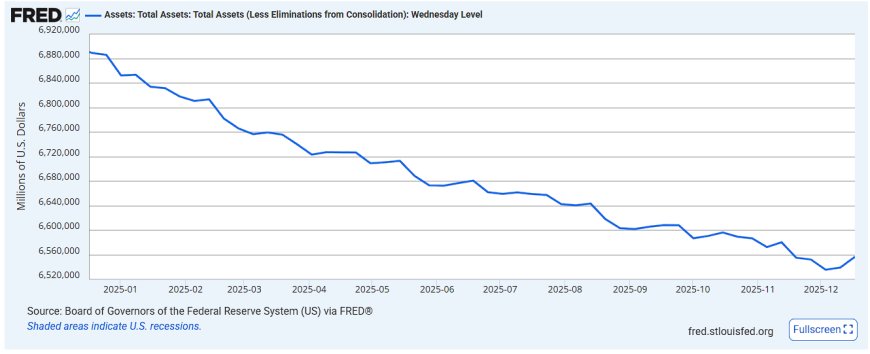
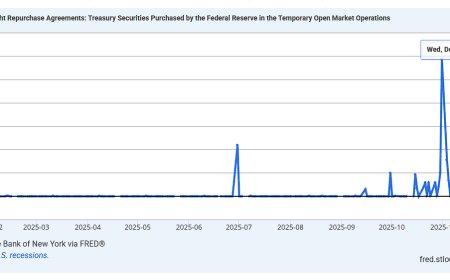
Overnight repo usage has reappeared in size and in clusters across Treasury and MBS collateral. This is not a headline-driven story. It is plumbing. It is the same failure mode that showed up in late-2019: the private system hits a functional constraint, and the Fed becomes the clearing layer. Labels can change. The sequence usually does not.
Summary
- Repo usage is no longer dormant. It is recurring across multiple days in late-2025.
- The activity spans Treasury and MBS collateral, which points to balance-sheet intermediation limits rather than “one weird settlement day.”
- This matches late-2019 in the way that matters: the failure mode, not the headlines.
- The key question is simple: can the Fed step back without funding conditions tightening again?
Pattern Nexus note: This is not a “crisis call.” It is a regime signal. When overnight operations become repetitive, the system is telling you where the constraint lives.
The Signal in the Last Month
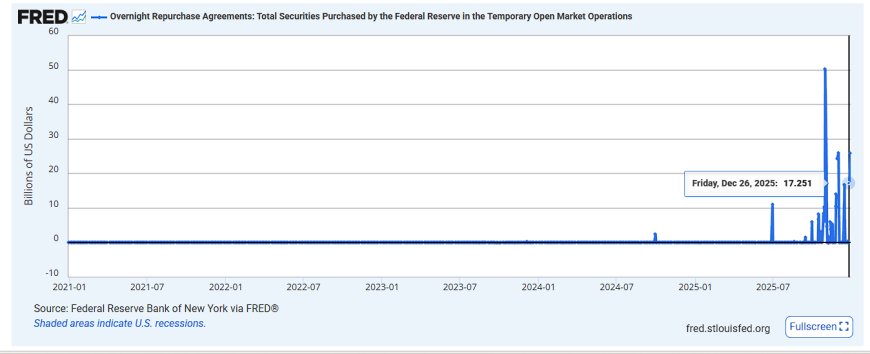
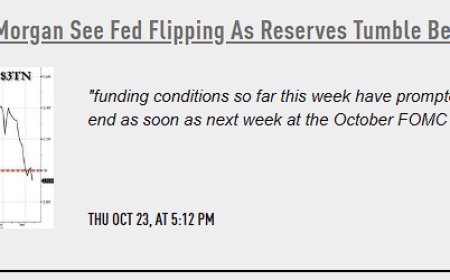
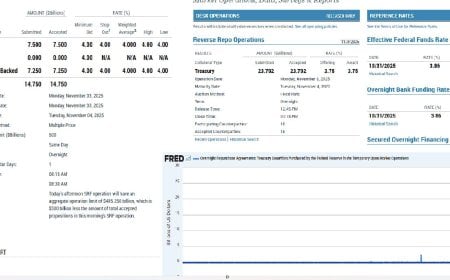
The core point is not philosophical. It is measurable. In the last several weeks, overnight repo operations moved from “background noise” to “persistent tool.” When the Fed is repeatedly supplying cash against collateral in overnight operations, it means the private system is not clearing funding with enough slack at the margin.
That is the entire signal. Everything else is interpretation layered on top of it.
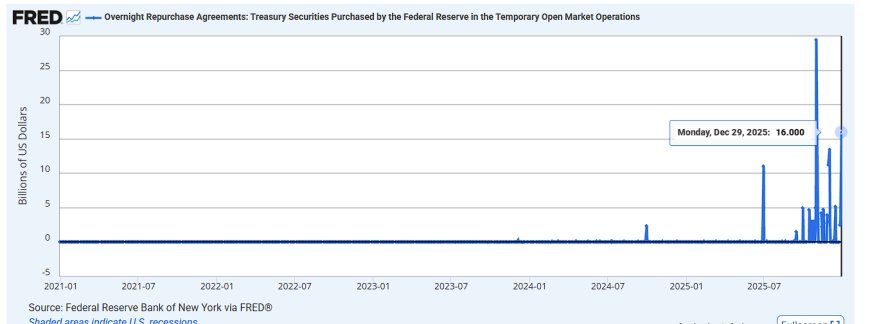
Two details make this stronger than the usual “it’s just quarter-end” dismissal.
- Clustering: The spikes appear in repeated clusters rather than a single isolated event.
- Collateral breadth: Treasury and MBS collateral both show up, which reduces the odds this is purely one-off Treasury settlement dynamics.
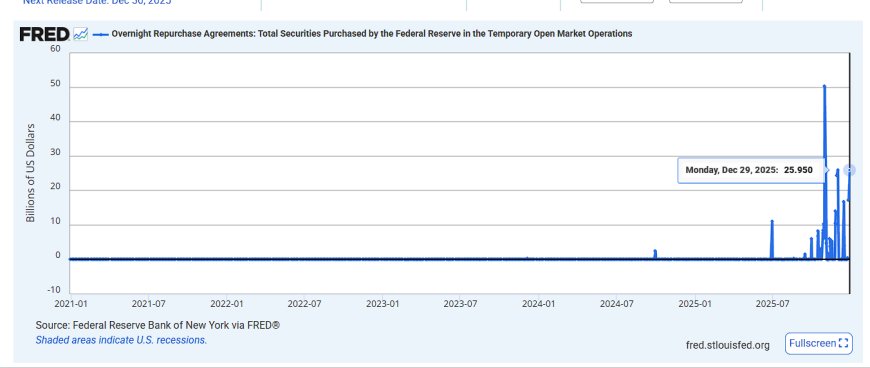
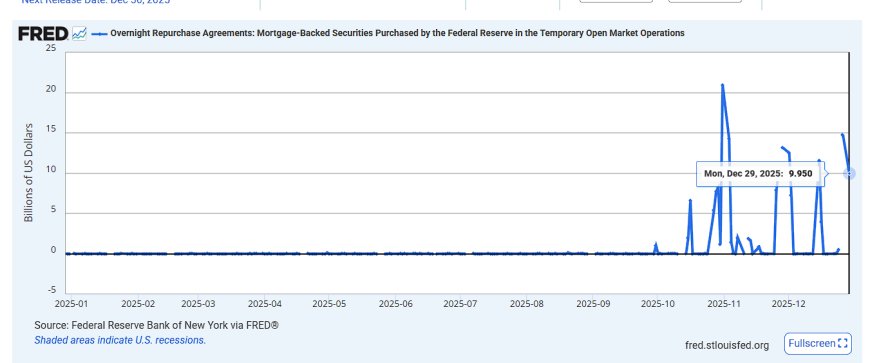
If you want the shortest possible translation: the dealer complex is using the Fed as a funding counterparty again. That is a meaningful regime change versus a dormant repo tape.
Why This Rhymes With Late-2019
“Same environment” is easy to attack because macro conditions differ across cycles. “Same failure mode” is much harder to dismiss, because it is mechanical.
Late-2019 was not about a dramatic headline catalyst. It was about a threshold in funding. When reserves and balance-sheet capacity hit a point where the private system could not intermediate smoothly, overnight funding stress surfaced and the Fed stepped in.
Failure mode parity: The system reaches a point where overnight funding and collateral intermediation do not clear with enough slack without central-bank participation.
That’s the rhyme. It doesn’t require the same inflation prints, the same growth prints, or the same political calendar. It requires one thing: the margin is tight enough that the Fed becomes the stabilizing layer.
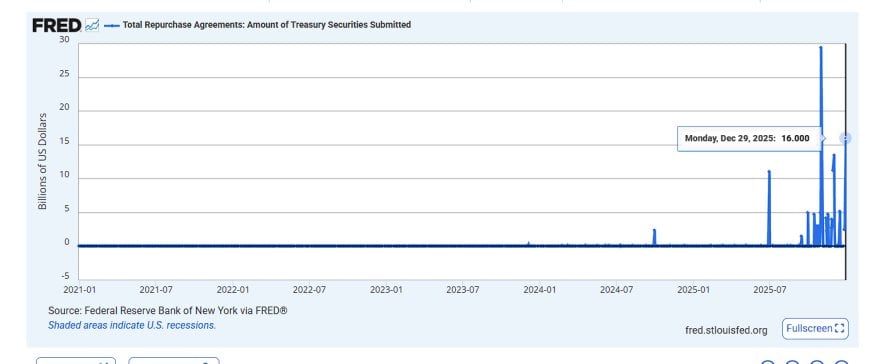
When multiple collateral lanes are active, it suggests a balance-sheet constraint rather than a single collateral-specific story. You don’t need “panic” for that. You just need enough constraint that dealers choose the Fed window as the cleanest path for funding.
What This Is and What It Is Not
This is where people get lost in semantics, so keep it precise.
What it is
- Reserve support: Repo operations inject cash into the system against collateral.
- Fed as clearing layer: The central bank is backstopping the funding channel at the margin.
- A regime tell: Persistent repo usage is a signal the private system is operating closer to a constraint.
What it is not
- Proof of panic: You can have orderly markets and still have tight plumbing.
- A single-day anomaly: Clusters matter more than one spike.
- Pure narrative fuel: This is measurable behavior, not vibes.
The point is not to argue labels. The point is to identify whether the Fed has become structurally necessary again for smooth overnight clearing.
The Sequence That Follows
When the failure mode is “the system needs Fed participation to clear funding smoothly,” the path tends to follow a familiar sequence. Not because the Fed wants it, but because once the market normalizes around the support, removing it reintroduces instability.
- Repo reappears: Operations begin and persist across multiple days.
- Technical framing: Officials present it as plumbing management, not a policy shift.
- Normalization: Markets incorporate the backstop as part of the base case.
- Withdrawal becomes costly: Pulling back tightens conditions quickly.
- Durability increases: Tenors expand, frequency persists, or the toolkit shifts toward more durable measures.
This is why the “can they stop” test is so important. If they can stop, it was episodic. If they can’t, it becomes a new baseline.
What To Watch Next
Ignore the commentary cycle and track the plumbing signals.
- Can repo usage return to near-zero? If not, the backstop is becoming structural.
- Do operations broaden? Higher frequency, larger size, or longer tenors are escalation tells.
- Does collateral breadth persist? Treasury-only is one story. Treasury plus MBS is a wider constraint.
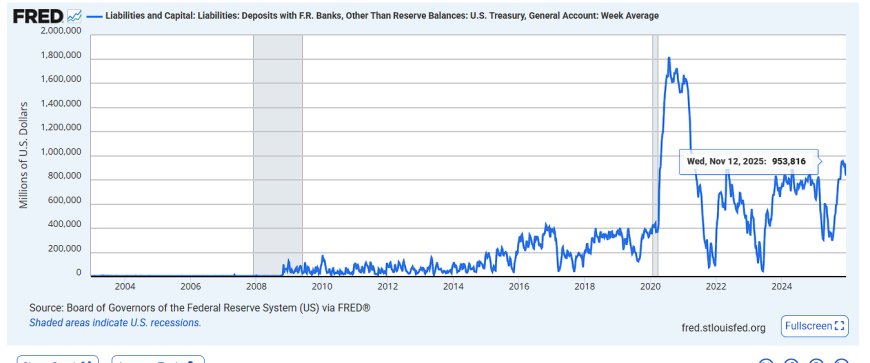
- Do TGA swings coincide with spikes? If spikes cluster around fiscal cash-management volatility, that’s a recurring stress amplifier.
If you want one line that captures it: the market doesn’t need to “break” for the Fed to become necessary. It only needs to become tight enough that the Fed is the cleanest marginal counterparty.
Bottom Line
Late-2025 repo behavior is not a theoretical debate. It is the system speaking in its native language: funding operations.
When overnight repo usage shifts from dormant to repetitive and meaningful, you are watching a threshold get crossed. That threshold is what late-2019 was about. And once that threshold is crossed, the question is no longer “is this easing?” The question is “can they remove support without consequences?”
Pattern Nexus conclusion: This is late-2019 failure-mode parity. The private system is operating close enough to a funding constraint that the Fed has reinserted itself as a routine clearing layer. If usage cannot return to near-zero, the regime has already changed.
Sources
Wat is jouw reactie?
 Vind ik leuk
0
Vind ik leuk
0
 Niet leuk
0
Niet leuk
0
 Liefde
0
Liefde
0
 Grappig
0
Grappig
0
 Wauw
0
Wauw
0
 Verdrietig
0
Verdrietig
0
 Boos
0
Boos
0

Founder of Pattern Nexus. I research markets, macro, geopolitics, AI, history, ancient systems, and the patterns most people overlook. I’m also building Market Radar, a trading scanner designed to read pressure, risk, confirmation, and setup quality before chasing a move. Pattern Nexus is where I connect the dots between data, history, technology, and the bigger system playing out around us.














Opmerkingen (0)