
Spruce Pine Quartz: The Hidden Bottleneck Under Chips, AI, Solar, and the Modern World
Spruce Pine, North Carolina may be one of the most strategically important locations on Earth because its high-purity quartz sits underneath silicon wafers, semiconductor manufacturing, AI infrastructure, solar panels, optical fiber, and the modern digital control layer.
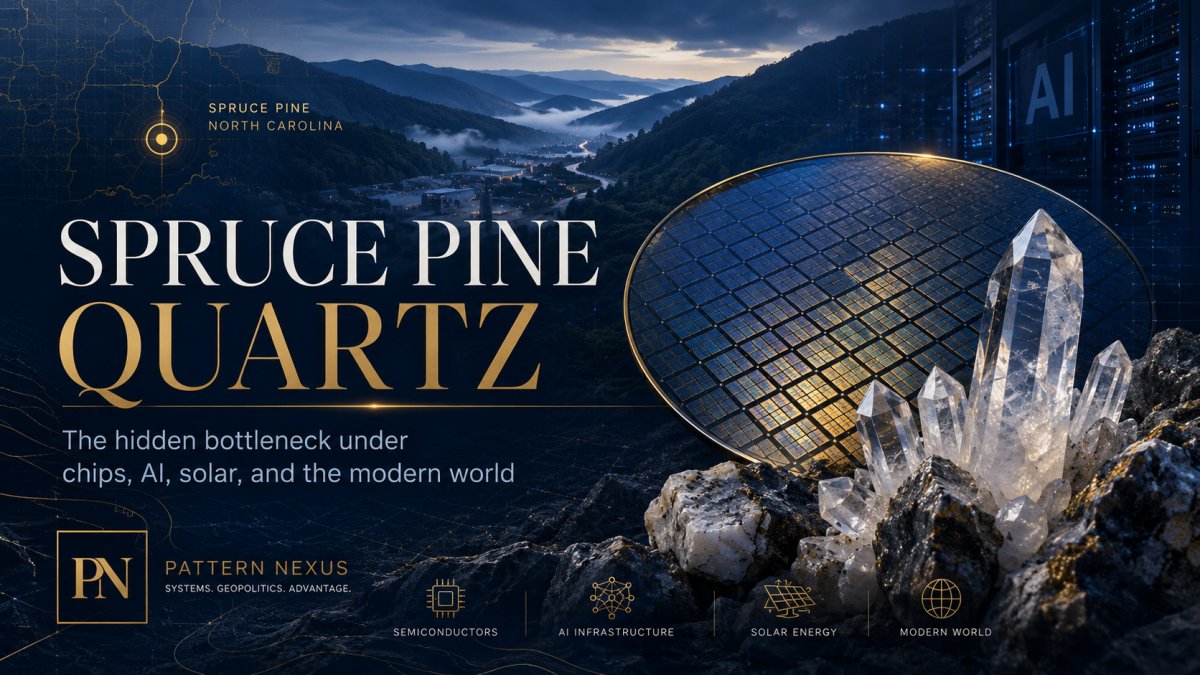
Spruce Pine Quartz: The Hidden Bottleneck Under Chips, AI, Solar, and the Modern World
The modern world does not run on chips first. It runs on purified material layers underneath chips. One of the most important places in that stack is not a fab in Taiwan, a lithography supplier in the Netherlands, or a data center corridor in Virginia. It is a small mining district in North Carolina called Spruce Pine.

Quick Read
Spruce Pine, North Carolina sits on one of the most important hidden material bottlenecks in the world: high-purity quartz used to make fused quartz crucibles for growing silicon ingots. Those ingots are sliced into wafers. Those wafers become semiconductors. Those semiconductors become AI accelerators, servers, phones, satellites, defense electronics, vehicles, grid systems, optical networks, solar equipment, and the digital infrastructure people now mistake for reality.
The mistake is thinking this is about ordinary quartz. It is not. Quartz is everywhere. Qualified high-purity quartz is not. Semiconductor-grade quartz is not just a rock. It is geology plus chemistry plus processing plus certification plus customer trust plus scale.
That is why Spruce Pine matters. It is not literally the only quartz on Earth. The stronger point is that Spruce Pine is the dominant proven natural high-purity quartz supply chain with the purity, scale, processing history, customer qualification, and industrial trust needed for the semiconductor crucible layer.
In normal language, that means this place acts like an “only” source in the real industrial system even if other quartz deposits technically exist on a geological map.
This is the difference between a rock existing somewhere and a material being qualified inside one of the most demanding manufacturing chains ever created. That distinction matters. Most people miss it because they think the bottleneck is the mineral. It is not. The bottleneck is the purity, the process, the qualification history, the scale, the trust, and the fact that tiny contamination can move through the entire semiconductor stack.
The quiet place under the digital world
When people talk about semiconductors, they usually talk about Taiwan, TSMC, Nvidia, ASML, lithography, export controls, chip bans, fabs, GPUs, or AI data centers. That is the visible layer. That is the layer everyone debates because it looks modern. It has clean rooms, government subsidies, glass buildings, earnings calls, policy documents, stock tickers, and defense briefings.
But beneath that visible layer is a much older layer: minerals.
Not rare earths in the generic political sense. Not the lazy “critical minerals” phrase that gets thrown around whenever someone wants to sound strategic. I mean specific materials with specific purity requirements that sit at specific points in the production chain where substitution is hard, qualification takes time, and contamination can destroy the final product.
Spruce Pine, North Carolina is one of those points.
It is a small Appalachian mining district that most people never think about. But its high-purity quartz helps make the fused quartz crucibles used in the Czochralski process, the process used to grow silicon ingots that are later sliced into wafers. Those wafers become the foundation of modern semiconductor manufacturing.
This is the part people miss: the chip world is not only a high-tech story. It is also a geology story. The AI world is not only a software story. It is also a mining story. The cloud is not in the cloud. It is sitting on land, power, water, cooling systems, copper, steel, silicon, wafers, quartz, chemical purification, and people operating physical systems in physical places.
That is why Spruce Pine matters. It is not famous because the system usually points people toward the finished product. But the upstream layer is often where the real control points live.
The finished chip looks clean. The data center looks clean. The AI model looks abstract. But the foundation is not abstract. It is rock, heat, pressure, chemistry, energy, water, logistics, and an industrial process so specialized that even most people who talk about semiconductors never trace it back this far.
Pattern Nexus is built around that kind of map. Not the map everyone sees. The map underneath the map.
The plain-English version before we go deeper
Before this turns into a technical article, let’s slow it down.
A semiconductor is not just “a chip.” A chip is a tiny engineered electrical system built on a flat slice of ultra-pure silicon called a wafer. That wafer has to be clean, uniform, stable, and controlled down to ridiculous levels because the circuits being built on top of it are microscopic.
To make that wafer, manufacturers first grow a large single-crystal silicon ingot. Think of an ingot as a long cylinder of silicon where the atoms are lined up in a consistent crystal structure. That matters because chips need predictable electrical behavior. If the silicon crystal is messy, contaminated, or inconsistent, the chip quality falls apart.
To grow that ingot, manufacturers melt purified polysilicon inside a crucible. A crucible is basically a bowl or container designed to survive extreme heat. But this is not a kitchen bowl. It has to hold molten silicon at roughly 1420°C while staying stable enough that it does not contaminate the melt.
The crucible is often made from fused quartz. Fused quartz is made from high-purity quartz. That is where Spruce Pine enters the system.
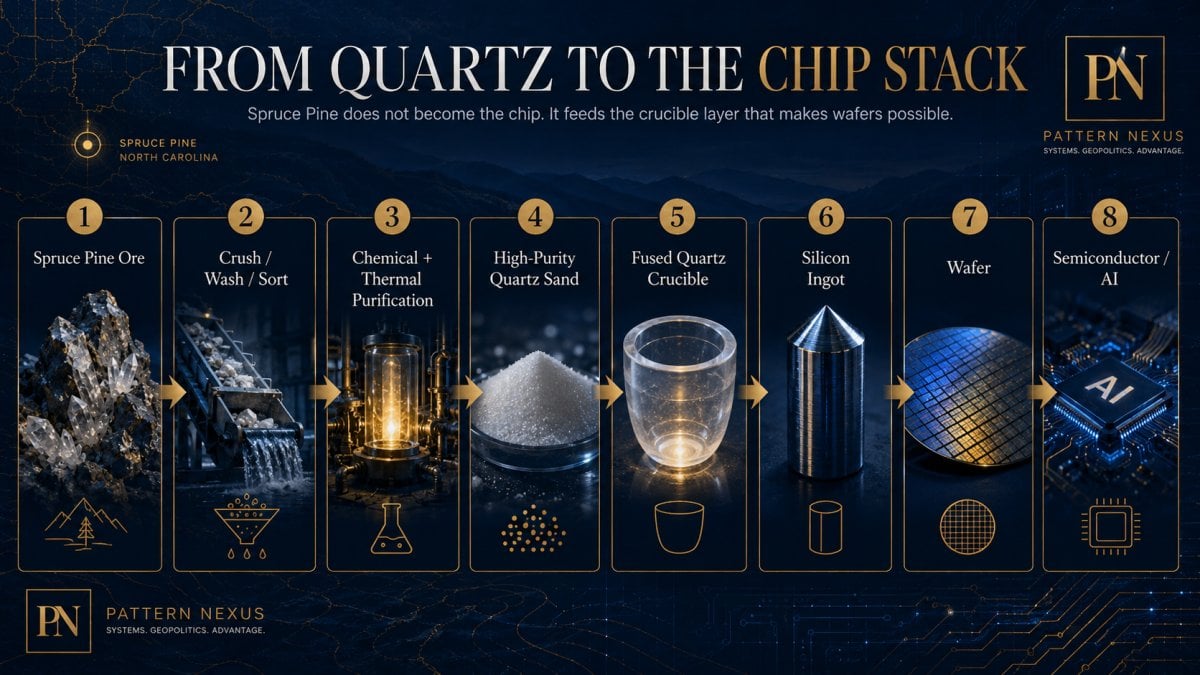
So the chain looks like this:
- Spruce Pine high-purity quartz is mined and processed.
- That quartz becomes high-purity quartz sand.
- The sand is used to make fused quartz crucibles.
- The crucibles hold molten polysilicon during crystal growth.
- A single-crystal silicon ingot is pulled from the melt.
- The ingot is sliced into wafers.
- The wafers become chips.
- The chips become AI, phones, solar systems, servers, weapons, vehicles, satellites, and almost everything modern.
That is why this matters.
Spruce Pine does not become the chip directly. It feeds the container layer that makes the wafer layer possible. That sounds minor until you understand that if the container layer fails, the entire downstream stack gets more expensive, less reliable, or harder to produce.
Quartz is common. This quartz is not.
The easiest mistake is to hear “quartz” and think this cannot matter because quartz is everywhere.
That is the beginner-level misunderstanding.
Yes, quartz is common. It is one of the most abundant minerals in the Earth’s crust. You can find quartz in sand, rocks, countertops, decorative stones, watches, glassmaking, and industrial materials.
But semiconductor manufacturing does not need “quartz” in the generic sense. It needs high-purity quartz with extremely low impurity levels and a trace-element profile that can survive the demands of silicon crystal growth.
The U.S. Geological Survey generally defines ground high-purity quartz as natural quartz containing less than 100 parts per million of total impurities, equal to roughly 99.99% purity. Some ultra-high-purity quartz products contain less than 10 parts per million of impurities, or about 99.999% purity. But the important part is not only the headline purity number. HPQ is also defined by specific trace-element limits that depend on end-use requirements. [1]
Parts per million and parts per billion sound like abstract numbers, so put it this way: a material can look pure to you and still be dirty at the semiconductor level. At normal human scale, 99.99% sounds basically perfect. At chip scale, the remaining impurity can still matter because the entire product is built around controlling electrical behavior in microscopic structures.
This is the difference between “clean enough for glass” and “clean enough for semiconductor process equipment.” Those are not the same standard.
Sibelco describes its IOTA high-purity quartz range as being mined from two uniquely pure ore bodies at Spruce Pine, North Carolina, and used in semiconductors, photovoltaic cells, optical fiber, and quartz lighting. [2]
The Quartz Corp makes the same point from the manufacturing side: quartz crucibles are critical components in the manufacture of photovoltaic cells and semiconductor chips because they are used to grow ingots that are sliced and polished into ultra-thin wafers. [3]
This is why the public gets the story wrong. They look at abundance at the wrong layer. Quartz as a mineral is abundant. Semiconductor-qualified high-purity quartz is not.
It is the same mistake people make with energy, shipping, food, chips, water, and money. They look at the object, not the usable form of the object. Crude oil is not gasoline. Sand is not a semiconductor wafer. A map full of quartz deposits is not a qualified HPQ supply chain. A raw resource is not the same thing as an industrial capability.
Where Spruce Pine enters semiconductor fabrication
Spruce Pine quartz does not become the chip itself in the way people sometimes imagine. It is not mined, melted, and directly turned into a microprocessor.
The role is more specific and more important than that.
Semiconductor manufacturing begins with silicon wafers. To make those wafers, the industry grows large monocrystalline silicon ingots. Monocrystalline means “single crystal.” In plain English, the atoms are lined up in one continuous structure instead of being a bunch of separate crystal grains smashed together.
That single-crystal structure matters because chips need predictable electrical behavior. If the underlying silicon has too many structural problems or impurities, everything downstream becomes harder: patterning, doping, transistor performance, yield, reliability, and final device quality.
In the Czochralski process, often shortened to CZ, polysilicon is melted inside a quartz crucible. A seed crystal is dipped into the melt and slowly pulled upward while rotating. As it rises, molten silicon solidifies around the seed and copies its crystal orientation, forming a large single-crystal ingot.
SUMCO describes this process directly: purified polysilicon is put into a quartz crucible with tiny amounts of dopants such as boron and phosphorus, melted at around 1420°C, and pulled from a seed crystal into a monocrystalline ingot. [6]
That one sentence is doing a lot of work. It explains why the crucible matters, why purity matters, and why this is not the same as melting ordinary material in an ordinary container.
The crucible holding the molten silicon has to survive extreme heat while avoiding contamination of the silicon melt. That is where high-purity quartz matters. Sibelco specifically lists its IOTA HPQ as being used for fused quartz crucibles in the CZ process and for fused quartz tubing and ingots used to create fabricated quartzware for the semiconductor wafer process. [2]
Shin-Etsu also lists quartz glass crucibles for silicon single-crystal pulling in the Czochralski process, manufactured using high-purity silica raw materials. [7]
This is the hidden foundation. If the wafer is the foundation of the chip, and the ingot is the foundation of the wafer, then the crucible is one of the quiet foundations underneath the ingot.
That makes high-purity quartz part of the hidden foundation under the entire digital world.
From quartz to wafers: the process chain
To understand why this is strategic, people need to understand the actual chain. Not every chemical step, not the proprietary parts, but the basic logic.
The Quartz Corp describes the chain in simple terms: raw ore is extracted from the Appalachian Mountains, crushed, quartz is isolated from other minerals, purification goes through multiple process steps and quality controls, and the finished product is packed and delivered globally. [3]
That sounds simple until you realize each step has to preserve or improve purity. You are not just separating pretty white crystals from ugly rock. You are removing the wrong atoms, the wrong minerals, the wrong inclusions, and the wrong trace contaminants from a material that will later be used in an extremely unforgiving production environment.
The basic pathway looks like this:
- Ore: pegmatite rock from the Spruce Pine district contains quartz along with minerals like feldspar and mica.
- Crushing and sorting: the ore is physically broken down and separated.
- Mineral separation: quartz is isolated from other minerals.
- Chemical and thermal purification: additional processing removes more impurities and narrows the trace-element profile.
- Certification: the product is tested and qualified because customers need consistency, not guesses.
- Crucible production: HPQ is turned into fused quartz crucibles used in CZ crystal growth.
- Ingot pulling: purified polysilicon is melted and pulled into a single-crystal ingot.
- Wafer production: the ingot is sliced, polished, cleaned, inspected, and prepared for chip fabrication.
This is where the whole “just use other quartz” line falls apart. You do not just need a quartz deposit. You need a deposit that can be processed into a product that can pass the quality controls of the companies making crucibles and wafers. Then that material has to be accepted by customers whose entire business depends on yield.
Yield means how many usable chips or wafers come out of a production run. In advanced manufacturing, yield is everything. A small impurity problem can become a huge money problem because it can reduce the number of usable wafers, create hidden reliability problems, or force more testing and rejection.
That is why the material layer becomes a trust layer.
The impurity problem
Advanced semiconductors are not forgiving. The system works because impurities are controlled. A chip is basically engineered behavior at microscopic scale. You are not just making “silicon.” You are shaping electrical properties by controlling structure, doping, contamination, patterning, heat, deposition, etching, lithography, and yield.
Doping is the intentional addition of tiny amounts of specific elements to change the electrical behavior of silicon. That is controlled impurity. Contamination is the uncontrolled version. One is engineering. The other is damage.
This is where the reader has to understand the difference. Semiconductors are not pure because purity is some abstract moral goal. They are pure because the device only works correctly if the wrong atoms are kept out and the right atoms are added in controlled amounts at controlled locations.
If a crucible introduces unwanted metals or other contaminants into molten silicon, the problem does not stay isolated at the crucible layer. It propagates downstream into the ingot, wafer, device performance, yield, reliability, and cost.
SUMCO says metal impurities in polysilicon for CZ growth are reduced to no more than a few parts per billion before being placed into the quartz crucible. That is the scale of control we are talking about. Parts per billion is not normal industrial cleanliness. That is a different universe. [6]
The Quartz Corp also notes that high-purity quartz crucibles are one of the few known materials capable of performing in the extreme environment of silicon ingot production, where crystal uniformity and purity have to be controlled under high heat. [5]
This is why the “just use other quartz” argument is weak. Other quartz may look clean to the naked eye. It may look clean under normal industrial standards. It may even be high quality for glass, construction, lighting, or general industrial use. That does not mean it is acceptable for semiconductor crystal growth.
At the semiconductor layer, the standard is not whether the rock looks pure. The standard is whether the material behaves predictably inside a thermal, chemical, and atomic environment where tiny contamination levels can ruin expensive downstream production.
That is a different world.
This is where modern civilization becomes fragile. It does not fail because the Earth runs out of rocks. It fails because the specific qualified rock, processed the specific way, delivered to the specific customer, accepted under the specific quality regime, becomes difficult to replace quickly.
That is the point. The physical world has abundance at one layer and scarcity at another. The public sees abundance because quartz is everywhere. Industry sees scarcity because qualified HPQ is not everywhere.
Why Spruce Pine is different
Spruce Pine’s advantage begins with geology.
Sibelco describes the Spruce Pine mining district as having been created roughly 380 million years ago when Africa collided with North America. The intense heat and pressure helped create mineral-forming material that cooled and crystallized over time. Sibelco also attributes the purity of Spruce Pine’s quartz partly to a lack of water during formation, which prevented the introduction of many impurities. [4]
That last part matters. Water can carry impurities into mineral systems. In the Spruce Pine case, the geological history helped produce quartz that was unusually clean and unusually suitable for further purification.
But geology alone is not the full story.
This is where most versions of the Spruce Pine story are too shallow. They roughly 380 million years ago when Africa collided with North America. The intense heat and pressure helped create mineral-forming material that cooled and crystallized over time. Sibelco also attributes the purity of talk like the mountain itself is magic. The geology is critical, but the strategic advantage is the combination of geology and industrial development.
Spruce Pine has the ore body. It also has more than a century of mining history. It has specialized processing infrastructure. It has firms that know how to process, certify, and deliver high-purity quartz to demanding customers. It has a customer base that has already qualified the material. It has a supply chain built around repeatability.
Sibelco says its Spruce Pine operation became the world’s leading provider of HPQ through continued investment in extraction and processing technologies, and that almost all IOTA products are exported thousands of miles from North Carolina to specialist electronics and solar PV markets in Asia. [4]
That detail matters because it shows the real shape of the system. The rock is in North Carolina. The fabs and solar supply chains may be in Asia. The companies are global. The finished products come back into your phone, your grid, your car, your AI model, your financial system, and your military hardware.
That is not a local mining story. That is a global dependency loop.
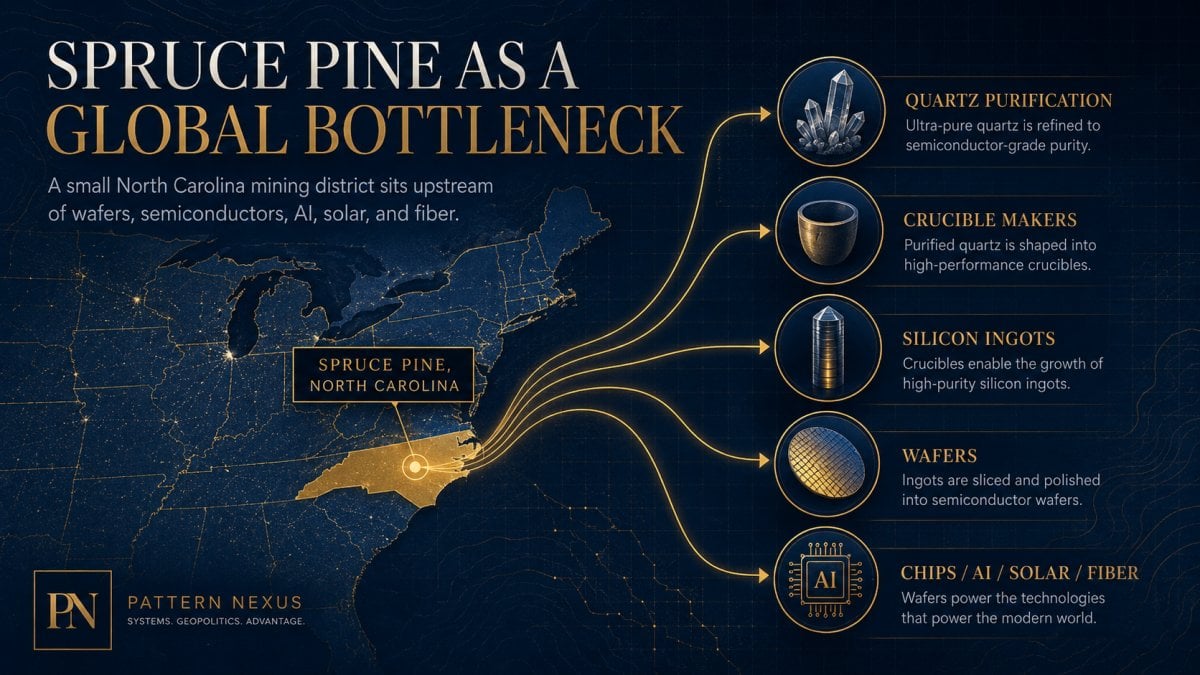
That is why the location matters so much. It is not just a pile of pure rock. It is a working industrial trust layer.
Why this may be the most strategic location in the world
When I say Spruce Pine may be the most strategically important location in the world, I am not saying it has the biggest military base, the largest economy, the most people, or the most obvious political power.
I mean something more precise.
If strategic importance is measured by upstream leverage over the most important downstream systems, Spruce Pine belongs near the top of the global map.
It sits underneath semiconductors. Semiconductors sit underneath AI, defense systems, satellites, telecommunications, payment rails, vehicles, medical equipment, grid management, logistics, energy systems, cloud computing, surveillance networks, and modern finance.
That means Spruce Pine is not just a mining location. It is a hidden choke point under the digital control layer.
Everyone understands that Taiwan matters because advanced chips come from Taiwan. Everyone understands that ASML matters because EUV lithography matters. Everyone understands that Nvidia matters because AI accelerators matter. But fewer people understand that the wafer stack itself depends on a physical input chain that starts much farther back.
This is the Pattern Nexus view: modern systems are not controlled only at the visible command layer. They are controlled at the dependency layer. Whoever understands the dependency layer understands the real map.
Spruce Pine is one of those dependency nodes. It is small on the population map and massive on the systems map.
And that is usually how real strategic power hides. It does not always sit where the cameras are. It sits where replacement is slow, where quality matters, where downstream systems cannot easily tolerate disruption, and where everyone quietly assumes the input will keep showing up.
That assumption is the vulnerability.
Why the U.S. dominates this bottleneck
The U.S. dominance here is not just political. It is geological, industrial, and jurisdictional.
The USGS states that in 2025 there were two companies producing high-purity quartz in the United States around Spruce Pine, North Carolina. It also states that the United States was estimated to be the leader in HPQ production, with other sources including Australia, Brazil, Canada, China, India, and Russia. [1]
That does not mean every company involved is purely American in ownership. Sibelco is a Belgian materials company. The Quartz Corp has Norwegian roots and global operations. But the critical geological asset is inside the United States. The resource sits on U.S. soil. The permitting, infrastructure, emergency response, labor base, regional mining history, and geopolitical security layer are tied to the United States.
That matters because strategic dominance is not always about owning the brand name at the end of the chain. Sometimes it is about controlling the physical location that everyone else needs to route through.
The U.S. has spent years focusing public attention on advanced fabs, reshoring, export controls, and chip policy. Those things matter. But they are not the whole picture. A country can subsidize fabs and still depend on material bottlenecks. A country can build data centers and still depend on wafer inputs. A country can dominate software and still depend on geology.
Spruce Pine is one of the places where U.S. geography becomes strategic power.
This is also why the story is uncomfortable. The U.S. does not dominate every part of the semiconductor stack. It depends on Taiwan for advanced foundry capacity. It depends on the Netherlands for EUV lithography equipment. It depends on Asian packaging, chemicals, substrates, and manufacturing ecosystems.
But at this specific material layer, the United States holds an unusually powerful position.
That makes Spruce Pine different. It is not a symbolic asset. It is a functional chokepoint.
The companies may be global. The market may be global. The customers may be global. But the rock is here. The geology is here. The mining district is here. And that means the U.S. has a quiet upstream lever inside the same semiconductor world where it is trying to reduce dependence elsewhere.
That is why this story should be talked about in the same breath as Taiwan, ASML, TSMC, Nvidia, data centers, export controls, rare earths, and grid capacity.
It is not separate. It is underneath them.
The “only quartz” claim
This is where the claim needs to be framed properly.
The lazy version is: “Spruce Pine has the only quartz that can be used for semiconductors.”
The stronger and more accurate version is this: Spruce Pine is not literally the only place on Earth with high-purity quartz potential, but it is the dominant proven natural high-purity quartz supply chain with the purity, scale, processing capability, customer qualification, and industrial trust needed for the semiconductor crucible layer.
That distinction matters because critics will attack the simple version. They will say there is quartz in other countries. They will say substitutes exist. They will say other deposits can be developed. Technically, some of that is true.
But it misses the actual bottleneck.
Industrial systems do not switch critical materials like changing brands of bottled water. Especially not in semiconductor supply chains. A replacement material has to be mined, processed, tested, qualified, scaled, delivered, accepted by customers, and proven across production cycles.
If it affects yield, contamination, failure rates, thermal behavior, or cost, the entire downstream system has to care.
That is why Spruce Pine behaves like an “only” source strategically even if it is not the only possible source geologically.
The real issue is not whether another deposit exists. The real issue is whether another deposit can replace Spruce Pine at the purity, scale, cost, certification, and trust layer without damaging the downstream semiconductor stack.
That is a much harder problem.
Construction Physics framed the nuance well: Spruce Pine is not an absolutely irreplaceable magic column holding up all semiconductor manufacturing, but alternatives are generally some combination of not as developed, not as good, not as cheap, or not yet qualified at scale. [9]
That is the correct strategic framing. It is not “there is no other quartz.” It is “the real system has a qualified dominant source, and replacing that source is slower, more expensive, and more complicated than the public assumes.”
That is how bottlenecks actually work.
The China angle
This story also matters because China understands the mineral layer.
China has spent decades building positions across processing, refining, rare earths, industrial inputs, batteries, solar, metals, and manufacturing ecosystems. It does not look at supply chains like isolated products. It looks at systems.
The USGS 2026 quartz summary notes that China’s Ministry of Natural Resources announced more than 35 million tons of HPQ reserves in Henan and Xinjiang in April 2025. But the same USGS summary reported that initial tests achieved 99.995% to 99.998% purity, compared with greater-than-99.999% pure HPQ sourced from Spruce Pine. [1]
That difference may look small to a normal reader.
It is not small at the semiconductor layer.
The gap between 99.998% and 99.999% can sound meaningless if you are thinking like a consumer. But the semiconductor world is not operating at consumer scale. It is operating at atomic and microscopic manufacturing scale. The wrong impurities do not need to be visible to matter. They only need to interfere with electrical behavior, crystal quality, thermal performance, or yield.
Again, the issue is not just headline purity. It is impurity profile, trace elements, processing behavior, thermal performance, customer qualification, and whether the material can be used without hurting yield or reliability.
A few decimal places in a purity number can represent the difference between a viable upstream input and an expensive science project.
China will keep trying to reduce dependence on U.S.-controlled bottlenecks. That is what a serious industrial state does. It will develop deposits, improve processing, subsidize alternatives, stockpile, qualify domestic supply, and build redundancy where it can.
But that does not mean the problem disappears tomorrow.
The systems question is not whether China can find quartz. The systems question is whether China can build a fully qualified high-purity quartz supply chain that matches Spruce Pine’s role in the global semiconductor stack at scale, with acceptable cost, acceptable yields, and acceptable customer trust.
That is a very different question.
This is also why the U.S.-China semiconductor fight is not just about banning chips or restricting lithography machines. It is about every layer underneath the chip. Minerals, chemicals, tools, wafers, specialty gases, optics, power, packaging, talent, software, and standards all become part of the same war for control over the future industrial base.
Spruce Pine is one of those layers.
Hurricane Helene was the warning shot
Hurricane Helene exposed the vulnerability in real time.
Spruce Pine and surrounding communities were severely damaged, and both Sibelco and The Quartz Corp shut down operations ahead of the storm. AP later reported that Sibelco restarted production and shipments were ramping back up, while The Quartz Corp had also halted operations before the hurricane. [8]
AP also reported that Spruce Pine quartz is used around the world to manufacture equipment needed to make silicon chips and cited an estimate that 70% to 90% of the crucibles used worldwide to melt polysilicon for chips are made from Spruce Pine quartz. [8]
That is the type of number that should make people stop.
A town gets hit by a storm, and suddenly a major portion of the semiconductor crucible chain becomes part of the risk conversation. That is not a normal commodity story. That is a hidden systems dependency being revealed by weather.
Helene did not end semiconductor manufacturing. That is not the point. The point is that it showed how a local infrastructure shock can touch a global technology stack.
Roads, power, employees, water systems, processing facilities, logistics, and community recovery all became part of the chip story.
That is the real world. The wafer supply chain does not float above geography. It is anchored to roads, mountains, workers, storms, power grids, and chemical processing.
This is also why strategic risk cannot only be measured by war. Sometimes the risk is a hurricane, a road washout, a power outage, a labor disruption, a processing plant fire, a regulatory fight, or a local community that suddenly becomes the center of a global supply chain because the rest of the world forgot how dependent it was.
That is not a theory. That is what fragile systems look like before everyone admits they were fragile.
AI runs through this rock
This is where the story becomes bigger than semiconductors.
AI is usually framed as software, models, data, chips, GPUs, and data centers. But AI is not only a digital system. It is a physical system pretending to be digital.
It depends on power generation, transmission, cooling, water, transformers, copper, silicon wafers, advanced packaging, memory, servers, fiber, land, and industrial logistics.
Spruce Pine quartz sits near the beginning of that chain.
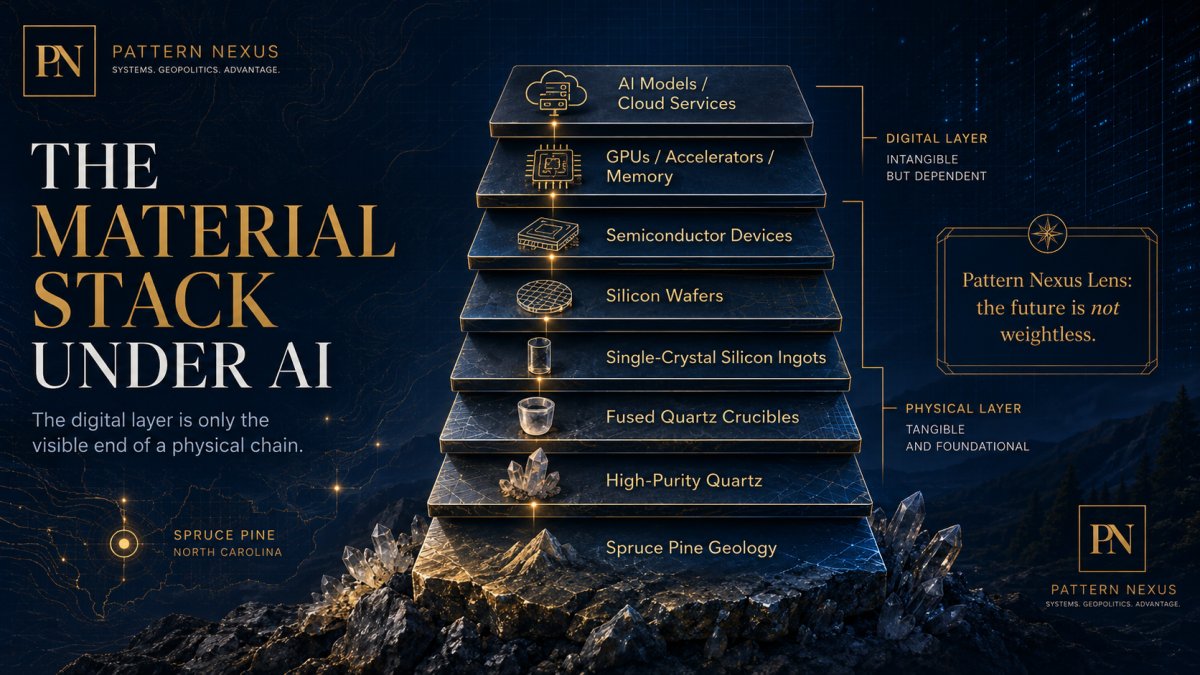
No wafers, no advanced chips. No advanced chips, no modern AI acceleration. No AI acceleration, no large-scale model deployment. No large-scale model deployment, no AI operating layer.
That means a quartz mining district in North Carolina is indirectly connected to every major argument about AI dominance, national security, automation, robotics, surveillance, data centers, cloud power, and future economic control.
This is why the public conversation is too shallow. People argue about AI as if it is just code. It is not. Code is the abstract layer. Compute is the execution layer. Chips are the hardware layer. Wafers are the substrate layer. Materials are the physical layer. Mining is the geological layer.
Spruce Pine is sitting down in that geological layer, quietly carrying part of the entire stack.
The farther AI expands, the more important the upstream material stack becomes. Data centers get the headlines. But the bottlenecks that matter may be buried far away from the server rack.
The same people who think AI is just a software race are missing the whole structure. AI is compute. Compute is chips. Chips are wafers. Wafers are ingots. Ingots are crucibles. Crucibles are high-purity quartz. High-purity quartz is geology, mining, processing, quality control, and trusted supply.
That is the Pattern Nexus map.
Follow the dependency far enough and the future always comes back to physical reality.
It is not only chips
The semiconductor angle is the biggest reason Spruce Pine matters, but it is not the only one.
High-purity quartz is also used in photovoltaic manufacturing, optical fiber, quartz lighting, specialty glass, and other high-tech applications. Sibelco lists semiconductors, photovoltaic cells, optical fiber, and quartz lighting as key uses for its high-purity quartz. [2]
The USGS also lists HPQ uses including electronics, fiber-optic cables, fused quartz crucibles for silicon metal ingots later processed into wafers for photovoltaic cells and semiconductor markets, high-temperature lamp tubing, and specialty glass. [1]
That widens the strategic frame.
Spruce Pine is not only under the chip stack. It is also under the solar buildout, fiber networks, communications infrastructure, and parts of the energy transition.
That means the same bottleneck touches multiple future-facing systems at once:
- AI compute
- Advanced semiconductors
- Solar supply chains
- Optical fiber and communications infrastructure
- Defense electronics
- Industrial controls
- Grid modernization
- Satellite and aerospace systems
- Consumer electronics
- Payment systems and financial infrastructure
- Cloud computing and data centers
- Robotics and automation
This is exactly what makes a node strategically important. It does not only matter to one industry. It matters across multiple layers of the future economy.
If one input touches chips, solar, fiber, and high-temperature specialty glass, it is not just an industrial material. It is a civilization material.
And civilization materials are where power hides.
The replacement problem
The obvious question is whether the world could replace Spruce Pine if it had to.
In the long run, probably yes in some form. Industrial systems adapt. Alternatives can be developed. New deposits can be explored. Processing can improve. Synthetic or cultured quartz can be used in some applications, although cost and scale are major issues. Customers can requalify supply chains over time.
But the phrase “over time” is doing a lot of work.
Strategic risk lives in the gap between theory and operational reality. It is one thing to say alternatives exist on paper. It is another thing to replace a qualified supply chain inside a global semiconductor system without increasing costs, reducing yields, creating delays, or forcing redesigns.
The USGS states that global HPQ reserves are estimated to be limited to a few locations and that no economic substitutes or alternatives for HPQ exist for most applications. It also notes that cultured quartz can be used as a substitute for HPQ, but it is not commonly done because of the high price of cultured quartz. [1]
That is the key. There may be alternatives, but they are not frictionless. They are not free. They are not instant. They are not automatically qualified. They do not erase the chokepoint just because someone can point to another mineral deposit on a map.
The replacement problem is not only material. It is institutional. Customers have to trust the material. Manufacturers have to trust the process. The process has to be repeatable. The economics have to work. The risk has to be acceptable.
The Quartz Corp gives a sense of scale: one full ingot can weigh more than 500 kilograms and measure 4.3 meters long with a 25-centimeter diameter, and one quartz crucible can pull approximately eight ingots over a 400-hour period. The company also states that one 300-millimeter silicon ingot can be used to manufacture approximately 2 million semiconductor chips. [5]
Those numbers matter because they show how much production sits downstream of these material choices. The crucible is not decorative. It is a consumable production tool inside one of the most important manufacturing chains on Earth.
If better alternatives are developed, that could eventually reduce the bottleneck. Researchers and manufacturers are always looking for longer-lasting crucibles, synthetic materials, alternative purification methods, and different crystal-growth approaches. But that is the future-development side of the story.
The current operational story is simpler: Spruce Pine remains dominant because it has the rare combination of geology, processing, cost, customer trust, and industrial scale.
That is why Spruce Pine remains dominant.
What people get wrong about this story
There are a few predictable ways people will misunderstand this.
First, they will say quartz is common. That is true and irrelevant. The question is not whether quartz exists. The question is whether the right quartz can be processed into the right purity with the right consistency and accepted by the right customers at the right scale.
Second, they will say alternatives exist. Also true. But alternatives existing in theory is not the same thing as alternatives replacing a qualified supply chain without time, cost, yield penalties, or requalification risk.
Third, they will say Spruce Pine is not literally the only source. Correct. That is why the stronger claim is not “only rock on Earth.” The stronger claim is “dominant qualified industrial chokepoint.”
Fourth, they will say chips are made in fabs, not mines. That misses the stack. Fabs do not magically create wafers from nothing. Fabs sit downstream from wafers, wafers sit downstream from ingots, ingots sit downstream from crucibles, and crucibles sit downstream from high-purity quartz.
Fifth, they will say AI is software. That is the surface layer. AI is software running on compute hardware that depends on chips that depend on wafers that depend on physical material supply chains.
This is the entire point of Pattern Nexus. The public gets trapped at the visible layer. The real system lives in the layers underneath.
Pattern Nexus Lens: The old world under the new world
Spruce Pine quartz is a perfect example of how the modern world hides its foundations.
We are told the future is digital. It is not. The interface is digital. The foundation is physical. The interface is software. The foundation is geology, energy, labor, logistics, chemistry, and heat.
The chip industry looks futuristic because the clean room is futuristic. But the clean room sits on wafers. Wafers sit on ingots. Ingots sit on crucibles. Crucibles sit on high-purity quartz. High-purity quartz sits in specific geological formations. Those formations sit in specific jurisdictions. Those jurisdictions sit inside political, weather, infrastructure, and trade systems.
That is the stack.
And once the stack is visible, the myth that technology floats above the physical world falls apart.
It does not.
AI does not escape mining. Semiconductors do not escape geology. Solar does not escape industrial inputs. Digital money does not escape power grids. The cloud does not escape land. Modern control systems do not escape materials.
Spruce Pine is not just a quartz story. It is a reminder that the future is still built out of the Earth.
This is why I keep coming back to the same framework: control systems are not only laws, agencies, banks, narratives, or military power. They are also permissions, standards, chokepoints, bottlenecks, inputs, and invisible dependencies.
A society can believe it is entering a weightless digital future while quietly becoming more dependent on very specific physical nodes.
That is the contradiction.
The more advanced the system becomes, the more fragile some of its upstream dependencies become. Not because there are fewer materials on Earth, but because the system demands narrower and narrower forms of those materials.
Spruce Pine is one of those narrow forms.
It is old geology sitting underneath the newest machines on Earth.
Conclusion: the world runs on quiet bottlenecks
The most important places in the world are not always the ones with the most cameras pointed at them.
Spruce Pine, North Carolina is one of those places.
It does not look like the center of the modern world. It does not look like a semiconductor capital. It does not look like an AI chokepoint. It does not look like a strategic command node.
But that is because people are trained to look at the finished layer.
Look deeper.
Spruce Pine produces high-purity quartz that feeds the crucible layer of silicon wafer production. That wafer layer feeds semiconductors. Semiconductors feed AI, defense, communications, solar, vehicles, finance, logistics, and every major control system in the modern economy.
This is why the location matters.
Not because quartz is rare.
Because qualified high-purity quartz at scale is rare.
Not because no other country has rocks.
Because the semiconductor stack does not run on rocks. It runs on qualified materials, trusted suppliers, proven processing, trace-element control, customer acceptance, and repeatable industrial performance.
That is Spruce Pine’s power.
It is not loud. It is not branded. It is not sitting at the front of the conversation.
But it is sitting under the stack.
And in a world built on chips, AI, solar, optical fiber, satellites, sensors, defense electronics, and data centers, the things sitting under the stack matter more than most people understand.
That is exactly the kind of hidden bottleneck the public usually does not see until the system shakes.
Sources
- U.S. Geological Survey, Mineral Commodity Summaries 2026: Quartz, High-Purity and Industrial Cultured Crystal
- Sibelco: High Purity Quartz
- The Quartz Corp: High Purity Quartz
- Sibelco: Spruce Pine
- The Quartz Corp: Silicon Wafer Production
- SUMCO: Monocrystalline Pulling Process
- Shin-Etsu: Quartz Glass Crucibles for Silicon Single Crystal Pulling Applications
- Associated Press: North Carolina Maker of High-Purity Quartz Back Operating Post-Helene
- Construction Physics: Does All Semiconductor Manufacturing Depend on Spruce Pine Quartz?
Pattern Nexus closing note: Spruce Pine is not just a mining district. It is a reminder that the most advanced systems on Earth still depend on ancient geology, physical bottlenecks, and supply chains most people never see.
Frequently Asked Questions
Aká je vaša reakcia?
 Páči sa mi to
0
Páči sa mi to
0
 Nehodnotiť
0
Nehodnotiť
0
 Láska
0
Láska
0
 Zábavné
0
Zábavné
0
 Wow
0
Wow
0
 Smútiť
0
Smútiť
0
 Rozhněvaný
0
Rozhněvaný
0

Founder of Pattern Nexus. I research markets, macro, geopolitics, AI, history, ancient systems, and the patterns most people overlook. I’m also building Market Radar, a trading scanner designed to read pressure, risk, confirmation, and setup quality before chasing a move. Pattern Nexus is where I connect the dots between data, history, technology, and the bigger system playing out around us.





Komentáre (0)