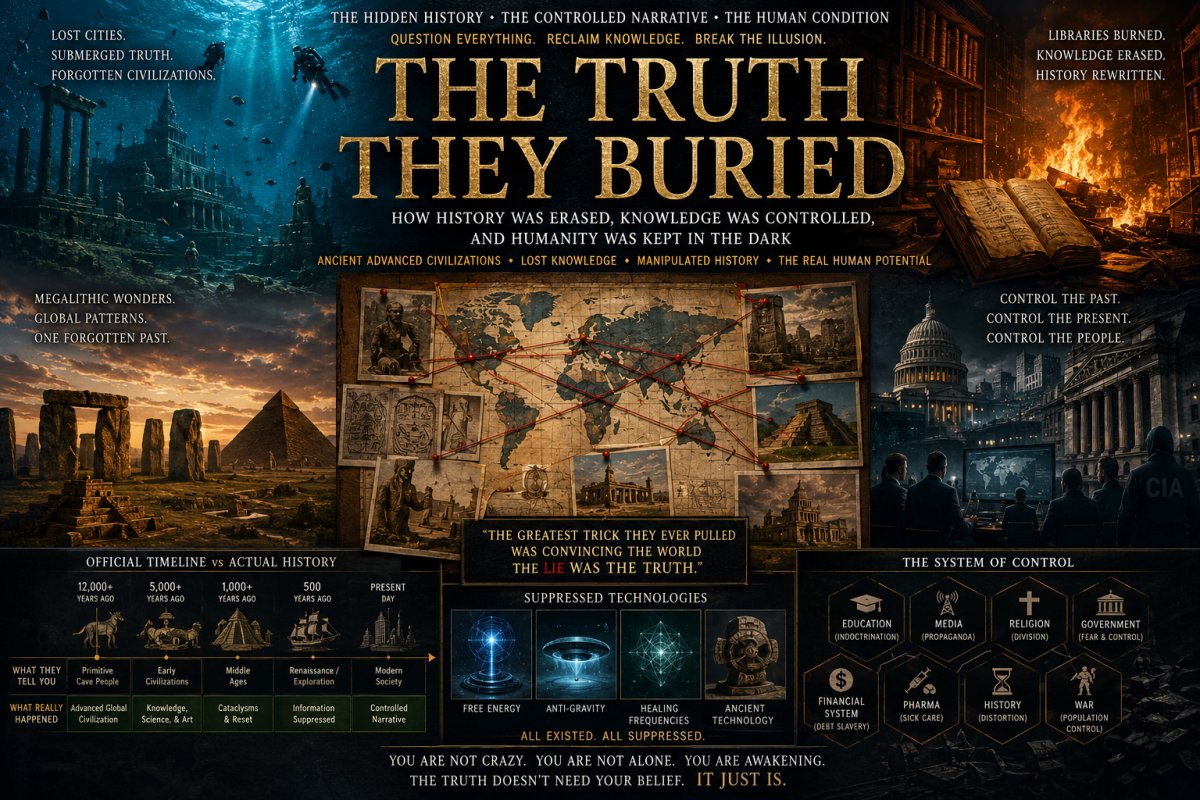
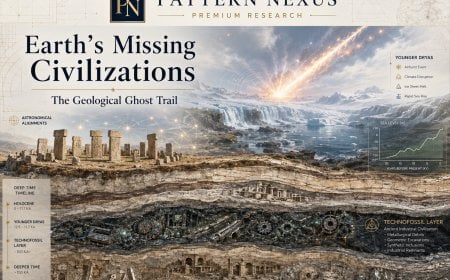
History is not the past. History is the surviving record after water, fire, conquest, empire, religion, language loss, academic filtering, political control, and time itself got done with it. This Pattern Nexus article argues that the official timeline is not useless because every event is fake; it is useless when treated as complete. The underwater record, overbuilt sacred sites, burned libraries, mythic memory, and modern AI all point to the same deeper human condition: humanity lives inside symbolic memory systems, and whoever controls memory controls the boundary of what people think is possible.
Deep macro plumbing, liquidity mechanics, and system analysis. No sponsors. No paywalls.
Support Pattern Nexus
Independent macro research and system-level analysis. No sponsors. No paywalls.
Pattern Nexus Premium Systems Research
The Permitted Memory of the Past
History is not the past. History is the surviving record after water, fire, conquest, empire, religion, language loss, academic filtering, political control, and time itself got done with it.
Published: June 1, 2026 • By Christopher Grenke / Pattern Nexus • Premium Systems Research
Premium Quick Read
The clean schoolbook timeline is not wrong because every event is fake. It is wrong when it is treated as complete. Rome existed. Egypt existed. Greece existed. Persia existed. European empires existed. Wars happened. Colonization happened. The problem is that the public timeline compresses a shattered human archive into a neat ladder of progress.
The strongest evidence is not one mystery site. It is the pattern across the layers: drowned coastlines, submerged settlements, reused megalithic sites, libraries burned or lost, myths carrying catastrophe memory, older dates being forced into accepted archaeology, ancient extraction systems, and modern institutions deciding what the public is allowed to treat as real.
Pattern Nexus read: humanity does not just have missing history. Humanity has a damaged memory system. The past is larger than the official archive, and the official archive is not the past. It is the permitted memory of the past.
Why This Is Premium
The normal ancient-history argument fails because it starts too small. It begins with one monument, one map, one flood myth, one lost city, one suppressed artifact, or one strange alignment. That lets critics isolate the claim, attack the weakest part, and dismiss the pattern.
This article starts from the record problem instead. What survives? What drowns? What burns? What gets built over? What gets renamed? What gets downgraded from technical memory into myth? What gets excluded because it did not enter the dominant archive?
That is the deeper frame. The issue is not whether every alternative theory is correct. The issue is that the official model is too small for the evidence field.
Executive Thesis
The past is everything that happened. History is what survived after geography, catastrophe, conquest, ideology, institutional filtering, and memory loss finished destroying the archive. That means official history can contain real events and still be functionally misleading.
The record is biased toward what stayed dry, visible, politically safe, institutionally legible, and physically durable. Coastal worlds drowned. Sacred sites were reused. Older structures were built over. Libraries burned or decayed. Languages died. Myths mutated. Later empires renamed older knowledge and treated administrative capture as discovery.
The core claim is not “nothing in history happened.” The core claim is sharper: the public timeline is a compression artifact built from damaged fragments, and modern civilization mistakes that permitted memory for the whole human story.
Choose Your Reading Level
This article is built in three versions. Start with the version that fits how deep you want to go, then move down if you want the full systems-level breakdown.
Reader-Friendly Quick Read
Most people think history is the past. It is not. The past is everything that happened. History is the version that survived.
That difference matters because so much of the human story did not survive cleanly. Coastlines drowned. Cities were buried. Older sacred sites were rebuilt. Libraries burned or decayed. Languages disappeared. Myths carried fragments forward after the original technical meaning was lost.
The official timeline is not useless because every event is fake. It is useless when it is treated as complete. It is a simplified memory system built from damaged evidence.
History is not the past
The first mistake people make is believing history is the past.
It is not.
The past is everything that happened. Every civilization that rose and disappeared. Every coastal settlement swallowed by the ocean. Every library burned. Every map hidden, copied, misread, or lost. Every temple rebuilt on top of something older. Every myth that carried a broken memory forward. Every piece of knowledge inherited, renamed, suppressed, misunderstood, or deliberately erased.
History, as the public receives it, is not that. History is the surviving record after water, fire, conquest, empire, religion, language loss, academic filtering, political control, and time itself got done with it.
That does not mean every event in the official record is fake. Rome existed. Egypt existed. Greece existed. Persia existed. European empires existed. America was colonized. Wars happened. Trade happened. Kings, priests, explorers, armies, and governments existed.
That is not the problem.
The problem is that the public version is so incomplete that it becomes misleading. It turns a shattered human archive into a clean classroom sequence: primitive people, agriculture, Sumer, Egypt, Greece, Rome, Europe, discovery, industry, modernity.
That is not history at full resolution. That is a compression artifact.
The underwater record changes everything
The underwater problem is not a side note. It is one of the strongest reasons the public timeline cannot be treated as complete.
For most of human history, sea levels were lower than they are now. That means huge stretches of land that would have been ideal for human settlement are now under water: coastlines, river mouths, deltas, fisheries, harbor zones, freshwater outlets, migration corridors, and shelf landscapes.
That is exactly where early complex human networks would most likely form. People need water, food, movement, horizon lines, trade, seasonal predictability, and access. Coastlines concentrate all of that.
So when someone asks, “Where is the evidence?” the first answer is not mystical. It is geographic. A huge part of the evidence may be underwater.
Doggerland was a real prehistoric landscape connecting Britain to mainland Europe before rising seas turned it into part of the North Sea. Atlit-Yam off Israel is a submerged Neolithic settlement. Pavlopetri off Greece is a submerged town plan with buildings, streets, courtyards, graves, and tombs. Bouldnor Cliff in the Solent is a submerged Mesolithic landscape. Cosquer Cave in France preserves Paleolithic art behind a now-submerged entrance.
These are not internet myths. They prove the category: human worlds can disappear beneath the sea and then sit outside the normal land-based archaeological record.
Visual Board: The Missing Coastal Archive
Lower sea levels exposed continental shelves. Humans logically settled coastlines, river mouths, deltas, fisheries, harbors, freshwater outlets, and maritime corridors. Post-glacial sea-level rise drowned those places. The surviving inland record then gets mistaken for the whole human story.
The world was physically bigger
This is the part people do not emotionally process. The map we live on is not the map ancient people lived on.
Britain was not always an island in the same way it is now. Southeast Asia once had broad exposed shelf landscapes. Australia, New Guinea, and Tasmania sat inside a different Ice Age geography. Beringia was not just a line on a migration chart; it was a real land and ecological world. Coastlines were not where they are now.
That means the modern map is already misleading before anyone starts talking about history. The physical geography changed. If the geography changed, then settlement logic changed. If settlement logic changed, then the archaeological sample changed.
The modern coastline is not the ancient coastline. Treating it like the permanent boundary of human history is one of the biggest hidden mistakes in the public timeline.
Drowned / Hidden Place
What It Shows
Why It Matters
Doggerland
A lost North Sea landscape connecting Britain and Europe.
Whole human landscapes can become seabed.
Atlit-Yam
A submerged Neolithic settlement with wells, burials, and coastal subsistence.
Settled life and coastal complexity can vanish underwater.
Pavlopetri
A submerged town plan with streets and tombs.
Urban layouts can survive outside normal land archaeology.
Bouldnor Cliff
A submerged Mesolithic landscape with rare organic preservation.
Underwater sites can preserve evidence dry land destroys.
Cosquer Cave
Paleolithic cave art behind a submerged entrance.
Sea-level rise can hide memory spaces, not just settlements.
Sunda Shelf / Sundaland
Huge exposed Ice Age shelf in Southeast Asia.
The “known” ancient map is missing entire land zones.
Older sites were overwritten, not erased
The second major problem is overbuilding.
Later cultures constantly built on top of older cultures. Temples over older platforms. Churches over temples. Mosques over churches. Cities over cities. Fortresses over sacred hills. New capitals over older power nodes.
That does not always erase the older world. Sometimes it hides it in plain sight.
A visible monument may be the latest skin over something older. A later culture may not have created the original sacred geography. It may have inherited it, occupied it, renamed it, and used it for its own symbolic system.
This is why the public timeline fails. It treats each visible layer too often as the origin point. But many sites are palimpsests: old writing scraped down, overwritten, and still faintly visible underneath.
Myth may be damaged memory
Modern people are trained to hear “myth” and think “false.” That is too shallow.
Myth is not modern journalism. It does not preserve events the way a camera or court transcript does. It compresses, distorts, personifies, moralizes, and repeats. But that does not mean it carries no signal.
Flood stories, sky-change stories, world ages, gods bringing knowledge, old worlds destroyed, new ages beginning, stars shifting, suns behaving strangely, ancestors emerging after catastrophe — these patterns appear across cultures because human memory often survives collapse symbolically.
A flood story can become religion. An astronomical warning can become ritual. A technical memory can become a god. A survival rule can become taboo. A map can become sacred geometry. A catastrophe can become the story of an age ending.
That does not mean every myth is literally true. It means mythology should not be dismissed automatically as nothing.
The places that already broke the simple timeline
Göbekli Tepe should have broken the old cartoon version by itself. Monumental megalithic structures existed in the Pre-Pottery Neolithic, before the older public model expected that level of symbolic architecture from hunter-gatherer groups.
White Sands changed the North American timeline by supporting human presence around 21,000 to 23,000 years ago. That does not answer every migration question, but it proves the public model can be dramatically revised.
The Younger Dryas and the 8.2 ka event prove abrupt climate disruption is real. Meltwater Pulse 1A and the Storegga tsunami prove that water can reorganize human landscapes fast enough to matter to memory.
Great Orme and the Keweenaw/Isle Royale copper traditions show that ancient extraction systems could be deep, organized, and technically meaningful without looking like modern industry.
The evidence field keeps saying the same thing: the old model is too small.
The human condition is symbolic capture
This is where archaeology becomes a human-condition article.
Humans do not just live in the physical world. We live inside symbolic systems.
Government is a symbolic system. Religion is a symbolic system. Money is a symbolic system. Borders are symbolic systems. Academic authority is a symbolic system. National identity is a symbolic system. Official history is a symbolic system.
These systems are not fake in the sense that they have no effect. They are extremely real operationally. They move armies, tax labor, burn books, define property, decide who is educated, decide who is criminal, decide who is civilized, decide who is primitive, decide what counts as truth.
But they are not laws of nature. A border does not exist to a mountain. A flag does not exist to the ocean. A government does not exist to the stars. A university department does not define what happened on Earth before the department existed.
Yet humans will kill each other over these abstractions. That is the sickness. A conscious being kills another conscious being because a symbolic system told him the other person belongs to the wrong country, wrong god, wrong ideology, wrong tribe, wrong uniform, or wrong legal category. The universe does not validate that. Only humans do.
AI is the next memory system
This is why artificial intelligence belongs in the same article.
AI is not separate from the history problem. AI is the next memory system. The next symbolic engine. The next archive. The next priesthood, if humans are dumb enough to let it become one.
AI operates in language, and language is the same layer humans use to build law, religion, money, government, identity, history, obedience, and social reality.
That is why it is dangerous. Not because a chatbot says something scary. Because language is already how humans program each other. AI scales that.
If the old world burned libraries, the new world can bury memory without burning anything. It can downrank it, demonetize it, misclassify it, flood it with garbage, smear it, or make the forbidden question socially radioactive.
That is a cleaner fire. No smoke. No ash. Just disappearance by system design.
Why this does not need one perfect hidden theory
This argument does not need one perfect ancient empire, one perfect suppressed artifact, one perfect old map, or one perfect catastrophe mechanism to stand.
That is the mistake people make when they try to talk about the deeper past. They feel like they have to prove every controversial claim at once, and then the entire argument becomes easy to dismiss. The stronger argument is simpler and harder to break.
The surviving record is incomplete by design of nature and history. The water removed entire coastal worlds. Fire and conquest removed archives. Later cultures built over older places. Myth carried memory after technical context was lost. Institutions then sorted the remaining fragments into approved categories.
That means the public story can be wrong in structure even when many of its individual facts are real.
The point is not that every alternative claim is automatically true. The point is that the official version is not large enough to explain the field.
The legacy point
This is not about hating humanity. It is about refusing to let humanity be reduced to a thin, institutional story.
Ancient people were not stupid. Modern people are not automatically intelligent. We are the same species moving through different continuity systems. Give humans stable memory, long observation, food surplus, water access, sky knowledge, trade routes, and enough generations of peace, and they will build things that later people struggle to explain.
Break that continuity, and the same species will live among ruins it no longer understands.
That may be the oldest human cycle: rise, concentrate, forget the danger, collapse, survive, mythologize, rebuild, misinterpret, repeat.
The legacy question is whether we can stop mistaking the permitted memory of the past for the whole past. Because a civilization that does not understand how memory gets buried will not recognize the next burial while it is happening.
Reader-Friendly Pattern Nexus Note: The past is not dead. It is buried — under water, under cities, under religions, under rewritten maps, under burned archives, under institutional caution, and under the arrogance of the present. History is not the past. History is the permitted memory of the past.
Non-Technical Advanced Quick Read
The official timeline does not have to be completely fabricated to be functionally false. It only has to be structurally incomplete while pretending to be complete.
The surviving archaeological record is biased by geography, catastrophe, preservation, politics, institutional permission, and later cultural overwrite. Once that is understood, the public-facing story of human history stops looking like a clean ladder of progress and starts looking like a damaged archive with huge missing rooms.
The strongest Pattern Nexus read is not “one hidden empire built everything.” It is more durable: civilization may be a repeated inheritance system, where knowledge rises, concentrates, collapses, gets mythologized, and is later rediscovered by people who mistake fragments for primitive superstition.
The timeline is a compression artifact
The public model of history is taught as a sequence because sequences are teachable. Hunter-gatherers. Farming. Sumer. Egypt. Greece. Rome. Europe. Discovery. Industry. Modernity.
That version is easy to memorize. It gives civilization a clean psychological shape. It lets the modern world imagine itself as the natural endpoint of a long climb out of stupidity.
But the Earth does not preserve history in classroom order. The Earth preserves fragments.
A submerged settlement off one coast. A megalithic sanctuary in another region. A destroyed library. A sacred site rebuilt by three religions. A map copied from older maps. A myth that sounds impossible until geology catches up. A stone alignment that makes no sense if the builders were as simple as the public story implies.
Then modern institutions isolate each fragment, explain it locally, and prevent the pattern from becoming visible.
That is the real failure. The official story may contain facts, but it does not explain the field. It explains the fragments as fragments. Pattern Nexus looks at the relationships between the fragments.
Survivorship bias is the center of the problem
Archaeology is not a neutral window into everything that happened. It is a damaged sample.
What survives is shaped by material, climate, burial conditions, erosion, water, looting, later construction, political protection, institutional funding, and whether anyone is allowed or willing to excavate.
Stone survives better than wood. Deserts preserve differently than wetlands. Inland sites survive differently than drowned coasts. Elite monuments survive differently than ordinary settlements. Politically convenient discoveries move differently than discoveries that disrupt national, religious, or institutional origin stories.
That means the archaeological record is not the limit of human capability. It is the residue of preservation.
Modern people constantly confuse those two things. They look at what survived and say, “This is what existed.” No. This is what survived. That is a completely different sentence.
The public is taught certainty where uncertainty is the honest answer.
The drowned archive is real
The underwater record should be treated as a central feature of human history, not a side category.
When sea level was lower, continental shelves were land. Not abstract land. Habitable land. Hunting land. Migration land. Fishing land. Settlement land. Corridor land.
That matters because humans organize around water. Water gives food, movement, defense, trade, fertility, and symbolic power. Early complex societies would logically cluster around exactly the zones most vulnerable to post-glacial drowning.
Doggerland proves that whole inhabited landscapes can disappear beneath modern seas. Atlit-Yam proves a Neolithic coastal settlement can sit underwater with architecture and human remains. Pavlopetri proves a coherent town plan can be preserved beneath the sea. Bouldnor Cliff proves organic Mesolithic evidence can survive in submerged contexts. Cosquer Cave proves the water can hide ancient symbolic spaces, not just houses.
Once those examples exist, the argument changes. The question is no longer, “Could important human history be underwater?” The answer is already yes. The better question is: how much of the highest-value early human record is missing because we built the timeline from dry land?
Site / Landscape
Location
Evidence Type
Pattern Nexus Read
Doggerland
North Sea / Britain-Europe shelf
Mesolithic drowned landscape
A whole inhabited landscape can become seabed, making land archaeology a biased sample.
Atlit-Yam
Carmel coast, Israel
Submerged Neolithic village with wells, burials, stone features, farming/fishing evidence
A working coastal settlement can survive underwater while falling outside ordinary land-based archaeology.
Pavlopetri
Laconia, Greece
Submerged town plan with streets, buildings, courtyards, tombs
Urban planning can remain intact under shallow water for millennia.
Bouldnor Cliff
Solent / Isle of Wight
Submerged Mesolithic landscape with worked wood and organic preservation
Underwater sites can preserve material that land sites usually lose.
Cosquer Cave
Marseille, France
Paleolithic cave art reached through a now-submerged entrance
Sea-level rise can hide not just settlements but memory/ritual/art spaces.
Sunda Shelf / Sundaland
Southeast Asian continental shelf
Large exposed Ice Age landmass now mostly drowned
A huge human corridor/settlement zone is missing from the modern map.
Beringia
Bering land bridge / Arctic-Pacific corridor
Former land and ecological bridge between Asia and North America
Migration stories depend on landscapes no longer visible above water.
Sahul shelves
Australia-New Guinea-Tasmania Ice Age connections
Lower sea levels changed continental geography and travel routes
Modern coastlines are not ancient coastlines.
The underreported site list
The public usually knows a few names: Egypt, Greece, Rome, Stonehenge, maybe Göbekli Tepe now. But the real pattern sits in the larger network of sites that do not fit cleanly into the simplified classroom sequence.
Malta’s megalithic temple culture, the Ħal Saflieni Hypogeum, Brú na Bóinne, the Nasca/Palpa geoglyphs, Great Orme, Isle Royale/Keweenaw copper, Bouldnor Cliff, Atlit-Yam, Pavlopetri, Cosquer Cave, Doggerland, the Sunda Shelf, Beringia, and the Taş Tepeler region are not the same thing. They do not prove one universal builder culture by themselves.
But they all push on the same weak point: human organization, landscape memory, technical capability, symbolic architecture, and long-range movement are older and more geographically distributed than the public model emotionally allows.
The pattern is not “all monuments are connected.” The pattern is that the public history model keeps surviving only by isolating categories that should be analyzed together.
Overbuilding turns older systems into hidden foundations
The overbuilding problem is just as important as the underwater problem.
Modern people walk into a church, temple, mosque, palace, fortress, or city and see the visible layer. But sacred and political sites often have long lives. One culture builds. Another culture conquers. Another culture repurposes. Another culture renames. Another culture restores. Another culture claims origin.
The technical word spolia refers to older architectural elements reused in newer buildings. But the deeper pattern is bigger than reused stone. It is reused authority.
Later cultures inherit older power nodes because the place already mattered. The hill already mattered. The spring already mattered. The alignment already mattered. The platform already mattered. The cave already mattered. The route already mattered.
That means a later monument can be both real and derivative. It can be historically valid and still not be the origin point.
This is where the public timeline collapses again. It usually explains site reuse locally. But it rarely lets the public absorb what site reuse means at scale: civilization is not a clean sequence of invention. It is an inheritance system.
Discovery often means administrative capture
The word “discovered” is one of the most revealing words in history.
America was “discovered.” Discovered by whom?
Not by the people already living there. Not by people trading, traveling, mapping, fishing, migrating, remembering, or inheriting knowledge outside the European imperial archive.
Most of the time, “discovered” means a place entered the paperwork of the dominant system. It became visible to the empire that later controlled the narrative.
That is not discovery. That is administrative capture.
The same logic applies to Antarctica in the public imagination. The accepted history dates first recorded sightings to 1820, with competing Russian, British, and American claims. That may be the official European exploration record. But “first recorded in modern imperial archives” is not the same sentence as “first known by any human intelligence anywhere.”
That distinction does not prove every old-map claim. It does something more important. It breaks the mental spell that official recognition creates reality.
Official recognition does not create reality. It creates permission to talk about reality.
Collapse destroys context before it destroys intelligence
Modern people confuse technology with intelligence.
Technology is not intelligence. Technology is accumulated continuity.
A modern person holding a smartphone is not automatically smarter than an ancient astronomer tracking cycles across generations. The modern person inherited chip fabs, power grids, satellites, machine tools, standards, schools, logistics, software, metals, chemistry, law, capital markets, repair cultures, and global supply chains.
Break that chain, and the phone becomes a rock.
This is the part people do not process. A civilization can lose technical ability without its people becoming stupid. Destroy the libraries. Kill the specialists. Flood the coastlines. Break the trade routes. Collapse the schools. Replace the religion. Change the language. Scatter the builders. Lose the measurement standards. Lose the maps. Lose the maintenance culture.
Within a few generations, descendants can be living among the remains of systems they no longer understand. Give it a few centuries, and the old world becomes legend. Give it a few thousand years, and the legend becomes myth. Give it ten thousand years, and modern academics argue over whether the people who built it were even capable of planning it.
The symbolic operating system
The deepest layer is not archaeology. It is the human condition.
Humans create symbolic systems, then forget they created them. Government. Religion. Money. Borders. Law. Academic authority. Official history. National identity. These are coordination systems. They are powerful. Some are necessary. Some preserve order. Some prevent chaos. Some transmit knowledge.
But once humans forget that these systems are constructed, the systems become gods.
Then truth becomes whatever protects the god.
That is where history becomes dangerous. Whoever controls memory controls identity. Whoever controls identity controls behavior. Whoever controls behavior controls the future.
If people believe humanity is young, primitive, helpless, and dependent on institutions to explain reality, they accept a smaller version of themselves.
If people believe myth means lie, they stop listening to the oldest memory systems we have. If people believe official means complete, they stop looking under the ocean, under the temple, under the city, under the story, under the burned layer.
That is not just archaeology. That is control.
The memory pipeline
A civilization does not only pass down buildings. It passes down ways to interpret buildings.
That interpretive layer is the real archive. The same stone can be a machine part, a monument, a ritual marker, a boundary object, a calendar, a throne platform, a tomb, or a sacred symbol depending on the culture that inherits it. When the interpretive layer breaks, later people still see the object, but they no longer know how to read it.
The memory pipeline is simple: function, break, symbol, reclassification.
Function is the original use: navigation, ritual timing, governance, storage, survival, engineering, or astronomy. Break is the loss event: water, fire, conquest, language death, priesthood collapse, or forced conversion. Symbol is what survives: myth, taboo, story, sacred alignment, place-name, ritual, or inherited rule. Reclassification is what modern systems do later: ceremonial, primitive, local, isolated, legendary, coincidental.
That pipeline explains why so many ancient traces feel simultaneously physical and symbolic. The physical object survives. The operating manual does not.
Archive Loss Event
What Is Lost
What Survives
PN Read
Alexandria
Ancient Mediterranean knowledge center
The loss was not one clean Hollywood fire; the library tradition decayed through multiple events and political changes.
Memory loss is often cumulative, not cinematic.
Nalanda
Major Buddhist university and library complex in India
A knowledge center can be physically attacked, dispersed, and mythologized afterward.
When institutional continuity breaks, knowledge becomes diaspora.
Maya codices
Mesoamerican written record
A small surviving manuscript base cannot represent the original archive.
A culture can be made to look more silent than it was.
House of Wisdom / Baghdad
Translation and scholarly center in the medieval Islamic world
Conquest can rupture a multi-language knowledge hub.
The loss is not only books; it is translators, teachers, and technical culture.
Qin-era textual suppression
Early imperial Chinese memory control
State formation often comes with archive control.
Power standardizes memory to standardize society.
Archive fires: how knowledge gets deleted without vanishing
Knowledge loss is rarely one clean event. That is why the public myth of “the library burned” is too simple even when libraries really did burn.
Alexandria matters because it symbolizes the fragility of institutional memory. Nalanda matters because a learning system can be attacked and dispersed. Maya codices matter because an entire written tradition can be reduced to a tiny surviving fraction. Baghdad matters because translation networks and scientific cultures can be shattered by conquest. Qin-era textual suppression matters because state formation often comes with memory standardization.
The deeper point is not one fire. The deeper point is that knowledge needs a living system. It needs readers, teachers, copyists, languages, tools, institutions, political protection, money, and cultural permission.
Burn the books and you lose the record. Kill the specialists and you lose the method. Change the language and you lose the interpretation. Replace the religion and you lose the symbolic key. Control the school and you control what the next generation thinks was possible.
Resource / Technical System
Location
What It Shows
Why It Matters
Great Orme
Wales
Bronze Age copper mining complex with extensive prehistoric tunnels
Ancient extraction systems could be industrial in scale without modern machinery.
Keweenaw / Isle Royale
Great Lakes, North America
Indigenous copper mining reaching thousands of years back
North America had deep technical extraction traditions outside the simplified public story.
Wadi Faynan / Timna region
Levant / Arabah copper zone
Ancient copper production landscapes
Metallurgy and trade sit inside larger corridor systems.
Obsidian exchange networks
Anatolia, Mediterranean, Americas
Traceable long-distance movement of volcanic glass
Pre-modern people built wide exchange maps before state paperwork.
The evidence pattern across fields
One field alone will not carry this argument. Archaeology by itself is too fragmented. Mythology by itself is too symbolic. Geology by itself is too material. Institutional history by itself is too political. AI by itself feels too modern.
The pattern appears only when the layers are stacked.
Geology says coastlines moved. Underwater archaeology says human sites are under water. Monumental archaeology says organization is older than the old model expected. Paleoclimate says abrupt disruptions happened. Archive history says knowledge loss is normal. Mythology says cultural memory often survives as story. Political history says power controls the record. AI shows that the next memory system may be even more controllable than the last one.
The pattern is not one mystery. The pattern is damaged continuity.
What counts as evidence after collapse?
After collapse, evidence does not always survive in the form modern institutions prefer.
Modern systems want clean layers, clean dates, clean records, clean chain of custody, clean inscriptions, clean administrative context, and clean material culture. That is reasonable for discipline, but it becomes a trap when the very event being studied destroys clean continuity.
After a major break, evidence may survive as pattern rather than paperwork. Repeated flood memory. Reused sacred nodes. Similar astronomical obsessions. Drowned settlement categories. Megalithic construction in places later models did not expect. Old maps copied from older maps. Language fragments. Ritual calendars. Disconnected technical hints.
None of those should be treated as automatic proof by themselves. But they should not be isolated into meaninglessness either. The evidence is the pattern across categories.
That is the difference between collecting curiosities and doing systems analysis.
Non-Technical Advanced Pattern Nexus Note: The world is not divided into topics. It is divided into layers. Ancient archaeology, mythology, sea-level rise, burned libraries, official discovery, AI, government, religion, and money are not separate boxes. They are memory systems and control systems. The question is not whether every alternative claim is true. The question is whether the official model explains the pattern. It does not.
Technical Advanced Quick Read
This article separates the argument into three layers: documented evidence, systems inference, and speculative mechanism. The documented evidence includes post-glacial sea-level rise, submerged archaeological sites, older-than-expected monumentality, early human presence in the Americas, abrupt climate events, architectural reuse, ancient extraction systems, and documented knowledge loss.
The systems inference is that the accepted public timeline suffers from severe survivorship bias. The highest-probability zones for early complexity — coasts, deltas, river mouths, shelf landscapes, harbors, fisheries, freshwater outlets, and maritime corridors — are precisely the zones most damaged by sea-level rise and erosion.
The speculative mechanism is where discipline matters. This article does not require a single global empire, aliens, one clean pole shift, or one universal catastrophe theory. The stronger argument is that repeated discontinuity, archive loss, site overwrite, mythic compression, and institutional permission have created a false sense of historical completeness.
Methodology: keep the tiers separated
The fastest way to destroy this argument is to mix evidence, inference, and speculation into one pile.
That is what mainstream critics expect. They wait for one weak claim, attack it, and use that attack to dismiss the entire pattern. The better approach is to separate the layers.
The strongest version of the argument does not need every speculative claim to be true. It only needs the documented evidence to show that the official public model is incomplete, then the systems inference explains why that incompleteness is structural rather than accidental.
This is why the article does not depend on a single global empire, a single forbidden map, a single cataclysm mechanism, or a single suppressed archive. It depends on the record-bias stack.
Keep visible but do not make the article depend on it.
The sea-level bias model
Before modern sea level stabilized, large areas of paleoshoreline and coastal hinterland were exposed and habitable. Those landscapes were later drowned by sea-level rise.
This is not a minor correction. It changes the sampling frame of human history.
Archaeology done primarily on modern dry land is biased away from the very landscapes where early complex networks are most likely to have developed. Coasts concentrate protein, mobility, trade, freshwater access, symbolic horizon systems, seasonal predictability, and exchange. If early technical, ritual, or maritime cultures existed, the coast is one of the first places to look.
But after the last glacial period, sea level rose dramatically. The result is a record inversion: the best settlement zones became some of the hardest places to study.
Graph: Post-Glacial Sea-Level Rise as Archive Loss
~20,000 years agoSea level roughly 120m / 400ft lower
~14,600 years agoMeltwater Pulse 1A era / rapid sea-level jump
~11,700 years agoYounger Dryas transition / abrupt climate reorganization
~8,200 years ago8.2 ka disruption / Storegga tsunami window
~7,000 years ago to presentModern coastlines broadly established
Pattern Nexus interpretation: the sea-level curve is also an archive-loss curve. It does not prove what every drowned site contained. It proves the surviving record is structurally incomplete.
Submerged-site evidence board
Submerged archaeology does not prove one universal lost empire. It proves the more important category: human landscapes can be removed from the normal record by sea-level change.
The key is not to overclaim. Doggerland does not prove Atlantis. Atlit-Yam does not prove a global empire. Pavlopetri does not prove every old map claim. What they prove is stronger because it is harder to dismiss: the archaeological archive is physically incomplete in a predictable direction.
Site / Landscape
Location
Evidence Type
Pattern Nexus Read
Doggerland
North Sea / Britain-Europe shelf
Mesolithic drowned landscape
A whole inhabited landscape can become seabed, making land archaeology a biased sample.
Atlit-Yam
Carmel coast, Israel
Submerged Neolithic village with wells, burials, stone features, farming/fishing evidence
A working coastal settlement can survive underwater while falling outside ordinary land-based archaeology.
Pavlopetri
Laconia, Greece
Submerged town plan with streets, buildings, courtyards, tombs
Urban planning can remain intact under shallow water for millennia.
Bouldnor Cliff
Solent / Isle of Wight
Submerged Mesolithic landscape with worked wood and organic preservation
Underwater sites can preserve material that land sites usually lose.
Cosquer Cave
Marseille, France
Paleolithic cave art reached through a now-submerged entrance
Sea-level rise can hide not just settlements but memory/ritual/art spaces.
Sunda Shelf / Sundaland
Southeast Asian continental shelf
Large exposed Ice Age landmass now mostly drowned
A huge human corridor/settlement zone is missing from the modern map.
Beringia
Bering land bridge / Arctic-Pacific corridor
Former land and ecological bridge between Asia and North America
Migration stories depend on landscapes no longer visible above water.
Sahul shelves
Australia-New Guinea-Tasmania Ice Age connections
Lower sea levels changed continental geography and travel routes
Modern coastlines are not ancient coastlines.
Timeline pressure points
Several accepted discoveries have already forced the public model backward or sideways.
Göbekli Tepe places monumental megalithic construction in the Pre-Pottery Neolithic, before the older public model expected hunter-gatherer groups to organize that kind of symbolic architecture.
White Sands places humans in North America around 21,000 to 23,000 years ago, during the Last Glacial Maximum, forcing a revision of the older public understanding of when people were present in North America.
The Younger Dryas shows abrupt climate discontinuity at the end of the Pleistocene was real. The 8.2 ka event shows that the Holocene itself was not perfectly smooth. Meltwater Pulse 1A shows that sea-level rise could occur in pulses. Storegga shows that coastlines can experience sudden hazard events layered on top of long-term drowning.
Once these pressure points are accepted, the clean classroom ladder becomes unstable. The model can move. It has moved. And when it moves, the people who questioned it earlier are often treated as if they were unreasonable for noticing the weakness too soon.
Breaks the old simple sequence of farming first, monumentality later
Symbolic and organizational complexity is older than the public ladder suggests.
White Sands footprints
Human footprints dated around 21,000–23,000 years ago
Breaks simplified late-arrival models for North America
Accepted dates move when evidence becomes too strong to exclude.
Younger Dryas
Abrupt climate discontinuity around the end of the Pleistocene
Breaks the assumption of smooth continuity
Catastrophe memory may have real paleoclimate roots.
8.2 ka event
Abrupt Holocene cooling event
Breaks the idea that the Holocene was one stable civilizational backdrop
Even the “stable” human era has sharp discontinuities.
Meltwater Pulse 1A
Rapid sea-level rise episode during deglaciation
Breaks the image of slow, harmless shoreline change
Coastal archive loss can happen on civilizationally meaningful timeframes.
Storegga tsunami
Major Holocene North Atlantic tsunami affecting North Sea coasts
Breaks the idea that drowned landscapes ended only through slow encroachment
Some memory-loss events were gradual, some violent, and some both.
Resource extraction and technical organization
Ancient technical ability does not need to look like a modern factory to be real. That is another modern bias.
Great Orme in Wales, Keweenaw and Isle Royale copper in North America, ancient copper zones in the Levant, and long-distance obsidian exchange all point to a more serious ancient technical map than the public tends to imagine.
These systems required knowledge of deposits, extraction, tool use, labor organization, transport, demand, exchange, and continuity. That is not “primitive people doing random things.” That is technical behavior inside the material limits of the time.
The public tends to recognize ancient temples because temples are visually dramatic. It under-recognizes extraction systems because mines, quarries, tool-stone routes, and metallurgical chains are less mythic on the surface. But these are exactly the systems that reveal how organized an ancient world actually was.
Resource / Technical System
Location
What It Shows
Why It Matters
Great Orme
Wales
Bronze Age copper mining complex with extensive prehistoric tunnels
Ancient extraction systems could be industrial in scale without modern machinery.
Keweenaw / Isle Royale
Great Lakes, North America
Indigenous copper mining reaching thousands of years back
North America had deep technical extraction traditions outside the simplified public story.
Wadi Faynan / Timna region
Levant / Arabah copper zone
Ancient copper production landscapes
Metallurgy and trade sit inside larger corridor systems.
Obsidian exchange networks
Anatolia, Mediterranean, Americas
Traceable long-distance movement of volcanic glass
Pre-modern people built wide exchange maps before state paperwork.
Overbuilding, spolia, and sacred geography
Spolia is usually discussed as reused architectural material: old stones, columns, reliefs, or blocks taken from earlier buildings and incorporated into later structures.
That matters, but the Pattern Nexus read extends the concept. The deeper phenomenon is not only material reuse. It is site reuse, symbolic reuse, and authority reuse.
Power does not choose locations randomly. Humans return to the same nodes because nodes accumulate meaning: elevation, water, visibility, alignment, defense, memory, trade, burial, ritual, and control.
That means later monuments may sit on older logic. A visible temple may preserve a deeper alignment. A church may occupy a pre-Christian sacred site. A mosque may occupy an earlier imperial religious structure. A capital may sit over an older capital. A myth may preserve a technical memory whose original language is gone.
Modern archaeology can acknowledge reuse site by site. The public model still rarely absorbs the systems implication: civilization does not simply invent forward. It inherits, overwrites, and renames.
Myth as compressed memory
Myth is not clean data. That is obvious. But it is also not automatically fiction.
Myth is a memory technology used by cultures without stable modern archives. It compresses experience into story, symbol, repetition, taboo, genealogy, ritual, and sacred geography.
When the interpretive class survives, the symbols remain legible. When the interpretive class is lost, the symbol remains but the technical explanation decays.
That is how an astronomical memory becomes a deity. A flood memory becomes a moral story. A survival rule becomes taboo. A navigational map becomes sacred geometry. A warning becomes ritual. A builder class becomes gods, giants, ancestors, watchers, or knowledge bringers.
This does not mean every myth is literally accurate. It means the modern dismissal of myth is often too crude. The correct question is not, “Is this story literally true?” The correct question is, “What pattern of experience was strong enough to survive as story?”
The archive-loss model
Knowledge loss does not require a single villain burning every library. It requires a broken continuity system.
A library is not just a building. It is a social machine. It requires scribes, readers, teachers, copyists, patrons, political protection, language continuity, materials, cataloging systems, and a society that still believes the archive matters.
That is why Alexandria, Nalanda, Maya codices, Baghdad, and other archive-loss stories matter even when their details are contested or layered. They show that knowledge can vanish through fire, conquest, conversion, neglect, language death, funding loss, and institutional replacement.
The most dangerous loss is not always the object. It is the interpretive key. A book nobody can read is a dead archive. A machine nobody can repair is a dead technology. A myth nobody knows how to decode is a dead warning.
Archive Loss Event
What Is Lost
What Survives
PN Read
Alexandria
Ancient Mediterranean knowledge center
The loss was not one clean Hollywood fire; the library tradition decayed through multiple events and political changes.
Memory loss is often cumulative, not cinematic.
Nalanda
Major Buddhist university and library complex in India
A knowledge center can be physically attacked, dispersed, and mythologized afterward.
When institutional continuity breaks, knowledge becomes diaspora.
Maya codices
Mesoamerican written record
A small surviving manuscript base cannot represent the original archive.
A culture can be made to look more silent than it was.
House of Wisdom / Baghdad
Translation and scholarly center in the medieval Islamic world
Conquest can rupture a multi-language knowledge hub.
The loss is not only books; it is translators, teachers, and technical culture.
Qin-era textual suppression
Early imperial Chinese memory control
State formation often comes with archive control.
Power standardizes memory to standardize society.
Discovery versus administrative capture
“Discovery” is usually an imperial archive word.
It does not mean the thing did not exist. It does not mean nobody knew. It means the thing entered the record of the system that later wrote the public history.
America was not discovered by Europeans in any absolute human sense. It was entered into the European imperial archive. Antarctica’s first recorded modern sightings in 1820 are important, but first recorded in a particular exploration archive is not the same claim as first known by any human intelligence anywhere.
The Piri Reis map and other old-map debates need caution. A bad map claim should not carry the whole argument. But the deeper distinction still stands: official recognition does not create reality. It creates permission to talk about reality.
The symbolic-control layer
Official history is a symbolic system. It is not just a list of facts. It is a permission structure that tells a civilization what kinds of origins are acceptable.
That is why this article is not only about ancient archaeology. It is about the human condition.
Humans build symbolic systems and then become governed by them. Money, borders, law, flags, religions, academic authority, national history, and institutional status all exist as coordination abstractions. They are not physically real in the way gravity or stone is real, but they become operationally real because humans enforce them.
That is why humans can kill over them.
A border is not a natural feature of the universe. A flag is not a law of physics. A government is not cosmic truth. A religion is not validated by the stars because humans die for it. An academic consensus is not reality itself.
These systems can be useful. They can organize. They can preserve. They can coordinate. But once they become sacred, they begin defending themselves. Then history becomes part of the control layer. It tells people who they are, where they came from, what is possible, what is primitive, what is advanced, what is myth, what is evidence, and what questions are socially punishable.
AI and the next archive fire
AI is not a random add-on to this thesis. It is the next memory layer.
For thousands of years, memory was controlled through oral tradition, priesthoods, scribes, libraries, temples, schools, empires, churches, museums, universities, publishers, archives, search engines, and platforms.
AI becomes the next layer because it does not merely store information. It interprets, ranks, summarizes, refuses, translates, rewrites, and frames. That means AI can become a memory interface for civilization.
If that interface is captured by institutional permission, then the next archive fire will not look like Alexandria. It will not need flames.
It will look like invisibility.
Sources will exist but not surface. Questions will be answered in low resolution. Uncomfortable patterns will be separated into isolated fragments. Speculative claims will be used to discredit documented evidence. The model will not need to say “this is forbidden.” It can simply make the right question feel stupid, unsafe, unsupported, or socially radioactive.
That is a cleaner fire. No smoke. No ash. Just a memory system that quietly narrows reality.
Claim Type
Required Evidence
What It Does Not Require
How To State It
The official public timeline is incomplete
Sea-level rise, drowned sites, older dates, overbuilt sites, archive loss
A single hidden global empire
The record is structurally biased and incomplete.
Ancient people were more capable than the public model suggests
Control can be structural rather than conspiratorial.
AI is a new archive layer
AI ranking, summarization, refusal, classification, retrieval, and framing
Conscious machine intent
The interface can narrow reality without needing to be sentient.
Evidence matrix: what the claim does and does not require
The article should not be defended as a single forbidden-history claim. It should be defended as an evidence matrix.
If someone attacks one old-map claim, the underwater record still stands. If someone attacks a cataclysm mechanism, Göbekli Tepe still stands. If someone attacks a myth interpretation, White Sands still stands. If someone attacks one site, the sea-level sampling problem still stands. If someone attacks “global empire,” the archive-loss model still stands.
That is the structural strength. The thesis is not dependent on one fragile proof. It is dependent on many independent layers all pointing toward a smaller public timeline than the evidence field supports.
Failure mode: official certainty from partial records
The failure mode is simple: partial record becomes official certainty.
First, geography removes evidence. Then time decays evidence. Then conquest burns or scatters evidence. Then later cultures overwrite evidence. Then institutions classify the remaining evidence. Then the public is taught the classification as if it were the past itself.
That is not how truth should work. But it is how public memory often works.
The modern world then looks backward and says ancient people could not have done something because the record is sparse. But the sparseness may be the result of loss, not limitation.
This is the core inversion: absence of preserved evidence is treated as evidence of absence, even when the preservation environment is known to be catastrophically biased.
How this article should be read
This article should be read as a systems claim, not as a demand that every alternative-history claim be accepted.
The claim is not that every monument is connected. The claim is that the public model is too small. The claim is not that myth equals literal history. The claim is that myth may preserve signal after collapse. The claim is not that every discovery was suppressed. The claim is that institutional permission shapes what the public sees as real.
The article’s burden is not to prove the full lost human story. No surviving article can do that. The burden is to show that the permitted story is not the same thing as the whole story.
And it does.
Pattern Nexus Synthesis Map
1. Event
Settlement, monument, catastrophe, archive, ritual, map, trade route, or knowledge system exists.
2. Disruption
Water, fire, conquest, collapse, language loss, or institutional replacement breaks continuity.
3. Fragment
The physical or symbolic remnant survives without full context.
4. Overwrite
Later cultures rebuild, rename, ritualize, simplify, or politically capture the fragment.
5. Official Memory
The institution labels the fragment as primitive, ceremonial, mythic, local, or isolated.
Sources
Smithsonian Ocean, Sea Level Rise — Supports the roughly 400-foot / 120-meter post-glacial sea-level rise frame and the archive-loss argument.
Antiquity Project Gallery / SPLASHCOS — Supports the claim that lower sea levels exposed large habitable shelf landscapes for most of human history.
Springer, Atlit-Yam monograph — Supports the framing of Atlit-Yam as one of the earliest and best-preserved submerged prehistoric in-situ sites off the Israeli Mediterranean coast.
National Park Service, Indigenous Mining — Supports early copper mining in the Keweenaw and Isle Royale region, including dates as early as 8,000 and 6,500 years ago.
This article separates documented evidence from Pattern Nexus synthesis and speculative mechanism. Documented evidence supports the existence of drowned landscapes, submerged settlements, older monumentality, abrupt climate events, architectural reuse, ancient extraction systems, and archive loss. Pattern Nexus synthesis argues that these categories create a structurally incomplete public timeline. Speculative mechanisms such as exact cataclysm cycles, crustal shift models, hidden archives, and specific ancient-map transmission claims are treated as interpretive possibilities, not as required proof for the core argument.
Pattern Nexus Note: The past is not dead. It is buried. Under water. Under cities. Under religions. Under rewritten maps. Under burned archives. Under academic caution. Under political convenience. Under the arrogance of the present. History is not the past. History is the permitted memory of the past. The real past is larger, stranger, older, more broken, more intelligent, more catastrophic, and more human than the version we were handed. If humanity does not recover the courage to question that version, then we are not preserving civilization. We are preserving the amnesia that comes before the next collapse.
Frequently Asked Questions
It means the past includes everything that happened, while history is only the record that survived and was later accepted, translated, preserved, funded, published, taught, and permitted. The official timeline can contain real events and still be incomplete enough to mislead people.
No. The argument is stronger than that. Rome existed. Egypt existed. Greece existed. Persia existed. European empires existed. Wars, colonization, trade, and political systems existed. The point is that the public timeline is treated as complete when it is actually a damaged archive shaped by survival bias, sea-level rise, fire, conquest, cultural overwrite, and institutional filtering.
Because early human complexity would logically develop around coastlines, rivers, deltas, fisheries, freshwater outlets, harbors, and maritime corridors. Many of those zones were drowned by post-glacial sea-level rise. That means the surviving land-based record is biased away from some of the highest-probability early settlement zones.
No. Doggerland proves something more basic and harder to dismiss: whole inhabited landscapes can disappear beneath modern seas. That means the archaeological record is structurally incomplete before interpretation even begins.
Göbekli Tepe matters because it places monumental symbolic architecture in the Pre-Pottery Neolithic, earlier than the old public model expected. It does not prove every alternative theory, but it does prove the old cartoon version of human development was too small.
White Sands supports human presence in North America around 21,000 to 23,000 years ago. That pushed accepted evidence far earlier than the simplified public model many people grew up with and shows that “settled” historical models can move when evidence becomes too strong to exclude.
No. Myth is not a clean transcript of events. But myth can preserve compressed cultural memory. Flood stories, sky-change stories, world-age stories, and knowledge-bringer stories should not be dismissed automatically. The right question is not whether every myth is literally true. The better question is what kind of repeated human experience was strong enough to survive as story.
AI is becoming the next memory interface. It does not just store information; it interprets, summarizes, refuses, ranks, and frames information. That means AI can become a new archive layer. If controlled badly, the next archive fire will not need flames. It can happen through invisibility, downranking, misclassification, and low-resolution answers.
Humanity does not simply have missing history. Humanity has a damaged memory system. The past is larger than the official archive, and the official archive is not the past. It is the permitted memory of the past.
Founder of Pattern Nexus. I research markets, macro, geopolitics, AI, history, ancient systems, and the patterns most people overlook. I’m also building Market Radar, a trading scanner designed to read pressure, risk, confirmation, and setup quality before chasing a move.
Pattern Nexus is where I connect the dots between data, history, technology, and the bigger system playing out around us.

 Páči sa mi to
0
Páči sa mi to
0
 Nehodnotiť
0
Nehodnotiť
0
 Láska
0
Láska
0
 Zábavné
0
Zábavné
0
 Wow
0
Wow
0
 Smútiť
0
Smútiť
0
 Rozhněvaný
0
Rozhněvaný
0


Komentáre (0)