
Everything Bubble 3 — Why the World Isn’t Collapsing (It’s Expanding Faster Than Our Old Tools Can Measure)
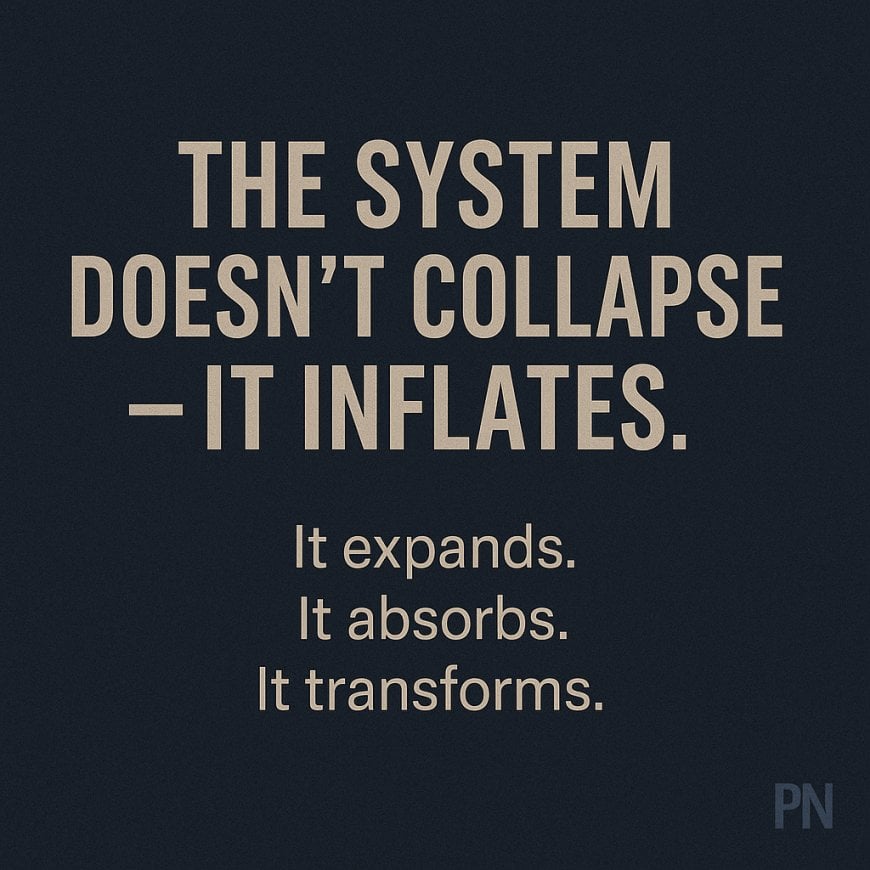
The world isn’t heading toward collapse — it’s undergoing structural expansion. Central banks cannot allow deflation, global collateral must grow, and the modern system is built to inflate, not implode. Everything Bubble 3 is the next phase of systemic survival.
Why the System Cannot Collapse — A Plain-English Guide to Liquidity, Collateral, and Expansion
A regular person’s map to how the modern economy actually works — and why “collapse” narratives miss the operating system.
Overview
Most people were taught an economy of wages, budgets, and savings. The world we actually live in runs on liquidity, collateral, and debt rollover — a system designed to prevent contraction from turning into collapse. That’s why, in every crisis, policy follows the same sequence: liquidity first, stability second, narrative third.
For the structural lens behind this piece, see End of the Bond Supercycle and the forward path sketched in Calm Before the Liquidity Storm (QE 2026).
The Global System Is Too Big to Shrink
Debt is not just borrowing; it’s the plumbing of the system. Sovereign bonds sit at the core as collateral. Banks, money markets, pensions, insurers — all reference that collateral to function. If collateral values fall hard and stay down, the system seizes.
That’s why policymakers don’t “let the market clear” in a crisis. They can’t. A true contraction would cascade into bank failures, pension impairment, mass unemployment, and political breakdown. For the practical mechanics, see Reverse Repo Trap and Treasury’s Line in the Sand.
What Central Banks Actually Do (Plain English)
- Prevent panic (provide cash against good collateral)
- Stabilize collateral (signal/operations that support sovereign bonds)
- Keep rollover going (so everyone can refinance)
- Avoid defaults (because defaults = systemic risk)
This is why Japan didn’t collapse at 260% debt-to-GDP, why 2008 and 2020 didn’t end civilization, and why the U.S./Europe/China keep functioning through shocks. The operating logic is expansionary by design; details in The Silent War Chest and Repo Surge Note.
Why Asset Prices “Have” to Trend Up
Because asset prices are the system’s balance sheet. If sovereign collateral and major risk assets structurally deflate, refinancing breaks and the credit machine locks. So policy leans — sometimes gently, sometimes forcefully — toward reflation. That’s the through-line of the last 40+ years.
For the cross-asset view that removes fiat distortion, read Everything Bubble 3 — Priced in Gold. For how fiscal and term premium interact, see Fiscal Dominance.
Why This Isn’t “Money Printing = Hyperinflation”
Most new money in modern crises enters financial channels (bank reserves, repo, collateral facilities, asset purchases) rather than day-to-day consumer spending. That’s why 2020’s extreme interventions produced high but not runaway inflation — and why the pressure showed up first in assets, not bread aisles.
Think of the dollar less as a “store of value” instrument and more as an operating system for global settlement and collateral. That’s the thesis of The Dollar Isn’t Collapsing — It’s Evolving and the follow-on The Dollar’s Last Stand.
Why Use Gold as the Ruler
Gold isn’t magic; it’s a consistent denominator. It strips out a lot of fiat-measurement stretch and reveals relative value — across time, regimes, and borders. That’s why, when you price assets in gold, many “bubbles” deflate into normal trend channels. The exercise clarifies structure rather than predicting next-week moves.
For the empirical walk-through, see Gold Front-Runs Liquidity (Again) and the real-yield linkage mapped in Gold vs. the 10-Year.
Why Collapse “Feels” Real (Even When the System Expands)
People feel strain in wages, rent, healthcare, time. Meanwhile, the financial system routes support through balance sheets and collateral pipes. The result is a perception gap: households feel pressure while markets and credit stabilize first.
Add secular forces — aging demographics, AI automation, supply chain rewiring, geopolitical fragmentation — and the transition can feel like decay. But as argued in Humanity’s Next Operating System and Systemic Realignment, the system is reorganizing, not dying.
The W-2 Explainer (One-Page Logic)
- Everything references collateral. Sovereign bonds anchor the system.
- Defaults break the anchor. So policymakers avoid contraction that forces default.
- Therefore the system expands. Liquidity support → rollover → reflation.
- Assets trend up over time. Not from euphoria, but from balance-sheet mechanics.
- Gold clarifies the picture. It reveals structure by reducing fiat distortion.
For timing/risk windows (what could delay vs. accelerate), see Fed Cuts Then Holds and the earlier setup in QE 2026.
Conclusion — Expansion Is the Operating System
Collapse requires voluntary abstinence from printing, coordinated across major central banks and elected governments — which is structurally impossible. Humanity selects expansion because expansion is survival. The next phase won’t be collapse; it will be the next leg of structural reflation — what we’ve called Everything Bubble 3.
உங்கள் பிரதியாக என்ன?
 போல்
0
போல்
0
 எதிர்ப்பு
0
எதிர்ப்பு
0
 காதல்
0
காதல்
0
 காமெடி
0
காமெடி
0
 வா
0
வா
0
 துக்கம்
0
துக்கம்
0
 கோபமாக
0
கோபமாக
0

Founder of Pattern Nexus. I research markets, macro, geopolitics, AI, history, ancient systems, and the patterns most people overlook. I’m also building Market Radar, a trading scanner designed to read pressure, risk, confirmation, and setup quality before chasing a move. Pattern Nexus is where I connect the dots between data, history, technology, and the bigger system playing out around us.





















விமர்சனங்கள் (0)