
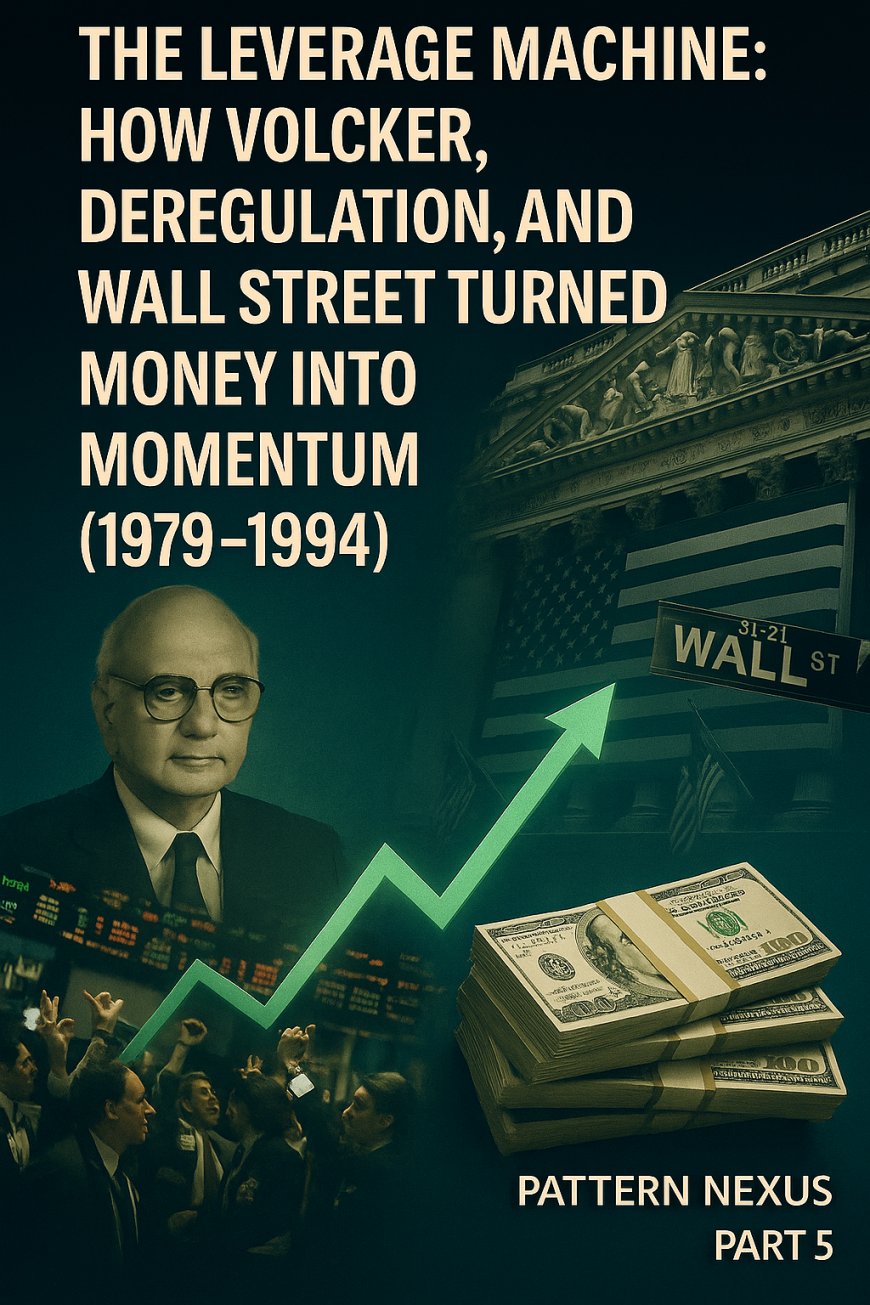
The Leverage Machine: How Volcker, Deregulation, and Wall Street Turned Money Into Momentum (1979–1994)
After the 1970s inflation and the end of Bretton Woods, the global system didn’t normalize — it hardened and then financialized. Between 1979 and 1994, Volcker’s shock therapy, Reagan–Thatcher deregulation, junk bonds, LBOs, and market-based credit built a new regime where leverage, not wages, became the main growth engine.
The Setup: From Monetary Break to Discipline by Pain
Part 4 ended with a system in mutation. The gold window was closed, exchange rates floated, oil shocks had ripped through the real economy, and Eurodollars plus petrodollars were pumping dollar liquidity around the planet. The problem was simple and brutal: inflation.
In the United States and many other advanced economies, inflation had become embedded in wages, contracts, and expectations. Double-digit CPI was not an event; it was a background assumption. The postwar social bargain of stable prices and rising wages was gone.
At the same time, the new dollar architecture needed credibility. You cannot run a fiat, network-backed, energy-anchored currency system if everyone assumes the unit will keep melting. So someone had to absorb the adjustment.
The 1979–1994 era is the story of how policymakers chose to:
- crush inflation with interest rates instead of price controls
- shift power from labor toward capital
- replace repression and capital controls with deregulation and market pricing
- let financial markets become the main enforcement mechanism for discipline
The result was not a “return to normal.” It was the construction of a new regime where leverage would become the main amplification tool for growth, profits, and crises.
Volcker’s Shock: Killing Inflation, Pricing Everything
In 1979, Paul Volcker became chair of the Federal Reserve. Within months, he launched a radical shift in policy. Officially, the Fed pivoted from targeting interest rates to targeting the growth of monetary aggregates. In practice, Volcker allowed short-term interest rates to soar to whatever level was needed to crush inflation.
Fed funds rates surged into the mid-teens and briefly above 20 percent. Mortgage rates followed into the high teens. The United States experienced back-to-back recessions in 1980 and 1981–82. Unemployment spiked, factories closed, and interest-sensitive sectors like housing and autos were hammered.
Volcker’s critics saw unnecessary brutality. His defenders saw existential necessity: without a shock to expectations, the dollar risked becoming just another soft currency in a world that still needed a global anchor.
Structurally, the Volcker shock did three things:
- It broke inflation expectations. Economic agents began to believe that the central bank would not tolerate runaway prices, even at the cost of recessions.
- It set the starting point for a multi-decade bond bull market. High nominal yields in the early 1980s, combined with falling inflation and then falling policy rates, created enormous capital gains for holders of long-duration debt.
- It redistributed power. Debtors with floating-rate liabilities were devastated. Savers and future asset buyers who survived the storm gained access to a world of high real yields that would gradually transition into capital gains as rates drifted lower.
Outside the United States, the consequences were even more dramatic. Many developing countries had borrowed heavily in dollars during the 1970s at what seemed like manageable rates. When Volcker slammed on the brakes, their funding costs exploded just as global demand slowed. That stress would soon detonate into a series of sovereign debt crises.
Reagan, Thatcher, and the Policy Regime Shift
Monetary shock alone doesn’t define a regime. It needs a political and ideological container. That came in the form of Reagan in the United States and Thatcher in the United Kingdom.
Their governments pushed a menu of policies that, in different ways, shared a common direction:
- lower marginal tax rates and an emphasis on supply-side growth
- weaker unions and more flexible labor markets
- privatization of state-owned enterprises and public services
- deregulation across finance, energy, and other sectors
- a rhetorical and policy tilt toward “free markets” as superior to state planning
Combined with the Volcker shock, this regime shift did two important things for the future leverage machine:
- It normalized economic pain as a policy tool. Recessions, unemployment spikes, and asset-price volatility were acceptable collateral damage in the pursuit of price stability and “market efficiency.”
- It strengthened the relative position of capital versus labor. As unions weakened and global competition intensified, wage growth decoupled from productivity growth in many advanced economies.
The ideological subtext was clear: discipline would be applied by markets, not by planning boards, and success would increasingly be measured in terms of returns to capital rather than broad-based wage gains. In that world, leverage had room to grow.
Deregulation and Market-Based Credit: Turning Banks Into Pipes
The postwar model of finance relied heavily on regulated banks, capped interest rates, and a significant degree of financial repression. The 1980s began to dismantle that structure.
In the United States, the Depository Institutions Deregulation and Monetary Control Act of 1980 started phasing out interest-rate ceilings on deposits and broadened the Fed’s reach but also opened the door to more competition. Two years later, the Garn–St Germain Act expanded the powers of savings and loans to offer new types of mortgages and loans, which would later feed into the S&L crisis.
Parallel to the legal changes, markets innovated around the old constraints:
- money market mutual funds emerged as deposit substitutes with market-based yields
- mortgage-backed securities allowed mortgage originators to sell loans into capital markets
- interest-rate swaps and currency derivatives gave institutions tools to manage or speculate on rate and FX risk
In the United Kingdom, the 1986 “Big Bang” deregulation transformed the City of London by removing fixed commissions, ending old club-style structures, and allowing foreign firms to own U.K. securities houses. London cemented its role as a central hub for global wholesale finance and Eurodollar intermediation.
The combined effect was a decisive shift from:
- bank-centric, deposit-funded credit creation
- toward market-based credit where securities, not loans, sat at the center of the system
Banks increasingly became conduits and arrangers:
- originating loans
- packaging and securitizing them
- selling them into portfolios, mutual funds, and insurance company balance sheets
In this architecture, leverage could scale in new ways. It no longer had to live entirely on bank balance sheets. It could be sliced, repackaged, rated, and distributed across the global investor base.
The Leverage Machine: Junk Bonds, LBOs, and Shareholder Rule
While regulators and legislators were opening new lanes for credit, Wall Street was inventing new vehicles to race down them. The most iconic of these was the modern high-yield bond market.
High-yield, or “junk,” bonds were not conceptually new. Lower-rated bonds had always existed. What changed in the late 1970s and 1980s was the deliberate use of these instruments to finance leveraged buyouts and corporate restructurings at scale.
Investment banks and specialized firms developed a playbook:
- identify underperforming or “undervalued” companies
- raise large amounts of high-yield debt to buy them out
- restructure operations, cut costs, sell assets, and redirect cash flow to service the debt
- exit via sale or public offering once metrics and valuations improved
The threat of hostile takeovers and LBOs had a disciplinary effect even on firms that were never taken over. Managers now faced a credible external force saying: if you don’t maximize shareholder value, someone else will borrow against your company and do it for you.
The corporate balance sheet became a battlefield. Where earlier eras emphasized stability, diversified operations, and long-term employment, the new regime emphasized:
- return on equity and earnings per share
- cost-cutting, outsourcing, and asset sales
- stock buybacks and dividend policies geared toward shareholders
Over time, more and more free cash flow was directed into financial engineering rather than physical investment. Leverage, not just productivity, became a key driver of reported performance. The “shareholder value” revolution was inseparable from the availability of cheapening, increasingly sophisticated credit.
Global Fallout: Debt Crises, Plaza/Louvre, Japan’s Bubble, and the Greenspan Put
A new regime rarely rolls out smoothly. Between 1979 and 1994, the emerging leverage machine was stress-tested repeatedly.
Latin American Debt Crisis and the Brady Era
During the 1970s, many developing countries borrowed heavily in dollars, often funded by recycled petrodollars. Volcker’s rate spike and the global slowdown made those debts unsustainable. Mexico’s 1982 announcement that it could no longer service its obligations triggered a broader Latin American debt crisis.
For much of the 1980s, restructuring negotiations, IMF programs, and austerity defined the region’s experience. Eventually, the Brady Plan turned many of these loans into tradable Brady bonds, securitizing sovereign risk and embedding it deeper into global markets.
Plaza, Louvre, and the Management of the Dollar
By the mid-1980s, Volcker’s policy and the U.S. stance had driven the dollar very high relative to other major currencies, hurting U.S. exporters and manufacturing. The 1985 Plaza Accord saw major economies agree to coordinate a weaker dollar. Later, the Louvre Accord tried to stabilize the system after that adjustment.
These agreements showed that currency values were not purely “market outcomes.” They were subject to coordinated state management within the broader dollar-centric framework.
Japan’s Bubble and the Long Aftermath
A weaker dollar and strong yen, combined with Japan’s own financial liberalization and policies, helped fuel a major asset bubble in Japanese stocks and real estate in the late 1980s. At the peak, valuations reached surreal levels, with land in central Tokyo supposedly worth more than entire countries on paper. The crash at the start of the 1990s ushered in what became known as Japan’s “lost decades” of low growth and deflationary pressure.
Black Monday and the Greenspan Put
In October 1987, global stock markets experienced a sudden and severe crash, with U.S. indices dropping more than 20 percent in a single day. The newly installed Fed chair, Alan Greenspan, responded quickly with statements and actions signaling that the central bank would provide liquidity and support the functioning of markets.
The lesson markets learned was simple: there was a backstop. When volatility turned catastrophic, the central bank would not stand aside. This perception evolved into what traders later called the “Greenspan put” — the idea that there was an implicit floor under major asset prices.
Taken together, these episodes showed the new pattern:
leverage builds, a crisis hits, authorities intervene to stabilize the system, and the next cycle starts from a higher base of complexity and scale.
Wiring the Casino: PCs, Screens, and the Derivatives Layer
Underneath the policy and credit story, the technological command layer from Part 3 kept evolving. The 1980s and early 1990s wired the financial system into something recognizably modern.
Personal computers spread into offices, bringing spreadsheets and financial modeling tools directly to traders, analysts, and corporate treasurers. Bloomberg terminals and similar platforms delivered real-time price data, analytics, and messaging in one interface.
Electronic trading began displacing traditional floor-based systems in many markets, with futures and options exchanges pushing screen-based access and algorithmic order routing. Derivatives such as interest-rate swaps, currency swaps, and equity index futures became standard tools for managing risk and for levering views.
This infrastructure did two things:
- it dramatically increased the speed at which information and orders could propagate
- it standardized complex exposures into tradable, margined instruments
In other words, it made it easier to build and manage leverage, both for hedging and for speculation. The command line from Part 3 now had a full casino built on top of it.
Winners, Losers, and the New Social Hierarchy
The macro numbers of the era — falling inflation, rising GDP, booming markets — obscured a deep shift in distribution.
As unions weakened and global competition intensified, wage growth for median workers in many advanced economies lagged behind productivity. Real wages stagnated or grew only modestly, even as corporate profits and financial-sector earnings rose.
For households, the emerging pattern was:
- greater access to credit (credit cards, mortgages, consumer loans)
- increasing reliance on asset appreciation (homes, pensions, stocks) for wealth building
- exposure to market volatility whether they realized it or not
For those with capital and access to financial markets, the period was extraordinarily rewarding. Owning equity, long-duration bonds, or property in the right jurisdictions during the disinflationary, deregulated era could generate large returns.
Globally, emerging markets were pulled into a cycle of capital inflows, dollar borrowing, and periodic crises. The leverage machine extended opportunity but also fragility: when conditions turned, capital could exit quickly, leaving deep recessions and social upheaval.
The underlying message of the system was clear: participate in markets and manage leverage well, or be priced by them instead.
Why 1979–1994 Rhymes With the 2020s AI–Energy Shift
The late 20th century leverage machine may feel far removed from a world of AI models, data centers, and energy-transition politics, but the structural rhyme is strong.
Anchoring a New Regime With Pain
Then, Volcker’s shock established that the United States would defend the value of its currency with real economic pain. Now, central banks and governments face a different set of constraints — fiscal loads, demographic headwinds, and geopolitical fragmentation — but similar questions: how much pain will they tolerate to maintain credibility and funding capacity in a world of huge AI and energy capex?
Deregulation and Perimeter Shifts
Then, deregulation and market-based credit moved activity from tightly controlled bank balance sheets into markets and shadow banking. Now, we see activity moving from traditional banking into private credit funds, tokenized collateral pools, and new digital rails. The perimeter shifts, but the logic — find new pipes for leverage — remains.
Technology as Leverage Multiplier
Then, PCs, terminals, and derivatives infrastructure made it easier to express and scale financial bets. Now, AI-augmented trading, real-time data, and automated risk systems amplify both the speed and complexity of financial cycles.
Distributional Friction
Then, disinflation and deregulation favored capital over labor, widening inequality. Now, automation, AI, and capital-heavy energy infrastructure risk doing the same unless the pattern is consciously interrupted.
The Pattern Nexus point is not that history will copy and paste itself. It is that the playbook of:
- shock to reset expectations
- deregulation to open new pipes
- technology to scale leverage
- intervention to manage crises without fully deleveraging
is already encoded in the modern system’s DNA. Understanding 1979–1994 is understanding how the leverage machine learned to run — and how it might behave in an AI–industrial, energy-constrained future.
Pattern Nexus Framework: From Dollar Web to Leverage Engine
In the Pattern Nexus megaseries, each chapter stacks on the last:
- Part 1: build the industrial hardware (1870–1914).
- Part 2: build the dollar fortress to manage it (1947–1953).
- Part 3: build the command line — the compute–defense complex (1956–1969).
- Part 4: break the old gold rules and spin up a dollar web anchored in oil and offshore credit (1968–1979).
- Part 5: discipline the new system with pain, deregulate the pipes, and let leverage become the main amplifier (1979–1994).
The core Pattern Nexus takeaways from Part 5:
- Credibility was restored by sacrifice. Volcker’s shock redistributed losses and signaled that the dollar regime would not accept chronic high inflation, even at the cost of recessions and unemployment.
- Constraints moved, not disappeared. Deregulation did not remove discipline; it shifted it into market prices, spreads, and margin calls.
- Leverage became structural. With market-based credit, securitization, and derivatives, adding leverage became a design choice rather than an occasional exception.
- Interventions prevented collapse, not excess. Crises in Latin America, Japan, and markets like 1987 did not trigger systemic redesign; they triggered ad hoc stabilization, preserving the basic leverage-friendly architecture.
- Distribution tilted toward asset owners. The combination of disinflation, cheapening leverage, and technology-driven finance set up the long arc of widening inequality in many advanced economies.
Looking ahead, the next chapters will track how this leverage engine interacts with globalization, the rise of China, the dot-com cycle, and ultimately the crises and responses of the 21st century. But the basic operating system — strong-dollar credibility plus a market-based leverage machine — is largely a product of 1979–1994.
FAQ: Quick Answers and “So What?”
Did Volcker act alone, or was this a broader political decision?
Volcker had institutional independence and conviction, but his policies were ultimately tolerated and supported by political leadership that prioritized defeating inflation, even at high social cost. The broader shift toward market-centric, disinflationary policy was a collective choice, not a purely technocratic one.
Was deregulation a mistake?
It depends on what outcome you measure. Deregulation and market-based credit increased flexibility, innovation, and access to funding. They also amplified leverage, complexity, and the scale of crises. The system became more dynamic and more fragile at the same time.
Why are junk bonds and LBOs so important in this story?
Because they turned the corporate balance sheet into a strategic weapon and rewired management incentives. The ability to finance takeovers and restructurings with high-yield debt changed how companies thought about risk, employment, and investment, embedding leverage into corporate strategy.
What is the “Greenspan put” and why does it matter?
The “Greenspan put” is the perception that the Federal Reserve would respond to severe market declines with supportive policy, effectively providing a safety net for investors. This mattered because it encouraged risk-taking and leverage under the assumption that catastrophic downside would be cushioned.
How does this chapter help investors and builders today?
Understanding 1979–1994 shows how regimes change through a mix of crisis, ideological shifts, and plumbing tweaks rather than clean resets. It highlights how leverage becomes embedded in institutions and behaviors, and how interventions often preserve the structure that caused the last crisis while setting up the next one. For anyone building in an AI–energy–dollar world, it is a map of how power flows when money is both disciplined and hyper-elastic.
Sources
- Historical analyses of the Volcker shock, Great Inflation, and U.S. disinflation policy. Federal Reserve History – The Great Inflation
- Overviews of 1980s U.S. financial deregulation (DIDMCA, Garn–St Germain) and the savings and loan crisis. Savings and Loan Crisis
- Discussions of the Big Bang reforms and the City of London’s transformation. Bank of England – Big Bang 30 Years On
- Histories of the high-yield bond market, leveraged buyouts, and corporate restructuring. Brookings – Leveraged Buyouts and the Changing Corporate Landscape
- Background on the Latin American debt crisis and the Brady Plan. IMF – Debt Crises in Latin America
- Studies of the 1987 crash and central bank responses. Federal Reserve History – 1987 Stock Market Crash
- Material on the Plaza and Louvre Accords and coordinated exchange-rate management. FRBSF – Plaza Accord 30 Years Later
- Analyses of Japan’s late-1980s asset bubble and subsequent stagnation. Bank of Japan – Japan’s Bubble, Deflation and Long-term Stagnation
உங்கள் பிரதியாக என்ன?
 போல்
0
போல்
0
 எதிர்ப்பு
0
எதிர்ப்பு
0
 காதல்
0
காதல்
0
 காமெடி
0
காமெடி
0
 வா
0
வா
0
 துக்கம்
0
துக்கம்
0
 கோபமாக
0
கோபமாக
0

Founder of Pattern Nexus. I research markets, macro, geopolitics, AI, history, ancient systems, and the patterns most people overlook. I’m also building Market Radar, a trading scanner designed to read pressure, risk, confirmation, and setup quality before chasing a move. Pattern Nexus is where I connect the dots between data, history, technology, and the bigger system playing out around us.

















விமர்சனங்கள் (0)