
Silver Isn’t Wrong — But the Risk Regime Has Shifted
Silver can be structurally bullish while becoming tactically dangerous. This Pattern Nexus analysis breaks down four historical and modern silver charts to explain why vertical moves change risk, even when the long-term thesis remains intact.
Silver Isn’t Wrong — But the Risk Regime Has Shifted
This is not a call for silver to fail, nor a denial of its structural relevance in the modern economy. It is a warning about regimes. When silver accelerates vertically, the nature of risk changes — not because the thesis disappears, but because price behavior shifts from accumulation to reflexivity.
Executive Summary
Silver can be structurally supported by modern industrial demand and still deliver violent drawdowns. These two facts are not in conflict. They operate on different time axes.
- Silver historically transitions from trend-following to momentum-dominated behavior late in cycles
- Vertical price action alters the risk profile regardless of fundamentals
- Modern demand (energy, AI, nuclear) strengthens the long-term case, not the short-term entry
- Gold and silver respond differently to liquidity stress
- This is a warning about *how* to hold silver, not whether it should exist
Chart I: The 1979–1980 Silver Spike
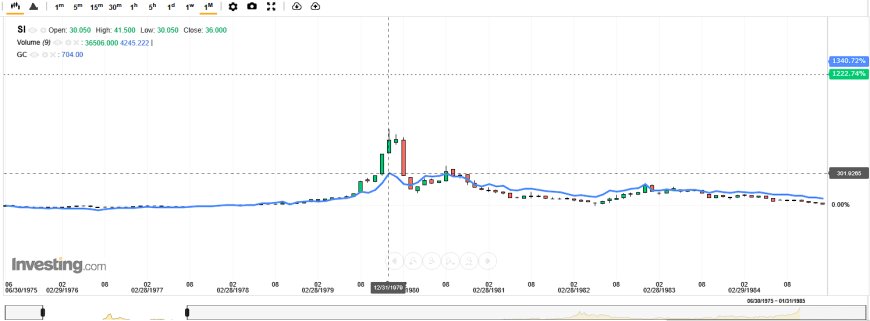
This chart is not included to say “this will repeat exactly.” It is included to show silver’s behavioral tendency when momentum overwhelms structure. In the late 1970s, silver did not simply trend higher — it disconnected from its baseline.
Once that disconnection occurred, price was no longer governed by gradual accumulation. It became governed by leverage, forced participation, and narrative feedback. When that loop broke, the reversion was not gentle.
The lesson is not that silver always crashes. The lesson is that once silver goes vertical, risk is no longer symmetric.
Chart II: The 2000–2011 Cycle
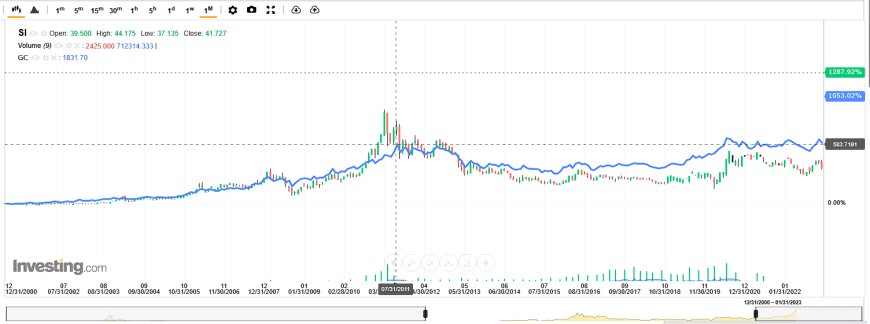
The 2000–2011 cycle matters because it occurred in a more modern financial system. Silver spent nearly a decade building quietly, then exploded during peak monetary stress.
What followed was not an immediate collapse — it was something worse for many participants: years of sideways decay while conviction remained high. This is the hidden risk of late-cycle entries.
Even though inflation narratives, debt narratives, and monetary distrust persisted, silver still punished poor timing.
Chart III: The Current Secular Context
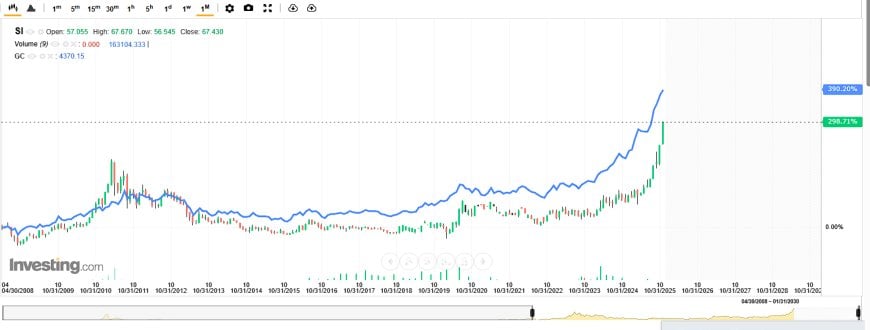
This is where nuance matters. Today’s environment is not a carbon copy of the past. Silver now sits inside electrification, solar, advanced electronics, AI infrastructure, and a broader reindustrialization push.
That strengthens the *floor* of the long-term thesis. It does not eliminate the tendency for silver to overshoot during liquidity-driven phases.
Structural relevance improves durability. It does not remove volatility.
Chart IV: The Late-Stage Acceleration
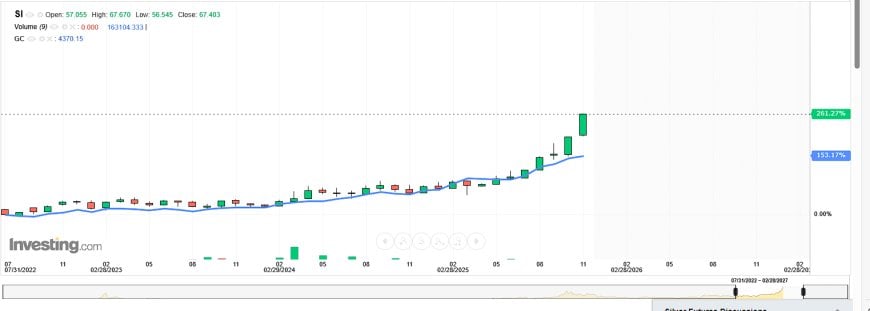
This final chart is the warning flag. The concern is not the absolute price level. The concern is distance from trend combined with rising participation enthusiasm.
At this stage, silver stops behaving like a slow hedge and starts behaving like a leveraged expression of macro fear. That can still resolve higher — but the path becomes violent.
Structural Demand Is Real
It is important to state clearly: dismissing modern silver demand is intellectually lazy. Silver is embedded in power systems, electronics, grid upgrades, defense-adjacent manufacturing, and energy reliability efforts.
Nuclear power — including small modular reactor ambitions — reinforces the need for dense, reliable, conductive materials throughout the energy stack. AI is not “virtual.” It is power-hungry infrastructure.
Structural demand supports the thesis. It does not guarantee smooth price paths.
Gold vs Silver: Same Theme, Different Tool
Gold and silver often rise for similar macro reasons, but they express those reasons differently.
- Gold behaves like a reserve hedge with institutional anchoring
- Silver behaves like a high-beta amplifier of monetary stress
- Gold absorbs flows; silver reflects sentiment
Confusing these roles is how investors apply the wrong risk assumptions.
A Regime-Based Risk Framework
Keep the thesis. Adjust the exposure.
This is not about exiting silver. It is about recognizing when a market transitions from accumulation to reflexivity.
Regime awareness allows you to survive volatility without abandoning conviction.
PN Lens: Liquidity, Feedback, and Crowd Timing
Markets are control systems. Late-cycle price acceleration often reflects feedback loops, not incremental information.
When narratives peak, risk usually rises — even when the narrative itself is not false.
FAQ
Are you bearish on silver?
No. I am cautious about timing and exposure.
Is this saying silver will crash?
No. It is saying volatility risk has increased.
Can silver still go higher?
Yes — but the path matters more now than the destination.
உங்கள் பிரதியாக என்ன?
 போல்
0
போல்
0
 எதிர்ப்பு
0
எதிர்ப்பு
0
 காதல்
0
காதல்
0
 காமெடி
0
காமெடி
0
 வா
0
வா
0
 துக்கம்
0
துக்கம்
0
 கோபமாக
0
கோபமாக
0

Founder of Pattern Nexus. I research markets, macro, geopolitics, AI, history, ancient systems, and the patterns most people overlook. I’m also building Market Radar, a trading scanner designed to read pressure, risk, confirmation, and setup quality before chasing a move. Pattern Nexus is where I connect the dots between data, history, technology, and the bigger system playing out around us.

















விமர்சனங்கள் (0)