
Stablecoins, Treasuries, and the Synthetic Liquidity Engine
Stablecoins are no longer just digital cash. Backed by U.S. Treasuries and amplified through DeFi leverage loops, they form a synthetic liquidity engine reshaping the short end of the financial system.



Stablecoins are not “crypto dollars.” They are a collateral wrapper around Treasury bills with 24/7 transferability.
Looping multiplies claims without adding base collateral. The constraint becomes confidence, liquidity, and liquidation mechanics.
The short end is being bid because it’s becoming the reserve substrate for a new synthetic-liquidity stack.
From Treasury Bills to Tokenized Dollars
Start with the real base layer: U.S. Treasury bills. In the modern era, bills have become the system’s preferred “industrial-grade” cash-equivalent collateral because they are short, liquid, and roll constantly. That roll behavior is not a bug. It is the design. Bills are built for continuous refinancing and continuous secondary-market absorption.
The stablecoin system plugs directly into that design. A modern payment stablecoin issuer is functionally a private money market structure with instant settlement. Cash enters the issuer. The issuer buys eligible reserve assets, then mints tokens. Under the current U.S. framing, the permitted reserve set is intentionally narrow: cash, insured deposits, and short-maturity Treasury exposure (including Treasury-backed repo and money funds constrained to those assets). That constraint is exactly why the front end gets bid.
The U.S. government already borrowed against the bill when it issued it. When that bill backs a stablecoin, the private sector creates an additional claim layer on the same collateral. That’s the seed crystal for everything that comes next.
How big is the stablecoin stack right now?
Total stablecoins are now roughly $300B+ on most market-wide trackers. The system is also highly concentrated. The two dominant tokens account for the bulk of supply, with USDT as the lead and USDC as the #2. This concentration matters because the collateral behavior is issuer-dependent. When the top two issuers scale, the reserve bid scales in a very targeted way.
A useful way to think about stablecoin size is that every $1 of circulating stablecoin requires roughly $1 of reserve assets inside the issuer’s reserve structure. Even before you discuss DeFi leverage, you already have a large and persistent reserve allocation engine pointing directly at the short end.
How the issuer buys T-bills “over and over”
The issuer does not buy one bill once. The issuer runs a rolling inventory. Bills mature every few weeks or months. At maturity, the issuer receives cash and immediately re-allocates into new bills, or uses repo to maintain reserve composition while keeping redemption liquidity available.
Mechanically, it looks like this:
- Customer wires $X into the issuer or its reserve vehicle
- Issuer purchases short-duration Treasury bills and/or Treasury-backed repo
- Issuer mints $X stablecoins and sends them to the customer
- As bills mature, proceeds are reinvested into new bills (the same “roll” behavior money markets have always used)
- If redemptions rise, reserves are liquidated or repo’d to meet cash needs, then rebuilt as conditions normalize
That’s the issuer loop: Treasury issuance and bill roll mechanics powering a continuously refreshed reserve base, while token supply expands and contracts instantly based on mint/redemption flow.
Scale is no longer theoretical
This is not a niche sidebar. Stablecoins are now a meaningful buyer class for short-duration Treasury collateral. Even if stablecoin reserves represent only a single-digit percentage of the total bill market, that demand is structurally different from “hot money.” It is tied to a payment rail, it is regulated (increasingly), and it is reinforced by market plumbing incentives.
Stablecoins also operate as a global dollar distribution network. They are used for trading, settlement, cross-border transfers, and increasingly for enterprise flows. When a stablecoin becomes the settlement currency of a market, the reserve engine behind it becomes a persistent collateral allocator.
Tokenization changes velocity, not the bill
A bill held at a custodian is static. A stablecoin minted against it is mobile. That mobility is the product. Tokenization does three things that traditional T-bill holding cannot do:
- It converts a slow settlement asset into an always-on settlement rail
- It enables collateral to be pledged and reused across independent systems
- It allows claims to be layered (issuer claim, holder claim, lender claim, rehypothecated claim) with fewer visibility constraints than the traditional system
This is the first critical conceptual shift: stablecoins are not merely “digital cash.” They are “portable reserve claims” that can be inserted into leverage systems. Once the claim is portable, it becomes loopable.
The Treasury “creates” bills by issuing them. Stablecoin issuers don’t create the bills. They create a persistent buyer class for bills, which can make it easier for the Treasury to rely more heavily on the front end, especially when policymakers prefer to avoid locking in long-duration rates. In other words: stablecoins do not print Treasuries, but they can change the demand structure that determines how much the Treasury can issue at the short end without destabilizing pricing.
The Stablecoin Leverage Loop
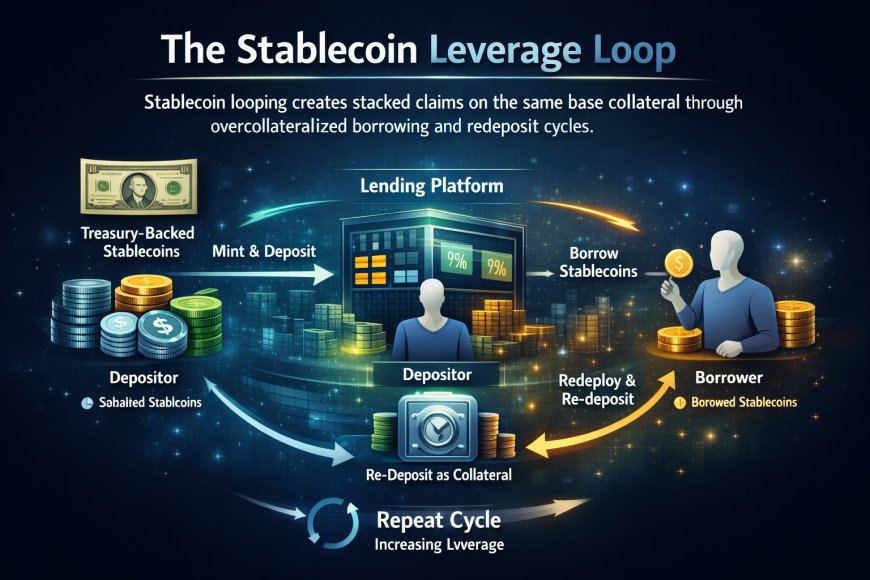
What “looping” actually is
Looping is not magic and it is not a meme. It is a balance-sheet structure expressed through code: deposit collateral, borrow against it, redeposit the borrowed asset as new collateral, borrow again. Each iteration increases the gross notional footprint while the base collateral remains the same.
In most DeFi lending markets, borrowing is overcollateralized. Stablecoins (especially major ones) often have high maximum loan-to-value parameters relative to volatile assets. As a concrete example, one major money market venue lists USDC with max LTV at 90% and a liquidation threshold at 92% (parameters vary by market and change over time). The point is not the exact decimals. The point is the structural capacity to stack.
If max LTV is r, then the theoretical gross collateral multiplier from recursive borrow-and-redeposit is approximately 1/(1−r). At r=0.90, the theoretical gross multiplier approaches 10x. Net borrowed exposure approaches r/(1−r), or ~9x. Real-world results are lower because loopers keep liquidation buffers, fees exist, utilization spikes change borrow rates, and liquidity constraints matter under stress.
A realistic $100 → “big number” walk-through
This is the practical version that mirrors what loopers actually do:
- Deposit $100 USDC as collateral
- Borrow $90 USDC (90% LTV)
- Deposit the borrowed $90 back as collateral
- Borrow $81
- Deposit $81
- Borrow $72.90
- Continue until the marginal borrow is not worth the risk/fees
The gross collateral posted across the system grows with each loop. The total borrowed grows with each loop. But the base “seed” was still the original $100. That’s why people talk in “10x” and “20x” language. They’re describing gross notional stacking and claim layering, not literal free money.
The full real-world loop, end-to-end
If you want the real framework, you have to treat this as a multi-stage machine with three connected loops: issuer reserve loop, on-chain leverage loop, and collateral-demand feedback loop.
Stage 1: Base collateral acquisition. Treasury issues a bill. The government already borrowed against that instrument. Stablecoin issuer buys it and holds it as reserve.
Stage 2: Tokenization. The issuer mints $1 of stablecoin against $1 of reserve collateral. The token is now a portable claim on a reserve portfolio anchored in the front end.
Stage 3: Mobility. The token leaves the issuer and enters markets where it can be pledged, borrowed against, rehypothecated, and used as settlement.
Stage 4: Looping. The token is deposited as collateral. It is borrowed against. The borrowed token is redeposited. This stacks claims.
Stage 5: Feedback. The growth of stablecoins increases the reserve bid (more bills purchased and rolled), and the growth of tokenized Treasury products converts stablecoin demand into repeated front-end demand.
The Treasury already borrowed when it issued the bill. When the bill backs a stablecoin, the private sector has created a second claim layer on top of that same base collateral. Then DeFi and collateral programs can stack additional claim layers on the token. That’s why this feels like liquidity creation. You’re watching the same collateral get referenced multiple times across the system.
Sizing the leverage envelope
Here’s the practical way to estimate “how much liquidity could this create” without doing fantasy math.
Define three variables:
- S = total stablecoin supply (base tokens outstanding)
- f = fraction of stablecoins that actually enter looping/leverage venues (not all do)
- m = effective gross multiplier from stacking (real, not theoretical max)
Then the gross notional footprint associated with looping is approximately: S × f × m.
Use simple scenario ranges to keep this honest. In normal conditions, f is not 100% because many stablecoins sit in wallets, exchanges, payment flows, settlement buffers, or idle treasury operations. Meanwhile, m is not always 10x because loopers preserve buffers and utilization changes borrow costs.
If you want the “headline number,” plug in S at roughly $300B+ and you quickly see why this matters. Even conservative participation produces hundreds of billions in additional gross credit footprint. Base-case participation produces a trillion-class notional footprint. The aggressive case moves into multiple-trillion territory. That’s before you count off-chain rehypothecation, exchange margin netting, or structured products.
Where the Treasury bill comes back in again
Here’s the part most explanations skip: the stablecoin is not just being looped as a token. The stablecoin loop feeds back into Treasury demand through multiple channels, and that’s the “T-bill over and over” dynamic.
Channel A: issuer roll. The issuer continuously rolls Treasury bills to maintain reserves as stablecoins grow. That alone can create persistent, price-insensitive demand for the front end.
Channel B: stablecoin holders buying tokenized Treasury funds. Increasingly, stablecoins become the purchase currency for tokenized money market and T-bill products. Stablecoin demand becomes indirect demand for T-bill exposure, again and again, with the stablecoin acting as the settlement medium.
Channel C: collateral for derivatives and off-exchange margin. Tokenized Treasury vehicles and stablecoins are increasingly accepted as collateral in margin frameworks. That turns “T-bill exposure” into a margin substrate, reinforcing short-end demand because front-end paper is what the system prefers as clean collateral.
Rehypothecation: the hidden multiplier
Looping is visible in code. Rehypothecation is not always visible. Rehypothecation means the same collateral supports multiple obligations across intermediaries. In traditional markets, repo chains do this. In digital markets, custodians, prime brokers, and collateral programs can do this through internal credit, collateral substitution, and netting.
If stablecoins are the transferable “cash leg,” tokenized Treasury products are increasingly the transferable “collateral leg.” When those two meet, you get a hybrid repo-like stack that operates 24/7 with fewer friction points and different liquidation triggers.
What keeps the loop from going infinite
The system does have brakes. They’re just different brakes than TradFi:
- Utilization and borrow rates: when everyone borrows the same stablecoin, rates spike and the loop becomes unprofitable
- Liquidation thresholds and buffers: loopers maintain headroom, which caps effective leverage
- Liquidity depth: thin secondary markets turn liquidations into price-impact events
- Protocol risk: smart contract failures, oracle issues, governance changes
- Issuer redemption mechanics: redemption friction matters under stress, especially for non-institutional holders
But in normal conditions, when confidence is high, the loop can run large and the notional footprint can scale fast. This is why the system can feel like “everything is up.” You’re watching liquidity get assembled and reassembled, not printed.
Why the Short End Is Being Absorbed
If you only view T-bills as “yield,” you miss the trade. The short end is increasingly being treated as the raw material for the next liquidity layer.
Stablecoins create a durable bid for short-duration Treasuries because the reserve set is designed to be:
- liquid enough for redemption
- safe enough for confidence
- short enough to avoid duration shocks
- standard enough to be audited and regulated
That points directly at bills and Treasury-backed repo.
How stablecoins help the front end, mechanically
“Helping the front end” is not a vibe. It is a collateral math statement. When a structural buyer class is constrained to buy the front end, it does three things:
- It creates recurring demand at auction and in secondary markets, reducing the need for marginal buyers to absorb all issuance
- It improves market depth and turnover because reserves roll continuously
- It makes the front end behave like infrastructure demand rather than discretionary yield chasing
When the system is under macro stress, you often see the front end become the battlefield: TGA management, bill issuance, money market fund flows, repo rates, collateral scarcity, and cash preference. Stablecoins are now plugged into that battlefield as an additional demand channel.
Why this is happening now
There are five drivers, and they reinforce each other.
First, regulation. The U.S. is formalizing payment stablecoins as a defined category. That pulls issuers toward standardized reserve behavior, which tends to mean front-end collateral.
Second, interest rates. In a high-rate world, the reserve portfolio yields real money. Stablecoin issuance becomes a profitable business that scales with supply. That incentive pushes issuers to grow and defend market share, which increases reserve allocations.
Third, settlement and speed. Stablecoins are a 24/7 settlement layer. Markets that settle faster are more capital efficient. Capital efficiency attracts institutional flow. Institutional flow expands stablecoin adoption. That adoption increases the reserve bid.
Fourth, collateral modernization. Tokenized Treasury products are expanding. Once the ecosystem accepts tokenized front-end exposure as collateral, the boundary between “cash” and “collateral” starts to dissolve. This creates new ways to build credit stacks on top of the same base substrate.
Fifth, global dollar demand. Stablecoins export the dollar. That matters geopolitically, but it also matters mechanically. It creates a global user base that prefers dollar stability without banking friction. That preference pushes stablecoin growth, which pushes reserve growth.
Why the Treasury likes this
The Treasury’s job is to fund the government. If there is persistent demand for front-end issuance, the Treasury can lean more heavily on bills. That can be desirable when policymakers are trying to avoid locking in higher coupon rates at longer maturities. The trade-off is refinancing risk, but the demand channel is real, and it is growing.
When short-end collateral becomes the base layer of a synthetic liquidity stack, the front end stops behaving like “just financing” and starts behaving like “infrastructure demand.”
That’s the macro tell. If “everything is up” and the short end is still being absorbed, you’re not just looking at risk-on psychology. You’re watching a collateral substrate being built.
Pattern Nexus Lens
Stablecoins are a control-layer interface between sovereign debt and programmable finance. They do not replace Treasuries. They weaponize Treasuries as collateral.
In the old system, liquidity expansion was mostly a centralized function: bank credit creation, central bank reserves, dealer balance sheets, repo markets. In the new system, liquidity expansion becomes modular: wrap collateral, tokenize claims, loop collateral, rehypothecate, and route the resulting liquidity into any market that accepts the token.
This does not mean “infinite money.” It means the transmission mechanism is changing. Confidence, redemption liquidity, and liquidation mechanics become monetary policy variables, because those variables determine whether the claim stack expands or collapses.
Liquidity is no longer only printed. It is assembled. When the assembly line reverses, synthetic liquidity becomes synthetic illiquidity faster than most models assume.
This is why stablecoins matter beyond crypto. They are becoming a monetary interface layer that can scale reserves, accelerate settlement, and stack credit claims on sovereign collateral in ways that compete with, complement, and sometimes bypass traditional banking channels.
FAQ
Are the numbers in this framework real?
Yes, at the level that matters: total stablecoins are now roughly $300B+, USDT and USDC dominate supply, Treasury bills outstanding are multi-trillion, and the leverage mechanics are real (high LTV stablecoin collateral + recursive borrow/redeposit + rehypothecation). Exact figures fluctuate daily, but the structural relationships are stable.
Does looping literally “turn $100 into $1,500”?
Not as free money. Looping increases gross notional exposure and total collateral posted while simultaneously increasing debt, liquidation risk, and reliance on market depth. People cite big multipliers because the claim stack can become large relative to the original seed, especially when multiple systems reference the same base collateral.
Why do people say stablecoins are “buying Treasuries over and over”?
Because issuers roll bills continuously as part of reserve maintenance, and because stablecoins increasingly act as the settlement currency for tokenized Treasury products and collateral programs that require actual front-end collateral under the hood.
What breaks first in a stress event?
Usually one of three things: redemption liquidity, secondary market depth, or liquidation cascades. When confidence weakens, the loop reverses and deleveraging compresses notional liquidity fast, often faster than discretionary human risk management can react.
Does this make the front end safer or riskier?
It can make the front end more consistently bid in normal conditions because reserves are forced into short-duration instruments. But it can also increase event risk if a major stablecoin experiences a run, because reserves may need to be liquidated quickly or repo’d aggressively to meet redemption demands.
How big can this get?
If stablecoins expand from $300B into the $1–$2T range over the next few years, the reserve bid becomes comparable to major traditional buyer classes. Then layer in leverage participation and collateral rehypothecation and you can get trillion-class gross notional footprints tied to the stablecoin stack even before you count derivatives or exchange margin systems.
Sources
Primary references for the reserve framework, market scale, and leverage parameters used in the framework.
- DefiLlama: Total stablecoin market cap
- DefiLlama: Tether (USDT) market cap
- DefiLlama: USD Coin (USDC) market cap
- Aave: USDC risk parameters (LTV, liquidation threshold)
- U.S. Treasury Fiscal Data: Monthly Statement of the Public Debt (MSPD)
- GENIUS Act: bill text
- CRS overview: GENIUS Act
- Kansas City Fed: stablecoins and Treasury demand
- Reuters: issuance mix expectations (T-bills up, coupons steady)
- CoinDesk: USDC vs USDT growth and market scale
- CoinMarketCap: USDT market cap (cross-check)
உங்கள் பிரதியாக என்ன?
 போல்
0
போல்
0
 எதிர்ப்பு
0
எதிர்ப்பு
0
 காதல்
0
காதல்
0
 காமெடி
0
காமெடி
0
 வா
0
வா
0
 துக்கம்
0
துக்கம்
0
 கோபமாக
0
கோபமாக
0

Founder of Pattern Nexus. I research markets, macro, geopolitics, AI, history, ancient systems, and the patterns most people overlook. I’m also building Market Radar, a trading scanner designed to read pressure, risk, confirmation, and setup quality before chasing a move. Pattern Nexus is where I connect the dots between data, history, technology, and the bigger system playing out around us.


















விமர்சனங்கள் (0)