
Why Silver Terrifies China: Velocity, Manufacturing Fragility, and the Limits of Control
Silver’s rapid rise threatens China’s manufacturing model, export margins, and capital controls. Unlike gold, silver is an embedded industrial input—making volatility, not price level, the real danger.
Published: December 2025
By: Pattern Nexus
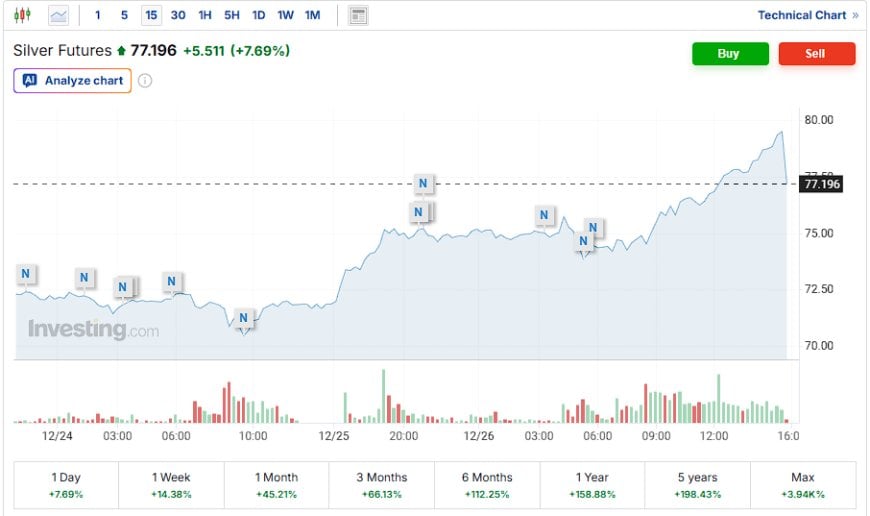
Silver’s rapid ascent is not a speculative curiosity for China—it is a structural threat. Unlike gold, silver sits inside China’s manufacturing, defense, and infrastructure core. When silver reprices too quickly, it transmits stress directly into production costs, export margins, capital controls, military readiness, and political legitimacy. This report explains why Beijing fears silver’s velocity, how it differs from gold, how London market strain and delivery risk amplify the problem, and how all of this fits into the broader liquidity–housing–hard-asset framework.
Summary
China’s anxiety around silver is structural, not tactical. Silver is embedded across China’s industrial and strategic base—solar panels, electronics, EVs, grid infrastructure, semiconductors, AI hardware, and military systems. When silver prices rise slowly, the system adapts. When silver prices accelerate rapidly, hedging fails, margins compress, capital misbehaves, delivery risk emerges, and Beijing’s core advantage—predictable, controllable production—erodes.
This is why China repeatedly applies friction to silver markets. Not to cap prices, but to slow them. Not to suppress silver, but to prevent it from behaving like gold at the exact moment global liquidity stress is intensifying.
Silver’s danger lies in its hybridity. It is small enough to move violently, liquid enough to attract leverage, industrial enough to matter, and strategic enough to affect military readiness. In a world where gold is repricing currency credibility and housing lags behind liquidity cycles, silver becomes an amplifier China cannot afford to ignore.
China’s Control-Based Economic Model
China’s economic system is not optimized for free price discovery. It is optimized for stability, continuity, and scale. Growth is managed through controlled inputs: labor, energy, credit, land, and materials. Volatility is treated as a governance failure rather than a market feature.
This distinction matters. Inflation can be offset through subsidies, FX management, and fiscal tools. Volatility cannot. Inflation unfolds gradually. Volatility is instantaneous. Inflation allows response. Volatility forces reaction.
China’s manufacturing dominance depends on long planning horizons, thin margins, and contractual predictability. A sudden repricing of a core input does not merely reduce profitability—it destabilizes the timing and sequencing of the entire system.
Silver sits directly inside this vulnerability.
Silver vs Gold: Two Very Different Problems
Gold and silver are often grouped together rhetorically. China does not treat them the same operationally.
Gold is a balance-sheet asset. It signals sovereignty, monetary independence, and long-term credibility. China tolerates—and in many ways encourages—gold’s repricing because it strengthens reserve diversification optics away from the dollar.
Silver is not a reserve asset in that sense. It is a throughput asset.
Gold rising challenges the global monetary narrative. Silver rising challenges China’s factory floor, power grid, data centers, and weapons systems.
When silver begins trading like gold—tracking monetary distrust, liquidity stress, or currency debasement—it crosses a red line. It stops being a manageable industrial input and becomes a systemic irritant.
Velocity as the Real Enemy
The level of silver prices matters far less to Beijing than the speed of change.
Slow appreciation allows hedging programs to function, procurement cycles to roll forward, export pricing to adjust, and subsidies or tax offsets to be calibrated.
Rapid repricing does none of this.
Instead, it invalidates hedges, triggers margin calls, forces inventory repricing, compresses export margins overnight, and destabilizes production schedules. From a control-systems perspective, silver volatility pushes the system beyond its damping threshold.
China reacts not to price signals, but to instability signals.
Manufacturing Exposure and Margin Fragility
China is the world’s largest producer of silver-intensive goods. Solar panels, EV power electronics, consumer electronics, grid components, and advanced industrial systems all embed silver at scale.
These industries already face geopolitical tariffs, supply-chain scrutiny, and razor-thin margins. A sudden increase in silver costs cannot be passed through immediately without sacrificing competitiveness.
At scale, this erodes China’s most important export narrative: reliable, affordable manufacturing.
The political dimension matters. Manufacturing employment and export performance are legitimacy anchors. Anything that destabilizes them invites intervention.
Speculation, Capital Flows, and Narrative Risk
Silver’s volatility attracts the wrong kind of capital from Beijing’s perspective.
Fast silver moves draw retail speculation, leveraged commodity funds, momentum-driven cross-border flows, and capital seeking volatility rather than productivity.
This is especially dangerous during periods of FX management stress and domestic confidence fragility. Silver becomes a speculative pressure valve for broader systemic anxieties.
Worse, silver can become a public signal. When it trades alongside gold during liquidity stress, it reinforces narratives of currency debasement and loss of control—narratives Beijing works aggressively to suppress.
The London Silver Market Strain
The London Bullion Market Association silver market underpins global physical settlement. It is also increasingly strained.
Rising physical demand has collided with limited immediately deliverable inventories, elevated lease rates, and an expanding gap between paper claims and available metal.
London strain matters globally. Futures markets assume deliverability that may not exist at scale. When London tightens, stress propagates outward into all silver-linked markets.
China watches London closely. London strain signals potential supply fragility in a metal China consumes relentlessly and cannot easily substitute.
Failure to Deliver: What It Means Systemically
Failure to deliver silver does not mean the metal disappears. It means trust disappears.
When paper silver cannot reliably convert into physical:
- Paper pricing loses credibility
- Physical premiums explode
- Strategic stockpiling accelerates
- Supply chains scramble for secure inventory
For China, this is destabilizing. It forces competition for physical silver in global markets at unpredictable prices, undermining cost control across industrial and military systems.
Silver in AI, Weapons, and Modern Warfare
Silver is not just an industrial metal—it is a strategic material.
It is embedded in missile guidance systems, radar arrays, targeting electronics, high-frequency communications, AI hardware, data-center power distribution, and advanced military batteries.
Modern warfare is electronic, sensor-driven, and power-intensive. Silver’s conductivity, reliability, and thermal properties make it difficult to replace in many applications.
As geopolitical risk rises, silver demand becomes increasingly inelastic. China must secure silver simultaneously for civilian manufacturing and military readiness. That dual-use exposure magnifies Beijing’s sensitivity to volatility.
Silver Inside the Global Liquidity Cycle
Silver does not move in isolation. It moves within global liquidity regimes.
When central banks expand balance sheets, suppress real rates, or signal accommodation, hard assets reprice. Gold leads. Silver follows with leverage.
China cannot print silver. It must source it.
As liquidity excess collides with physical scarcity, silver becomes a conduit through which financial stress transmits into the real economy.
Housing, Gold, and the Hard-Asset Repricing Loop
Gold has already repriced currency credibility. Housing has not fully adjusted. That divergence creates systemic tension.
Silver absorbs the overflow. It is small enough to spike, liquid enough to attract flows, and real enough to disrupt production.
That makes it uniquely dangerous inside a system like China’s, which depends on slow, predictable adjustment.
How China Applies Friction Without “Controls”
China rarely sets prices directly. Instead, it modifies behavior.
Tools include margin increases, tighter position limits, adjusted price bands, fund subscription restrictions, and risk guidance to state-linked institutions.
These measures do not suppress silver. They slow it. They reduce leverage. They damp reflexivity.
The objective is stability, not suppression.
The Pattern Nexus Lens
From a Pattern Nexus perspective, silver is a stress amplifier embedded inside a global control-system breakdown.
Gold challenges the monetary layer. Silver challenges the operational layer.
As liquidity cycles intensify, housing lags, and geopolitical risk rises, silver increasingly sits at the intersection of finance, production, and security.
FHQ: Frequently Heard Questions
Is China trying to suppress silver prices?
No. China is trying to suppress volatility.
Why does delivery risk matter?
Because delivery failure breaks trust and forces physical competition.
Is silver strategically important?
Yes. It is embedded in AI systems, weapons platforms, and modern warfare.
Can China permanently control silver?
No. Friction slows momentum, but structural forces eventually dominate.
Sources
உங்கள் பிரதியாக என்ன?
 போல்
0
போல்
0
 எதிர்ப்பு
0
எதிர்ப்பு
0
 காதல்
0
காதல்
0
 காமெடி
0
காமெடி
0
 வா
0
வா
0
 துக்கம்
0
துக்கம்
0
 கோபமாக
0
கோபமாக
0

Founder of Pattern Nexus. I research markets, macro, geopolitics, AI, history, ancient systems, and the patterns most people overlook. I’m also building Market Radar, a trading scanner designed to read pressure, risk, confirmation, and setup quality before chasing a move. Pattern Nexus is where I connect the dots between data, history, technology, and the bigger system playing out around us.
















விமர்சனங்கள் (0)