
Gold Didn’t Just Reprice — It Quietly Cut Housing in Half
Gold’s 2025 repricing didn’t happen in isolation. Measured in gold, U.S. housing has quietly lost 40–50% of its value without a nominal crash. This article breaks down the hard-asset divergence, why it can’t persist, and how housing may reprice despite poor affordability.
Gold Didn’t Just Reprice — It Forced a Housing Reckoning
Everyone is watching gold in dollar terms. Very few are asking the harder, more uncomfortable question: what happens to housing when gold reprices the currency faster than housing can adjust? Hard assets do not move independently forever. When one reprices violently, the rest of the system is forced to respond — whether the public narrative is ready for it or not.
PN Executive Study
Gold’s 2025 repricing is behaving like a currency signal, not a normal risk-on asset move. Housing, represented here by the Case-Shiller National Index (CSUSHPINSA), remains elevated and sticky in nominal terms, but when measured against gold the relative relationship has shifted sharply in a very short period of time.
This study is not making a timing call. It is identifying a regime condition: the monetary layer is moving faster than the slow, leveraged asset layer can adjust. Historically, when a hard-asset ratio moves this quickly, the system does not return to equilibrium through calm consensus. It returns through policy, credit structure, inflation absorption, or repricing events.
The practical conclusion: the housing–gold divergence should be treated as an instability signal. The longer it persists, the more likely resolution occurs through distortion rather than orderly adjustment.
Why This Matters: This is the type of shift that looks like “nothing is happening” in dollar charts while the underlying purchasing-power regime is changing under your feet.
Executive Summary
Gold’s 2025 move is not a speculative event. It is a monetary signal. Housing, when viewed through traditional dollar-based lenses, appears stable. When viewed against gold — a hard monetary reference — housing has materially de-rated in a very short period of time. That divergence is the signal.
- Housing (Case-Shiller) is structurally slow. It adjusts over years, not months.
- Gold reprices quickly. It front-runs liquidity shifts and regime changes.
- The ratio exposes reality. Housing priced in gold reveals real purchasing power changes.
- This is a system-level imbalance. Hard assets do not remain this far out of alignment indefinitely.
This is not a housing crash call. It is not a gold hype piece. It is a warning that a relative valuation gap has opened — and gaps like this do not close quietly.
The Setup
The way most people track housing is fundamentally incomplete. They focus on monthly mortgage payments, rate levels, wages, and affordability. That frame is valid for households. It is not sufficient for understanding how systems price assets during monetary regime changes.
Gold sits close to the monetary layer. It reacts early. It reprices quickly. Housing sits at the opposite end: slow, financed, politically protected, and structurally illiquid. That creates an asymmetry. When gold moves first, the ratio moves first. Housing reacts later.
Why This Matters: When the monetary layer reprices before the asset layer, you get a temporary “quiet imbalance” phase. That phase is where the most important signals form.
In 2025, that imbalance is now visible. The question is not whether it exists. The question is how it closes.
The Blind Spot
Most market participants think in isolated narratives. Gold is “up.” Housing is “unaffordable.” Stocks are “resilient.” Each asset is discussed as if it exists in a vacuum.
That framing is fundamentally incomplete. Hard assets exist in a relative system. They can diverge for periods of time, but prolonged divergence always creates pressure somewhere else in the system — in credit, in policy, or in asset prices themselves.
When gold reprices the monetary layer, it mechanically changes the real value of every other asset priced in that currency. Housing does not receive an exemption simply because it is slow-moving or politically sensitive.
Why This Matters: People usually recognize regime changes only when their primary asset breaks. Ratios let you see the break forming before the headline event.
This dynamic is rarely discussed because it produces conclusions that feel contradictory. Affordability metrics say housing cannot go higher. Hard-asset ratios say housing has become cheap relative to money itself. Both cannot be true indefinitely.
What We’re Actually Measuring
Precision matters here, because sloppy measurement creates false conclusions.
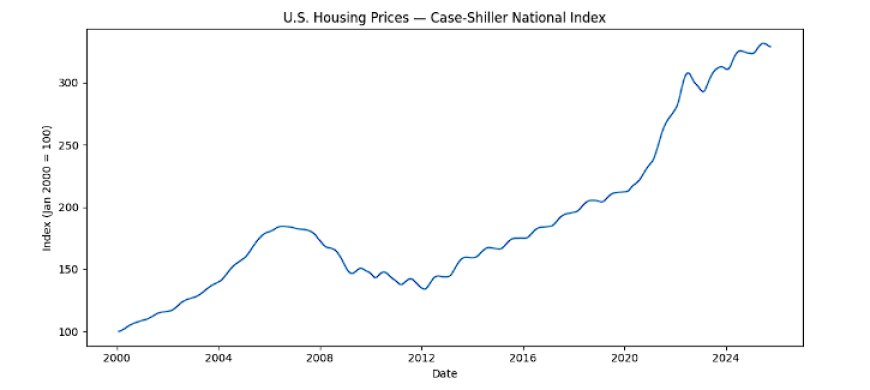
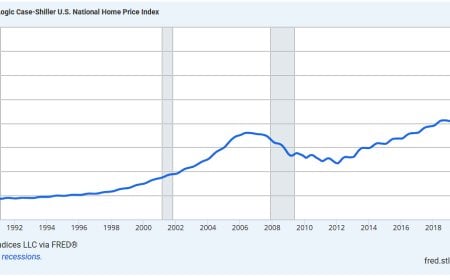
Housing in this analysis is represented by the Case-Shiller National Home Price Index (CSUSHPINSA). This is not a dollar price and not a forecast. It is a long-running index designed to capture broad housing price movements across cycles.
Gold is measured in dollars per ounce using the futures data shown in the charts. The gold series shown is a defined window, and the housing series spans a longer horizon. The ratio is evaluated only where both series overlap.
The relationship being examined is straightforward:
Housing priced in gold = Case-Shiller Index ÷ Gold price
The absolute units are less important than the direction. A falling ratio means housing is losing value relative to gold — even if housing prices are flat or rising in nominal terms.
Why This Matters: Dollar charts can hide real repricing because the denominator is moving. Gold helps reveal when the unit of account is being re-marked.
This is how repricing often occurs in real time: quietly, through ratios, before the public narrative catches up.
Breaking Down the Charts
Each chart below answers a specific question. Together, they tell a coherent story.
Why This Matters: If you only look at Chart 1, you conclude “nothing changed.” That is exactly how regime shifts hide until the ratio forces them into view.
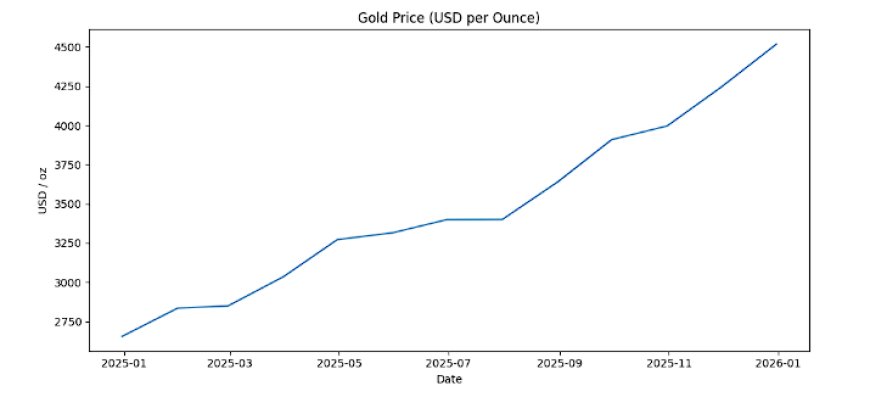
Why This Matters: Gold moving quickly is the monetary layer moving quickly. When that happens, slow assets don’t get to stay “stable” in real terms — they just lag until the adjustment shows up somewhere else.
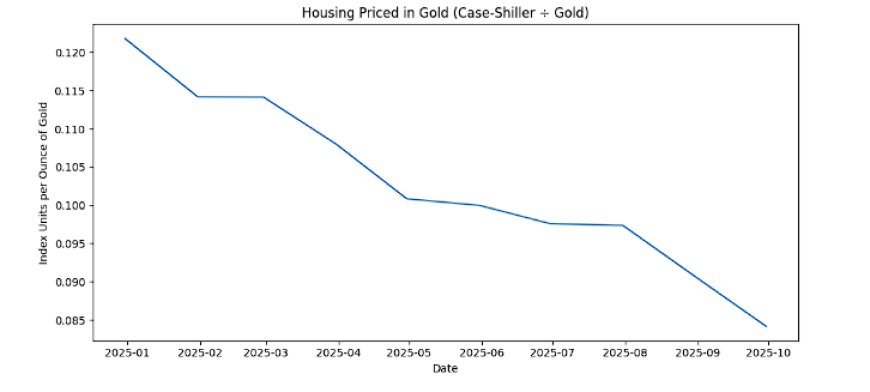
Why This Matters: This is real de-rating without a crash. If the ratio keeps falling, it becomes increasingly difficult for the system to pretend housing is “stable.”
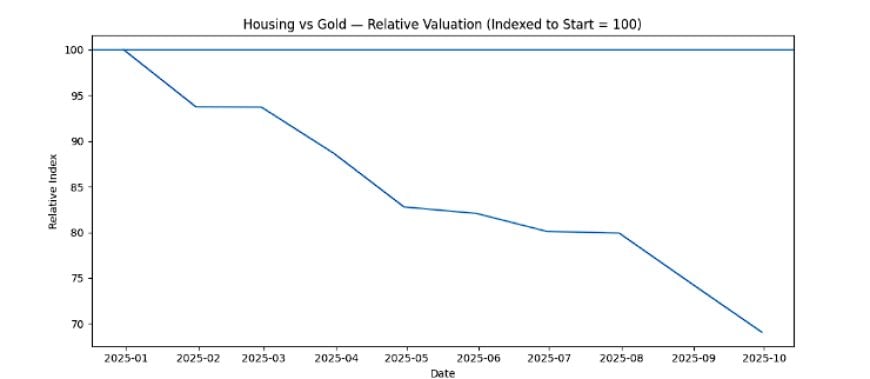
The conclusion is not that housing collapsed. The conclusion is that gold moved first — and housing is now lagging in real terms.
What the Data Actually Implies
The simplest interpretation is the most important one: in a short window, the monetary reference asset moved hard, and the slow financed asset did not. The ratio compressed. That compression is the signal that the system is currently off balance.
If you’re living inside household affordability frameworks, this sounds impossible. But the system does not price housing purely off wages. Housing is a credit asset. It is collateral. It is a political object. It has structural bid support that does not exist in normal consumer goods.
Why This Matters: The question is not “can households afford higher prices.” The question is “what does the system do when collateral is cheapening versus money while remaining expensive versus income.”
That contradiction is exactly where distortions form: the system can’t allow housing to collapse because it’s collateral, but households can’t bid it materially higher because incomes lag. That forces resolution through other channels.
Why This Gap Cannot Persist
Here is the contradiction the system must resolve.
Housing affordability is poor. Wages are constrained. Rates remain elevated. From a household perspective, higher housing prices appear impossible.
Yet relative to gold — a hard monetary reference — housing has just become meaningfully cheaper.
Hard assets do not stay this far out of alignment indefinitely. Either the ratio closes, or pressure builds elsewhere in the system.
Why This Matters: Equilibrium is not optional. The longer adjustment is delayed, the more likely it arrives through policy distortion or abrupt repricing.
Markets do not resolve contradictions through fairness or consensus. They resolve them through repricing, policy intervention, credit restructuring, or inflation absorption.
How Housing Still Reprices
This is the part that feels unintuitive — and why most people dismiss it.
“If people can’t afford housing, how can housing go higher?”
Because markets do not require wages to rise first. They require a marginal bid.
- Credit engineering: longer terms, subsidies, targeted programs, fee structures, and buyer-side interventions that change monthly payments without changing principal affordability in a clean way.
- Institutional capital: buyers not constrained by wages, treating housing as a long-duration store-of-value, a rental yield instrument, or collateral exposure.
- Inflation absorption: the unit of account degrades while nominal asset levels hold, which looks like “stability” but is actually a transfer in real terms.
- Relative rotation: capital flows toward assets that are cheap relative to hard money, even if those assets are expensive relative to income.
None of these outcomes are desirable. They are simply the mechanisms systems historically use to close valuation gaps.
Why This Matters: The path of least resistance is rarely “prices fall until fairness returns.” The path of least resistance is usually “structure changes until the market clears.”
Resolution Mechanisms
There are only a few ways this resolves. Pick your poison.
- Gold mean reversion: gold gives back the move and the ratio re-expands without housing doing anything. This is the cleanest resolution, and often the least likely in the early phase of a monetary repricing regime.
- Housing reflation: housing prices rise, not because wages justify it, but because capital and credit structures force an adjustment.
- Policy-driven smoothing: interventions soften the affordability shock while preserving collateral values. This often looks like “helping buyers,” but structurally it is about preventing collateral impairment.
- Inflationary closure: the ratio closes because the unit of account deteriorates and nominal levels drift higher while real affordability continues to degrade.
- Stress event: if neither side moves cleanly, the pressure can express elsewhere — banking, credit markets, or forced liquidation pockets.
Why This Matters: If you don’t specify resolution mechanisms, you end up with vague doomposting. The point here is structural: the system must choose a channel.
Historical Context: How These Gaps Resolve
History is consistent on one point: prolonged hard-asset divergences do not end quietly.
They usually end in one of two ways:
- Orderly closure: slow normalization via mean reversion or gradual reflation.
- Distorted closure: policy, credit engineering, or inflation do the work because the market cannot clear cleanly through households.
The common mistake is to assume that because an outcome is economically irrational for households, it cannot occur. That is not how the system behaves. The system behaves to preserve stability of collateral, credit, and institutional balance sheets first. Household logic is downstream.
Why This Matters: Housing is not just shelter. In modern finance it is collateral infrastructure. That single fact changes how the system responds under stress.
What Could Break This Thesis
A real framework includes its own failure modes.
- Gold reverses hard: if gold mean reverts sharply, the ratio can normalize without housing moving.
- Housing index rolls over: if housing begins declining in the index while gold continues higher, the ratio compression accelerates and the “reckoning” becomes more obvious, faster.
- Policy shock in either direction: intervention can delay resolution or change the channel entirely.
- Credit event: if credit breaks, the system may be forced into liquidation-style closure instead of engineered closure.
Why This Matters: Knowing the failure modes keeps you from turning a regime signal into a religion. The goal is positioning, not worship.
What To Watch Next
If this divergence matters, it will eventually show up in observable stress points. Here is what to watch.
- Housing momentum: does Case-Shiller re-accelerate, plateau, or roll over.
- Gold continuation: does gold consolidate, grind, or extend the repricing.
- Rate policy and mortgage structure: any shift that changes monthly payment math is a signal of engineered closure.
- Credit spreads and bank balance sheets: housing is collateral. Collateral stress appears first in credit plumbing.
- Policy messaging: when “affordability” becomes an emergency talking point, it usually means stability is being protected behind the curtain.
Why This Matters: The ratio is the early warning. The watchlist is where you confirm the system has started choosing a resolution channel.
Pattern Nexus Lens
Gold moves first because it sits closest to the monetary layer. Housing moves last because it is slow, leveraged, and political.
When the ratio between them moves violently, it is not random. It is an early warning signal that an adjustment is being forced somewhere in the system.
This is not a timing call. It is a regime signal. Regime signals do not fade quietly — they force adjustment.
FAQ
Are you saying housing is about to crash?
No. Housing can remain elevated in nominal terms while still losing value relative to gold. This is a relative-valuation read, not a crash prediction.
Is gold the “real” unit of account?
No. Gold is a reference ruler. It is useful precisely because it helps reveal when the currency denominator is being re-marked.
Isn’t this a short data window?
Yes — and that’s exactly why it matters. The speed of the move is the signal. Slow assets rarely get repriced in real terms this quickly without follow-on effects.
Could gold fall instead and solve this?
Yes. Divergences can close from either side. The point is that a divergence exists and the system must eventually choose a channel to close it.
Is this a prediction?
No. It’s a framework for identifying imbalance. The timing and the path remain uncertain. The regime condition is visible.
మీ ప్రతిస్పందన ఏమిటి?
 ఇష్టం
0
ఇష్టం
0
 ప్రతికూలం
0
ప్రతికూలం
0
 ప్రేమ
0
ప్రేమ
0
 కలుకలు
0
కలుకలు
0
 అబ్బా
0
అబ్బా
0
 దురద
0
దురద
0
 కోపంగా
0
కోపంగా
0

Founder of Pattern Nexus. I research markets, macro, geopolitics, AI, history, ancient systems, and the patterns most people overlook. I’m also building Market Radar, a trading scanner designed to read pressure, risk, confirmation, and setup quality before chasing a move. Pattern Nexus is where I connect the dots between data, history, technology, and the bigger system playing out around us.


















కామెంట్లు (0)