
The Short-End Liquidity Loop: How T-Bills Became a Permanent Monetary Conveyor Belt
A step-by-step, plumbing-accurate explanation of the Fed–Treasury–dealer short-end liquidity loop: T-bill issuance, secondary-market bill purchases, the TGA reserve drain and fiscal re-injection, and why this regime has no credible end state.
Published: December 12, 2025
By: Pattern Nexus
Executive Summary
As of December 12, 2025, the U.S. monetary system is operating in a regime where:
- Treasury issues large volumes of T-bills to manage financing and cash balances.
- The Federal Reserve conducts secondary-market T-bill purchases framed as “reserve management.”
- Treasury spending draws down the TGA, returning reserves to the banking system.
These actions form a self-reinforcing liquidity loop at the short end. Reserves are drained, refilled, and re-injected in sequence, allowing the system to maintain stability without resolving its dependency on ongoing balance-sheet support.
This regime does not rely on perfect simultaneity between issuance, purchases, and spending. It relies on predictability. Markets price front-end risk and auction outcomes based on the expectation that reserve-additive tools and TGA re-injection remain reliably available.
Current Policy Context (As of 12-12-2025)
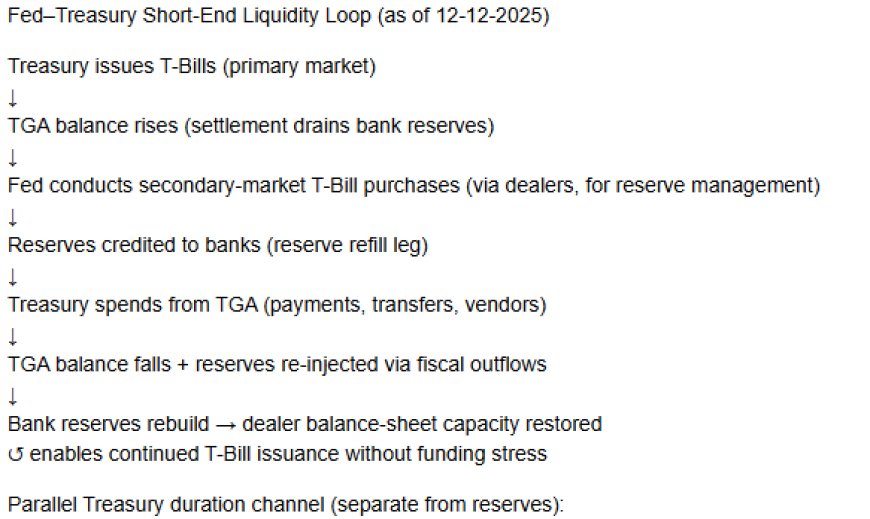
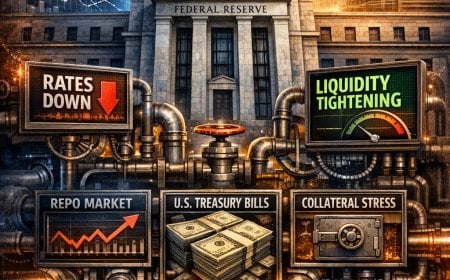
Fed–Treasury Short-End Liquidity Loop (as of 12-12-2025)
Treasury issues T-Bills (primary market)
↓
TGA balance rises (settlement drains bank reserves)
↓
Fed conducts secondary-market T-Bill purchases (via dealers, for reserve management)
↓
Reserves credited to banks (reserve refill leg)
↓
Treasury spends from TGA (payments, transfers, vendors)
↓
TGA balance falls + reserves re-injected via fiscal outflows
↓
Bank reserves rebuild → dealer balance-sheet capacity restored
↺ enables continued T-Bill issuance without funding stress
Parallel Treasury duration channel (separate from reserves):
Treasury relies on T-Bill issuance and cash balances to facilitate coupon buybacks (notes & bonds)
→ duration supply reduced
→ no reserves created
Net system behavior (emergent):
Closed-loop reserve recycling at the front end
+ duration management at the coupon level
Three developments frame the current environment:
1. Fed rate cuts
The Federal Reserve has lowered its policy rate range and adjusted administered rates accordingly. This signals a shift away from restrictive conditions and reduces the tolerance for funding stress.
In operational terms, administered rates control the price of reserves, while balance-sheet and cash-management operations increasingly determine the quantity and distribution of reserves in the system.
2. Reserve-management T-bill purchases
The Fed has announced and begun Treasury bill purchases explicitly framed as reserve-management operations. These purchases are conducted in the secondary market, with amounts announced on a rolling monthly basis.
3. Treasury cash-balance operations
Treasury continues to issue T-bills to manage deficits and the Treasury General Account (TGA). Treasury buybacks — where conducted — apply to coupon securities, not bills, and are operationally separate.
Buybacks are designed to improve market functioning and duration distribution, not to replace bill issuance or finance spending.
The Core Mechanism
Stripped of labels, the system operates as follows:
- Treasury issues T-bills → reserves move into the TGA.
- The Fed buys T-bills in the secondary market → reserves return to banks.
- Treasury spends from the TGA → reserves re-enter the banking system.
- Restored reserves fund the next auction cycle.
At no point does this mechanism require net money destruction to function. Stability is achieved through managed circulation, not balance-sheet contraction.
Treasury Buybacks and the Second Stabilization Axis
Treasury buybacks are not a substitute for bill issuance and are not a mirror image of Federal Reserve operations. They function on a different axis of the same stabilization regime.
While bill issuance and Federal Reserve secondary-market purchases operate on the quantity and distribution of reserves, Treasury buybacks operate on the composition, duration, and market depth of outstanding debt.
In practice, this creates a complementary structure:
- Treasury increases reliance on short-duration T-bills to meet financing and cash-management needs.
- The Federal Reserve supports the bill market through reserve-management purchases, maintaining funding stability and auction clearance.
- Treasury selectively buys back longer-duration coupon securities in the secondary market, relieving dealer balance-sheet pressure and reducing duration indigestion.
These actions are operationally distinct but systemically linked. Bill issuance concentrates duration risk at the front end, where it is easier to fund and absorb. Coupon buybacks remove stress from longer maturities, where balance-sheet constraints and term-premium sensitivity are higher.
The result is a two-axis stabilization regime: reserves and funding conditions are managed at the front end, while duration and market functioning are managed in the coupon sector. Together, they reduce volatility without requiring overt, large-scale long-duration quantitative easing.
Step-by-Step Plumbing
Step 1: Treasury issues T-bills
Bills are auctioned in the primary market. Settlement moves reserves from banks and money funds into the TGA. This is a reserve drain.
Step 2: Dealer intermediation
Dealers intermediate bill supply. Balance-sheet capacity becomes a constraint when reserves feel scarce or volatility rises.
When dealer balance sheets are constrained, auction tails widen and funding markets tighten, increasing the probability of stabilizing intervention.
Step 3: Fed secondary-market purchases
The Fed purchases T-bills from dealers. Payment credits reserves back into the banking system. This is a reserve injection.
Step 4: Treasury spending
Treasury disburses funds. The TGA declines. Deposits and reserves rise.
Step 5: Cycle repeats
With reserves restored, the next issuance clears more smoothly. The loop continues.
Common Misconceptions
- “Treasury buys T-bills.” False. Treasury issues bills and spends cash.
- “The Fed buys from Treasury.” False. The Fed buys in the secondary market.
- “This has a defined end date.” No such endpoint is stated or operationally credible.
- “Bills don’t matter because duration is short.” Reserve effects do not depend on duration.
- “High reserves mean no liquidity risk.” False. Liquidity stress emerges at the margin, through collateral availability, dealer capacity, and market tolerance for volatility.
Why the Loop Persists
“Ample reserves” is not a fixed quantity. It rises with issuance volume, collateral demand, dealer constraints, and market sensitivity.
The threshold for what is considered “ample” is defined by market tolerance, not accounting levels. When volatility or auction stress becomes visible, reserves are retroactively deemed insufficient.
Front-end operations are the least visible and least politically costly way to provide ongoing liquidity. That makes this regime durable.
Market Implications
- Front-end volatility is actively suppressed.
- Reserves are structurally maintained above stress thresholds.
- Collateral is increasingly absorbed by the system through Fed holdings and reduced effective float.
- Financial conditions loosen even without long-duration QE.
Pattern Nexus Lens
QT, as a governing framework, is effectively over. What remains is balance-sheet management aimed at preventing instability.
QT may persist rhetorically or mechanically in parts of the portfolio, but it no longer operates as a binding constraint when front-end stability and reserve adequacy are at risk.
The debate over labels misses the point. Markets respond to flows. This system produces persistent flows.
FAQ
Is this QE?
It is reserve-additive and persistent. The duration profile differs, but the liquidity effect does not.
Operationally, reserves are being added. From a duration perspective, the impact is concentrated at the front end rather than the long end.
Does this conflict with rate cuts?
No. Rate cuts reduce tolerance for funding stress. Reserve-management purchases reinforce that stance operationally.
What would break the loop?
A sustained willingness to tolerate front-end funding stress — which the system has repeatedly shown it does not have.
That would require accepting auction volatility, dealer balance-sheet strain, and visible spread widening as normal conditions rather than triggers for intervention.
మీ ప్రతిస్పందన ఏమిటి?
 ఇష్టం
0
ఇష్టం
0
 ప్రతికూలం
0
ప్రతికూలం
0
 ప్రేమ
0
ప్రేమ
0
 కలుకలు
0
కలుకలు
0
 అబ్బా
0
అబ్బా
0
 దురద
0
దురద
0
 కోపంగా
0
కోపంగా
0

Founder of Pattern Nexus. I research markets, macro, geopolitics, AI, history, ancient systems, and the patterns most people overlook. I’m also building Market Radar, a trading scanner designed to read pressure, risk, confirmation, and setup quality before chasing a move. Pattern Nexus is where I connect the dots between data, history, technology, and the bigger system playing out around us.
















కామెంట్లు (0)