
Greenland, the Board of Peace, and the Fracturing Order: Territorial Leverage, Trusteeship Platforms, and the Liquidity Regime
U.S. tariffs over Greenland, Trump’s Board of Peace for Gaza, elevated U.S. force posture, and the rise of synthetic dollar liquidity are not isolated stories. Together they mark a structural transition: from consensus-based multilateralism to capital-gated trusteeship, territorial coercion, and fragmented liquidity rails.
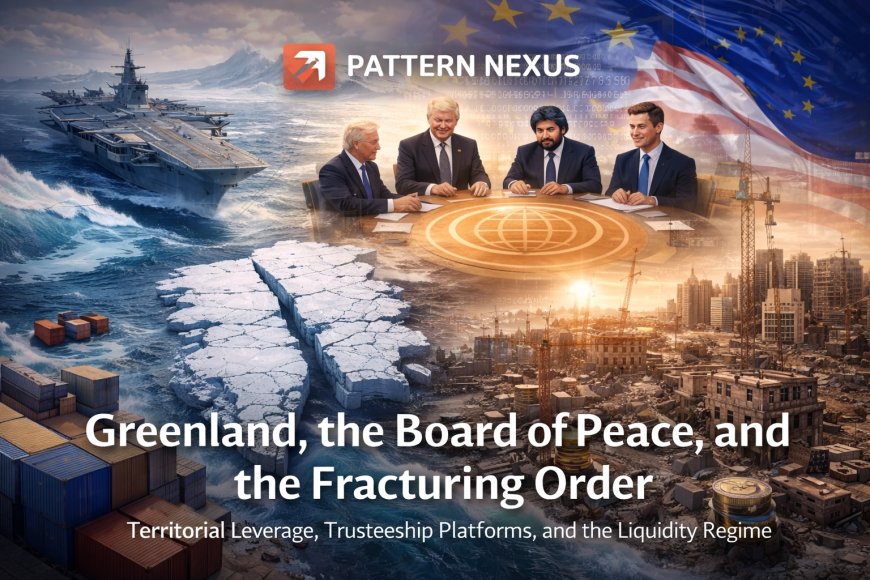

Greenland Framework: From Tariff Ultimatum to Enclave Architecture (January 21, 2026)
Late-day update – January 21, 2026: tariffs shelved, annexation language dropped, but the U.S. quietly walks away with the real prize — basing rights, missile nodes, and resource corridors.
The framework that emerged out of Davos today transformed the Greenland crisis from an overt sovereignty play into an architectural one. The U.S. president announced the cancellation of the February 1 tariff package on eight European economies and publicly ruled out the use of military force to seize Greenland. At face value this looked like a climb-down. In reality, the maximalist tools were swapped for a structured Arctic package negotiated through NATO channels, not bilateral coercion.
The centerpiece of the deal is a new U.S.–NATO integrated air and missile defence system for the Arctic. Greenland becomes one of the primary anchor nodes in that shield. The name being pushed in Washington and Brussels — the “Golden Dome” — is not just branding flair. It signals that the Arctic and North Atlantic arcs are being reclassified as components of U.S. homeland defence. Once a region is mapped into homeland defence, rights to build, harden, and integrate infrastructure expand dramatically, and objections from allies carry less weight.
The second pillar of the framework is the territorial one — though no one will use that term officially. European and U.S. officials are now openly referencing the British sovereign base areas in Cyprus as the comparable model. Under that schema, Denmark retains formal sovereignty, but the United States secures long-duration or potentially perpetual use areas, ports, airfields, and logistics nodes on Greenland under special-status arrangements. These enclaves function as de facto U.S. territorial extensions for defence, intelligence, and space operations, without triggering the diplomatic combustion of an outright transfer of sovereignty.
Even before any formal treaty language is released, the Cyprus analogy is doing a lot of the political groundwork. It conditions the European policy class to reinterpret “no sale” as compatible with “permanent U.S. enclaves,” and it gives Copenhagen and Nuuk rhetorical cover: nothing is being sold, yet control over critical sites, restrictions on access, and the right to expand or fortify facilities migrate to Washington. The map does not change colors, but the control surface does.
The third pillar is the resource corridor. Greenland’s mineral endowment — rare earths, hydrocarbons, and strategic minerals — is being folded into a joint development model. In practice this means privileged U.S. and allied off-take rights, infrastructure finance, and capital vehicles anchored to the island’s mining and processing base. Denmark and Greenland maintain title and licensing authority on paper, but the commercial and logistical backbone shifts toward U.S.-aligned firms and financing, particularly those tied to defense supply chains and the emerging green industrial base.
Europe’s counter-move has been to wrap the island in more NATO. The Danish-led Arctic Endurance exercise, France’s push for a broader Alliance drill, and Commission-level conversations around an Arctic security package all drive toward the same outcome: more allied flags on the island, more multinational planning cells in Nuuk, and more justification for hardened military infrastructure. This gives Washington what it really wanted: political and legal cover to expand the U.S. footprint inside a NATO-branded Arctic envelope.
That is the real sleight of hand. The tariff ultimatum made the fight look bilateral: Washington versus Copenhagen. The framework reclassifies the issue as a collective security problem inside NATO. Once inside that frame, Europe loses negotiation leverage, and Denmark loses the ability to treat Greenland as a purely national matter. As soon as Greenland is rendered a NATO problem, it becomes an American defense problem. And once it is an American defense problem, the basing logic is locked in, and the resource corridor becomes a strategic co-benefit.
Net effect as of tonight: the crisis has pivoted from “Will the United States buy or seize Greenland?” to “How much functional territory can the United States secure through defense integration and Arctic governance?” Copenhagen keeps the flag; Washington secures the launchpads. It is the modern version of territorial acquisition under alliance cover — not annexation, but embedding. Not sovereignty transfer, but enclave architecture. It is slower, quieter, and far more durable.
Greenland: Today’s Moves – January 21, 2026 Update
Update – January 21, 2026 (evening U.S. time): Davos pivot, NATO signaling, and street pressure fold back into the Greenland corridor.
The Greenland play just went through its first visible pivot. At Davos, the U.S. president abruptly stepped back from the most maximalist instruments — ruling out the use of military force to seize Greenland and cancelling the threatened February 1 tariff package on eight European economies. Instead, he announced that NATO had agreed to a vague but politically useful “framework” for a future Arctic deal after talks with the Alliance’s secretary general. The hard annexation language is dialed down; the pressure is being re-routed into process, basing, and “cooperative security” language.
Europe, for its part, is not treating this as resolved. Paris has formally called for a NATO exercise in Greenland and publicly declared that France is “ready to contribute,” an unusual move that externalizes European alarm into Alliance signaling. A NATO drill on Greenlandic territory, framed as collective defense and Arctic stability, would both normalize a higher allied military presence on the island and make any unilateral U.S. move costlier inside the Alliance’s own optics.
Below the summitry, the social and political costs are now on record. The “Hands off Greenland” protests on January 17 produced the largest demonstrations in Greenland’s history, with roughly a quarter of Nuuk’s population in the streets, and tens of thousands in Copenhagen and other Danish cities. The core slogan — “Greenland is not for sale” — makes it harder for any Danish government to treat the island as a negotiable asset without triggering a domestic legitimacy crisis. Greenland’s own leadership has started talking openly about preparing for low-probability, high-impact scenarios, including coercion or force, which is itself a signal of how seriously they read the risk.
Markets treated the Davos pivot as a short-term de-escalation: risk assets bounced as the tariff overhang was removed, and commentary moved quickly to the language of “progress” and “frameworks.” Structurally, however, nothing fundamental has changed. Washington has demonstrated that it is willing to link tariffs, alliance commitments, and territorial demands in one package; Europe has demonstrated that it has few clean exits from the corridor; Greenlandic and Danish publics have demonstrated that they see the island’s status as non-fungible. The immediate crisis has been converted into an ongoing negotiation over basing, missile arcs, and Arctic governance rather than a binary annexation question.
In other words: the knob has been turned down from “imminent rupture” to “managed confrontation,” but the experiment continues. Greenland is now locked in as a live test case of how far a hegemon can push territorial leverage inside an alliance system using a mix of tariffs, basing deals, and NATO-branded security architecture without formally breaking the system it still depends on.
Board of Peace: Today’s Alignment Map – January 21, 2026
Update – January 21, 2026: the Board of Peace stops being a charter on paper and turns into a map of who will sit inside a Trump-chaired trusteeship, who refuses, and who is trying to stand in the doorway.
The same Davos window that cooled the Greenland tariff play brought the Board of Peace into much sharper relief. What started as a Gaza-specific trusteeship architecture under UN Security Council Resolution 2803 is now being sold as a global conflict platform, with invitations out to roughly fifty to sixty capitals and a first wave of public acceptances and refusals on the record.
On the membership side, the outer shell of the Board is consolidating around a familiar pattern: a core of Middle Eastern and Islamic states, a Central Asian arc, and a handful of politically aligned outliers from Europe, Latin America, and Asia. As of this evening, public acceptances include:
- Middle East / Islamic core: Saudi Arabia, Egypt, Jordan, Qatar, United Arab Emirates, Turkey, Pakistan.
- North Africa and broader region: Morocco.
- Post-Soviet and Central Asia: Kazakhstan, Uzbekistan, Belarus, Azerbaijan, Armenia.
- Europe-adjacent / Global South outliers: Hungary, Kosovo, Argentina, Paraguay, Vietnam, Indonesia.
- Regional conflict actors: Israel and Russia, both joining despite internal objections and external criticism.
That list is not static: several of these capitals still have to run the invitation through their own domestic procedures, but the political signal is already out in the open. The Board is not “the international community” in the broad sense; it is a curated club anchored on U.S.-aligned, Gulf, Central Asian, and selected Global South partners willing to pay capital and political cost to sit inside a Trump-chaired platform.
On the other side of the ledger, the lines of refusal are just as revealing. France has publicly signaled that it will not join, warning that the Board risks supplanting the United Nations rather than complementing it. Germany, Norway, Sweden, Denmark, and Italy are either on record as declining or are widely reported as preparing to say no. The United Kingdom, Canada, India, the EU institutions, and others are still in the gray zone: invited, publicly “studying” the offer, but not yet clearly in or out.
Inside the region, the reversals are where the structural story lives. Israel has moved from early objections over composition — particularly Turkish and Qatari roles on the Gaza Executive Board — to formally joining after securing a set of clarifications and cosmetic adjustments. Russia’s decision to climb aboard, even as it is still fighting in Ukraine, pushes the Board even further away from a narrow “Gaza reconstruction” committee and toward a stage for major-power bargaining with a Trump veto at the center.
Trump himself is leaning into that expansion. The Davos messaging was explicit: the Board of Peace will not just oversee Gaza’s reconstruction; it will act as a broader conflict-mediation and governance body, with Trump describing it as potentially more effective and more “prestigious” than the UN system it sits alongside. The charter’s $1 billion clause for de facto permanent membership, and the Chair’s control over interpretation and amendments, mean that this is not simply another talk shop. It is a capital-gated control node with its own internal gravity.
Seen next to the Greenland pivot, the outline sharpens. The same White House that just used tariffs and Arctic basing leverage on NATO allies is simultaneously standing up an external trusteeship platform where seats are priced in cash and loyalty. Europe is split three ways: a bloc that wants nothing to do with the experiment, a bloc that feels too exposed to openly refuse, and a sizable middle that is trying to wait it out without getting crushed between U.S. pressure, domestic opinion, and UN legitimacy concerns.
As of January 21, 2026, the Board of Peace is no longer just a Gaza clause in Resolution 2803. It is a live test of whether a U.S.-designed, capital-gated trusteeship can pull key states away from UN-centered multilateralism and into a parallel control loop — one where the price of admission, the rules of membership, and the interpretation of the charter all flow through a single chair.
The Greenland tariff threat and the Gaza Board of Peace are two halves of the same experiment: using economic coercion and capital-gated trusteeship to redraw territorial control and postwar governance without a conventional great-power war.
Europe is trapped in a tightening corridor: security-dependence on the U.S., monetary entanglement with the dollar, and now open tariff coercion and territorial pressure. None of the available exits are clean; all of them fracture something.
The liquidity regime is shifting from a single, Fed-centric pipe to overlapping rails: swap lines, sanctions, and Treasuries on one side; stablecoins, tokenized RWAs, and reconstruction platforms on the other. Governance, capital, and force posture are converging into one control system.
Objects in Play: Tariffs, Trusteeship, and Force Posture
Strip away the headlines and three hard objects sit on the table at the same time: a coercive territorial play over Greenland, a new trusteeship platform for Gaza, and an elevated U.S. force posture that looks more like pre-crisis optionality than routine deterrence. None of these are hypothetical; all of them are live.
Greenland as Territorial Leverage
The first object is the tariff threat over Greenland. The United States has announced a 10% tariff, rising to 25%, on imports from multiple European countries — Denmark, Norway, Sweden, Germany, France, the United Kingdom, the Netherlands, and Finland — unless Denmark agrees to the “complete and total purchase of Greenland” by the U.S.
Greenland’s importance is structural, not symbolic. It anchors:
- Arctic sea lanes that will become viable shipping corridors as ice recedes.
- ISR and missile arcs over the North Atlantic and polar routes.
- Potential hydrocarbon, mineral, and rare-earth reserves.
- Forward basing options for air and naval assets in the Arctic theater.
Historically, territorial changes at this level inside the Western alliance system have either been consensual or war-driven. Using tariffs against NATO economies to pressure a sovereignty transfer is a structural break: territory is being treated as a negotiable, coercible asset within an alliance, not just across adversarial lines.

Arctic theater map showing Greenland, polar sea lanes, and overlapping missile/ISR arcs. Credit : Institute for Global Affairs
Board of Peace: Trusteeship Stack in Gaza
The second object is the Board of Peace (BoP), created under UN Security Council Resolution 2803 (2025) as part of a 20-point U.S. plan to end the Gaza conflict. On January 15, 2026, the U.S. president announced that “THE BOARD OF PEACE has been formed,” branding it “the Greatest and Most Prestigious Board ever assembled.”
Behind the rhetoric is a defined architecture:
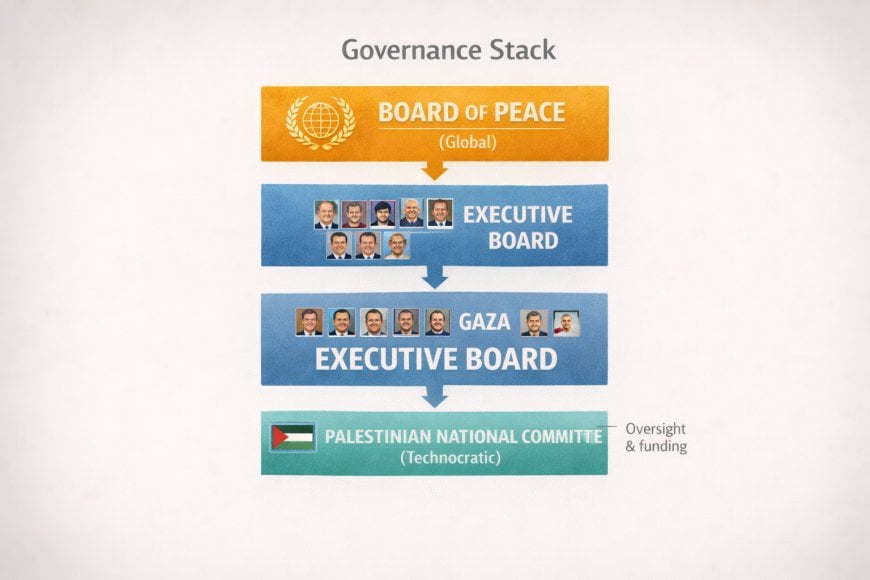
- A global Board of Peace at the state level, chaired by the U.S. president, sets membership, budget, and overall strategy.
- An Executive Board blends state actors, multilateral finance, and private capital: Rubio, Witkoff, Kushner, Tony Blair, Marc Rowan, Ajay Banga, Mladenov, and others.
- A Gaza Executive Board runs operational oversight alongside a Palestinian National Committee, nominally technocratic and apolitical.
On paper, this stack controls reconstruction funding, security coordination via an International Stabilization Force, and the benchmarks that determine when Gaza is considered “terror-free” and ready for more autonomous governance. In practice, it functions as a trusteeship system: Gaza is administered by Palestinians but financially and politically supervised by an external board whose chair holds ultimate interpretive authority over the charter.
Force Posture: From Deterrent-Steady to Pre-Crisis Options
The third object is force posture. The U.S. typically operates around three carrier strike groups deployed at any given time, with others in maintenance or training. The current pattern shows roughly five carriers forward at once, while three to four are in maintenance, combined with increased fighter movements, SOF deployments, and heightened naval activity in the Middle East, European rim, and other key theaters.
This does not automatically mean imminent war, but it is a different posture than the long-run “deterrent steady state.” It matches a pre-crisis configuration: the system is being positioned so that multiple theaters can escalate on short notice without large-scale redeployment lag.
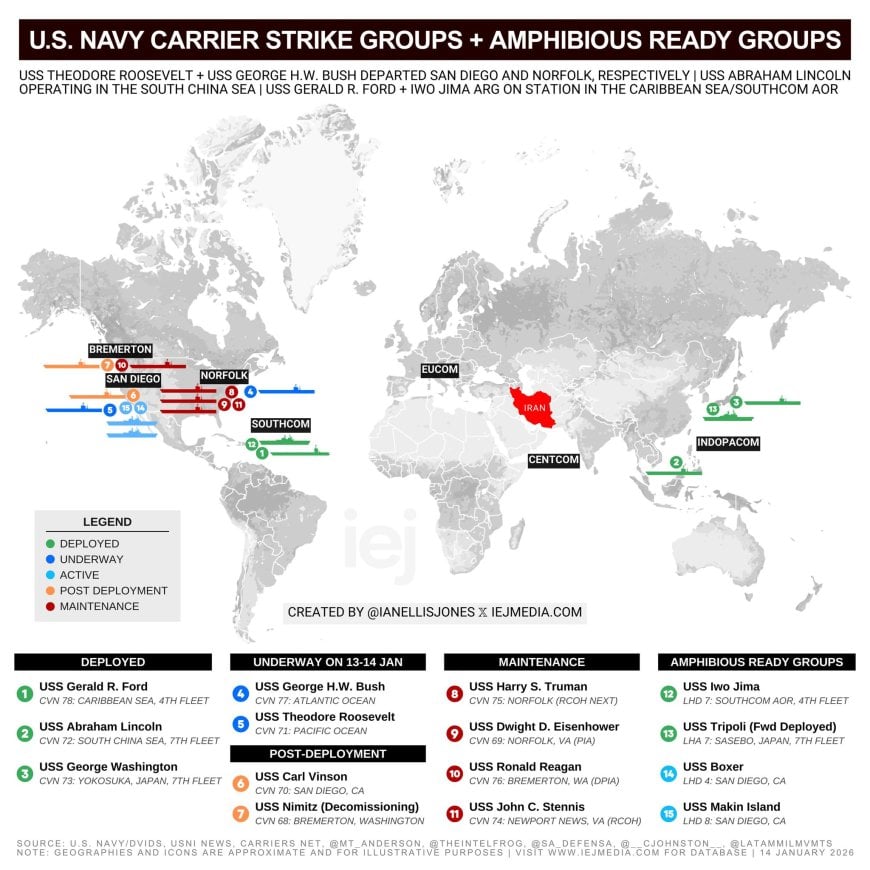
Global map of U.S. carrier deployments, showing an elevated number of active strike groups relative to peacetime norms.
One move pressures an ally to cede strategic territory using tariffs. Another erects a capital-gated trusteeship over a conflict zone under UN cover. A third quietly shifts military posture into a pre-crisis configuration. Standing alone, each is notable. Aggregated, they signal an attempt to rewrite norms on territorial acquisition, postwar governance, and acceptable uses of military and economic leverage inside the Western system itself.
Inside the Board of Peace: Capital-Gated Trusteeship as Platform
The Board of Peace is not a classic UN committee. It is a hybrid: UN-endorsed in mandate, U.S.-designed in charter, capital-weighted in membership, and chair-dominated in interpretation. Understanding its structure is critical, because it appears designed to be portable beyond Gaza.
Legal Skeleton and Governance Layers
The BoP’s legal skeleton runs through three layers:
- Mandate: UN Security Council Resolution 2803 establishes the Board as part of a Gaza peace and reconstruction package, but the Board itself is not a UN organ. It sits adjacent to the UN, not under it.
- Charter: The Board’s charter defines functions, terms, immunities, and amendment rules. The Chairman is the final authority on how the charter is interpreted and applied.
- Subsidiaries: The Board is empowered to create sub-entities, including the Gaza Executive Board and potential future project-specific vehicles.
Functionally, this creates a trusteeship platform with legal cover from the UN, decision rights concentrated in a small group, and the ability to spawn additional governance nodes.
Personnel and Power Concentration
The Executive Board brings together:
- U.S. political leadership (Trump as Chair, Rubio at State, Kushner and Gabriel Jr. as key operators).
- Multilateral finance (Ajay Banga at the World Bank, Tony Blair as a long-running envoy figure).
- Private capital (Marc Rowan, Steve Witkoff, Yakir Gabay).
- Regional state actors (Turkish, Qatari, Egyptian, Emirati officials, among others).
This is not “the international community” in the egalitarian sense. It is a curated coalition of states, financiers, and intermediaries whose incentives run through capital, security, and political leverage in the region.
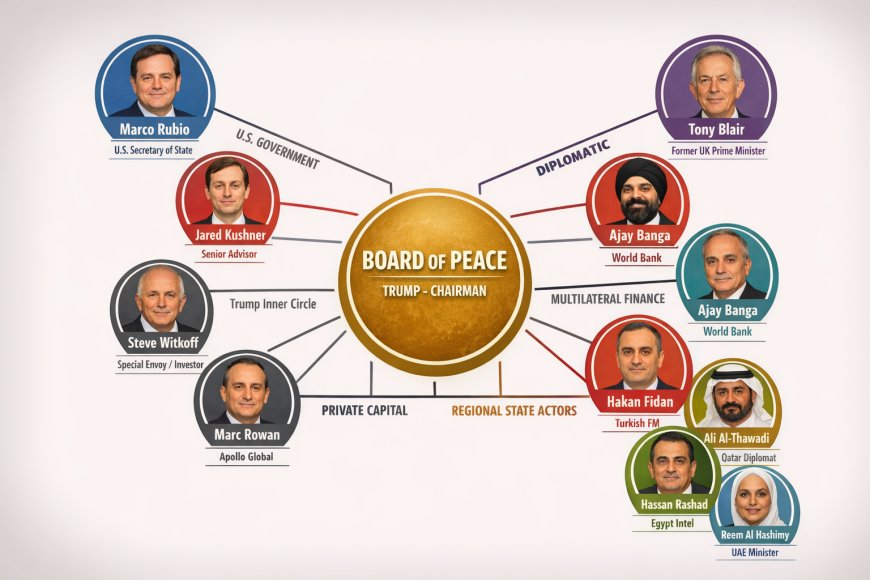
Network diagram of Executive Board members, showing linkages between state positions, multilateral institutions, and private capital.
Membership, Money, and the $1B Clause
Membership rules formalize the link between capital and governance rights:
- Standard state membership term: three years, renewable.
- Critical carve-out: any state contributing more than $1 billion in cash during the first year becomes exempt from the term limit.
- Amendments: require unanimity plus Chair confirmation.
- Charter interpretation: reserved to the Chair.
This creates a pay-to-lock-in mechanism. Large early checks do not merely buy goodwill; they buy structural staying power in the platform. “Peace-building” becomes an asset allocation decision. Governance influence is priced.
What It Actually Does in Gaza
On the ground, the BoP:
- Supervises a Palestinian technocratic National Committee that runs daily administration.
- Controls phased reconstruction funds for infrastructure, housing, hospitals, and schools.
- Coordinates an International Stabilization Force for security, even though no state has yet publicly committed troops.
- Links funding tranches to political and security conditions, including disarmament of armed groups and “terror-free” certification benchmarks that are intentionally fuzzy.
The result is a de facto trusteeship: sovereignty is formally Palestinian, but purse strings, benchmarks, and high-level decision rights sit with an external board whose composition and charter are designed elsewhere.
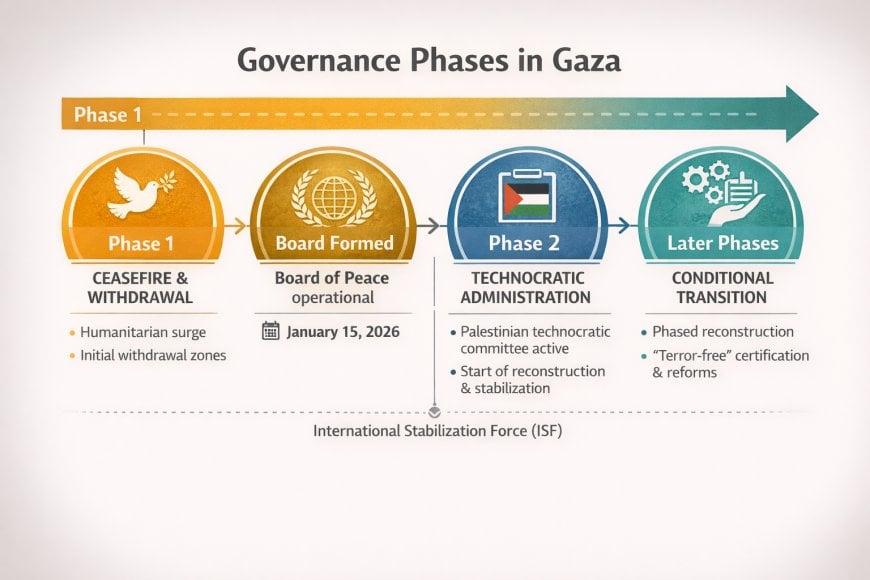
Timeline of Gaza phases — ceasefire, Board formation, technocratic committee activation, phased reconstruction, and conditional transition.
Regional and System-Level Reactions
Fault lines emerge immediately:
- Israel objects to the composition of the Gaza Executive Board, particularly Turkish and Qatari roles, and claims the structure contradicts its policy preferences.
- Hamas rejects the Board as foreign trusteeship; other Palestinian actors are caught between sovereignty concerns and dependence on reconstruction capital.
- Regional states see Board participation as a way to lock in long-term leverage over Gaza’s political and economic trajectory.
- The UN endorses the resolution but does not direct the Board, raising the prospect of a parallel peace architecture with its own rules and immunities.
The BoP therefore functions as a proof-of-concept: can conflict governance and reconstruction be routed through a capital-gated, chair-dominated platform “blessed” by the UN but not bound by UN voting rules?
The Board of Peace is a governance platform disguised as a one-off Gaza committee. It can be cloned or extended to other conflicts, carries its own capital-gating logic, and sits just far enough outside the UN to rewrite decision rules without openly abolishing older institutions.
Europe’s Corridor, Liquidity Architecture, and the Scenario Tree
The Greenland play and the Board of Peace do not land in a vacuum. They land on a European block that is highly dependent on U.S. security and dollar liquidity, and into a global monetary system that is already transitioning from a single dominant rail to overlapping, partially interoperable liquidity networks.
Europe as a Dollar-System Proxy
Functionally, Europe sits downstream of U.S. monetary policy and security guarantees:
- Dollar funding markets and Fed swap lines underpin European banks in crises.
- NATO and the U.S. security umbrella reduce European defense spending and shape threat perceptions.
- Sanctions regimes, export controls, and financial rules are jointly executed but designed in a U.S.-centric legal and enforcement environment.
The Greenland tariff threat weaponizes this dependency. It tests how much economic pain and political humiliation Europe will tolerate while staying inside the dollar/NATO architecture. It also incentives hedging behaviors: exploring Chinese capital, alternative energy and trade arrangements, or at least rhetorical distancing from Washington.
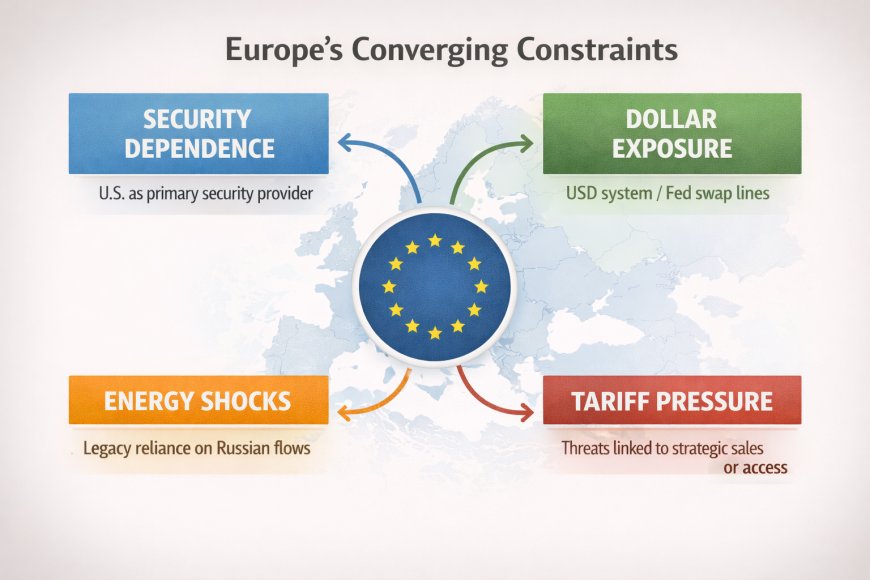
Europe corridor diagram showing constraints from security dependence, dollar exposure, energy shocks, and tariff pressure.
Legacy Liquidity vs Synthetic Rails
The legacy liquidity architecture runs through:
- USD as reserve and trade currency.
- U.S. Treasuries as core global collateral.
- Fed swap lines as ultimate backstop for key allied central banks.
- New York and London as main clearing nodes.
Alongside this, a new architecture is emerging:
- Dollar stablecoins with large and growing floats, used for cross-border settlement and leverage.
- Tokenized Treasuries and other real-world assets, allowing on-chain collateralization and rehypothecation.
- DeFi-based leverage loops, creating “synthetic liquidity” that expands purchasing power without the same regulatory bottlenecks as bank credit.
These “synthetic rails” are still anchored in the dollar and U.S. debt but are less directly controllable by traditional policy levers. They can route around some capital controls while still reinforcing demand for U.S. assets, depending on how they are regulated and integrated into the formal system.
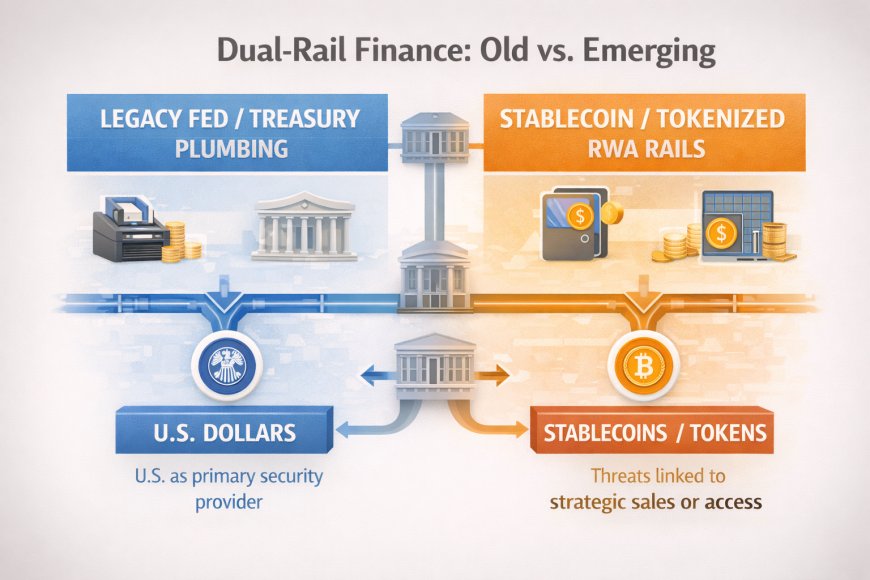
Dual-rail diagram showing legacy Fed/Treasury plumbing on one side and stablecoin/tokenized RWA rails on the other.
BoP as Liquidity Router and Conflict Assetization
The Board of Peace sits directly on top of this evolving liquidity landscape:
- States contribute capital; early, large contributions (> $1B) buy persistent governance influence.
- Reconstruction spending is phased and conditioned, creating predictable funding tranches.
- Those tranches can be securitized directly (via bonds, guarantees, blended finance) or indirectly (via contractor cash flows and derived instruments).
As tokenized Treasuries and stablecoin rails mature, BoP-linked flows can be onboarded into that ecosystem. Conflict resolution becomes a structured product:
- Political risk and security benchmarks are encoded as conditions.
- Meeting them unlocks tranches of capital.
- Tranches fund reconstruction contracts that can be financed and re-financed.
- Those cash flows can be further packaged into financial products on or off chain.
In this sense, Gaza is the first test of “conflict as an asset class” under a capital-gated trusteeship and in a world where parallel dollar rails already exist.
Scenario Tree: How This Can Evolve
The combination of Greenland leverage, Board of Peace trusteeship, elevated force posture, and shifting liquidity rails points into a finite scenario space. The path taken will be determined by how actors react over the next few years.
Branch A – Managed Fracture Without Major War
Alliances weaken but do not formally break. Greenland remains under Danish control after prolonged standoff; tariffs are partially walked back or managed via carve-outs. BoP stabilizes Gaza at a minimal operational level. Europe hedges via limited Chinese engagement and incremental RMB usage but keeps core reserves and security relationships in the Western system.
Liquidity-wise, stablecoins and tokenized Treasuries grow, but within a U.S.-tolerated, regulated perimeter. The global system transitions to a messier, multipolar-but-still-dollar-centered regime with higher baseline volatility.
Branch B – Kinetic Crisis and Hard Realignment
Elevated force posture intersects with a trigger: escalation in the Middle East, a miscalculation involving U.S. or allied assets, or a breakdown of the Gaza framework. A regional war or multi-theater crisis forces clear choices. Some European states align firmly with the U.S.; others resist, creating visible fractures within NATO and the EU.
Dollar demand spikes in the short run as global risk-off, but repeated use of sanctions and capital controls accelerates the search for alternative rails among non-aligned states. BoP either becomes the central node for reconstruction or fails spectacularly, affecting adoption of similar platforms in the future.
Branch C – Institutional Pluralization Without Open Fracture
BoP works well enough in Gaza to be replicated or extended to other conflicts, while rival platforms emerge in other regions (BRICS-aligned, Gulf-led, etc.). The UN persists but is bypassed more often. Governance becomes networked: overlapping boards, regional alliances, and specialized liquidity clubs.
Stablecoins and tokenized RWAs integrate into mainstream finance; different blocs use overlapping but not identical rails. The U.S. remains central, but control becomes a question of interoperability rather than monopoly.
Branch D – Re-Subordination of Europe
Economic and security shocks push Europe back into a more fully subordinate role. Financial crises or security scares make Fed backstops and U.S. protection indispensable. European attempts to hedge toward China or alternative rails stall under political pressure.
In this branch, Greenland may remain unresolved or be settled on U.S.-favored terms; BoP remains U.S.-centric; the dollar system reasserts primacy. Long-term structural fragilities remain but are deferred.
Branch E – Multipolar Splintering
Tariff war escalation, perceived overreach on Greenland, or visible BoP failure pushes Europe into more aggressive hedging. China and Russia deepen alternative governance and liquidity frameworks; Europe quietly diversifies reserves and trade settlement away from pure USD dependence.
The result is a world with multiple liquidity pools and governance platforms that only partially interoperate. The old U.S.-centric order dissolves into overlapping, sometimes competing networks of security, capital, and norms.
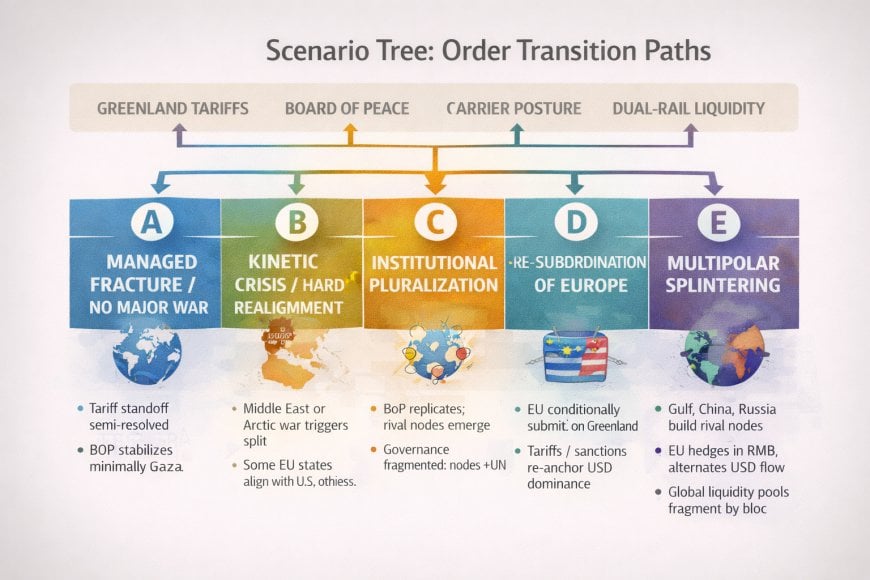
Scenario tree diagram with branches A–E, showing different paths for alliances, governance platforms, and liquidity rails.
Regardless of which branch dominates, the direction of travel is clear: alliances and monetary plumbing are no longer background constants. They are instruments being actively tuned, tested, and, in some cases, repurposed to coerce allies, manage conflicts as structured products, and route capital through new, capital-gated governance platforms.
Pattern Nexus Lens
At the control-system level, Greenland, the Board of Peace, carrier deployments, and synthetic liquidity are instances of the same pattern: the shift from soft consensus governance to hard, instrumented control loops that connect territory, capital, and force.
The Greenland tariffs test whether a hegemon can extract territorial concessions from allies using economic instruments, not just adversaries. The Board of Peace tests whether conflict governance can be consolidated into a small, capital-gated platform that sits above local sovereignty but outside traditional multilateral constraints. Elevated force posture creates a kinetic backstop for both experiments. Synthetic dollar rails provide the fluid that can move quickly through whichever corridors are opened.
In this lens, “order” is no longer a static set of rules. It is a live feedback system where:
- Territorial and resource nodes (Greenland, Gaza, Arctic, corridors) are targets and anchors.
- Governance nodes (UN, BoP, regional boards) are routers.
- Liquidity rails (swap lines, sanctions, stablecoins, tokenized Treasuries) are control channels.
- Force posture is the enforcement mechanism, visible even when unused.
The observable trend is away from one big, coherent, rules-based system and toward a mesh of overlapping control systems. Some will be U.S.-centric. Others will be regionally or financially defined. The question is not whether the old order survives. It is how much of it is absorbed into these new control loops, and how much spins off into parallel networks that no single actor fully controls.
Greenland, Gaza, and the liquidity rails are not separate stories. They are test cases in how far capital-gated governance, territorial coercion, and modular liquidity can be pushed before the old alliance and monetary scaffolding snaps, rearranges, or quietly forks into something new.
FAQ
Is this just about one U.S. president’s personality?
No. Individual leaders change style, tempo, and messaging, but the underlying machinery — sanctions tools, tariff levers, swap lines, carrier groups, and governance charters — predates any single administration. The structural pattern is that the system is increasingly comfortable using these instruments coercively inside the alliance network itself, not just against adversaries.
Does this automatically mean a major war is coming?
Structural stress and pre-crisis posture raise the probability of kinetic outcomes, but they do not guarantee them. Multiple branches exist: managed fracture, pluralized governance without open war, hard realignment after a crisis, or slow multipolar splintering. The danger is not just war; it is uncontrolled transition, where none of the emerging governance and liquidity systems are stable enough to absorb shocks cleanly.
What does this mean for markets and liquidity over the next cycle?
The main implication is fragmentation and optionality. Treasuries and the dollar are unlikely to lose primacy overnight, especially under stress. But more flows will run through parallel rails: stablecoins, tokenized RWAs, regional reconstruction platforms, and bespoke governance-linked vehicles like the Board of Peace. Liquidity will increasingly come with governance strings attached: which platforms a state or firm plugs into will determine not just funding costs but political obligations.
Sources
Selected public reporting and documents referenced or aligned with this analysis.
- UN Security Council Resolution 2803 text and related UN press releases
- White House / official announcements outlining the Board of Peace and Gaza plan
- Major outlet coverage of Greenland-linked U.S. tariff announcements on European allies
- European and NATO member reactions to Greenland tariffs and alliance strain
- Open-source tracking of U.S. carrier and force deployments
- Data and analysis on the growth of dollar stablecoins and tokenized Treasuries
Ano ang Iyong Reaksyon?
 Gusto
0
Gusto
0
 Hindi Gusto
0
Hindi Gusto
0
 Pag-ibig
0
Pag-ibig
0
 Nakakatawa
0
Nakakatawa
0
 Wow
0
Wow
0
 Malungkot
0
Malungkot
0
 Galit
0
Galit
0

Founder of Pattern Nexus. I research markets, macro, geopolitics, AI, history, ancient systems, and the patterns most people overlook. I’m also building Market Radar, a trading scanner designed to read pressure, risk, confirmation, and setup quality before chasing a move. Pattern Nexus is where I connect the dots between data, history, technology, and the bigger system playing out around us.







Mga Komento (0)