
The Silent Currency War: Containment, Collateral, and the 2030 Regime Window
The United States and China have entered a silent currency war layered on top of maritime containment, commodity dependencies, and financial plumbing. The next phase will determine whether the dollar system evolves, resets, or fragments into parallel rails.


The “currency war” is a collateral war first. Settlement power follows whoever controls the highest-grade collateral and the rails that rehypothecate it at scale.
Shadow blockades don’t start with a declared blockade. They start with insurance premiums, compliance choke points, and “nobody wants to touch that cargo.”
Stablecoins + tokenized T-bills are not “crypto.” They’re a new offshore dollar layer that runs 24/7, clears fast, and routes around bank friction.
If the U.S. keeps “containing China” while simultaneously exporting frontier chips under transactional rules, you’re watching policy become a market instrument.
The Premise: It Hasn’t Reverted
All of this keeps continuing. It hasn’t reverted. It hasn’t “normalized.” It hasn’t cooled off into some neat academic cycle where everyone pretends we’re back to 2016. We’re not. The posture stayed locked. The incentives stayed locked. The infrastructure build stayed locked.
So are we in an open currency war or a silent shadow war with China? Probably. We’re probably at that point. And if you think “currency war” means only the yuan fix or some FX headline, you’re already behind. The real war is over pipes: energy pipes, shipping pipes, data pipes, payment pipes, collateral pipes. Whoever controls the pipes controls the options.
Everything we do is about containing China. Contain China, contain China. That’s the pattern. You can call it “de-risking” if you want, but it walks like containment and talks like containment. It’s basing, access, and logistics. It’s sanctions and export controls. It’s chip sovereignty. It’s critical minerals. It’s “who gets to settle” and “who gets to insure” and “who gets to clear.”
The U.S.–China contest is not one thing. It is a stacked system of constraints. And once it becomes stacked, it rarely unwinds cleanly. It compounds until a reset, a mutation, or a fracture forces a new equilibrium.
The Two-Year Tape: 1/13/2024 → 1/13/2026
If you want “real-world facts,” you have to read the tape like a systems person, not like a headline consumer. The tape is not one dramatic event. It’s dozens of “small” moves that harden the environment: agreements, base access, export rules, counter-rules, sanctions routing, insurance repricing, and the slow build of parallel rails.
- January 2024: Taiwan election locks in continuity with a pro-sovereignty party winning again. That is not a trivial political event; it is a structural pressure event in the Taiwan Strait.
- March 2024: COFA funding is enacted and formalized across Micronesia / Marshall Islands / Palau. Those aren’t “tiny islands.” They’re strategic logistics, basing, and denial geography in the Pacific lattice.
- March 2024: South China Sea confrontations keep rising. Water cannons, collisions, and higher injury/damage risk at Second Thomas Shoal are escalation-by-friction.
- April 2024: The first U.S.–Japan–Philippines leaders summit happens. Commitments harden around maritime security and “ironclad” defense language. This is containment policy becoming trilateral infrastructure.
- May 2024: The U.S. hikes tariffs across Chinese strategic categories (EVs, batteries, chips, critical minerals). Even if some items were already constrained, the signal is political hardening.
- December 2024: BIS strengthens export controls on advanced semiconductor production. Entity list additions and tool restrictions broaden the containment perimeter.
- Late 2024 → January 2025: Outbound investment restrictions move from concept to enforceable rules, aiming at semiconductors, AI, and quantum. This is capital containment.
- Mid-2025: A stablecoin regulatory framework is signed into law (GENIUS Act). Whether you love it or hate it, it formalizes stablecoins as a sanctioned dollar-adjacent rail.
- 2025: China counters with export controls and leverage on key inputs (rare earth related items, magnets, battery chain materials) while the West accelerates diversification initiatives.
- 2024–2025: Red Sea disruption reroutes trade, increases costs, and proves how quickly insurance and risk premiums can rewrite global logistics.
- Late 2025: CIPS volumes continue to expand, RMB share remains small but persistent in SWIFT data, and mBridge is handed off from BIS to partner central banks. Parallel rails keep maturing.
- January 2026: We see the weird hybrid reality: containment logic remains, but transactional exceptions emerge (chip export approvals under conditions). Policy becomes a tradable parameter.
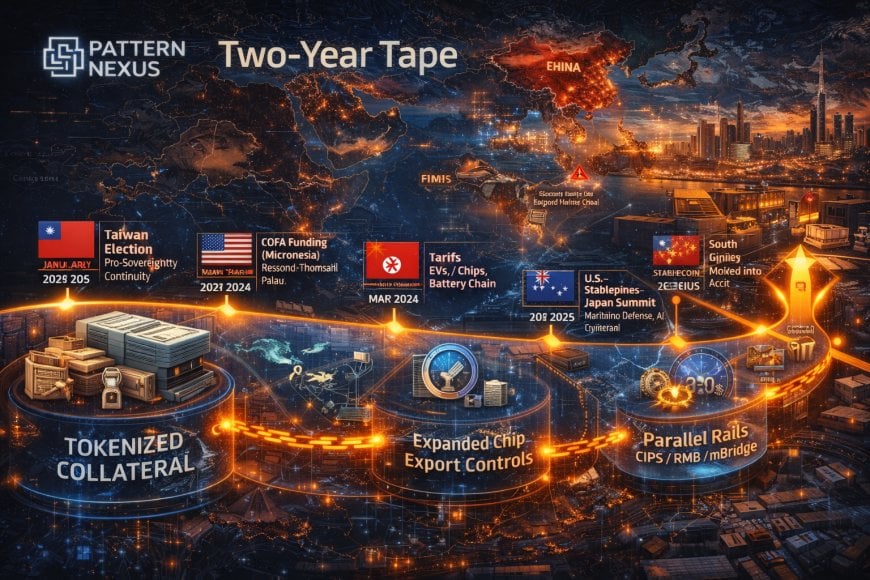
When the tape is mostly administrative, legal, and infrastructural, it’s easy to miss. But that’s exactly how durable regime shifts are built.
Containment Lattice: Archipelagos, Access, and ISR
This is where the “archipelagos you’ve never heard of” matter. The U.S. has poured money into Pacific access and freely associated states because geography is physics. You can’t negotiate with distance. You can only build around it.
COFA funding isn’t a charity program. It’s strategic permanence: economic assistance, infrastructure support, and long-duration commitment that keeps the U.S. anchored across crucial Pacific corridors. That matters for basing rights, denial strategy, radar coverage, maritime domain awareness, and logistics depth.
EDCA expansion in the Philippines is the same story: access points, airfields, ports, prepositioning, and the ability to operate forward without pretending you’re “building bases.” The map is the message.
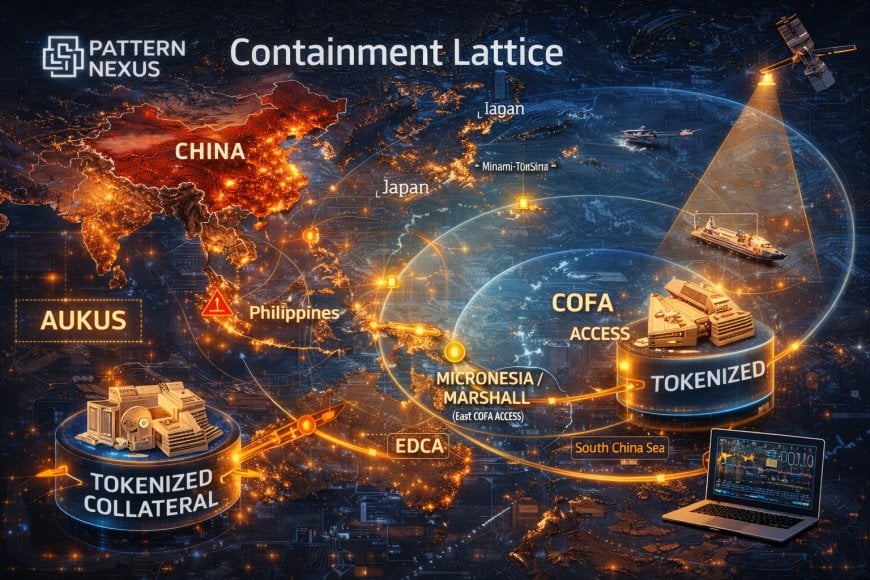
- COFA geography: logistics depth, denial geography, and strategic continuity.
- Philippines access: proximity to Taiwan and the South China Sea, and a forward lattice that compresses response time.
- Trilateral hardening: Japan–U.S.–Philippines coordination increases the cost of Chinese gray-zone escalation.
China’s Structural Exposure: Imports, Energy, and Time
China has leverage. Rare earth processing, manufacturing scale, industrial depth. But China is also an import-dependent machine for the stuff that keeps the machine alive: crude oil, LNG, iron ore, and huge volumes of food inputs. People talk about reserves like they’re infinite. They’re not. In a real stress scenario, reserves are time. And time is what you run out of.
China’s crude import dependence is the cleanest illustration. China is the world’s largest crude importer. It imported roughly 11.1 million barrels per day in 2024, about 74% of apparent consumption by some estimates. That’s not a weakness in normal times. It becomes a weakness when the sea lanes become a bargaining chip.
Now add the Iran layer. In 2025, China was buying the majority of Iran’s shipped crude, and those flows move through a sanctions-and-routing gray zone. That is a perfect example of how energy dependence intersects with U.S. financial enforcement: sanctions pressure isn’t abstract, it’s literally priced into the barrel.
Rare earths are leverage. Oil is survival. Food is survival. Shipping is survival. If you can’t keep the inflows moving, you can’t keep the industrial machine stable under stress.
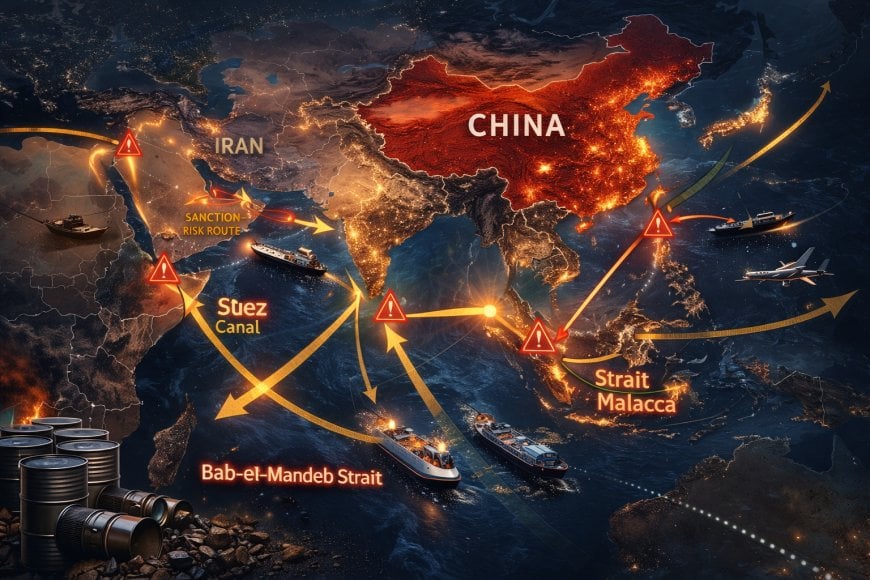
- Exposure: the sea is not optional if your economy is built on imported energy and raw materials.
- Constraint: chokepoints concentrate risk into a few lanes and a few insurance decisions.
- Leverage: containment isn’t always about stopping flows; it’s often about pricing flows until they become economically or politically intolerable.
Shadow Blockade Mechanics: Insurance, Compliance, and Risk Premiums
This is the part most people don’t understand. You don’t need a declared blockade to get blockade effects. You need risk repricing. You need insurance premiums to spike. You need “this cargo isn’t worth it.”
Watch what happens in real time when risk changes: insurers re-rate routes, shipping companies reroute, transit times stretch, freight rates move, and suddenly the world is paying a tax to move physical reality through a narrow geographic corridor. That’s not theory. We just watched the global system reroute around chokepoints when the Red Sea was unstable. And when stability returns, the system slowly reintroduces the route because the economics are better. This is exactly how a shadow blockade looks: it’s a price signal enforced by security conditions.
Now translate that concept to a major-power conflict. You don’t have to “stop” Chinese shipping outright to create strategic pain. You can layer uncertainty into the system and let insurers and compliance teams do the work. That’s why I call it a shadow war. It’s the war of permission.
Step 1: risk premiums rise. Step 2: insurers restrict coverage. Step 3: shippers reroute or stop. Step 4: scarcity appears. Step 5: political pressure follows. You never needed an official blockade announcement.
- Insurance is a weapon: it is permission encoded as price.
- Compliance is a choke point: sanctions and screening become friction.
- Rerouting is an economic tax: time, fuel, and capital are consumed in transit.
Tech Containment: Chips, Outbound Capital, and AI Gravity
The chip war is not about consumer electronics. It’s about who gets to build frontier compute, train frontier models, and deploy military-grade AI at scale. That’s why the U.S. keeps tightening export controls on advanced semiconductors and the tools needed to produce them. It’s why entity lists expand. It’s why the control perimeter moves from “chips” to “equipment” to “HBM” to “advanced packaging.” The target is not one product. The target is the ability to replicate the entire stack.
Then the policy evolved again: outbound investment restrictions. This is the U.S. saying “we’re not just restricting what you can buy, we’re restricting what we will finance.” That is capital containment. It’s CFIUS logic pushed outward.
And here’s the modern twist: policy becomes transactional. When you see frontier chip exports being approved under specific conditions, caps, and fees, you’re watching national security rules being turned into a controllable valve. That does not mean containment ended. It means containment became a dial with politics attached.
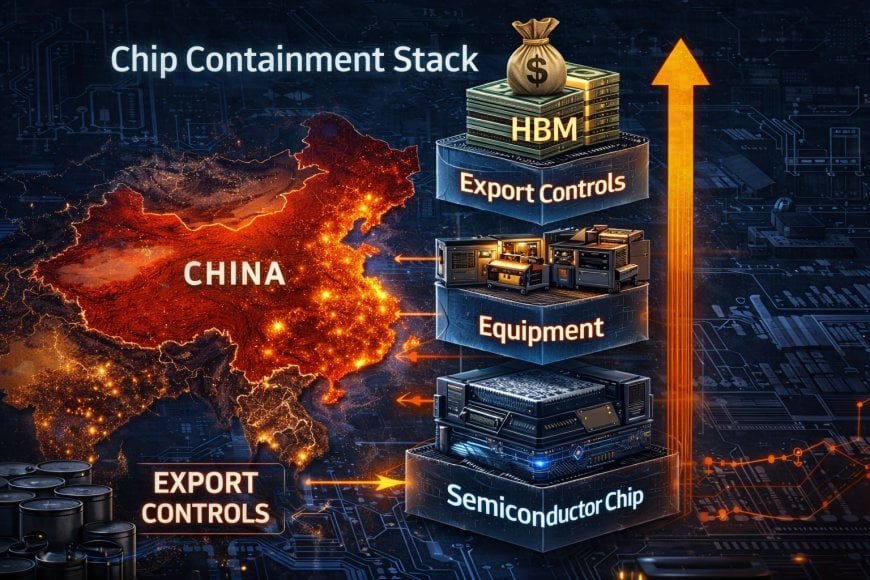
- Export controls: slow China’s frontier compute, especially for AI and military-civil fusion targets.
- Outbound investment: reduce U.S. capital fueling China’s sensitive tech sectors.
- Transactionization: policy becomes a valve, not a wall, which creates new incentives and new enforcement risk.
Commodity War: Rare Earths, Graphite, Battery Inputs
Now zoom into the materials layer. This is where people say “China controls rare earths,” and they’re not wrong, but they don’t go far enough. The real leverage isn’t just raw extraction. It’s processing. It’s magnets. It’s intermediate materials. It’s the stuff that sits between the mine and the missile, between the ore and the drone, between the chemistry and the factory.
Over the last two years we’ve watched a step-by-step pattern: the U.S. tightens tech controls, China counters with material controls. The U.S. raises tariffs and hardens supply chains, China signals it can squeeze the inputs. That is exactly what a modern industrial war looks like: not an embargo on “everything,” but pressure on the specific components that break your production schedule.
Graphite, gallium, germanium, antimony, medium and heavy rare earth related items, magnets, battery materials. These are not niche. They are the real economy’s critical path items.
And then the West reacts: G7 finance ministers and partners explicitly discussing ways to reduce dependence on Chinese rare earths. That tells you the concern is no longer theoretical. It’s policy-level.
It means you can’t surge production of key military and energy transition components without permission from a rival. That is strategic leverage encoded in supply chains.
Extreme Plumbing: Eurodollars, Repo, Sanctions, Collateral
This is where the article stops being “geopolitics” and becomes “how the world actually runs.” The global system is not run by banknotes. It is run by secured funding, collateral chains, and settlement permissions.
The eurodollar system was the original offshore dollar machine: global banks creating dollar liabilities outside U.S. borders, using U.S. markets, U.S. collateral, and U.S. legal credibility as the base layer. Over time, the “dollar” became less a currency and more a settlement domain: access to correspondent banking, clearing, and the ability to rehypothecate high-grade collateral.
Then sanctions fused into the plumbing. Post-9/11 sanctions logic matured into a weaponized compliance stack. If you can deny a bank’s access, you can deny a country’s access. You don’t have to invade to constrain. You can just remove permission.
Now add the modern collateral reality: Treasuries are the world’s primary “acceptable” collateral. Repo is how the system breathes. If collateral gets scarce or politically constrained, the system tightens. If collateral gets abundant or is refactored into new rails, the system loosens.
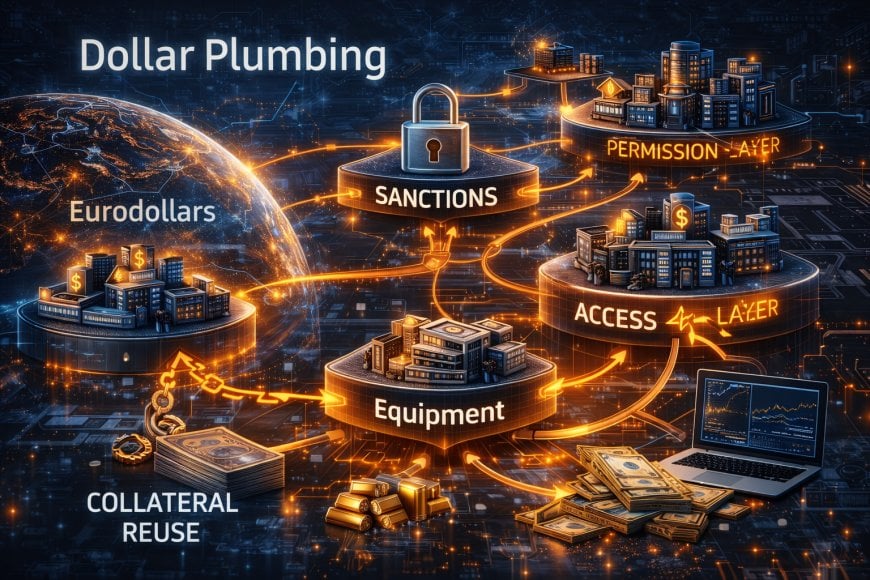
Modern “money” is a network of collateralized promises. If you control the collateral and the network’s permission gates, you control the regime.
- Eurodollar logic: offshore dollar liabilities built on U.S. credibility and collateral.
- Repo logic: secured funding and collateral reuse are the system’s oxygen.
- Sanctions logic: permission and access become strategic weapons.
- Containment logic: chips and capital are contained the same way money is contained: by denying critical inputs and routes.
New Rails: Stablecoins, Tokenized Treasuries, and Regulatory Lock-In
Now we get to the part that most people still refuse to treat seriously: stablecoins and tokenized Treasuries are becoming a new offshore dollar layer. Not someday. Now.
As of early January 2026, stablecoins sit around the low-$300B range in market cap depending on the day. That’s not a rounding error anymore. It’s a liquidity instrument with global distribution, 24/7 settlement, and real adoption in cross-border flows, crypto markets, and increasingly, traditional finance interfaces.
Then tokenized T-bills show up and the rails get real. Tokenized U.S. Treasury products push into the high single-digit billions and keep expanding. This is what happens when you take the world’s preferred collateral and you make it programmable, portable, and compatible with a new settlement layer.
The regulatory layer matters. When stablecoin regulation becomes law, the U.S. isn’t “allowing crypto.” It’s formalizing a dollar-adjacent rail that can extend U.S. monetary influence through new channels. It is a strategic choice even if the public debate is framed as consumer protection. This is how regimes mutate without admitting they’re mutating.
Here’s the real punchline: stablecoins are not just a crypto thing. They are a treasury-collateral distribution mechanism. They can become a parallel deposit base outside banks. They can route around frictions. They can accelerate velocity in specific channels while the legacy system is still constrained.
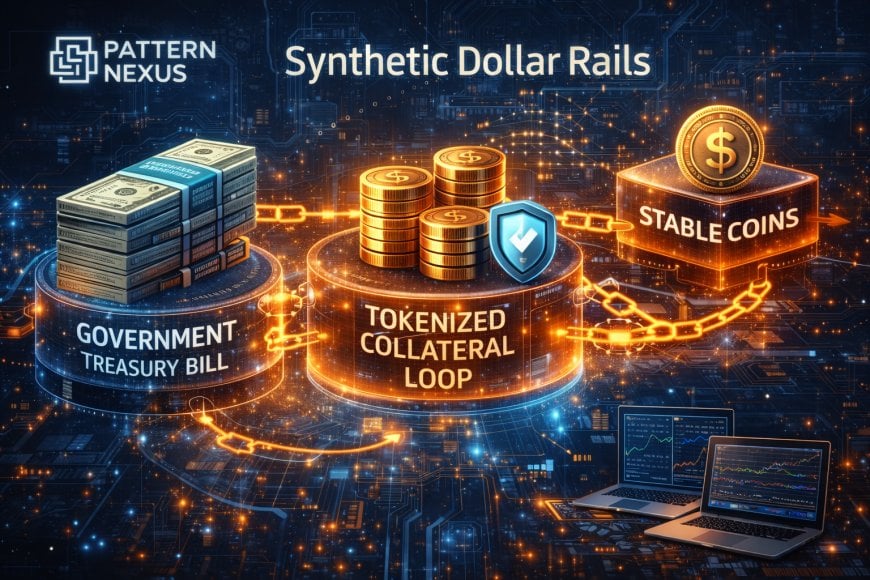
- Stablecoins: digital dollar claims, increasingly tied to Treasury collateral and regulated frameworks.
- Tokenized T-bills: programmable high-grade collateral; usable as settlement and collateral primitives.
- Regulatory lock-in: policy shifts from “ban/allow” to “formalize and steer.”
- System effect: dollar regime extension through rail refactoring, not through currency replacement.
Parallel Rails: RMB Share, CIPS Growth, mBridge Handoff
China isn’t sitting still. It’s building parallel rails. The RMB share of global payments remains modest, but it persists and it grows in pockets. CIPS volumes have expanded materially over time, and official reporting continues to show meaningful throughput. That is not “the dollar is dead.” It is “parallel capacity is being built.”
mBridge is another signal. It reached a minimum viable product stage and was handed off from BIS involvement to partner central banks. That is exactly what a parallel rail looks like in its early stage: not ready to replace the old system, but ready to exist alongside it, especially in corridors where participants want more control and less exposure to sanctions risk.
Notice the pattern: The U.S. system is permissioned through banks and compliance. China’s alternative systems are permissioned through state alignment and corridor participation. Neither model is “free.” Both models are control systems.
They only need to exist as an option. Options change bargaining power. Options change risk pricing. Options change the regime over time.
- SWIFT share: RMB remains a smaller slice by value but entrenches in specific flows.
- CIPS: throughput growth is a measurable indicator of parallel settlement capacity.
- mBridge: cross-border CBDC experimentation moving from pilot to partner-owned infrastructure.
Platform Control: Ports, Cables, Satellites, and Data as Power
Containment is not only ships and missiles. It is platforms. Ports. Undersea cables. Satellite coverage. Cloud compute. Standards. Identity systems. Payment rails. The modern world is governed by infrastructure that enforces outcomes automatically.
This is why chip control matters. Compute is now a strategic resource. If you restrict compute, you restrict model training, autonomy development, and industrial optimization. If you restrict the tools to manufacture compute, you restrict the future, not the present.
This is also why islands matter. The Pacific lattice is not just “bases.” It is denial geography and sensor geography. It is the ability to see, track, and shape movement through corridors that matter to China’s survival math.
And this is why tokenization matters. When collateral becomes portable and programmable, the financial layer becomes a platform too. Control shifts to whoever can enforce standards and custody at scale.
Scenario Modeling: Soft Mutation vs Hard Reset vs Bifurcation
This is where we stop pretending the future is one clean path. There are multiple plausible paths, and the path is determined by which constraints break first.
Scenario A: Soft Mutation (Dollar Regime Extends Through New Rails)
The dollar doesn’t “lose.” It refactors. Stablecoins become a regulated global settlement layer. Tokenized T-bills become a mainstream collateral primitive. Major asset managers expand tokenized money funds. Banks integrate token rails. The U.S. retains monetary dominance by upgrading the plumbing faster than rivals can replace it.
- Trigger set: regulatory clarity + tokenized collateral adoption + controlled risk management
- Mechanism: rail upgrade without currency replacement
- Result: the dollar system looks different, but remains dominant
Scenario B: Hard Reset (Crisis Forces a Monetary Re-Architecture)
A shock hits the system: war escalation, severe commodity disruption, sanctions blowback, or a collateral liquidity event. Settlement fractures. Confidence breaks somewhere. Emergency measures follow. The reset happens not because anyone wants it, but because the system can’t maintain the old configuration under stress.
- Trigger set: major kinetic event, severe chokepoint shock, collateral squeeze, or sanction cascade
- Mechanism: forced repricing of risk and forced redesign of settlement architecture
- Result: new rules, new institutions, new constraints
Scenario C: Bifurcation (Parallel Systems Become Semi-Closed Blocs)
Rather than one system winning, the world splits into interoperable-but-hostile rails. The West routes through dollar/stablecoin/tokenized Treasury infrastructure. China and aligned corridors route through RMB/CIPS/mBridge-like networks. Trade still happens, but it happens through politically filtered channels. The global system becomes an access-control system.
- Trigger set: sustained sanctions arms race + export control escalation + corridor alignment
- Mechanism: permissioned settlement blocs
- Result: lower efficiency, higher friction, higher security premium
Scenario D: Accident Path (The War Starts by Miscalculation)
The most dangerous scenario is not the one people plan. It’s the one that emerges from repeated gray-zone friction: South China Sea incidents, Taiwan Strait brinkmanship, insurance shocks, cyber escalations, tit-for-tat seizures, and a single misread that cascades into kinetic action.
- Trigger set: friction accumulation + high tempo + narrative lock-in
- Mechanism: escalation ladder activated by one event
- Result: rapid repricing of everything, especially energy and shipping
The 2030 window is where these paths converge: currency-cycle maturity, tech and commodity constraint maturity, and rail mutation maturity. It’s not a date. It’s a regime zone.
What to Watch: Indicators That Tell You the Phase
If you want to know whether we’re drifting, mutating, or breaking, you watch the indicators that reflect pipe control.
- Stablecoin market cap and composition: growth rate, concentration, reserve quality, and regulatory alignment.
- Tokenized Treasury value: growth in on-chain T-bills and money-market tokens; integration into collateral systems.
- Export control trajectory: whether restrictions expand to new categories (HBM, packaging, tools) and whether exceptions become transactional.
- Outbound investment enforcement: actual compliance actions, carve-outs, and expansions.
- Rare earth and battery material policy: new control lists, licensing intensity, and retaliation cycles.
- Shipping insurance repricing: persistent war-risk premiums at chokepoints and corridor rerouting.
- CIPS throughput and participant growth: parallel settlement capacity.
- RMB share of payments: not “to replace,” but to measure persistence and corridor capture.
- South China Sea incident tempo: collision frequency, injury events, and political signaling.
- Pacific basing and access expansion: construction, funding, and operational integration.
When “policy” starts behaving like a market instrument, you are in a different regime. That is when the mutation phase accelerates.
Pattern Nexus Lens
This is an Age of Control Systems problem. Not an “economics” problem. Not a “politics” problem. A control-systems problem.
The U.S. is trying to contain China by controlling the constraint stack: forward access, chokepoints, chip sovereignty, outbound capital, and settlement permission. China is trying to survive containment by building options: critical mineral leverage, parallel settlement rails, corridor alignment, and domestic substitution.
Both sides are building systems that enforce outcomes automatically. That’s why it doesn’t revert. Once you build enforcement into infrastructure, unwinding requires dismantling physical and legal architecture, not just changing rhetoric.
If the pipes shift faster than institutions can adapt, volatility becomes structural. That’s the regime. Not an anomaly.
FAQ
Are we actually in a “currency war” right now?
Yes, but it’s not mostly FX. It’s settlement permission, collateral access, and the ability to move value under sanctions and stress.
Why do you keep saying “it hasn’t reverted”?
Because the evidence is infrastructural. Base access expands. Export controls harden. Material controls retaliate. Parallel rails mature. That’s not reversion behavior.
What makes China vulnerable in a conflict scenario?
Import dependence under chokepoint risk. Oil, LNG, iron ore, and food flows are survival math, not optional inputs.
What makes the U.S. vulnerable?
Overuse of sanctions can accelerate parallel rail adoption, and transactional exceptions can undermine the credibility of the control regime if enforcement can’t match policy intent.
Why do rare earths matter so much?
Because the leverage is in processing, magnets, and intermediate products that sit in the critical path of modern industry and defense systems.
How do stablecoins fit into geopolitics?
They function as a new offshore dollar distribution rail, often backed by Treasuries, operating outside traditional bank rails and increasingly within regulated frameworks.
Is stablecoin size “big enough” to matter?
Yes. At the low-$300B scale, it is already a meaningful liquidity instrument. More importantly, it is a rail with compounding adoption dynamics.
What is tokenized Treasury growth actually telling us?
It’s telling you the market wants portable, programmable, high-grade collateral. That is a direct signal about where the system is migrating.
Does CIPS replace SWIFT?
No. Not globally. But it doesn’t need to. It needs to grow enough to create options in specific corridors, which changes bargaining power.
What does mBridge matter if BIS stepped back?
Because it signals partner-owned development of a cross-border settlement option. The handoff is maturation, not disappearance.
What is the most likely path: soft mutation, hard reset, or bifurcation?
Base case is soft mutation with pockets of bifurcation. Hard reset risk rises sharply if a major chokepoint shock or Taiwan/sea-lane incident forces rapid repricing.
What’s the single biggest tell that we’ve entered the next phase?
When insurance and compliance start shutting corridors quietly and persistently, and when tokenized collateral becomes mainstream collateral, not an experiment.
Sources
These sources support the two-year timeline, basing and access posture, chip and outbound investment controls, critical mineral counter-controls, stablecoin and tokenized Treasury growth, and the parallel-rail development context.
- U.S. DOI: COFA funding packages (Mar 11, 2024)
- U.S. State Dept: Enactment of Compact-related legislation (Mar 9, 2024)
- INDOPACOM: Locations of four new EDCA sites (Apr 3, 2023 reference for EDCA nodes)
- U.S. State Dept: Bilateral Strategic Dialogue statement (Apr 24, 2024)
- Reuters: South China Sea water cannon incident (Mar 23, 2024)
- CSIS AMTI: Shifting tactics at Second Thomas Shoal (Aug 22, 2024)
- Reuters: U.S.–Japan–Philippines summit focus (Apr 10, 2024)
- Japan MOFA: Japan–U.S.–Philippines Summit summary (Apr 11, 2024)
- Reuters: U.S. tariff hikes on Chinese strategic imports (May 14, 2024)
- BIS: Strengthened export controls on advanced semiconductors (Dec 2, 2024)
- Federal Register: Advanced computing/FDPR refinements (Dec 5, 2024)
- U.S. Treasury: Outbound Investment Security Program overview (Final rule Oct 28, 2024; effective Jan 2, 2025)
- BIS: mBridge reaches MVP stage (Jun 5, 2024)
- Reuters: BIS leaves mBridge project (Oct 31, 2024)
- SWIFT RMB Tracker: RMB share of global payments (July 2025 report)
- FXC Intelligence: CIPS growth and volumes (Jul 4, 2025)
- PBoC: Payment System Report PDF (CIPS metrics; Jan 2026 publication)
- MOFCOM: Export control on medium/heavy rare earth related items (Announcement No.18 of 2025)
- Reuters: China tightens rare earth export controls (Oct 2025)
- Reuters: China suspends ban on key materials to U.S. (Nov 9, 2025)
- Reuters: G7 partners discuss reducing dependence on Chinese rare earths (Jan 12, 2026)
- Reuters: China rare earth exports and restrictions context (Jan 14, 2026)
- Reuters: China reliance on Iranian oil flows (Jan 13, 2026)
- Columbia SIPA: China oil demand, imports, and supply security (2024 import share context)
- U.S. EIA: China energy analysis (imports and trends)
- DeFiLlama: Stablecoins market cap dashboard (Jan 2026 context)
- CoinDesk: Stablecoin market composition and growth (Jan 6, 2026)
- Tether: Transparency / reserves reporting portal
- RWA.xyz: Tokenized U.S. Treasuries dashboard (market size)
- Franklin Templeton: Franklin OnChain U.S. Government Money Fund (FOBXX)
- Fortune: BlackRock BUIDL tokenized money market fund context (Nov 14, 2025)
- White House: Fact sheet on GENIUS Act signed into law (Jul 18, 2025)
- Congress.gov: GENIUS Act text (Public Law 119-27, Jul 18, 2025)
- Reuters: U.S. approves Nvidia H200 exports under conditions (Jan 13, 2026)
- Reuters: Red Sea transit resumption and chokepoint trade share context (Jan 12, 2026)
你的反应是什么?
 喜欢
0
喜欢
0
 不喜欢
0
不喜欢
0
 爱
0
爱
0
 有趣
0
有趣
0
 哇
0
哇
0
 悲伤
0
悲伤
0
 愤怒
0
愤怒
0

Founder of Pattern Nexus. I research markets, macro, geopolitics, AI, history, ancient systems, and the patterns most people overlook. I’m also building Market Radar, a trading scanner designed to read pressure, risk, confirmation, and setup quality before chasing a move. Pattern Nexus is where I connect the dots between data, history, technology, and the bigger system playing out around us.














评论s (0)