
The 10-Year Decoupling: Why Long Rates No Longer Follow Cuts
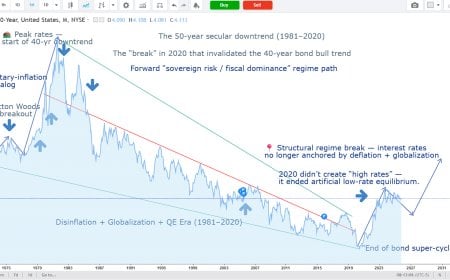
The U.S. 10-year Treasury is no longer responding to policy rate cuts. This article explains the structural decoupling between front-end easing and long-end yields, why this regime persists for months to years, and what conditions eventually force balance sheet expansion.
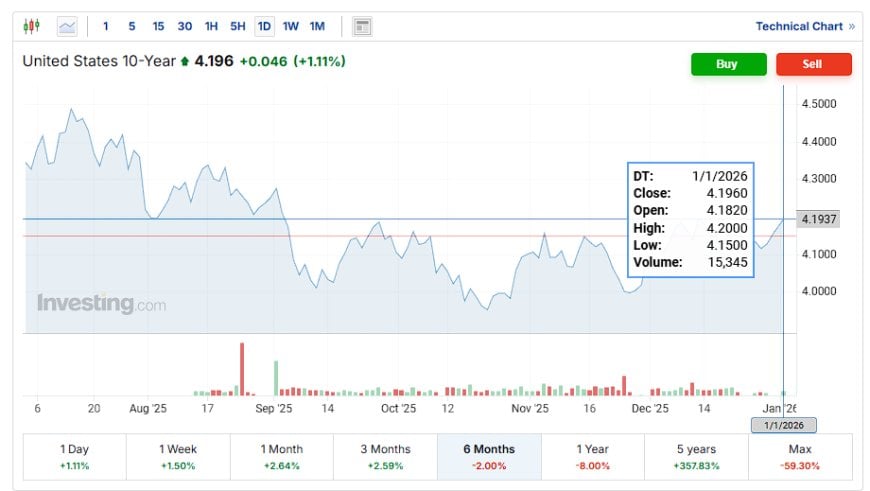
Cuts can relieve the front end while the long end stays anchored. That is not a mystery. It is the regime.
The Signal
The most important rates signal in this cycle is not the pace of cuts. It is the repeated failure of the 10-year to follow them.
Markets still behave as if the policy path should “pull the curve.” That belief is legacy-cycle thinking. In this regime, cuts can occur and the long end can remain anchored for months to years because the long end is no longer primarily pricing the policy path. It is pricing constraints.
Key Takeaway
The 10-year is not “disobeying” cuts. It is pricing the system’s ability to absorb duration under sustained sovereign supply, limited balance-sheet capacity, and a marginal-buyer world that is no longer automatic.
Regime Definition
This is the decoupling regime.
Definition: A sustained period where front-end easing reduces short-rate pressure but does not compress the long end because long yields are governed by duration absorption capacity, term premium persistence, and fiscal/issuance dominance rather than by the expected short-rate path.
Operating rules in this regime:
- Cuts can reduce front-end stress without producing a parallel long-end rally
- Long yields can remain range-bound even as the market “prices more cuts”
- Curve behavior becomes about clearing mechanisms, not central-bank signaling
- Macro commentary that treats every cut as long-end bullish becomes systematically wrong
What No Longer Applies
The old shortcut: “Cuts = lower 10-year.” That only works when duration is scarce, balance sheets are elastic, and the marginal buyer is structural. Those conditions are not the base state now.
Framework Map: What the 10-Year Prices Now
In Pattern Nexus terms, the 10-year is now a composite price of four layers. If you don’t model the layers, you misread the market.
The 10-Year Composite (PN Map)
- Layer 1: Duration Supply — how much long paper must clear, net of any offsets, over a rolling window
- Layer 2: Absorption Capacity — who can hold it, under what balance-sheet constraints, and at what funding cost
- Layer 3: Term Premium — the compensation required for long-horizon uncertainty, persistence, and policy/fiscal credibility
- Layer 4: Risk Transmission — how long rates feed into credit, housing, equities, and political tolerance
Policy cuts mainly affect the front end. They do not automatically reduce duration supply, do not automatically expand absorption capacity, and do not automatically erase term premium. That’s the entire story.
Why Cuts Fail to Transmit
Transmission fails when the variable being adjusted is not the binding constraint.
In the decoupling regime, the binding constraints are not “the price of overnight money.” They are the mechanics of clearing long paper without destabilizing the system.
Cuts change:
- front-end carry
- short-rate expectations
- some refinancing margins
Cuts do not change, by themselves:
- net duration that must be absorbed
- dealer balance-sheet limits
- structural foreign demand
- the required term premium for long-horizon uncertainty
Translation
You can ease the front end while the long end remains anchored because the long end is clearing a different problem.
Duration Supply: The Anchor
Long rates anchor when duration supply is persistent and non-negotiable on the timeline markets care about.
Think in rolling windows, not headlines. The market is continuously clearing the next several quarters of duration supply. If that clearing requirement stays heavy, the long end must price in the clearing concession regardless of whether the policy rate is drifting lower.
This is why “cuts are coming” can coexist with “10-year won’t drop.”
Because cuts do not retire duration.
They do not reduce the debt stock.
They do not automatically reduce the required term premium for holding the long end.
PN Principle
In a supply-dominant regime, the long end trades like a clearing instrument. It is less a policy barometer and more a supply-absorption price.
The Marginal Buyer Problem
When markets say “who is going to buy all this,” that’s not a meme. That is the central variable of the regime.
The 10-year is ultimately priced at the margin, by the buyer who must be induced to hold duration when the natural, structural buyers are either saturated, price-sensitive, or intermittent.
In prior eras, the marginal buyer was often reliable.
In this regime, the marginal buyer is conditional.
Conditional buyers require concession. Concession is long yield.
This is also why the 10-year can stay stubborn even when data softens or cuts arrive. It is not ignoring macro. It is demanding clearing compensation.
Why This Lasts Months to Years
The decoupling regime persists because the drivers resolve slowly.
Markets are trained to expect rapid feedback loops: cut → rally → easing of financial conditions → recovery.
But duration-clearing regimes run on slower clocks:
- issuance schedules operate quarterly and annually
- balance-sheet capacity changes via regulation, capital, and risk appetite over long horizons
- foreign reserve behavior shifts gradually and often reverses only after new geopolitical or policy equilibria
- term premium is sticky because uncertainty is sticky
This is why you can be “right for a long time” watching the 10-year behave the way you expected while the market keeps calling for the old transmission model to reappear.
The old model is not delayed. It is displaced.
What Actually Changes the Regime
The regime changes when one of the binding constraints changes meaningfully.
There are only a few true regime-breakers:
Regime Breakers
- Duration Supply Relief — a sustained shift in issuance composition or net duration pace that reduces clearing pressure over multiple quarters
- Absorption Capacity Expansion — balance-sheet capacity increases materially, allowing intermediaries and structural holders to take more duration without stress
- Term Premium Compression — credibility and long-horizon uncertainty compress enough that the market stops demanding persistent concession
- Cross-Asset Stress Feedback — long-end anchoring transmits stress into credit/housing/equities enough to force a different clearing outcome
Notice what is not on the list: “a cut.”
A cut can help. A cut can be a component. A cut can change near-term carry and some risk appetite.
But a cut is not a regime-breaker unless it materially changes supply, capacity, or term premium.
That is the entire decoupling thesis.
Pattern Nexus Lens
The 10-year is no longer a follower of the policy narrative. It is a governor on the system.
In the decoupling regime, the long end prices the clearing problem: duration supply meets finite absorption capacity under persistent term premium.
This is why long yields can stay anchored through months and even years of easing expectations.
Most market participants are still trading the old cycle.
This is a different machine.
One-Line Summary
The front end can move with cuts. The long end moves only when the system’s clearing constraints change.
FAQ
Does this mean cuts “don’t matter” at all?
Cuts matter for front-end conditions, near-term carry, and pockets of refinancing. The point is that cuts do not automatically resolve long-end clearing constraints.
Why didn’t this happen in older cycles?
Because the structural backdrop was different: lower relative issuance pressure, more elastic balance sheets, and more reliable structural duration demand.
What’s the biggest mistake people make reading the 10-year right now?
They treat it like a clean expectation instrument. In this regime, it is a constraint-clearing instrument.
What should I watch to confirm the regime is still active?
Watch whether long yields stay anchored even as short-rate expectations move. If the 10-year refuses to follow repeated easing reprices, the regime is active.
Sources
你的反应是什么?
 喜欢
0
喜欢
0
 不喜欢
0
不喜欢
0
 爱
0
爱
0
 有趣
0
有趣
0
 哇
0
哇
0
 悲伤
0
悲伤
0
 愤怒
0
愤怒
0

Founder of Pattern Nexus. I research markets, macro, geopolitics, AI, history, ancient systems, and the patterns most people overlook. I’m also building Market Radar, a trading scanner designed to read pressure, risk, confirmation, and setup quality before chasing a move. Pattern Nexus is where I connect the dots between data, history, technology, and the bigger system playing out around us.















评论s (0)