
Trump Signs Sweeping AI Executive Order: Federal Preemption, State Law Crackdown, and the New AI Power Stack
President Trump signs a sweeping AI Executive Order targeting state-level regulation, creating DOJ litigation mechanisms, conditioning federal funding, and setting the stage for a unified national AI framework. Pattern Nexus breaks down what it actually does—and why it matters.
Published: December 11, 2025
By: Pattern Nexus
President Trump’s newly signed AI Executive Order is not a regulatory framework in the traditional sense. It is a consolidation maneuver. By combining litigation threats, funding leverage, and agency coordination, the administration is actively dismantling state-level AI governance and laying the groundwork for centralized federal control over artificial intelligence.
Executive Summary
On December 11, 2025, President Trump signed an Executive Order titled Ensuring a National Policy Framework for Artificial Intelligence. The order is designed to aggressively counter state-level AI regulations by invoking federal preemption, constitutional arguments, and funding leverage.
Rather than regulating AI directly, the order reshapes the battlefield. It deputizes federal agencies to pressure, punish, and litigate states that attempt to impose independent AI governance regimes.
The result is a de facto nationalization of AI oversight—without passing a single line of congressional legislation.
Why This Order Exists
Over the last two years, states such as California, New York, Illinois, and Colorado have advanced AI laws covering bias, disclosures, training data, content moderation, and algorithmic accountability. While framed as consumer protection, these laws introduced conflicting compliance standards for AI developers operating across state lines.
The administration’s position is that AI, like telecommunications and finance before it, now operates at a scale where fragmented governance creates systemic risk.
The Executive Order explicitly frames state AI regulation as:
- An impediment to interstate commerce
- A constitutional risk to speech and expression
- A strategic vulnerability in the global AI race
This framing is critical. It places AI squarely within the federal government’s traditional consolidation playbook.
The Enforcement Architecture
DOJ: Litigation as Deterrence
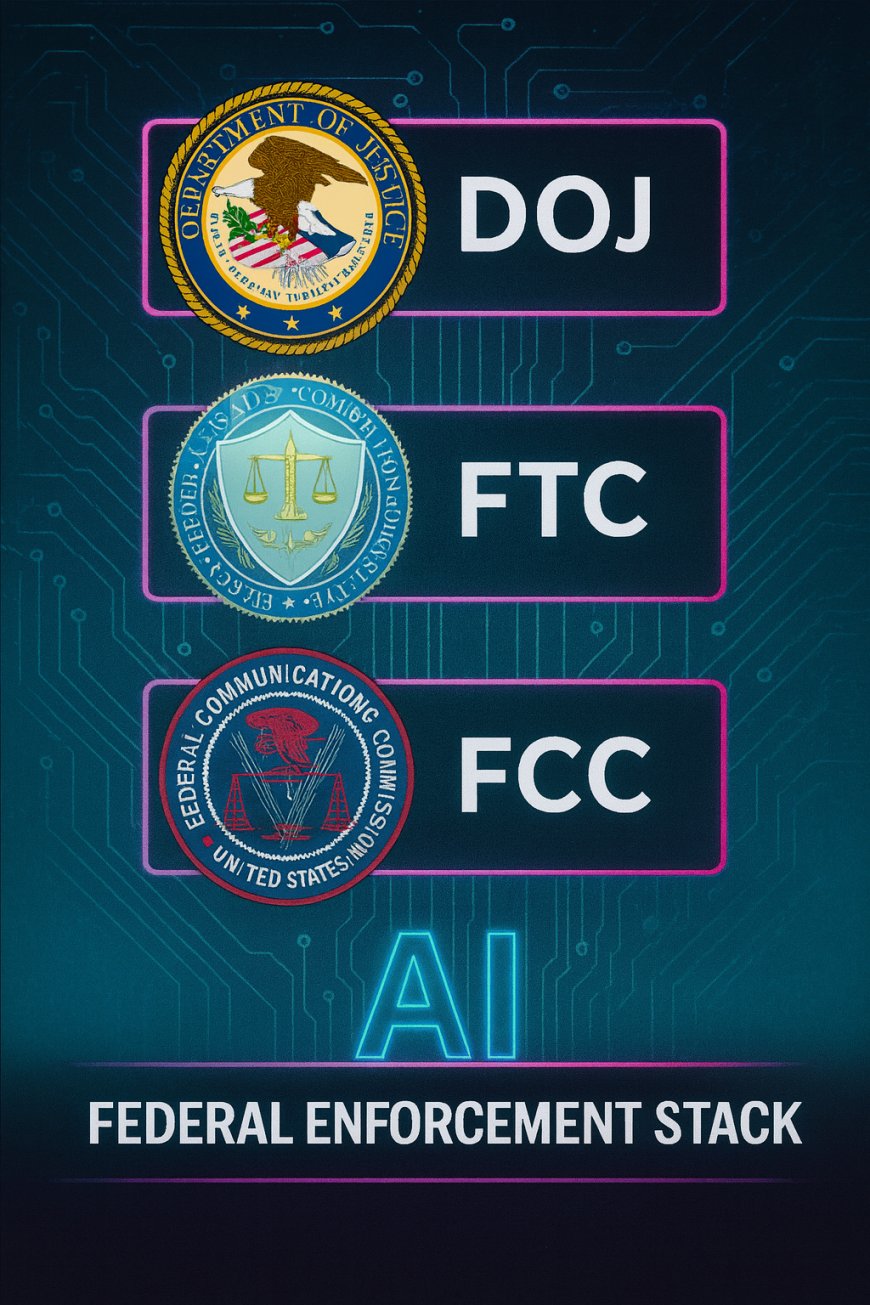
The order requires the Attorney General to establish an AI Litigation Task Force within 30 days. This unit’s sole function is to challenge state AI laws deemed incompatible with federal policy.
The order explicitly encourages the use of:
- Commerce Clause arguments
- Federal preemption doctrine
- First Amendment challenges
This is not reactive enforcement. It is proactive deterrence. The intent is to make state legislatures reconsider AI laws before they are even enforced.
Commerce: Regulatory Blacklisting
The Department of Commerce is tasked with publishing an evaluation of “onerous” state AI laws within 90 days. Once identified, these laws are effectively placed on a federal watchlist and referred to DOJ.
Importantly, the order defines “onerous” broadly—capturing laws that require AI systems to alter truthful outputs or impose disclosure regimes that conflict with federal constitutional interpretations.
Financial Coercion as Policy
Perhaps the most consequential component of the order is its use of federal funding as an enforcement weapon.
Commerce is directed to issue a policy notice tying eligibility for certain non-deployment BEAD broadband funds to AI regulatory compliance. States identified as maintaining conflicting AI laws may lose access to discretionary funding streams.
Separately, all federal agencies are instructed to review grant programs and condition awards on states agreeing not to enforce conflicting AI laws during the grant period.
This mirrors historical federal strategies used in highway funding, education standards, and environmental policy. Compliance is technically voluntary. In practice, it is not.
AI, Speech, and Output Control
A central theme of the Executive Order is opposition to state laws that require AI systems to modify or suppress truthful outputs.
The administration frames these mandates as compelled speech and, in some cases, as forced deception. The FTC is instructed to issue a policy statement clarifying when such requirements violate the FTC Act’s prohibition on unfair or deceptive practices.
This reclassification is strategic. It shifts the legal framing from “consumer protection” to “consumer harm.”
In parallel, the FCC is directed to explore a federal AI reporting and disclosure standard that would override state-level disclosure mandates, further centralizing control.
Operational Timeline
- 30 days: DOJ AI Litigation Task Force established
- 90 days: Commerce publishes list of onerous AI laws
- 90 days: BEAD funding policy notice issued
- 90 days: FTC policy statement released
- Post-evaluation: FCC initiates federal AI disclosure proceedings
The Pattern Nexus Lens
This order follows a recurring Pattern Nexus rule: when a system becomes infrastructure, governance consolidates.
AI is no longer a novelty layer. It is compute-intensive, energy-intensive, capital-intensive, and geopolitically sensitive. Systems at this scale do not remain locally regulated for long.
What makes this order notable is its sequencing. Rather than waiting for Congress, the administration is clearing the regulatory landscape first—neutralizing state resistance before a national framework is even proposed.
This mirrors earlier transitions in railroads, telecom, banking, and energy grids. Fragmentation gives way to federal control not through debate, but through enforcement reality.
Notably, the order avoids restricting compute infrastructure, data centers, or energy build-outs. Those assets are already aligned with federal priorities. Control is being asserted at the governance and output layer instead.
Second-Order Effects
For AI developers, this reduces state compliance complexity but increases exposure to federal discretion.
For states, it raises the cost of independent AI policy experimentation.
For markets, it confirms that AI is now treated as strategic national infrastructure—subject to the same consolidation forces as defense, energy, and finance.
This order is not the endpoint. It is the preconditioning phase.
Why Congress Was Bypassed
This Executive Order is structured around enforcement authority rather than statutory creation for a reason: Congress is structurally incapable of moving at AI speed.
A comprehensive AI bill would require reconciling speech law, commerce authority, national security carve-outs, labor concerns, and state sovereignty—all while technology cycles compress from years to months.
By using existing agency authority, the administration avoids legislative gridlock while achieving functional centralization first. The law can come later—after the terrain has been cleared.
This sequencing mirrors earlier federal consolidations in telecom, aviation, and banking, where enforcement reality preceded statutory formalization.
How States Are Likely to Respond
Not all states will comply quietly.
Some are likely to challenge the order on Tenth Amendment grounds, arguing that AI governance falls within traditional state police powers. Others may selectively suspend enforcement to preserve funding while litigating in parallel.
A third category—primarily high-tech states—may shift from direct regulation to procurement-based controls, governing AI through state purchasing power rather than statutory mandates.
The result will not be immediate uniformity, but a gradual erosion of independent state AI regimes as legal and financial pressure accumulates.
Sources
你的反应是什么?
 喜欢
0
喜欢
0
 不喜欢
0
不喜欢
0
 爱
0
爱
0
 有趣
0
有趣
0
 哇
0
哇
0
 悲伤
0
悲伤
0
 愤怒
0
愤怒
0

Founder of Pattern Nexus. I research markets, macro, geopolitics, AI, history, ancient systems, and the patterns most people overlook. I’m also building Market Radar, a trading scanner designed to read pressure, risk, confirmation, and setup quality before chasing a move. Pattern Nexus is where I connect the dots between data, history, technology, and the bigger system playing out around us.













评论s (0)