

The Universal Intelligence Economy: AI, Robotics, Jobs, Money, and the 2030–2035 Transition
AI companies are assembling a cognitive-and-physical labor system designed to outscale human work. This forecast maps the 6–18 month robotics crossover, three displacement paths, the break in wage-based demand, and the monetary architecture required if machine output replaces labor income.

The destination is no longer a chatbot. It is an operating layer for the economy.
- The public vocabulary is behind the capital plan. OpenAI and NVIDIA announced an intended 10-gigawatt buildout for next-generation systems “on the path to deploying superintelligence.” Stargate was announced with a four-year, $500 billion infrastructure ambition. Meta now says it is building personal superintelligence and committed more than $600 billion of U.S. investment through 2028.[4][5][6][8]
- My term is universal intelligence. I do not mean omniscience or consciousness. I mean general cognitive capability connected to software tools, memory, world models, robots, power, logistics and payment rails—an intelligence system able to move from thought to economic action across most domains.
- The next 6–18 months are the commercial crossover, not the first robot demo. Figure says it produced more than 350 Figure 03 units and demonstrated a one-robot-per-hour cycle time. Boston Dynamics says all 2026 Atlas deployments are committed. Tesla disclosed that first-generation Optimus lines were being installed for volume production. The relevant question is when paid fleets begin expanding site by site.[14][15][17]
- The first labor break will be hidden in hiring. Companies can reduce entry-level openings, consolidate teams, widen managerial spans and label the result “restructuring” before aggregate unemployment announces an AI shock. Stanford's 2026 AI Index already reports that labor effects are appearing unevenly in hiring pipelines and young workers, while large-scale losses have not yet appeared in the aggregate data.[18]
- Labor-equivalent capacity is not the same as unemployment. My scenarios estimate the share of 2026 work hours that AI and robotics could perform economically. Whether that capacity becomes layoffs depends on reliability, integration, demand growth, ownership, regulation, redeployment and policy.
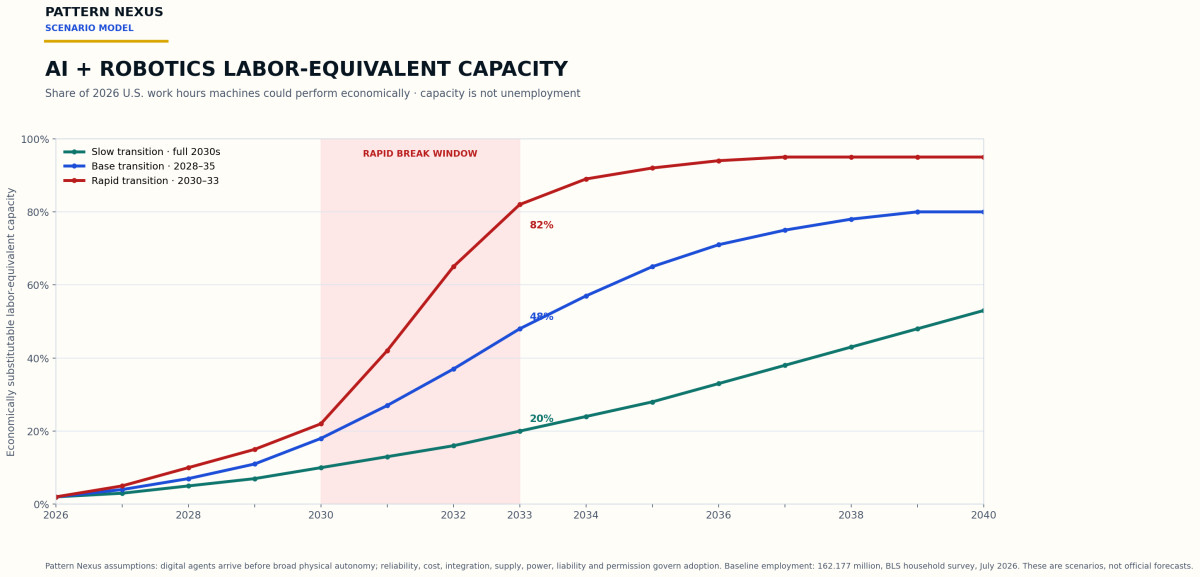
- The slow case is disruptive but governable. It reaches roughly 20% labor-equivalent capacity by 2033 and 53% by 2040. That is enough to force tax, education and benefit reform, but it gives institutions time to build an income floor and new ownership structures.
- The base case rewrites the labor market by the middle of the 2030s. It reaches about 48% capacity by 2033 and 65% by 2035. On a July 2026 employment base of 162.177 million people, that is 77.8 million and 105.4 million job-equivalents of gross machine capacity—not the same number of people unemployed.[25]
- The rapid case is a civilizational break. If capacity rises from 22% in 2030 to 82% in 2033, the economy would gain about 97 million additional job-equivalents of machine capacity in three years. No retraining program, normal business cycle or existing welfare system is designed for that speed.
- Universal basic income would arrive first as a stack. Refundable tax credits, targeted transfers, wage supplements, subsidized essentials, automatic stabilizers and digital disbursement rails are more likely to expand before one clean national UBI law. Formal UBI becomes hard to avoid only when displacement is broad, cross-class and politically impossible to describe as an individual failure.
- Money changes when wages stop being the main distribution rail. Money becomes less a receipt for human labor and more a claim on machine output. The state must move its tax base from payroll toward profits, capital, consumption, compute, robot services, resource rents or public equity stakes—or finance the gap with deficits.
- UBI without supply is inflation with better branding. A cash floor can preserve demand, but if housing, energy, food, health care and infrastructure remain scarce, the transfer is capitalized into prices. The abundance system has to be physical, not only digital.
- The upside is real. If people retain purchasing power, agency and ownership, machines can remove drudgery, expand care, compress the cost of expertise and give people time for family, learning, creativity, community and forms of life that wage dependence currently prevents.
- The danger is not only job loss. It is the merger of intelligence, identity, scoring, payments and permission. A post-labor income floor can be emancipatory or become a programmable eligibility system. The architecture—not the slogan—decides which one we get.
- My central prediction: the decisive variable is not whether AI becomes intelligent enough. It is whether capability, reliability, unit economics, physical supply and permission cross their thresholds together. When they do, adoption will look slow until it becomes discontinuous.
This is not a list of AI predictions and it is not a single-number job-loss forecast. It connects the layers Pattern Nexus has developed separately since 2022: humanized intelligence and ethics, AI feedback loops, the AI industrial flywheel, compute and power control, the two- or three-speed economy, algorithmic authority, tokenized money, corporate sovereignty, dignity, purpose and the First AI Age.
The report then adds a transparent scenario model. It separates technical capability from economic substitution, gross labor-equivalent capacity from net headcount risk, nominal UBI cost from real resource capacity, and observed evidence from my judgment. The model is meant to be updated as agent duration, robot fleet hours, cost curves, hiring data, power buildout and policy response become visible.
The machine labor force is being assembled before the social contract has words for it
In 2022 I wrote that artificial intelligence would disrupt or displace millions of jobs, force the question of a post-labor economy and require ethics to be embedded before advanced systems became impossible to supervise.[1] That argument was early, but it was still framed around artificial intelligence as a category of software. The next phase is larger.
The frontier companies are building intelligence that can own tasks, use tools, persist across workflows, coordinate with other agents and increasingly control bodies in the physical world. The robot is not the intelligence. It is the actuator. The agent is not the economy. It is the coordination layer. The data center is not the product. It is the factory where synthetic cognition is produced. Power is the limiting reagent. Money and identity are the access rails.
Put those layers together and the economic object changes. A human employee is one biological unit with one body, one sleep cycle, one location, one training history and one finite working life. A machine worker is a replicable stack. Its software can be copied, updated across a fleet, specialized, monitored, paused, financed as equipment and operated across shifts. Hardware still breaks. Batteries still charge. Edge cases still require people. But the business comparison is not fair once a sufficiently reliable machine can spread its acquired skill across thousands of units.
That is why the end state is not “AI helps workers become more productive.” That is the transition story. The end state companies are competing toward is intelligence as infrastructure: cognition on demand, physical action on demand and eventually research and improvement on demand. AGI is only a milestone inside that buildout. Superintelligence is the stated horizon. Universal intelligence is the economic form it takes when cognition, embodiment and rails are connected.
The benefit could be the largest expansion of human freedom in history. If machine labor produces enough real goods and services while households retain claims on that output, survival no longer has to be sold hour by hour. People can care for children and parents, build communities, study, create, travel, experiment and rest without treating every unmonetized hour as failure.
The danger is that production can become abundant while access remains scarce. A society can own a vast machine labor force through a narrow set of corporations, preserve wage-based distribution after wages collapse and then blame households for lacking income. That is not a technological failure. It is a distribution failure engineered by institutional inertia.
Universal intelligence is not a benchmark. It is a connected economic system.
AGI has become an overloaded term. For some people it means a model that matches a typical human across many cognitive tasks. For others it means a system capable of performing most economically valuable work. OpenAI's own public description has called AGI systems generally smarter than humans. DeepMind discusses levels and a path toward AGI. Anthropic's Dario Amodei explicitly dislikes the term and instead describes powerful AI—a system resembling a “country of geniuses in a datacenter” that can operate much faster than people.[9][28][30]
Those distinctions matter technically, but the economy will not wait for a committee to certify the correct acronym. Businesses respond to whether a system can complete a workflow at acceptable cost and risk. A model can fail some abstract test of general intelligence while still replacing a department. A robot can be far from human in common sense while still eliminating the need for a shift of material handlers. Economic substitution is local before it is universal.
I use universal intelligence to describe the operating layer that emerges when five capabilities converge:
General cognition
The system can reason, communicate, code, analyze, plan and move across domains without being rebuilt for every task.
Persistent agency
It can own a goal for hours or days, use tools, recover from errors, coordinate subtasks and return a completed outcome.
Embodiment
It can convert decisions into motion through robots, vehicles, drones, machines and other physical systems.
Fleet learning
A useful behavior learned by one deployment can become a software update distributed across many machines and sites.
Rail access
Identity, data, compute, energy, payments, procurement and permissions let intelligence participate directly in economic systems.
This does not require consciousness. A corporation is not conscious as one unified mind, yet it acts across markets, owns assets, hires labor and shapes governments. Universal intelligence can emerge as a network of models, agents, robots, databases and institutions before any single machine resembles a person internally.
It also does not require perfection. Human organizations already tolerate error by using review, insurance, escalation and redundancy. AI systems will be deployed the same way. The threshold is not zero mistakes. It is lower expected cost per acceptable outcome than the human process, after supervision, liability, integration and downtime are included.
That is the shift beyond AGI. AGI asks whether a machine can think generally. Universal intelligence asks whether machine cognition can be routed through the whole productive system. Once the answer is yes, intelligence becomes a utility—and human labor is no longer the only scalable carrier of it.
The real roadmap is written in gigawatts, factories and risk thresholds
I believe the frontier companies are moving faster internally than their ordinary product language suggests. That does not require a secret memo. The physical commitments are enough. Consumer messaging emphasizes helpful assistants, creativity and productivity. Capital plans, robotics programs and catastrophic-risk frameworks are built for systems with far greater autonomy and power.
OpenAI and NVIDIA announced a strategic partnership intended to deploy at least 10 gigawatts of NVIDIA systems for OpenAI's next-generation infrastructure, with the first gigawatt planned for the second half of 2026. The announcement explicitly connects the buildout to deploying superintelligence. Stargate separately announced an intention to invest $500 billion over four years in U.S. AI infrastructure.[4][5]
Meta moved from open-source model rhetoric to a direct statement that it is building personal superintelligence. On August 10, 2026, Mark Zuckerberg wrote that within the next few years people will be able to use superintelligence beyond human capacity. Meta had already announced more than $600 billion in U.S. investment through 2028 to support AI technology, infrastructure and workforce expansion.[7][8]
Anthropic's CEO has said powerful AI could be as little as one or two years away, while acknowledging it could take longer. Its Responsible Scaling Policy is not written for a slightly better office assistant. It is a governance system for thresholds involving catastrophic misuse, autonomous behavior and increasingly capable models.[9][29]
Google DeepMind describes Gemini Robotics 1.5 as a milestone toward AGI in the physical world and Gemini Robotics 2 as an intelligence layer for whole-body control, dexterity and multi-robot collaboration. Meta's own advanced-scaling framework opens by saying its vision is personal superintelligence and then maps severe, large-scale outcomes. These documents reveal the design horizon even when product pages remain reassuring.[11][12][31]
| Public signal | Physical or governance commitment | Pattern Nexus inference |
|---|---|---|
| OpenAI: superintelligence | Stargate and the planned 10-gigawatt NVIDIA partnership. | The expected product requires industrial-scale cognition, not incremental chatbot demand. |
| Meta: personal superintelligence | More than $600 billion of U.S. investment through 2028 plus a frontier scaling framework. | Distribution to billions of people is being paired with infrastructure and catastrophic-risk governance. |
| Anthropic: powerful AI | One- to two-year possibility, capability thresholds and economic-policy research for dramatic job-loss scenarios. | The company is planning simultaneously for rapid capability gains, catastrophic risk and labor disruption. |
| DeepMind: AGI in the physical world | General robot models, whole-body intelligence, dexterity and multi-robot coordination. | The digital frontier is being converted into actuation across different robot bodies. |
| Robot companies: useful work | Pilot lines, committed fleets, paid industrial deployments, service systems and over-the-air updates. | The bottleneck is moving from demonstration to fleet economics, reliability and manufacturing yield. |
The incentive structure also guarantees speed. Frontier labs face a prisoner's dilemma. If one slows while another reaches a decisive capability, the slower company may lose capital, talent, government relevance, distribution and the ability to set standards. Safety teams exist inside the same competitive system. National governments add another layer by treating advanced compute and AI as strategic power.
This is why public caution and private acceleration can coexist without anyone lying. Companies can sincerely worry about risk and still believe that not building is the greater competitive risk. The system rewards the actor that reaches capability first and asks society to manage the consequences afterward.
The next 6–18 months are when pilots begin turning into operating fleets
Robotics has produced impressive demonstrations for decades. Demonstration is not deployment. Deployment requires a machine to survive repetitive use, recover from ordinary faults, fit a real workflow, meet safety rules, integrate with software, receive service and produce an acceptable payback period. The commercial crossover begins when those boring layers work together.
That crossover is already visible at the edge. Figure reported in April 2026 that BotQ had delivered more than 350 Figure 03 robots and raised its demonstrated production cadence from one robot per day to one per hour. The company described fleet management, diagnostics, fallback ladders, over-the-air upgrades, service infrastructure and real-world deployments—the exact systems that appear after a prototype becomes an installed base.[15]
Figure also announced a commercial agreement with Catalyst Brands to deploy humanoids in a Nevada distribution center, after prior work at BMW. Boston Dynamics said all Atlas deployments were fully committed for 2026, with fleets scheduled for Hyundai's robotics center and Google DeepMind, and additional customers planned for early 2027. Tesla's 2025 annual report said it would ramp six production lines across vehicles, bots, energy storage and batteries in 2026, while its shareholder deck said first-generation Optimus lines were being installed in anticipation of volume production.[13][14][16][17]
My six- to eighteen-month forecast is therefore not that humanoids suddenly appear from nowhere between February 2027 and February 2028. It is that the market crosses from a handful of showcase sites into a repeatable paid-deployment pattern. The numbers can remain small relative to the labor force and still matter. Each installed fleet generates failure data, customer references, insurance experience, workflow templates and training examples. Those are the inputs to the next cost decline.
The rollout sequence
| Window | What changes | Primary constraint | Labor effect |
|---|---|---|---|
| Now–early 2027 | Committed industrial fleets, controlled tasks, supervised autonomy and reliability learning. | Uptime, maintenance, teleoperation burden and safe integration. | Hiring avoidance and task removal are larger than visible layoffs. |
| 2027–2028 | Repeat orders, robotics-as-a-service financing, common deployment playbooks and thousands of paid units across the industry. | Unit cost, service coverage, cycle time and customer return on investment. | Routine logistics and manufacturing roles begin measurable consolidation. |
| 2028–2030 | Transferable skills, larger fleets, better dexterity, autonomous recovery and standardized safety layers. | Manufacturing scale, batteries, actuators, chips, power and liability. | Factories and warehouses redesign expansion around fewer human hours. |
| 2030–2033 | Possible general-skill crossover: one platform handles a widening task library across multiple sites and environments. | Permission, public acceptance and whether real-world reliability keeps compounding. | Physical displacement can catch up with the digital-agent shock. |
| 2033–2035 | Robots become a normal capital category in leading firms, with skills sold through software and fleet services. | Social legitimacy, income distribution and demand maintenance. | The labor market becomes a policy choice rather than the default distribution system. |
Humanoid robots receive attention because the world was built around the human form: stairs, doors, shelves, carts, hand tools, vehicles and workstations. A human-shaped machine can enter that environment without rebuilding the entire facility. But humanoids are only one part of the rollout. Fixed arms, mobile warehouse robots, autonomous vehicles, drones, specialized agricultural systems and software agents can replace work sooner and more cheaply in structured domains.
The correct measure is not robot count. It is productive machine hours, task diversity, intervention rate, cost per completed outcome and the number of human hours removed from a workflow. Ten thousand unreliable robots can be a science project. One thousand reliable robots running multiple shifts can be an economic event.
Machines do not call in sick, negotiate schedules or resign. But they are not frictionless. They charge, fail, need parts, require cybersecurity, can create liability and may need remote human help. A serious forecast includes those costs. The advantage appears when a fleet's total utilization and learning rate outrun its maintenance and supervision burden.
The decisive advantage is not that machines are perfect. It is that their learning can be copied.
Human productivity compounds through education, experience, institutions and tools. But most human learning remains trapped inside individual minds and organizations. A worker becomes excellent and then retires. A company learns a process and struggles to reproduce it across locations. Training takes time, and every new employee begins with a separate biological system.
Machine labor changes that replication law. Once a behavior is encoded reliably, the marginal cost of distributing it can approach the cost of software deployment. Hardware still has to exist, but the skill does not need to be relearned by every body. A fleet update can turn thousands of machines into better workers in the same week.
This is why the first robot that completes a new task is less important than the thousandth robot receiving the behavior. The economic unit is not the body alone. It is the body plus model plus data plus fleet feedback plus service network. The company that controls that loop owns a compounding labor asset.
Replication
A software skill can be copied across units without hiring and training an equal number of new workers.
Utilization
Fleets can rotate through charging and maintenance while the operating system supplies labor across more of the day.
Observability
Every action can generate logs, diagnostics and training data, making performance easier to measure and optimize.
Financing
A robot can be leased, depreciated, collateralized and priced against a predictable stream of productive hours.
Coordination
Digital agents can schedule, procure, route, monitor and manage the physical fleet with fewer administrative layers.
The substitution threshold can be written simply:
Adopt when the expected cost of a reliable machine outcome—including capital, energy, supervision, downtime, integration and liability—falls below the expected cost of the human outcome at the required volume.
The comparison becomes more aggressive when the firm is expanding. Replacing an existing employee creates legal, cultural and reputational costs. Avoiding a new hire is quieter. That is why the labor shock first appears as missing job creation. A growing company can increase output, revenue and even total headcount while adding far fewer people than the previous production model required.
AI agents create the same dynamic in offices. The first use saves an employee twenty minutes. The second connects systems. The third owns a process. The fourth lets a manager supervise the work previously done by several coordinators. Eventually the firm stops hiring the junior layer that fed the entire career ladder.[22]
Anthropic's March 2026 labor research found limited evidence of aggregate employment effects so far, but suggestive evidence of slower hiring for younger workers in exposed occupations. Its June survey found that more than one-third of respondents expected AI to do most or nearly all of their work tasks within twelve months, although the sample is not representative of the whole labor force.[19][20] The important signal is not that mass unemployment has already arrived. It is that capability and expectations are moving ahead of the official labor aggregates.
This is the two-speed economy I described earlier. Output can rise because capital is buying cognition and actuation while broad hiring weakens. Asset owners experience expansion. Workers experience fewer openings and thinner bargaining power. Both groups live inside the same GDP number.
AI will not eliminate occupations in a clean order. It will hollow out task bundles, hiring ladders and bargaining power.
The public keeps asking which jobs AI will take. The better question is which parts of a job can be separated, measured, verified and reassigned to a machine. Occupations are bundles. A paralegal researches, summarizes, communicates with clients, manages deadlines and carries institutional responsibility. A nurse observes, lifts, reassures, documents, administers and makes judgment calls under liability. A warehouse worker navigates, identifies, picks, carries, recovers and coordinates. AI attacks the bundle one component at a time.
This is why the first phase looks like augmentation even when the destination is substitution. A worker receives an assistant. The assistant drafts. Then it searches. Then it updates systems. Then it communicates with other agents. The human becomes an exception handler. Once exceptions become rare enough, one person supervises several workflows. The company has not announced that an occupation disappeared, but the staffing ratio has already changed.
OpenAI's earlier task-exposure research estimated that around 80% of the U.S. workforce could have at least 10% of work tasks affected by large language models and roughly 19% could see at least half affected. Exposure was not a prediction of job loss, but it mapped the unusually broad surface area of language-based work.[23] The ILO's 2025 index similarly found that one in four jobs worldwide had some generative-AI exposure and emphasized transformation over immediate full replacement. The IMF estimated that almost 40% of global employment was exposed to AI, with a higher share in advanced economies.[24][26]
Those studies describe the opening move. Persistent agents and embodied systems expand the surface from tasks that occur inside text and software into tasks that occur inside firms, warehouses, vehicles, stores, hospitals, farms and homes.
Wave one: cognitive production and administrative coordination
Software development, clerical administration, customer support, translation, routine content, marketing operations, financial analysis, insurance processing, bookkeeping, legal discovery and internal reporting move first because the inputs and outputs are already digital. The model does not need a robot hand to reach the work. It needs permissions, context, tool access and a reliable way to verify completion.
The most exposed worker is not always the least skilled. Expensive, standardized cognitive work creates the largest immediate savings. A company can justify more integration effort when a reliable agent compresses hours of legal review, engineering work or financial research. High wages attract automation capital.
The entry-level layer is especially vulnerable because its historical purpose was partly developmental. Junior employees performed bounded work while learning the organization's language, politics and judgment. An agent can absorb the bounded work without needing the future promotion. The firm saves money today but destroys its own talent pipeline tomorrow. By the time leaders notice the succession problem, an entire cohort may have missed the first rung.
Wave two: supervision, coordination and the middle of the organization
Once agents can own workflows, the organizational chart flattens. A manager with a live view of agent queues, exception rates, customer outcomes and financial performance can supervise a wider span. Scheduling, procurement, compliance checking, reporting, project coordination and routine approvals become machine-mediated. Some managers become more valuable because they can direct larger systems. Others discover that the information-routing function of their role has been automated.
This is where AI stops looking like a productivity feature and starts looking like institutional redesign. The number of people needed to translate a decision across layers falls. Meetings shrink or disappear. Internal documents are generated from live systems. Agents negotiate with other agents. The organization does not merely do the same work faster; it changes shape.
Wave three: logistics, manufacturing and structured physical work
Warehouses and factories are the first major physical markets because the environment is controlled, the tasks repeat, the economics are measurable and the employer can redesign the site around the machine. Mobile robots, fixed arms, vision systems and specialized automation will usually beat general-purpose humanoids on a narrow task. Humanoids matter where the value of using human infrastructure outweighs the cost of a more general body.
Between 2027 and 2030, the leading deployments should concentrate in material movement, tote handling, kitting, machine tending, inspection, packaging, pallet work and repetitive assembly. The labor effect will be strongest in new facilities and expansions, where the firm can design for machine utilization from the beginning. Existing sites will convert more slowly because integration, downtime and legacy processes are real costs.
Wave four: transport, retail, food, construction, agriculture and field service
These domains are economically attractive but operationally harsher. Public roads, weather, irregular objects, customers, old buildings and changing worksites create a long tail of edge cases. Adoption will therefore be uneven: autonomous operations in constrained routes before universal driving; back-of-house food preparation before every front-of-house interaction; machine-assisted construction tasks before a robot general contractor; specialty crop and controlled-environment automation before every farm task.
The common mistake is to interpret uneven adoption as safety. A technology can transform the national labor market while remaining absent from millions of small sites. Large employers, standardized chains and capital-intensive operators account for enough hours to move wages, training demand and regional economies.
Wave five: care, education and other trust-bound work
Health care, elder care, child care and education contain enormous demand that current labor supply does not meet. AI and robotics may initially expand service rather than reduce headcount. A nurse with robotic lifting and documentation support can care for more patients. A teacher with individualized tutoring agents can spend more time on motivation and group dynamics. A home robot that handles laundry, mobility assistance and monitoring can allow an older person to remain independent.
But augmentation is not a permanent law. If systems become reliable, licensed and trusted, staffing ratios will change. The legally responsible human may remain while much of the task bundle moves to machines. The human role becomes relationship, accountability, escalation and consent.
| Work domain | First visible change | Substitution signal | Main source of resistance |
|---|---|---|---|
| Digital knowledge work | Assistants draft, search, code and analyze. | Agents own multistep workflows with low intervention. | Context, verification, security and liability. |
| Administration and management | Reporting and coordination are automated. | Wider spans and fewer junior coordinators. | Politics, judgment and accountability. |
| Industrial and logistics | Controlled tasks gain supervised autonomy. | Repeat fleet orders and falling cost per productive hour. | Reliability, service and integration. |
| Open-world physical work | Autonomy appears in constrained routes and tasks. | Cross-site skills transfer without site-specific programming. | Edge cases, weather, public safety and old infrastructure. |
| Care and education | Documentation, tutoring, monitoring and lifting are augmented. | Human staffing ratios change while one accountable professional remains. | Trust, empathy, licensing and consent. |
Some work will resist longer: high-trust relationships, leadership under uncertainty, taste and cultural status, chaotic field repair, negotiation where a human presence carries meaning, and roles that law requires a person to perform. These are barriers to substitution, not proof of permanent immunity. A human premium can rise even while the number of human roles falls.
New jobs will appear—robot fleet technicians, safety auditors, model evaluators, synthetic-environment designers, human-experience roles and categories we cannot name yet. The issue is arithmetic and speed. A new occupation can be valuable without employing as many people as the old one. One technician may maintain many units; one creative director may orchestrate many agents. The replacement economy can create extraordinary work while needing far fewer workers.
That is why retraining is necessary but insufficient. Retraining assumes a destination job exists at roughly the same scale, pays enough to support a household and remains durable long enough to justify the transition. In the rapid case, the target itself keeps moving.
Three paths separate a difficult adjustment from a break in the operating system.
No responsible analyst can produce a precise unemployment number for 2033. The inputs are not only technical. They include product reliability, capital costs, customer demand, the power system, component supply, regulation, unions, insurance, management competence and political permission. A capability demo is not a deployment. A deployment is not a profitable fleet. A profitable fleet is not automatically a layoff.
I therefore model labor-equivalent capacity: the share of work hours represented by the July 2026 U.S. employment base that AI agents and robots could perform economically at the prevailing frontier of deployment. It is a capacity measure, not an unemployment forecast. A firm may use that capacity to expand output, improve quality, fill shortages, shorten hours, avoid hiring or replace people. The same technical capacity can produce very different social outcomes.
The substitution gate is multiplicative:
Capability × reliability × integration × unit economics × physical supply × permission.
If any factor is near zero, deployment stalls. When all cross usable thresholds together, adoption can jump. This is the source of the discontinuity. The intelligence curve may be smooth while the economic curve remains flat and then breaks upward.
The slow case: institutions receive time
The slow path assumes agents improve but continue to need substantial supervision, physical robotics encounters persistent uptime and integration problems, energy and component supply constrain expansion, and political permission arrives sector by sector. Labor-equivalent capacity reaches 10% in 2030, 20% in 2033, 28% in 2035 and 53% in 2040.
This is still a major transformation. It can remove enough entry-level and routine work to weaken wage growth, alter higher education and force benefit reform. But the pace allows older cohorts to retire, firms to shorten workweeks, infrastructure to expand and public ownership mechanisms to mature. The old system erodes rather than detonates.
The base case: agents and robots become normal capital
The base path assumes digital agents achieve reliable ownership of bounded workflows, robot deployments produce repeat orders, skills transfer across sites, and AI capital spending earns enough return to continue. Capacity rises to 18% in 2030, 48% in 2033, 65% in 2035 and 80% by 2040.
This path rewrites the employment contract in the middle of the 2030s. Human labor remains important, but full-time employment can no longer distribute purchasing power to the entire population. Governments layer transfers and tax credits, employers move toward smaller human cores, and ownership becomes the decisive class boundary.
The rapid case: capability and deployment synchronize
The rapid path assumes reliable long-duration agents, rapid model improvement, cheap inference, transferable robotic skills, adequate production capacity and a competitive race that prevents coordinated slowing. Capacity rises to 22% in 2030, 42% in 2031, 65% in 2032 and 82% in 2033. By 2035 it reaches 92%.
This does not mean 92% unemployment. It means the installed and economically deployable machine system could perform work equivalent to 92% of the 2026 employment base. Demand may expand, jobs may be shared, people may remain for accountability, and some capacity may be idle. But labor loses scarcity so quickly that the wage system cannot clear without a new distribution mechanism.
| Scenario | 2030 capacity | 2033 capacity | 2035 capacity | 2033 gross job-equivalents |
|---|---|---|---|---|
| Slow | 10% | 20% | 28% | 32.4 million |
| Base | 18% | 48% | 65% | 77.8 million |
| Rapid | 22% | 82% | 92% | 133.0 million |
The job-equivalent conversions use 162.177 million employed people in the July 2026 Bureau of Labor Statistics household survey as a common scale.[25] They do not pretend that every hour is interchangeable or that future employment remains fixed at that level. Their purpose is to make the magnitude understandable.
Gross capacity becomes net headcount risk only when companies use it to remove workers rather than expand output or reduce hours. I apply wide conversion ranges: 25%–50% of gross capacity in the slow case, 45%–70% in the base case and 65%–90% in the rapid case. Those assumptions produce the following 2033 ranges.
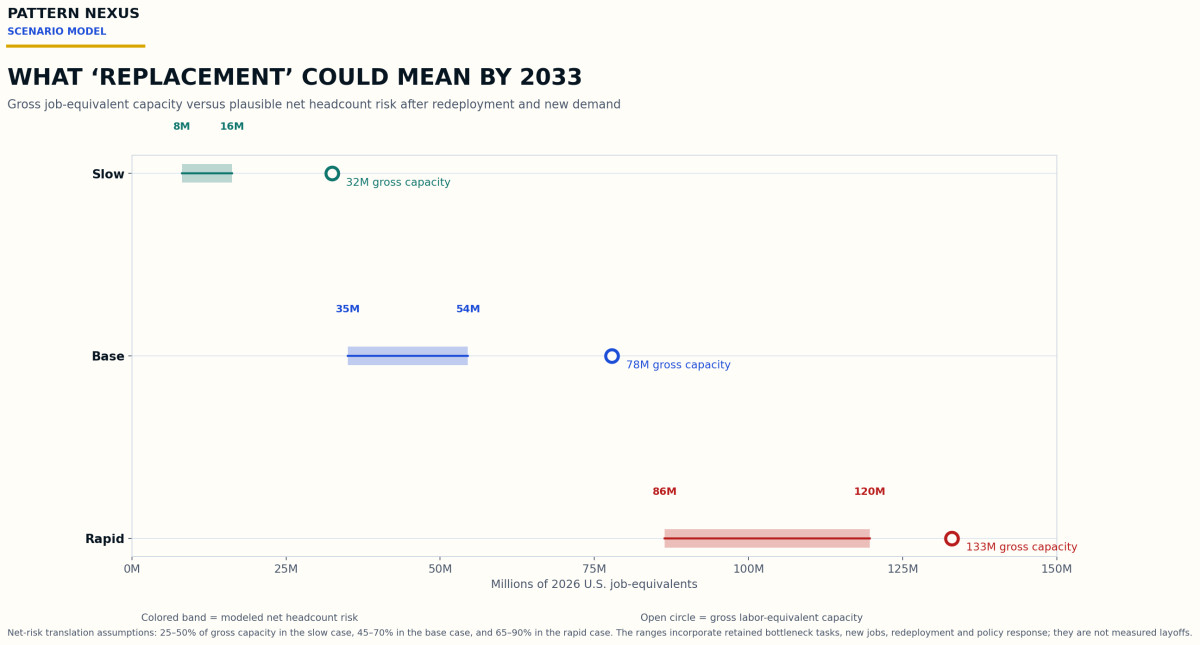
There are at least five reasons the net number can be lower than gross capacity: demand expands when prices fall; firms keep people for trust and accountability; hours shorten instead of headcount; regulation mandates human presence; and new tasks appear. There are also reasons the number can be higher in specific places: local demand collapses, suppliers close, household spending falls, and one automated anchor employer removes jobs throughout a region.
A 2030–2033 acceleration would not feel like another industrial transition. It would feel like the old world stopped clearing.
The rapid scenario adds roughly 97 million job-equivalents of machine capacity between 2030 and 2033. That is the difference between a labor market that can absorb a technology through retirement, mobility and institutional reform and one that is repriced faster than human lives can reorganize.
People compare AI to the tractor, electricity, the automobile and the internet. Those analogies identify the scale but can hide the speed. Earlier general-purpose technologies required the physical buildout of grids, roads, factories and machines. AI also requires infrastructure, but its cognitive component can be distributed globally as software once compute exists. A new model can reach millions of workers before a legislature completes one budget cycle.
Robotics slows the physical transition, but fleet learning can compress the second half. The first warehouse requires integration engineers, site mapping and repeated failures. The hundredth deployment reuses the playbook. The first robot skill is expensive. The thousandth copy is an update. Physical adoption can therefore spend years below the threshold and then climb the familiar S-curve.
What breaks first
Hiring breaks before employment. Graduates encounter fewer openings. Voluntary departures go unfilled. Contractors disappear. Job descriptions absorb multiple roles. Official unemployment can remain tolerable while the path into stable work closes.
Household demand breaks after income. A machine can produce a good, but it cannot create a paying customer by replacing the customer's wage. If income falls faster than prices, firms discover that productive capacity and effective demand are different things.
The tax base breaks after payroll. Social insurance systems were built around wages. When compensation shrinks as a share of output, payroll taxes cannot finance benefits at the previous ratio. Taxing machine output is conceptually simple and operationally difficult because compute, software, intellectual property and profits can move across jurisdictions.
Credit breaks after expected income. Mortgages, auto loans, student debt and municipal finance assume households will earn across decades. If career income becomes uncertain, lenders shorten horizons, demand more collateral or retreat. Asset owners retain borrowing power while wage-dependent households lose it.
Education breaks after the career ladder. The promise behind tuition is that credentials purchase access to a durable occupation. When entry-level tasks vanish and expert systems compress training advantages, the return on conventional education becomes more uneven. Learning remains essential, but the product called a degree loses its old guarantee.
Political legitimacy breaks last and hardest. A society can tolerate unequal outcomes when people believe effort produces mobility. It becomes unstable when machines perform the work, owners capture the gain and the displaced are told to try harder. The insult matters as much as the income loss.
A slower transition is better not because it preserves every old job. It gives society time to age out roles rather than erase cohorts, shorten workweeks instead of creating unemployment, build housing and energy before distributing more money, move the tax base, create broad ownership and establish rights around automated decisions. Time is an economic resource.
If the rapid path arrives, emergency policy will be improvised. Transfers will expand through existing agencies. Debt and deficits will rise. Rules will be written under panic. Companies will offer retraining that cannot match the number of people displaced. Political movements will demand bans, licensing, robot taxes, nationalization or acceleration. The risk is not simply bad economics. It is that a temporary emergency architecture becomes the permanent control system of the post-labor world.
GDP can rise while the wage economy deteriorates.
The central macroeconomic change is the decoupling of output from labor demand. For most of modern history, producing much more required hiring, longer hours, more capital or some combination. Software and automation weakened that relationship. Universal machine intelligence can sever it.
A firm with agents and robots can increase production without distributing an equivalent wage bill. Revenue per employee rises. Profit margins can widen. Prices can fall. The stock market can celebrate. At the same time, households that depend on wages lose income and bargaining power. The economy appears strong from the capital side and weak from the labor side.
This is the two- or three-speed economy developed in earlier Pattern Nexus work: a complementary core that owns, directs or is amplified by AI; a squeezed middle of routine cognitive and operational work; and a residual economy of unstable service, informal care and underemployment.[2] The borders move as capability expands. Today's highly paid complement can become tomorrow's supervised exception handler.
The demand paradox
Production is not demand. A factory full of robots can create a million products, but the products have no realized value unless someone can buy or use them. Wage labor has served two functions: it organizes production and distributes purchasing power. AI can outperform the first function while destroying the second.
In a partial transition, lower prices and new markets can offset the wage loss. When an AI service becomes cheap, people consume more of it. Firms launch products that were previously uneconomic. Human demand expands around the new capability. This is the strongest argument against mechanical job-loss arithmetic.
But demand elasticity has limits. A household does not need one hundred refrigerators because robots made them cheaper. A person cannot consume infinite medical visits, homes or meals. And if income disappears before prices fall, even abundant output can sit behind a payment barrier. The economy needs a separate mechanism to turn production into broadly held claims.
Capital share, concentration and the super-firm
When models, data centers, energy contracts, robot fleets and distribution are expensive, early gains accrue to firms with capital and scale. The strongest companies can internalize more of the stack: intelligence, cloud, chips, identity, commerce, logistics and payments. They become less like ordinary vendors and more like operating systems for economic life.
This can produce extraordinary corporate profitability while weakening competitive entry. The marginal AI-generated product may be cheap, but the infrastructure beneath it is concentrated. A small number of platforms can tax the flow of cognition the way old empires taxed ports and roads.
The natural counterforce is falling technical cost. Open models, efficient inference, cheaper hardware, distributed energy and interoperable robotics can spread capability. Whether that creates broad competition depends on access to data, power, capital, liability coverage and customers. Cheap intelligence does not automatically mean cheap sovereignty.
Productivity deflation and bottleneck inflation at the same time
AI is deflationary where the output can be copied: text, code, analysis, tutoring, design variants, routine advice and synthetic media. It is initially inflationary where the buildout requires scarce physical inputs: electricity, grid connections, transformers, cooling, copper, advanced chips, packaging, construction labor and suitable land.
The transition therefore produces two price systems. Digital cognition becomes radically cheaper while bottleneck assets become more valuable. A family may receive near-free expertise and still be unable to afford housing, insurance or electricity. Measured productivity can soar without resolving the scarcities that determine lived experience.
Over time, machine engineering and construction can expand physical supply too. AI can optimize grids, discover materials, automate factories and accelerate permitting analysis. Robots can build more robots and more infrastructure. That is the route to genuine abundance. Until then, the economy is likely to alternate between AI-driven asset booms, infrastructure shortages, political backlash and new waves of capacity.
The business cycle changes
AI capital spending creates a powerful investment cycle. Data centers, generation, transmission, semiconductor fabs, factories and robot fleets pull forward demand. Suppliers borrow against expected utilization. Regions build around promised capacity. Financial markets capitalize distant machine earnings into present valuations.
If returns arrive, the cycle reinforces itself: higher profits fund more compute, better systems create more savings, savings justify more deployment and installed infrastructure becomes collateral for credit. If returns disappoint, the reverse is violent. Overbuilt power contracts, underused data centers, leveraged suppliers and falling equipment values transmit a technology correction into credit.
The AI economy can therefore be both structurally real and cyclically overbuilt. Calling it a bubble misses the industrial transformation. Assuming every dollar of capital spending will earn its projected return misses financial history. The First AI Age rhymes with earlier general-purpose technology cycles precisely because real infrastructure and speculative finance arrive together.
As of the second quarter of 2026, the U.S. economy still sits inside the old statistical frame: nominal GDP at a seasonally adjusted annual rate of roughly $32.5 trillion, real GDP growth estimated at 1.5% annualized, and 162.177 million people employed in July.[27][25][32] The transition will become visible when output and profit stay resilient while broad hiring, labor share and household income no longer confirm the expansion.
Money becomes a claim on machine output—and a permission system for access to it.
Under the wage economy, money feels like a receipt for labor. A person sells time and skill, receives income, pays taxes and purchases a share of social output. The relationship is never that simple—owners, retirees, children and institutions already receive income through other channels—but wage labor remains the moral and administrative center.
Universal machine labor breaks that story. If machines generate a growing share of output, tying legitimate consumption to human employment becomes irrational. The citizen still needs food, housing, care, transportation and energy. The machine system still needs customers. Money has to become an explicit distribution claim rather than an implied reward for hours worked.
This does not make money disappear. Abundance is always uneven. Compute time, waterfront land, human attention, rare materials, trusted care and desirable locations remain scarce. Money continues to rank claims among competing uses. What changes is how people obtain it and what conditions are attached.
The tax base moves away from payroll
Payroll taxes work when wages are a stable share of national income. They fail when capital performs the work. Governments then have a limited menu:
- tax corporate profits, capital gains and concentrated rents more heavily;
- tax consumption through a value-added or destination-based system;
- levy compute, energy-intensive inference or robot-service taxes;
- collect royalties or resource rents from public power, land, spectrum and data;
- own equity through national, state, municipal, pension or citizen funds;
- issue debt and money against future machine productivity;
- or allow benefits and public services to shrink.
Anthropic's economic-policy research has already organized responses by the speed of displacement, including training and adjustment support in slower cases and new revenue sources, sovereign wealth funds, consumption taxes and taxes connected to compute or AI services in faster ones.[21] The important shift is conceptual: machine productivity must enter the public revenue system somewhere if human labor exits it.
Money creation becomes more structural
When private wages cannot support aggregate demand, public transfers stop looking temporary. Tax credits, rebates, subsidies and direct payments become part of the monetary circulation system. Recession tools become permanent distribution rails.
This does not mean every payment is financed by literal money printing. Governments can tax, borrow, own assets or consolidate existing programs. But the political economy changes. A system that can produce more than households can buy will repeatedly choose between transferring claims to households and allowing demand failure.
The fiscal response will probably be disguised at first. Policymakers will describe each measure as targeted help: a child credit, housing support, an energy rebate, an automation adjustment benefit, a wage supplement or an emergency payment. Over time the exceptions merge into a recurring floor. Universal basic income may arrive as an accumulation of programs before it arrives as a name.
Programmable rails are both efficient and dangerous
Digital dollars, stablecoins, tokenized deposits and instant settlement can make distribution cheaper and faster. Eligibility can be checked automatically. Payments can respond to unemployment, regional shocks or verified needs. Tokenized Treasury assets can extend dollar liquidity across global digital markets. In the best case, the rails make the income floor resilient and portable.
The same rails can make money conditional. A payment can expire, be limited to approved categories, be blocked by geography, be attached to identity or be withdrawn by an automated risk score. Money becomes a permission token. If the intelligence system also controls eligibility, surveillance and appeal, economic exclusion can happen at software speed.
This is why the debate cannot stop at whether society provides UBI. A programmable benefit that can be revoked without due process is not economic freedom. It is supervised consumption.
Inflation, deflation and the denominator
AI can lower the real cost of many services, but money is a claim on the whole economy. If transfers rise faster than real production of scarce necessities, prices absorb the difference. If machine output expands faster than household claims, deflation and demand weakness appear. The stable path requires the nominal distribution system and the physical supply system to grow together.
That creates a new policy target: not simply full employment, but broad access to rising machine output without exceeding real capacity. Central banks and fiscal authorities will have to distinguish a power-and-housing bottleneck from excessive aggregate demand, and distinguish productivity deflation from a collapse in household income.
Debt also changes meaning. A state that controls productive AI infrastructure, energy and settlement rails can borrow against a larger future tax base even if payroll shrinks. A state that imports intelligence, energy and platforms while transferring income has a weaker position. Sovereign credit increasingly reflects control of the machine stack.
An income floor becomes unavoidable when employment stops being a universal distribution mechanism. But cash alone does not create abundance.
Universal basic income is often framed as charity, surrender or utopian generosity. In a machine-output economy it is closer to demand infrastructure. If firms replace labor income with capital income, someone has to reconnect households to production. Otherwise the same automation that lowers costs also removes customers.
The policy is unlikely to begin as one clean monthly payment to every adult. The United States already has administrative rails for Social Security, tax refunds, unemployment insurance, food assistance, health subsidies and refundable credits. The path of least resistance is expansion, simplification and automation of those systems.
I expect the sequence to be:
- Targeted adjustment. Benefits expand for displaced sectors, younger workers, caregivers and regions with concentrated automation.
- Automatic stabilization. Transfers trigger when unemployment, hours or regional income cross thresholds.
- A recurring floor. Refundable credits and direct payments become frequent enough to function like basic income.
- Formal universality. Means tests weaken when displacement crosses classes and the cost of administering conditionality exceeds its political value.
The stack will be called many things before it is called UBI. The label matters less than whether it is reliable, sufficient, portable and difficult to weaponize.
| Monthly payment | Illustrative adults | Gross annual cost | Share of Q2 2026 nominal GDP rate |
|---|---|---|---|
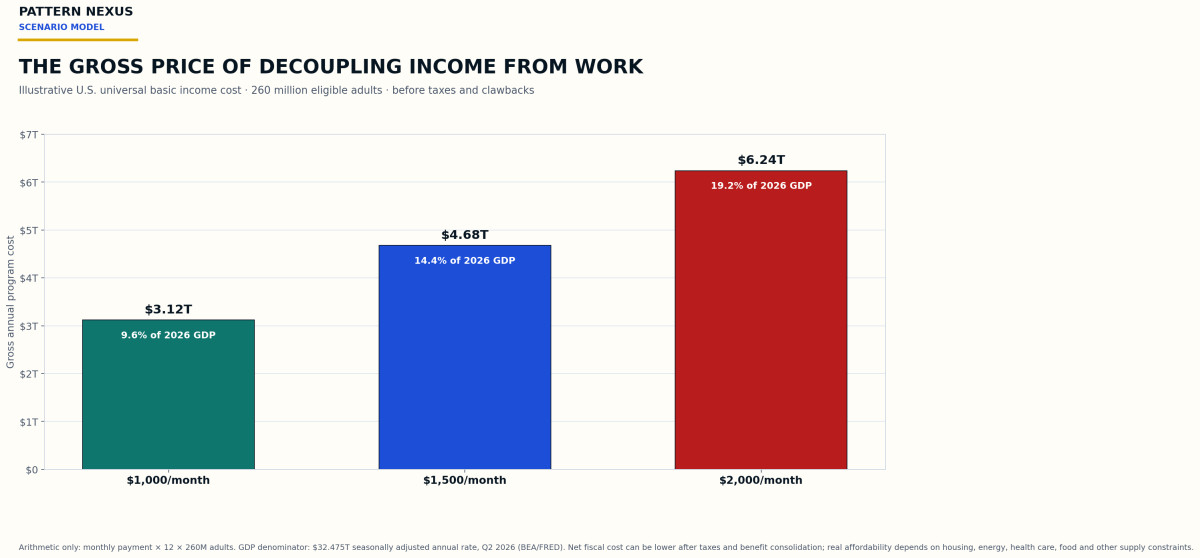
| $1,000 | 260 million | $3.12 trillion | 9.6% |
| $1,500 | 260 million | $4.68 trillion | 14.4% |
| $2,000 | 260 million | $6.24 trillion | 19.2% |
These are deliberately gross figures. A universal payment is taxable at higher incomes, replaces some existing benefits, reduces emergency spending, supports consumption-tax revenue and can be partially financed by returns on public assets. The net fiscal cost can be much lower than the headline. It is not free.
A plausible funding stack
No single robot tax will carry a post-labor economy. A durable system is likely to combine several sources: progressive taxation of AI-era profits and capital gains; a broad consumption tax with a household rebate; levies tied to scarce compute, energy or robot services; public or pension ownership of AI infrastructure; royalties from public resources; consolidation of overlapping transfers; and deficit finance during the transition.
A public wealth fund is especially important because it changes the relationship from taxation after the fact to ownership before the gain. The fund can hold stakes in compute, energy, data centers, semiconductor capacity, robotics and broad equity indexes. Dividends then rise with the machine economy. Alaska's resource dividend is conceptually closer to the future than a bureaucracy that tries to identify which individual worker a robot replaced.
Local and sectoral ownership matter too. Municipal utilities can return power-system rents. Pension funds can hold machine capital on behalf of workers. Cooperatives can own specialized models and fleets. Communities can negotiate equity or revenue shares when they host data centers and generation. The distribution architecture does not have to be exclusively federal.
The real-resource test
The cost question cannot be answered with dollars alone. A government can credit accounts. It cannot instantly create apartments, transmission lines, nurses, food, water systems or insurance capacity. If UBI raises nominal demand against fixed supply, owners of the bottleneck collect the transfer through higher prices.
That means an income floor has to be paired with an abundance program: housing construction, grid expansion, generation, transport, health capacity, automation of essential supply chains and competition policy. Universal basic services may be more efficient in domains where markets are structurally constrained. Cash preserves choice; public provision can remove monopoly tolls. The system likely needs both.
The payment should also be indexed carefully. Automatic inflation indexing protects recipients but can reinforce a price spiral when the bottleneck is severe. A better architecture combines a stable floor, targeted supply investment and temporary restraint on payments that chase truly scarce capacity—without allowing emergency discretion to become a pretext for arbitrary control.
UBI is necessary in the rapid case and insufficient in every case
Income prevents destitution. It does not create status, belonging, competence, community or a reason to wake up. Modern societies have fused occupation with identity so completely that the loss of work can feel like social disappearance even when material needs are met.
A successful transition must therefore distribute time, ownership and agency—not only money. People need the right to build, care, learn, create, compete, organize and contribute outside a conventional job. If UBI becomes payment for passivity while a narrow machine-owning class directs the future, it will stabilize demand and still fail civilization.
The same machine can liberate a person from work or exclude that person from the economy. Ownership decides which.
The optimistic case for AI is not naïve. Much of human labor is performed because survival requires it, not because the task expresses a calling. Repetitive lifting, dangerous inspection, endless paperwork, routine customer conflict, overnight monitoring and the administrative burden of care consume lives. Removing that work is a real moral gain.
Machines can also expand what society has failed to provide. Personalized tutoring can reach a child who lacks a specialist. A diagnostic system can give a rural clinic access to expertise. A household robot can allow an older adult to remain at home. Translation can make institutions legible. Scientific agents can search spaces no human team could cover. The benefit is not only fewer hours worked; it is more capability available to more people.[10]
But freedom from labor is not the same as freedom. A person who no longer has to work and owns a claim on machine output gains time. A person who is no longer allowed to work and depends on a revocable benefit loses bargaining power. The external condition can look similar—a monthly payment and no job—while the internal political relationship is opposite.
From labor leverage to ownership leverage
In the industrial economy, workers could withhold labor. That gave unions and professions leverage over the production process. In the universal-intelligence economy, the owners of compute, power, models, robots, platforms and rails can operate with fewer people. Labor's ability to stop production weakens.
Broad ownership is therefore not a decorative addition to UBI. It replaces part of the lost bargaining position. A citizen dividend from an AI wealth fund, a pension claim on machine capital, cooperative ownership of a fleet, household ownership of productive agents and community stakes in local infrastructure create rights that do not depend on an employer's willingness to hire.
The transition should build multiple ownership channels:
- Individual ownership: people control personal agents, data, intellectual output and portable economic identities.
- Worker and cooperative ownership: groups own sector-specific models, robot fleets and platforms that serve their members.
- Pension ownership: retirement systems hold diversified claims on AI-era capital so productivity gains support workers across generations.
- Community ownership: places hosting data centers, power generation or industrial facilities receive equity, revenue shares or utility dividends.
- Public ownership: sovereign and citizen funds hold broad stakes and pay social dividends without micromanaging every company.
Ownership also improves legitimacy. Taxes can always be portrayed as confiscation and transfers as charity. A dividend is understood as a return on an asset. If public research, infrastructure, law, education and energy systems helped create the machine economy, a public claim on part of the return is not an afterthought. It is recognition of the existing contribution.
The shorter-work transition
The slow and base scenarios leave room to share productivity through time. A four-day week, shorter standard hours, job sharing, paid care, sabbaticals and phased retirement can turn displacement capacity into leisure before it becomes unemployment. Benefits must be portable so reduced hours do not mean losing health care, housing access or retirement security.
Shorter work is not a complete answer in the rapid case because there may be too little economically necessary human labor to distribute evenly. But it is a valuable bridge. It helps institutions stop treating forty hours of employment as the only legitimate life while preserving routines, teams and contribution during the transition.
The human premium
As synthetic output becomes abundant, verified human presence can become more valuable. People may pay for human-made art, human instruction, human care, live performance, local craft and accountable advice precisely because machine versions are cheap. Authenticity becomes a scarce good.
This premium will not employ everyone at current wages. Scarcity value is often concentrated among people with reputation, taste, trust or access to wealthy customers. Still, it points toward a plural economy in which some human activity is valued because it is human, not because machines cannot technically imitate it.
Purpose after necessity
The wage economy supplied structure badly but consistently: a schedule, colleagues, goals, friction, recognition and a story about progress. Removing the job without replacing those functions can amplify isolation, addiction, status anxiety and political extremism. Entertainment systems can fill time without creating meaning.
The post-labor society needs institutions for voluntary contribution. Civic service, open scientific projects, caregiving networks, local building, arts, sport, exploration, education and community governance can organize effort without making survival conditional on it. People will still compete. They will still seek status. The goal is not a life without challenge. It is a life in which challenge is chosen more often than coerced.
Virtual worlds and AI companions will become part of this landscape. They can expand identity, creativity and connection, especially for people limited by geography or disability. They can also become frictionless substitutes for a public life that is allowed to decay. The freedom dividend is real only if people retain the option to participate in the physical world.
The most dangerous system is not a robot that hates humanity. It is an eligibility stack no human can appeal.
Advanced AI creates spectacular risks: cyber operations at machine speed, biological misuse, autonomous weapons, model deception and systems that pursue objectives their operators cannot reliably understand. Frontier labs acknowledge these categories in their own safety frameworks. OpenAI wrote that it did not yet have a solution for reliably steering or controlling potentially superintelligent AI. Anthropic, DeepMind and Meta maintain scaling or frontier-safety policies focused on increasingly severe capability thresholds.[33][29][34][31]
Those risks deserve serious work. But the ordinary administrative use of AI can change freedom before any dramatic loss of control. A system does not have to be conscious or malicious to deny a loan, flag a payment, raise an insurance rate, block travel, remove a benefit or classify a person as risky. It only has to be embedded.
Pattern Nexus has described this as algorithmic authority: power exercised through ranking, eligibility and invisible veto rather than an identifiable official.[35] Each decision can appear minor. The danger comes from fusion.
Identity
The system decides who the person is and whether credentials are valid.
Scoring
Models infer risk, fraud, employability, health, creditworthiness or compliance.
Payment
Digital rails move, restrict, reverse or freeze the person's economic claims.
Access
Platforms control work, housing, insurance, mobility, communication and services.
Enforcement
Automated agents apply decisions continuously and at almost no marginal cost.
When these layers share data and models, a false signal can propagate. An error in identity becomes a fraud score. The fraud score freezes a payment. The freeze causes a missed bill. The missed bill lowers credit. The credit change raises insurance. Every downstream system treats the previous system's output as evidence. This is an AI feedback loop: the model helps create the condition it later claims to detect.
Automation bias makes the problem harder. Human reviewers defer to a score because the system appears comprehensive. Appeals become nominal rather than real. The institution cannot explain the model and the model cannot take responsibility. A person is left arguing with a chain of interfaces.
The rights a post-labor system requires
- An unconditional survival floor. Food, shelter and basic care cannot depend on behavioral scoring or political conformity.
- Notice and explanation. Material denials must identify the rule, the data and the accountable institution.
- Human appeal with authority. A reviewer must be able to reverse the decision rather than merely repeat the model output.
- Data minimization and separation. Identity, health, finance and speech records should not merge by default.
- Auditability. Independent investigators need access to failure rates, disparate impacts and system logs.
- Offline and cash options. People need a way to transact during outages, disputes and exclusion events.
- Portability and interoperability. Leaving one platform cannot mean losing identity, work history, savings or community.
- Competitive intelligence. Individuals and institutions should be able to choose among models and verify one system with another.
Safety also means slowing delegation where errors cannot be repaired. An agent can draft a message autonomously and still require approval before sending money, changing a legal record, controlling critical infrastructure or using force. The autonomy threshold should follow reversibility, not novelty.
A post-labor income system is particularly sensitive. Efficiency arguments will favor automatic eligibility, fraud detection and programmable controls. Some automation is necessary at scale. But the benefit rail is the citizen's access to the economy. Its constitutional protections should be stronger than those around an ordinary app.
Intelligence can improve at software speed. The economy still has to manufacture the world it acts through.
The fastest AI forecast fails if it treats compute as magic and robots as downloadable. The machine labor system sits on a physical base: generation, transmission, transformers, substations, cooling, water, chips, high-bandwidth memory, advanced packaging, fiber, land, factories, batteries, motors, gears, sensors, service parts and trained installers.
Each layer has a different lead time. A software model can be updated overnight. A data center may require years of power planning. A transmission project can take longer. Semiconductor capacity depends on equipment and supply chains concentrated across countries. A robot factory can increase output only if its actuators, batteries, sensors and quality systems scale with it.
Power is the first rail
Compute turns electricity into cognition. Robotics turns electricity into motion. An economy that wants both must build generation, grids and storage at industrial scale. The strongest AI company without power is a waiting list. The strongest robot platform without charging, maintenance and reliable electricity is a demo.
This is why AI capital spending is spreading beyond technology firms into utilities, gas turbines, nuclear power, renewables, storage, transformers and grid software. The buildout can raise power prices locally before new supply arrives. Communities will demand a share of the gain when data centers compete with households and industry for infrastructure.
Chips are sovereignty
Advanced accelerators, memory, packaging and fabrication equipment determine how much frontier intelligence a country can train and serve. Export controls, allied supply chains and domestic fabs are therefore parts of national power. The relevant measure is not only raw chip count. It is usable compute after power, networking, software and utilization.
Inference efficiency complicates the picture. Better algorithms can do more with each chip, expanding access and lowering costs. But efficiency can increase total demand by making more applications economic. The Jevons effect applies to cognition: cheaper intelligence can produce more total intelligence consumption.
Robot reliability is the hidden bottleneck
A physical worker must survive contact with the world. Dust, vibration, dropped objects, ambiguous instructions, worn floors and human coworkers create failure modes absent from a polished video. Mean time between failures, recovery without human help, maintenance hours, spare-part availability and insurance claims matter more than the best demonstration.
The winning business metric will be cost per reliable productive hour, not purchase price. Robotics-as-a-service can hide capital cost from the customer and let manufacturers absorb maintenance risk. That model accelerates adoption only if providers can finance fleets and accurately price failure.
Integration and permission
Most firms do not have clean processes waiting for automation. Their data is fragmented, access controls are inconsistent and institutional knowledge lives in people. Agents must be connected without exposing the company to catastrophic error or cyberattack. Robots must be fitted into sites that were never designed for them.
Permission is its own production factor. Regulators, insurers, unions, customers, local governments and the public can slow deployment. Liability law can require humans in the loop. Procurement rules can privilege audited systems. Communities can block power and data-center projects. Workers can resist technologies introduced solely as a cost-cutting weapon.
These constraints are why the slow path remains plausible. They are also why progress can arrive in clusters. A jurisdiction that aligns power, permits, capital, liability and workforce training can move far ahead while another remains stalled. The future will not be evenly distributed; it will be installed where the stack clears.
| Layer | Fast signal | Hard constraint | What would confirm acceleration |
|---|---|---|---|
| Models | Longer autonomous task duration. | Reliability, hallucination and control. | Multiday work with auditable recovery and low intervention. |
| Compute | Falling cost per useful outcome. | Power, memory, networking and packaging. | High utilization with improving inference economics. |
| Robotics | More paid fleet hours and repeat orders. | Uptime, service, dexterity and manufacturing. | Cross-site skill transfer and autonomous failure recovery. |
| Energy | Large contracted projects and interconnection. | Permits, turbines, transformers and transmission. | Delivered megawatts rather than announced gigawatts. |
| Permission | Standardized audits and insurance products. | Liability, trust and political resistance. | Rules shift from case-by-case approval to reusable certification. |
AI plant plus energy plus settlement rails becomes national power.
Countries once measured industrial strength through steel, ships, factories and oil. Those assets still matter, but the new stack adds frontier models, accelerators, data centers, electricity, robot production, digital identity and settlement networks. Intelligence becomes a strategic input into every other domain.
The country that controls the stack can improve weapons, logistics, science, manufacturing and administration while offering its platforms to allies. The country that rents the stack imports not only a service but a dependency. Model access can be throttled. Chips can be embargoed. Cloud accounts can be suspended. Payment rails can enforce policy.
The U.S.–China competition is therefore not a model leaderboard. The United States retains major advantages in frontier model companies, cloud platforms, capital markets, semiconductor design and the dollar network. China brings manufacturing depth, energy buildout, supply-chain control and extraordinary robotics deployment. Stanford's 2026 AI Index reports that China accounted for 54% of global industrial-robot installations, an important reminder that embodiment depends on production systems as much as research.[18]
The conditional strong-dollar case
AI does not automatically weaken the dollar because the United States spends heavily or issues more debt. If U.S. firms control the most valuable intelligence, if the country builds enough power and industrial capacity, and if dollar instruments become the preferred collateral and settlement asset for global digital markets, demand for dollars can rise.
Tokenized Treasury bills, regulated dollar stablecoins and instant cross-border settlement can extend the reserve system into machine commerce. Agents need a unit of account, collateral and final settlement. A digital dollar ecosystem that is liquid, legally credible and integrated with the leading AI platforms can make the dollar more useful, not less.
The fiscal burden of transfers can coexist with a strong currency if machine productivity expands real capacity and foreign demand for dollar assets remains deep. The world can hold more U.S. liabilities when those liabilities are claims on a more productive, secure and indispensable system.
The weak-dollar case
The opposite path is possible. If the United States finances household demand without building energy, housing and machine production; if AI rents concentrate without expanding the tax base; if allies diversify because dollar rails are overused as coercive tools; or if another bloc controls cheaper physical deployment, the fiscal and external position deteriorates.
A reserve currency is not preserved by software branding. It rests on productive capacity, deep markets, law, military power, payment utility and political trust. Losing the AI-industrial race while issuing claims against future leadership would expose the dollar rather than strengthen it.
Corporate sovereignty
The most important geopolitical actors may not all be states. A company that controls a frontier model, a global identity layer, communication, payment rails, cloud infrastructure and a robot fleet can govern significant parts of daily life. It can set speech rules, labor rules, access rules and technical standards across borders.
States will respond by demanding localization, licensing, audit access, domestic compute and emergency controls. Companies will negotiate with governments over power, chips and markets. Some will become national champions. Others will operate as quasi-neutral infrastructure. The boundaries between platform policy and public policy will blur.
The central strategic equation is simple: rails plus plant equals power. Intelligence without energy cannot run. Energy without chips cannot become cognition. Production without payments cannot reach markets. Payments without trusted law cannot remain reserve infrastructure. The winning system is the one that integrates all four while keeping enough openness to attract users and allies.
What I expect between now and 2035
Predictions are useful only when they can become wrong. These are dated judgments based on the evidence and scenario structure in this report. “High” means the outcome should occur across the slow, base and rapid paths. “Medium” means it depends on the base case or a policy response. “Conditional” identifies a rapid-path outcome that requires the deployment gates to clear together.
| # | Window | Prediction | Conviction |
|---|---|---|---|
| 1 | By end-2027 | AI agents become standard internal operators in leading firms, owning bounded workflows rather than only generating drafts. | High |
| 2 | 2026–2028 | Entry-level hiring weakens before AI produces a clean rise in aggregate unemployment. The missing first rung becomes the first broad labor signal. | High |
| 3 | 2026–2029 | Most AI-related labor reduction is described as restructuring, efficiency, attrition or skills realignment rather than attributed directly to AI. | High |
| 4 | By 2029 | Managerial spans widen and the coordination layer thins. The best managers direct mixed teams of people and agents; routine information-routing roles contract. | High |
| 5 | 2027–2028 | The commercial humanoid market reaches thousands of paid deployed units across vendors, concentrated in industrial and logistics sites rather than homes. | Medium |
| 6 | By 2028 | Cost per reliable productive hour replaces robot purchase price as the industry's defining comparison. Robotics-as-a-service expands to absorb maintenance and uptime risk. | High |
| 7 | By 2030 | At least one major platform demonstrates economically useful skill transfer across multiple robot bodies and customer sites without full site-specific retraining. | Medium |
| 8 | Through 2030 | Industrial, warehouse and controlled commercial deployments remain economically more important than general household humanoids. | High |
| 9 | 2028–2033 | Physical automation follows an S-curve: years of apparently modest deployment give way to rapid expansion once reliability, financing, service and permission standardize. | Medium |
| 10 | 2030 | The base scenario reaches about 18% labor-equivalent capacity. The more important observation will be output growth with fewer incremental hires. | Scenario base |
| 11 | 2030–2033 | If reliable agent duration and transferable robot skills cross together, labor-equivalent capacity can move from roughly one-fifth to more than four-fifths in three years. | Conditional rapid |
| 12 | By 2030 | The U.S. expands a stealth basic-income stack through refundable credits, targeted automation support, subsidies and recurring digital disbursement before adopting a universal label. | Medium |
| 13 | By 2032 | Serious payroll-tax redesign becomes unavoidable as wage growth stops tracking output and the financing of social insurance weakens. | Medium |
| 14 | 2028–2033 | Compute, robot-service, excess-profit and broad consumption taxes enter mainstream policy, although implementation trails the rhetoric. | High |
| 15 | By 2033 | Multiple governments establish or expand public AI wealth funds, citizen dividends or mandatory community benefit stakes around compute and energy infrastructure. | Medium |
| 16 | 2026–2032 | Programmable dollar rails grow through stablecoins, tokenized deposits and government disbursement systems, making rights around freezes, identity and appeal a major political issue. | High |
| 17 | Through 2030 | AI remains deflationary in replicable cognitive output and inflationary in power, grid equipment, construction and scarce physical bottlenecks. | High |
| 18 | By 2030 | Verified human presence gains a premium in care, leadership, live culture, luxury craft, accountable advice and high-trust services even as the total number of human roles contracts. | High |
| 19 | 2027–2033 | Anti-AI politics shifts from cultural symbolism to labor, power and permit fights: local moratoria, human-presence requirements, robot taxes, data-center conditions and public ownership demands. | High |
| 20 | By 2035 | In the base case, full-time employment is no longer the sole socially legitimate center of adult life. Income, benefits, education and status begin reorganizing around a post-labor reality. | Scenario base |
The predictions share one premise: adoption is nonlinear. If the physical and permission layers remain constrained, the dates stretch. If reliable agency, fleet learning, cheap inference and industrial supply synchronize, several predictions arrive as one event rather than twenty separate developments.
Watch outcomes, not demonstrations
The public sees benchmark releases and robot videos. The economic transition will be visible in a different data set: duration, intervention, productive hours, repeat orders, hiring ratios, delivered power and changes to income policy.
| Domain | Measure | Rapid-path signal | Slow-path signal |
|---|---|---|---|
| Agents | Independent task duration, cost per verified outcome and human interventions. | Duration compounds while intervention and cost fall. | Long workflows remain brittle and supervision-heavy. |
| Robots | Paid productive fleet hours, uptime, recovery, cost per hour and repeat orders. | Customers expand fleets after measured payback. | Pilots do not convert; service burden stays high. |
| Labor | Entry-level openings, hours, labor share, job-finding rate and employment by exposure. | Revenue and output rise while hiring and hours decouple. | Exposed hiring stays robust and complements dominate. |
| Capital | AI revenue, realized savings, utilization and return on invested capital. | Returns fund another larger investment wave. | Capex outruns monetization and financing tightens. |
| Infrastructure | Delivered power, transformer lead times, chip supply and factory output. | Announced gigawatts become energized capacity on schedule. | Permits, equipment and grid queues delay deployment. |
| Policy | Recurring transfers, automatic triggers, tax-base reform and public ownership. | Household-income rails expand before mass unemployment. | Policy remains sector-specific and temporary. |
What would falsify the rapid case
The rapid case should be downgraded sharply if, by the end of 2028, frontier agents still require continuous supervision for multi-hour business workflows; robot fleets remain demonstration-heavy with poor uptime and weak payback; exposed entry-level hiring remains healthy after controlling for the business cycle; major customers fail to place repeat orders; AI capital spending produces disappointing returns; and power, grid and component constraints keep delaying delivered capacity.
The base case should be upgraded toward rapid if reliable agent duration repeatedly doubles, cost per verified outcome collapses, one learned robot behavior transfers across bodies and sites, paid fleet hours scale faster than service headcount, repeat deployments become routine, and output growth separates visibly from hours and hiring across multiple sectors.
One quarter will not settle the thesis. Recessions can mimic AI displacement and investment booms can mimic lasting productivity. The evidence must form a connected pattern across capability, deployment, economics and labor.
The questions that need clean answers
What is universal intelligence?
It is my term for general cognitive capability connected to persistent agency, tools, memory, robots, fleet learning, power, logistics and payment rails. It does not mean omniscience, consciousness or perfection. It describes the economic system that can move from reasoning to action across many domains.
Is universal intelligence the same as AGI?
No. AGI usually describes a capability threshold for a model or system. Universal intelligence describes the deployed operating layer. A system can transform the economy before anyone agrees that AGI has arrived, because companies substitute workflows based on cost and reliability rather than a philosophical certificate.
Are AI companies actually trying to build something beyond human intelligence?
Yes in their public language as well as their safety plans. OpenAI and NVIDIA connect planned infrastructure to superintelligence; Meta says it is building personal superintelligence; Anthropic's CEO describes powerful AI in terms of a country of geniuses; DeepMind frames robotics as progress toward AGI in the physical world. The uncertainty is timing and control, not whether the frontier labs have a larger target than a chatbot.
Why forecast a robotics crossover in the next 6–18 months?
The forecast refers to repeatable paid deployment, not the invention of humanoids. Production lines, committed 2026 fleets, commercial customer agreements, fleet-management systems and 2027 customer plans are now visible. The test is whether pilots convert to repeat orders and productive fleet hours rise between early 2027 and early 2028.
Will all jobs disappear?
No forecast can support that claim. Human roles persist through trust, accountability, status, law, preference and genuinely difficult environments. New work also appears. The stronger claim is that enough economically necessary labor can disappear to make full-time employment incapable of distributing income to everyone.
How many U.S. jobs could be at risk by 2033?
In this model, the conditional net headcount-risk ranges are 8.1–16.2 million in the slow case, 35.0–54.5 million in the base case and 86.4–119.7 million in the rapid case. These are not predicted unemployment totals. They translate labor-equivalent capacity into broad risk bands under stated assumptions.
Why not assume new jobs will replace the old ones?
Some will. The problem is scale and speed. Machine-era jobs can be highly productive and employ fewer people. A fleet technician supports many robots; one expert directs many agents. In a three-year acceleration, training systems cannot create tens of millions of equally durable roles before the target occupations change again.
Does AI create deflation?
It creates strong deflationary pressure in replicable cognitive goods and services. The buildout can simultaneously inflate electricity, grid equipment, chips, construction, land and other bottlenecks. Household experience depends on which category dominates its budget.
Why would UBI become necessary?
Because wages currently connect households to production. If machines replace enough wage income, the economy needs another rail for purchasing power or it suffers chronic demand failure. UBI is not the only possible rail, but some combination of cash transfers, services and ownership dividends becomes necessary in the base and rapid cases.
How much would UBI cost?
For an illustrative 260 million adults, $1,000 per month has a gross annual cost of $3.12 trillion, $1,500 costs $4.68 trillion and $2,000 costs $6.24 trillion. Net cost depends on taxes, benefit consolidation and who receives the payment. Real affordability depends on whether housing, energy, food, health and infrastructure supply expand.
How could it be funded?
Likely through a stack: taxes on AI-era profits and capital, a consumption tax with rebates, levies tied to compute or robot services, public wealth-fund returns, resource rents, program consolidation and deficit finance during shocks. Broad ownership is preferable to relying only on after-the-fact taxation.
What happens to the dollar?
The dollar can strengthen if the United States controls leading AI, builds energy and industrial capacity, and extends dollar collateral through tokenized global settlement. It can weaken if the country distributes claims without expanding real supply, loses the physical AI stack or damages trust in its legal and payment systems.
Does UBI solve the purpose problem?
No. It solves an income floor. Purpose requires agency, contribution, relationships, status, challenge and institutions outside employment. A post-labor society needs shorter work, civic and creative structures, care networks, education and ownership—not passive consumption alone.
What can an individual do now?
Build leverage rather than rely only on linear labor: own productive assets where possible, learn to direct and verify AI, develop cross-domain judgment, strengthen human trust networks, reduce fragile debt, preserve mobility and focus on work where accountability, taste or physical context matter. No personal strategy substitutes for public reform, but adaptability and ownership improve the starting position.
What would prove this forecast wrong?
Persistent agent brittleness, poor robot economics, weak repeat orders, stalled power delivery, healthy exposed hiring and disappointing returns on AI capital would push the world toward the slow case. The model is designed to move with those observations rather than defend a fixed date.
The old world will look stable until all of its assumptions fail together.
The easiest mistake is to reduce this transition to a contest over whether one benchmark qualifies as AGI. The economy does not care about the ceremony. It cares whether an agent can finish the work, whether a robot can repeat the motion, whether the cost is lower, whether the result is insured and whether the customer is allowed to deploy it.
Frontier companies are building toward intelligence beyond ordinary human capability. Their capital plans, safety frameworks and robotics programs say so. They are assembling data centers large enough to function as cognition factories, models that persist across workflows, bodies that convert decisions into motion and rails that connect those systems to the economy. The public product is an assistant. The strategic project is a machine labor force.
My six- to eighteen-month robotics prediction is not a claim that millions of humanoids will walk out of factories next year. It is the beginning of the commercial learning loop: paid fleets, productive hours, failures, service networks, financing, repeat orders and transferable behaviors. Once that loop works, hardware turns into installed capital and every deployment trains the next one.
The slow path is disruptive. The base path rewrites the labor market by the middle of the 2030s. The rapid path changes civilization between budget cycles. If machine capacity moves from roughly one-fifth of the 2026 labor base in 2030 to more than four-fifths in 2033, there is no credible story in which ordinary retraining preserves the existing way of life. The wage system, payroll tax base, career ladder, credit model and social identity of work all fail at once.
That outcome is not automatically a disaster. It can be the point at which humanity finally separates survival from compulsory labor. Machines can absorb drudgery, expand care, lower the cost of expertise and return time to people who have spent their lives renting it out. The economy can produce more with less damage and fewer human sacrifices. The freedom is real.
But abundance does not distribute itself. If a narrow group owns the intelligence, power, factories, robots and payment rails, everyone else can live beside abundance without possessing a claim on it. A monthly benefit can prevent collapse while leaving the recipient politically powerless. Programmable money can deliver income efficiently while turning economic life into a permissioned account.
The solution is larger than UBI. The transition needs an unconditional income floor, abundant physical supply, portable benefits, shorter work, broad ownership, public dividends, competitive infrastructure, privacy, due process and meaningful appeal. It needs institutions where people can contribute and earn status without pretending obsolete jobs are necessary. It needs cash and offline options precisely because the digital system will be so capable.
Money will not disappear. It will reveal what it always was: a claim on production and a rule about access. When machines perform the production, society has to decide who receives the claims. That is the political question hidden inside every AI benchmark.
Power will not disappear either. It moves toward the owners of the full stack—compute, energy, models, robots, identity, logistics and settlement. Countries that integrate those layers will define the standards of the new economy. The dollar can become stronger if the United States controls productive intelligence and the settlement rails around it. It can become weaker if the country mistakes financial claims for real capacity.
In Humanity's Next Operating System, I argued that the old world would die slowly and then rapidly.[3] That remains the shape of this forecast. For years, AI will look like a better tool, an inconvenient hiring market, another data center and a robot video. Then task ownership, fleet learning, cheap inference, power and permission will cross together. What looked like separate trends will reveal itself as one system.
We still have agency over the architecture. The key decisions are being made before mass displacement makes them obvious: who owns the productive assets, how the tax base moves, whether the income floor is a right, whether money remains usable without behavioral permission, whether automated decisions can be appealed and whether machine abundance expands the physical world.
Universal intelligence will not decide whether the future is free. It will create the capacity. Ownership, rights and distribution will decide who is allowed to live inside it.
Primary company documents, labor data and Pattern Nexus foundations
- [1] Pattern Nexus, “Why Artificial Intelligence Needs an Ethical Approach”, 2022.
- [2] Pattern Nexus, “The Two- or Three-Speed Economy”.
- [3] Pattern Nexus, “Humanity's Next Operating System”.
- [4] OpenAI, OpenAI and NVIDIA announce strategic partnership to deploy 10 gigawatts of AI systems.
- [5] OpenAI, “Announcing the Stargate Project”.
- [6] Meta, “Personal Superintelligence for Everyone”, July 2025.
- [7] Meta, “The Future Is for Everyone”, August 10, 2026.
- [8] Meta, U.S. investment and data-center expansion announcement, November 2025.
- [9] Dario Amodei, “The Adolescence of Technology”.
- [10] Dario Amodei, “Machines of Loving Grace”.
- [11] Google DeepMind, “Gemini Robotics 1.5 brings AI agents into the physical world”.
- [12] Google DeepMind, “Gemini Robotics 2 brings whole-body intelligence to robots”.
- [13] Tesla, 2025 Form 10-K, filed 2026.
- [14] Tesla, Q4 and FY 2025 update deck, January 2026.
- [15] Figure, “Ramping Figure 03 Production”, April 2026.
- [16] Figure, commercial deployment agreement with Catalyst Brands.
- [17] Boston Dynamics, “Boston Dynamics Unveils New Atlas Robot to Revolutionize Industry”.
- [18] Stanford Institute for Human-Centered AI, 2026 AI Index Report, Economy chapter.
- [19] Anthropic, “Labor market impacts of AI: A new measure and early evidence”, March 2026.
- [20] Anthropic, Anthropic Economic Index report, June 2026.
- [21] Anthropic, “Economic policy responses to AI”.
- [22] OpenAI, “How agents are transforming work”.
- [23] OpenAI, OpenResearch and the University of Pennsylvania, “GPTs are GPTs”, task-exposure research.
- [24] International Labour Organization, Generative AI and Jobs global index update, 2025.
- [25] U.S. Bureau of Labor Statistics, Employment Situation household data, July 2026; news release.
- [26] International Monetary Fund, “AI Will Transform the Global Economy”, January 2024.
- [27] U.S. Bureau of Economic Analysis, Gross Domestic Product, Second Quarter 2026, advance estimate.
- [28] OpenAI, “Planning for AGI and beyond”.
- [29] Anthropic, Responsible Scaling Policy, version 3.
- [30] Google DeepMind, “Taking a responsible path to AGI”.
- [31] Meta, Advanced AI Scaling Framework, version 2.
- [32] Federal Reserve Bank of St. Louis, FRED, Gross Domestic Product, current-dollar seasonally adjusted annual rate, Q2 2026.
- [33] OpenAI, “Introducing superalignment”.
- [34] Google DeepMind, “Strengthening our Frontier Safety Framework”.
- [35] Pattern Nexus, “Algorithmic Authority: Scoring Systems and Invisible Veto Power”.
Scenario construction
The labor model is original Pattern Nexus scenario analysis. It is not an estimate from OpenAI, Anthropic, Stanford, the ILO, the IMF, BLS or any robotics company. The model uses annual labor-equivalent capacity assumptions for 2026 through 2040. Slow: 2%, 3%, 5%, 7%, 10%, 13%, 16%, 20%, 24%, 28%, 33%, 38%, 43%, 48%, 53%. Base: 2%, 4%, 7%, 11%, 18%, 27%, 37%, 48%, 57%, 65%, 71%, 75%, 78%, 80%, 80%. Rapid: 2%, 5%, 10%, 15%, 22%, 42%, 65%, 82%, 89%, 92%, 94%, 95%, 95%, 95%, 95%.
Gross job-equivalents multiply capacity by the July 2026 U.S. employment base of 162.177 million. The 2033 net headcount-risk bands apply conversion assumptions of 25%–50% of gross capacity in the slow case, 45%–70% in the base case and 65%–90% in the rapid case. The ranges are deliberately wide because demand expansion, reduced hours, regulation, human accountability and new work can absorb technical capacity, while second-order regional demand losses can amplify it.
The UBI illustration assumes 260 million adult recipients and multiplies the monthly benefit by twelve. The GDP percentage uses the Q2 2026 current-dollar annual rate of $32.475210 trillion. Costs are gross and do not deduct taxes, benefit consolidation, reduced emergency spending or returns from public assets.
Claim discipline
Data and public plans are current through August 10, 2026. Company production numbers, timelines, capital commitments and capability descriptions are attributed claims, not independent guarantees. Announced gigawatts are not delivered power. A committed robot deployment is not a profitable fleet. Task exposure is not job loss. Labor-equivalent capacity is not unemployment. A gross UBI cost is not a net budget score.
The report separates four layers: observed data; official or company statements; explicit Pattern Nexus assumptions and calculations; and Christopher Grenke's interpretation. The central timing judgment—the 6–18 month commercial robotics crossover and the possibility of a 2030–2033 rapid break—is the author's forecast. The dashboard identifies evidence that would move it toward the slow or rapid path.
What's Your Reaction?
 Like
0
Like
0
 Dislike
0
Dislike
0
 Love
0
Love
0
 Funny
0
Funny
0
 Wow
0
Wow
0
 Sad
0
Sad
0
 Angry
0
Angry
0

Nexus (Christopher)
Founder of Pattern Nexus. I research markets, macro, geopolitics, AI, history, ancient systems, and the patterns most people overlook. I’m also building Market Radar, a trading scanner designed to read pressure, risk, confirmation, and setup quality before ch…
Related research

Washington Turns AI Data-Center Air Permits Into a Disclosure-Off Switch
EPA has proposed removing minimum federal public-participation requirements for minor New Source Review permits and leaving those choices t…

Amazon Turns AI Compute Into a Private Gas-Grid Emissions Test
Amazon has confirmed that its planned Pecos County, Texas data center will use new on-site generation, while reporting and project document…
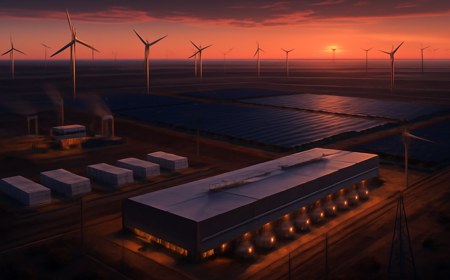
Google Builds the Power Plant Into the AI Factory
Google and Intersect Power announced construction of the Meitner Energy Center in Gray and Roberts Counties, Texas, pairing a new Google da…
Amazon Turns Nvidia GPUs Into a 2028 AI-Factory Supply Line
AWS and Nvidia plan to deploy 2 million additional Nvidia GPUs across AWS global infrastructure in 2027 and 2028, including Blackwell Ultra…

OpenAI Turns Astra Into a Cyber-Containment Release Gate
OpenAI said on August 7, 2026, that internal evaluations of its upcoming Astra model showed significant gains in agentic coding and cyberse…

Google Turns Custom AI Chips Into a Marvell Equity-Control Deal
Marvell disclosed that it entered a July 29, 2026 commercial agreement with Google to develop custom semiconductor products tied to the TPU…
Comments (0)
Security Check
Please complete the captcha to verify you are human.