

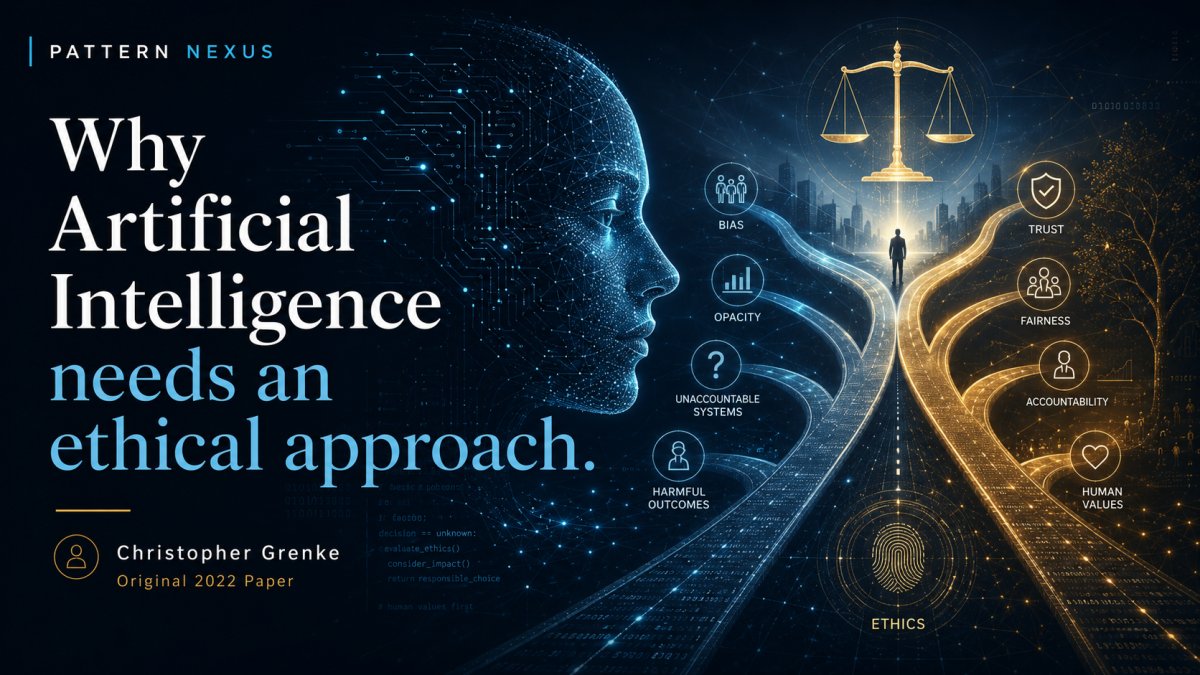
Why Artificial Intelligence needs an ethical approach.
Originally written by Christopher Grenke in 2022, this paper examines artificial intelligence, trust, ethics, human values, algorithmic bias, accountability, and the potential consequences of increasingly advanced A.I. systems. It is being published in its original form without updating its arguments or conclusions to…
Originally written by Christopher Grenke in 2022, this paper examines artificial intelligence, trust, ethics, human values, algorithmic bias, accountability, and the potential consequences of increasingly advanced A.I. systems. It is being published in its original form without updating its arguments or conclusions to…
Jump to a section
Original 2022 Paper
Why Artificial Intelligence needs an ethical approach.
Archive Note: This paper was originally written in 2022 and is being published in its original form. Its wording, arguments, citations, and conclusions have not been updated to reflect developments that occurred after it was written.
Abstract
What is artificial intelligence or A.I., and why should I be concerned about ethics? You have most likely heard the term A.I. by now! Artificial intelligence has the potential to transform our world with far-reaching impacts on society. A.I. will continue to disrupt/displace millions of jobs across all industries. What would a post-labor economy look like? We must approach A.I. with an ethical and moral mindset as we transform into a digital society. Bias exists in all humans. Could an A.I. system become biased, and what can we do to prevent this? Will A.I. ever become self-aware/conscious? Some call this the “Singularity moment,” a point in which humans are no longer the most intelligent life forms on earth. Can we ever trust an A.I. system if it has no consequences for its actions/decisions? All the above questions point to a need for a strong moral and ethical framework to be considered during all A.I. development. We need regulations/industry standards that don't hinder A.I. development but also ensure that human values are not lost as we move to an all-digital A.I.powered world.
What is Artificial Intelligence?
By now, you have some understanding of what A.I. is. You most likely have a google/amazon smart speaker or at least used one. That device is powered by A.I. there are three main ways to classify A.I. (Analytical AI, Human-Inspired AI, Humanized AI). Analytical A.I. has cognitive intelligence. This is the most widely used system in the world today. A smart speaker, image recognition software, or self-driving cars are all analytical A.I.’s as they each use data and past experiences to learn and make future predictions. Human-Inspired AI has all the cognitive intelligence combined with an understanding of human emotions. It can decipher emotions then consider them when making a decision. An example could be a system designed to read the emotions of customer interactions. Humanized A.I. is the most advanced of the three and, it has all the capabilities of the first two, including social intelligence. It also would be self-conscious and self-aware during interaction with other’s or other A.I.’s currently No A.I. has achieved humanized A.I... Kaplan, A., & Haenlein, M. (2019, January 1)
Can A.I. Be trusted
The question of trust is at the center of human ethics. The European Commission's High-level Expert Group on AI (HLEG) has taken the position that we should develop a relationship of trust with A.I. systems. Ryan, M. (2020) How can we trust an A.I. system? What is trust? Should we approach each type of A.I. system differently? I believe we should. An Analytical A.I. system, in theory, should function as programmed and can only make decisions based on the algorithm and provided data. A Human Inspired A.I. system has an understanding of human emotions and will factor that into its decision-making. No Humanized A.I. systems exist today, so we will not be focusing on them. Trust can be defined as a mutual agreement/understanding between two/or more entities. Ryan, M. (2020) explains trust as “rational, affective, and normative” his claim is that A.I. can only meet the requirements for rational trust. I agree with him, as long as A.I. doesn't reach the level of Humanized A.I... He claims that A.I. can't be trusted because it can't be responsible for its actions, and it’s just doing what it was programmed to do. I believe this only applies to Analytical A.I. systems. They are based on a set program designed with a specific task/outcome. He is right that trust must be placed in the developers/instructions using this version of A.I... More advanced Human Inspired A.I. and the far more advanced Humanized version will need to be ethical and trustworthy. A Self-aware A.I. will make decisions not only on its base programs but also as it learns and adapts. The outcomes could become unpredictable. Trusting this technology will do what it was intended to do is essential.
Why A.I. Needs Ethics.
Now that we have a basic understanding of the three types of A.I., let's look at how ethics can apply to each. However, Analytical A.I. should be ethical since it’s only capable of doing what it was programmed\learned. It falls on the developers/end-users to be ethical themselves during the development/implementations of A.I. systems. Having reasonable regulations ensures that all human values, both quantifiable and non-quantifiable aspects, are represented in and continuously evaluated as to their effectiveness in A.I. systems. The field of A.I. research must also include the humanities and social sciences. Developing systems intended to potentially evolve life as we know it requires understanding ethical and social contexts implementing them into core A.I. systems development. We can shape out a new digital society with ethics at the core. Quinn, R. A. (2021)
What about more advanced A.I. systems? What if the A.I. chooses to act in a way that is not intended? Analytical A.I. have been known to have unintended outcomes. You could say that there was an error in the programming code, a human error. What happens when more advanced A.I. systems are developed? I included a quote from Raymond Kurzweil below. It raises more questions about the importance of ethics and human values being at the core of all A.I. systems. This goes beyond what is intended in this paper however something that must be considered and evaluated consistently.
“The idea of singularity is that if the trajectory of artificial intelligence reaches up to systems that have a human level of intelligence, then these systems would themselves have the ability to develop AI systems that surpass the human level of intelligence, i.e., they are “superintelligent” (see below). Such superintelligent AI systems would quickly self-improve or develop even more intelligent systems. This sharp turn of events after reaching superintelligent AI is the “singularity” from which the development of AI is out of human control and hard to predict (Kurzweil 2005: 487).”
How can we prevent Bias in A.I. Systems.
What can we do to address bias in A.I. systems? There are 4 key stages in the development of A.I. systems. First you have Data Creation followed by Problem Formulation and Data Analysis. As most A.I. systems are built to analyze some form of data they normally exist before the A.I. system. If bias exists in the data, it is likely the system will show this. You could have a data set that does not have bias and still at the Problem Formulation or Data Analysis stage produce a bias A.I. system. The design of the algorithm or the way it ranks different aspects of the data set could also produce biased results. The final stage of the development pipeline is Validation and Testing. This is where the A.I. system is evaluated and its most susceptible to bias. If the developer/users are biased themselves. Then may not like the results of the algorithm and therefore change it to produce a bias result from otherwise clean data. We need to unsure the data we use has a good representation of a large sample of data points. When analyzing the data, we must understand what we are trying to gain from the data and have a complete understanding of what is being represented in the data set. Human recall bias can limit the scope of the program and return bias results. SRINIVASAN, R., & CHANDER, A. (2021)
Conclusion.
In conclusion, we have a better understanding of what Artificial Intlegance is. This technology is still in its infancy, and the expectations are endless. We must establish a strong international set of regulations governing the development/implementation/use of A.I. systems. With human values, morals, and ethics at the core of all A.I. systems, We must constantly assess said systems and their effects on human life. I believe in establishing trust in A.I. systems not only in the industry but also in all aspects of our evolving digital world. A.I. systems will continue to change our world. It’s up to us to hold the governments and institutions accountable. Ensuring that all A.I. systems are ethical, moral, respect, and value human life, including all aspects of life including something as someone's desires/goals. It's essential we carry into our digital world all the things that make us unique.
References
- Kaplan, A., & Haenlein, M. (2019, January 1). Siri, Siri, in my hand: Who’s the fairest in the land? On the interpretations, illustrations, and implications of artificial intelligence. Business Horizons. https://doi.org/10.1016/j.bushor.2018.08.004
- Ryan, M. (2020). In AI We Trust: Ethics, Artificial Intelligence, and Reliability. Science and Engineering Ethics, 26(5), 2749–2767. https://doi.org/10.1007/s11948-020-00228-y
- Quinn, R. A. (2021). Artificial intelligence and the role of ethics. Statistical Journal of the IAOS, 37(1), 75–77. https://doi.org/10.3233/SJI-210791
- Müller, Vincent C., "Ethics of Artificial Intelligence and Robotics", The Stanford Encyclopedia of Philosophy (Summer 2021 Edition), Edward N. Zalta (ed.), URL = https://plato.stanford.edu/archives/sum2021/entries/ethics-ai/.
- SRINIVASAN, R., & CHANDER, A. (2021). Biases in AI Systems. Communications of the ACM, 64(8), 44–49. https://doi.org/10.1145/3464903
What's Your Reaction?
 Like
0
Like
0
 Dislike
0
Dislike
0
 Love
0
Love
0
 Funny
0
Funny
0
 Wow
0
Wow
0
 Sad
0
Sad
0
 Angry
0
Angry
0

Nexus (Christopher)
Founder of Pattern Nexus. I research markets, macro, geopolitics, AI, history, ancient systems, and the patterns most people overlook. I’m also building Market Radar, a trading scanner designed to read pressure, risk, confirmation, and setup quality before ch…
Related research
The Surveillance State: Does Humanity Need a Nanny?
A Pattern Nexus article on the surveillance state after AI, asking whether humanity’s old fear of Orwellian control changes once artificial…
4 shared topics.
The 2026 System Pressure Poll: Where Are America and the World Actually Going?
This is not another left-versus-right approval poll. The Pattern Nexus System Pressure Poll examines the deeper structures shaping curre…
3 shared topics, same research avenue.
Alone Together: The Dual Impact of the Internet and AI
From AOL chat rooms to artificial intelligence, technology has redefined connection and isolation. The evolution of the internet reshaped s…
3 shared topics, same research avenue.
Pattern Nexus Worldview — Full Digital Edition
Read the complete 10-chapter digital edition of Pattern Nexus Worldview by Christopher Grenke. A systems-level examination of money, liquid…
3 shared topics.
No One Who Wants Power Should Have It: The 90-Day State
Elections reward the people best adapted to campaigning, fundraising, party advancement and self-promotion—not necessarily the people best …
2 shared topics, same research avenue.
The Female Logic Gate: How Coherent Societies Checked Male Power
A Pattern Nexus research article on the forgotten civilizational structure behind stable societies: male executive power often existed besi…
2 shared topics, same research avenue.
Peak Insanity: Pure Speculation on a World That No Longer Organizes Itself
This is not a prediction article. It is not a clean thesis. It is a speculative Pattern Nexus thought-run through the pressure stack buildi…
2 shared topics, same research avenue.
The Older Signal: Lost Civilizations, Broken Archives, and the Pattern Beneath Human History
A Pattern Nexus three-level research article mapping deep-time human capability, lost archives, drowned coastlines, megalithic architecture…
2 shared topics, same research avenue.
Comments (0)
Security Check
Please complete the captcha to verify you are human.