

A Thought Experiment: Consciousness
Human labels are one interpretation of a world already full of other minds. Whales, dolphins, crows, our stellar origins, and a thought experiment about consciousness as the universe experiencing itself.
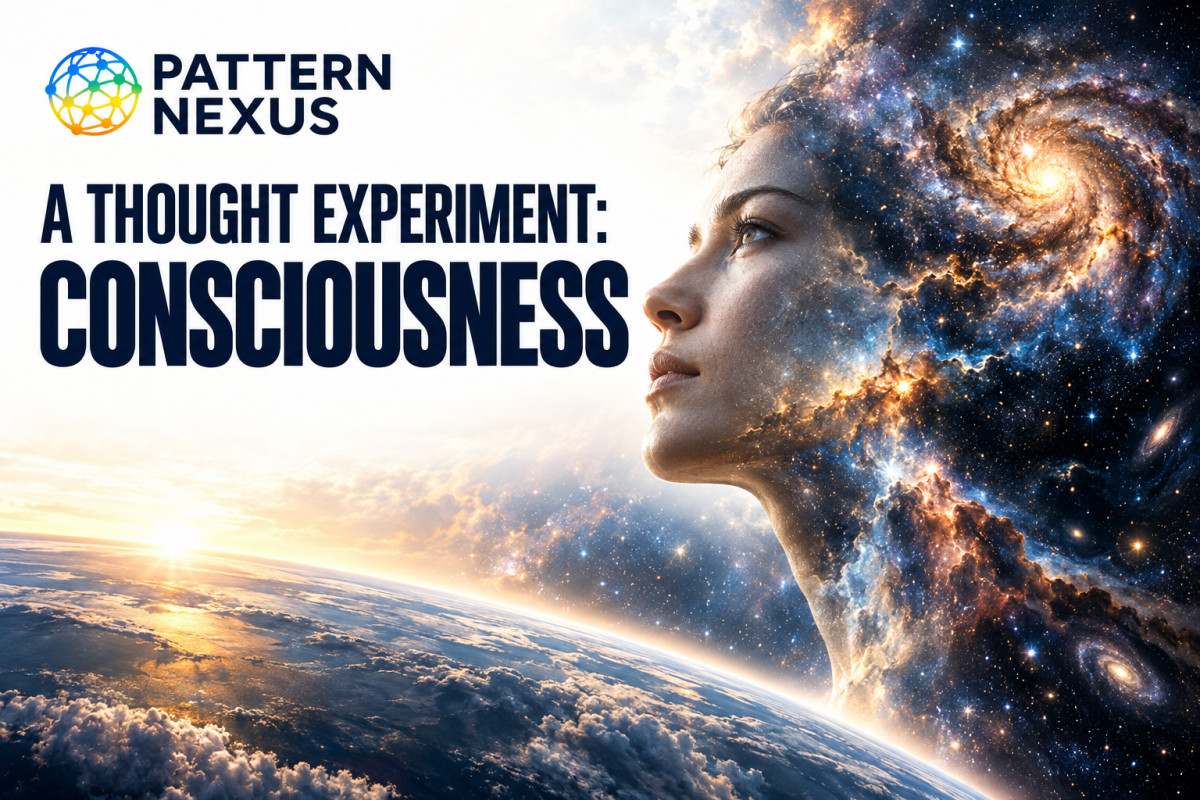
Human labels are one interpretation of a world already full of other minds. Whales, dolphins, crows, our stellar origins, and a thought experiment about consciousness as the universe experiencing itself.
Jump to a section
Our explanation of reality is built around us.
Before I go on this journey, we need to establish a baseline. Everything humans have named, labeled, valued, or assigned a purpose has passed through a human mind. We built the language, the categories, and the systems we use to explain it. Much of what we fight over and spend our lives chasing only matters inside those systems. For this thought experiment, I want to step outside that human-centered view and consider what we are actually participating in.
Everything is made up. Let me explain what I mean.
The land existed before the deed. The planet existed before the border. The material existed before we named it, priced it, or decided what it was for. Those names and rules let us communicate and organize a civilization. They also make it very easy to forget where the physical world ends and our agreements about it begin.
Take money. The paper, metal, or computer storing the balance has a physical existence. The value depends on a system of human agreements, institutions, expectations, and enforcement. That value can determine whether somebody eats tonight. Something being made up does not stop it from having enormous consequences.
That is what I mean when I say most of what we call reality is made up. We encounter something, give it a name, decide how to use it, and fit it into a human communication structure. We then start treating that structure as though it came with the universe.
Our descriptions can be accurate and useful while still being incomplete. A calendar helps us coordinate our lives. It does not mean the universe is keeping track of Monday.
| What exists or happens | What humans add | Why the distinction matters |
|---|---|---|
| Land and its physical features | Borders, deeds, ownership, and prices | The territory and the rules governing it are different kinds of things. |
| Physical change and recurring cycles | Seconds, calendars, deadlines, and workweeks | Our timekeeping organizes processes it did not create. |
| A material and its physical properties | A name, a price, and a chosen use | Our current application does not exhaust what the material can do. |
| A person living among other people | Titles, status rankings, and measures of success | A social ranking is a judgment within a human system. |
There are entire social worlds around us that do not run on human definitions.
Whales, dolphins, and crows matter to this argument because they already live inside relationships and communication systems that have meaning without our participation. They recognize individuals, learn from one another, maintain social connections, and pass information through their communities. We arrive with a microphone and a human vocabulary, and then judge the world we are hearing by how much of it we can translate.
Whales have cultures, relationships, and ways of learning from one another.
Humpback whales learn songs socially, and those songs can move between populations across an ocean basin. Researchers have traced song transmission across the South Pacific, from western populations through French Polynesia and into Ecuador. A separate 2025 study, using eight years of recordings, found language-like statistical structure in humpback song. We are looking at learned, organized communication moving through a culture. [1] [2]
Killer whales give us another example. Researchers studying southern resident orcas documented whales biting off pieces of kelp and using them between their bodies during social grooming. The behavior involves making a tool and using it with another whale. That belongs in our understanding of their intelligence and their relationships. [3]
Belugas form social networks extending beyond close relatives. Research has documented unrelated individuals traveling together over long periods, sometimes separating and reuniting. Contact-call studies have also examined what belugas do during isolation, reunion, births, external stress, and the death of a calf. Those are the circumstances in which attachment, recognition, and distress become relevant. The emotional side of these animals belongs in the discussion alongside their problem-solving abilities. [4] [5]
Sperm whale research adds still another system: click sequences with combinations of rhythm, tempo, and contextual variation. Different species have developed different ways of organizing and maintaining a social world. [6]
Dolphins remember who they are dealing with.
Bottlenose dolphins develop individual signature whistles, and playback experiments show that copies can be used to address particular individuals. Another study found recognition of former companions' signature whistles after separations lasting at least 20 years. An individual, a learned identity signal, and a relationship remembered across decades: that is a substantial social and cognitive system. [7] [8]
The U.S. Navy has spent decades working with dolphins because their capabilities have practical value. Its Marine Mammal Program trains bottlenose dolphins to locate and mark underwater mines and to help detect unauthorized swimmers and divers. We depend on their ability to learn tasks and operate within an environment that humans and machines can struggle to read. [9]
We also recognize that human interference can harm their lives. In the United States, feeding or harassing wild marine mammals is prohibited. NOAA warns against swimming with, touching, or attempting to interact with them, and some populations have specific legal approach restrictions, including Hawaiian spinner dolphins. These protections concern animals with their own feeding, resting, movement, and social needs. [10]
Crows recognize us, learn about us, and share information.
Wild American crows can learn the face of a threatening human and remember it for years. Other crows can learn to respond to that face through social exposure, including young birds learning from their parents. The information does not have to remain inside the bird that had the original encounter. A particular human becomes a recognizable individual with a history inside the crows' social world. [11] [12]
The newer recording and AI work makes this even more interesting. University of León and Earth Species Project researchers equipped wild carrion crows with miniature recorders and used machine learning to detect more than 127,000 vocalizations. They captured quiet, close-range communication that conventional recording methods often missed. The loud caw humans notice is only part of what these birds are doing. [13]
A 2026 preprint extends this line of research by mapping vocal repertoires to behavior in cooperatively breeding crows. Separate tracking research on New Caledonian crows has mapped encounters across multi-family communities and modeled how rapidly information could flow through those local networks. There is a social structure here, with pathways through which knowledge can move. [14] [15]
Their lives do not begin when we understand them.
This is the part I want readers to consider. A whale does not need our word for culture before it can learn something from another whale. A beluga does not need our word for attachment before a relationship can matter. A crow does not need a human name for you before it can recognize you and learn how to respond to you.
The scientific discussion has already moved beyond treating conscious experience as an exclusively human possibility. The 2024 New York Declaration on Animal Consciousness states that there is strong scientific support for conscious experience in other mammals and birds. [16]
Our inability to follow another species' communication is a limit in our access to its world. It does not make that world empty. This is why the animal research belongs at the center of a thought experiment about consciousness. Human experience is one form of access to reality. We keep trying to make it the definition of reality itself.
Giving something a use does not finish discovering it.
There is another assumption buried in all of this: once we find a use for something, we act as though we have figured out what it is for. A material becomes a tool. A substance becomes a product. A process becomes an industry. The use that works for us becomes the identity of the thing.
Think about silicon. Its physical properties did not begin when humans learned to build semiconductors. What changed was our understanding of what we could do with those properties. There is no reason to assume our current uses exhaust the possibilities of the materials and processes around us.
I suspect many things we use have applications we have not even considered. Whether those uses would be better depends on what we are trying to achieve. The larger point is that the limits of our imagination are not the limits of what something can do.
This is where I keep coming back to the same problem: we do not know what we do not know. We have learned enough to split atoms and send instruments beyond the planets. We still cannot measure the size of everything we are missing. Knowing more than the previous generation does not mean we are close to knowing the whole system.
What are we actually trying to win?
Now look at how much of a human life gets spent defending status, accumulating symbols, arguing over labels, and trying to meet expectations established by other people. We inherit a scoreboard and spend decades trying to move up it.
Food, shelter, safety, relationships, and the conditions that keep us alive matter. So does what we do to one another. My point is that a huge amount of the competition layered on top of those needs has significance because humans keep assigning significance to it. I see no reason to assume those rankings have some built-in purpose in the natural structure of the universe.
That is what I mean by pointless in the grander scheme. A title can matter inside an organization. A possession can signal success inside a culture. An argument can consume somebody's entire week. Change the social system, or step outside the species, and much of that importance falls away.
The useful question is what remains valuable once we recognize that we assigned the score. For me, understanding more, building something useful, and improving the experience of being alive hold up much better than spending a life defending a label.
You are a supernova.
I use that phrase because I want people to stop thinking of themselves as something that arrived separately from the rest of the universe. The material in your body has a history that reaches far beyond you.
Stars make heavier elements through nuclear reactions. Stellar winds, supernovae, and other stellar events return material to space, where it can become part of later stars and planets. The carbon, oxygen, and iron in a human body belong to that larger history. The hydrogen has a different, earlier origin. We are a mixture of cosmic processes, rather than the product of one particular explosion. [17]
So when I say you are a supernova, I am compressing an enormous physical history into a phrase. You are living material assembled from processes that took place long before Earth existed. Some of that material is now reading these words and thinking about where it came from.
That connection is the part I want you to sit with. The universe produced the material that became a being capable of asking what the universe is.
What if consciousness is the universe experiencing itself?
This is where I move from that physical connection into the thought experiment. I keep coming back to the idea that consciousness and reality are connected more deeply than the way we normally discuss them allows. I have worked through parts of this in The Trap of Reality: Consciousness, the Observer, and the Field Layer Beneath Spacetime.
Consider what an experience actually involves. Something happens in the universe, and a living system within it has an experience of that event. The observer came from the same physical history as the thing being observed. A whale, a crow, and a human bring very different capacities and histories to that encounter. If we begin by treating the human version as the whole subject, we have already excluded much of what we are trying to understand.
My larger question is whether that is incidental, or whether experience belongs more deeply to the structure of reality. Perhaps consciousness is one way the universe comes to understand itself. Perhaps what we call an individual is a temporary perspective within something much larger.
I do not mean that every event was arranged to teach a person a lesson. I mean that there may be a relationship between existence and experience that our human categories are poorly equipped to describe. Calling something a brain, a self, or an observer gives us a place to start. It does not complete the explanation of why there is an experience at all.
The simpler version of this idea already follows from our place in nature: we are parts of the universe that can investigate it. The deeper version asks whether consciousness has a more fundamental role. That is the possibility I am exploring.
Even our idea of the container may be incomplete.
The discussion around James Webb observations and black hole cosmology is interesting to me for exactly this reason. We can spend our entire lives arguing about what happens inside a system while still misunderstanding the scale or structure of the system itself.
One piece of evidence being discussed comes from a 2025 study of the apparent rotation directions of galaxies in a James Webb deep field. Lior Shamir reported an imbalance in the sample. The study and the university's account discuss possible explanations, including observational effects and the possibility of a rotating universe, which could fit some black hole cosmology models. That is evidence worth investigating, with the interpretation still open. [18]
The broader idea predates Webb. Physicist Nikodem Popławski has developed models in which the collapse inside a black hole avoids a singularity and gives rise to an expanding universe. In that kind of model, what appears to be an entire universe from the inside could exist within a larger structure. The possibility of universes within black holes is the part that interests me; the specific models have to stand or fall on their physics and observations. [19]
White holes enter a related discussion. They are theoretical objects that allow matter and light to emerge rather than enter, and some research explores black holes transitioning into white holes. A confirmed white hole would give us something extraordinary to investigate. Connecting it to the origin of our universe would still require evidence of that connection. [20]
For this thought experiment, the important possibility is that what we call the whole universe may not be the largest structure there is. Even the word universe could turn out to describe a boundary in our understanding.
Start by noticing what we added.
I am not asking you to abandon your life or pretend human responsibilities disappear. I am asking you to notice how much of the reality you defend consists of meanings humans assigned, and how quickly those meanings can start limiting what you are willing to consider.
Try it with something ordinary: a possession, a title, a disagreement, or a goal. Ask what is physically there, what you are experiencing, and what meaning you or your society added. Then ask whether that meaning is helping you understand the thing or keeping you from looking any further.
The fact that we create meaning gives us responsibility for what we create. We can decide that learning matters, that another person's experience matters, and that understanding the world is worth more than winning an argument about the names we gave it.
What interests me is the possibility that consciousness is far more connected to reality than our everyday language makes it sound. We are made from the universe, living inside it, experiencing it, and trying to understand it. Maybe that is closer to our purpose than most of the things we spend our lives competing over.
Research behind the discussion
-
Schulze, J. N., et al. (2022). Humpback whale song revolutions continue to spread from the central into the eastern South Pacific. Royal Society Open Science, 9, 220158. Inter-population song transmission across the South Pacific.
-
Arnon, I., et al. (2025). Whale song shows language-like statistical structure. Science, 387, 649–653. Analysis of eight years of humpback recordings.
-
University of Exeter / Center for Whale Research (2025). Killer whales make seaweed tools to scratch each other’s backs. Research-team account of the Current Biology study, Wild killer whales manufacture and use allogrooming tools. Findings concern southern resident killer whales.
-
O’Corry-Crowe, G., et al. (2020). Group structure and kinship in beluga whale societies. Scientific Reports, 10, 11462. Social relationships involving relatives and non-relatives.
-
Vergara, V., Michaud, R., & Barrett-Lennard, L. (2010). What can captive whales tell us about their wild counterparts? Identification, usage, and ontogeny of contact calls in belugas. Contact-call use across socially significant events, with observations from captive and wild belugas.
-
Sharma, P., et al. (2024). Contextual and combinatorial structure in sperm whale vocalisations. Nature Communications, 15, 3617. Contextual and combinatorial structure in sperm whale click sequences.
-
King, S. L., & Janik, V. M. (2013). Bottlenose dolphins can use learned vocal labels to address each other. PNAS, 110, 13216–13221. Playback evidence of individually addressed signature whistles.
-
Bruck, J. N. (2013). Decades-long social memory in bottlenose dolphins. Proceedings of the Royal Society B. Recognition of former companions’ signature whistles after long separations in a study involving animals housed at different facilities.
-
Naval Information Warfare Center Pacific. Marine Mammal Program. Official description of mine-location and swimmer-detection work.
-
NOAA Fisheries. Frequent questions: Feeding or harassing marine mammals in the wild. Federal prohibitions and guidance are distinct from population-specific approach rules. NOAA: Hawaiian spinner dolphin approach restrictions.
-
Marzluff, J. M., et al. (2010). Lasting recognition of threatening people by wild American crows. Animal Behaviour. Long-lasting recognition of human facial features in wild birds.
-
Cornell, H. N., Marzluff, J. M., & Pecoraro, S. (2012). Social learning spreads knowledge about dangerous humans among American crows. Proceedings of the Royal Society B. Horizontal and parent-to-young social learning about dangerous human faces.
-
Baglione, V., et al. (2025). Capturing vocal communication in a free-living corvid: high-resolution data from low-impact miniaturized tags. Animal Cognition, 28, 85. Bird-borne recordings and machine-learning detection of more than 127,000 vocalizations. Earth Species Project: research-team summary.
-
Cusimano, M., et al. (2026). Repertoire-behavior mapping reveals signal functions in cooperatively breeding crows. Preprint. Preprint listed by the collaborating research organization. Earth Species Project: publication listing.
-
St Clair, J. J. H., et al. (2015). Experimental resource pulses influence social-network dynamics and the potential for information flow in tool-using crows. Nature Communications, 6, 7197. Field-recorded local association networks; information diffusion was simulated.
-
Andrews, K., Birch, J., Sebo, J., Sims, T., and fellow signatories (2024). The New York Declaration on Animal Consciousness. Scientific declaration and supporting background on evidence concerning animal experience.
-
NASA Science. Stars. Stellar element formation and the enrichment of later generations of stars. For primordial hydrogen, see NASA's account of the early universe. NASA: Cosmic history.
-
Shamir, L. (2025). The distribution of galaxy rotation in JWST Advanced Deep Extragalactic Survey. Monthly Notices of the Royal Astronomical Society, 538, 76–91. Study of galaxy rotation directions in a particular deep field, with multiple possible explanations. Kansas State University: the researcher’s account.
-
Popławski, N. J. (2010). Cosmology with torsion: An alternative to cosmic inflation. A theoretical model connecting a cosmological bounce with collapse inside a black hole.
-
Haggard, H. M., & Rovelli, C. (2014). Black hole fireworks: quantum-gravity effects outside the horizon spark black to white hole tunneling. A theoretical black-to-white-hole transition model.
This article develops my interpretation and a thought experiment. The cited studies support the specific research discussed alongside them.
Frequently Asked Questions
What's Your Reaction?
 Like
0
 Dislike
0
 Love
0
 Funny
0
 Wow
0
 Sad
0
 Angry
0

Nexus (Christopher)
Founder of Pattern Nexus. I research markets, macro, geopolitics, AI, history, ancient systems, and the patterns most people overlook. I’m also building Market Radar, a trading scanner designed to read pressure, risk, confirmation, and setup quality before ch…
Related research
The Signal Under the Noise: The Perennial Pattern and the Modern Machine
A Pattern Nexus systems read on an “ancient texts agree on five truths
3 shared topics, same research avenue.
The Trap of Reality: Consciousness, the Observer, and the Field Layer Beneath Spacetime
Donald Hoffman is closer to the truth because he is trying to step outside the interface. Tom Bilyeu is still trying to explain the interfa…
3 shared topics.
The AI Causal Chain Explained Like You're Five: From Cold War Radar to Robots and the Economy
AI did not begin with ChatGPT. This accessible, fully sourced Pattern Nexus research map follows the 1943 artificial-neuron paper, Cold War…
2 shared topics, same research avenue.
The AI Is the Same. The System Isn’t: How Long-Term Use Creates a Shared Language
After a conversation moved from a media headline to political age limits, documented forecasts, cognitive bias, simulation theory, and fina…
2 shared topics, same research avenue.
Google Turns Rogue AI Agents Into an Insider-Threat Security Problem
Google DeepMind published an AI Control Roadmap alongside a June 18, 2026 blog post on securing internal AI agents. The roadmap treats some…
2 shared topics, same research avenue.
They Put a Fly Brain in Minecraft. The Mind-Uploading Pipeline Is No Longer Hypothetical.
A complete fruit-fly central nervous system can now be mapped at synaptic resolution, instantiated as a computational network and wired int…
2 shared topics.
The Surveillance State: Does Humanity Need a Nanny?
A Pattern Nexus article on the surveillance state after AI, asking whether humanity’s old fear of Orwellian control changes once artificial…
2 shared topics.
Ancient China Was Not Isolated: Megaliths, Mercury Rivers, Quantum Pigments, and the Pattern Layer Nobody Wants to Connect
This article uses a full video transcript on ancient Chinese mysteries as the starting point, then breaks each site and artifact through th…
2 shared topics.
Comments (0)
Security Check
Please complete the captcha to verify you are human.