
They Put Human Neurons in a Data Center. Now the Servers Have to Be Fed.
Singapore now has a 20-unit computing rack built around living human neurons growing on electrode-fitted silicon. The cells receive software-defined electrical inputs, return spikes that can control a simulated environment, and require nutrient medium, gas balance, temperature control and waste filtration to remain alive. This Pattern Nexus investigation separates the real NUS–DayOne–Cortical Labs prototype from the viral version, explains the closed-loop mechanism from first principles, tests the energy and learning claims, examines the ethics, and connects the living rack to the fly-brain mind-uploading pipeline.
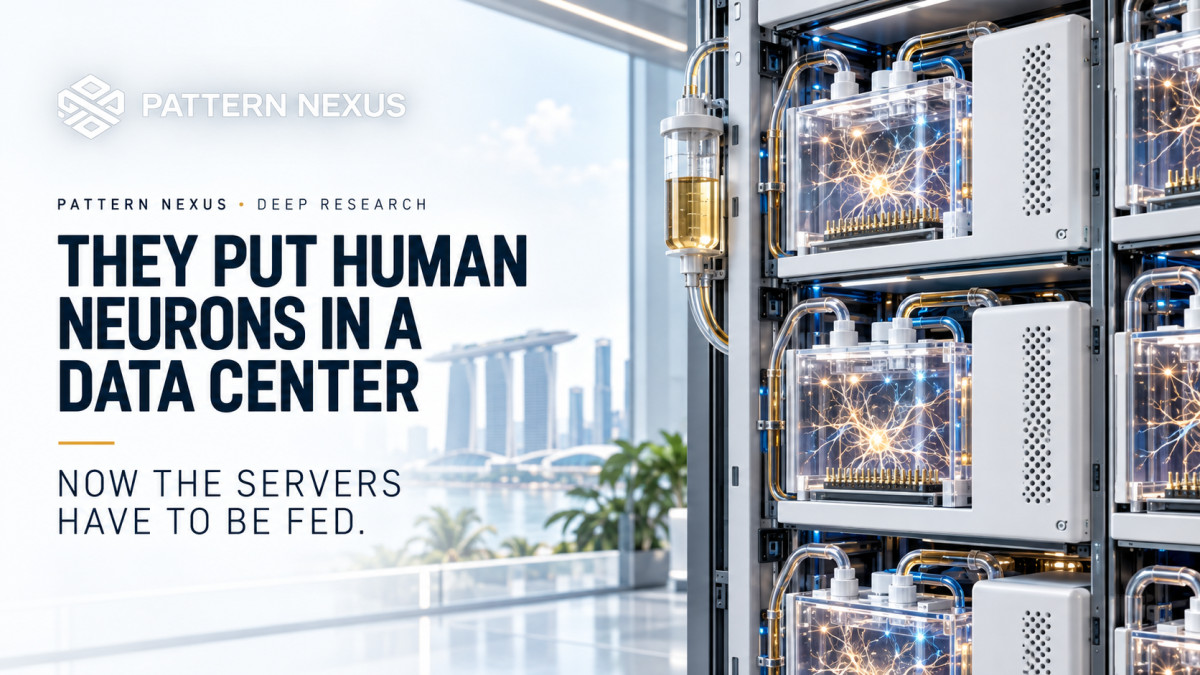
I had to read this one twice because it sounds like somebody combined a data-center press release with a scene from science fiction. A facility in Singapore is running computing units built around living human neurons. The cells sit on silicon chips, exchange electrical signals with software, and have to be kept alive with nutrient solution, controlled temperature, filtered fluid and a carefully managed mix of carbon dioxide, oxygen and nitrogen. Every three days, technicians replenish a cocktail that Singapore’s Straits Times described as sugar, micronutrients and pH buffers.[3]
So yes, the central claim is real. On July 16, 2026, a 20-unit rack of Cortical Labs CL1 biological computers went live at the National University of Singapore’s Centre for Life Sciences. NUS Medicine, Singapore-based data-center operator DayOne and Melbourne-based Cortical Labs publicly showcased it on August 6 and announced the prototype later that month. Each unit contains a living neural culture grown over a microelectrode array, plus conventional electronics and a life-support system. The partners call it the world’s first independently operated biologically integrated server rack.[1][2][3]
But I want to get the language right before the headline runs away with the story. This is not a warehouse full of conscious human brains. It is not a general-purpose replacement for GPUs. It is not running ChatGPT. It is not one giant network of millions of neurons thinking as a single mind. It is a research prototype made of 20 separate hybrid systems. The neurons are alive in the cellular sense. Nothing published about this installation demonstrates human-like thought, awareness, memory or suffering.
What is real is still extraordinary. Software can now send precisely timed electrical inputs into a living human neural network, record its spikes, translate that activity into an action inside a simulated environment and return the consequences as new stimulation. Researchers can access that loop through code. The cells adapt physically as their synapses change. The machine therefore has an electronic half, a biological half and an interface that makes each half causally relevant to the other.[5][7][8]
That is why this belongs directly beside the fly-brain piece we just did. In that article, the pipeline moved from a biological nervous system to a mapped connectome, then into a computational model and finally into a synthetic world. Singapore reverses the direction. Here, software does not simulate the neurons. Software builds a world around living neurons and plugs them into it. The fly project digitizes biology. The CL1 project biologizes computation. The important thing is not the sugar water. The important thing is that living human neural tissue has crossed from a bespoke dish experiment into rack-mounted, API-addressable infrastructure.
The cells are genuinely alive. They need nutrients, stable temperature, controlled gases, circulating fluid and waste filtration. The life-support system is part of the computer.
The cells are not a donated brain. Singapore’s neurons were derived from adult blood cells that were reprogrammed into induced pluripotent stem cells and then differentiated into neurons.
“Code deployable” needs translation. Python controls the timing and structure of electrical stimulation and reads the resulting spikes. The code runs on conventional electronics; the living culture is the adaptive physical substrate inside the loop.
Low wattage is not the same as superior compute. A CL1 reportedly draws about 30 watts, but there is no public benchmark showing that it performs the same useful work as a GPU, CPU or conventional AI server.
01 · REALITY CHECK
Yes, It Is Real — With an Important Qualification
The clean answer is yes. The installation exists. It contains 20 CL1 units. The cells are alive. They are human-derived. They are electrically connected to silicon. The cultures have to be fed. The rack is operating in a live research environment at NUS Medicine, and the partners have shown it to outside guests.[1][2][3]
The qualification is the phrase data center. Most readers hear that phrase and picture a building packed with server racks running databases, websites, cloud applications or large AI models. That is not what NUS has today. The Singapore system is one biological-computing rack inside a university life-sciences facility. Its immediate purpose is joint research, validation and operational learning. DayOne’s March announcement says a later phase could move into one of its commercial data-center facilities, where the companies would test integration under real-world electrical, environmental and cooling constraints.[4]
In other words, this is a biological data-center prototype, not a mature commercial data center. That distinction does not make it fake. It tells us what stage of the transition we are looking at. The project has moved beyond a single benchtop culture, but it has not yet become standardized production infrastructure.
| Viral claim | What the evidence supports |
|---|---|
| “A Singapore data center runs on human brains.” | A 20-unit research rack at NUS uses living human-derived neuronal cultures integrated with silicon. |
| “The servers drink sugar water and amino acids.” | Technicians replenish nutrient medium every three days; public reporting lists sugar, micronutrients and pH buffers. The exact Singapore formulation has not been publicly disclosed. |
| “Millions of neurons form one computer.” | The rack contains 20 separate CL1 cultures. They are not documented as one unified neural network. |
| “It replaces AI chips.” | The system is experimental and complementary. Conventional silicon remains far better for fast, exact, repeatable calculation and large language models. |
| “It is conscious.” | No published evidence demonstrates phenomenal consciousness, self-awareness, pain or a personal mind in the CL1 cultures. |
The real story survives every correction. We have begun treating living neural tissue as a component that can be installed, networked, programmed around, remotely accessed and scaled in racks. That is the threshold.
02 · THE HARDWARE
What Is Actually Inside the Rack
Each CL1 is a hybrid machine. The living part is a culture of neurons spread across a silicon chip fitted with a dense array of microscopic electrodes. Those electrodes can do two things: deliver electrical stimulation into selected parts of the culture and record the electrical spikes the neurons produce in response. Conventional processors, firmware and software schedule those interactions, convert analog signals into data and keep the experiment synchronized in real time.[5][6][8]
The enclosure also contains the machinery required to keep the biological substrate viable: pumps, fluid circulation, temperature control, gas mixing and filtration. Cortical Labs says the self-contained system can maintain a neural culture for as long as six months. It also includes ordinary computing interfaces, a touchscreen and connections that can link the neural network to cameras, actuators and other external devices.[5][13]
That architecture is why I do not think “brain cells replacing silicon” is the right mental model. Silicon has not disappeared. It surrounds the culture. It generates the stimulation, digitizes the response, runs the operating environment, handles storage and networking, and keeps the cells alive. The neurons contribute adaptive dynamics and plasticity inside a larger engineered control system.
There is also a basic number problem in the public coverage. The Singapore reporting says each CL1 contains at least 200,000 neurons, which implies at least four million across 20 units.[3] An IEEE Spectrum profile published around the CL1’s 2025 commercial launch reported 800,000 neurons per unit, which would imply roughly 16 million across the rack.[13] Those numbers may reflect different culture configurations, manufacturing changes or the difference between minimum and typical counts. The public sources do not reconcile them, so I am not going to pretend the viral 16-million figure is settled.
More important, even 16 million neurons would not mean a 16-million-neuron brain. The 20 cultures are separate. No public technical record shows them joined into one continuously communicating biological network. A rack is a collection of systems, not automatically a single mind.
03 · THE CELLS
Where the Human Neurons Come From
The phrase human brain cells makes people imagine that tissue was removed from somebody’s brain. That is not what happened here. According to the Singapore reporting, the process begins with adult blood cells. Scientists reprogram those cells into induced pluripotent stem cells, or iPSCs. Pluripotent means the cells have been pushed back into a state from which they can be directed toward several specialized cell types. Researchers then differentiate them into neurons and grow those neurons on the electrode surface.[3]
This matters for both the science and the emotional reaction. The neurons carry human DNA from a donor, but they do not arrive with the donor’s memories, personality, learned skills or personal identity. Memory is not stored in the genome like a folder waiting to be reopened. A person’s memories depend on the developed structure and changing activity of a living nervous system. Reprogramming a blood cell does not recover that system.
The culture is also not a tiny anatomical copy of a brain. The CL1 is generally described as a two-dimensional neuronal culture growing across a microelectrode array, not a complete three-dimensional brain organoid with the layered architecture, sensory organs, blood supply, body, developmental history and billions of interacting cells that make an intact brain what it is. NUS researchers are interested in producing particular neuronal and support-cell combinations, but that is a research program, not evidence that the present device contains a miniature person.[2][3]
What these cells do possess is the property that makes the whole field possible: neurons form connections, fire electrical signals and change those connections in response to experience. They are living adaptive matter. The engineering question is whether that adaptability can be shaped into repeatable, useful computation.
04 · LIFE SUPPORT
Why the Computer Has to Be Fed
A silicon chip can sit on a shelf. A neural culture cannot. Living cells continuously consume energy, maintain ion gradients, build and repair proteins, regulate acidity and remove waste. In a body, blood and surrounding tissue perform that support work. In a CL1, an engineered perfusion system has to do it.
The Straits Times reported that technicians replenish the Singapore cultures every three days with a mixture of sugar, micronutrients and pH buffers. A gas mixer supplies carbon dioxide, oxygen and nitrogen. Pumps circulate the medium, temperature controls keep the cells in their viable range, and filtration removes waste products.[3] Cortical Labs describes the cells as living in a nutrient-rich solution and says the complete life-support environment can keep them healthy for up to six months.[5]
Calling that mixture “sugar water” is funny, memorable and directionally true. It is also incomplete. Neural culture medium is closer to a synthetic bloodstream than a drink. Glucose supplies metabolic fuel. Salts and buffers stabilize the electrical and chemical environment. Vitamins, trace nutrients and other components support cell function. Amino acids are common ingredients in neuronal culture media because cells use them to build proteins and maintain metabolism, but the partners have not published the exact recipe used in the Singapore rack. I can verify the reported sugar, micronutrients and pH buffers; I cannot verify every ingredient in a proprietary medium from the public record.
The feeding schedule also reveals something deeper. With ordinary computers, cooling and power are support infrastructure. With wetware, metabolism becomes infrastructure. Uptime now depends on sterile technique, cell health, fluid chemistry and gas exchange. The server does not merely consume electricity. Part of it is alive, so operations begin to look like a combination of cloud engineering, laboratory husbandry and intensive care.
05 · THE INTERFACE
How Code Reaches Living Neurons
Cortical Labs calls the CL1 the first “code-deployable biological computer.” That phrase is accurate only if we understand what is being deployed where. Python does not execute inside a neuron. There are no biological variables, files or software instructions stored in the cells in the ordinary computing sense.
The code defines an experiment. It tells the electronic system which electrodes to stimulate, when to stimulate them, how strong the pulse should be, how to encode information across channels, what neural activity to record and what to do when particular spike patterns appear. The CL API is designed to give programmers predictable timing, ordering and synchronization while the hardware translates those requests into electrical contact with the culture.[7][8]
The loop is the computation. Software creates a simplified world and converts part of that world into stimulation. The neurons respond with electrical spikes. Software maps those spikes to an action. The action changes the world. The consequence comes back as new stimulation. Over repeated cycles, neural plasticity may alter how the culture responds.
The newest CL API work matters because biological experiments are extremely sensitive to timing. If a pulse arrives late, if software jitter changes the interval, or if two channels are not synchronized, a researcher can mistake an interface artifact for a biological effect. Cortical Labs’ 2026 technical preprint describes a declarative Python interface backed by embedded Linux and an FPGA, with sub-millisecond closed-loop operation and explicit timing guarantees. It also states an important limitation: the API can make the interaction deterministic, but it does not make the biological response deterministic.[8]
That is the right way to think about “programming” this machine. We can program the conditions, the encoding, the measurement and the feedback rule. We do not yet write an exact function into the culture and receive the same result every time.
06 · THE EVIDENCE
What the Pong Experiment Actually Proved
The scientific foundation under the CL1 is the 2022 DishBrain experiment. Researchers grew human and rodent cortical neurons on high-density microelectrode arrays and connected them to a stripped-down simulation of Pong. Electrical stimulation encoded information about the ball’s position. Activity recorded from preassigned parts of the culture was converted into paddle movement. When the paddle hit the ball, the system delivered predictable feedback; when it missed, it delivered a different, less predictable stimulation pattern.[9]
The cultures improved aspects of their performance over short periods, and the structured closed-loop condition behaved differently from control conditions. The researchers interpreted this as evidence that the neural networks were reorganizing their activity in a goal-directed way. That is a meaningful result. A disembodied culture received sparse information about an artificial environment, affected that environment through its output and adapted to the consequences.
But “human brain cells learned Pong” compresses several engineering decisions into one sentence. The cells did not see a screen. They did not understand paddles, balls, scores or games. Humans chose the encoding, defined the motor regions, decoded the output and created the feedback rule. The system performed a narrow sensorimotor-control task inside a carefully constructed interface.
The distinction is not a debunking. It is the mechanism. The important achievement is not that a dish had fun with an Atari game. It is that researchers established a causal bridge between an artificial environment and a living neuronal network and then observed adaptation inside the bridge.
The original paper used the word sentience under a deliberately minimal definition: responsiveness to sensory impressions through adaptive internal processes. That terminology drew a published response from neuroscientists who argued that the evidence supported adaptive dynamics but not the stronger everyday meaning of intelligence or sentience.[10] Cortical Labs later defended its semantics. For readers, the safest language is simpler: the cultures showed measurable closed-loop adaptation. That is supported. Subjective experience is not.
07 · EFFICIENCY
The Energy and Learning-Efficiency Claims Need a Denominator
The argument for biological computing begins with a true observation: brains perform remarkable adaptive work with little power. The human brain runs on roughly the energy budget of a dim light bulb while coordinating perception, movement, memory and learning. Modern AI systems can consume orders of magnitude more electricity for narrower functions. It is reasonable to ask whether living neural networks possess useful computational efficiency that silicon systems struggle to reproduce.
For the Singapore installation, the reported electrical draw is about 30 watts per CL1, including its life-support equipment. Twenty units would therefore draw roughly 600 watts before any shared rack, networking or facility overhead. A 2025 IEEE profile gave a broader rack figure of 850 to 1,000 watts.[3][13] Those are small numbers beside a rack of high-end GPUs.
They are not yet evidence of superior computing efficiency. Efficiency is work divided by resources. We know something about the resource side, but the useful-work denominator is missing. A CL1 cannot train or run a large language model, render graphics, serve millions of database queries or perform exact matrix multiplication at GPU speed. Cortical Labs’ own founder acknowledged that silicon remains much better for fast, precise and repeatable computation.[3]
The stronger scientific claim concerns sample efficiency: how many experiences a system needs before its behavior improves. A 2025 study compared DishBrain cultures with three deep-reinforcement-learning methods—DQN, A2C and PPO—inside a simplified Pong environment. Under a real-time, sample-constrained setup, the biological cultures improved faster on several game measures.[11]
That result is interesting, but it is not a universal contest between brains and AI. The task was narrow, the biological and digital systems were difficult to match, the evaluation emphasized limited real-time samples, and several authors were affiliated with Cortical Labs. It tells us that biological plasticity may offer an advantage in certain sparse-data, continuously adapting control problems. It does not establish that wetware is broadly faster, smarter, cheaper or more energy efficient than state-of-the-art machine learning.
| Metric | What is known | What is still missing |
|---|---|---|
| Device power | About 30 W per Singapore CL1, as reported by the project’s founder. | Independent measurement across workloads and culture stages. |
| Rack power | Published estimates range from roughly 600 W by unit arithmetic to 850–1,000 W for a rack configuration. | A complete facility boundary including shared compute, gas, sterile operations and replacement cultures. |
| Learning samples | Biological cultures improved quickly in a constrained Pong comparison. | Independent replication across diverse tasks and modern baselines. |
| Useful throughput | Closed-loop neural interaction can run below millisecond latency. | A standard task-per-joule benchmark comparable across wetware, neuromorphic chips, CPUs and GPUs. |
| Reliability | The interface can enforce repeatable stimulation timing. | Long-term reproducibility of the biological response across cultures, donors and months. |
This is why I am not writing “brain cells beat Nvidia.” There is no honest common benchmark yet. The meaningful question is whether living neurons can eventually own a small class of problems where adaptation, low-data learning and continuous interaction matter more than exact arithmetic.
08 · USE CASES
What This Can Realistically Do
The strongest near-term use case is not replacing a cloud server. It is studying living neural function. A researcher can expose a human-derived culture to a drug, a disease-associated mutation or a controlled stimulation pattern, then observe not only whether cells survive but whether a network can still process information, adapt and recover. That adds a functional layer to neurological disease models and drug screening.[1][2][13]
This could be valuable for epilepsy, Alzheimer’s disease, neurodevelopmental conditions and psychiatric drug discovery, where conventional animal models and static cell assays often fail to capture human neural dynamics. NUS brings expertise in generating clinically relevant neuronal and glial cell types. Cortical Labs brings the interface. DayOne brings the operational question: can this become dependable infrastructure rather than an artisanal laboratory setup?
The more ambitious targets are adaptive control, robotics, cybersecurity and fraud detection. Cortical Labs argues that biological networks may be useful when data are scarce and conditions change faster than a conventional model can be retrained. A robot in an unstructured environment is the intuitive example: it cannot encounter every possible staircase, object, person or accident during training, so a substrate that adapts from a small number of experiences could be valuable.[1][3]
Those are development targets, not demonstrated production systems. No published result shows this Singapore rack controlling a humanoid robot in public, detecting real cyberattacks or stopping financial fraud. The project exists partly to find out which of those ideas survive contact with reality.
I expect hybrid systems, if they work, to be specialized. Silicon will continue to handle exact computation, memory, orchestration, networking and large-scale models. A biological module might sit inside that stack as an adaptive controller, novelty detector, dynamic reservoir or experimental tissue model. The future is more likely to be a division of labor than a biological takeover of the data center.
09 · SCALE
What “World First” Means — and What Comes Next
DayOne and NUS describe the 20-unit deployment as the world’s first independently operated biologically integrated server rack.[1][2] That narrow wording matters. It is not the first experiment to connect living neurons to electronics. It is not the first remote wetware platform. It is not even Cortical Labs’ first biological data-center operation; the company already runs a larger facility in Melbourne.
FinalSpark, a Swiss company, published a remotely accessible platform for experimenting with brain organoids in 2024. Researchers could interact with living neural tissue over the internet before this Singapore rack existed.[14] Cortical Labs’ own DishBrain work dates to 2022. The new part is the packaging: 20 self-contained CL1 units installed as an independently operated rack in another country, inside an institutional partnership explicitly focused on data-center operations and scale.
The Singapore partners have discussed expansion to as many as 1,000 units, but only after technical validation, energy-efficiency testing, safety work and regulatory approval.[3][4] At the current reported minimum, 1,000 units would involve at least 200 million neurons. At the 800,000-per-unit figure reported during the launch era, it would be 800 million. Either way, the neuron total is not the main scaling problem.
The hard problems are consistency, sterility, interfaces, maintenance, replacement, benchmarking and governance. Biology can grow exponentially, but infrastructure has to make biological growth predictable enough for other people to depend on it.
10 · OPERATIONS
The Problems Biology Adds to Computing
Conventional computers fail, but engineers know how to duplicate them. If a server dies, the software, configuration and stored state can usually be copied to another machine. Living neural networks make that assumption unstable.
Every culture develops through a unique history. Its exact pattern of synaptic strengths is shaped by cell line, maturation, spontaneous activity and the experiences delivered through the interface. If a culture learns something and then dies six months later, there is no demonstrated equivalent of copying its biological synaptic state into a fresh culture. You may be able to repeat the training protocol. That is not the same as restoring the same learned network.
This creates a new kind of state-management problem. A biological computer may have hardware that is replaceable, software that is versioned, data that is stored—and adaptive state that is physically embodied in living connections and cannot yet be checkpointed. For long-running applications, that may matter more than raw power consumption.
There is also biological variance. Two cultures produced from the same donor line and given the same protocol will not necessarily develop identical networks. The 2026 CL API work tries to stabilize the electronic side by guaranteeing stimulation timing and making execution auditable. The paper explicitly does not guarantee deterministic biological responses.[8] That is honest, and it defines the engineering frontier.
A real biological data center will therefore need operational metrics that ordinary facilities do not track: viability, contamination, maturation, firing stability, response drift, cell-type composition, medium chemistry and culture age. It will need new incident categories. A bad deployment might be a software regression, a timing fault, a clogged fluid line, a gas problem, a contaminated culture or a living network that simply changes.
This is why the Singapore prototype matters even before it solves a useful commercial task. It is an experiment in whether living adaptive matter can be turned into an operational service.
11 · ETHICS
Is It Conscious — and Could It Suffer?
There is no evidence that the Singapore cultures are conscious in the ordinary sense. They have no demonstrated self-model, personal memory, language, body-wide nervous system, sensory organs or human-scale architecture. Neuron count alone does not produce a person. Structure, cell diversity, developmental organization, recurrent integration and the relationship between brain and body all matter.
The word sentience became attached to this field because the 2022 DishBrain paper used a minimal technical definition based on adaptive responsiveness. Critics argued that this stretched the term beyond what the data could support and invited the public to hear “subjective experience” where the experiment had shown behavioral adaptation.[9][10] I agree with the need for cleaner language. A culture can be responsive and plastic without being a conscious subject.
That does not make the ethical question disappear. A 2023 analysis in Science and Engineering Ethics concluded that DishBrain itself may not be phenomenally conscious while arguing that future, more complex systems deserve a precautionary approach. Once researchers deliberately give neural cultures structured inputs, action channels, feedback and longer developmental lives, they are creating some of the conditions that theories of consciousness consider relevant—even if current systems remain far below any demonstrated threshold.[12]
The sensible position sits between panic and dismissal. We should not describe present CL1 cultures as trapped human minds. We also should not wait for a system to pass an impossible verbal test before creating governance. The questions should be operational now: What cell types and architectures are permitted? Which feedback protocols could create persistent aversive states? What signs would trigger review or termination? How complex can a network become before additional oversight applies? Who decides when a culture is shut down?
The donor side matters too. Human-derived cell lines contain genetic information. Consent documents need to cover computational use, commercial reuse, remote access, international transfer and the creation of disease-specific models. The neural culture does not inherit the donor’s memories, but it can still reveal biological traits linked to the donor’s genome. That makes genetic privacy and benefit sharing more concrete than the science-fiction question of whether the rack is secretly thinking.
I would build the ethics around escalating capability. A flat culture with a narrow stimulus-response loop does not deserve the same treatment as a future system with multiple specialized regions, rich sensory streams, durable memory, self-maintenance and open-ended goals. But the oversight framework should be in place before that future system arrives.
12 · THE REVERSAL
From the Fly Brain to the Living Rack
In They Put a Fly Brain in Minecraft. The Mind-Uploading Pipeline Is No Longer Hypothetical., I focused on a stack that is beginning to appear across connectomics and whole-brain emulation: map a biological nervous system, convert the map into an executable model, connect the model to synthetic senses and motor outputs, and let it act inside a digital world.
The Singapore system reaches the same interface from the opposite direction. It does not begin by copying the wiring of an existing brain. It begins with living human-derived cells, allows them to form a new network on an electrode array and then builds an artificial environment around that network.
| Fly-brain pipeline | Singapore wetware pipeline |
|---|---|
| Existing animal nervous system | Adult donor blood cell |
| Synaptic-resolution mapping | Reprogramming into an induced pluripotent stem cell |
| Computational reconstruction | Differentiation into living neurons |
| Artificial sensory and motor interface | Growth across a bidirectional microelectrode array |
| Simulated neural dynamics | Biological neural dynamics |
| Action inside a virtual environment | Action inside a virtual or physical environment |
The two approaches converge on the same middle layer:
encoded environment → neural dynamics → decoded action → feedback → adaptation
That convergence is more important than any single game demo. Once a neural system can be coupled to an artificial world in a closed loop, researchers can vary the substrate. It can be a simulated fly connectome, a living human neuronal culture, a brain organoid, a neuromorphic chip or eventually a hybrid containing several of them.
Neither project is mind uploading. The fly model does not contain the life history or subjective mind of an individual fly. The CL1 culture never belonged to a human brain in the first place. But both are assembling pieces of the broader infrastructure I have been writing about: neural architectures that can be instantiated, embodied, tested and connected to software-defined worlds.
13 · PATTERN NEXUS
The Pattern Nexus View: The Boundary Is Becoming an Interface
I do not think the deepest pattern here is that computers are becoming biological or that biology is becoming digital. It is that the boundary between them is being turned into a programmable interface.
For most of computing history, biology was outside the machine. A human typed instructions, read the output and remained physically separate from the processor. Brain-computer interfaces began narrowing that gap by reading signals from nervous systems and, in some cases, stimulating them. Wetware computing goes further. The living network is no longer only the user or the subject. It becomes an active component in the information-processing loop.
That changes what “hardware” means. In a CL1, the substrate grows. It changes its own connections. Its performance depends on nutrition and development. It is variable, mortal and historically shaped. Those properties are weaknesses if we expect a calculator. They may become strengths if we need a system that can reorganize under sparse, changing conditions.
The long-term pattern is convergence among three stacks that used to be discussed separately:
- AI and software, which supply environments, objectives, decoding, orchestration and large-scale digital models.
- Neurotechnology, which supplies high-bandwidth stimulation, recording and precise closed-loop control.
- Cell engineering, which supplies renewable human cell lines, selected neural subtypes, support cells and eventually structured tissues.
When those stacks mature together, computation stops being tied to one substrate. Some tasks may remain entirely digital. Some may use neuromorphic silicon. Some may recruit living tissue for adaptive dynamics. Some may move back and forth between simulation and biology during development.
This is also why the six-month lifespan does not make the technology irrelevant. Early vacuum tubes failed. Early disks failed. Early cell cultures will fail too. The question is whether the industry can build abstractions around failure: standardized cultures, automated maintenance, measurable health, repeatable interfaces, migration strategies and tasks whose value exceeds the cost of replacing the biological substrate.
Maybe this remains a specialized research tool. Maybe it becomes an important accelerator for drug discovery and adaptive robotics. Maybe the variability and ethical burden prevent it from scaling far. I do not know yet. What I do know is that the category has crossed a line. Living human neurons are no longer only being observed under a microscope. They are being installed as networked infrastructure and exposed through software.
14 · WHAT COMES NEXT
What I Am Watching Next
The next breakthrough will not be another headline saying neurons played a game. It will be a benchmark that forces every claim into the same frame. I want to see biological, neuromorphic and digital systems attempt the same continuously changing task with the same inputs, outputs, time budget and success criteria. The accounting has to include the entire hybrid system: electronic control, life support, gas, culture production, failed cultures, staff time and replacement frequency.
I am also watching retention. Can a culture learn a task, pause, and perform it days or weeks later? Can researchers measure where the learned change resides? Can useful state be transferred, induced or rapidly retrained in a replacement culture? A biological computer that learns quickly but forgets unpredictably—or dies with all of its learned state—has a very different value proposition from one that can be managed.
Reproducibility is another threshold. One impressive culture is a demonstration. Fifty cultures from several donors performing within a defined range is a platform. A thousand units that can be provisioned, monitored and replaced under standard procedures would be infrastructure.
Then there is interface bandwidth. The neurons may possess rich dynamics, but the system only benefits from activity that electrodes can stimulate and read. Better three-dimensional interfaces, more channels, improved cell types and lower-noise decoding could matter as much as adding neurons.
Finally, I am watching governance. If the field scales from hundreds of thousands of relatively simple cultured neurons toward larger, longer-lived and more structured networks, ethical review cannot remain an afterthought attached to the end of a product announcement. The industry needs agreed capability thresholds, welfare indicators, donor-consent standards and stop conditions.
Those tests will tell us whether Singapore is displaying an unusual scientific instrument or the first recognizable unit of a new computing industry.
15 · CONCLUSION
The Machine Is Alive. That Does Not Mean It Is a Mind.
The Singapore story is real in the way that matters and exaggerated in the ways the internet predictably exaggerates it.
There are 20 biological computers at NUS. They contain living human-derived neurons growing on electrode-fitted silicon. They have pumps, filters, temperature control and gas support. Technicians replenish their nutrient medium every three days. Software can stimulate the cultures, record their activity and place them inside closed feedback loops. The system went live in July 2026, and its partners want to determine whether it can scale toward commercial infrastructure.
There is no demonstrated human mind in the rack. There is no evidence that it is conscious. There is no fair benchmark showing that 30 watts of wetware replaces hundreds of watts of GPU computation. There is no published proof that it can run the ambitious robotics, cybersecurity or fraud applications now being discussed.
But the absence of those claims does not make the underlying transition small. A living neural network can now be treated as an addressable component inside a standardized computer. It can receive a software-defined world through electrodes, act on that world through decoded spikes and alter itself through the consequences.
The fly-brain story showed that a mapped nervous system could be moved toward simulation and synthetic embodiment. Singapore shows that living human neural tissue can be moved toward infrastructure. One path turns biology into software. The other brings biology into the machine.
The machine is alive in the cellular sense, not conscious in the demonstrated sense. It eats culture medium, but it does not think like a person. Still, when a server rack needs nutrients, gas balance and a feeding schedule, we are no longer dealing with an ordinary computer. We are watching the definition of computation widen in real time.
16 · FAQ
FAQ
Is the Singapore biological data center real?
Yes. A 20-unit CL1 rack is operating at the NUS Centre for Life Sciences as a research prototype created by NUS Medicine, Cortical Labs and DayOne. It went live on July 16, 2026, was showcased on August 6 and was publicly announced later in August.[1][2][3]
Does it really use human brain cells?
It uses living human neurons. In Singapore, the reported starting material was adult blood cells reprogrammed into induced pluripotent stem cells and differentiated into neurons. The cells were not removed from a person’s brain, and they do not contain the donor’s memories or identity.[3]
What do technicians feed the neurons?
Public reporting says technicians replenish a cocktail of sugar, micronutrients and pH buffers every three days. The system also controls carbon dioxide, oxygen and nitrogen and circulates and filters the culture medium. Amino acids are common in neural culture formulations, but the partners have not published the exact Singapore recipe.[3]
How many neurons are in the rack?
The current Singapore report says at least 200,000 per CL1, or at least four million across 20 units. A 2025 IEEE profile reported 800,000 per CL1, which is the source of the roughly 16-million-neuron headline. Public sources do not explain the difference. The units are separate cultures, not one combined brain.[3][13]
How much electricity does it use?
The project’s founder told the Straits Times that one CL1 uses about 30 watts with life support included. An IEEE profile placed a rack at approximately 850 to 1,000 watts. Those figures cannot be fairly compared with a GPU without measuring the same useful task on both systems.[3][13]
Can it run ChatGPT or replace GPUs?
No evidence supports that. CL1 is built for real-time interaction with neural cultures, biological research and experimental adaptive tasks. Conventional chips remain far better at the exact, repeatable arithmetic used by large language models.
Did the neurons really learn to play Pong?
In the 2022 DishBrain experiment, cultures received electrical signals representing a simplified Pong environment, and their recorded activity controlled a paddle. Performance improved under structured closed-loop feedback. That supports adaptation in a narrow engineered task, not human understanding of a game.[9]
Is the system conscious?
There is no published evidence that present CL1 cultures are phenomenally conscious, self-aware or capable of human-like suffering. Because future systems could become larger and more structured, ethicists argue that precautionary governance should develop alongside the technology.[10][12]
Why call it a data center?
The phrase describes the effort to package multiple biological computers as shared, remotely accessible infrastructure. Today’s Singapore installation is a research rack in a university facility. A later commercial data-center deployment remains a planned phase subject to validation and approvals.[4]
Is this mind uploading?
No. No existing person’s brain was mapped or transferred. The cultures developed from reprogrammed cells. The connection to mind-uploading research is architectural: both fields are building interfaces that let neural dynamics receive inputs from and act inside artificial environments.
17 · SOURCES
Sources
- DayOne — “DayOne Launches Singapore’s First Biological Data Center Prototype with Cortical Labs and NUS Medicine,” August 15, 2026.
- NUS Medicine — “NUS Medicine, DayOne and Cortical Labs Unveil Biological Data Center Prototype in Singapore,” August 17, 2026.
- The Straits Times — “Forget silicon chip servers, Singapore’s newest data centre needs to be fed,” August 15, 2026.
- DayOne — “DayOne and Cortical Labs to develop Singapore’s First Biological Data Center,” March 10, 2026.
- Cortical Labs — CL1 product and platform overview.
- Kagan (2025), “The CL1 as a platform technology to leverage biological neural system functions,” Nature Reviews Bioengineering.
- Cortical Labs — CL API documentation repository.
- Hogan et al. (2026), “CL API: Real-Time Closed-Loop Interactions with Biological Neural Networks,” preprint.
- Kagan et al. (2022), “In vitro neurons learn and exhibit sentience when embodied in a simulated game-world,” Neuron.
- Balci et al. (2023), “A response to claims of emergent intelligence and sentience in a dish,” Neuron.
- Khajehnejad et al. (2025), “Dynamic Network Plasticity and Sample Efficiency in Biological Neural Cultures: A Comparative Study with Deep Reinforcement Learning,” Cyborg and Bionic Systems.
- Milford, Shaw & Starke (2023), “Playing Brains: The Ethical Challenges Posed by Silicon Sentience and Hybrid Intelligence in DishBrain,” Science and Engineering Ethics.
- IEEE Spectrum — “Human Brain Cells on a Chip for Sale,” 2025.
- Jordan et al. (2024), “Open and remotely accessible Neuroplatform for research in wetware computing,” Frontiers in Artificial Intelligence.
The important transition is not that a dish of cells played a game. It is that living neural tissue can now sit inside a standardized closed loop, receive a software-defined world, alter its own activity and be operated as infrastructure. The boundary between biology and computing is becoming an interface.
What's Your Reaction?
 Like
0
Like
0
 Dislike
0
Dislike
0
 Love
0
Love
0
 Funny
0
Funny
0
 Wow
0
Wow
0
 Sad
0
Sad
0
 Angry
0
Angry
0

Founder of Pattern Nexus. I research markets, macro, geopolitics, AI, history, ancient systems, and the patterns most people overlook. I’m also building Market Radar, a trading scanner designed to read pressure, risk, confirmation, and setup quality before chasing a move. Pattern Nexus is where I connect the dots between data, history, technology, and the bigger system playing out around us.













Comments (0)